
Articles | Volume 22, issue 3
https://doi.org/10.5194/cp-22-541-2026
© Author(s) 2026. This work is distributed under
the Creative Commons Attribution 4.0 License.
the Creative Commons Attribution 4.0 License.
https://doi.org/10.5194/cp-22-541-2026
© Author(s) 2026. This work is distributed under
the Creative Commons Attribution 4.0 License.
the Creative Commons Attribution 4.0 License.
Research article
| Highlight paper
| 
06 Mar 2026
Research article | Highlight paper |
| 06 Mar 2026
| 06 Mar 2026
Wine must yields as indicators of May to July climate in Central Europe, 1416–1988
Christian Pfister
CORRESPONDING AUTHOR

Oeschger Centre for Climate Change Research, University of Bern, Hochschulstr. 4, 3023 Bern, Switzerland
Stefan Brönnimann
CORRESPONDING AUTHOR
Oeschger Centre for Climate Change Research, University of Bern, Hochschulstr. 4, 3023 Bern, Switzerland
Institute of Geography, University of Bern, Hallerstr. 12, 3023 Bern, Switzerland
Laurent Litzenburger
Le Centre de Recherche Universitaire Lorrain d'Histoire (CRULH), Université de Lorraine, CRULH, 54000 Nancy, France
Peter Thejll
Danish Meteorological Institute, Sankt Kjelds Plads 11, 2100 Copenhagen Ø, Denmark
Andres Altwegg
Independent Researcher, Schilplinstrasse 15, 5200 Brugg, Switzerland
Rudolf Brázdil
Institute of Geography, Masaryk University, 611 37 Brno, Czech Republic
Global Change Research Institute of the Czech Academy of Sciences, 603 00 Brno, Czech Republic
Andrea Kiss
Institute of Hydraulic Engineering and Water Resources Management, Vienna University of Technology, Taubstummengasse 11, 1040 Vienna, Austria
Erich Landsteiner
Department of Economic and Social History, University of Vienna, Universitätsring 1, 1001 Vienna, Austria
Fredrik Charpentier Ljungqvist
Department of History, Stockholm University, 106 91 Stockholm, Sweden
Bolin Centre for Climate Research, Stockholm University, 106 91 Stockholm, Sweden
Thomas Pliemon
Fredy and Nadine Herrmann Institute of Earth Sciences, Hebrew University, Sderot Magnes, Jerusalem, Israel
Related authors
Laura Lipfert, Ralf Hand, Angela-Maria Burgdorf, Christian Pfister, Heinz Wanner, and Stefan Brönnimann
Clim. Past, 22, 1863–1879, https://doi.org/10.5194/cp-22-1863-2026, https://doi.org/10.5194/cp-22-1863-2026, 2026
Short summary
Short summary
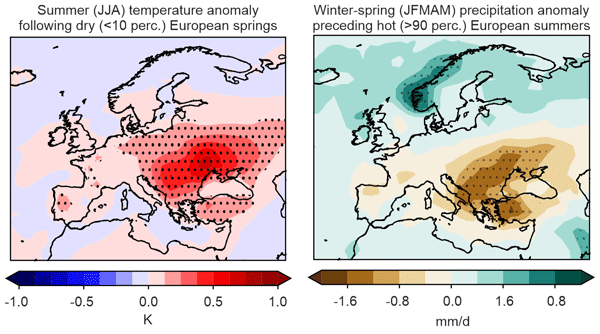
We analyse the link between dry springs and hot summers in Europe over the past 600 years. Starting with a study of the heat summer of 1473, which followed dry spring conditions in Southeastern Europe, we use the ModE-RA data set family to statistically analyse the link. We find that the link is strongest in regions where evaporation is moisture-limited. Hot summers are preceded by increased blocking over north-central Europe and a positive East Atlantic pattern in spring.
Christian Pfister, Stefan Brönnimann, Andres Altwegg, Rudolf Brázdil, Laurent Litzenburger, Daniele Lorusso, and Thomas Pliemon
Clim. Past, 20, 1387–1399, https://doi.org/10.5194/cp-20-1387-2024, https://doi.org/10.5194/cp-20-1387-2024, 2024
Short summary
Short summary
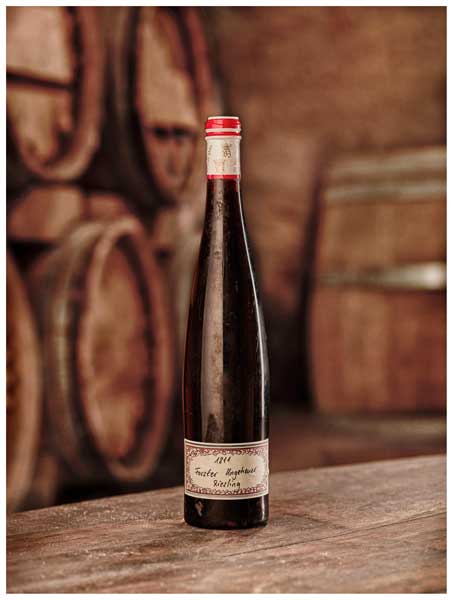
This bottle of Riesling from the traditional Bassermann Jordan winery in Deidesheim (Germany) is a relic of the premium wine harvested in 1811. It was named “Comet Wine” after the bright comet that year. The study shows that wine quality can be used to infer summer weather conditions over the past 600 years. After rainy summers with cold winds, wines turned sour, while long periods of high pressure led to excellent qualities. Since 1990, only good wines have been produced due to rapid warming.
Fredrik Charpentier Ljungqvist, Bo Christiansen, Jan Esper, Heli Huhtamaa, Lotta Leijonhufvud, Christian Pfister, Andrea Seim, Martin Karl Skoglund, and Peter Thejll
Clim. Past, 19, 2463–2491, https://doi.org/10.5194/cp-19-2463-2023, https://doi.org/10.5194/cp-19-2463-2023, 2023
Short summary
Short summary
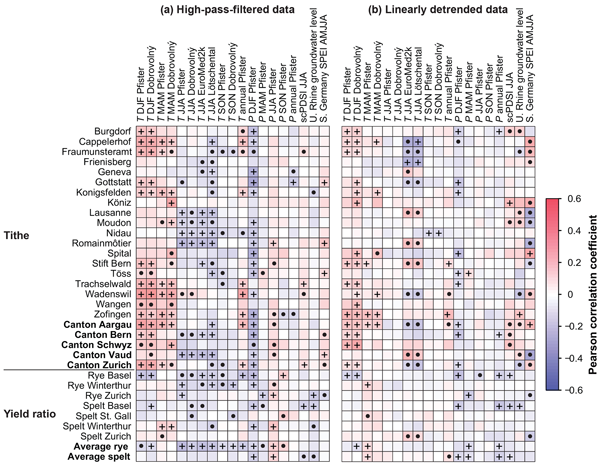
We study the climate signal in long harvest series from across Europe between the 16th and 18th centuries. The climate–harvest yield relationship is found to be relatively weak but regionally consistent and similar in strength and sign to modern climate–harvest yield relationships. The strongest climate–harvest yield patterns are a significant summer soil moisture signal in Sweden, a winter temperature and precipitation signal in Switzerland, and spring temperature signals in Spain.
Thomas Pliemon, Ulrich Foelsche, Christian Rohr, and Christian Pfister
Clim. Past, 19, 2237–2256, https://doi.org/10.5194/cp-19-2237-2023, https://doi.org/10.5194/cp-19-2237-2023, 2023
Short summary
Short summary
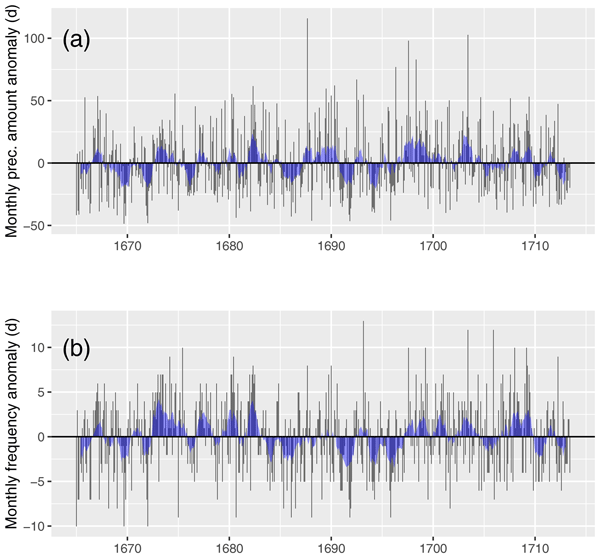
Louis Morin consistently recorded precipitation intensity and duration between 1665 and 1713. We use these records to reconstruct precipitation totals. This reconstruction is validated by several methods and then presented using precipitation indexes. What is exceptional about this dataset is the availability of a sub-daily resolution and the low number of missing data points over the entire observation period.
Rudolf Brázdil, Petr Dobrovolný, Christian Pfister, Katrin Kleemann, Kateřina Chromá, Péter Szabó, and Piotr Olinski
Clim. Past, 19, 1863–1890, https://doi.org/10.5194/cp-19-1863-2023, https://doi.org/10.5194/cp-19-1863-2023, 2023
Short summary
Short summary
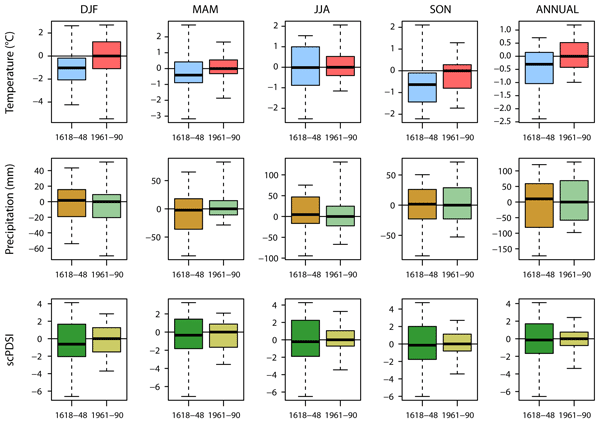
The Thirty Years' War (from 1618 to 1648 CE), an armed military conflict in Europe, brought extensive devastation to Europe. The paper analyses annual and seasonal temperature, precipitation, and drought patterns, as well as severe weather extremes, based particularly on documentary data, during this event in central Europe to demonstrate their broad impacts on human society and human responses in coincidence with weather and climate during this period of hardship.
Thomas Pliemon, Ulrich Foelsche, Christian Rohr, and Christian Pfister
Clim. Past, 18, 1685–1707, https://doi.org/10.5194/cp-18-1685-2022, https://doi.org/10.5194/cp-18-1685-2022, 2022
Short summary
Short summary
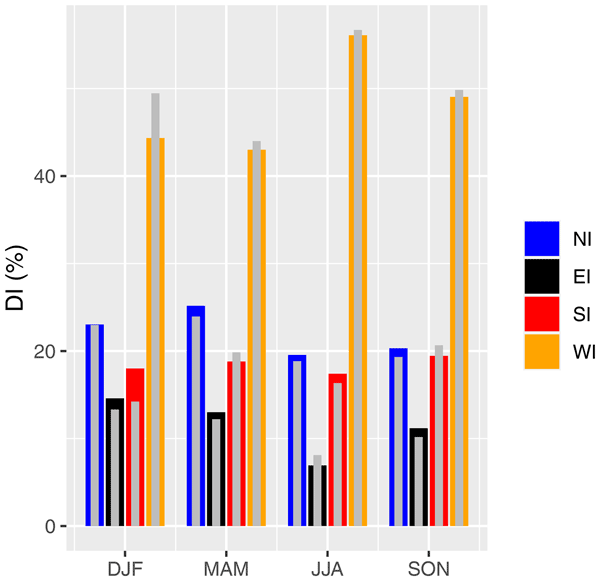
We have digitized and analyzed meteorological variables (temperature, direction of the movement of the clouds, and cloud cover), which were noted by Louis Morin in the period 1665–1713 in Paris. This time period is characterized by cold winters and autumns and moderate springs and summers. A low frequency of westerlies in the winter months leads to a cooling. Morin's measurements seem to be trustworthy. Only cloud cover in quantitative terms should be taken with caution.
Laura Lipfert, Ralf Hand, Angela-Maria Burgdorf, Christian Pfister, Heinz Wanner, and Stefan Brönnimann
Clim. Past, 22, 1863–1879, https://doi.org/10.5194/cp-22-1863-2026, https://doi.org/10.5194/cp-22-1863-2026, 2026
Short summary
Short summary
We analyse the link between dry springs and hot summers in Europe over the past 600 years. Starting with a study of the heat summer of 1473, which followed dry spring conditions in Southeastern Europe, we use the ModE-RA data set family to statistically analyse the link. We find that the link is strongest in regions where evaporation is moisture-limited. Hot summers are preceded by increased blocking over north-central Europe and a positive East Atlantic pattern in spring.
Siyu Chen and Stefan Brönnimann
EGUsphere, https://doi.org/10.5194/egusphere-2026-5219, https://doi.org/10.5194/egusphere-2026-5219, 2026
This preprint is open for discussion and under review for Climate of the Past (CP).
Short summary
Short summary
We systematically digitize and categorize daily weather and climate information from the Guan Tingfen Diary in eastern China from 1815 to 1865. Comparisons with other climate datasets demonstrate the climatic value of these historical records. The digitized dataset provides new opportunities to investigate past climate variability, the intra-seasonal evolution of extreme events, potential signals of volcanic eruptions, and daily weather reconstruction.
Sofie Hedetoft, Olivia Bang Brinck, Ruth Mottram, Andrea M. U. Gierisch, Steffen Malskær Olsen, Martin Olesen, Nicolaj Hansen, Anders Anker Bjørk, Erik Loebel, Anne Solgaard, and Peter Thejll
The Cryosphere, 20, 5071–5098, https://doi.org/10.5194/tc-20-5071-2026, https://doi.org/10.5194/tc-20-5071-2026, 2026
Short summary
Short summary
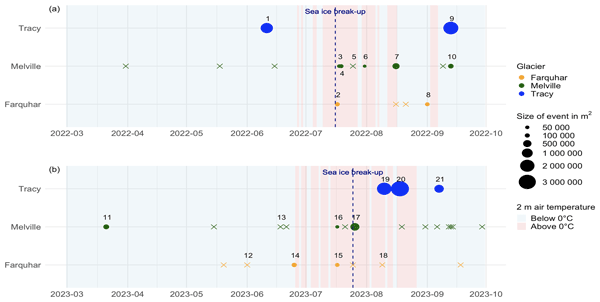
Iceberg mélange is the jumble of icebergs in front of some glaciers that calve into the sea. Some studies suggest mélange might help to control the retreat of glaciers. We studied 3 glaciers in NW Greenland where we used GPS sensors and satellites to track ice movement. We found that glaciers push forward and calve all year, including when mélange and landfast sea ice are present, suggesting mélange is not important in supporting glaciers, but may influence the seasonal calving cycle.
Vaughan T. J. Phillips, Sanne M. H. de Jong, Robert Garvey, Martin K. Skoglund, Torbjörn Ahlström, Fredrik Charpentier Ljungqvist, Mikael Pontarp, Joacim Rocklöv, Matthew Toohey, Jun-Ichi Yano, Helene Castenbrandt, Carl-Johan Fraenkel, Adam Linder, Henrik Sjödin, and Jesper Sjolte
EGUsphere, https://doi.org/10.5194/egusphere-2026-5195, https://doi.org/10.5194/egusphere-2026-5195, 2026
This preprint is open for discussion and under review for Climate of the Past (CP).
Short summary
Short summary
We investigate how volcanic eruptions may have amplified plague pandemics through climate-driven harvest failure and malnutrition. Using a model linking climate, food production, nutrition and disease, we find that the eruptions of 536 and 540 CE could have greatly increased mortality during the Justinianic Plague. The results suggest that food shortages and human movement were important in shaping the pandemic's severity and spread.
Dominik Collet, Sam White, Wendy Khumalo, Dann Grotum, Ingar Mørkestøl Gundersen, Heli Huhtamaa, Katrin Kleemann, Kirstin Krüger, Hans W. Linderholm, Elin Lundstad, Fredrik Charpentier Ljungqvist, Michael Sigl, Martin K. Skoglund, Ingar Stene, and Helene Løvstrand Svarva
EGUsphere, https://doi.org/10.5194/egusphere-2026-5137, https://doi.org/10.5194/egusphere-2026-5137, 2026
This preprint is open for discussion and under review for Climate of the Past (CP).
Short summary
Short summary
Our study investigates the 1783–1784 Laki eruption with an interdisciplinary regional focus. It reveals how volcanic climate shocks combined with unrelated weather fluctuations (drought) and societal tensions across the Nordic region to form a ‘compound event’. We use high-resolution instrumental and tree-ring data as well as historical records to test the ModE-RA ensemble reconstructions, reveal intra-regional differences, and situate the different crisis trajectories Nordic societies faced.
Noemi Imfeld and Stefan Brönnimann
Earth Syst. Sci. Data, 18, 4019–4045, https://doi.org/10.5194/essd-18-4019-2026, https://doi.org/10.5194/essd-18-4019-2026, 2026
Short summary
Short summary
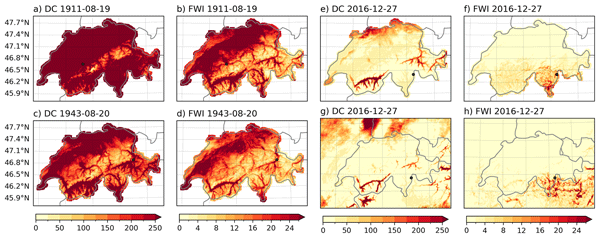
We extended the Swiss daily climate reconstructions from 1763 to 2020 to six additional variables at 1 × 1 km resolution using analogue resampling and data assimilation. Wind and temperature reconstructions show reasonable skill, while humidity and sunshine duration perform less well. Application to historical wildfire events demonstrates the data set's potential for impact studies. This is the first Swiss data set providing several variables at a high-resolution of 1 × 1 km and going back to 1763.
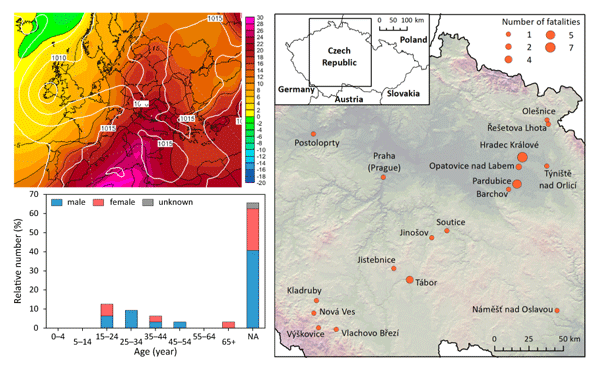
Rudolf Brázdil, Kateřina Chromá, Miloslav Müller, Jan Lhoták, and Kateřina Skripniková
Nat. Hazards Earth Syst. Sci., 26, 1889–1912, https://doi.org/10.5194/nhess-26-1889-2026, https://doi.org/10.5194/nhess-26-1889-2026, 2026
Short summary
Short summary
This paper presents the sudden weather-related events with the highest numbers of fatalities (≥ 20) over the territory of the Czech Lands (now the Czech Republic) in the 1851–2025 CE period, which were connected to or influenced by floods, windstorms, convective storms, thunderstorms, snow, and fog. For each of the 13 selected events, meteorological conditions, their course, accompanying circumstances, and selected fatality characteristics such as sex and age are described in detail.

Peter Stucki, Stefan Brönnimann, Noemi Imfeld, Lucas Pfister, Conall E. Ruth, Yannis V. Schmutz, Yuri Brugnara, Martin Wegmann, Rajmund Przybylak, and Janusz Filipiak
Clim. Past, 22, 517–540, https://doi.org/10.5194/cp-22-517-2026, https://doi.org/10.5194/cp-22-517-2026, 2026
Short summary
Short summary
We test nine reconstructions of Europe’s hot summer of 1807, using weather records, reanalyses, machine-learning (ML), and data assimilation. Most approaches match observed temperature and pressure well. Approaches based on physics of atmospheric flow capture weather patterns well, while ML approaches better reflect station records. Ingestion of accurate records from new regions improves the reconstructions markedly. In all, the approaches provide new insights to pre-industrial extreme weather.
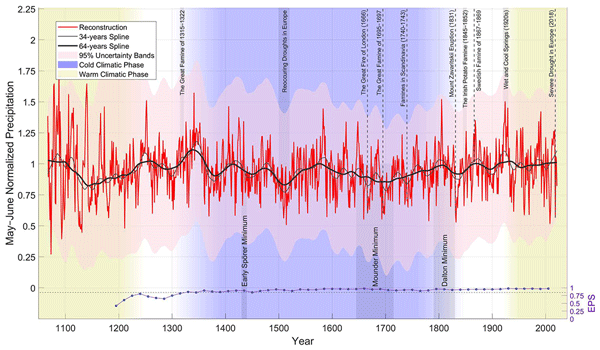
Petter Stridbeck, Jesper Björklund, Fredrik Charpentier Ljungqvist, Jennie Sandström, Mauricio Fuentes, Paul J. Krusic, Zhi-Bo Li, and Kristina Seftigen
Clim. Past, 22, 461–481, https://doi.org/10.5194/cp-22-461-2026, https://doi.org/10.5194/cp-22-461-2026, 2026
Short summary
Short summary
Here we present the first tree-ring-based reconstruction of precipitation in sub-Arctic Sweden, extending back to medieval times. The reconstruction is derived from living and dead Scots pine growing in the rocky, drought-prone High Coast region (63° N). Unlike most high-latitude conifers that are typically limited by temperature, these trees thrive during cool, cloudy, and wet summers. This rare response enabled filling a significant gap in our understanding of historical climate variability.
Peter W. Thorne, John M. Nicklas, John J. Kennedy, Bruce Calvert, Baylor Fox-Kemper, Mark T. Richardson, Adrian Simmons, Ed Hawkins, Robert Rhode, Kathryn Cowtan, Nerilie J. Abram, Axel Andersson, Simon Noone, Phillipe Marbaix, Nathan Lenssen, Dirk Olonscheck, Tristram Walsh, Stephen Outten, Ingo Bethke, Bjorn H. Samset, Chris Smith, Anna Pirani, Jan Fuglestvedt, Lavanya Rajamani, Richard A. Betts, Elizabeth C. Kent, Blair Trewin, Colin Morice, Tim Osborn, Samantha N. Burgess, Oliver Geden, Andrew Parnell, Piers M. Forster, Chris Hewitt, Zeke Hausfather, Valerie Masson-Delmotte, Jochem Marotzke, Nathan Gillett, Sonia I. Seneviratne, Gavin A. Schmidt, Duo Chan, Stefan Brönnimann, Andy Reisinger, Matthew Menne, Maisa Rojas Corradi, Christopher Kadow, Peter Huybers, David B. Stephenson, Emily Wallis, Joeri Rogelj, Andrew Schurer, Karen McKinnon, Panmao Zhai, Fatima Driouech, Wilfran Moufouma Okia, Saeed Vazifehkhah, Sophie Szopa, Christopher J. Merchant, Shoji Hirahara, Masayoshi Ishii, Francois A. Engelbrecht, Qingxiang Li, June-Yi Lee, Alex J. Cannon, Christophe Cassou, Karina von Schuckmann, Amir H. Delju, and Ellie Murtagh
Earth Syst. Sci. Data Discuss., https://doi.org/10.5194/essd-2025-825, https://doi.org/10.5194/essd-2025-825, 2026
Preprint under review for ESSD
Short summary
Short summary
We reassess the basis for determining the present level of long-term global warming. Unbiased estimates of both realised warming and anthropogenic warming are possible that approximate a 20-year retrospective mean. Our resulting estimates of 1.40 [1.23–1.58] °C (realised) and 1.34 [1.18–1.50] °C (anthropogenic) as at end of 2024 highlight the urgency of immediate, far-reaching and sustained climate mitigation actions if we are to meet the long term temperature goal of the Paris Agreement.

Rudolf Brázdil, Petr Dobrovolný, Max Carl Arne Torbenson, Lukáš Dolák, and Kateřina Chromá
Clim. Past, 22, 49–71, https://doi.org/10.5194/cp-22-49-2026, https://doi.org/10.5194/cp-22-49-2026, 2026
Short summary
Short summary
Documentary data about weather and climate are used to reconstruct temperature and precipitation patterns as well as hydrometeorological extremes in the Czech Lands for the 15th century. These data significantly complement existing knowledge of climatic patterns in Central Europe during this century and coincide well with other climate reconstructions from this area based on different proxies.
Siyu Chen and Stefan Brönnimann
EGUsphere, https://doi.org/10.5194/egusphere-2025-5326, https://doi.org/10.5194/egusphere-2025-5326, 2025
Short summary
Short summary
This study applies a Bayesian framework to reconstruct winter temperatures in southwestern China from 1700–1949 using documentary records and paleo-simulations. The reconstruction identifies major cold and warm winters, captures long-term climatic phases, and demonstrates how Bayesian methods integrate historical evidence with simulation priors to produce regional climate reconstructions from a perspective of probability.
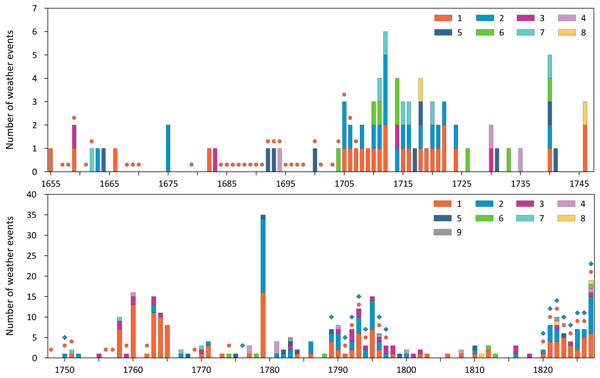
Rudolf Brázdil, Jan Lhoták, Kateřina Chromá, and Laurent Litzenburger
Clim. Past, 21, 1961–1979, https://doi.org/10.5194/cp-21-1961-2025, https://doi.org/10.5194/cp-21-1961-2025, 2025
Short summary
Short summary
The tax relief data connected with weather damage to farmers' yields from the Prácheň Region (southwestern Bohemia) in the period 1655–1827 were used to identify frequency, severity and impacts of damaging weather events presented in the context of other documentary data. Tax relief data used represent the very rarely used source of administrative records for historical-climatological research.
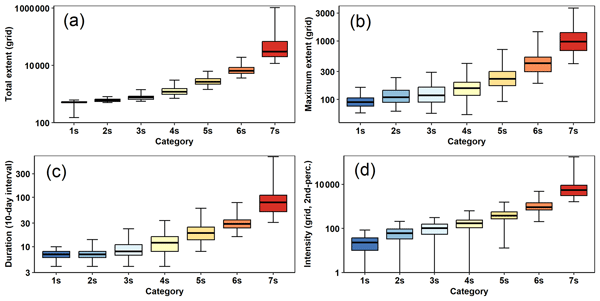
Jan Řehoř, Rudolf Brázdil, Oldřich Rakovec, Martin Hanel, Milan Fischer, Rohini Kumar, Jan Balek, Markéta Poděbradská, Vojtěch Moravec, Luis Samaniego, Yannis Markonis, and Miroslav Trnka
Hydrol. Earth Syst. Sci., 29, 3341–3358, https://doi.org/10.5194/hess-29-3341-2025, https://doi.org/10.5194/hess-29-3341-2025, 2025
Short summary
Short summary
We present a robust method for identification and classification of global land drought events (GLDEs) based on soil moisture. Two models were used to calculate soil moisture and delimit soil drought over global land from 1980–2022, with clusters of 775 and 630 GLDEs. Using four spatiotemporal and three motion-related characteristics, we categorized GLDEs into seven severity and seven dynamic categories. The frequency of GLDEs has generally increased in recent decades.
Nicolás Duque-Gardeazabal, Andrew R. Friedman, and Stefan Brönnimann
Hydrol. Earth Syst. Sci., 29, 3277–3295, https://doi.org/10.5194/hess-29-3277-2025, https://doi.org/10.5194/hess-29-3277-2025, 2025
Short summary
Short summary
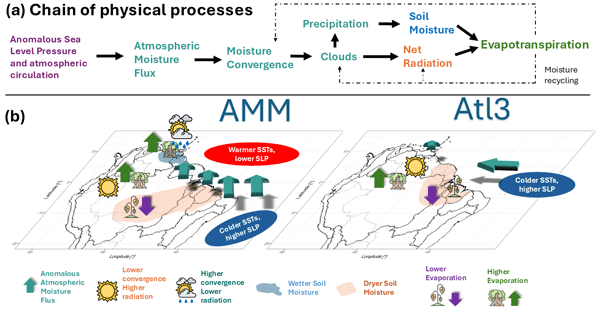
Understanding hydrological variability is essential for ecological conservation and sustainable development. Evapotranspiration influences the carbon cycle, and finding what causes its variability is important for ecosystems. This study shows that ENSO (El Niño–Southern Oscillation) influences not only South America’s rainfall, soil moisture, radiation, and evaporation but also other phenomena in the Atlantic Ocean. The impacts change regionally depending on the season analysed and have implications for heat extremes.
Lucas Pfister, Lena Wilhelm, Yuri Brugnara, Noemi Imfeld, and Stefan Brönnimann
Weather Clim. Dynam., 6, 571–594, https://doi.org/10.5194/wcd-6-571-2025, https://doi.org/10.5194/wcd-6-571-2025, 2025
Short summary
Short summary
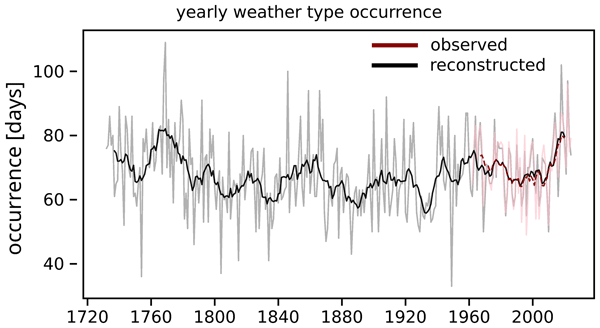
Our work compares different machine learning approaches for creating long-term classifications of daily atmospheric circulation patterns using input data from surface meteorological observations. Our comparison reveals that a feedforward neural network performs best at this task. Using this model, we present a daily reconstruction of a commonly used weather type classification for central Europe that dates back to 1728.
Rudolf Brázdil, Jan Lhoták, Kateřina Chromá, Dominik Collet, Petr Dobrovolný, and Heli Huhtamaa
Clim. Past, 21, 547–570, https://doi.org/10.5194/cp-21-547-2025, https://doi.org/10.5194/cp-21-547-2025, 2025
Short summary
Short summary
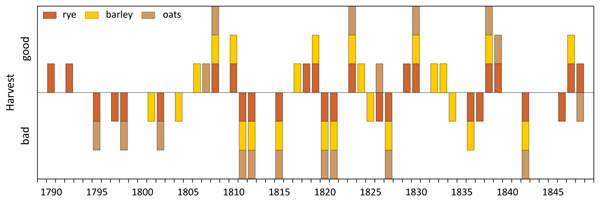
Public granaries served as key infrastructure to improve food security in agrarian societies. Granary data from 15 domains at the Sušice region (southwestern Bohemia) in the period 1789–1849 CE are used here to identify years with bad and good grain harvests, which have been further analysed using documentary data and climatic reconstructions. The data used represent a new source of proxy data for historical–climatological research.
Fredrik Charpentier Ljungqvist, Bo Christiansen, Lea Schneider, and Peter Thejll
Clim. Past, 21, 327–342, https://doi.org/10.5194/cp-21-327-2025, https://doi.org/10.5194/cp-21-327-2025, 2025
Short summary
Short summary
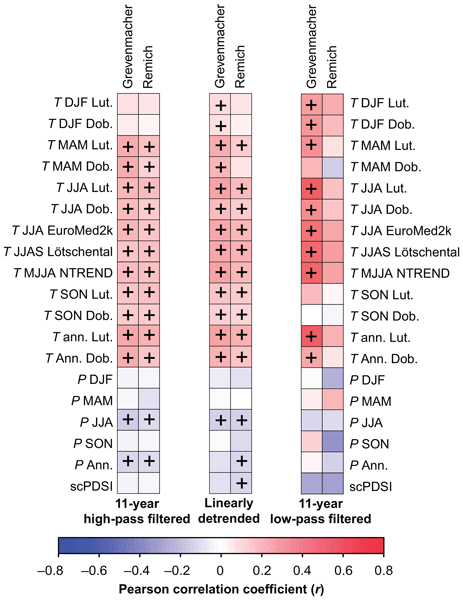
We study the climatic signal, with a focus on volcanic-induced shocks, in two long annual records of wine production quantity (spanning 1444–1786) from present-day Luxembourg, close to the northern limit of viticulture in Europe. Highly significant wine production declines are found during years following major volcanic events. Furthermore, warmer and drier climate conditions favoured wine production, with spring and summer conditions being the most important ones.
Tzu Tung Chen, Rodney Edvinsson, Karin Modig, Hans W. Linderholm, and Fredrik Charpentier Ljungqvist
Clim. Past, 21, 185–210, https://doi.org/10.5194/cp-21-185-2025, https://doi.org/10.5194/cp-21-185-2025, 2025
Short summary
Short summary
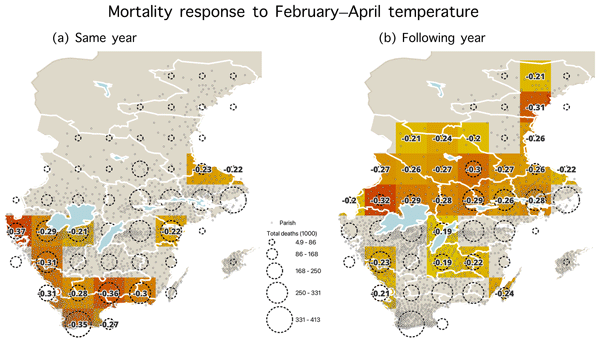
We study the climate effects on mortality, using annual mortality records and meteorological data, in Sweden between 1749 and 1859. It is found that colder winter and spring temperatures increased mortality, while no statistically significant associations were observed between summer or autumn temperatures and mortality, and only weak associations existed with hydroclimate. Further research is needed about which specific diseases caused the mortality increase following cold winters and springs.
Richard Warren, Niklaus Emanuel Bartlome, Noémie Wellinger, Jörg Franke, Ralf Hand, Stefan Brönnimann, and Heli Huhtamaa
Clim. Past, 20, 2645–2662, https://doi.org/10.5194/cp-20-2645-2024, https://doi.org/10.5194/cp-20-2645-2024, 2024
Short summary
Short summary
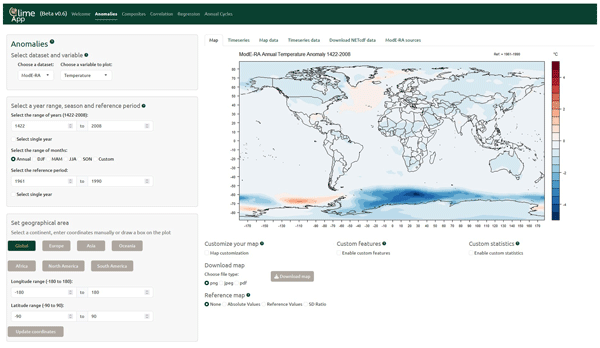
This paper introduces the ClimeApp web application. The app provides quick access to the ModE-RA global climate reanalysis. Users can calculate and plot anomalies, composites, correlations, regressions and annual cycles across three different datasets and four climate variables. By re-examining the 1815 Tambora eruption, we demonstrate how combining results from different datasets and sources can help us investigate the historical palaeoclimate and integrate it into human history.
Rudolf Brázdil, Dominika Faturová, Monika Šulc Michalková, Jan Řehoř, Martin Caletka, and Pavel Zahradníček
Nat. Hazards Earth Syst. Sci., 24, 3663–3682, https://doi.org/10.5194/nhess-24-3663-2024, https://doi.org/10.5194/nhess-24-3663-2024, 2024
Short summary
Short summary
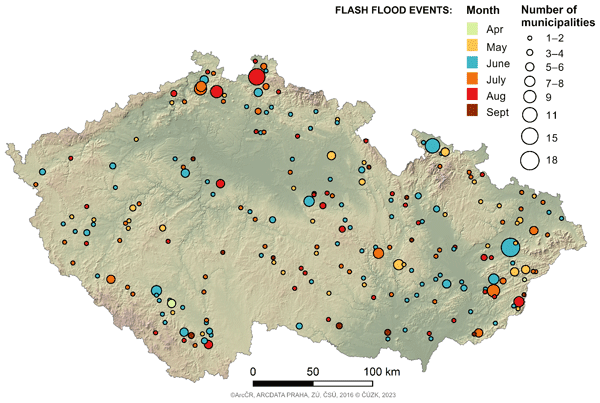
Flash floods belong to natural hazards that can be enhanced in frequency, intensity, and impact during recent climate change. This paper presents a complex analysis of spatiotemporal variability and human impacts (including material damage and fatalities) of flash floods in the Czech Republic for the 2001–2023 period. The analysis generally shows no statistically significant trends in the characteristics analyzed.
Peter Stucki, Lucas Pfister, Yuri Brugnara, Renate Varga, Chantal Hari, and Stefan Brönnimann
Clim. Past, 20, 2327–2348, https://doi.org/10.5194/cp-20-2327-2024, https://doi.org/10.5194/cp-20-2327-2024, 2024
Short summary
Short summary
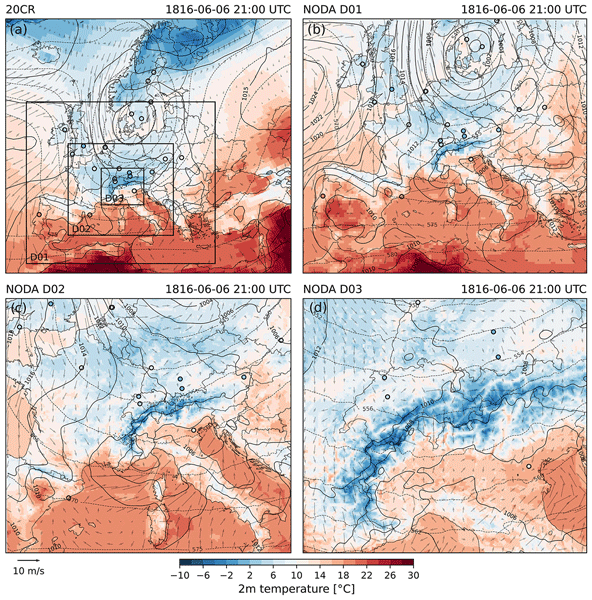
In our work, we reconstruct the weather of the extremely cold and wet summer in 1816 using a weather forecasting model to obtain high-resolution, three-dimensional weather simulations. We refine our simulations with surface pressure and temperature observations, representing a novel approach for this period. Our results show that this approach yields detailed and accurate weather reconstructions, opening the door to analyzing past weather events and their impacts in detail.

Stefan Brönnimann, Janusz Filipiak, Siyu Chen, and Lucas Pfister
Clim. Past, 20, 2219–2235, https://doi.org/10.5194/cp-20-2219-2024, https://doi.org/10.5194/cp-20-2219-2024, 2024
Short summary
Short summary
The year 1740 was the coldest in central Europe since at least 1421. New monthly global climate reconstructions, together with daily weather reconstructions, allow a detailed view of this climatic event. Following several severe cold spells in January and February, a persistent circulation pattern with blocking over the British Isles caused northerly flow towards western Europe during a large part of the year. It was one of the strongest, arguably unforced excursions in European temperature.
Christian Pfister, Stefan Brönnimann, Andres Altwegg, Rudolf Brázdil, Laurent Litzenburger, Daniele Lorusso, and Thomas Pliemon
Clim. Past, 20, 1387–1399, https://doi.org/10.5194/cp-20-1387-2024, https://doi.org/10.5194/cp-20-1387-2024, 2024
Short summary
Short summary
This bottle of Riesling from the traditional Bassermann Jordan winery in Deidesheim (Germany) is a relic of the premium wine harvested in 1811. It was named “Comet Wine” after the bright comet that year. The study shows that wine quality can be used to infer summer weather conditions over the past 600 years. After rainy summers with cold winds, wines turned sour, while long periods of high pressure led to excellent qualities. Since 1990, only good wines have been produced due to rapid warming.
Rudolf Brázdil, Jan Lhoták, Kateřina Chromá, and Petr Dobrovolný
Clim. Past, 20, 1017–1037, https://doi.org/10.5194/cp-20-1017-2024, https://doi.org/10.5194/cp-20-1017-2024, 2024
Short summary
Short summary
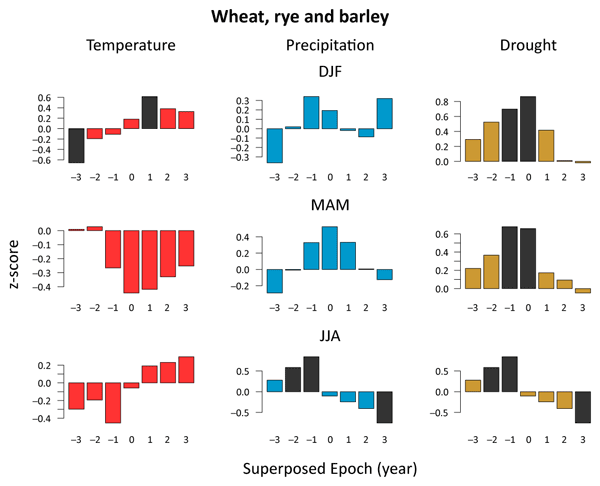
The newly developed series of wheat, rye, barley, and oats prices from Sušice (southwestern Bohemia) for the period 1725–1824 CE is used to demonstrate effects of weather, climate, socio-economic, and societal factors on their fluctuations, with particular attention paid to years with extremely high prices. Cold spring temperatures and wet conditions from winter to summer were reflected in very high grain prices.
Rudolf Brázdil, Kateřina Chromá, and Pavel Zahradníček
Nat. Hazards Earth Syst. Sci., 24, 1437–1457, https://doi.org/10.5194/nhess-24-1437-2024, https://doi.org/10.5194/nhess-24-1437-2024, 2024
Short summary
Short summary
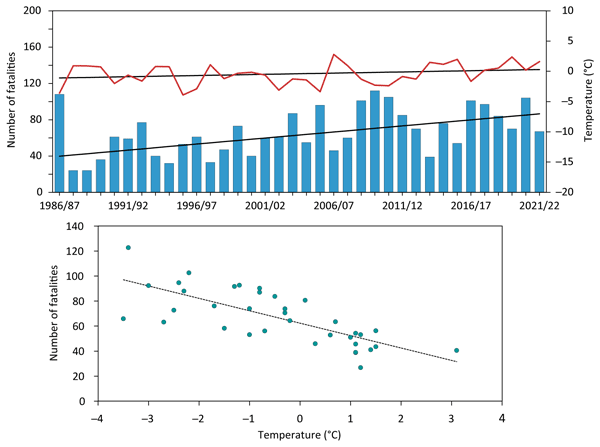
The official mortality data in the Czech Republic in 1919–2022 are used to show long-term fluctuations in the number of fatalities caused by excessive natural cold and heat, lightning, natural disasters, and falls on ice/snow, as well as the sex and age of the deceased, based on certain meteorological, historical, and socioeconomic factors that strongly influence changes in the number and structure of such fatalities. Knowledge obtained is usable in risk management for the preservation of lives.
Stefan Brönnimann, Yuri Brugnara, and Clive Wilkinson
Clim. Past, 20, 757–767, https://doi.org/10.5194/cp-20-757-2024, https://doi.org/10.5194/cp-20-757-2024, 2024
Short summary
Short summary
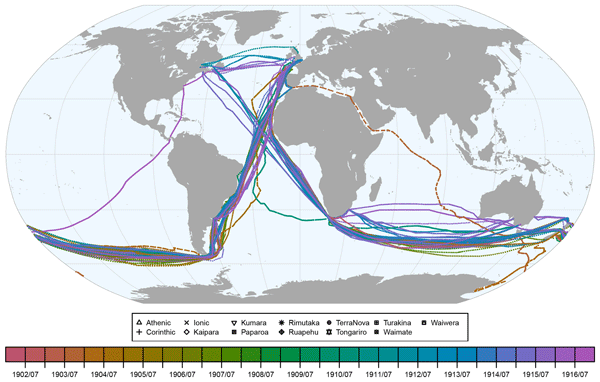
The early 20th century warming – the first phase of global warming in the 20th century – started from a peculiar cold state around 1910. We digitised additional ship logbooks for these years to study this specific climate state and found that it is real and likely an overlap of several climatic anomalies, including oceanic variability (La Niña) and volcanic eruptions.
Noemi Imfeld, Koen Hufkens, and Stefan Brönnimann
Clim. Past, 20, 659–682, https://doi.org/10.5194/cp-20-659-2024, https://doi.org/10.5194/cp-20-659-2024, 2024
Short summary
Short summary
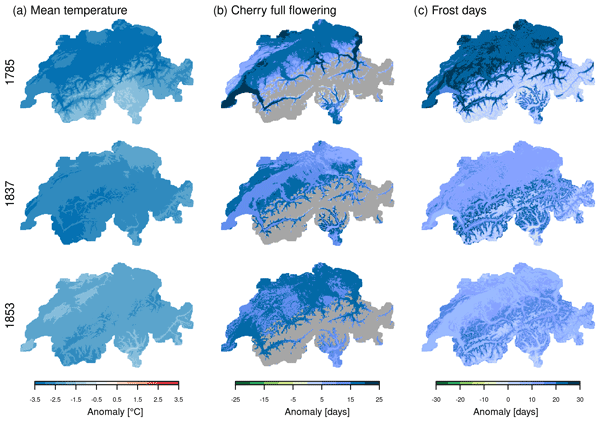
Climate and weather in spring are important because they can have far-reaching impacts, e.g. on plant growth, due to cold spells. Here, we study changes in climate and phenological indices for the period from 1763 to 2020 based on newly published reconstructed fields of daily temperature and precipitation for Switzerland. We look at three cases of extreme spring conditions, namely a warm spring in 1862, two frost events in 1873 and 1957, and three cold springs in 1785, 1837, and 1852.
Fredrik Charpentier Ljungqvist, Bo Christiansen, Jan Esper, Heli Huhtamaa, Lotta Leijonhufvud, Christian Pfister, Andrea Seim, Martin Karl Skoglund, and Peter Thejll
Clim. Past, 19, 2463–2491, https://doi.org/10.5194/cp-19-2463-2023, https://doi.org/10.5194/cp-19-2463-2023, 2023
Short summary
Short summary
We study the climate signal in long harvest series from across Europe between the 16th and 18th centuries. The climate–harvest yield relationship is found to be relatively weak but regionally consistent and similar in strength and sign to modern climate–harvest yield relationships. The strongest climate–harvest yield patterns are a significant summer soil moisture signal in Sweden, a winter temperature and precipitation signal in Switzerland, and spring temperature signals in Spain.
Thomas Pliemon, Ulrich Foelsche, Christian Rohr, and Christian Pfister
Clim. Past, 19, 2237–2256, https://doi.org/10.5194/cp-19-2237-2023, https://doi.org/10.5194/cp-19-2237-2023, 2023
Short summary
Short summary
Louis Morin consistently recorded precipitation intensity and duration between 1665 and 1713. We use these records to reconstruct precipitation totals. This reconstruction is validated by several methods and then presented using precipitation indexes. What is exceptional about this dataset is the availability of a sub-daily resolution and the low number of missing data points over the entire observation period.
Rudolf Brázdil, Petr Dobrovolný, Christian Pfister, Katrin Kleemann, Kateřina Chromá, Péter Szabó, and Piotr Olinski
Clim. Past, 19, 1863–1890, https://doi.org/10.5194/cp-19-1863-2023, https://doi.org/10.5194/cp-19-1863-2023, 2023
Short summary
Short summary
The Thirty Years' War (from 1618 to 1648 CE), an armed military conflict in Europe, brought extensive devastation to Europe. The paper analyses annual and seasonal temperature, precipitation, and drought patterns, as well as severe weather extremes, based particularly on documentary data, during this event in central Europe to demonstrate their broad impacts on human society and human responses in coincidence with weather and climate during this period of hardship.
Eric Samakinwa, Christoph C. Raible, Ralf Hand, Andrew R. Friedman, and Stefan Brönnimann
Clim. Past Discuss., https://doi.org/10.5194/cp-2023-67, https://doi.org/10.5194/cp-2023-67, 2023
Publication in CP not foreseen
Short summary
Short summary
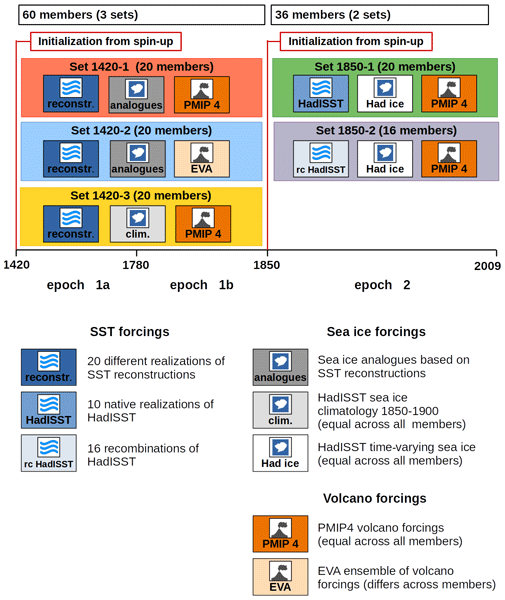
In this study, we nudged a stand-alone ocean model MPI-OM to proxy-reconstructed SST. Based on these model simulations, we introduce new estimates of the AMOC variations during the period 1450–1780 through a 10-member ensemble simulation with a novel nudging technique. Our approach reaffirms the known mechanisms of AMOC variability and also improves existing knowledge of the interplay between the AMOC and the NAO during the AMOC's weak and strong phases.
Ralf Hand, Eric Samakinwa, Laura Lipfert, and Stefan Brönnimann
Geosci. Model Dev., 16, 4853–4866, https://doi.org/10.5194/gmd-16-4853-2023, https://doi.org/10.5194/gmd-16-4853-2023, 2023
Short summary
Short summary
ModE-Sim is an ensemble of simulations with an atmosphere model. It uses observed sea surface temperatures, sea ice conditions, and volcanic aerosols for 1420 to 2009 as model input while accounting for uncertainties in these conditions. This generates several representations of the possible climate given these preconditions. Such a setup can be useful to understand the mechanisms that contribute to climate variability. This paper describes the setup of ModE-Sim and evaluates its performance.
Stefan Brönnimann and Yuri Brugnara
Clim. Past, 19, 1435–1445, https://doi.org/10.5194/cp-19-1435-2023, https://doi.org/10.5194/cp-19-1435-2023, 2023
Short summary
Short summary
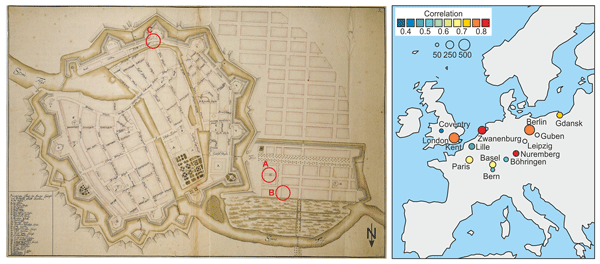
We present the weather diaries of the Kirch family from 1677–1774 containing weather observations made in Leipzig and Guben and, from 1701 onward, instrumental observations made in Berlin. We publish the imaged diaries (10 445 images) and the digitized measurements (from 1720 onward). This is one of the oldest and longest meteorological records from Germany. The digitized pressure data show good agreement with neighbouring stations, highlighting their potential for weather reconstruction.
Stefan Brönnimann
Clim. Past, 19, 1345–1357, https://doi.org/10.5194/cp-19-1345-2023, https://doi.org/10.5194/cp-19-1345-2023, 2023
Short summary
Short summary
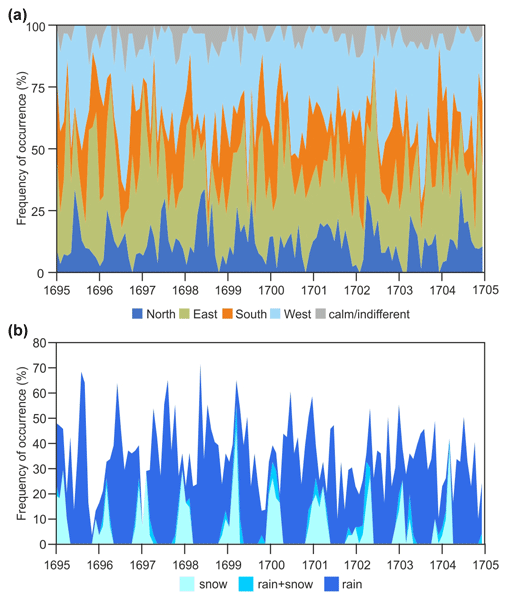
Weather reconstructions could help us to better understand the mechanisms leading to, and the impacts caused by, climatic changes. This requires daily weather information such as diaries. Here I present the weather diary by Georg Christoph Eimmart from Nuremberg covering the period 1695–1704. This was a particularly cold period in Europe, and the diary helps to better characterize this climatic anomaly.

Noemi Imfeld, Lucas Pfister, Yuri Brugnara, and Stefan Brönnimann
Clim. Past, 19, 703–729, https://doi.org/10.5194/cp-19-703-2023, https://doi.org/10.5194/cp-19-703-2023, 2023
Short summary
Short summary
Climate reconstructions give insights into monthly and seasonal climate variability of the past few hundred years. However, to understand past extreme weather events and to relate them to impacts, for example to periods of extreme floods, reconstructions on a daily timescale are needed. Here, we present a reconstruction of 258 years of high-resolution daily temperature and precipitation fields for Switzerland covering the period 1763 to 2020, which is based on instrumental measurements.
Moritz Buchmann, Gernot Resch, Michael Begert, Stefan Brönnimann, Barbara Chimani, Wolfgang Schöner, and Christoph Marty
The Cryosphere, 17, 653–671, https://doi.org/10.5194/tc-17-653-2023, https://doi.org/10.5194/tc-17-653-2023, 2023
Short summary
Short summary
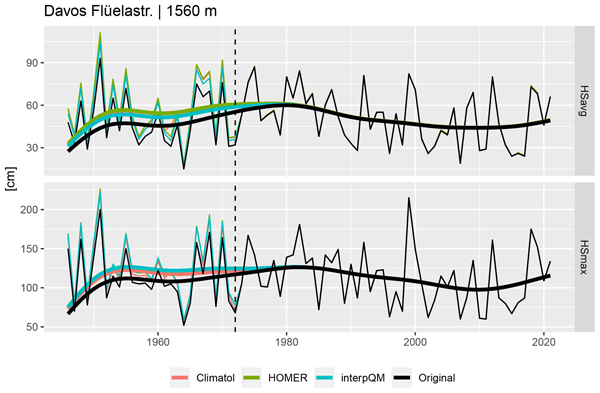
Our current knowledge of spatial and temporal snow depth trends is based almost exclusively on time series of non-homogenised observational data. However, like other long-term series from observations, they are susceptible to inhomogeneities that can affect the trends and even change the sign. To assess the relevance of homogenisation for daily snow depths, we investigated its impact on trends and changes in extreme values of snow indices between 1961 and 2021 in the Swiss observation network.
Jianquan Dong, Stefan Brönnimann, Tao Hu, Yanxu Liu, and Jian Peng
Earth Syst. Sci. Data, 14, 5651–5664, https://doi.org/10.5194/essd-14-5651-2022, https://doi.org/10.5194/essd-14-5651-2022, 2022
Short summary
Short summary
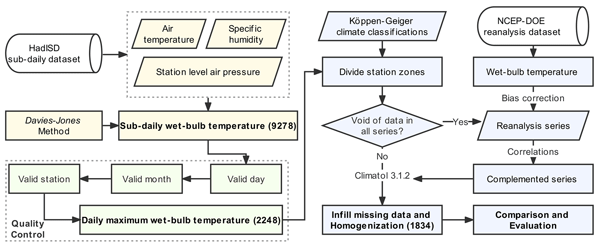
We produced a new dataset of global station-based daily maximum wet-bulb temperature (GSDM-WBT) through the calculation of wet-bulb temperature, data quality control, infilling missing values, and homogenization. The GSDM-WBT covers the complete daily series of 1834 stations from 1981 to 2020. The GSDM-WBT dataset handles stations with many missing values and possible inhomogeneities, which could better support the studies on global and regional humid heat events.
Duncan Pappert, Mariano Barriendos, Yuri Brugnara, Noemi Imfeld, Sylvie Jourdain, Rajmund Przybylak, Christian Rohr, and Stefan Brönnimann
Clim. Past, 18, 2545–2565, https://doi.org/10.5194/cp-18-2545-2022, https://doi.org/10.5194/cp-18-2545-2022, 2022
Short summary
Short summary
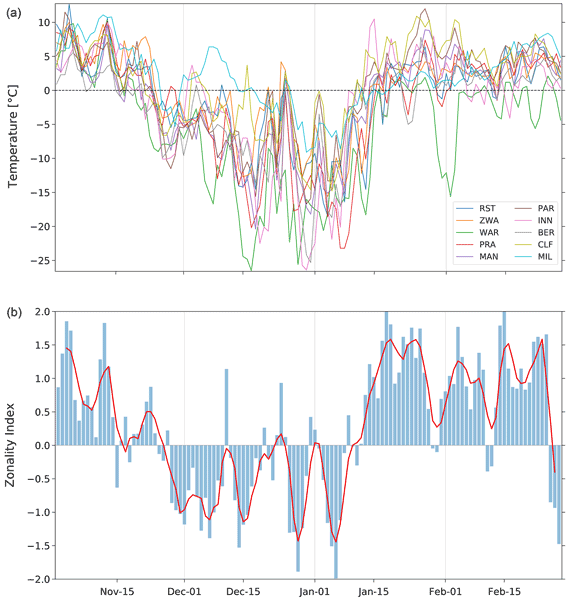
We present daily temperature and sea level pressure fields for Europe for the severe winter 1788/1789 based on historical meteorological measurements and an analogue reconstruction approach. The resulting reconstruction skilfully reproduces temperature and pressure variations over central and western Europe. We find intense blocking systems over northern Europe and several abrupt, strong cold air outbreaks, demonstrating that quantitative weather reconstruction of past extremes is possible.
Chantal Camenisch, Fernando Jaume-Santero, Sam White, Qing Pei, Ralf Hand, Christian Rohr, and Stefan Brönnimann
Clim. Past, 18, 2449–2462, https://doi.org/10.5194/cp-18-2449-2022, https://doi.org/10.5194/cp-18-2449-2022, 2022
Short summary
Short summary
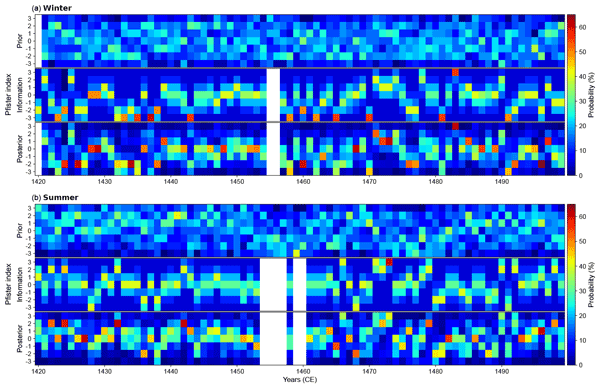
We present a novel approach to assimilate climate information contained in chronicles and annals from the 15th century to generate climate reconstructions of the Burgundian Low Countries, taking into account uncertainties associated with the descriptions of narrative sources. Our study aims to be a first step towards a more quantitative use of available information contained in historical texts, showing how Bayesian inference can help the climate community with this endeavor.
Yuri Brugnara, Chantal Hari, Lucas Pfister, Veronika Valler, and Stefan Brönnimann
Clim. Past, 18, 2357–2379, https://doi.org/10.5194/cp-18-2357-2022, https://doi.org/10.5194/cp-18-2357-2022, 2022
Short summary
Short summary
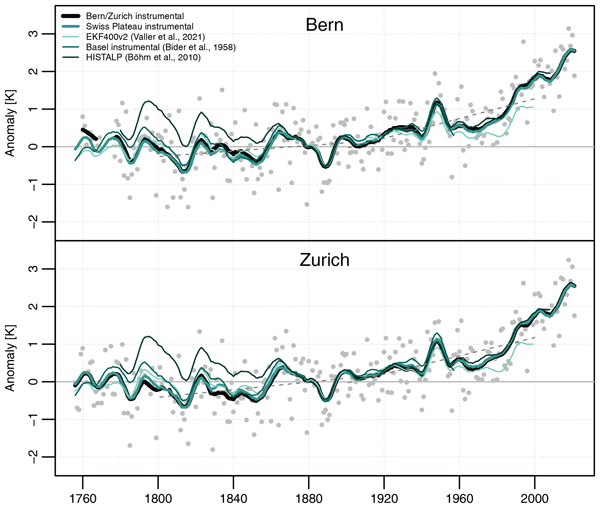
We digitized dozens of weather journals containing temperature measurements from in and around Bern and Zurich. They cover over a century before the creation of a national weather service in Switzerland. With these data we could create daily temperature series for the two cities that span the last 265 years. We found that the pre-industrial climate on the Swiss Plateau was colder than suggested by previously available instrumental data sets and about 2.5 °C colder than the present-day climate.
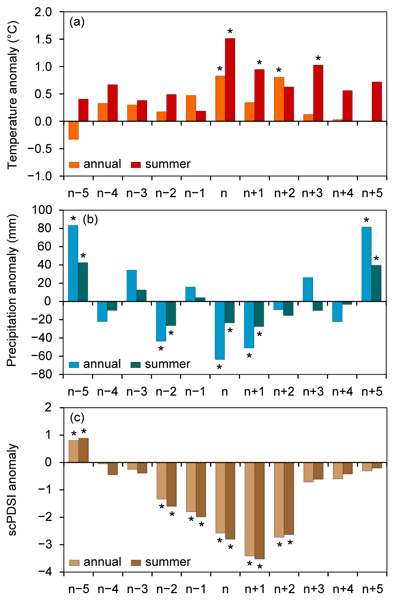
Rudolf Brázdil, Petr Zahradník, Péter Szabó, Kateřina Chromá, Petr Dobrovolný, Lukáš Dolák, Miroslav Trnka, Jan Řehoř, and Silvie Suchánková
Clim. Past, 18, 2155–2180, https://doi.org/10.5194/cp-18-2155-2022, https://doi.org/10.5194/cp-18-2155-2022, 2022
Short summary
Short summary
Bark beetle outbreaks are important disturbances to Norway spruce forests. Their meteorological and climatological triggers are analysed for the main oubreaks over the territory of the Czech Republic based on newly created series of such outbreaks, covering the 1781–2021 CE period. The paper demonstrates the shift from windstorms as the main meteorological triggers of past outbreaks to effects of high temperatures and droughts together with windstorms in past decades.
Thomas Pliemon, Ulrich Foelsche, Christian Rohr, and Christian Pfister
Clim. Past, 18, 1685–1707, https://doi.org/10.5194/cp-18-1685-2022, https://doi.org/10.5194/cp-18-1685-2022, 2022
Short summary
Short summary
We have digitized and analyzed meteorological variables (temperature, direction of the movement of the clouds, and cloud cover), which were noted by Louis Morin in the period 1665–1713 in Paris. This time period is characterized by cold winters and autumns and moderate springs and summers. A low frequency of westerlies in the winter months leads to a cooling. Morin's measurements seem to be trustworthy. Only cloud cover in quantitative terms should be taken with caution.
Gilles Delaygue, Stefan Brönnimann, and Philip D. Jones
Weather Clim. Dynam. Discuss., https://doi.org/10.5194/wcd-2022-33, https://doi.org/10.5194/wcd-2022-33, 2022
Revised manuscript not accepted
Short summary
Short summary
We test whether any association between solar activity and meteorological conditions in the north Atlantic – European sector could be detected. We find associations consistent with those found by previous studies, with a slightly better statistical significance, and with less methodological biases which have impaired previous studies. Our study should help strengthen the recognition of meteorological impacts of solar activity.
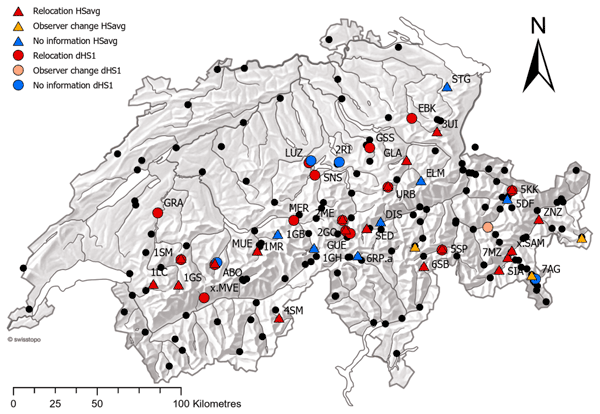
Moritz Buchmann, John Coll, Johannes Aschauer, Michael Begert, Stefan Brönnimann, Barbara Chimani, Gernot Resch, Wolfgang Schöner, and Christoph Marty
The Cryosphere, 16, 2147–2161, https://doi.org/10.5194/tc-16-2147-2022, https://doi.org/10.5194/tc-16-2147-2022, 2022
Short summary
Short summary
Knowledge about inhomogeneities in a data set is important for any subsequent climatological analysis. We ran three well-established homogenization methods and compared the identified break points. By only treating breaks as valid when detected by at least two out of three methods, we enhanced the robustness of our results. We found 45 breaks within 42 of 184 investigated series; of these 70 % could be explained by events recorded in the station history.
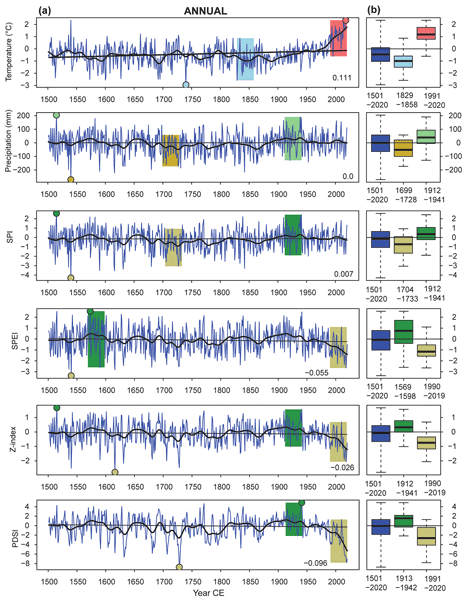
Rudolf Brázdil, Petr Dobrovolný, Jiří Mikšovský, Petr Pišoft, Miroslav Trnka, Martin Možný, and Jan Balek
Clim. Past, 18, 935–959, https://doi.org/10.5194/cp-18-935-2022, https://doi.org/10.5194/cp-18-935-2022, 2022
Short summary
Short summary
The paper deals with 520-year series (1501–2020 CE) of temperature, precipitation, and four drought indices reconstructed from documentary evidence and instrumental observations for the Czech Lands. Basic features of their fluctuations, long-term trends, and periodicities as well as attribution to changes in external forcings and climate variability modes are analysed. Representativeness of Czech reconstructions at European scale is evaluated. The paper shows extreme character of past decades.
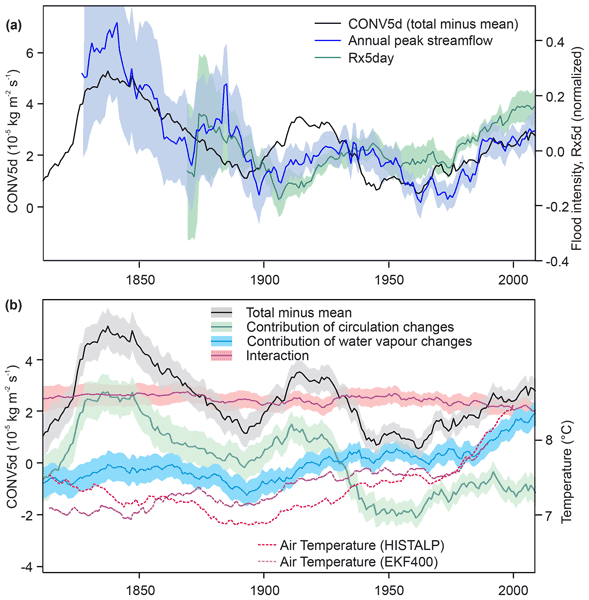
Stefan Brönnimann, Peter Stucki, Jörg Franke, Veronika Valler, Yuri Brugnara, Ralf Hand, Laura C. Slivinski, Gilbert P. Compo, Prashant D. Sardeshmukh, Michel Lang, and Bettina Schaefli
Clim. Past, 18, 919–933, https://doi.org/10.5194/cp-18-919-2022, https://doi.org/10.5194/cp-18-919-2022, 2022
Short summary
Short summary
Floods in Europe vary on time scales of several decades. Flood-rich and flood-poor periods alternate. Recently floods have again become more frequent. Long time series of peak stream flow, precipitation, and atmospheric variables reveal that until around 1980, these changes were mostly due to changes in atmospheric circulation. However, in recent decades the role of increasing atmospheric moisture due to climate warming has become more important and is now the main driver of flood changes.
Daniel Steinfeld, Adrian Peter, Olivia Martius, and Stefan Brönnimann
EGUsphere, https://doi.org/10.5194/egusphere-2022-92, https://doi.org/10.5194/egusphere-2022-92, 2022
Preprint archived
Short summary
Short summary
We assess the performance of various fire weather indices to predict wildfire occurrence in Northern Switzerland. We find that indices responding readily to weather changes have the best performance during spring; in the summer and autumn seasons, indices that describe persistent hot and dry conditions perform best. We demonstrate that a logistic regression model trained on local historical fire activity can outperform existing fire weather indices.
Duncan Pappert, Yuri Brugnara, Sylvie Jourdain, Aleksandra Pospieszyńska, Rajmund Przybylak, Christian Rohr, and Stefan Brönnimann
Clim. Past, 17, 2361–2379, https://doi.org/10.5194/cp-17-2361-2021, https://doi.org/10.5194/cp-17-2361-2021, 2021
Short summary
Short summary
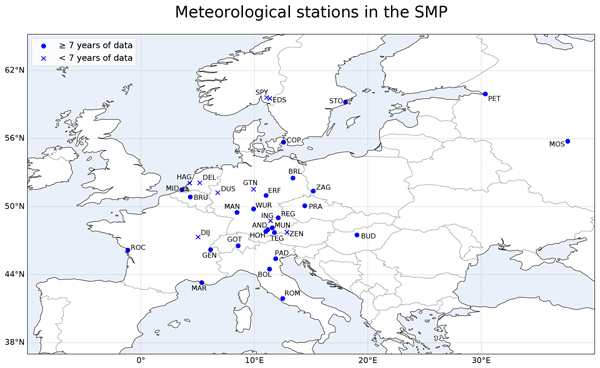
This paper presents temperature and pressure measurements from the 37 stations of the late 18th century network of the Societas Meteorologica Palatina, in addition to providing an inventory of the available observations, most of which have been digitised. The quality of the recovered series is relatively good, as demonstrated by two case studies. Early instrumental data such as these will help to explore past climate and weather extremes in Europe in greater detail.
Gerard van der Schrier, Richard P. Allan, Albert Ossó, Pedro M. Sousa, Hans Van de Vyver, Bert Van Schaeybroeck, Roberto Coscarelli, Angela A. Pasqua, Olga Petrucci, Mary Curley, Mirosław Mietus, Janusz Filipiak, Petr Štěpánek, Pavel Zahradníček, Rudolf Brázdil, Ladislava Řezníčková, Else J. M. van den Besselaar, Ricardo Trigo, and Enric Aguilar
Clim. Past, 17, 2201–2221, https://doi.org/10.5194/cp-17-2201-2021, https://doi.org/10.5194/cp-17-2201-2021, 2021
Short summary
Short summary
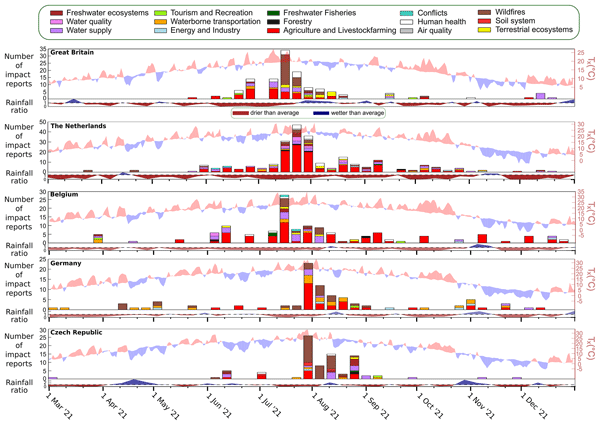
The 1921 drought was the most severe drought to hit Europe since the start of the 20th century. Here the climatological description of the drought is coupled to an overview of its impacts, sourced from newspapers, and an analysis of its drivers. The area from Ireland to the Ukraine was affected but hardest hit was the triangle between Brussels, Paris and Lyon. The drought impacts lingered on until well into autumn and winter, affecting water supply and agriculture and livestock farming.
Cited articles
Alber, W. and Vogt, A.: Württemberger Weingeschichten, Klöpfer & Meyer, Tübingen, ISBN 978-3863514181, 2016.
Als, G.: Histoire quantitative du Luxembourg. Service central de la statistique et des études économiques, Luxembourg, https://search.worldcat.org/de/title/Histoire-quantitative (last access: 13 September 2024), 1991
Altwegg, A.: Vom Weinbau am Zürichsee, Th. Gut & Co, Stäfa, 1980.
Altwegg, A.: Weinlandschaft Zürichsee – Geschichte und Gesichter, Th. Gut Verlag, Zürich, ISBN, 978-3-85717-233-5, 216 pp., 2018.
Altwegg, A.: Der Falsche Mehltau – die Geissel des Weinbaus, Schweizer Zeitschrift für Obst- und Weinbau (SZOW), 1, 17–20, https://obstundwein.ch/der-falsche-mehltau-die-geissel-des-weinbaus/ (last access: 5 January 2026), 2023.
Altwegg, A. and Pfister C.: Der Schweizer Weinbau in Bedrängnis, Schweiz, Zeitschrift für Obst- und Weinbau, 10/11 2025, 52, https://obstundwein.ch/der-schweizer-weinbau-in-bedraengnis (last access: 12 July 2025), 2025.
Angot, A.: Études sur les vendanges en France, Annales du Bureau Central Météorologique de France, Paris, année 1883, B29–B120, 1885.
Anonymous: Luxemburger Weinchronik 809–1904, 25e Anniversaire de la Fédération Viticole du Grand-Duché de Luxembourg, Imprimerie Saint-Paul, Luxembourg, 122–128, 1937.
Assmann, A.: Erinnerungsräume: Formen und Wandlungen des kulturellen Gedächtnisses, C.H.Beck, ISBN: 9783406509612, 2009.
Bartlome, N.: Wettstreit um den Weinbau, Spätmittelalterlicher Reben- und Weinzinsbesitz am Nordufer des Bielersees, Berner Zeitschriftfür Geschichte, Band 86, Heft 4, 3–44, https://www.e-periodica.ch/digbib/vollist?UID=zgh-002 (last access: 27 May 2025), 2024.
Bassermann-Jordan, F.: Geschichte des Weinbaus, Keller, Frankfurt/M., 1907.
Brázdil, R., Zahradníček, P., Dobrovolný, P., Kotyza, O., and Valášek, H.: Historical and recent viticulture as a source of climatological knowledge in the Czech Republic, Geografie, 113, 351–371, https://doi.org/10.37040/geografie2008113040351, 2008.
Brázdil, R., Možný, M., Klír, T., Řezníčková, L., Trnka. M., Dobrovolný P., and Kotyza, O.: Climate variability and changes in the agricultural cycle in the Czech Lands from the sixteenth century to the present, Theor. Appl. Climatol., 136, 553–573, https://doi.org/10.1007/s00704-018-2508-3, 2019.
Büntgen, U., Frank, D., and Nievergelt, C.: Summer temperature variations in the European Alps, A.D. 755–2004, J. Climate, 19, 5606–5623, https://doi.org/10.1175/JCLI3917.1, 2006.
Camenisch, C., Keller, K. M., Salvisberg, M., Amann, B., Bauch, M., Blumer, S., Brázdil, R., Brönnimann, S., Büntgen, U., Campbell, B. M. S., Fernández-Donado, L., Fleitmann, D., Glaser, R., González-Rouco, F., Grosjean, M., Hoffmann, R. C., Huhtamaa, H., Joos, F., Kiss, A., Kotyza, O., Lehner, F., Luterbacher, J., Maughan, N., Neukom, R., Novy, T., Pribyl, K., Raible, C. C., Riemann, D., Schuh, M., Slavin, P., Werner, J. P., and Wetter, O.: The 1430s: a cold period of extraordinary internal climate variability during the early Spörer Minimum with social and economic impacts in north-western and central Europe, Clim. Past, 12, 2107–2126, https://doi.org/10.5194/cp-12-2107-2016, 2016.
Collet, D.: Die doppelte Katastrophe: Klima und Kultur in der europäischen Hungerkrise 1770–1772, Vandenhoeck & Ruprecht, ISBN 9783525355923, 2019.
Connover, W. J.: Practical Nonparametric Statistics (New York: John Wiley & Sons, 1999), ISBN 9780471160687, 1999.
Dobrovolný, P., Moberg, A., Brázdil, R., Pfister, C., Glaser, R., Wilson, R., van Engelen, A., Limanówka, D., Kiss, A., Halíčková, M., Macková, J., Riemann, D., Luterbacher, J., and Böhm, R.: Monthly, seasonal and annual temperature reconstructions for central Europe derived from documentary evidence and instrumental records since AD 1500, Clim. Change., 101, 69–107, https://doi.org/10.1007/s10584-009-9724-x, 2010.
Draper, N. R. and Smith, H.: Applied Regression Analysis, 3rd edn., Wiley, New York, 742 pp., https://onlinelibrary.wiley.com/doi/book/10.1002/9781118625590 (last access: 21 September 2024), 1998.
Dubler, A. M.: Feudallasten [feudal charges], in: Historisches Lexikon der Schweiz (HLS), https://hls-dhs-dss.ch/de/articles/008980/2015-03-05 (last access: 5 January 2026), 2015.
Dufour, M. L.: Notes sur le problème de la variation de climat, Bulletin de la Société Vaudoise des Sciences Naturelles, 10, 359–556, https://books.google.ch/books?id=yLtDAAAAcAAJ&pg=PA357&hl=de&source=gbs_toc_r&cad=3#v=onepage&q&f=false (last access: 5 January 2026), 1870.
Dürr, F.: Heilbronner Chronik, Carl Rembold, Heilbronn, 1926.
Faust, E. and Herbold, J.: Spring frost losses and climate change – not a contradiction in terms, Munich RE, Munich, 2018.
Fontaine, M. C., Labbé, F., Dussert, Y., Dussert, J., Delière, L., Richart-Cervera, S., Giraud, T., and Delmotte, F.: Europe as a bridgehead in the worldwide invasion history of grapevine downy mildew, Plasmopara viticola, Curr. Biol., 31, 2155–2166, https://doi.org/10.1016/j.cub.2021.03.009, 2021.
Hertzog, A.: Die Weinjahre von Elsass-Lothringen [...] die Weinjahre des lothringischen Moseltales [in der Vergangenheit], Bulletin de la Société Naturelle de Colmar, N.S. VIII, Colmar, Decker, 1–86, 1906.
Heuss, T.: Weinbau und Weingärtnerstand in Heilbronn am Neckar, Reprint of the 1950 edition, Heilbronn, 129 pp., ISBN 9783928990912, 2009.
Holzkämper, A., Fuhrer, J., and Frei, C.: Temperaturtrends und Rebbau in der Schweiz, Schweizer Zeitschrift für Obst- und Weinbau (SZOW), 149, 6–9, 2013.
Jones, G. V. and Davis, R. E.: Using a synoptic climatological approach to understand climate–viticulture relationships, Int. J. Climatol., 20, 813–837, https://doi.org/10.1002/1097-0088(20000630)20:8<813::AID-JOC495>3.0.CO;2-W, 2000.
Kiss, A., Wilson, R., and Bariska, I.: An experimental 392-year documentary-based multi-proxy (vine and grain) reconstruction of May–July temperatures for Kőszeg, West-Hungary, Int. J. Biometeorol., 55, 595–611, https://doi.org/10.1007/s00484-010-0367-4, 2011.
Klipffel, H.: Metz, cité épiscopale et impériale, Hayez, 1867.
Krack, P.: Der Weinbaubetrieb des Wiener Bürgerspitals (1523–1618), MA thesis, Universität Wien, 2019.
Labbé, T., Pfister, C., Brönnimann, S., Rousseau, D., Franke, J., and Bois, B.: The longest homogeneous series of grape harvest dates, Beaune 1354–2018, and its significance for the understanding of past and present climate, Clim. Past, 15, 1485–1501, https://doi.org/10.5194/cp-15-1485-2019, 2019.
Laessle, M. N.: Le goût du vin, Alphil, Neuchâtel, ISBN 978-2-88930-192-8, 572 pp., 2018.
Lachiver, M.: Vins, vignes et vignerons. Histoire du vignoble francais, Fayard, Paris, ISBN 9782213612553, 715 pp., 1988.
Landsteiner, E.: The crisis of wine production in late sixteenth century Central Europe: Climatic causes and economic consequences, Clim. Change, 43, 323–334, https://doi.org/10.1023/A:1005590115970, 1999.
Landsteiner, E.: Weinbau und Alkoholproduktion im südöstlichen Mitteleuropa, Eine langfristige Perspektive (16.–19. Jahrhundert), Österreich in Geschichte und Literatur, 48/5, 266–284, 2004.
Lauer, W. and Frankenberg, P.: Zur Rekonstruktion des Klimas im Bereich der Rheinpfalz seit Mitte des 16. Jahrhunderts mit Hilfe von Zeitreihen der Weinquantität und Weinqualität, Gustav Fischer, Stuttgart, 54 pp., ISBN 3437305344, 1986.
LePage, H.: Annuaire Statistique, Historique [...] de la Meurthe, Grimbolt et Veuve Raybois, Nancy, 1854.
Ljungqvist, F. C., Christiansen, B., Schneider, L., and Thejll, P.: Strong volcanic-induced climatic shocks on historical Moselle wine production, Clim. Past, 21, 327–342, https://doi.org/10.5194/cp-21-327-2025, 2025.
Lorusso, D.: Il clima del Vino. Metodi di Riconstruzione e impatti economici delle fluttuazioni climatiche nelle regioni vitivinicole (Secoli XVII–XX), PhD thesis, Università di Milano, https://air.unimi.it/retrieve/dfa8b991-0f57-748b-e053-3a05fe0a3a96/phd_unimi_R09333.pdf (last access: 5 January 2026), 2013.
Le Roy Ladurie, E.: Times of feast, times of famine: a history of climate since the year 1000, Allen & Unwin, London, ISBN 978-0374521226, 1971.
Litzenburger, L.: Une ville face au climat, Metz à la fin du Moyen Âge, 1400–1530, Presses Universitaires de Nancy, Nancy, https://doi.org/10.4000/13obk, 2015.
Liu, Y., Zhang, Y., and Peñuelas J.: Drought legacies delay spring green-up in northern ecosystems, Nat. Clim. Change, 15, 444–451, https://doi.org/10.1038/s41558-025-02273-6, 2025.
Loose, R.: Gustav Schübler (1787–1834): Professor für Naturgeschichte und Botanik in Tübingen, Franz Steiner, Stuttgart, ISBN 978-3-515-13254-1, 2022.
Massard, J. A.: Vor hundert Jahren: Die Reblaus ist da!, Lëtzebuerger Journal, 143, 19–21, https://download.data.public.lu/resources/history-of-the-luxemburger-vineyardregion/20230119-163456/die-reblaus-massard.pdf (last access: 27 February 2025), 2007.
Matheus, M.: Römischer Weinkelterfund an Nahe/Glan, Neue Perspektiven zu den Anfängen der deutschen Weinbaugeschichte, Gesellschaft für die Geschichte des Weines, https://www.geschichte-des-weines.de/schriften-buecher/neu-schriften-digital.html (last access: 11 February 2026), 2025.
Metz Archives: CC 1 (1408–1413) to CC 409, 1789.
Mitchell, B. R.: International Historical Statistics, Europe 1750–1988, 3rd edn., Stockton Press, New York, ISBN 978-1349127931, 1992.
Molitor, D., Udelhoven, T., Ney, S., Hoffmann, I., and Pfister, L.: Historical vintage descriptions from Luxembourg – an indicator for the climatic conditions in the past?, Vitis, 55, 23–30, https://doi.org/10.5073/vitis.2016.55.23-30, 2016.
Müller, K.: Geschichte des Badischen Weinbaus, Lahr, Schauenburg, 1953.
Neumann, N. and Matzarakis, A.: Viticulture in southwest Germany under climate change conditions, Clim. Res., 47, 161–169, https://doi.org/10.3354/CR01000, 2011.
Niedermayr, M.: Der Weinbaubetrieb des Wiener Bürgerspitals im 17. Jahrhundert, MA thesis, Universität Wien, https://doi.org/10.25365/thesis.60945, 2020.
Ollat, N., Yobregat, O., Lacombe, T., and Rienth, M.: Grafting, the most sustainable way to control phylloxera over 150 years, IVES Technical Reviews vine and wine, https://doi.org/10.58233/RgZguHaB, 2025.
Pérès, S.: La vigne et la ville: forme urbaine et usage des sols, Economies et finances, Université Montesquieu Bordeaux IV, PhD thesis, https://theses.hal.science/tel-00448670/file/THESE.pdf (last access: 26 April 2024), 2007.
Pfaff, K.: Württembergische Wein-Chronik: ein Bericht über die Quantität und Qualität des Weins und die darauf einwirkenden Witterungsverhältnisse der einzelnen Jahrgänge, von den ältesten Zeiten bis aufs Jahr 1865, Konrad Meychardt, Esslingen, 1865.
Pfister, C.: Die Fluktuationen der Weinmosterträge im schweizerischen Weinland vom 16. bis ins frühe 19. Jahrhundert: klimatische Ursachen und sozioökonomische Bedeutung, Schweiz. Z. Gesch., 31, 445–491, 1981.
Pfister, C.: Das Klima der Schweiz von 1525 bis 1860 und seine Bedeutung in der Geschichte von Bevölkerung und Landwirtschaft, Haupt, Bern, ISBN 978-3258033198, 1984.
Pfister, C.: When Europe was burning, The multi-season mega-drought of 1540 and Arsonist Paranoia, in: Historical disaster experiences: Towards a Comparative and Transcultural History of Disasters Across Asia and Europe, edited by: Schenk, G. J., Springer Publishing, Cham, 155–185, https://doi.org/10.1007/978-3-319-49163-9_8, 2017.
Pfister, C.: Wine must quantity Europe 1416 to 1988, University of Bern, BORIS Portal [data set], https://doi.org/10.48620/91251, 2026.
Pfister, C. and Wanner, H.: Climate and society in Europe, The last thousand years, Haupt, Bern, ISBN 978-3-258-08234-9, 2021.
Pfister, C., Brönnimann, S., Altwegg, A., Brázdil, R., Litzenburger, L., Lorusso, D., and Pliemon, T.: 600 years of wine must quality and April to August temperatures in western Europe 1420–2019, Clim. Past, 20, 1387–1399, https://doi.org/10.5194/cp-20-1387-2024, 2024.
Rima, A.: Considerazioni su una serie agraria biseculare: la produzione di vino nel Rheingau (1791–1950), Geofis. Meteorol., 12, 1–11, 1963.
Ritzmann-Blickenstorfer, H.: Historische Statistik der Schweiz, Chronos, Zürich, 1221 pp., ISBN 978-3-905311-30-3, 1996.
Rousseau, D.: Fluctuations des dates de vendanges bourguignonnes et fluctuations des températures d'avril à septembre de 1378 à 2010, XXVIIe Colloque de l'Association Internationale de Climatologie, 2014 – Dijon (France), 757–763, 2015.
Rousseau, D.: La série des températures journalières à Paris de 1658 à 2023, La Météorologie, 127, 33–42, https://doi.org/10.37053/lameteorologie-2024-0083, 2023.
Schübler, G.: Nachrichten über die Verhältnisse des Weinbaues in Würtemberg [sic!] vom Jahr 1236–1830 [...], Cottasche Buchhandlung, Stuttgart, https://books.google.it/books?id=S2E7AAAAcAAJ&ots=M6aYiW3HBj&lr&hl=it&pg=PA1#v=onepage&q&f=false (last access: 9 May 2024), 1831.
Sigl, M., Winstrup, M., McConnell, J. R., Welten, K. C., Plunkett, G., Ludlow, F., and Büntgen, U.: Timing and climate forcing of volcanic eruptions for the past 2,500 years, Nature, 523, 543–549, https://doi.org/10.1038/nature14565, 2015.
Smith, G. D.: Beer: a global history, Reaktion Books, ISBN: 1780232608, 2014.
Staab, J., Seeliger, H. R., and Schleicher, W.: Schloss Johannisberg – Neun Jahrhunderte Weinkultur am Rhein, Gütersloh, Woschek, 144 pp., ISBN 3-924744-35-1, 2001.
Toma, F.: Wasser, Europäische Geschichte Online (EGO), https://ieg-ego.eu/de/threads/hintergruende/natur-und-umwelt/franziska-torma-wasser (last access: 5 January 2026), 2017.
Trachsel, S.: Climate, wine and crisis. Assessment of Grape Harvest Fluctuations in Swiss Viticulture in the 19th Century and Alpine Summer Temperature Reconstruction back to 1529, MA thesis, unpublished, University of Bern, https://infoclio.ch/sites/default/files/licdiss/l-trachsel-ma-climatewine-09_0.pdf (last access: 12 June 2025), 2009.
Trapp, J. L., Wagner, P. E., and Chastillon, C.: Représenter Metz au XVIIe siècle. Le travail de Claude Chastillon. Partie 1: une ville empreinte de son passé antique, Les cahiers lorrains : organe des sociétés littéraires et scientifiques de Metz et de la Moselle, 1, 70–79, https://hal.univ-lorraine.fr/hal-03288755v1/document (last access: 27 August 2024), 2021.
Valler, V., Franke, J., Brugnara, Y., Samakinwa, E., Hand, R., Lundstad, E., Burgdorf, A. M., Lipfert, L., Friedman, A. R., and Brönnimann, S.: ModE-RA – a global monthly paleo-reanalysis of the modern era (1421–2008), Sci. Data, 11, 36, https://doi.org/10.1038/s41597-023-02733-8, 2024.
Volk, O.: Weinbau und Weinabsatz im späten Mittelalter, Forschungsstand und Forschungsprobleme, https://www.regionalgeschichte.net/bibliothek/aufsaetze/volk-
weinbau-weinabsatz-spaetmittelalter.htm (last access: 15 January 2026), 2009.
Weber, A. O.: Klösterlicher Weinbau im mittelalterlichen Herzogtum Bayern, in: Schriften zur Weingeschichte, Nr. 205, Gesellschaft für Geschichte des Weines, Wiesbaden, https://www.geschichte-des-weines.de/schriften-buecher/neu-schriften-digital.html (last access: 11 February 2026), 2023.
Weingärtner, K. H.: Studien zur Geschichtsschreibung der Reichsstadt Heilbronn a.N., Stadtarchiv Heilbronn, 1962.
Yante, J. M.: Grains et vins des terroirs mosellans de Remich et Grevenmacher (Xve–XVIIIe siècles), Revue belge de Philologie et d'Histoire, 63, 273–309, https://www.persee.fr/doc/rbph_0035-0818_1985_num_63_2_3504 (last access: 30 August 2024), 1985.
Editorial statement
The paper shows that historical records of wine yield and quality from Central Europe (1416–1988) can be combined into a Yield Quality Index (YQI). This index serves as a reliable indicator of climate conditions from May to July. Using long-term tax, tithe, and estate records from the Moselle region in Germany and the Swiss Plateau, the study shows that high YQI values correspond to warm summers, early harvests, and supportive tree-ring evidence. Conversely, low values often reflect cold summers or frost damage. These results confirm that wine production data can significantly improve climate reconstructions and help explain the social and economic impacts of past climate extremes.
The paper shows that historical records of wine yield and quality from Central Europe...
Short summary
Narrative historical records of wine production in Central Europe date back to 1200. A study of taxes paid to authorities in the French-Luxembourg Moselle region, Germany, and the Swiss Plateau over the last few centuries shows that wine yields provide indirect indications of summer temperatures when the impact of heavy frosts is taken into account. This enables climate reconstructions based on tree rings to be refined and confirmed. Occasionally, poor harvests gave rise to witch hunts.
Narrative historical records of wine production in Central Europe date back to 1200. A study of...


