Articles | Volume 22, issue 3
https://doi.org/10.5194/cp-22-517-2026
Research article
 | Highlight paper
 | 
05 Mar 2026
Research article | Highlight paper |  | 05 Mar 2026

Evaluation of nine gridded daily weather reconstructions for the European heatwave summer of 1807

Peter Stucki, Stefan Brönnimann, Noemi Imfeld, Lucas Pfister, Conall E. Ruth, Yannis V. Schmutz, Yuri Brugnara, Martin Wegmann, Rajmund Przybylak, and Janusz Filipiak

Related authors

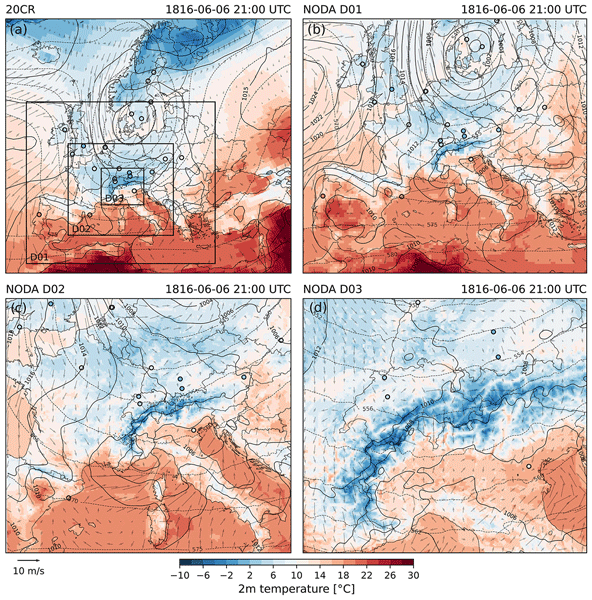
Dynamical downscaling and data assimilation for a cold-air outbreak in the European Alps during the Year Without a Summer of 1816
Peter Stucki, Lucas Pfister, Yuri Brugnara, Renate Varga, Chantal Hari, and Stefan Brönnimann
Clim. Past, 20, 2327–2348, https://doi.org/10.5194/cp-20-2327-2024,https://doi.org/10.5194/cp-20-2327-2024, 2024
Short summary
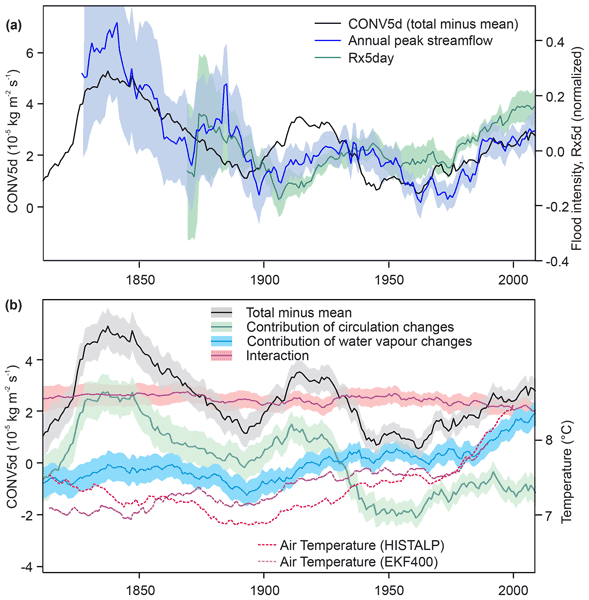
Influence of warming and atmospheric circulation changes on multidecadal European flood variability
Stefan Brönnimann, Peter Stucki, Jörg Franke, Veronika Valler, Yuri Brugnara, Ralf Hand, Laura C. Slivinski, Gilbert P. Compo, Prashant D. Sardeshmukh, Michel Lang, and Bettina Schaefli
Clim. Past, 18, 919–933, https://doi.org/10.5194/cp-18-919-2022,https://doi.org/10.5194/cp-18-919-2022, 2022
Short summary

Cited articles

Allan, R., Brohan, P., Compo, G. P., Stone, R., Luterbacher, J., and Brönnimann, S.: The International Atmospheric Circulation Reconstructions over the Earth (ACRE) Initiative, Bull. Am. Meteorol. Soc., 92, 1421–1425, https://doi.org/10.1175/2011BAMS3218.1, 2011. 
Auchmann, R., Brönnimann, S., Breda, L., Bühler, M., Spadin, R., and Stickler, A.: Extreme climate, not extreme weather: the summer of 1816 in Geneva, Switzerland, Clim. Past, 8, 325–335, https://doi.org/10.5194/cp-8-325-2012, 2012. 
Barriendos, M., Martín-vide, J., and Peña, J. C.: Daily Meteorological Observations in Cádiz, Clim. Change, 53, 151–170, 2002. 
Begert, M., Seiz, G., Schlegel, ThomasFoppa, N., Appenzeller, C., and Müller, G.: Die Überführung der klimatologischen Referenzstationen der Schweiz in das Swiss National Basic Climatological Network (Swiss NBCN), Arbeitsbericht MeteoSchweiz, 43, 2007. 
Download
Editorial statement
This study uses historical weather observations rescued from across Europe, as well as machine learning techniques to improve our understanding of a series of heatwaves in 1806. The results indicate that while machine learning models can do a good job of reproducing historical weather observations, they can't capture the physics behind why a heatwave would occur.
Short summary
We test nine reconstructions of Europe’s hot summer of 1807, using weather records, reanalyses, machine-learning (ML), and data assimilation. Most approaches match observed temperature and pressure well. Approaches based on physics of atmospheric flow capture weather patterns well, while ML approaches better reflect station records. Ingestion of accurate records from new regions improves the reconstructions markedly. In all, the approaches provide new insights to pre-industrial extreme weather.
Share