
Articles | Volume 22, issue 9
https://doi.org/10.5194/cp-22-1675-2026
© Author(s) 2026. This work is distributed under
the Creative Commons Attribution 4.0 License.
the Creative Commons Attribution 4.0 License.
https://doi.org/10.5194/cp-22-1675-2026
© Author(s) 2026. This work is distributed under
the Creative Commons Attribution 4.0 License.
the Creative Commons Attribution 4.0 License.
Research article
| Highlight paper
| 
15 Sep 2026
Research article | Highlight paper |
| 15 Sep 2026
| 15 Sep 2026
Limited atmospheric iron availability increase during the Younger Dryas in the Northern Hemisphere
François Burgay
Department of Environmental Sciences, University of Basel, Basel, Switzerland
Department of Environmental Sciences, Informatics and Statistics, Ca' Foscari University of Venice, Venice Mestre, Italy
Haley Derrod
Department of Environmental Sciences, Informatics and Statistics, Ca' Foscari University of Venice, Venice Mestre, Italy
Tobias Erhardt
Climate and Environmental Physics, Physics Institute & Oeschger Centre for Climate Change Research, University of Bern, Bern, Switzerland
Institute of Geosciences, Goethe University Frankfurt, Frankfurt am Main, Germany
Federico Scoto
Department of Environmental Sciences, Informatics and Statistics, Ca' Foscari University of Venice, Venice Mestre, Italy
Institute of Polar Sciences, National Research Council, Venice Mestre, Italy
Delia Segato
European Commission, Joint Research Centre, Ispra, Italy
Department of Environmental Sciences, Informatics and Statistics, Ca' Foscari University of Venice, Venice Mestre, Italy
Niccolò Maffezzoli
Department of Environmental Sciences, Informatics and Statistics, Ca' Foscari University of Venice, Venice Mestre, Italy
Institute of Polar Sciences, National Research Council, Venice Mestre, Italy
Department of Earth System Science, University of California, Irvine, Irvine, United States of America
Federico Dallo
Institute of Polar Sciences, National Research Council, Venice Mestre, Italy
Daniele Zannoni
Department of Environmental Sciences, Informatics and Statistics, Ca' Foscari University of Venice, Venice Mestre, Italy
Azzurra Spagnesi
Department of Environmental Sciences, Informatics and Statistics, Ca' Foscari University of Venice, Venice Mestre, Italy
Helle-Astrid Kjær
Physics for Ice, Climate and Earth, Niels Bohr Institute, University of Copenhagen, Copenhagen, Denmark
Hubertus Fischer
Climate and Environmental Physics, Physics Institute & Oeschger Centre for Climate Change Research, University of Bern, Bern, Switzerland
Cristiano Varin
Department of Environmental Sciences, Informatics and Statistics, Ca' Foscari University of Venice, Venice Mestre, Italy
Carlo Barbante
Department of Environmental Sciences, Informatics and Statistics, Ca' Foscari University of Venice, Venice Mestre, Italy
Climate and Environmental Physics, Physics Institute & Oeschger Centre for Climate Change Research, University of Bern, Bern, Switzerland

Department of Environmental Sciences, Informatics and Statistics, Ca' Foscari University of Venice, Venice Mestre, Italy
Climate and Environmental Physics, Physics Institute & Oeschger Centre for Climate Change Research, University of Bern, Bern, Switzerland
Related authors
Azzurra Spagnesi, Elena Barbaro, Matteo Feltracco, Federico Scoto, Marco Vecchiato, Massimiliano Vardè, Mauro Mazzola, François Burgay, Federica Bruschi, Clara Jule Marie Hoppe, Allison Bailey, Andrea Gambaro, Carlo Barbante, and Andrea Spolaor
Atmos. Chem. Phys., 25, 16215–16232, https://doi.org/10.5194/acp-25-16215-2025, https://doi.org/10.5194/acp-25-16215-2025, 2025
Short summary
Short summary
Svalbard is ideal for studying how warming affects snow’s seasonal chemistry. By comparing the snow chemical composition of the 2019–2020 season with 2018–2019 and 2020–2021, we provide an overview of the seasonal and interannual variability of several chemical species on the Svalbard snowpack, furnishing insights into the interplay between short-term meteorological variability and the long-term climatic impacts of climate changes.
Johanna Schäfer, Anja Beschnitt, François Burgay, Thomas Singer, Margit Schwikowski, and Thorsten Hoffmann
Atmos. Meas. Tech., 18, 421–430, https://doi.org/10.5194/amt-18-421-2025, https://doi.org/10.5194/amt-18-421-2025, 2025
Short summary
Short summary
Glaciers preserve organic compounds from atmospheric aerosols, which can serve as markers for emission sources. Most studies overlook the enantiomers of chiral compounds. We developed a two-dimensional liquid chromatography method to determine the chiral ratios of the monoterpene oxidation products cis-pinic acid and cis-pinonic acid in ice-core samples. Applied to samples from the Belukha Glacier (1870–1970 CE), the method revealed fluctuating chiral ratios for the analytes.
Andrea Spolaor, Federico Scoto, Catherine Larose, Elena Barbaro, Francois Burgay, Mats P. Bjorkman, David Cappelletti, Federico Dallo, Fabrizio de Blasi, Dmitry Divine, Giuliano Dreossi, Jacopo Gabrieli, Elisabeth Isaksson, Jack Kohler, Tonu Martma, Louise S. Schmidt, Thomas V. Schuler, Barbara Stenni, Clara Turetta, Bartłomiej Luks, Mathieu Casado, and Jean-Charles Gallet
The Cryosphere, 18, 307–320, https://doi.org/10.5194/tc-18-307-2024, https://doi.org/10.5194/tc-18-307-2024, 2024
Short summary
Short summary
We evaluate the impact of the increased snowmelt on the preservation of the oxygen isotope (δ18O) signal in firn records recovered from the top of the Holtedahlfonna ice field located in the Svalbard archipelago. Thanks to a multidisciplinary approach we demonstrate a progressive deterioration of the isotope signal in the firn core. We link the degradation of the δ18O signal to the increased occurrence and intensity of melt events associated with the rapid warming occurring in the archipelago.
Tobias Erhardt, Camilla Marie Jensen, Florian Adolphi, Helle Astrid Kjær, Remi Dallmayr, Birthe Twarloh, Melanie Behrens, Motohiro Hirabayashi, Kaori Fukuda, Jun Ogata, François Burgay, Federico Scoto, Ilaria Crotti, Azzurra Spagnesi, Niccoló Maffezzoli, Delia Segato, Chiara Paleari, Florian Mekhaldi, Raimund Muscheler, Sophie Darfeuil, and Hubertus Fischer
Earth Syst. Sci. Data, 15, 5079–5091, https://doi.org/10.5194/essd-15-5079-2023, https://doi.org/10.5194/essd-15-5079-2023, 2023
Short summary
Short summary
The presented paper provides a 3.8 kyr long dataset of aerosol concentrations from the East Greenland Ice coring Project (EGRIP) ice core. The data consists of 1 mm depth-resolution profiles of calcium, sodium, ammonium, nitrate, and electrolytic conductivity as well as decadal averages of these profiles. Alongside the data a detailed description of the measurement setup as well as a discussion of the uncertainties are given.
Niccolò Maffezzoli, Eliza Cook, Willem G. M. van der Bilt, Eivind N. Støren, Daniela Festi, Florian Muthreich, Alistair W. R. Seddon, François Burgay, Giovanni Baccolo, Amalie R. F. Mygind, Troels Petersen, Andrea Spolaor, Sebastiano Vascon, Marcello Pelillo, Patrizia Ferretti, Rafael S. dos Reis, Jefferson C. Simões, Yuval Ronen, Barbara Delmonte, Marco Viccaro, Jørgen Peder Steffensen, Dorthe Dahl-Jensen, Kerim H. Nisancioglu, and Carlo Barbante
The Cryosphere, 17, 539–565, https://doi.org/10.5194/tc-17-539-2023, https://doi.org/10.5194/tc-17-539-2023, 2023
Short summary
Short summary
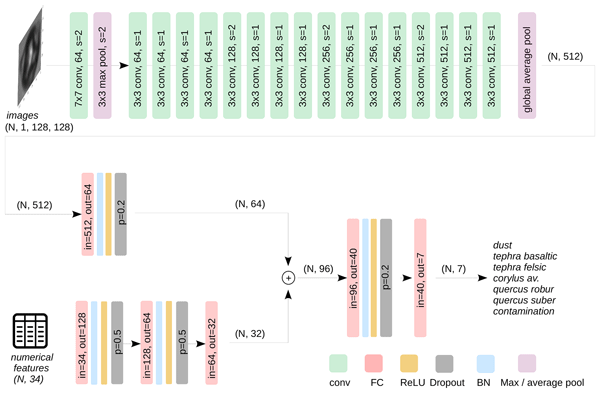
Multiple lines of research in ice core science are limited by manually intensive and time-consuming optical microscopy investigations for the detection of insoluble particles, from pollen grains to volcanic shards. To help overcome these limitations and support researchers, we present a novel methodology for the identification and autonomous classification of ice core insoluble particles based on flow image microscopy and neural networks.
François Burgay, Rafael Pedro Fernández, Delia Segato, Clara Turetta, Christopher S. Blaszczak-Boxe, Rachael H. Rhodes, Claudio Scarchilli, Virginia Ciardini, Carlo Barbante, Alfonso Saiz-Lopez, and Andrea Spolaor
The Cryosphere, 17, 391–405, https://doi.org/10.5194/tc-17-391-2023, https://doi.org/10.5194/tc-17-391-2023, 2023
Short summary
Short summary
The paper presents the first ice-core record of bromine (Br) in the Antarctic plateau. By the observation of the ice core and the application of atmospheric chemical models, we investigate the behaviour of bromine after its deposition into the snowpack, with interest in the effect of UV radiation change connected to the formation of the ozone hole, the role of volcanic deposition, and the possible use of Br to reconstruct past sea ice changes from ice core collect in the inner Antarctic plateau.
Raffaello Nardin, Mirko Severi, Alessandra Amore, Silvia Becagli, Francois Burgay, Laura Caiazzo, Virginia Ciardini, Giuliano Dreossi, Massimo Frezzotti, Sang-Bum Hong, Ishaq Khan, Bianca Maria Narcisi, Marco Proposito, Claudio Scarchilli, Enricomaria Selmo, Andrea Spolaor, Barbara Stenni, and Rita Traversi
Clim. Past, 17, 2073–2089, https://doi.org/10.5194/cp-17-2073-2021, https://doi.org/10.5194/cp-17-2073-2021, 2021
Short summary
Short summary
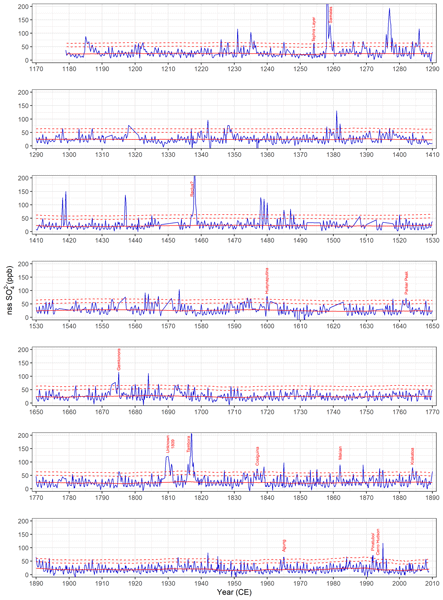
The first step to exploit all the potential information buried in ice cores is to produce a reliable age scale. Based on chemical and isotopic records from the 197 m Antarctic GV7(B) ice core, accurate dating was achieved and showed that the archive spans roughly the last 830 years. The relatively high accumulation rate allowed us to use the non-sea-salt sulfate seasonal pattern to count annual layers. The accumulation rate reconstruction exhibited a slight increase since the 18th century.
Alexander Mattin, Simon J. Barker, V. Holly L. Winton, Andrea Burke, William Hutchison, Patrick J. Sugden, Kirstin Krüger, Alexa R. Van Eaton, Larry G. Mastin, Michael Sigl, Eric W. Wolff, Shuji Fujita, Kumiko Goto-Azuma, Ikumi Oyabu, Motohiro Hirabayashi, Anders Svensson, Magali Verkerk, Colin J. N. Wilson, Stephen B. Piva, Nels A. Iverson, Nelia W. Dunbar, Helle A. Kjær, Nancy A. N. Bertler, Mirko Severi, Andrei V. Kurbatov, and Dominic A. Winski
EGUsphere, https://doi.org/10.5194/egusphere-2026-3434, https://doi.org/10.5194/egusphere-2026-3434, 2026
This preprint is open for discussion and under review for Climate of the Past (CP).
Short summary
Short summary
This study presents evidence of the ~25.3 Ōruanui supereruption preserved in Antarctic ice cores. Glaciochemical signals and volcanic ash were identified across multiple sites, revealing regional differences in volcanic transport, deposition, and preservation. Combining ice core records with climate model simulations, we show the eruption likely caused substantial short-term global cooling and atmospheric change but was unlikely to trigger long-term climate shifts.
Rafael dos Reis, Denise Mondragon, Nolan Magner, Bruce Vaughn, Valerie Morris, Kevin Hand, Catherine Walker, Christopher German, Joseph McConnell, Helle Astrid Kjaer, and Melisa A. Diaz
EGUsphere, https://doi.org/10.5194/egusphere-2026-4356, https://doi.org/10.5194/egusphere-2026-4356, 2026
This preprint is open for discussion and under review for The Cryosphere (TC).
Short summary
Short summary
We present a new high‑resolution continuous melter system specifically engineered for sediment‑laden sea‑ice cores. The system combines full‑core melting, inline multi‑stage filtration, and electronic depth‑resolution control to enable simultaneous discrete sampling of dissolved and particulate phases. The new system approaches particularly high‑impurity ice.
Geunwoo Lee, Tobias Erhardt, Piers Larkman, Chantal Zeppenfeld, Sarah Jackson, Jochen Schmitt, Barbara Delmonte, Giovanni Baccolo, Catherine Ritz, Frank Wilhelms, Dorthe Dahl-Jensen, Kevin Michael Nikolaus, Pascal Bohleber, and Hubertus Fischer
EGUsphere, https://doi.org/10.5194/egusphere-2026-4574, https://doi.org/10.5194/egusphere-2026-4574, 2026
This preprint is open for discussion and under review for The Cryosphere (TC).
Short summary
Short summary
Deep ice cores preserve records of past climate, but chemical reactions inside the ice can blur these signals over time. To find out how, we studied millions of dust particles in a deep Antarctic ice core. We found that, over long timescales, dust dissolves and reforms into new minerals within tiny pockets of liquid, trapping chemical elements. Warm temperatures speed up this process. Accounting for it helps scientists interpret ancient climate records from deep ice more reliably.
Noah Liguori-Bills, Catherine E. Scott, Ken S. Carslaw, Natalie Kehrwald, Stijn Hantson, Susan Kaspari, Carlo Barbante, Elena Barbaro, Paolo Gabrielli, Roberta Zangrando, Lonnie G. Thompson, and Douglas S. Hamilton
EGUsphere, https://doi.org/10.5194/egusphere-2026-2728, https://doi.org/10.5194/egusphere-2026-2728, 2026
This preprint is open for discussion and under review for Atmospheric Chemistry and Physics (ACP).
Short summary
Short summary
Ice cores preserve changes in landscape fires and human-caused combustion. In this study, we compared ice core data from every continent, except Oceania, to computer model simulations of fire. We found a large disagreement in the 1850 CE to 1980 CE black carbon ratio. After exploring changes in emissions, transport, and aerosol microphysical processes as potential reasons for this disagreement, our results suggested that fire emission input datasets for climate models are the primary cause.
Christian Wirths, Kyung-Sook Yun, Axel Timmermann, Hubertus Fischer, Thomas F. Stocker, and Johannes C. R. Sutter
EGUsphere, https://doi.org/10.5194/egusphere-2026-4275, https://doi.org/10.5194/egusphere-2026-4275, 2026
Short summary
Short summary
Ice drilled from deep inside Antarctica reveals how climate changed over hundreds of thousands of years. However, the ice sheet itself rises and sinks over time, which can distort temperatures read from the ice. Using three computer simulations covering the last two million years, we show that drilling sites rose and sank by up to 240 metres and their summits shifted by up to 120 kilometres, and we estimate how this biases climate records, including potential for the oldest ice.
Agnese Petteni, Mathieu Casado, Christophe Leroy-Dos Santos, Amaelle Landais, Niels Dutrievoz, Cécile Agosta, Pete D. Akers, Joel Savarino, Andrea Spolaor, Massimo Frezzotti, and Barbara Stenni
The Cryosphere, 20, 3581–3598, https://doi.org/10.5194/tc-20-3581-2026, https://doi.org/10.5194/tc-20-3581-2026, 2026
Short summary
Short summary
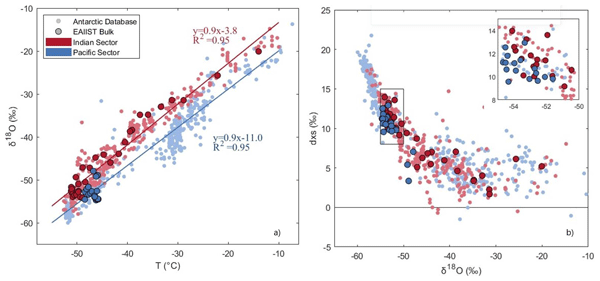
We investigated the isotopic composition of surface snow in a previously unexplored region of East Antarctica to understand how differences in air mass origin influence its variability. By comparing observations with model data, we validated the model and quantified the impact of post-depositional processes at the snow–atmosphere interface. Our results offer valuable insights for reconstructing past temperatures from ice cores.
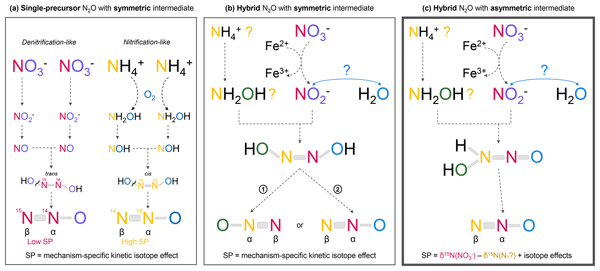
Lison Soussaintjean, Jochen Schmitt, Joël Savarino, J. Andy Menking, Edward J. Brook, Barbara Seth, Vladimir Lipenkov, Thomas Röckmann, and Hubertus Fischer
Biogeosciences, 23, 3939–3963, https://doi.org/10.5194/bg-23-3939-2026, https://doi.org/10.5194/bg-23-3939-2026, 2026
Short summary
Short summary
Nitrous oxide (N2O) produced in dust-rich Antarctic ice complicates the reconstruction of past atmospheric levels from ice core records. Using isotope analysis, we show that N2O forms from two nitrogen precursors, one being nitrate. For the first time, we demonstrate that the site preference (SP) of N2O reflects the isotopic difference between these precursors, not the production pathway, which challenges the common interpretation of SP.
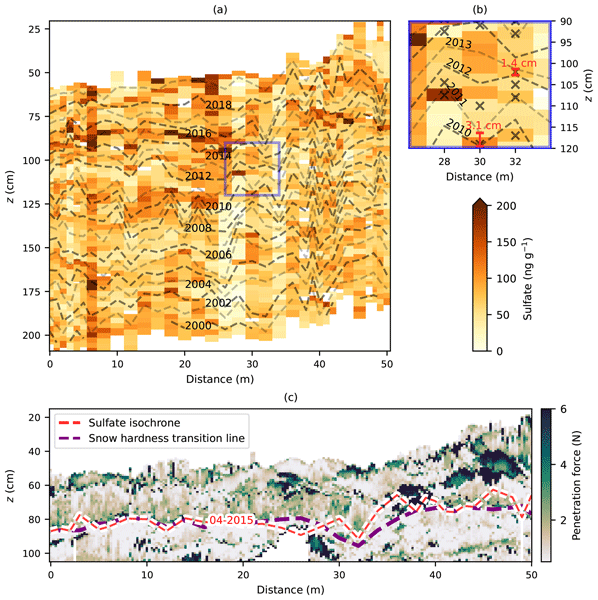
Adrien Ooms, Mathieu Casado, Ghislain Picard, Laurent Arnaud, Maria Hörhold, Andrea Spolaor, Rita Traversi, Joel Savarino, Patrick Ginot, Pete Akers, Birthe Twarloh, and Valérie Masson-Delmotte
The Cryosphere, 20, 3235–3255, https://doi.org/10.5194/tc-20-3235-2026, https://doi.org/10.5194/tc-20-3235-2026, 2026
Short summary
Short summary
This work presents a new approach to the estimation of accumulation rates at Concordia Station, East-Antarctica, for the last 20 years, from a new data set of chemical tracers and snow micro-scale properties measured in a snow trench. Multi-annual and meter to decameter scale variability of accumulation rates are compared again in-situ measurements of surface laser scanner and stake farm, with very good agreement. This further constrains SMB estimation for Antarctica at high temporal resolution.
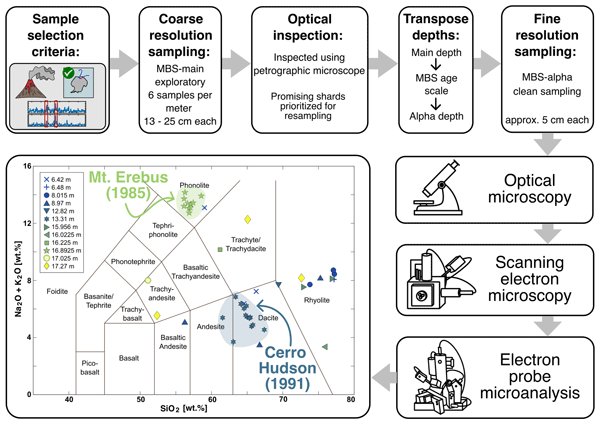
Margaret M. Harlan, Jodi Fox, Helle Astrid Kjær, Tessa R. Vance, Anders Svensson, and Eliza Cook
Clim. Past, 22, 1057–1083, https://doi.org/10.5194/cp-22-1057-2026, https://doi.org/10.5194/cp-22-1057-2026, 2026
Short summary
Short summary
The ~300 m Mount Brown South ice core (MBS) was drilled in coastal East Antarctica in 2017-2018. Here, we combine atmospheric modeling, ice core chemistry, and eruption records to sample a ~20 m MBS companion core for volcanic ash. We identified two ash layers, geochemically correlated with eruptions of Mt. Erebus (1985) and Cerro Hudson (1991). This study proves long-range transport of ash to East Antarctica, validating MBS as an untapped record of high latitude Southern Hemisphere volcanism.
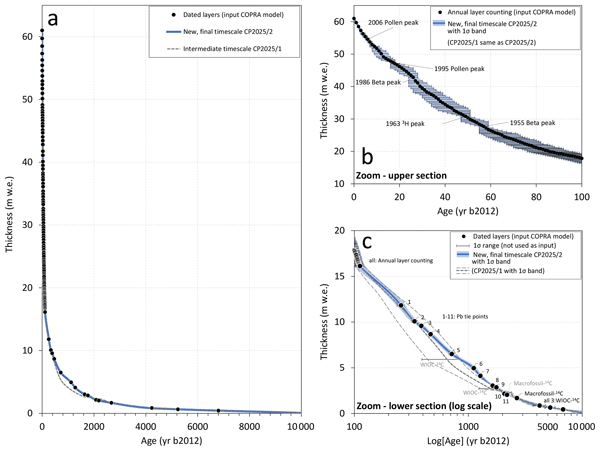
Paolo Gabrielli, Theo M. Jenk, Michele Bertó, Giuliano Dreossi, Daniela Festi, Werner Kofler, Mai Winstrup, Klaus Oeggl, Margit Schwikowski, Barbara Stenni, and Carlo Barbante
Clim. Past, 22, 1037–1055, https://doi.org/10.5194/cp-22-1037-2026, https://doi.org/10.5194/cp-22-1037-2026, 2026
Short summary
Short summary
A low latitude-high altitude Alpine ice core record was obtained in 2011 from the glacier Alto dell’Ortles (Eastern Alps, Italy) and provided evidence of one of the oldest Alpine ice core records spanning the last ~7000 years, back to the last Northern Hemisphere Climatic Optimum. Here we provide a new Alto dell’Ortles chronology of improved accuracy that will allow to constrain Holocene climatic and environmental histories emerging from this high-altitude glacial archive of Central Europe.
Alena Dekhtyareva, Harald Sodemann, Tim Carlsen, Iris Thurnherr, Aina Johannessen, Andrew Seidl, David M. Chandler, Daniele Zannoni, Alexandra Touzeau, Marvin Kähnert, Astrid B. Gjelsvik, Franziska Hellmuth, Britta Schäfer, and Robert O. David
Earth Syst. Sci. Data, 18, 2573–2607, https://doi.org/10.5194/essd-18-2573-2026, https://doi.org/10.5194/essd-18-2573-2026, 2026
Short summary
Short summary
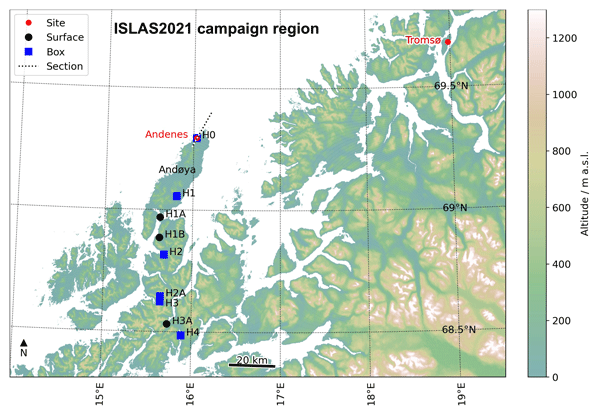
During a recent field campaign from 15 to 30 March 2021 at Andenes, Norway, we collected a set of observations that allows to better constrain how clouds and precipitation processes work. Frequent alternations between mid-latitude and arctic weather systems were encountered during the campaign. Our dataset is unique in combining measurements in both vapour and precipitation, aerosols, ice nucleating particles, and was made simultaneously at different elevations at a high latitude location.
Elena Barbaro, Francisco Ardini, Silvia Becagli, Stefano Bertinetti, Federica Bruschi, Giulia Calzolai, Alice Cavaliere, David Cappelletti, Stefano Crocchianti, Matteo Feltracco, Andrea Gambaro, Fabio Giardi, Stefania Gilardoni, Marco Grotti, Dominic Heslin-Rees, Radovan Krejci, Mery Malandrino, Matilde Mataloni, Simonetta Montaguti, Silvia Nava, Marco Paglione, Matteo Rinaldi, Chiara Ripa, Mirko Severi, Andrea Spolaor, Rita Traversi, Hilde Uggerud, Giulio Verazzo, Tessa Viglezio, Karl Espen Yttri, Wenche Aas, and Mauro Mazzola
EGUsphere, https://doi.org/10.5194/egusphere-2026-1467, https://doi.org/10.5194/egusphere-2026-1467, 2026
Short summary
Short summary
This study analyzes how Arctic atmospheric layering affects aerosol distribution by comparing data from the Gruvebadet (61 m) and Zeppelin (472 m) observatories in Svalbard. Results show consistent levels of human-made pollutants like sulfate at both heights, confirming long-range transport from Eurasia. Conversely, natural biogenic tracers were more concentrated at lower altitudes. By integrating chemical and meteorological data, the research highlights the need for multi-level monitoring.
Héloïse Guilluy, Émilie Capron, Frédéric Parrenin, Vladimir Lipenkov, Jochen Schmitt, Patricia Martinerie, Zhipeng Wu, Qiuzhen Yin, Anna Maria Klüssendorf, Amaëlle Landais, Barbara Seth, Hubertus Fischer, and Dominique Raynaud
EGUsphere, https://doi.org/10.5194/egusphere-2026-953, https://doi.org/10.5194/egusphere-2026-953, 2026
Short summary
Short summary
Air bubbles in polar ice cores retain information about past climates over hundreds of thousands of years. The total air content (TAC) trapped within these bubbles varies with summer insolation cycles, making it a tool for dating ice cores. We present a multi-site update on TAC, combining new and published data. We confirm that insolation impacts bubble volume in East Antarctica, but surface climate changes can hide the insolation signal in the TAC record, impacting the TAC-derived chronologies.
Dorothea Elisabeth Moser, Andrea Spolaor, Federico Scoto, and Elizabeth R. Thomas
EGUsphere, https://doi.org/10.5194/egusphere-2026-399, https://doi.org/10.5194/egusphere-2026-399, 2026
Short summary
Short summary
The Arctic is warming rapidly, and winter rain-on-snow events are becoming more common. These events can alter snow layers and disturb climate information stored in glaciers. We studied how small rain-on-snow events affect snow structure and water isotopes near Ny-Ålesund, Svalbard. Field experiments show that meltwater flow creates complex features, but isotope changes remain confined to them, meaning seasonal climate signals can still be preserved where enough snow accumulates.
Iris Arndt, Jonathan Erez, David Evans, Tobias Erhardt, Adam Levi, and Wolfgang Müller
Biogeosciences, 23, 585–603, https://doi.org/10.5194/bg-23-585-2026, https://doi.org/10.5194/bg-23-585-2026, 2026
Short summary
Short summary
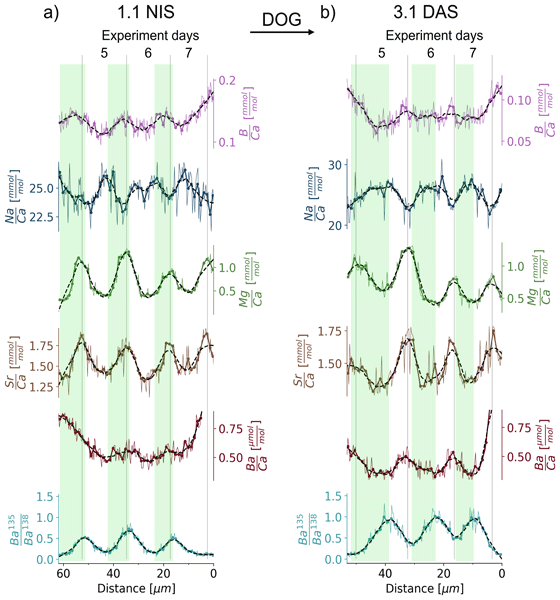
This study explores daily geochemical variations in giant clam (Tridacna) shells from controlled, isotopically-labelled day-night growth experiments. Results show five times higher daytime calcification rates. Light availability and metabolic activity significantly influence elemental incorporation mechanisms. The findings enhance our understanding of clam geochemistry and growth dynamics, offering valuable insights for studies on past environmental changes.
David Wachs, Azzurra Spagnesi, Pascal Bohleber, Andrea Fischer, Martin Stocker-Waldhuber, Alexander Junkermann, Carl Kindermann, Linus Langenbacher, Niclas Mandaric, Joshua Marks, Florian Meienburg, Theo M. Jenk, Markus K. Oberthaler, and Werner Aeschbach
Clim. Past, 22, 173–185, https://doi.org/10.5194/cp-22-173-2026, https://doi.org/10.5194/cp-22-173-2026, 2026
Short summary
Short summary
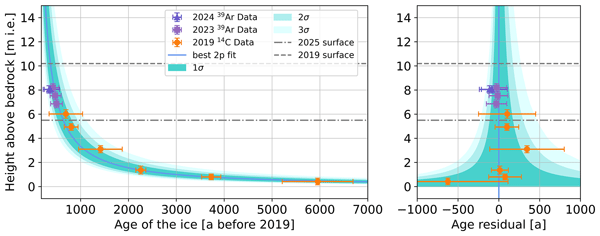
This study presents an age profile of the summit glacier of Weißseespitze in the Austrian Alps. The ages were obtained by combining 14C dating with the novel atom trap trace analysis for 39Ar. The data was used to constrain glacier age models. The results show that the surface ice is ~400 a old due to recent ice loss. The remaining ice continuously covers ages up to 6000 a. This work underscores the utility of 39Ar dating in glaciology, enabling precise reconstruction of age-depth relationships.
Antonio Donateo, Gianluca Pappaccogli, Federico Scoto, Maurizio Busetto, Francesca L. Lovisco, Natalie Brett, Douglas Keller, Brice Barret, Elsa Dieudonné, Roman Pohorsky, Andrea Baccarini, Slimane Bekki, Jean-Christophe Raut, Julia Schmale, Kathy S. Law, Steve R. Arnold, Javier G. Fochesatto, William R. Simpson, and Stefano Decesari
Atmos. Chem. Phys., 25, 18129–18156, https://doi.org/10.5194/acp-25-18129-2025, https://doi.org/10.5194/acp-25-18129-2025, 2025
Short summary
Short summary
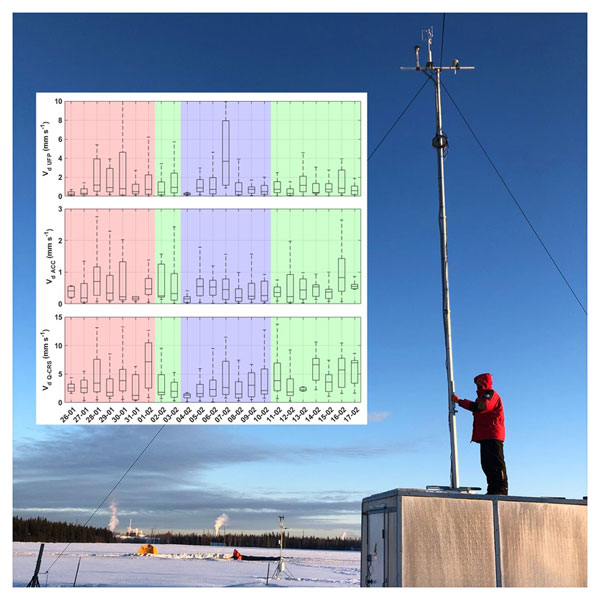
A study in Fairbanks, Alaska, measured winter aerosol fluxes on snow. Both emission and deposition occurred, with larger particles settling faster. Weather influenced dispersion and deposition, while wind-driven turbulence enhanced deposition despite stable conditions. Results show aerosol accumulation in snow impacts pollution and snowmelt. Findings help improve aerosol models and pollution studies in cold cities.
Margaret Harlan, Helle Astrid Kjær, Aylin de Campo, Anders Svensson, Thomas Blunier, Vasileios Gkinis, Sarah Jackson, Christopher Plummer, and Tessa Vance
Earth Syst. Sci. Data, 17, 6255–6271, https://doi.org/10.5194/essd-17-6255-2025, https://doi.org/10.5194/essd-17-6255-2025, 2025
Short summary
Short summary
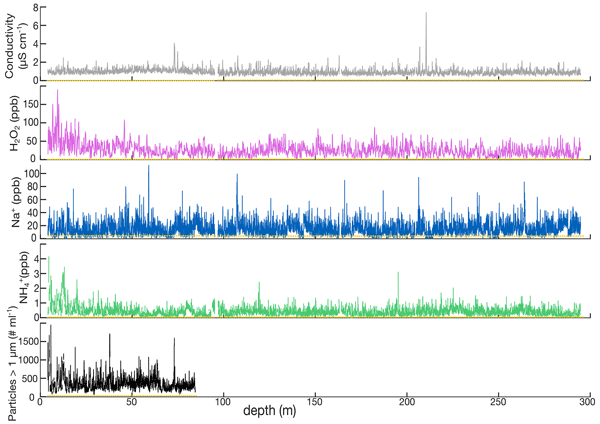
This paper provides high-resolution chemistry and impurity measurements from the Mount Brown South ice core in East Antarctica, from 873 to 2008 CE. Measurements include sodium, ammonium, hydrogen peroxide, electrolytic conductivity, and insoluble microparticles. Data are provided on three scales: 1 mm and 3 cm averaged depth resolution and decadally averaged. The paper also describes the continuous flow analysis systems used to collect the data and characterizes uncertainties and data quality.
Azzurra Spagnesi, Elena Barbaro, Matteo Feltracco, Federico Scoto, Marco Vecchiato, Massimiliano Vardè, Mauro Mazzola, François Burgay, Federica Bruschi, Clara Jule Marie Hoppe, Allison Bailey, Andrea Gambaro, Carlo Barbante, and Andrea Spolaor
Atmos. Chem. Phys., 25, 16215–16232, https://doi.org/10.5194/acp-25-16215-2025, https://doi.org/10.5194/acp-25-16215-2025, 2025
Short summary
Short summary
Svalbard is ideal for studying how warming affects snow’s seasonal chemistry. By comparing the snow chemical composition of the 2019–2020 season with 2018–2019 and 2020–2021, we provide an overview of the seasonal and interannual variability of several chemical species on the Svalbard snowpack, furnishing insights into the interplay between short-term meteorological variability and the long-term climatic impacts of climate changes.
Agnese Petteni, Elise Fourré, Elsa Gautier, Azzurra Spagnesi, Roxanne Jacob, Pete D. Akers, Daniele Zannoni, Jacopo Gabrieli, Olivier Jossoud, Frédéric Prié, Amaëlle Landais, Titouan Tcheng, Barbara Stenni, Joel Savarino, Patrick Ginot, and Mathieu Casado
Atmos. Meas. Tech., 18, 5435–5455, https://doi.org/10.5194/amt-18-5435-2025, https://doi.org/10.5194/amt-18-5435-2025, 2025
Short summary
Short summary
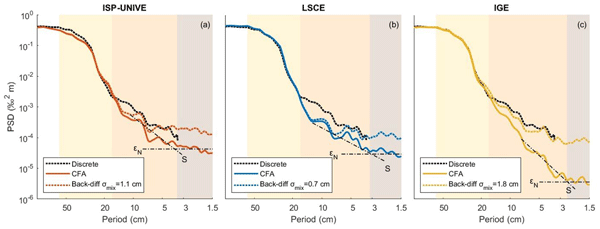
Our research compares three systems of continuous flow analysis coupled with cavity ring-down spectrometry (CFA-CRD) from Venice, Paris, and Grenoble laboratories for measuring water isotopes in ice cores, crucial for reconstructing past climate. We quantify each system’s mixing and measurement noise effects, which impact the achievable resolution of isotope continuous records. Our findings reveal specific configurations and procedures to enhance measurement accuracy, providing a framework to optimise water isotope analysis.
Daniele Zannoni, Hans Christian Steen-Larsen, Harald Sodemann, Iris Thurnherr, Cyrille Flamant, Patrick Chazette, Julien Totems, Martin Werner, and Myriam Raybaut
Atmos. Chem. Phys., 25, 9471–9495, https://doi.org/10.5194/acp-25-9471-2025, https://doi.org/10.5194/acp-25-9471-2025, 2025
Short summary
Short summary
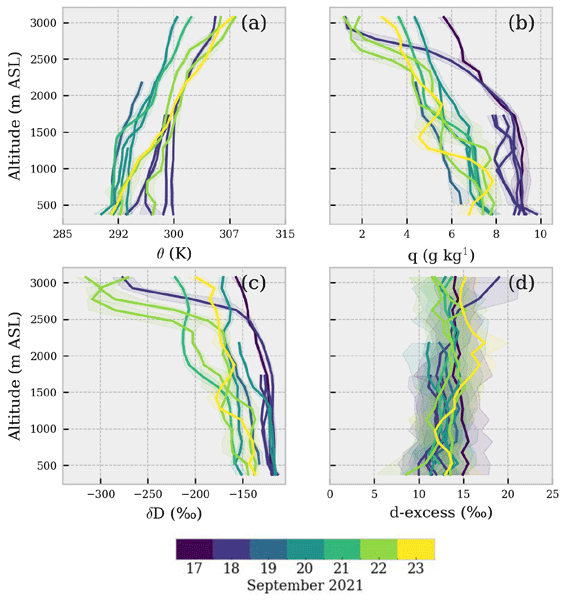
High-resolution airborne observations reveal that mixing between the free troposphere and surface evapotranspiration flux primarily modulates the water vapor isotopic composition in the lower troposphere. Water vapor isotope structure variations occur on the scale of hundreds of meters, underlining the utility of stable isotopes for studying microscale atmospheric dynamics. This study also provides the basis for better validation of water vapor isotope remote sensing retrievals with surface observations.
Niccolò Maffezzoli, Eric Rignot, Carlo Barbante, Troels Petersen, and Sebastiano Vascon
Geosci. Model Dev., 18, 2545–2568, https://doi.org/10.5194/gmd-18-2545-2025, https://doi.org/10.5194/gmd-18-2545-2025, 2025
Short summary
Short summary
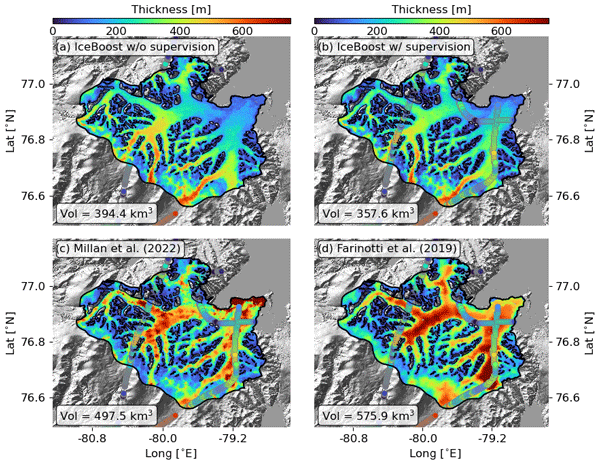
In this work we introduce IceBoost, a machine learning framework to model the ice thickness distribution of all the world's glaciers with greater accuracy than state-of-the-art methods. The model is trained on 3.7 million measurements globally available and provides skilful estimates across all regions. This advancement will help in better assessing future sea level changes and freshwater resources, with significance for both the scientific community and society at large.
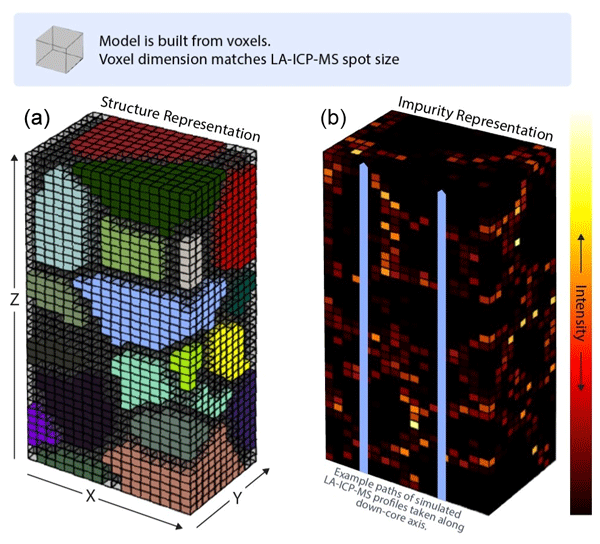
Piers Larkman, Rachael H. Rhodes, Nicolas Stoll, Carlo Barbante, and Pascal Bohleber
The Cryosphere, 19, 1373–1390, https://doi.org/10.5194/tc-19-1373-2025, https://doi.org/10.5194/tc-19-1373-2025, 2025
Short summary
Short summary
Impurities in ice cores can be preferentially located at the boundaries between crystals of ice, impacting the interpretation of high-resolution data collected from ice core samples. Through use of a modelling framework, we demonstrate that one-dimensional signals can be significantly affected by this association, meaning high-resolution measurements must be carefully designed. Accounting for this effect is important for interpreting ice core data, especially for deep ice samples.
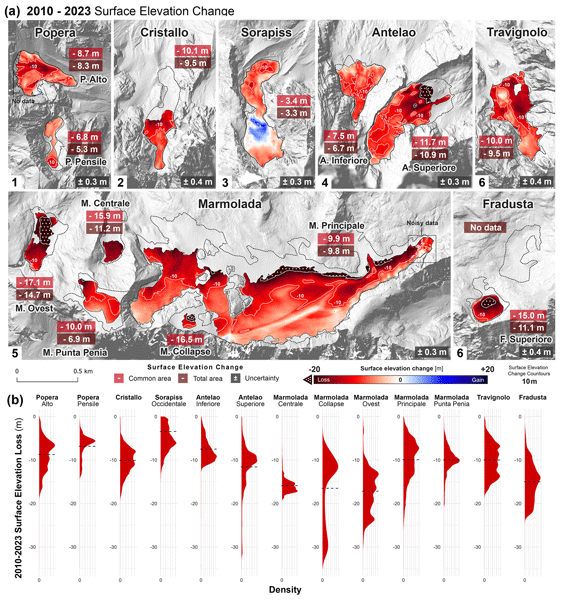
Andrea Securo, Costanza Del Gobbo, Giovanni Baccolo, Carlo Barbante, Michele Citterio, Fabrizio De Blasi, Marco Marcer, Mauro Valt, and Renato R. Colucci
The Cryosphere, 19, 1335–1352, https://doi.org/10.5194/tc-19-1335-2025, https://doi.org/10.5194/tc-19-1335-2025, 2025
Short summary
Short summary
We have reconstructed the multi-decadal (1980s–2023) ice mass changes for all the current mountain glaciers in the Dolomites. We used historical aerial photographs, drone surveys, and lidar to fill the glaciological data gap for the region. We observed an alarming decline in both glacier area and volume, with some of the glaciers showing smaller losses due to local topography and debris cover feedback. We strongly recommend more specific monitoring of these glaciers.
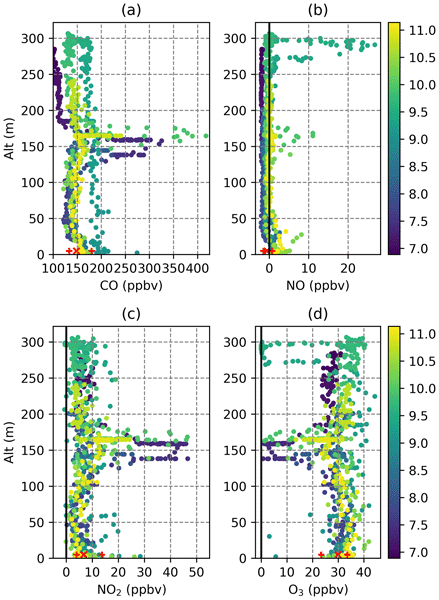
Brice Barret, Patrice Medina, Natalie Brett, Roman Pohorsky, Kathy S. Law, Slimane Bekki, Gilberto J. Fochesatto, Julia Schmale, Steve R. Arnold, Andrea Baccarini, Maurizio Busetto, Meeta Cesler-Maloney, Barbara D'Anna, Stefano Decesari, Jingqiu Mao, Gianluca Pappaccogli, Joel Savarino, Federico Scoto, and William R. Simpson
Atmos. Meas. Tech., 18, 1163–1184, https://doi.org/10.5194/amt-18-1163-2025, https://doi.org/10.5194/amt-18-1163-2025, 2025
Short summary
Short summary
The Fairbanks area experiences severe pollution episodes in winter because of enhanced emissions of pollutants trapped near the surface by strong temperature inversions. Low-cost sensors were deployed on board a car and a tethered balloon to measure the concentrations of gaseous pollutants (CO, O3, and NOx) in Fairbanks during winter 2022. Data calibration with reference measurements and machine learning methods enabled us to document pollution at the surface and power plant plumes aloft.
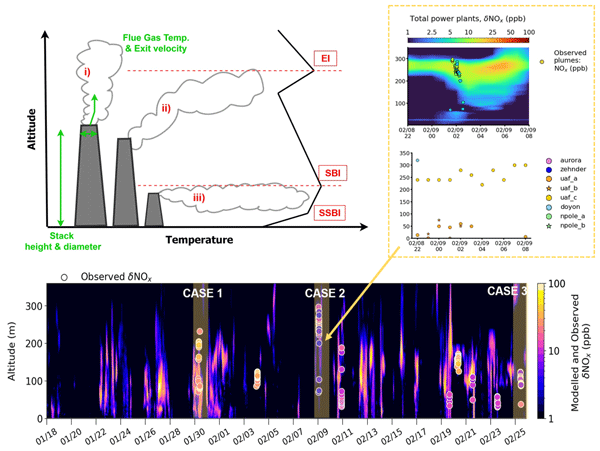
Natalie Brett, Kathy S. Law, Steve R. Arnold, Javier G. Fochesatto, Jean-Christophe Raut, Tatsuo Onishi, Robert Gilliam, Kathleen Fahey, Deanna Huff, George Pouliot, Brice Barret, Elsa Dieudonné, Roman Pohorsky, Julia Schmale, Andrea Baccarini, Slimane Bekki, Gianluca Pappaccogli, Federico Scoto, Stefano Decesari, Antonio Donateo, Meeta Cesler-Maloney, William Simpson, Patrice Medina, Barbara D'Anna, Brice Temime-Roussel, Joel Savarino, Sarah Albertin, Jingqiu Mao, Becky Alexander, Allison Moon, Peter F. DeCarlo, Vanessa Selimovic, Robert Yokelson, and Ellis S. Robinson
Atmos. Chem. Phys., 25, 1063–1104, https://doi.org/10.5194/acp-25-1063-2025, https://doi.org/10.5194/acp-25-1063-2025, 2025
Short summary
Short summary
Processes influencing dispersion of local anthropogenic pollution in Arctic wintertime are investigated with Lagrangian dispersion modelling. Simulated power plant plume rise that considers temperature inversion layers improves results compared to observations (interior Alaska). Modelled surface concentrations are improved by representation of vertical mixing and emission estimates. Large increases in diesel vehicle emissions at temperatures reaching −35°C are required to reproduce observed NOx.
Johanna Schäfer, Anja Beschnitt, François Burgay, Thomas Singer, Margit Schwikowski, and Thorsten Hoffmann
Atmos. Meas. Tech., 18, 421–430, https://doi.org/10.5194/amt-18-421-2025, https://doi.org/10.5194/amt-18-421-2025, 2025
Short summary
Short summary
Glaciers preserve organic compounds from atmospheric aerosols, which can serve as markers for emission sources. Most studies overlook the enantiomers of chiral compounds. We developed a two-dimensional liquid chromatography method to determine the chiral ratios of the monoterpene oxidation products cis-pinic acid and cis-pinonic acid in ice-core samples. Applied to samples from the Belukha Glacier (1870–1970 CE), the method revealed fluctuating chiral ratios for the analytes.
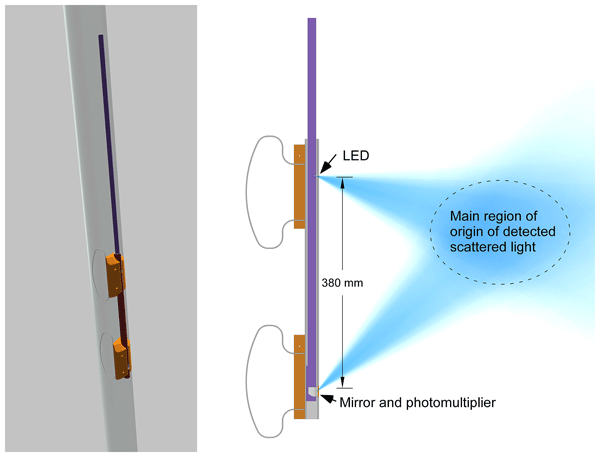
Jakob Schwander, Thomas F. Stocker, Remo Walther, Samuel Marending, Tobias Erhardt, Chantal Zeppenfeld, and Jürg Jost
The Cryosphere, 18, 5613–5617, https://doi.org/10.5194/tc-18-5613-2024, https://doi.org/10.5194/tc-18-5613-2024, 2024
Short summary
Short summary
The RADIX (Rapid Access Drilling and Ice eXtraction) optical dust logger is part of the exploratory 20 mm drilling system at the University of Bern and is inserted into the hole after drilling. Temperature and attitude sensors were successfully tested but not the dust sensor, as no RADIX hole reached the required bubble-free ice. In 2023, we tested the logger with an adapter for the deep borehole of the East Greenland Ice-core Project and obtained a good Late Glacial–Early Holocene dust record.
Luca Teruzzi, Andrea Spolaor, David Cappelletti, Claudio Artoni, and Marco A. C. Potenza
EGUsphere, https://doi.org/10.5194/egusphere-2024-2057, https://doi.org/10.5194/egusphere-2024-2057, 2024
Preprint archived
Short summary
Short summary
We present a novel probe to measure visible light penetration into the uppermost snow layers with high spatial resolution. The probe is designed to be lightweight and robust to be exploited in extreme environments, extrapolating to the UV region. Such experimental approach will allow to fill the gap in the current understanding of sunlight propagation through the snowpack, often based on numerical approaches, improving the understanding of those processes occurring in snow even in the UV region.
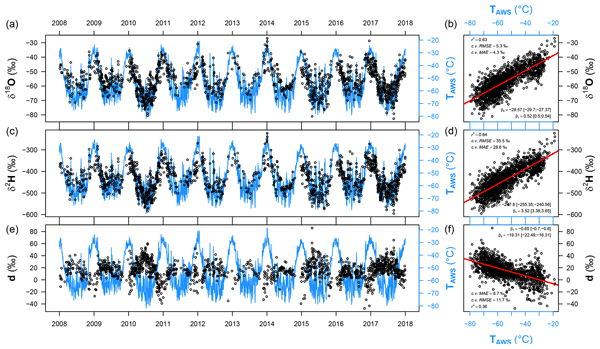
Giuliano Dreossi, Mauro Masiol, Barbara Stenni, Daniele Zannoni, Claudio Scarchilli, Virginia Ciardini, Mathieu Casado, Amaëlle Landais, Martin Werner, Alexandre Cauquoin, Giampietro Casasanta, Massimo Del Guasta, Vittoria Posocco, and Carlo Barbante
The Cryosphere, 18, 3911–3931, https://doi.org/10.5194/tc-18-3911-2024, https://doi.org/10.5194/tc-18-3911-2024, 2024
Short summary
Short summary
Oxygen and hydrogen stable isotopes have been extensively used to reconstruct past temperatures, with precipitation representing the input signal of the isotopic records in ice cores. We present a 10-year record of stable isotopes in daily precipitation at Concordia Station: this is the longest record for inland Antarctica and represents a benchmark for quantifying post-depositional processes and improving the paleoclimate interpretation of ice cores.
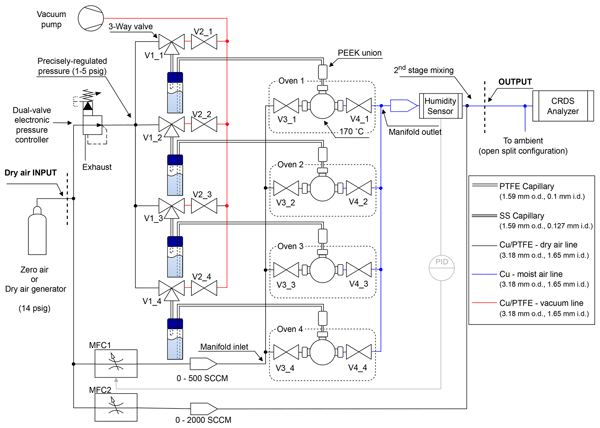
Hans Christian Steen-Larsen and Daniele Zannoni
Atmos. Meas. Tech., 17, 4391–4409, https://doi.org/10.5194/amt-17-4391-2024, https://doi.org/10.5194/amt-17-4391-2024, 2024
Short summary
Short summary
The water vapor generation module is completely scalable, allowing autonomous calibrations to use N standards and providing integration times only restricted by sample availability. We document improved reproducibility in 17O-excess liquid measurements. This module makes spectroscopy measurements comparable to mass spectrometry. We document that the vapor generation module can be used to analyze instrument performance and for vapor isotope calibration during field campaign measurements.
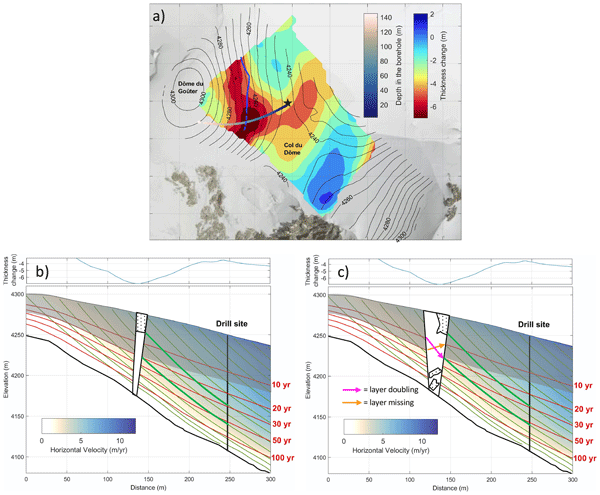
Susanne Preunkert, Pascal Bohleber, Michel Legrand, Adrien Gilbert, Tobias Erhardt, Roland Purtschert, Lars Zipf, Astrid Waldner, Joseph R. McConnell, and Hubertus Fischer
The Cryosphere, 18, 2177–2194, https://doi.org/10.5194/tc-18-2177-2024, https://doi.org/10.5194/tc-18-2177-2024, 2024
Short summary
Short summary
Ice cores from high-elevation Alpine glaciers are an important tool to reconstruct the past atmosphere. However, since crevasses are common at these glacier sites, rigorous investigations of glaciological conditions upstream of drill sites are needed before interpreting such ice cores. On the basis of three ice cores extracted at Col du Dôme (4250 m a.s.l; French Alps), an overall picture of a dynamic crevasse formation is drawn, which disturbs the depth–age relation of two of the three cores.
Tessa R. Vance, Nerilie J. Abram, Alison S. Criscitiello, Camilla K. Crockart, Aylin DeCampo, Vincent Favier, Vasileios Gkinis, Margaret Harlan, Sarah L. Jackson, Helle A. Kjær, Chelsea A. Long, Meredith K. Nation, Christopher T. Plummer, Delia Segato, Andrea Spolaor, and Paul T. Vallelonga
Clim. Past, 20, 969–990, https://doi.org/10.5194/cp-20-969-2024, https://doi.org/10.5194/cp-20-969-2024, 2024
Short summary
Short summary
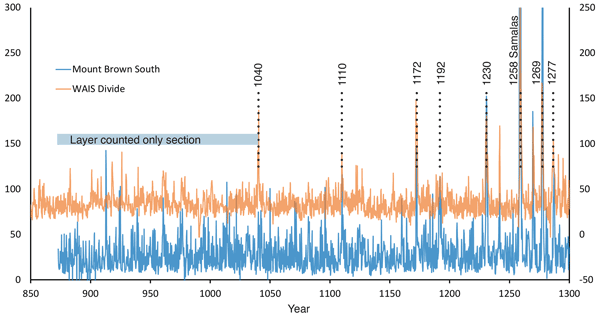
This study presents the chronologies from the new Mount Brown South ice cores from East Antarctica, which were developed by counting annual layers in the ice core data and aligning these to volcanic sulfate signatures. The uncertainty in the dating is quantified, and we discuss initial results from seasonal cycle analysis and mean annual concentrations. The chronologies will underpin the development of new proxy records for East Antarctica spanning the past millennium.
Andrea Spolaor, Federico Scoto, Catherine Larose, Elena Barbaro, Francois Burgay, Mats P. Bjorkman, David Cappelletti, Federico Dallo, Fabrizio de Blasi, Dmitry Divine, Giuliano Dreossi, Jacopo Gabrieli, Elisabeth Isaksson, Jack Kohler, Tonu Martma, Louise S. Schmidt, Thomas V. Schuler, Barbara Stenni, Clara Turetta, Bartłomiej Luks, Mathieu Casado, and Jean-Charles Gallet
The Cryosphere, 18, 307–320, https://doi.org/10.5194/tc-18-307-2024, https://doi.org/10.5194/tc-18-307-2024, 2024
Short summary
Short summary
We evaluate the impact of the increased snowmelt on the preservation of the oxygen isotope (δ18O) signal in firn records recovered from the top of the Holtedahlfonna ice field located in the Svalbard archipelago. Thanks to a multidisciplinary approach we demonstrate a progressive deterioration of the isotope signal in the firn core. We link the degradation of the δ18O signal to the increased occurrence and intensity of melt events associated with the rapid warming occurring in the archipelago.
Chiara I. Paleari, Florian Mekhaldi, Tobias Erhardt, Minjie Zheng, Marcus Christl, Florian Adolphi, Maria Hörhold, and Raimund Muscheler
Clim. Past, 19, 2409–2422, https://doi.org/10.5194/cp-19-2409-2023, https://doi.org/10.5194/cp-19-2409-2023, 2023
Short summary
Short summary
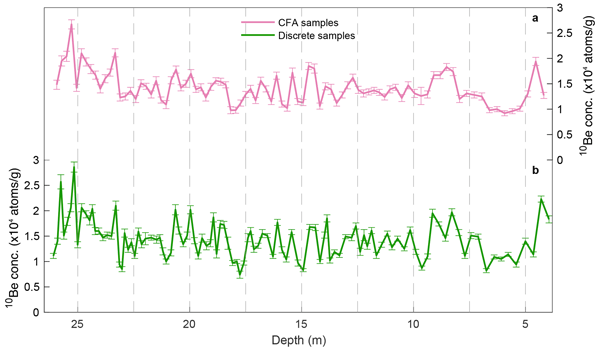
In this study, we test the use of excess meltwater from continuous flow analysis from a firn core from Greenland for the measurement of 10Be for solar activity reconstructions. We show that the quality of results is similar to the measurements on clean firn, which opens the possibility to obtain continuous 10Be records without requiring large amounts of clean ice. Furthermore, we investigate the possibility of identifying solar storm signals in 10Be records from Greenland and Antarctica.
Tobias Erhardt, Camilla Marie Jensen, Florian Adolphi, Helle Astrid Kjær, Remi Dallmayr, Birthe Twarloh, Melanie Behrens, Motohiro Hirabayashi, Kaori Fukuda, Jun Ogata, François Burgay, Federico Scoto, Ilaria Crotti, Azzurra Spagnesi, Niccoló Maffezzoli, Delia Segato, Chiara Paleari, Florian Mekhaldi, Raimund Muscheler, Sophie Darfeuil, and Hubertus Fischer
Earth Syst. Sci. Data, 15, 5079–5091, https://doi.org/10.5194/essd-15-5079-2023, https://doi.org/10.5194/essd-15-5079-2023, 2023
Short summary
Short summary
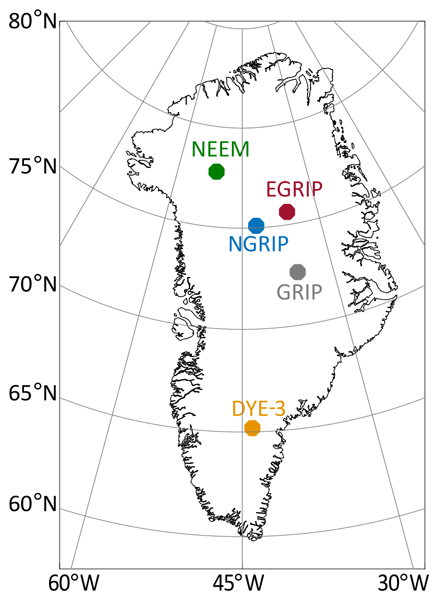
The presented paper provides a 3.8 kyr long dataset of aerosol concentrations from the East Greenland Ice coring Project (EGRIP) ice core. The data consists of 1 mm depth-resolution profiles of calcium, sodium, ammonium, nitrate, and electrolytic conductivity as well as decadal averages of these profiles. Alongside the data a detailed description of the measurement setup as well as a discussion of the uncertainties are given.
Sune Olander Rasmussen, Dorthe Dahl-Jensen, Hubertus Fischer, Katrin Fuhrer, Steffen Bo Hansen, Margareta Hansson, Christine S. Hvidberg, Ulf Jonsell, Sepp Kipfstuhl, Urs Ruth, Jakob Schwander, Marie-Louise Siggaard-Andersen, Giulia Sinnl, Jørgen Peder Steffensen, Anders M. Svensson, and Bo M. Vinther
Earth Syst. Sci. Data, 15, 3351–3364, https://doi.org/10.5194/essd-15-3351-2023, https://doi.org/10.5194/essd-15-3351-2023, 2023
Short summary
Short summary
Timescales are essential for interpreting palaeoclimate data. The data series presented here were used for annual-layer identification when constructing the timescales named the Greenland Ice-Core Chronology 2005 (GICC05) and the revised version GICC21. Hopefully, these high-resolution data sets will be useful also for other purposes.
Azzurra Spagnesi, Pascal Bohleber, Elena Barbaro, Matteo Feltracco, Fabrizio De Blasi, Giuliano Dreossi, Martin Stocker-Waldhuber, Daniela Festi, Jacopo Gabrieli, Andrea Gambaro, Andrea Fischer, and Carlo Barbante
EGUsphere, https://doi.org/10.5194/egusphere-2023-1625, https://doi.org/10.5194/egusphere-2023-1625, 2023
Preprint archived
Short summary
Short summary
We present new data from a 10 m ice core drilled in 2019 and a 8.4 m parallel ice core drilled in 2021 at the summit of Weißseespitze glacier. In a new combination of proxies, we discuss profiles of stable water isotopes, major ion chemistry as well as a full profile of microcharcoal and levoglucosan. We find that the chemical and isotopic signals are preserved, despite the ongoing surface mass loss. This is not be to expected considering what has been found at other glaciers at similar locations.
Michaela Mühl, Jochen Schmitt, Barbara Seth, James E. Lee, Jon S. Edwards, Edward J. Brook, Thomas Blunier, and Hubertus Fischer
Clim. Past, 19, 999–1025, https://doi.org/10.5194/cp-19-999-2023, https://doi.org/10.5194/cp-19-999-2023, 2023
Short summary
Short summary
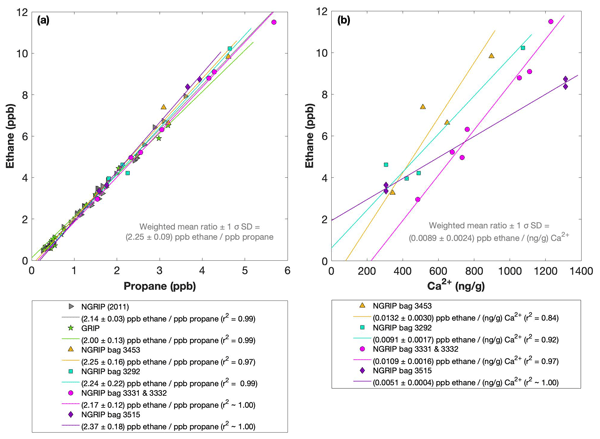
Our ice core measurements show that methane, ethane, and propane concentrations are significantly elevated above their past atmospheric background for Greenland ice samples containing mineral dust. The underlying co-production process happens during the classical discrete wet extraction of air from the ice sample and affects previous reconstructions of the inter-polar difference of methane as well as methane stable isotope records derived from dust-rich Greenland ice.
Nicolas Stoll, Julien Westhoff, Pascal Bohleber, Anders Svensson, Dorthe Dahl-Jensen, Carlo Barbante, and Ilka Weikusat
The Cryosphere, 17, 2021–2043, https://doi.org/10.5194/tc-17-2021-2023, https://doi.org/10.5194/tc-17-2021-2023, 2023
Short summary
Short summary
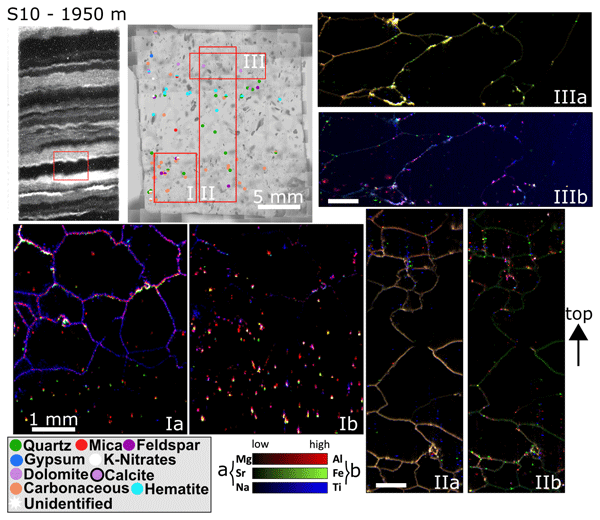
Impurities in polar ice play a role regarding its climate signal and internal deformation. We bridge different scales using different methods to investigate ice from the Last Glacial Period derived from the EGRIP ice core in Greenland. We characterise different types of cloudy bands, i.e. frequently occurring milky layers in the ice, and analyse their chemistry with Raman spectroscopy and 2D imaging. We derive new insights into impurity localisation and deposition conditions.
Robert Mulvaney, Eric W. Wolff, Mackenzie M. Grieman, Helene H. Hoffmann, Jack D. Humby, Christoph Nehrbass-Ahles, Rachael H. Rhodes, Isobel F. Rowell, Frédéric Parrenin, Loïc Schmidely, Hubertus Fischer, Thomas F. Stocker, Marcus Christl, Raimund Muscheler, Amaelle Landais, and Frédéric Prié
Clim. Past, 19, 851–864, https://doi.org/10.5194/cp-19-851-2023, https://doi.org/10.5194/cp-19-851-2023, 2023
Short summary
Short summary
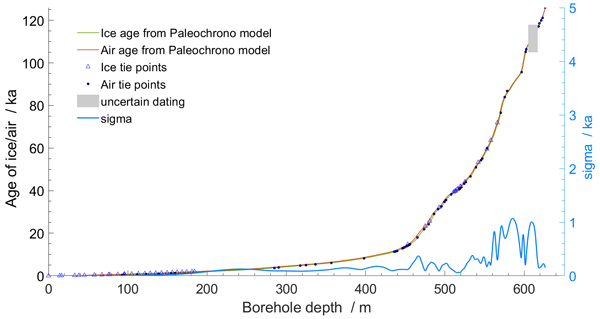
We present an age scale for a new ice core drilled at Skytrain Ice Rise, an ice rise facing the Ronne Ice Shelf in Antarctica. Various measurements in the ice and air phases are used to match the ice core to other Antarctic cores that have already been dated, and a new age scale is constructed. The 651 m ice core includes ice that is confidently dated to 117 000–126 000 years ago, in the last interglacial. Older ice is found deeper down, but there are flow disturbances in the deeper ice.
Simone Ventisette, Samuele Baldini, Claudio Artoni, Silvia Becagli, Laura Caiazzo, Barbara Delmonte, Massimo Frezzotti, Raffaello Nardin, Joel Savarino, Mirko Severi, Andrea Spolaor, Barbara Stenni, and Rita Traversi
EGUsphere, https://doi.org/10.5194/egusphere-2023-393, https://doi.org/10.5194/egusphere-2023-393, 2023
Preprint archived
Short summary
Short summary
The paper reports the spatial variability of concentration and fluxes of chemical impurities in superficial snow over unexplored area of the East Antarctic ice sheet. Pinatubo and Puyehue-Cordón Caulle volcanic eruptions in non-sea salt sulfate and dust snow pits record were used to achieve the accumulation rates. Deposition (wet, dry and uptake from snow surface) and post deposition processes are constrained. These knowledges are fundamental in Antarctic ice cores stratigraphies interpretation.
Niccolò Maffezzoli, Eliza Cook, Willem G. M. van der Bilt, Eivind N. Støren, Daniela Festi, Florian Muthreich, Alistair W. R. Seddon, François Burgay, Giovanni Baccolo, Amalie R. F. Mygind, Troels Petersen, Andrea Spolaor, Sebastiano Vascon, Marcello Pelillo, Patrizia Ferretti, Rafael S. dos Reis, Jefferson C. Simões, Yuval Ronen, Barbara Delmonte, Marco Viccaro, Jørgen Peder Steffensen, Dorthe Dahl-Jensen, Kerim H. Nisancioglu, and Carlo Barbante
The Cryosphere, 17, 539–565, https://doi.org/10.5194/tc-17-539-2023, https://doi.org/10.5194/tc-17-539-2023, 2023
Short summary
Short summary
Multiple lines of research in ice core science are limited by manually intensive and time-consuming optical microscopy investigations for the detection of insoluble particles, from pollen grains to volcanic shards. To help overcome these limitations and support researchers, we present a novel methodology for the identification and autonomous classification of ice core insoluble particles based on flow image microscopy and neural networks.
François Burgay, Rafael Pedro Fernández, Delia Segato, Clara Turetta, Christopher S. Blaszczak-Boxe, Rachael H. Rhodes, Claudio Scarchilli, Virginia Ciardini, Carlo Barbante, Alfonso Saiz-Lopez, and Andrea Spolaor
The Cryosphere, 17, 391–405, https://doi.org/10.5194/tc-17-391-2023, https://doi.org/10.5194/tc-17-391-2023, 2023
Short summary
Short summary
The paper presents the first ice-core record of bromine (Br) in the Antarctic plateau. By the observation of the ice core and the application of atmospheric chemical models, we investigate the behaviour of bromine after its deposition into the snowpack, with interest in the effect of UV radiation change connected to the formation of the ozone hole, the role of volcanic deposition, and the possible use of Br to reconstruct past sea ice changes from ice core collect in the inner Antarctic plateau.
Lars Mächler, Daniel Baggenstos, Florian Krauss, Jochen Schmitt, Bernhard Bereiter, Remo Walther, Christoph Reinhard, Béla Tuzson, Lukas Emmenegger, and Hubertus Fischer
Atmos. Meas. Tech., 16, 355–372, https://doi.org/10.5194/amt-16-355-2023, https://doi.org/10.5194/amt-16-355-2023, 2023
Short summary
Short summary
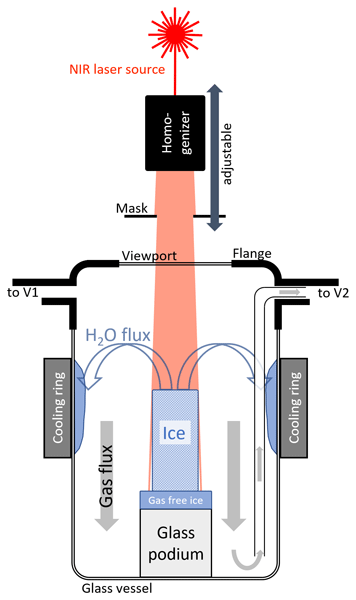
We present a new method to extract the gases from ice cores and measure their greenhouse gas composition. The ice is sublimated continuously with a near-infrared laser, releasing the gases, which are then analyzed on a laser absorption spectrometer. The main advantage over previous efforts is a low effective resolution of 1–2 cm. This capability is crucial for the analysis of highly thinned ice, as expected from ongoing drilling efforts to extend ice core history further back in time.
Helle Astrid Kjær, Patrick Zens, Samuel Black, Kasper Holst Lund, Anders Svensson, and Paul Vallelonga
Clim. Past, 18, 2211–2230, https://doi.org/10.5194/cp-18-2211-2022, https://doi.org/10.5194/cp-18-2211-2022, 2022
Short summary
Short summary
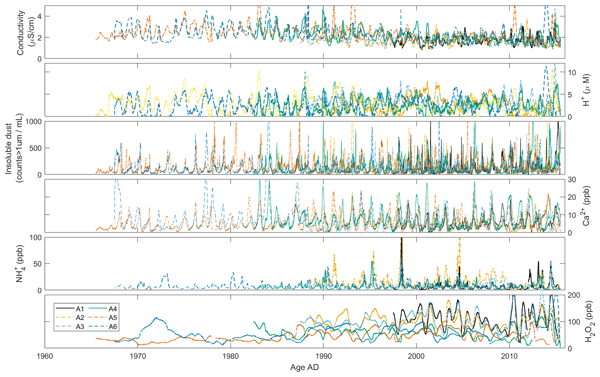
Six shallow cores from northern Greenland spanning a distance of 426 km were retrieved during a traversal in 2015. We identify several recent acid horizons associated with Icelandic eruptions and eruptions in the Barents Sea region and obtain a robust forest fire proxy associated primarily with Canadian forest fires. We also observe an increase in the large dust particle fluxes that we attribute to an activation of Greenland local sources in recent years (1998–2015).
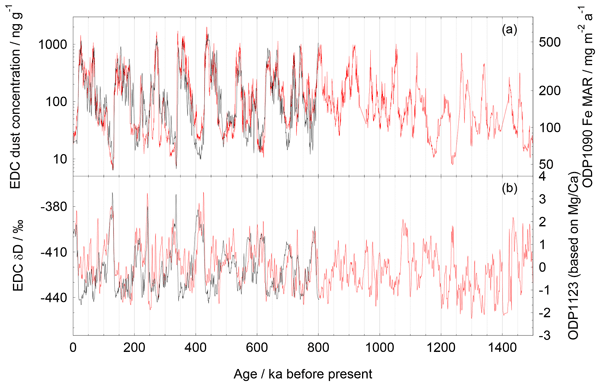
Eric W. Wolff, Hubertus Fischer, Tas van Ommen, and David A. Hodell
Clim. Past, 18, 1563–1577, https://doi.org/10.5194/cp-18-1563-2022, https://doi.org/10.5194/cp-18-1563-2022, 2022
Short summary
Short summary
Projects are underway to drill ice cores in Antarctica reaching 1.5 Myr back in time. Dating such cores will be challenging. One method is to match records from the new core against datasets from existing marine sediment cores. Here we explore the options for doing this and assess how well the ice and marine records match over the existing 800 000-year time period. We are able to recommend a strategy for using marine data to place an age scale on the new ice cores.
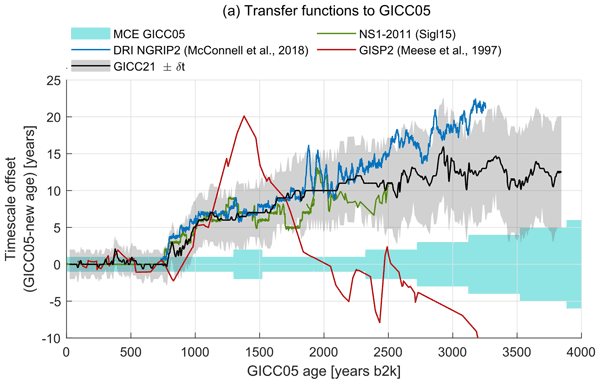
Giulia Sinnl, Mai Winstrup, Tobias Erhardt, Eliza Cook, Camilla Marie Jensen, Anders Svensson, Bo Møllesøe Vinther, Raimund Muscheler, and Sune Olander Rasmussen
Clim. Past, 18, 1125–1150, https://doi.org/10.5194/cp-18-1125-2022, https://doi.org/10.5194/cp-18-1125-2022, 2022
Short summary
Short summary
A new Greenland ice-core timescale, covering the last 3800 years, was produced using the machine learning algorithm StratiCounter. We synchronized the ice cores using volcanic eruptions and wildfires. We compared the new timescale to the tree-ring timescale, finding good alignment both between the common signatures of volcanic eruptions and of solar activity. Our Greenlandic timescales is safe to use for the Late Holocene, provided one uses our uncertainty estimate.
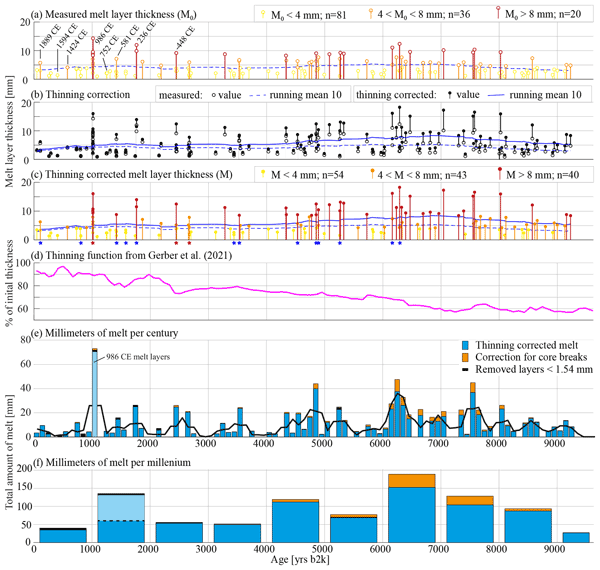
Julien Westhoff, Giulia Sinnl, Anders Svensson, Johannes Freitag, Helle Astrid Kjær, Paul Vallelonga, Bo Vinther, Sepp Kipfstuhl, Dorthe Dahl-Jensen, and Ilka Weikusat
Clim. Past, 18, 1011–1034, https://doi.org/10.5194/cp-18-1011-2022, https://doi.org/10.5194/cp-18-1011-2022, 2022
Short summary
Short summary
We present a melt event record from an ice core from central Greenland, which covers the past 10 000 years. Our record displays warm summer events, which can be used to enhance our understanding of the past climate. We compare our data to anomalies in tree ring width, which also represents summer temperatures, and find a good correlation. Furthermore, we investigate an outstandingly warm event in the year 986 AD or 991 AD, which has not been analyzed before.
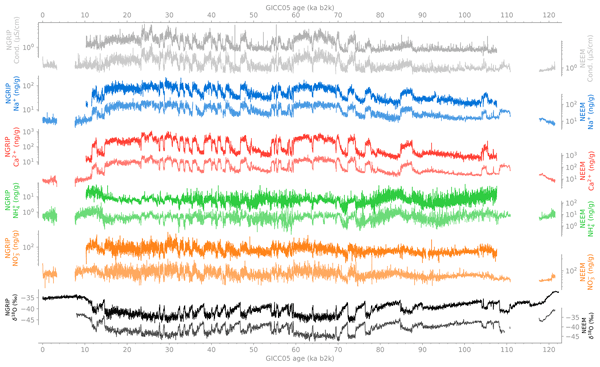
Tobias Erhardt, Matthias Bigler, Urs Federer, Gideon Gfeller, Daiana Leuenberger, Olivia Stowasser, Regine Röthlisberger, Simon Schüpbach, Urs Ruth, Birthe Twarloh, Anna Wegner, Kumiko Goto-Azuma, Takayuki Kuramoto, Helle A. Kjær, Paul T. Vallelonga, Marie-Louise Siggaard-Andersen, Margareta E. Hansson, Ailsa K. Benton, Louise G. Fleet, Rob Mulvaney, Elizabeth R. Thomas, Nerilie Abram, Thomas F. Stocker, and Hubertus Fischer
Earth Syst. Sci. Data, 14, 1215–1231, https://doi.org/10.5194/essd-14-1215-2022, https://doi.org/10.5194/essd-14-1215-2022, 2022
Short summary
Short summary
The datasets presented alongside this manuscript contain high-resolution concentration measurements of chemical impurities in deep ice cores, NGRIP and NEEM, from the Greenland ice sheet. The impurities originate from the deposition of aerosols to the surface of the ice sheet and are influenced by source, transport and deposition processes. Together, these records contain detailed, multi-parameter records of past climate variability over the last glacial period.
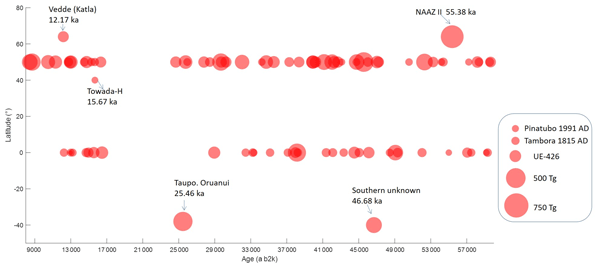
Jiamei Lin, Anders Svensson, Christine S. Hvidberg, Johannes Lohmann, Steffen Kristiansen, Dorthe Dahl-Jensen, Jørgen Peder Steffensen, Sune Olander Rasmussen, Eliza Cook, Helle Astrid Kjær, Bo M. Vinther, Hubertus Fischer, Thomas Stocker, Michael Sigl, Matthias Bigler, Mirko Severi, Rita Traversi, and Robert Mulvaney
Clim. Past, 18, 485–506, https://doi.org/10.5194/cp-18-485-2022, https://doi.org/10.5194/cp-18-485-2022, 2022
Short summary
Short summary
We employ acidity records from Greenland and Antarctic ice cores to estimate the emission strength, frequency and climatic forcing for large volcanic eruptions from the last half of the last glacial period. A total of 25 volcanic eruptions are found to be larger than any eruption in the last 2500 years, and we identify more eruptions than obtained from geological evidence. Towards the end of the glacial period, there is a notable increase in volcanic activity observed for Greenland.
Paolo Gabrielli, Theo Manuel Jenk, Michele Bertó, Giuliano Dreossi, Daniela Festi, Werner Kofler, Mai Winstrup, Klaus Oeggl, Margit Schwikowski, Barbara Stenni, and Carlo Barbante
Clim. Past Discuss., https://doi.org/10.5194/cp-2022-20, https://doi.org/10.5194/cp-2022-20, 2022
Revised manuscript not accepted
Short summary
Short summary
We present a methodology that reduces the chronological uncertainty of an Alpine ice core record from the glacier Alto dell’Ortles, Italy. This chronology will allow the constraint of the Holocene climatic and environmental histories emerging from this archive of Central Europe. This method will allow to obtain accurate chronologies also from other ice cores from-low latitude/high-altitude glaciers that typically suffer from larger dating uncertainties compared with well dated polar records.
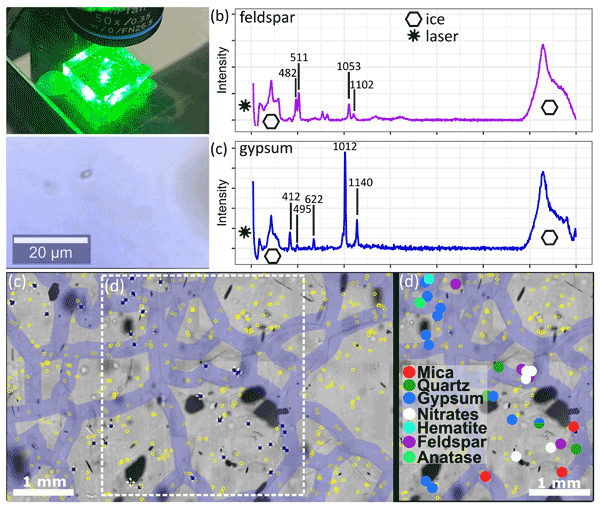
Nicolas Stoll, Maria Hörhold, Tobias Erhardt, Jan Eichler, Camilla Jensen, and Ilka Weikusat
The Cryosphere, 16, 667–688, https://doi.org/10.5194/tc-16-667-2022, https://doi.org/10.5194/tc-16-667-2022, 2022
Short summary
Short summary
We mapped and analysed solid inclusion in the upper 1340 m of the EGRIP ice core with Raman spectroscopy and microstructure mapping, based on bulk dust content derived via continuous flow analysis. We observe a large variety in mineralogy throughout the core and samples. The main minerals are sulfates, especially gypsum, and terrestrial dust minerals, such as quartz, mica, and feldspar. A change in mineralogy occurs around 900 m depth indicating a climate-related imprint.
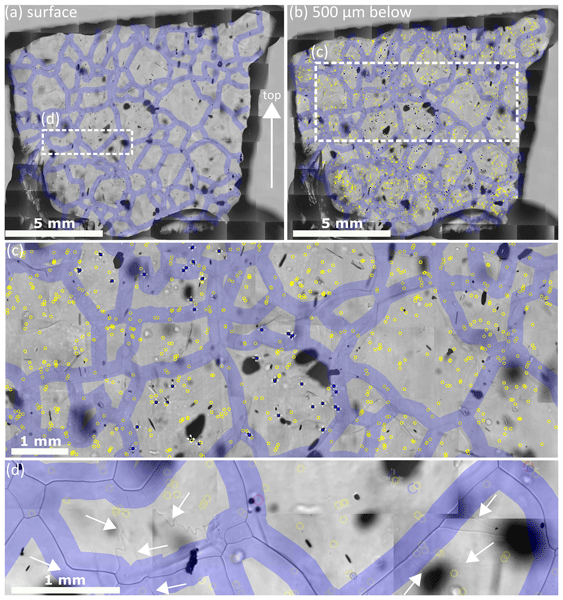
Nicolas Stoll, Jan Eichler, Maria Hörhold, Tobias Erhardt, Camilla Jensen, and Ilka Weikusat
The Cryosphere, 15, 5717–5737, https://doi.org/10.5194/tc-15-5717-2021, https://doi.org/10.5194/tc-15-5717-2021, 2021
Short summary
Short summary
We did a systematic analysis of the location of inclusions in the EGRIP ice core, the first ice core from an ice stream. We combine this with crystal orientation and grain size data, enabling the first overview about the microstructure of this unique ice core. Micro-inclusions show a strong spatial variability and patterns (clusters or horizontal layers); roughly one-third is located at grain boundaries. More holistic approaches are needed to understand deformation processes in the ice better.
Raffaello Nardin, Mirko Severi, Alessandra Amore, Silvia Becagli, Francois Burgay, Laura Caiazzo, Virginia Ciardini, Giuliano Dreossi, Massimo Frezzotti, Sang-Bum Hong, Ishaq Khan, Bianca Maria Narcisi, Marco Proposito, Claudio Scarchilli, Enricomaria Selmo, Andrea Spolaor, Barbara Stenni, and Rita Traversi
Clim. Past, 17, 2073–2089, https://doi.org/10.5194/cp-17-2073-2021, https://doi.org/10.5194/cp-17-2073-2021, 2021
Short summary
Short summary
The first step to exploit all the potential information buried in ice cores is to produce a reliable age scale. Based on chemical and isotopic records from the 197 m Antarctic GV7(B) ice core, accurate dating was achieved and showed that the archive spans roughly the last 830 years. The relatively high accumulation rate allowed us to use the non-sea-salt sulfate seasonal pattern to count annual layers. The accumulation rate reconstruction exhibited a slight increase since the 18th century.
Cited articles
Achterberg, E. P., Holland, T. W., Bowie, A. R., Mantoura, R. F. C., and Worsfold, P. J.: Determination of iron in seawater, Anal. Chim. Acta., 442, 1–14, 2001.
Andersen, K. K., Ditlevsen, P., Rasmussen, S., Clausen, H., Vinther, B., Johnsen, S., and Steffensen, J.: Retrieving a common accumulation record from Greenland ice cores for the past 1800 years, J. Geophys. Res.: Atmos., 111, 2006.
Baccolo, G., Delmonte, B., Di Stefano, E., Cibin, G., Crotti, I., Frezzotti, M., Hampai, D., Iizuka, Y., Marcelli, A., and Maggi, V.: Deep ice as a geochemical reactor: insights from iron speciation and mineralogy of dust in the Talos Dome ice core (East Antarctica), The Cryosphere, 15, 4807–4822, https://doi.org/10.5194/tc-15-4807-2021, 2021a.
Baccolo, G., Delmonte, B., Niles, P. B., Cibin, G., Di Stefano, E., Hampai, D., Keller, L., Maggi, V., Marcelli, A., and Michalski, J.: Jarosite formation in deep Antarctic ice provides a window into acidic, water-limited weathering on Mars, Nat. Commun., 12, 436, https://doi.org/10.1038/s41467-020-20705-z, 2021b.
Baker, A. and Jickells, T.: Mineral particle size as a control on aerosol iron solubility, Geophys. Res. Lett., 33, https://doi.org/10.1029/2006GL026557, 2006.
Bauska, T. K., Baggenstos, D., Brook, E. J., Mix, A. C., Marcott, S. A., Petrenko, V. V., Schaefer, H., Severinghaus, J. P., and Lee, J. E.: Carbon isotopes characterize rapid changes in atmospheric carbon dioxide during the last deglaciation, Proc. Natl. Aca. Sci. USA, 113, 3465–3470, 2016.
Boetius, A., Anesio, A. M., Deming, J. W., Mikucki, J. A., and Rapp, J. Z.: Microbial ecology of the cryosphere: sea ice and glacial habitats, Nat. Rev. Microbiol., 13, 677–690, 2015.
Bory, A.-M., Biscaye, P. E., Svensson, A., and Grousset, F. E.: Seasonal variability in the origin of recent atmospheric mineral dust at NorthGRIP, Greenland, Earth Planet. Sci. Lett., 196, 123–134, 2002.
Boyd, P. W., Jickells, T., Law, C. S., Blain, S., Boyle, E. A., Buesseler, K. O., Coale, K. H., Cullen, J., De Baar, H. J., and Follows, M.: Mesoscale iron enrichment experiments 1993-2005: synthesis and future directions, Science, 315, 612–617, 2007.
Burgay, F., Erhardt, T., Lunga, D. D., Jensen, C. M., Spolaor, A., Vallelonga, P., Fischer, H., and Barbante, C.: Fe2+ in ice cores as a new potential proxy to detect past volcanic eruptions, Sci. Tot. Environ., 654, 1110–1117, https://doi.org/10.1016/j.scitotenv.2018.11.075, 2019.
Burgay, F., Spolaor, A., Gabrieli, J., Cozzi, G., Turetta, C., Vallelonga, P., and Barbante, C.: Atmospheric iron supply and marine productivity in the glacial North Pacific Ocean, Clim. Past, 17, 491–505, https://doi.org/10.5194/cp-17-491-2021, 2021a.
Burgay, F., Barbaro, E., Cappelletti, D., Turetta, C., Gallet, J.-C., Isaksson, E., Stenni, B., Dreossi, G., Scoto, F., and Barbante, C.: First discrete iron (II) records from Dome C (Antarctica) and the Holtedahlfonna glacier (Svalbard), Chemosphere, 267, 129335, https://doi.org/10.1016/j.chemosphere.2020.129335, 2021b.
Conway, T. M., Wolff, E. W., Röthlisberger, R., Mulvaney, R., and Elderfield, H.: Constraints on soluble aerosol iron flux to the Southern Ocean at the Last Glacial Maximum, Nat. Commun., 6, 7850, https://doi.org/10.1038/ncomms8850, 2015.
Davies, M., Mix, A., Stoner, J., Addison, J., Jaeger, J., Finney, B., and Wiest, J.: The deglacial transition on the southeastern Alaska Margin: Meltwater input, sea level rise, marine productivity, and sedimentary anoxia, Paleoceanography, 26, https://doi.org/10.1029/2010PA002051, 2011.
Delmas, R. J.: Ice records of the past environment, Sci. Tot. Environ., 143, 17–30, 1994.
Delmonte, B., Petit, J. R., and Maggi, V.: LGM–Holocene changes and Holocene millennial-scale oscillations of dust particles in the EPICA Dome C ice core, East Antarctica, Ann. Glaciol., 35, 306–312, 2002.
Du, Z., Xiao, C., Zhang, Q., Handley, M. J., Mayewski, P. A., and Li, C.: Relationship between the 2014–2015 Holuhraun eruption and the iron record in the East GRIP snow pit, Arct. Antarct. Alp. Res., 51, 290–298, 2019.
Duggen, S., Croot, P., Schacht, U., and Hoffmann, L.: Subduction zone volcanic ash can fertilize the surface ocean and stimulate phytoplankton growth: Evidence from biogeochemical experiments and satellite data, Geophys. Res. Lett., 34, https://doi.org/10.1029/2006GL027522, 2007.
Duggen, S., Olgun, N., Croot, P., Hoffmann, L., Dietze, H., Delmelle, P., and Teschner, C.: The role of airborne volcanic ash for the surface ocean biogeochemical iron-cycle: a review, Biogeosciences, 7, 827–844, https://doi.org/10.5194/bg-7-827-2010, 2010.
Edelson, R., Gelbord, J., Cackett, E., Connolly, S., Done, C., Fausnaugh, M., Gardner, E., Gehrels, N., Goad, M., and Horne, K.: Swift monitoring of NGC 4151: evidence for a second X-ray/UV reprocessing, ApJ, 840, 41, https://doi.org/10.3847/1538-4357/aa6890, 2017.
Edwards, R. and Sedwick, P.: Iron in East Antarctic snow: Implications for atmospheric iron deposition and algal production in Antarctic waters, Geophys. Res. Lett., 28, 3907–3910, 2001.
Edwards, R., Sedwick, P., Morgan, V., and Boutron, C.: Iron in ice cores from Law Dome: A record of atmospheric iron deposition for maritime East Antarctica during the Holocene and Last Glacial Maximum, Geochem. Geophys. Geosyst., 7, 12, 2006.
Erhardt, T., Jensen, C. M., Borovinskaya, O., and Fischer, H.: Single particle characterization and total elemental concentration measurements in polar ice using continuous flow analysis-inductively coupled plasma time-of-flight mass spectrometry, Environ. Sci. Technol., 53, 13275–13283, 2019.
Erhardt, T., Jensen, C. M., Adolphi, F., Kjær, H. A., Dallmayr, R., Twarloh, B., Behrens, M., Hirabayashi, M., Fukuda, K., Ogata, J., Burgay, F., Scoto, F., Crotti, I., Spagnesi, A., Maffezzoli, N., Segato, D., Paleari, C., Mekhaldi, F., Muscheler, R., Darfeuil, S., and Fischer, H.: High-resolution aerosol data from the top 3.8 kyr of the East Greenland Ice coring Project (EGRIP) ice core, Earth Syst. Sci. Data, 15, 5079–5091, https://doi.org/10.5194/essd-15-5079-2023, 2023.
Fischer, H., Burke, A., Rae, J., Sugden, P. J., Erhardt, T., Twarloh, B., Hörhold, M., Freitag, J., Markle, B., and Severi, M.: Limited decrease of Southern Ocean sulfur productivity across the penultimate termination, Nat. Geosci., 18, 160–166, 2025.
Francois, R., Altabet, M. A., Yu, E.-F., Sigman, D. M., Bacon, M. P., Frank, M., Bohrmann, G., Bareille, G., and Labeyrie, L. D.: Contribution of Southern Ocean surface-water stratification to low atmospheric CO2 concentrations during the last glacial period, Nature, 389, 929–935, 1997.
Frogner, P., Gíslason, S. R., and Óskarsson, N.: Fertilizing potential of volcanic ash in ocean surface water, Geology, 29, 487–490, 2001.
Gaskell, C. M. and Sparke, L. S.: Line variations in quasars and Seyfert galaxies, Astrophysical Journal, Part 1 (ISSN 0004-637X), Research supported by McDonald Observatory and SERC., 305, 175–186, https://doi.org/10.1086/164238, 1986.
Gaspari, V., Barbante, C., Cozzi, G., Cescon, P., Boutron, C., Gabrielli, P., Capodaglio, G., Ferrari, C., Petit, J., and Delmonte, B.: Atmospheric iron fluxes over the last deglaciation: Climatic implications, Geophys. Res. Lett., 33, 3, https://doi.org/10.1029/2005GL024352, 2006.
Gerber, T. A., Hvidberg, C. S., Rasmussen, S. O., Franke, S., Sinnl, G., Grinsted, A., Jansen, D., and Dahl-Jensen, D.: Upstream flow effects revealed in the EastGRIP ice core using Monte Carlo inversion of a two-dimensional ice-flow model, The Cryosphere, 15, 3655–3679, https://doi.org/10.5194/tc-15-3655-2021, 2021.
Hammer, C. and Langway Jr., C.: Electrical conductivity method (ECM) stratigraphic dating of the Byrd Station ice core, Antarctica, Ann. Glaciol., 20, 115–120, 1994.
Hammer, C. U.: Acidity of polar ice cores in relation to absolute dating, past volcanism, and radio–echoes, J. Glaciol., 25, 359–372, 1980.
Han, C., Do Hur, S., Han, Y., Lee, K., Hong, S., Erhardt, T., Fischer, H., Svensson, A. M., Steffensen, J. P., and Vallelonga, P.: High-resolution isotopic evidence for a potential Saharan provenance of Greenland glacial dust, Sci. Rep., 8, 1–9, 2018.
Hiscock, W. T., Fischer, H., Bigler, M., Gfeller, G., Leuenberger, D., and Mini, O.: Continuous flow analysis of labile iron in ice-cores, Environ. Sci. Technol., 47, 4416–4425, 2013.
Hoshyaripour, G., Hort, M., Langmann, B., and Delmelle, P.: Volcanic controls on ash iron solubility: New insights from high-temperature gas–ash interaction modeling, J. Volcanol. Geotherm. Res., 286, 67–77, 2014.
Hvidberg, C. S., Grinsted, A., Dahl-Jensen, D., Khan, S. A., Kusk, A., Andersen, J. K., Neckel, N., Solgaard, A., Karlsson, N. B., and Kjær, H. A.: Surface velocity of the Northeast Greenland Ice Stream (NEGIS): assessment of interior velocities derived from satellite data by GPS, The Cryosphere, 14, 3487–3502, https://doi.org/10.5194/tc-14-3487-2020, 2020.
Jaccard, S. L., Hayes, C. T., Martinez-Garcia, A., Hodell, D. A., Anderson, R. F., Sigman, D. M., and Haug, G.: Two modes of change in Southern Ocean productivity over the past million years, Science, 339, 1419–1423, 2013.
Jansen, D., Franke, S., Bauer, C. C., Binder, T., Dahl-Jensen, D., Eichler, J., Eisen, O., Hu, Y., Kerch, J., and Llorens, M.-G.: Shear margins in upper half of Northeast Greenland Ice Stream were established two millennia ago, Nat. Commun., 15, 1193, https://doi.org/10.1038/s41467-024-45021-8, 2024.
Jung, J., Yoo, K.-C., Rosenheim, B. E., Conway, T. M., Lee, J. I., Yoon, H. I., Hwang, C. Y., Yang, K., Subt, C., and Kim, J.: Microbial Fe (III) reduction as a potential iron source from Holocene sediments beneath Larsen Ice Shelf, Nat. Commun., 10, 5786, https://doi.org/10.1038/s41467-019-13741-x, 2019.
Kanna, N., Lannuzel, D., van der Merwe, P., and Nishioka, J.: Size fractionation and bioavailability of iron released from melting sea ice in a subpolar marginal sea, Mar. Chem., 221, 103774, 2020.
Kaufmann, P. R., Federer, U., Hutterli, M. A., Bigler, M., Schüpbach, S., Ruth, U., Schmitt, J., and Stocker, T. F.: An improved continuous flow analysis system for high-resolution field measurements on ice cores, Environmental science & technology, 42, 8044–8050, 2008.
Kienast, S. S., Hendy, I. L., Crusius, J., Pedersen, T. F., and Calvert, S. E.: Export production in the subarctic North Pacific over the last 800 kyrs: No evidence for iron fertilization?, J. Oceanogr., 60, 189–203, 2004.
Kjær, H. A., Vallelonga, P., Svensson, A., Kristensen, M. E. L., Tibuleac, C., and Bigler, M.: Continuous flow analysis method for determination of dissolved reactive phosphorus in ice cores, Environ. Sci. Technol., 47, 12325–12332, 2013.
Kjær, H. A., Vallelonga, P., Svensson, A., Elleskov, L., Kristensen, M., Tibuleac, C., Winstrup, M., and Kipfstuhl, S.: An optical dye method for continuous determination of acidity in ice cores, Environ. Sci. Technol., 50, 10485–10493, 2016.
Kohfeld, K. E. and Chase, Z.: Temporal evolution of mechanisms controlling ocean carbon uptake during the last glacial cycle, Earth Planet. Sci. Lett., 472, 206–215, 2017.
Lambert, F., Tagliabue, A., Shaffer, G., Lamy, F., Winckler, G., Farias, L., Gallardo, L., and De Pol‐Holz, R.: Dust fluxes and iron fertilization in Holocene and Last Glacial Maximum climates, Geophys. Res. Lett., 42, 6014–6023, 2015.
Lambert, F., Opazo, N., Ridgwell, A., Winckler, G., Lamy, F., Shaffer, G., Kohfeld, K., Ohgaito, R., Albani, S., and Abe-Ouchi, A.: Regional patterns and temporal evolution of ocean iron fertilization and CO2 drawdown during the last glacial termination, Earth Planet. Sci. Lett., 554, 116675, https://doi.org/10.1016/j.epsl.2020.116675, 2021.
Langmann, B., Zakšek, K., Hort, M., and Duggen, S.: Volcanic ash as fertiliser for the surface ocean, Atmos. Chem. Phys., 10, 3891–3899, https://doi.org/10.5194/acp-10-3891-2010, 2010.
Lin, J., Svensson, A., Hvidberg, C. S., Lohmann, J., Kristiansen, S., Dahl-Jensen, D., Steffensen, J. P., Rasmussen, S. O., Cook, E., Kjær, H. A., Vinther, B. M., Fischer, H., Stocker, T., Sigl, M., Bigler, M., Severi, M., Traversi, R., and Mulvaney, R.: Magnitude, frequency and climate forcing of global volcanism during the last glacial period as seen in Greenland and Antarctic ice cores (60–9 ka), Clim. Past, 18, 485–506, https://doi.org/10.5194/cp-18-485-2022, 2022.
Lohan, M. C., Aguilar-Islas, A. M., and Bruland, K. W.: Direct determination of iron in acidified (pH 1.7) seawater samples by flow injection analysis with catalytic spectrophotometric detection: Application and intercomparison, Limnol. Oceanogr.: Methods, 4, 164–171, 2006.
Martin, J., Gordon, M., and Fitzwater, S.: Iron in Antarctic waters, Nature, 345, 156–158, 10.1038/345156a0, 1990.
Martin, J. H. and Fitzwater, S. E.: Iron deficiency limits phytoplankton growth in the north-east Pacific subarctic, Nature, 331, 341–343, 1988.
Martínez-García, A., Sigman, D. M., Ren, H., Anderson, R. F., Straub, M., Hodell, D. A., Jaccard, S. L., Eglinton, T. I., and Haug, G. H.: Iron fertilization of the Subantarctic Ocean during the last ice age, Science, 343, 1347–1350, 2014.
Matsui, H., Mahowald, N. M., Moteki, N., Hamilton, D. S., Ohata, S., Yoshida, A., Koike, M., Scanza, R. A., and Flanner, M. G.: Anthropogenic combustion iron as a complex climate forcer, Nat. Commun., 9, 1593, https://doi.org/10.1038/s41467-018-03997-0, 2018.
Mattin, A., Winton, H., Barker, S., and Hoffmann, L.: Volcanic ash impacts on marine primary productivity: a review, Bull. Volcanol. Soc. Jpn, 71, in press, 2026.
Méheust, M., Stein, R., Fahl, K., and Gersonde, R.: Sea-ice variability in the subarctic North Pacific and adjacent Bering Sea during the past 25 ka: new insights from IP25 and Uk′37 proxy records, arktos, 4, 8, https://doi.org/10.1007/s41063-018-0043-1, 2018.
Mills, M. M., Ridame, C., Davey, M., La Roche, J., and Geider, R. J.: Iron and phosphorus co-limit nitrogen fixation in the eastern tropical North Atlantic, Nature, 429, 292–294, 2004.
Mojtabavi, S., Wilhelms, F., Cook, E., Davies, S. M., Sinnl, G., Skov Jensen, M., Dahl-Jensen, D., Svensson, A., Vinther, B. M., Kipfstuhl, S., Jones, G., Karlsson, N. B., Faria, S. H., Gkinis, V., Kjær, H. A., Erhardt, T., Berben, S. M. P., Nisancioglu, K. H., Koldtoft, I., and Rasmussen, S. O.: A first chronology for the East Greenland Ice-core Project (EGRIP) over the Holocene and last glacial termination, Clim. Past, 16, 2359–2380, https://doi.org/10.5194/cp-16-2359-2020, 2020.
Olgun, N., Duggen, S., Croot, P. L., Delmelle, P., Dietze, H., Schacht, U., Oskarsson, N., Siebe, C., Auer, A., and Garbe-Schönberg, D.: Surface ocean iron fertilization: the role of subduction zone and hotspot volcanic ash and fluxes into the Pacific Ocean, Glob. Biogeochem. Cycles, 25, GB4001, https://doi.org/10.1029/2009GB003761, 2011.
Praetorius, S. K., Mix, A. C., Walczak, M., Wolhowe, M. D., Addison, J. A., and Prahl, F. G.: North Pacific deglacial hypoxic events linked to abrupt ocean warming, Nature, 527, 362–366, 2015.
R Core Team: R: A Language and Environment for Statistical Computing. R Foundation for Statistical Computing, Vienna, Austria: https://www.R-project.org/ (last access: 12 January 2026), 2025.
Ren, H., Studer, A. S., Serno, S., Sigman, D. M., Winckler, G., Anderson, R. F., Oleynik, S., Gersonde, R., and Haug, G. H.: Glacial‐to‐interglacial changes in nitrate supply and consumption in the subarctic North Pacific from microfossil‐bound N isotopes at two trophic levels, Paleoceanography, 30, 1217–1232, 2015.
Rogan, N., Achterberg, E. P., Le Moigne, F. A., Marsay, C. M., Tagliabue, A., and Williams, R. G.: Volcanic ash as an oceanic iron source and sink, Geophys. Res. Lett., 43, 2732–2740, 2016.
Ruth, U., Wagenbach, D., Steffensen, J. P., and Bigler, M.: Continuous record of microparticle concentration and size distribution in the central Greenland NGRIP ice core during the last glacial period, J. Geophys. Res.: Atmos., 108, https://doi.org/10.1029/2002JD002376, 2003.
Ruth, U., Barbante, C., Bigler, M., Delmonte, B., Fischer, H., Gabrielli, P., Gaspari, V., Kaufmann, P., Lambert, F., and Maggi, V.: Proxies and measurement techniques for mineral dust in Antarctic ice cores, Environ. Sci. Technol., 42, 5675–5681, 2008.
Saini, H., Meissner, K. J., Menviel, L., and Kvale, K.: Impact of iron fertilisation on atmospheric CO2 during the last glaciation, Clim. Past, 19, 1559–1584, https://doi.org/10.5194/cp-19-1559-2023, 2023.
Schmitt, J., Schneider, R., Elsig, J., Leuenberger, D., Lourantou, A., Chappellaz, J., Köhler, P., Joos, F., Stocker, T. F., and Leuenberger, M.: Carbon isotope constraints on the deglacial CO2 rise from ice cores, Science, 336, 711–714, 2012.
Schüpbach, S., Fischer, H., Bigler, M., Erhardt, T., Gfeller, G., Leuenberger, D., Mini, O., Mulvaney, R., Abram, N. J., and Fleet, L.: Greenland records of aerosol source and atmospheric lifetime changes from the Eemian to the Holocene, Nat. Commun., 9, 1–10, 2018.
Serno, S., Winckler, G., Anderson, R. F., Maier, E., Ren, H., Gersonde, R., and Haug, G. H.: Comparing dust flux records from the Subarctic North Pacific and Greenland: Implications for atmospheric transport to Greenland and for the application of dust as a chronostratigraphic tool, Paleoceanography, 30, 583–600, 2015.
Simonsen, M. F., Cremonesi, L., Baccolo, G., Bosch, S., Delmonte, B., Erhardt, T., Kjær, H. A., Potenza, M., Svensson, A., and Vallelonga, P.: Particle shape accounts for instrumental discrepancy in ice core dust size distributions, Clim. Past, 14, 601–608, https://doi.org/10.5194/cp-14-601-2018, 2018.
Spirakis, C. S.: Iron fertilization with volcanic ash?, Eos, Transactions American Geophysical Union, 72, 525–525, 1991.
Steffensen, J.: Analysis of the seasonal variation in dust, Cl−, NO
Stoll, H.: 30 years of the iron hypothesis of ice ages, Nature, 578, 370–371, https://doi.org/10.1038/d41586-020-00393-x, 2020.
Stoll, N., Eichler, J., Hörhold, M., Erhardt, T., Jensen, C., and Weikusat, I.: Microstructure, micro-inclusions, and mineralogy along the EGRIP ice core – Part 1: Localisation of inclusions and deformation patterns, The Cryosphere, 15, 5717–5737, https://doi.org/10.5194/tc-15-5717-2021, 2021.
Taylor, K., Hammer, C., Alley, R., Clausen, H., Dahl-Jensen, D., Gow, A., Gundestrup, N., Kipfstuh, J., Moore, J., and Waddington, E.: Electrical conductivity measurements from the GISP2 and GRIP Greenland ice cores, Nature, 366, 549–552, 1993.
Traversi, R., Barbante, C., Gaspari, V., Fattori, I., Largiuni, O., Magaldi, L., and Udisti, R.: Aluminium and iron record for the last 28 kyr derived from the Antarctic EDC96 ice core using new CFA methods, Ann. Glaciol., 39, 300–306, 2004.
Udisti, R., Becagli, S., Castellano, E., Delmonte, B., Jouzel, J., Petit, J., Schwander, J., Stenni, B., and Wolff, E.: Stratigraphic correlations between the European Project for Ice Coring in Antarctica (EPICA) Dome C and Vostok ice cores showing the relative variations of snow accumulation over the past 45 kyr, J. Geophys. Res.: Atmos., 109, https://doi.org/10.1029/2003JD004180, 2004.
Újvári, G., Klötzli, U., Stevens, T., Svensson, A., Ludwig, P., Vennemann, T., Gier, S., Horschinegg, M., Palcsu, L., and Hippler, D.: Greenland ice core record of last glacial dust sources and atmospheric circulation, J. Geophys. Res.: Atmos., 127, e2022JD036597, https://doi.org/10.1029/2022JD036597, 2022.
Vallelonga, P., Barbante, C., Cozzi, G., Gabrieli, J., Schüpbach, S., Spolaor, A., and Turetta, C.: Iron fluxes to Talos Dome, Antarctica, over the past 200 kyr, Clim. Past, 9, 597–604, https://doi.org/10.5194/cp-9-597-2013, 2013.
Vaughn, B., Morris, V., Jones, T., Brashear, C., Skorski, W., Hughes, A., and White, J.: EGRIP water isotope data 21.5 m (meters) to 2120.7 m depth at 10 cm resolution, from continuous flow analysis (CFA), Arctic Data Center, https://doi.org/10.18739/A25D8NG5F, 2022.
Visser, F., Gerringa, L., Van der Gaast, S., De Baar, H., and Timmermans, K.: The role of the reactivity and content of iron of aerosol dust on growth rates of two Antarctic diatom species 1, J. Phycol., 39, 1085–1094, 2003.
Watson, A. J.: Volcanic iron, CO2, ocean productivity and climate, Nature, 385, 587–588, 1997.
Weber, M. E., Bailey, I., Hemming, S. R., Martos, Y. M., Reilly, B. T., Ronge, T. A., Brachfeld, S., Williams, T., Raymo, M., and Belt, S. T.: Antiphased dust deposition and productivity in the Antarctic Zone over 1.5 million years, Nat. Commun., 13, 2044, https://doi.org/10.1038/s41467-022-29642-5, 2022.
Winton, V., Edwards, R., Delmonte, B., Ellis, A., Andersson, P., Bowie, A., Bertler, N., Neff, P., and Tuohy, A.: Multiple sources of soluble atmospheric iron to Antarctic waters, Glob. Biogeochem. Cycles, 30, 421–437, 2016.
Winton, V., Bowie, A., Curran, M., and Moy, A.: Enhanced deposition of atmospheric soluble iron by intrusions of marine air masses to East Antarctica, J. Geophys. Res.: Atmos., 127, e2022JD036586, https://doi.org/10.1029/2022JD036586, 2022.
Wolff, E. W., Moore, J. C., Clausen, H. B., and Hammer, C. U.: Climatic implications of background acidity and other chemistry derived from electrical studies of the Greenland Ice Core Project ice core, J. Geophys. Res.: Oceans, 102, 26325–26332, 1997.
Yoshida, T., Hayashi, K.-i., and Ohmoto, H.: Dissolution of iron hydroxides by marine bacterial siderophore, Chem. Geol., 184, 1–9, 2002.
Editorial statement
After a discussion among the co-editors-in-chief of Climate of the Past, we decided to support the handling editor's proposal to highlight this paper. Based on measurements of iron, acidity, and conductivity from the EGRIP ice core, the study suggests that the iron hypothesis may be less effective than previously thought in the Northern Hemisphere, particularly in the Fe-limited North Pacific Ocean. Despite a strong increase in total atmospheric iron deposition, the fraction of iron more likely to be available to phytoplankton increased only modestly. The findings suggest that other factors, such as sea-ice extent or iron remobilization from sediments, may have played a more relevant role than atmospheric iron deposition in regulating marine primary productivity during the last glacial transition.
denis-didier Rousseau on behalf of CP leadership
After a discussion among the co-editors-in-chief of Climate of the Past, we decided to support...
Short summary
Ice-core measurements from Greenland suggest that atmospheric iron deposition played a smaller role than previously thought in regulating marine productivity in the iron-limited North Pacific. Despite a strong increase in total iron deposition, the fraction of iron more likely to be available to phytoplankton rose only modestly, pointing to sea-ice extent and sedimentary iron remobilization as potentially more important factors during the last glacial transition.
Ice-core measurements from Greenland suggest that atmospheric iron deposition played a smaller...


