
Articles | Volume 22, issue 5
https://doi.org/10.5194/cp-22-1057-2026
© Author(s) 2026. This work is distributed under
the Creative Commons Attribution 4.0 License.
the Creative Commons Attribution 4.0 License.
https://doi.org/10.5194/cp-22-1057-2026
© Author(s) 2026. This work is distributed under
the Creative Commons Attribution 4.0 License.
the Creative Commons Attribution 4.0 License.
Research article
| Highlight paper
| 
29 May 2026
Research article | Highlight paper |
| 29 May 2026
| 29 May 2026
Cryptotephra in the East Antarctic Mount Brown South ice core

Australian Antarctic Program Partnership, Institute for Marine and Antarctic Studies, University of Tasmania, Hobart, Australia
Physics of Ice, Climate, and Earth, Niels Bohr Insitute, University of Copenhagen, Copenhagen, Denmark
Institute for Marine and Antarctic Studies, University of Tasmania, Hobart, Australia
Canadian Ice Core Lab, Earth and Atmospheric Sciences, University of Alberta, Edmonton, Canada
Jodi Fox
Institute for Marine and Antarctic Studies, University of Tasmania, Hobart, Australia
Department of Geology and Paleontology, National Museum of Nature and Science, Tsukuba, Japan
Australian Centre for Excellence in Antarctic Science, University of Tasmania, Hobart, Australia
Helle Astrid Kjær
Physics of Ice, Climate, and Earth, Niels Bohr Insitute, University of Copenhagen, Copenhagen, Denmark
Tessa R. Vance
Australian Antarctic Program Partnership, Institute for Marine and Antarctic Studies, University of Tasmania, Hobart, Australia
Anders Svensson
Physics of Ice, Climate, and Earth, Niels Bohr Insitute, University of Copenhagen, Copenhagen, Denmark
Eliza Cook
Physics of Ice, Climate, and Earth, Niels Bohr Insitute, University of Copenhagen, Copenhagen, Denmark
Related authors
Margaret Harlan, Helle Astrid Kjær, Aylin de Campo, Anders Svensson, Thomas Blunier, Vasileios Gkinis, Sarah Jackson, Christopher Plummer, and Tessa Vance
Earth Syst. Sci. Data, 17, 6255–6271, https://doi.org/10.5194/essd-17-6255-2025, https://doi.org/10.5194/essd-17-6255-2025, 2025
Short summary
Short summary
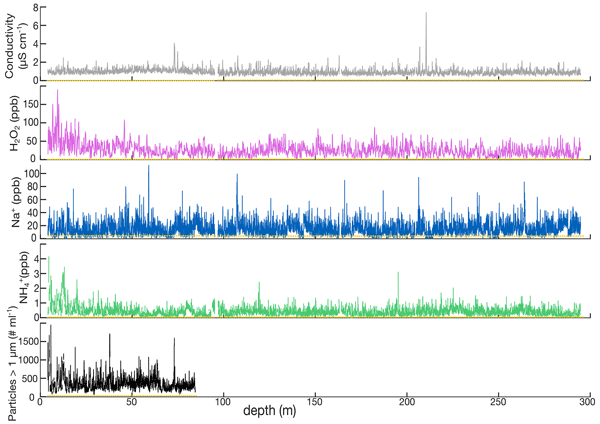
This paper provides high-resolution chemistry and impurity measurements from the Mount Brown South ice core in East Antarctica, from 873 to 2008 CE. Measurements include sodium, ammonium, hydrogen peroxide, electrolytic conductivity, and insoluble microparticles. Data are provided on three scales: 1 mm and 3 cm averaged depth resolution and decadally averaged. The paper also describes the continuous flow analysis systems used to collect the data and characterizes uncertainties and data quality.
Tessa R. Vance, Nerilie J. Abram, Alison S. Criscitiello, Camilla K. Crockart, Aylin DeCampo, Vincent Favier, Vasileios Gkinis, Margaret Harlan, Sarah L. Jackson, Helle A. Kjær, Chelsea A. Long, Meredith K. Nation, Christopher T. Plummer, Delia Segato, Andrea Spolaor, and Paul T. Vallelonga
Clim. Past, 20, 969–990, https://doi.org/10.5194/cp-20-969-2024, https://doi.org/10.5194/cp-20-969-2024, 2024
Short summary
Short summary
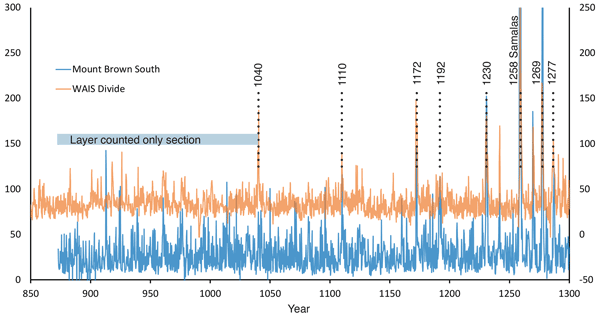
This study presents the chronologies from the new Mount Brown South ice cores from East Antarctica, which were developed by counting annual layers in the ice core data and aligning these to volcanic sulfate signatures. The uncertainty in the dating is quantified, and we discuss initial results from seasonal cycle analysis and mean annual concentrations. The chronologies will underpin the development of new proxy records for East Antarctica spanning the past millennium.
Seokhyun Ro, Florian Brouillet, William Hutchison, Patrick Sugden, Imogen Gabriel, Anders Svensson, Michael Sigl, Joseph R. McConnell, Nathan J. Chellman, and Andrea Burke
EGUsphere, https://doi.org/10.5194/egusphere-2026-6056, https://doi.org/10.5194/egusphere-2026-6056, 2026
This preprint is open for discussion and under review for Climate of the Past (CP).
Short summary
Short summary
Around 1108–1110, volcanic eruptions cooled Northern Hemisphere summers, and crop failures and famine followed in Europe. Their sources and nature have been unclear. Using sulfur isotopes and volcanic glass in Greenland ice, we identify several eruptions and estimate that about half as much sulfur reached the stratosphere as previously thought. An eruption north of the tropics in 1108 likely drove the 1109 cooling. These findings help improve reconstructions of past volcanic effects on climate.

François Burgay, Haley Derrod, Tobias Erhardt, Federico Scoto, Delia Segato, Niccolò Maffezzoli, Federico Dallo, Daniele Zannoni, Azzurra Spagnesi, Helle-Astrid Kjær, Hubertus Fischer, Cristiano Varin, Carlo Barbante, and Andrea Spolaor
Clim. Past, 22, 1675–1689, https://doi.org/10.5194/cp-22-1675-2026, https://doi.org/10.5194/cp-22-1675-2026, 2026
Short summary
Short summary
Ice-core measurements from Greenland suggest that atmospheric iron deposition played a smaller role than previously thought in regulating marine productivity in the iron-limited North Pacific. Despite a strong increase in total iron deposition, the fraction of iron more likely to be available to phytoplankton rose only modestly, pointing to sea-ice extent and sedimentary iron remobilization as potentially more important factors during the last glacial transition.
Alexander Mattin, Simon J. Barker, V. Holly L. Winton, Andrea Burke, William Hutchison, Patrick J. Sugden, Kirstin Krüger, Alexa R. Van Eaton, Larry G. Mastin, Michael Sigl, Eric W. Wolff, Shuji Fujita, Kumiko Goto-Azuma, Ikumi Oyabu, Motohiro Hirabayashi, Anders Svensson, Magali Verkerk, Colin J. N. Wilson, Stephen B. Piva, Nels A. Iverson, Nelia W. Dunbar, Helle A. Kjær, Nancy A. N. Bertler, Mirko Severi, Andrei V. Kurbatov, and Dominic A. Winski
EGUsphere, https://doi.org/10.5194/egusphere-2026-3434, https://doi.org/10.5194/egusphere-2026-3434, 2026
This preprint is open for discussion and under review for Climate of the Past (CP).
Short summary
Short summary
This study presents evidence of the ~25.3 Ōruanui supereruption preserved in Antarctic ice cores. Glaciochemical signals and volcanic ash were identified across multiple sites, revealing regional differences in volcanic transport, deposition, and preservation. Combining ice core records with climate model simulations, we show the eruption likely caused substantial short-term global cooling and atmospheric change but was unlikely to trigger long-term climate shifts.
Max T. Nilssen, Tessa R. Vance, Poul Christoffersen, Sue Cook, Alison S. Criscitiello, and Nerilie J. Abram
EGUsphere, https://doi.org/10.5194/egusphere-2026-4880, https://doi.org/10.5194/egusphere-2026-4880, 2026
This preprint is open for discussion and under review for Climate of the Past (CP).
Short summary
Short summary
To better understand how snowfall in East Antarctica changes over time, we reconstructed annual snow accumulation from the Mount Brown South ice core over the last millennium. The record shows significant variability across time scales, including multiple centennial-length periods with much less snowfall than observed in the satellite era. Our results raise implications for assessments of future sea level rise.
Rafael dos Reis, Denise Mondragon, Nolan Magner, Bruce Vaughn, Valerie Morris, Kevin Hand, Catherine Walker, Christopher German, Joseph McConnell, Helle Astrid Kjaer, and Melisa A. Diaz
EGUsphere, https://doi.org/10.5194/egusphere-2026-4356, https://doi.org/10.5194/egusphere-2026-4356, 2026
This preprint is open for discussion and under review for The Cryosphere (TC).
Short summary
Short summary
We present a new high‑resolution continuous melter system specifically engineered for sediment‑laden sea‑ice cores. The system combines full‑core melting, inline multi‑stage filtration, and electronic depth‑resolution control to enable simultaneous discrete sampling of dissolved and particulate phases. The new system approaches particularly high‑impurity ice.
John Bright Ayabilah, Matt King, Danielle Udy, and Tessa Vance
The Cryosphere, 20, 1237–1255, https://doi.org/10.5194/tc-20-1237-2026, https://doi.org/10.5194/tc-20-1237-2026, 2026
Short summary
Short summary
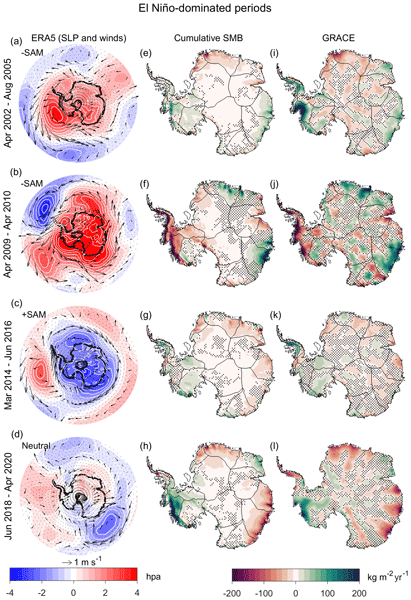
Large-scale climate modes significantly influence Antarctic Ice Sheet (AIS) mass variability. This study investigates AIS variability during different El Niño-Southern Oscillation (ENSO) periods using GRACE data (2002–2022). Results show strong spatial variability driven by changes in the Amundsen Sea Low (ASL) and Southern Annular Mode (SAM). This highlights the importance of understanding these patterns for future ice mass estimates and sea level rise predictions.
Margaret Harlan, Helle Astrid Kjær, Aylin de Campo, Anders Svensson, Thomas Blunier, Vasileios Gkinis, Sarah Jackson, Christopher Plummer, and Tessa Vance
Earth Syst. Sci. Data, 17, 6255–6271, https://doi.org/10.5194/essd-17-6255-2025, https://doi.org/10.5194/essd-17-6255-2025, 2025
Short summary
Short summary
This paper provides high-resolution chemistry and impurity measurements from the Mount Brown South ice core in East Antarctica, from 873 to 2008 CE. Measurements include sodium, ammonium, hydrogen peroxide, electrolytic conductivity, and insoluble microparticles. Data are provided on three scales: 1 mm and 3 cm averaged depth resolution and decadally averaged. The paper also describes the continuous flow analysis systems used to collect the data and characterizes uncertainties and data quality.
Helen J. Shea, Ailie Gallant, Ariaan Purich, and Tessa R. Vance
Clim. Past, 21, 2009–2030, https://doi.org/10.5194/cp-21-2009-2025, https://doi.org/10.5194/cp-21-2009-2025, 2025
Short summary
Short summary
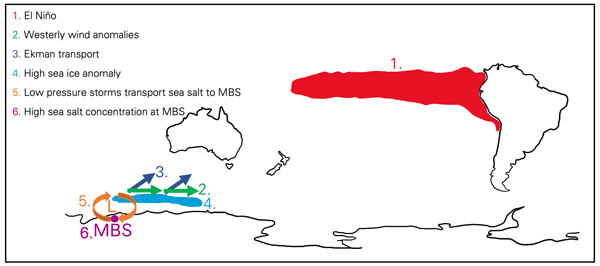
Ice core data from Mount Brown South (MBS), East Antarctica links high sea salt years to stronger westerly winds and increased sea ice near MBS's northeast coast. Low pressure storms off the coast might transport sea salts from sea ice regions to MBS. The tropical Pacific influences sea salt levels with El Niño events affecting wind patterns around MBS, impacting sea salt sources. Identifying these mechanisms aids in the understanding of climate variability before instrumental records.
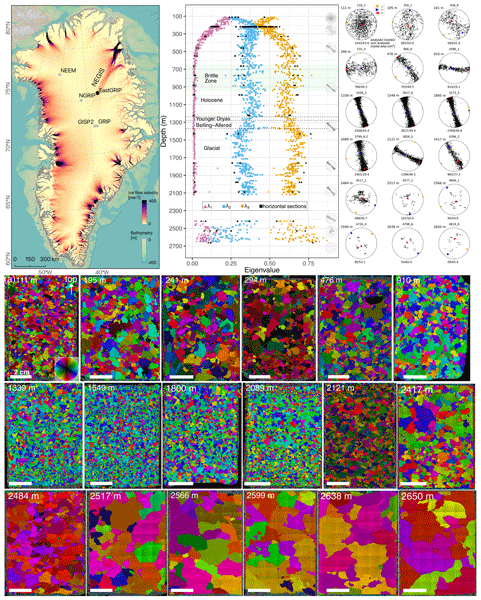
Nicolas Stoll, Ilka Weikusat, Daniela Jansen, Paul Bons, Kyra Darányi, Julien Westhoff, María-Gema Llorens, David Wallis, Jan Eichler, Tomotaka Saruya, Tomoyuki Homma, Sune Olander Rasmussen, Giulia Sinnl, Anders Svensson, Martyn Drury, Frank Wilhelms, Sepp Kipfstuhl, Dorthe Dahl-Jensen, and Johanna Kerch
The Cryosphere, 19, 3805–3830, https://doi.org/10.5194/tc-19-3805-2025, https://doi.org/10.5194/tc-19-3805-2025, 2025
Short summary
Short summary
A better understanding of ice flow requires more observational data. The EastGRIP core is the first ice core through an active ice stream. We discuss crystal orientation data determining the present deformation regimes. A comparison with other deep cores shows the unique properties of EastGRIP and shows that deep ice likely originates from the Eemian. We further show that the overall plug flow of NEGIS is characterised by many small-scale variations, which remain to be considered in ice flow models.
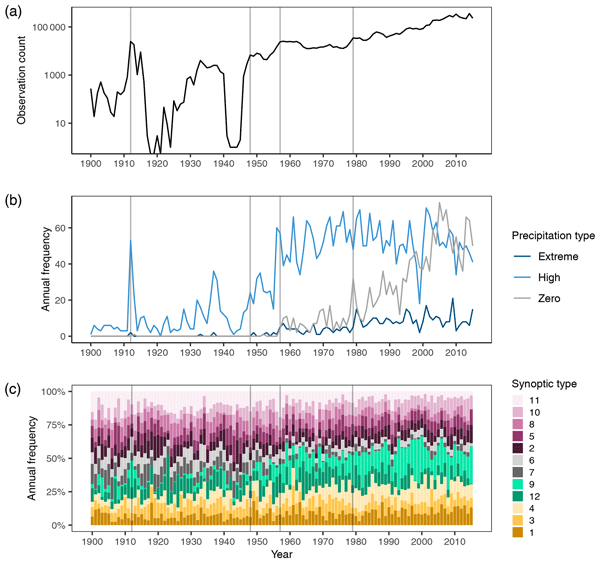
Max T. Nilssen, Danielle G. Udy, and Tessa R. Vance
Clim. Past, 21, 897–917, https://doi.org/10.5194/cp-21-897-2025, https://doi.org/10.5194/cp-21-897-2025, 2025
Short summary
Short summary
Reanalyses can be used to study past weather and climate, but their reliability is uncertain in data-sparse regions, such as the southern Indian Ocean. We used weather typing and an ice core record from East Antarctica to show that the 20th Century Reanalysis project can better represent the weather conditions that lead to snowfall variability at the ice core site when key weather observations from the Southern Ocean (e.g. Macquarie Island) commence around the mid-20th century.
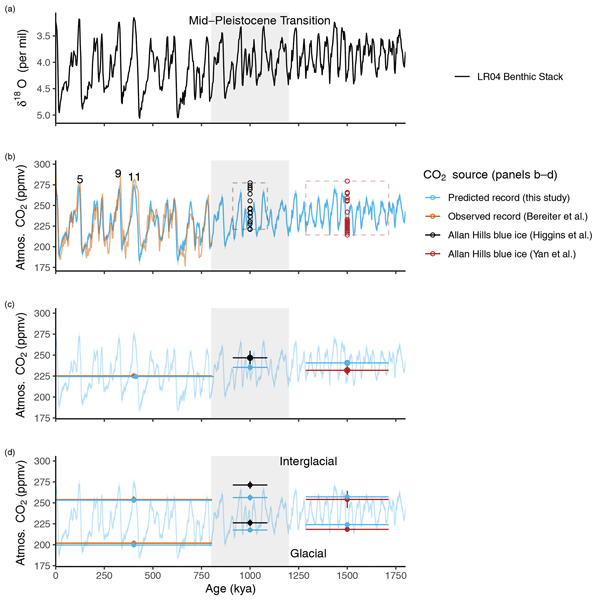
Jordan R. W. Martin, Joel B. Pedro, and Tessa R. Vance
Clim. Past, 20, 2487–2497, https://doi.org/10.5194/cp-20-2487-2024, https://doi.org/10.5194/cp-20-2487-2024, 2024
Short summary
Short summary
We use existing palaeoclimate data and a statistical model to predict atmospheric CO2 concentrations across the Mid-Pleistocene Transition. Our prediction assumes that the relationship between CO2 and benthic ẟ18Ocalcite over the past 800 000 years can be extended over the last 1.8 million years. We find no clear evidence from existing blue ice or proxy-based CO2 data to reject the predicted record. A definitive test awaits analysis of continuous oldest ice core records from Antarctica.
Tessa R. Vance, Nerilie J. Abram, Alison S. Criscitiello, Camilla K. Crockart, Aylin DeCampo, Vincent Favier, Vasileios Gkinis, Margaret Harlan, Sarah L. Jackson, Helle A. Kjær, Chelsea A. Long, Meredith K. Nation, Christopher T. Plummer, Delia Segato, Andrea Spolaor, and Paul T. Vallelonga
Clim. Past, 20, 969–990, https://doi.org/10.5194/cp-20-969-2024, https://doi.org/10.5194/cp-20-969-2024, 2024
Short summary
Short summary
This study presents the chronologies from the new Mount Brown South ice cores from East Antarctica, which were developed by counting annual layers in the ice core data and aligning these to volcanic sulfate signatures. The uncertainty in the dating is quantified, and we discuss initial results from seasonal cycle analysis and mean annual concentrations. The chronologies will underpin the development of new proxy records for East Antarctica spanning the past millennium.
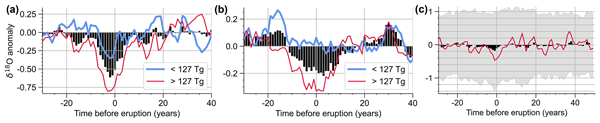
Johannes Lohmann, Jiamei Lin, Bo M. Vinther, Sune O. Rasmussen, and Anders Svensson
Clim. Past, 20, 313–333, https://doi.org/10.5194/cp-20-313-2024, https://doi.org/10.5194/cp-20-313-2024, 2024
Short summary
Short summary
We present the first attempt to constrain the climatic impact of volcanic eruptions with return periods of hundreds of years by the oxygen isotope records of Greenland and Antarctic ice cores covering the last glacial period. A clear multi-annual volcanic cooling signal is seen, but its absolute magnitude is subject to the unknown glacial sensitivity of the proxy. Different proxy signals after eruptions during cooler versus warmer glacial stages may reflect a state-dependent climate response.
Lingwei Zhang, Tessa R. Vance, Alexander D. Fraser, Lenneke M. Jong, Sarah S. Thompson, Alison S. Criscitiello, and Nerilie J. Abram
The Cryosphere, 17, 5155–5173, https://doi.org/10.5194/tc-17-5155-2023, https://doi.org/10.5194/tc-17-5155-2023, 2023
Short summary
Short summary
Physical features in ice cores provide unique records of past variability. We identified 1–2 mm ice layers without bubbles in surface ice cores from Law Dome, East Antarctica, occurring on average five times per year. The origin of these bubble-free layers is unknown. In this study, we investigate whether they have the potential to record past atmospheric processes and circulation. We find that the bubble-free layers are linked to accumulation hiatus events and meridional moisture transport.
Tobias Erhardt, Camilla Marie Jensen, Florian Adolphi, Helle Astrid Kjær, Remi Dallmayr, Birthe Twarloh, Melanie Behrens, Motohiro Hirabayashi, Kaori Fukuda, Jun Ogata, François Burgay, Federico Scoto, Ilaria Crotti, Azzurra Spagnesi, Niccoló Maffezzoli, Delia Segato, Chiara Paleari, Florian Mekhaldi, Raimund Muscheler, Sophie Darfeuil, and Hubertus Fischer
Earth Syst. Sci. Data, 15, 5079–5091, https://doi.org/10.5194/essd-15-5079-2023, https://doi.org/10.5194/essd-15-5079-2023, 2023
Short summary
Short summary
The presented paper provides a 3.8 kyr long dataset of aerosol concentrations from the East Greenland Ice coring Project (EGRIP) ice core. The data consists of 1 mm depth-resolution profiles of calcium, sodium, ammonium, nitrate, and electrolytic conductivity as well as decadal averages of these profiles. Alongside the data a detailed description of the measurement setup as well as a discussion of the uncertainties are given.
Marie Bouchet, Amaëlle Landais, Antoine Grisart, Frédéric Parrenin, Frédéric Prié, Roxanne Jacob, Elise Fourré, Emilie Capron, Dominique Raynaud, Vladimir Ya Lipenkov, Marie-France Loutre, Thomas Extier, Anders Svensson, Etienne Legrain, Patricia Martinerie, Markus Leuenberger, Wei Jiang, Florian Ritterbusch, Zheng-Tian Lu, and Guo-Min Yang
Clim. Past, 19, 2257–2286, https://doi.org/10.5194/cp-19-2257-2023, https://doi.org/10.5194/cp-19-2257-2023, 2023
Short summary
Short summary
A new federative chronology for five deep polar ice cores retrieves 800 000 years of past climate variations with improved accuracy. Precise ice core timescales are key to studying the mechanisms linking changes in the Earth’s orbit to the diverse climatic responses (temperature and atmospheric greenhouse gas concentrations). To construct the chronology, new measurements from the oldest continuous ice core as well as glaciological modeling estimates were combined in a statistical model.
Sarah L. Jackson, Tessa R. Vance, Camilla Crockart, Andrew Moy, Christopher Plummer, and Nerilie J. Abram
Clim. Past, 19, 1653–1675, https://doi.org/10.5194/cp-19-1653-2023, https://doi.org/10.5194/cp-19-1653-2023, 2023
Short summary
Short summary
Ice core records are useful tools for reconstructing past climate. However, ice cores favour recording climate conditions at times when snowfall occurs. Large snowfall events in Antarctica are often associated with warmer-than-usual temperatures. We show that this results in a tendency for the Mount Brown South ice core record to preserve a temperature record biased to the climate conditions that exist during extreme events, rather than a temperature record that reflects the mean annual climate.
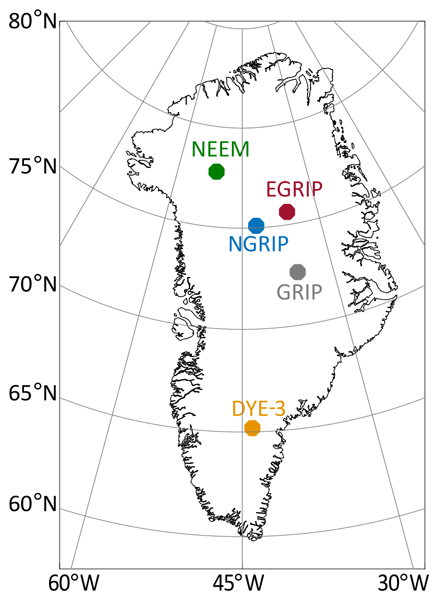
Sune Olander Rasmussen, Dorthe Dahl-Jensen, Hubertus Fischer, Katrin Fuhrer, Steffen Bo Hansen, Margareta Hansson, Christine S. Hvidberg, Ulf Jonsell, Sepp Kipfstuhl, Urs Ruth, Jakob Schwander, Marie-Louise Siggaard-Andersen, Giulia Sinnl, Jørgen Peder Steffensen, Anders M. Svensson, and Bo M. Vinther
Earth Syst. Sci. Data, 15, 3351–3364, https://doi.org/10.5194/essd-15-3351-2023, https://doi.org/10.5194/essd-15-3351-2023, 2023
Short summary
Short summary
Timescales are essential for interpreting palaeoclimate data. The data series presented here were used for annual-layer identification when constructing the timescales named the Greenland Ice-Core Chronology 2005 (GICC05) and the revised version GICC21. Hopefully, these high-resolution data sets will be useful also for other purposes.
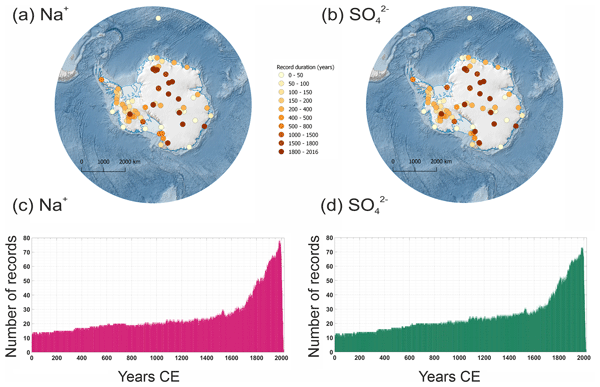
Elizabeth R. Thomas, Diana O. Vladimirova, Dieter R. Tetzner, B. Daniel Emanuelsson, Nathan Chellman, Daniel A. Dixon, Hugues Goosse, Mackenzie M. Grieman, Amy C. F. King, Michael Sigl, Danielle G. Udy, Tessa R. Vance, Dominic A. Winski, V. Holly L. Winton, Nancy A. N. Bertler, Akira Hori, Chavarukonam M. Laluraj, Joseph R. McConnell, Yuko Motizuki, Kazuya Takahashi, Hideaki Motoyama, Yoichi Nakai, Franciéle Schwanck, Jefferson Cardia Simões, Filipe Gaudie Ley Lindau, Mirko Severi, Rita Traversi, Sarah Wauthy, Cunde Xiao, Jiao Yang, Ellen Mosely-Thompson, Tamara V. Khodzher, Ludmila P. Golobokova, and Alexey A. Ekaykin
Earth Syst. Sci. Data, 15, 2517–2532, https://doi.org/10.5194/essd-15-2517-2023, https://doi.org/10.5194/essd-15-2517-2023, 2023
Short summary
Short summary
The concentration of sodium and sulfate measured in Antarctic ice cores is related to changes in both sea ice and winds. Here we have compiled a database of sodium and sulfate records from 105 ice core sites in Antarctica. The records span all, or part, of the past 2000 years. The records will improve our understanding of how winds and sea ice have changed in the past and how they have influenced the climate of Antarctica over the past 2000 years.
Giulia Sinnl, Florian Adolphi, Marcus Christl, Kees C. Welten, Thomas Woodruff, Marc Caffee, Anders Svensson, Raimund Muscheler, and Sune Olander Rasmussen
Clim. Past, 19, 1153–1175, https://doi.org/10.5194/cp-19-1153-2023, https://doi.org/10.5194/cp-19-1153-2023, 2023
Short summary
Short summary
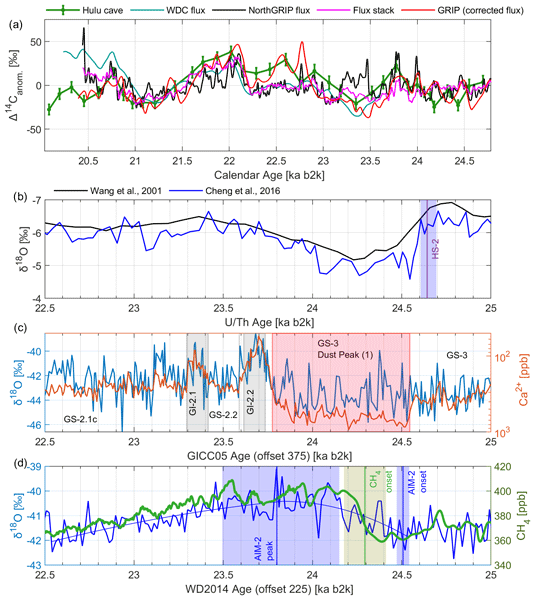
The record of past climate is preserved by several archives from different regions, such as ice cores from Greenland or Antarctica or speleothems from caves such as the Hulu Cave in China. In this study, these archives are aligned by taking advantage of the globally synchronous production of cosmogenic radionuclides. This produces a new perspective on the global climate in the period between 20 000 and 25 000 years ago.
Nicolas Stoll, Julien Westhoff, Pascal Bohleber, Anders Svensson, Dorthe Dahl-Jensen, Carlo Barbante, and Ilka Weikusat
The Cryosphere, 17, 2021–2043, https://doi.org/10.5194/tc-17-2021-2023, https://doi.org/10.5194/tc-17-2021-2023, 2023
Short summary
Short summary
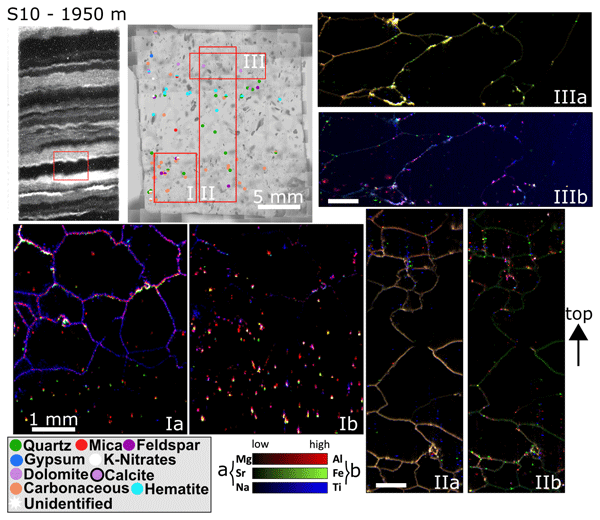
Impurities in polar ice play a role regarding its climate signal and internal deformation. We bridge different scales using different methods to investigate ice from the Last Glacial Period derived from the EGRIP ice core in Greenland. We characterise different types of cloudy bands, i.e. frequently occurring milky layers in the ice, and analyse their chemistry with Raman spectroscopy and 2D imaging. We derive new insights into impurity localisation and deposition conditions.
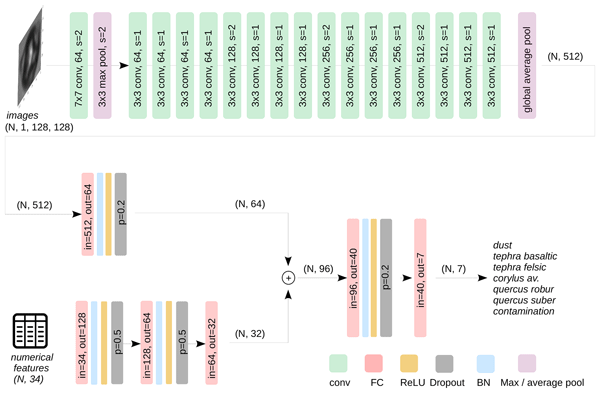
Niccolò Maffezzoli, Eliza Cook, Willem G. M. van der Bilt, Eivind N. Støren, Daniela Festi, Florian Muthreich, Alistair W. R. Seddon, François Burgay, Giovanni Baccolo, Amalie R. F. Mygind, Troels Petersen, Andrea Spolaor, Sebastiano Vascon, Marcello Pelillo, Patrizia Ferretti, Rafael S. dos Reis, Jefferson C. Simões, Yuval Ronen, Barbara Delmonte, Marco Viccaro, Jørgen Peder Steffensen, Dorthe Dahl-Jensen, Kerim H. Nisancioglu, and Carlo Barbante
The Cryosphere, 17, 539–565, https://doi.org/10.5194/tc-17-539-2023, https://doi.org/10.5194/tc-17-539-2023, 2023
Short summary
Short summary
Multiple lines of research in ice core science are limited by manually intensive and time-consuming optical microscopy investigations for the detection of insoluble particles, from pollen grains to volcanic shards. To help overcome these limitations and support researchers, we present a novel methodology for the identification and autonomous classification of ice core insoluble particles based on flow image microscopy and neural networks.
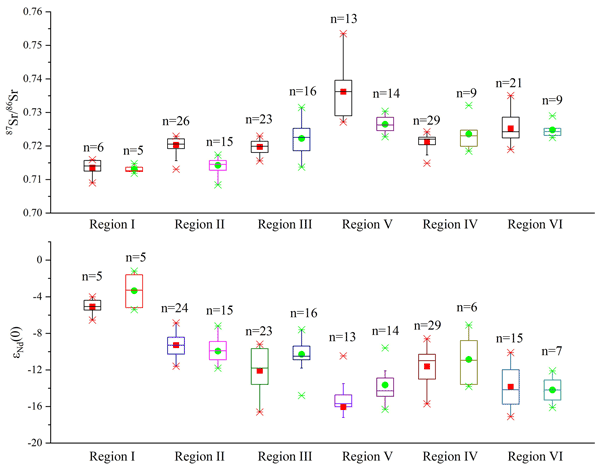
Zhiheng Du, Jiao Yang, Lei Wang, Ninglian Wang, Anders Svensson, Zhen Zhang, Xiangyu Ma, Yaping Liu, Shimeng Wang, Jianzhong Xu, and Cunde Xiao
Earth Syst. Sci. Data, 14, 5349–5365, https://doi.org/10.5194/essd-14-5349-2022, https://doi.org/10.5194/essd-14-5349-2022, 2022
Short summary
Short summary
A dataset of the radiogenic strontium and neodymium isotopic compositions from the three poles (the third pole, the Arctic, and Antarctica) were integrated to obtain new findings. The dataset enables us to map the standardized locations in the three poles, while the use of sorting criteria related to the sample type permits us to trace the dust sources and sinks. The purpose of this dataset is to try to determine the variable transport pathways of dust at three poles.
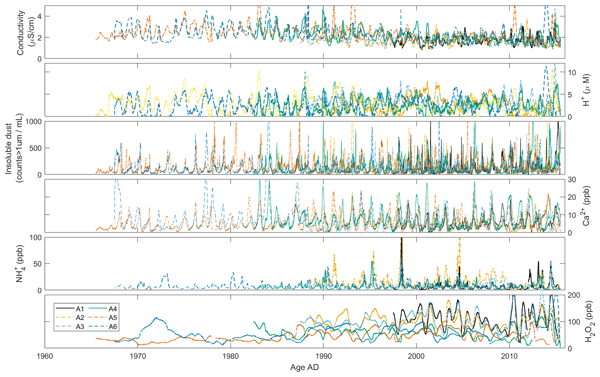
Helle Astrid Kjær, Patrick Zens, Samuel Black, Kasper Holst Lund, Anders Svensson, and Paul Vallelonga
Clim. Past, 18, 2211–2230, https://doi.org/10.5194/cp-18-2211-2022, https://doi.org/10.5194/cp-18-2211-2022, 2022
Short summary
Short summary
Six shallow cores from northern Greenland spanning a distance of 426 km were retrieved during a traversal in 2015. We identify several recent acid horizons associated with Icelandic eruptions and eruptions in the Barents Sea region and obtain a robust forest fire proxy associated primarily with Canadian forest fires. We also observe an increase in the large dust particle fluxes that we attribute to an activation of Greenland local sources in recent years (1998–2015).
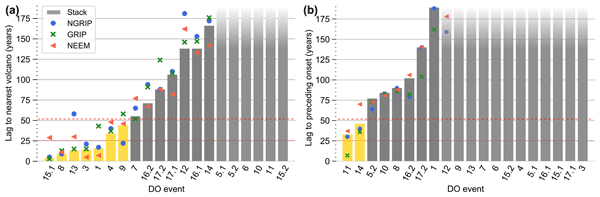
Johannes Lohmann and Anders Svensson
Clim. Past, 18, 2021–2043, https://doi.org/10.5194/cp-18-2021-2022, https://doi.org/10.5194/cp-18-2021-2022, 2022
Short summary
Short summary
Major volcanic eruptions are known to cause considerable short-term impacts on the global climate. Their influence on long-term climate variability and regime shifts is less well-understood. Here we show that very large, bipolar eruptions occurred more frequently than expected by chance just before abrupt climate change events in the last glacial period (Dansgaard–Oeschger events). Thus, such large eruptions may in some cases act as short-term triggers for abrupt regime shifts of the climate.
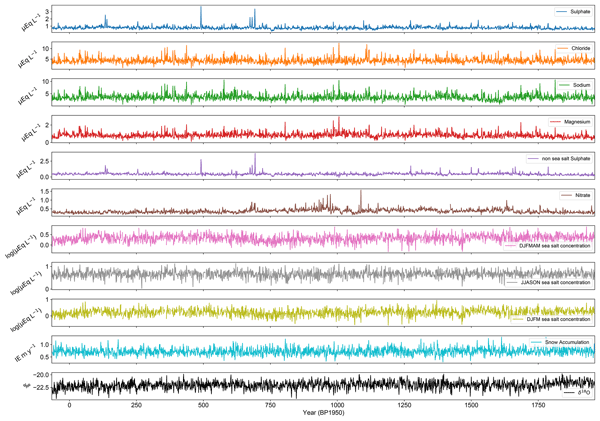
Lenneke M. Jong, Christopher T. Plummer, Jason L. Roberts, Andrew D. Moy, Mark A. J. Curran, Tessa R. Vance, Joel B. Pedro, Chelsea A. Long, Meredith Nation, Paul A. Mayewski, and Tas D. van Ommen
Earth Syst. Sci. Data, 14, 3313–3328, https://doi.org/10.5194/essd-14-3313-2022, https://doi.org/10.5194/essd-14-3313-2022, 2022
Short summary
Short summary
Ice core records from Law Dome in East Antarctica, collected over the the last 3 decades, provide high-resolution data for studies of the climate of Antarctica, Australia and the Southern and Indo-Pacific oceans. Here, we present a set of annually dated records from Law Dome covering the last 2000 years. This dataset provides an update and extensions both forward and back in time of previously published subsets of the data, bringing them together into a coherent set with improved dating.
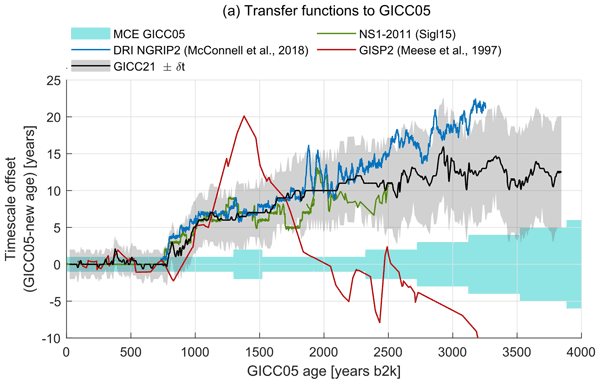
Giulia Sinnl, Mai Winstrup, Tobias Erhardt, Eliza Cook, Camilla Marie Jensen, Anders Svensson, Bo Møllesøe Vinther, Raimund Muscheler, and Sune Olander Rasmussen
Clim. Past, 18, 1125–1150, https://doi.org/10.5194/cp-18-1125-2022, https://doi.org/10.5194/cp-18-1125-2022, 2022
Short summary
Short summary
A new Greenland ice-core timescale, covering the last 3800 years, was produced using the machine learning algorithm StratiCounter. We synchronized the ice cores using volcanic eruptions and wildfires. We compared the new timescale to the tree-ring timescale, finding good alignment both between the common signatures of volcanic eruptions and of solar activity. Our Greenlandic timescales is safe to use for the Late Holocene, provided one uses our uncertainty estimate.
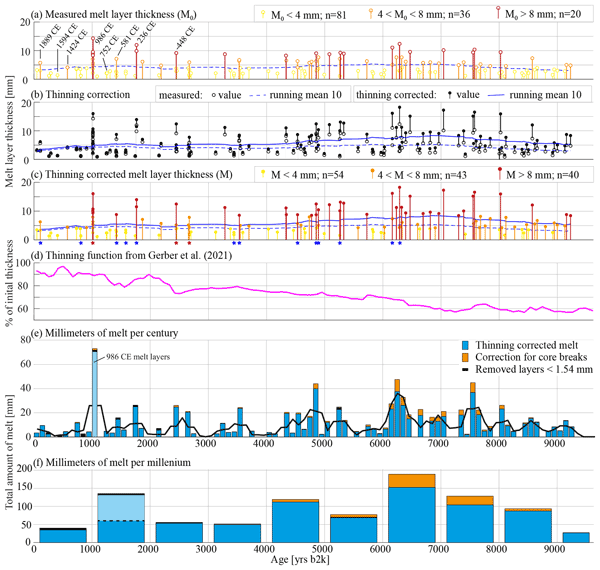
Julien Westhoff, Giulia Sinnl, Anders Svensson, Johannes Freitag, Helle Astrid Kjær, Paul Vallelonga, Bo Vinther, Sepp Kipfstuhl, Dorthe Dahl-Jensen, and Ilka Weikusat
Clim. Past, 18, 1011–1034, https://doi.org/10.5194/cp-18-1011-2022, https://doi.org/10.5194/cp-18-1011-2022, 2022
Short summary
Short summary
We present a melt event record from an ice core from central Greenland, which covers the past 10 000 years. Our record displays warm summer events, which can be used to enhance our understanding of the past climate. We compare our data to anomalies in tree ring width, which also represents summer temperatures, and find a good correlation. Furthermore, we investigate an outstandingly warm event in the year 986 AD or 991 AD, which has not been analyzed before.
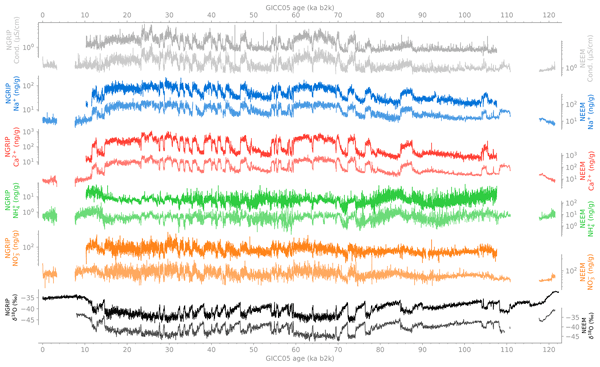
Tobias Erhardt, Matthias Bigler, Urs Federer, Gideon Gfeller, Daiana Leuenberger, Olivia Stowasser, Regine Röthlisberger, Simon Schüpbach, Urs Ruth, Birthe Twarloh, Anna Wegner, Kumiko Goto-Azuma, Takayuki Kuramoto, Helle A. Kjær, Paul T. Vallelonga, Marie-Louise Siggaard-Andersen, Margareta E. Hansson, Ailsa K. Benton, Louise G. Fleet, Rob Mulvaney, Elizabeth R. Thomas, Nerilie Abram, Thomas F. Stocker, and Hubertus Fischer
Earth Syst. Sci. Data, 14, 1215–1231, https://doi.org/10.5194/essd-14-1215-2022, https://doi.org/10.5194/essd-14-1215-2022, 2022
Short summary
Short summary
The datasets presented alongside this manuscript contain high-resolution concentration measurements of chemical impurities in deep ice cores, NGRIP and NEEM, from the Greenland ice sheet. The impurities originate from the deposition of aerosols to the surface of the ice sheet and are influenced by source, transport and deposition processes. Together, these records contain detailed, multi-parameter records of past climate variability over the last glacial period.
Jiamei Lin, Anders Svensson, Christine S. Hvidberg, Johannes Lohmann, Steffen Kristiansen, Dorthe Dahl-Jensen, Jørgen Peder Steffensen, Sune Olander Rasmussen, Eliza Cook, Helle Astrid Kjær, Bo M. Vinther, Hubertus Fischer, Thomas Stocker, Michael Sigl, Matthias Bigler, Mirko Severi, Rita Traversi, and Robert Mulvaney
Clim. Past, 18, 485–506, https://doi.org/10.5194/cp-18-485-2022, https://doi.org/10.5194/cp-18-485-2022, 2022
Short summary
Short summary
We employ acidity records from Greenland and Antarctic ice cores to estimate the emission strength, frequency and climatic forcing for large volcanic eruptions from the last half of the last glacial period. A total of 25 volcanic eruptions are found to be larger than any eruption in the last 2500 years, and we identify more eruptions than obtained from geological evidence. Towards the end of the glacial period, there is a notable increase in volcanic activity observed for Greenland.
Cited articles
Abbott, P. M. and Davies, S. M.: Volcanism and the Greenland ice-cores: the tephra record, Earth-Sci. Rev., 115, 173–191, https://doi.org/10.1016/j.earscirev.2012.09.001, 2012. a, b
Abbott, P. M., McConnell, J. R., Chellman, N. J., Kipfstuhl, S., Hörhold, M., Freitag, J., Cook, E., Hutchison, W., and Sigl, M.: Mid-to Late Holocene East Antarctic ice-core tephrochronology: Implications for reconstructing volcanic eruptions and assessing their climatic impacts over the last 5500 years, Quaternary Sci. Rev., 329, 108544, https://doi.org/10.1016/j.quascirev.2024.108544, 2024. a, b, c, d, e, f, g, h, i, j, k, l, m, n
Aoki, K.-I., Yoshida, T., Yusa, K., and Nakamura, Y.: Petrology and geochemistry of the Nyamuragira volcano, Zaire, J. Volcanol. Geoth. Res., 25, 1–28, https://doi.org/10.1016/0377-0273(85)90002-2, 1985. a
Baiman, R., Winters, A. C., Lenaerts, J., and Shields, C. A.: Synoptic Drivers of Atmospheric River Induced Precipitation Near Dronning Maud Land, Antarctica, J. Geophys. Res.-Atmos., 128, https://doi.org/10.1029/2022JD037859, 2023. a
Barling, J., Goldstein, S. L., and Nicholls, I. A.: Geochemistry of Heard Island (Southern Indian Ocean): Characterization of an Enriched Mantle Component and Implications for Enrichment of the Sub-Indian Ocean Mantle, J. Petrol., 35, 1017–1053, https://doi.org/10.1093/petrology/35.4.1017, 1994. a, b, c
Basile, I., Petit, J. R., Touron, S., Grousset, F. E., and Barkov, N.: Volcanic layers in Antarctic (Vostok) ice cores: Source identification and atmospheric implications, J. Geophys. Res.-Atmos., 106, 31915–31931, https://doi.org/10.1029/2000JD000102, 2001. a, b, c, d
Burke, A., Moore, K. A., Sigl, M., Nita, D. C., McConnell, J. R., and Adkins, J. F.: Stratospheric eruptions from tropical and extra-tropical volcanoes constrained using high-resolution sulfur isotopes in ice cores, Earth Planet. Sc. Lett., 521, 113–119, https://doi.org/10.1016/j.epsl.2019.06.006, 2019. a, b, c, d, e, f
Carn, S. A., Krueger, A. J., Bluth, G. J. S., Schaefer, S. J., Krotkov, N. A., Watson, I. M., and Datta, S.: Volcanic eruption detection by the Total Ozone Mapping Spectrometer (TOMS) instruments: a 22-year record of sulphur dioxide and ash emissions, Geol. Soc. Spec. Publ., 213, 177–202, 2003. a
Case, P. A., Colarco, P. R., Toon, O. B., and Newman, P. A.: Simulating the Volcanic Sulfate Aerosols From the 1991 Eruption of Cerro Hudson and Their Impact on the 1991 Ozone Hole, Geophys. Res. Lett., 51, https://doi.org/10.1029/2023GL106619, 2024. a, b
Castellano, E., Becagli, S., Jouzel, J., Migliori, A., Severi, M., Steffensen, J., Traversi, R., and Udisti, R.: Volcanic eruption frequency over the last 45 ky as recorded in Epica-Dome C ice core (East Antarctica) and its relationship with climatic changes, Global Planet. Change, 42, 195–205, https://doi.org/10.1016/j.gloplacha.2003.11.007, ice sheets and neotectonics, 2004. a, b
Clarke, I., McDougall, I., and Whitford, D.: Volcanic evolution of heard and Mc-Donald Islands, Southern Indian Ocean, in: Antarctic Earth Science, International Symposium, 16–20 August 1982, University of Adelaide, South Australia, 4, 631–635, 1983. a
Cook, E., Portnyagin, M., Ponomareva, V., Bazanova, L., Svensson, A., and Garbe-Schönberg, D.: First identification of cryptotephra from the Kamchatka Peninsula in a Greenland ice core: Implications of a widespread marker deposit that links Greenland to the Pacific northwest, Quaternary Sci. Rev., 181, 200–206, 2018. a, b, c
Cook, E., Abbott, P. M., Pearce, N. J., Mojtabavi, S., Svensson, A., Bourne, A. J., Rasmussen, S. O., Seierstad, I. K., Vinther, B. M., Harrison, J., Street, E., Steffensen, J. P., Wilhelms, F., and Davies, S. M.: Volcanism and the Greenland ice cores: A new tephrochronological framework for the last glacial-interglacial transition (LGIT) based on cryptotephra deposits in three ice cores, Quaternary Sci. Rev., 292, 107596, https://doi.org/10.1016/j.quascirev.2022.107596, 2022. a, b, c, d, e, f, g
Coulter, S. E., Pilcher, J. R., Plunkett, G., Baillie, M., Hall, V. A., Steffensen, J. P., Vinther, B. M., Clausen, H. B., and Johnsen, S. J.: Holocene tephras highlight complexity of volcanic signals in Greenland ice cores, J. Geophys. Res.-Atmos., 117, https://doi.org/10.1029/2012JD017698, 2012. a
Crameri, F.: Scientific colour maps, Zenodo [code], https://doi.org/10.5281/zenodo.8409685, 2023. a
Crameri, F., Shephard, G. E., and Heron, P. J.: The misuse of colour in science communication, Nat. Commun., 11, 5444, https://doi.org/10.1038/s41467-020-19160-7, 2020. a
Crockart, C. K.: El Niño Southern Oscillation signal in a new East Antarctic ice core, Mount Brown South, Version 1, Australian Antarctic Data Centre [data set], https://doi.org/10.4225/15/58eedf6812621, 2021. a
Crockart, C. K., Vance, T. R., Fraser, A. D., Abram, N. J., Criscitiello, A. S., Curran, M. A. J., Favier, V., Gallant, A. J. E., Kittel, C., Kjær, H. A., Klekociuk, A. R., Jong, L. M., Moy, A. D., Plummer, C. T., Vallelonga, P. T., Wille, J., and Zhang, L.: El Niño–Southern Oscillation signal in a new East Antarctic ice core, Mount Brown South, Clim. Past, 17, 1795–1818, https://doi.org/10.5194/cp-17-1795-2021, 2021. a, b, c, d, e, f, g, h, i, j, k, l, m, n
Del Carlo, P., Roberto, A. D., D'Orazio, M., Petrelli, M., Angioletti, A., Zanchetta, G., Maggi, V., Daga, R., Nazzari, M., and Rocchi, S.: Late Glacial-Holocene tephra from southern Patagonia and Tierra del Fuego (Argentina, Chile): A complete textural and geochemical fingerprinting for distal correlations in the Southern Hemisphere, Quaternary Sci. Rev., 195, 153–170, https://doi.org/10.1016/j.quascirev.2018.07.028, 2018. a, b, c, d, e
Delmonte, B., Baroni, C., Andersson, P., Narcisi, B., Salvatore, M., Petit, J., Scarchilli, C., Frezzotti, M., Albani, S., and Maggi, V.: Modern and Holocene aeolian dust variability from Talos Dome (Northern Victoria Land) to the interior of the Antarctic ice sheet, Quaternary Sci. Rev., 64, 76–89, https://doi.org/10.1016/j.quascirev.2012.11.033, 2013. a, b
Dmitrieva, N., Simonov, V., Safonova, I. Y., Kotlyarov, A., and Karmanov, N.: The Physicochemical Conditions for the Formation of Recent Basalts of Lokon Volcano, Sulawesi Island in the Pacific Ocean: Melt Inclusion Data, Russ. J. Pac. Geol., 17, 267–283, 2023. a
Doiron, S. D., Bluth, G. J. S., Schnetzler, C. C., Krueger, A. J., and Walter, L. S.: Transport of Cerro Hudson SO2 clouds, EOS T. Am. Geophys. Un., 72, 489–498, https://doi.org/10.1029/90EO00354, 1991. a, b, c, d
Dunbar, N. W., Zielinski, G. A., and Voisins, D. T.: Tephra layers in the Siple Dome and Taylor Dome ice cores, Antarctica: Sources and correlations, J. Geophys. Res., 108, https://doi.org/10.1029/2002jb002056, 2003. a, b
Dunbar, N. W., Iverson, N. A., Eaton, A. R. V., Sigl, M., Alloway, B. V., Kurbatov, A. V., Mastin, L. G., McConnell, J. R., and Wilson, C. J. N.: New Zealand supereruption provides time marker for the Last Glacial Maximum in Antarctica, Sci. Rep., 7, 12238, https://doi.org/10.1038/s41598-017-11758-0, 2017. a, b
Etheridge, D. M., Steele, L. P., Langenfelds, R. L., Francey, R. J., Barnola, J.-M., and Morgan, V. I.: Natural and anthropogenic changes in atmospheric CO2 over the last 1000 years from air in Antarctic ice and firn, J. Geophys. Res.-Atmos., 101, 4115–4128, https://doi.org/10.1029/95JD03410, 1996. a
Evangelista, H., Gastagna, A., Correia, A., Potocki, M., Aquino, F., Alencar, A., Mayewski, P., Kurbatov, A., Jaña, R., Nogueira, J., Licinio, M., Alves, E., and Simões, J. C.: The 1991 explosive Hudson volcanic eruption as a geochronological marker for the Northern Antarctic Peninsula, An. Acad. Bras. Ciênc., 94, https://doi.org/10.1590/0001-3765202220210810, 2022. a, b, c, d, e
Fox, J. M., McPhie, J., Carey, R. J., Jourdan, F., and Miggins, D. P.: Construction of an intraplate island volcano: The volcanic history of Heard Island, B. Volcanol., 83, 37, https://doi.org/10.1007/s00445-021-01452-5, 2021. a
Francis, P. W., Wadge, G., and Mouginis-Mark, P. J.: Satellite Monitoring of Volcanoes, Springer Berlin Heidelberg, Berlin, Heidelberg, 257–298, https://doi.org/10.1007/978-3-642-80087-0_8, 1996. a
Gao, C., Robock, A., and Ammann, C.: Volcanic forcing of climate over the past 1500 years: An improved ice core-based index for climate models, J. Geophys. Res.-Atmos., 113, https://doi.org/10.1029/2008JD010239, 2008. a, b
Gedeon, O., Hulínský, V., and Jurek, K.: Microanalysis of Glass Containing Alkali Ions, Microchim. Acta, 132, 505–510, https://doi.org/10.1007/s006040050050, 2000. a
Geyer, A., Di Roberto, A., Smellie, J., Van Wyk de Vries, M., Panter, K., Martin, A., Cooper, J., Young, D., Pompilio, M., Kyle, P., and Blankenship, D.: Volcanism in Antarctica: An assessment of the present state of research and future directions, J. Volcanol. Geoth. Res., 444, 107941, https://doi.org/10.1016/j.jvolgeores.2023.107941, 2023. a, b, c, d, e
Gkinis, V., Jackson, S., Abram, N. J., Curran, M., Blunier, T., Halan, M., Kjær, H. A., Moy, A., Peensoo, K., Quistgaard, T., Vance, T. R., and Vallelonga, P.: An 1135 year very high-resolution water isotope record of polar precipitation from the Indo-Pacific sector of East Antarctica, Ver. 1,, Australian Antarctic Data Centre, https://doi.org/10.26179/ygeq-1a95, last access: 7 September 2024, 2024a. a
Gkinis, V., Sarah Jackson, N. J. A., Plummer, C., Blunier, T., Harlan, M., Kjær, H. A., Moy, A. D., Peensoo, K. M., Quistgaard, T., Svensson, A., and Vance, T. R.: An East Antarctic, sub-annual resolution water isotope record from the Mount Brown South Ice core, Nature Scientific Data, 11, https://doi.org/10.1038/s41597-024-03751-w, 2024b. a, b, c, d
Global Volcanism Program: Volcanoes of the World (v. 5.2.1, (3 July 2024) [Database]. Distributed by Smithsonian Institution, compiled by Venzke, E., https://doi.org/10.5479/si.GVP.VOTW5-2024.5.2, 2024. a, b, c, d
Global Volcanism Program and McClelland, L. (Eds.): Report on Erebus (Antarctica), vol. 9, 9 edn., Smithsonian Institution, https://doi.org/10.5479/si.GVP.SEAN198409-390020, 1984. a
Global Volcanism Program and McClelland, L. (Eds.): Report on Erebus (Antarctica), vol. 11, 3 edn., Smithsonian Institution, https://doi.org/10.5479/si.GVP.SEAN198603-390020, 1986. a
Guo, S., Bluth, G. J. S., Rose, W. I., Watson, I. M., and Prata, A. J.: Re-evaluation of SO2 release of the 15 June 1991 Pinatubo eruption using ultraviolet and infrared satellite sensors, Geochem. Geophy. Geosy., 5, https://doi.org/10.1029/2003GC000654, 2004. a, b, c
Gutiérrez, F., Gioncada, A., Ferran, O. G., Lahsen, A., and Mazzuoli, R.: The Hudson Volcano and surrounding monogenetic centres (Chilean Patagonia): An example of volcanism associated with ridge–trench collision environment, J. Volcanol. Geoth. Res., 145, 207–233, https://doi.org/10.1016/j.jvolgeores.2005.01.014, 2005. a, b
Haberle, S. G. and Lumley, S. H.: Age and origin of tephras recorded in postglacial lake sediments to the west of the southern Andes, 44° S to 47° S, J. Volcanol. Geoth. Res., 84, 239–256, https://doi.org/10.1016/S0377-0273(98)00037-7, 1998. a, b, c
Harlan, M., Kjær, H. A., Vance, T., Gkinis, V., Jackson, S., Blunier, T., Svensson, A., Plummer, C., de Campo, A., and Vallelonga, P.: 1137 years of high-resolution Continuous Flow Analysis impurity data from the Mount Brown South Ice Core, Ver. 1, Australian Antarctic Data Centre, https://doi.org/10.26179/9tke-0s16, accessed: 2024-08-02, 2024. a, b
Harlan, M., Kjær, H. A., de Campo, A., Svensson, A., Blunier, T., Gkinis, V., Jackson, S., Plummer, C., and Vance, T.: High resolution continuous flow analysis impurity data from the Mount Brown South ice core, East Antarctica, Earth Syst. Sci. Data, 17, 6255–6271, https://doi.org/10.5194/essd-17-6255-2025, 2025a. a
Harpel, C., Kyle, P., and Dunbar, N.: Englacial tephrostratigraphy of Erebus volcano, Antarctica, J. Volcanol. Geoth. Res., 177, 549–568, https://doi.org/10.1016/j.jvolgeores.2008.06.001, 2008. a, b, c
Humphreys, M. C., Kearns, S. L., and Blundy, J. D.: SIMS investigation of electron-beam damage to hydrous, rhyolitic glasses: Implications for melt inclusion analysis, Am. Mineral., 91, 667–679, https://doi.org/10.2138/am.2006.1936, 2006. a
Hutchison, W., Gabriel, I., Plunkett, G., Burke, A., Sugden, P., Innes, H., Davies, S., Moreland, W. M., Krüger, K., Wilson, R., Vinther, B. M., Dahl-Jensen, D., Freitag, J., Oppenheimer, C., Chellman, N. J., Sigl, M., and McConnell, J. R.: High-Resolution Ice-Core Analyses Identify the Eldgjá Eruption and a Cluster of Icelandic and Trans-Continental Tephras Between 936 and 943 CE, J. Geophys. Res.-Atmos., 129, e2023JD040142, https://doi.org/10.1029/2023JD040142, 2024. a
Inda-Díaz, H. A., O'Brien, T. A., Zhou, Y., and Collins, W. D.: Constraining and Characterizing the Size of Atmospheric Rivers: A Perspective Independent From the Detection Algorithm, J. Geophys. Res.-Atmos., 126, https://doi.org/10.1029/2020JD033746, 2021. a
Innes, H. M., Hutchison, W., and Burke, A.: Geochemical analysis of extremely fine-grained cryptotephra: New developments and recommended practices, Quat. Geochronol., 83, 101553, https://doi.org/10.1016/j.quageo.2024.101553, 2024. a, b
Iverson, N. A., Kyle, P. R., Dunbar, N. W., McIntosh, W. C., and Pearce, N. J. G.: Eruptive history and magmatic stability of Erebus volcano, Antarctica: Insights from englacial tephra, Geochem. Geophy. Geosy., 15, 4180–4202, https://doi.org/10.1002/2014GC005435, 2014. a, b, c, d
Jackson, S. L., Vance, T. R., Crockart, C., Moy, A., Plummer, C., and Abram, N. J.: Climatology of the Mount Brown South ice core site in East Antarctica: implications for the interpretation of a water isotope record, Clim. Past, 19, 1653–1675, https://doi.org/10.5194/cp-19-1653-2023, 2023. a, b, c, d, e, f, g, h, i, j, k, l, m, n, o, p, q
Jarosewich, E., Nelen, J., and Norberg, J. A.: Reference Samples for Electron Microprobe Analysis, Geostandards Newslett., 4, 43–47, https://doi.org/10.1111/j.1751-908X.1980.tb00273.x, 1980. a
Kalnay, E., Kanamitsu, M., Kistler, R., Collins, W., Deaven, D., Gandin, L., Iredell, M., Saha, S., White, G., Woollen, J., Zhu, Y., Leetmaa, A., Reynolds, R., Chelliah, M., Ebisuzaki, W., Higgins, W., Janowiak, J., Mo, K. C., Ropelewski, C., Wang, J., Jenne, R., and Joseph, D.: The NCEP/NCAR 40-Year Reanalysis Project, B. Am. Meteorol. Soc., 77, 437–471, https://doi.org/10.1175/1520-0477(1996)077<0437:TNYRP>2.0.CO;2, 1996. a
Kelly, P. J., Kyle, P. R., Dunbar, N. W., and Sims, K. W.: Geochemistry and mineralogy of the phonolite lava lake, Erebus volcano, Antarctica: 1972–2004 and comparison with older lavas, J. Volcanol. Geoth. Res., 177, 589–605, https://doi.org/10.1016/j.jvolgeores.2007.11.025, 2008. a, b, c
Koffman, B. G., Kreutz, K. J., Kurbatov, A. V., and Dunbar, N. W.: Impact of known local and tropical volcanic eruptions of the past millennium on the WAIS Divide microparticle record, Geophys. Res. Lett, 40, 4712–4716, https://doi.org/10.1002/grl.50822, 2013. a
Koffman, B. G., Dowd, E. G., Osterberg, E. C., Ferris, D. G., Hartman, L. H., Wheatley, S. D., Kurbatov, A. V., Wong, G. J., Markle, B. R., Dunbar, N. W., Kreutz, K. J., and Yates, M.: Rapid transport of ash and sulfate from the 2011 Puyehue-Cordón Caulle (Chile) eruption to West Antarctica, J. Geophys. Res.-Atmos., 122, 8908–8920, https://doi.org/10.1002/2017JD026893, 2017. a, b, c, d
Kratzmann, D. J., Carey, S., Scasso, R. A., and Naranjo, J.-A.: Role of cryptic amphibole crystallization in magma differentiation at Hudson volcano, Southern Volcanic Zone, Chile, Contributions to Mineralogy and Petrology, 159, 237–264, https://doi.org/10.1007/s00410-009-0426-1, 2010a. a
Kratzmann, D. J., Carey, S. N., Fero, J., Scasso, R. A., and Naranjo, J.-A.: Simulations of tephra dispersal from the 1991 explosive eruptions of Hudson volcano, Chile, J. Volcanol. Geoth. Res., 190, 337–352, https://doi.org/10.1016/j.jvolgeores.2009.11.021, 2010b. a, b, c
Kuehn, S., Froese, D., and Shane, P.: The INTAV intercomparison of electron-beam microanalysis of glass by tephrochronology laboratories: Results and recommendations, Quatern. Int., 246, 19–47, https://doi.org/10.1016/j.quaint.2011.08.022, 2011. a
Kurbatov, A. V., Zielinski, G. A., Dunbar, N. W., Mayewski, P. A., Meyerson, E. A., Sneed, S. B., and Taylor, K. C.: A 12,000 year record of explosive volcanism in the Siple Dome Ice Core, West Antarctica, J. Geophys. Res.-Atmos., 111, https://doi.org/10.1029/2005JD006072, 2006. a, b, c, d
Kyle, P.: McMurdo Volcanic Group Western Ross Embayment, Chap. A., American Geophysical Union (AGU), 18–145, https://doi.org/10.1029/AR048p0018, 1990. a, b
Kyle, P. R., Moore, J. A., and Thirlwall, M. F.: Petrologic Evolution of Anorthoclase Phonolite Lavas at Mount Erebus, Ross Island, Antarctica, J. Petrol., 33, 849–875, https://doi.org/10.1093/petrology/33.4.849, 1992. a, b
Le Bas, M. J., Le Maitre, R. W., Streckeisen, A., Zanettin, B., and IUGS Subcommission on the Systematics of Igneous Rocks: A Chemical Classification of Volcanic Rocks Based on the Total Alkali-Silica Diagram, J. Petrol., 27, 745–750, https://doi.org/10.1093/petrology/27.3.745, 1986. a, b, c, d, e, f, g, h
Leach, F., Campbell, H., Eby, N., Holt, K., Regelous, M., Richards, R., and Weaver, S.: Obsidian floater washed up on a beach in the Chatham Islands: geochemical composition and comparison with other volcanic glasses, Tuhinga: Records of the Museum of New Zealand Te Papa Tongarewa, 27, 21–49, https://doi.org/10.3897/tuhinga.27.e34225, 2016. a, b, c, d, e, f
Lee, G., Burke, A., Hutchison, W., Sugden, P., Smith, C., McConnell, J. R., Sigl, M., Oppenheimer, C., Rasmussen, S. O., Steffensen, J. P., Lee, S. R., and Ahn, J.: Phasing and climate forcing potential of the Millennium Eruption of Mt. Baekdu, Communications Earth and Environment, 5, 549, 2024. a
Legrand, M. and Wagenbach, D.: Impact of the Cerro Hudson and Pinatubo volcanic eruptions on the Antarctic air and snow chemistry, J. Geophys. Res.-Atmos., 104, 1581–1596, https://doi.org/10.1029/1998JD100032, 1999. a, b, c
Lin, J., Svensson, A., Hvidberg, C. S., Lohmann, J., Kristiansen, S., Dahl-Jensen, D., Steffensen, J. P., Rasmussen, S. O., Cook, E., Kjær, H. A., Vinther, B. M., Fischer, H., Stocker, T., Sigl, M., Bigler, M., Severi, M., Traversi, R., and Mulvaney, R.: Magnitude, frequency and climate forcing of global volcanism during the last glacial period as seen in Greenland and Antarctic ice cores (60–9 ka), Clim. Past, 18, 485–506, https://doi.org/10.5194/cp-18-485-2022, 2022. a, b, c, d, e, f, g, h, i
Lohmann, J. and Svensson, A.: Ice core evidence for major volcanic eruptions at the onset of Dansgaard–Oeschger warming events, Clim. Past, 18, 2021–2043, https://doi.org/10.5194/cp-18-2021-2022, 2022. a, b
Luhr, J. F. and Melson, W. G.: Mineral and Glass Compositions in June 15, 1991, Pumices: Evidence for Dynamic Disequilibrium in the Dacite of Mount Pinatubo, in: FIRE and MUD: Eruptions and Lahars of Mount Pinatubo, Philippines, edited by: Newhall, C. G. and Punongbayan, R. S., University of Washington Press, ISBN 0-295-97585-7, 1996. a, b, c, d
Maclennan, M. L., Lenaerts, J. T. M., Shields, C., and Wille, J. D.: Contribution of Atmospheric Rivers to Antarctic Precipitation, Geophys. Res. Lett., 49, https://doi.org/10.1029/2022GL100585, 2022. a, b
Martin, A. P., Cooper, A. F., Price, R. C., Kyle, P. R., and Gamble, J. A.: Erebus Volcanic Province: petrology, in: Volcanism in Antarctica: 200 Million Years of Subduction, Rifting and Continental Break-up, Chapt. 5.2b, Geological Society of London, https://doi.org/10.1144/M55-2018-80, 2021. a, b
Matsuoka, K., Skoglund, A., and Roth, G., de Pomereu, J., Griffiths, H., Headland, R., Herried, B., Katsumata, K., Le Brocq, A., Licht, K. Morgan, F., Neff, P., Ritz, C., Scheinert, M., Tamura, T., Van de Putte, A., van den Broeke, M., von Deschwanden, A., Deschamps-Berger, C., Van Liefferinge, B., Tronstad, S., and Melvær, Y.: Quantarctica, Norwegian Polar Institute [data set], https://doi.org/10.21334/npolar.2018.8516e961, 2018. a
McPhie, J., Doyle, M., Allen, R., of Tasmania. Centre for Ore Deposit, U., and Studies, E.: Volcanic Textures: A Guide to the Interpretation of Textures in Volcanic Rocks, Centre for Ore Deposit and Exploration Studies, University of Tasmania, 1993. a
Moy, A., Vance, T. R., Plummer, C., Jackson, S., Gkinis, V., and Abram, N. J.: The Mount Brown South surface core (MBS1718 “Alpha”, “Bravo”, and “Charlie”) chronologies and stable water isotope records, Version 1, Australian Antarctic Data Centre [data set], https://doi.org/10.26179/372t-4q89, 2024. a, b, c
Narcisi, B. and Petit, J. R.: Englacial tephras of East Antarctica, in: Geological Society, London, Memoirs, Volcanism in Antarctica: 200 Million Years of Subduction, Rifting, and Continental Break-up, Chapt. 6.2, vol. 55, edited by: Smellie, J. L., Panter, K. S., and Geyer, A., Geological Society of London, 649–664, https://doi.org/10.1144/M55-2018-86, 2021. a, b
Narcisi, B., Petit, J., Delmonte, B., Basile-Doelsch, I., and Maggi, V.: Characteristics and sources of tephra layers in the EPICA-Dome C ice record (East Antarctica): Implications for past atmospheric circulation and ice core stratigraphic correlations, Earth Planet. Sc. Lett., 239, 253–265, https://doi.org/10.1016/j.epsl.2005.09.005, 2005. a, b
Narcisi, B., Petit, J. R., and Tiepolo, M.: A volcanic marker (92 ka) for dating deep east Antarctic ice cores, Quaternary Sci. Rev., 25, 2682–2687, https://doi.org/10.1016/j.quascirev.2006.07.009, 2006. a
Narcisi, B., Petit, J. R., Delmonte, B., Batanova, V., and Savarino, J.: Multiple sources for tephra from AD 1259 volcanic signal in Antarctic ice cores, Quaternary Sci. Rev., 210, 164–174, https://doi.org/10.1016/j.quascirev.2019.03.005, 2019. a
Neff, P. D. and Bertler, N. A. N.: Trajectory modeling of modern dust transport to the Southern Ocean and Antarctica, J. Geophys. Res.-Atmos., 120, 9303–9322, https://doi.org/10.1002/2015JD023304, 2015. a, b
Oyabu, I., Kawamura, K., Fujita, S., Inoue, R., Motoyama, H., Fukui, K., Hirabayashi, M., Hoshina, Y., Kurita, N., Nakazawa, F., Ohno, H., Sugiura, K., Suzuki, T., Tsutaki, S., Abe-Ouchi, A., Niwano, M., Parrenin, F., Saito, F., and Yoshimori, M.: Temporal variations of surface mass balance over the last 5000 years around Dome Fuji, Dronning Maud Land, East Antarctica, Clim. Past, 19, 293–321, https://doi.org/10.5194/cp-19-293-2023, 2023. a
Paladio-Melosantos, M. L. O., Solidum, R. U., Scott, W. E., Quiambao, R. B., Umbal, J. V., Rodolfo, K. S., Tubianosa, B. S., Reyes, P. J. D., Alonso, R. A., and Ruelo, H. B.: Tephra Falls of the 1991 Eruptions of Mount Pinatubo, in: FIRE and MUD: Eruptions and Lahars of Mount Pinatubo, Philippines, edited by: Newhall, C. G. and Punongbayan, R. S., University of Washington Press, ISBN 0-295-97585-7, 1996. a
Palais, J. M., Germani, M. S., and Zielinski, G. A.: Inter-hemispheric Transport of Volcanic Ash from a 1259 A. D. Volcanic Eruption to the Greenland and Antarctic Ice Sheets, Geophys. Res. Lett., 19, 801–804, https://doi.org/10.1029/92GL00240, 1992. a
Panaretos, P., Albert, P. G., Thomas, Z. A., Turney, C. S., Stern, C. R., Jones, G., Williams, A. N., Smith, V. C., Hogg, A. G., and Manning, C. J.: Distal ash fall from the mid-Holocene eruption of Mount Hudson (H2) discovered in the Falkland Islands: New possibilities for Southern Hemisphere archive synchronisation, Quaternary Sci. Rev., 266, 107074, https://doi.org/10.1016/j.quascirev.2021.107074, 2021. a, b
Pearce, J. A., Baker, P. E., Harvey, P. K., and Luff, I. W.: Geochemical evidence for subduction fluxes, mantle melting and fractional crystallization beneath the South Sandwich island arc, J. Petrol., 36, 1073–1109, 1995. a
Peccerillo, A. and Taylor, S. R.: Geochemistry of eocene calc-alkaline volcanic rocks from the Kastamonu area, Northern Turkey, Contributions to Mineralogy and Petrology, 58, 63–81, https://doi.org/10.1007/BF00384745, 1976. a, b
Pitts, M. C. and Thomason, L. W.: The impact of the eruptions of Mount Pinatubo and CERRO Hudson on Antarctic aerosol levels during the 1991 austral spring, Geophys. Res. Lett., 20, 2451–2454, https://doi.org/10.1029/93GL02160, 1993. a
Piva, S. B., Barker, S. J., Iverson, N. A., Winton, V. H. L., Bertler, N. A., Sigl, M., Wilson, C. J., Dunbar, N. W., Kurbatov, A. V., Carter, L., Charlier, B. L. A., and Newnham, R. M.: Volcanic glass from the 1.8 ka Taupō eruption (New Zealand) detected in Antarctic ice at 230 CE, Sci. Rep., 13, 16720, https://doi.org/10.1038/s41598-023-42602-3, 2023. a
Plummer, C. T., Curran, M. A. J., van Ommen, T. D., Rasmussen, S. O., Moy, A. D., Vance, T. R., Clausen, H. B., Vinther, B. M., and Mayewski, P. A.: An independently dated 2000-yr volcanic record from Law Dome, East Antarctica, including a new perspective on the dating of the 1450s CE eruption of Kuwae, Vanuatu, Clim. Past, 8, 1929–1940, https://doi.org/10.5194/cp-8-1929-2012, 2012. a, b, c, d
Plunkett, G., Sigl, M., Pilcher, J. R., McConnell, J. R., Chellman, N., Steffensen, J., and Büntgen, U.: Smoking guns and volcanic ash: the importance of sparse tephras in Greenland ice cores, Polar Res., 39, https://doi.org/10.33265/polar.v39.3511, 2020. a
Plunkett, G., Sigl, M., McConnell, J. R., Pilcher, J. R., and Chellman, N. J.: The significance of volcanic ash in Greenland ice cores during the Common Era, Quaternary Sci. Rev., 301, 107936, https://doi.org/10.1016/j.quascirev.2022.107936, 2023. a, b, c, d
Poland, M. P., Lopez, T., Wright, R., and Pavolonis, M. J.: Forecasting, detecting, and tracking volcanic eruptions from space, Remote Sensing in Earth Systems Sciences, 3, 55–94, 2020. a
Rhodes, R. H., Bollet-Quivogne, Y., Barnes, P., Severi, M., and Wolff, E. W.: New estimates of sulfate diffusion rates in the EPICA Dome C ice core, Clim. Past, 20, 2031–2043, https://doi.org/10.5194/cp-20-2031-2024, 2024. a, b
Salvioli-Mariani, E., Toscani, L., and Bersani, D.: Magmatic evolution of the Gaussberg lamproite (Antarctica): volatile content and glass composition, Mineralogical Mag., 68, 83–100, https://doi.org/10.1180/0026461046810173, 2004. a
Schoeberl, M. R., Doiron, S. D., Lait, L. R., Newman, P. A., and Krueger, A. J.: A simulation of the Cerro Hudson SO2 cloud, J. Geophys. Res.-Atmos., 98, 2949–2955, https://doi.org/10.1029/92JD02517, 1993. a
Sigl, M., McConnell, J. R., Layman, L., Maselli, O., McGwire, K., Pasteris, D., Dahl-Jensen, D., Steffensen, J. P., Vinther, B., Edwards, R., Mulvaney, R., and Kipfstuhl, S.: A new bipolar ice core record of volcanism from WAIS Divide and NEEM and implications for climate forcing of the last 2000 years, J. Geophys. Res.-Atmos., 118, 1151–1169, https://doi.org/10.1029/2012JD018603, 2013. a, b
Sigl, M., McConnell, J. R., Toohey, M., Curran, M., Das, S. B., Edwards, R., Isaksson, E., Kawamura, K., Kipfstuhl, S., Krüger, K., Layman, L., Maselli, O. J., Motizuki, Y., Motoyama, H., Pasteris, D. R., and Severi, M.: Insights from Antarctica on volcanic forcing during the Common Era, Nat. Clim. Change, 4, 693–697, 2014. a, b, c, d
Sigl, M., Winstrup, M., McConnell, J. R., Welten, K. C., Plunkett, G., Ludlow, F., Büntgen, U., Caffee, M., Chellman, N., Dahl-Jensen, D., Fischer, H., Kipfstuhl, S., Kostick, C., Maselli, O. J., Mekhaldi, F., Mulvaney, R., Muscheler, R., Pasteris, D. R., Pilcher, J. R., Salzer, M., Schüpbach, S., Steffensen, J. P., Vinther, B. M., and Woodruff, T. E.: Timing and climate forcing of volcanic eruptions for the past 2500 years, Nature, 523, 543–549, 2015. a, b
Silaev, V. I., Karpov, G. A., Filippov, V. N., Makeev, B. A., Shanina, S. N., Khazov, A. F., and Tarasov, K. V.: The Mineralogical and Geochemical Properties of Near-Crater Tephra from Erebus Volcano, Antarctica Based on the Ejecta of the 2000 Eruption, J. Volcanol. Seismol.+, 14, 246–261, https://doi.org/10.1134/S0742046320040053, 2020. a, b, c, d
Spain, E. A., Johnson, S. C., Hutton, B., Whittaker, J. M., Lucieer, V., Watson, S. J., Fox, J. M., Lupton, J., Arculus, R., Bradney, A., and Coffin, M. F.: Shallow Seafloor Gas emissions Near Heard and McDonald Islands on the Kerguelen Plateau, Southern Indian Ocean, Earth and Space Science (Hoboken, N. J.), 7, n/a, https://doi.org/10.1029/2019EA000695, 2020. a
Stein, A. F., Draxler, R. R., Rolph, G. D., Stunder, B. J. B., Cohen, M. D., and Ngan, F.: NOAA's HYSPLIT Atmospheric Transport and Dispersion Modeling System, B. Am. Meteorol. Soc., 96, 2059–2077, https://doi.org/10.1175/BAMS-D-14-00110.1, 2015. a, b
Stephenson, J., Budd, G. M., Manning, J., and Hansbro, P.: Major eruption-induced changes to the McDonald Islands, southern Indian Ocean, Antarct. Sci., 17, 259–266, https://doi.org/10.1017/S095410200500266X, 2005. a
Streeter, R. T., Cutler, N. A., Lawson, I. L., Hutchison, W., Dominguez, L., and Hiles, W.: Glass chemistry of tephra deposits from the 1991 eruption of Hudson, Version 1.0, Interdisciplinary Earth Data Alliance (IEDA), https://doi.org/10.60520/IEDA/113146, last access: 19 June 2024, 2024. a, b, c
Svensson, A., Dahl-Jensen, D., Steffensen, J. P., Blunier, T., Rasmussen, S. O., Vinther, B. M., Vallelonga, P., Capron, E., Gkinis, V., Cook, E., Kjær, H. A., Muscheler, R., Kipfstuhl, S., Wilhelms, F., Stocker, T. F., Fischer, H., Adolphi, F., Erhardt, T., Sigl, M., Landais, A., Parrenin, F., Buizert, C., McConnell, J. R., Severi, M., Mulvaney, R., and Bigler, M.: Bipolar volcanic synchronization of abrupt climate change in Greenland and Antarctic ice cores during the last glacial period, Clim. Past, 16, 1565–1580, https://doi.org/10.5194/cp-16-1565-2020, 2020. a, b, c
Tamura, T. and Nakagawa, M.: New petrological and geochemical insights into the magma plumbing system of the 1991 Pinatubo eruption, Contributions to Mineralogy and Petrology, 178, 43, https://doi.org/10.1007/s00410-023-02022-y, 2023. a, b, c, d
Turner, J., Phillips, T., Thamban, M., Rahaman, W., Marshall, G. J., Wille, J. D., Favier, V., Winton, V. H. L., Thomas, E., Wang, Z., van den Broeke, M., Hosking, J. S., and Lachlan-Cope, T.: The Dominant Role of Extreme Precipitation Events in Antarctic Snowfall Variability, Geophys. Res. Lett., 46, 3502–3511, https://doi.org/10.1029/2018GL081517, 2019. a, b
Turner, J., Lu, H., King, J. C., Carpentier, S., Lazzara, M., Phillips, T., and Wille, J.: An Extreme High Temperature Event in Coastal East Antarctica Associated With an Atmospheric River and Record Summer Downslope Winds, Geophys. Res. Lett., 49, e2021GL097108, https://doi.org/10.1029/2021GL097108, 2022. a
Udy, D. G., Vance, T. R., Kiem, A. S., Holbrook, N. J., and Curran, M. A. J.: Links between Large-Scale Modes of Climate Variability and Synoptic Weather Patterns in the Southern Indian Ocean, J. Climate, 34, 883–889, https://doi.org/10.1175/JCLI-D-20-0297.1, 2021. a, b, c, d
Udy, D. G., Vance, T. R., Kiem, A. S., and Holbrook, N. J.: A synoptic bridge linking sea salt aerosol concentrations in East Antarctic snowfall to Australian rainfall, Communications Earth and Environment, 3, 175, https://doi.org/10.1038/s43247-022-00502-w, 2022. a, b
Udy, D. G., Vance, T. R., Kiem, A. S., Holbrook, N. J., and Abram, N.: Australia's 2019/20 Black Summer fire weather exceptionally rare over the last 2000 years, Communications Earth and Environment, 5, 317, https://doi.org/10.1038/s43247-024-01470-z, 2024. a
Vallelonga, P. and Svensson, A.: Ice Core Archives of Mineral Dust, in: Mineral Dust, Springer Netherlands, 463–485, https://doi.org/10.1007/978-94-017-8978-3_18, 2014. a
Vance, T. R., Roberts, J. L., Moy, A. D., Curran, M. A. J., Tozer, C. R., Gallant, A. J. E., Abram, N. J., van Ommen, T. D., Young, D. A., Grima, C., Blankenship, D. D., and Siegert, M. J.: Optimal site selection for a high-resolution ice core record in East Antarctica, Clim. Past, 12, 595–610, https://doi.org/10.5194/cp-12-595-2016, 2016. a, b, c, d, e, f, g, h, i
Vance, T. R., Abram, N. J., Criscitiello, A. S., Crockart, C. K., DeCampo, A., Favier, V., Gkinis, V., Harlan, M., Jackson, S. L., Kjær, H. A., Long, C. A., Nation, M. K., Plummer, C. T., Segato, D., Spolaor, A., and Vallelonga, P. T.: An annually resolved chronology for the Mount Brown South ice cores, East Antarctica, Clim. Past, 20, 969–990, https://doi.org/10.5194/cp-20-969-2024, 2024. a, b, c, d, e, f, g, h, i, j, k, l, m, n, o, p, q, r, s, t, u, v, w, x, y
Vance, T. R., Abram, N. J., Gkinis, V., Harlan, M., Jackson, S., Plummer, C., Segato, D., Spolaor, A., Vallelonga, P., Nation, M. K., Long, C., and Kjær, H. A.: MBS2023 – The Mount Brown South ice core chronologies and chemistry data, Version 1, Australian Antarctic Data Centre [data set], https://doi.org/10.26179/352b-6298, 2024b. a, b, c, d, e, f
Warner, M.: Introduction to PySPLIT: A python toolkit for NOAA ARL's HYSPLIT model, Comput. Sci. Eng., 20, 47–62, https://doi.org/10.1109/MCSE.2017.3301549, 2018. a
Wille, J. D., Favier, V., Dufour, A., Gorodetskaya, I. V., Turner, J., Agosta, C., and Codron, F.: West Antarctic surface melt triggered by atmospheric rivers, Nat. Geosci., 12, 911–916, https://doi.org/10.1038/s41561-019-0460-1, 2019. a, b
Wille, J. D., Favier, V., Gorodetskaya, I. V., Agosta, C., Kittel, C., Beeman, J. C., Jourdain, N. C., Lenaerts, J. T. M., and Codron, F.: Antarctic Atmospheric River Climatology and Precipitation Impacts, J. Geophys. Res.-Atmos., 126, https://doi.org/10.1029/2020jd033788, 2021. a, b, c, d
Wilson, T. M., Cole, J. W., Stewart, C., Cronin, S. J., and Johnston, D. M.: Ash storms: impacts of wind-remobilised volcanic ash on rural communities and agriculture following the 1991 Hudson eruption, southern Patagonia, Chile, B. Volcanol., 73, 223–239, https://doi.org/10.1007/s00445-010-0396-1, 2011. a, b
Winstrup, M., Vallelonga, P., Kjær, H. A., Fudge, T. J., Lee, J. E., Riis, M. H., Edwards, R., Bertler, N. A. N., Blunier, T., Brook, E. J., Buizert, C., Ciobanu, G., Conway, H., Dahl-Jensen, D., Ellis, A., Emanuelsson, B. D., Hindmarsh, R. C. A., Keller, E. D., Kurbatov, A. V., Mayewski, P. A., Neff, P. D., Pyne, R. L., Simonsen, M. F., Svensson, A., Tuohy, A., Waddington, E. D., and Wheatley, S.: A 2700-year annual timescale and accumulation history for an ice core from Roosevelt Island, West Antarctica, Clim. Past, 15, 751–779, https://doi.org/10.5194/cp-15-751-2019, 2019. a, b
Zhang, L., Vance, T. R., Fraser, A. D., Jong, L. M., Thompson, S. S., Criscitiello, A. S., and Abram, N. J.: Identifying atmospheric processes favouring the formation of bubble-free layers in the Law Dome ice core, East Antarctica, The Cryosphere, 17, 5155–5173, https://doi.org/10.5194/tc-17-5155-2023, 2023. a
Editorial statement
This manuscript introduces an innovative method for identifying cryptotephra in Antarctic ice cores, which could lead to significant new findings at Mount Brown South (MBS) and throughout Antarctica. The manuscript describes the identification of two new cryptotephra horizons in the MBS ice core from Wilhelm II Land in Antarctica. These cryptotephra originate from the mid-1980s eruptive period of Mt. Erebus and the cataclysmic 1991 eruption of Cerro Hudson. These two tephra horizons are an important addition to the East Antarctic tephrochronological framework. The findings of this study challenge previous assumptions about transport trajectories and pathways and satellite-era ice core chronologies, offering new insights into atmospheric circulation dynamics.
This manuscript introduces an innovative method for identifying cryptotephra in Antarctic ice...
Short summary
The ~300 m Mount Brown South ice core (MBS) was drilled in coastal East Antarctica in 2017-2018. Here, we combine atmospheric modeling, ice core chemistry, and eruption records to sample a ~20 m MBS companion core for volcanic ash. We identified two ash layers, geochemically correlated with eruptions of Mt. Erebus (1985) and Cerro Hudson (1991). This study proves long-range transport of ash to East Antarctica, validating MBS as an untapped record of high latitude Southern Hemisphere volcanism.
The ~300 m Mount Brown South ice core (MBS) was drilled in coastal East Antarctica in 2017-2018....


