
Articles | Volume 22, issue 8
https://doi.org/10.5194/cp-22-1559-2026
© Author(s) 2026. This work is distributed under
the Creative Commons Attribution 4.0 License.
the Creative Commons Attribution 4.0 License.
https://doi.org/10.5194/cp-22-1559-2026
© Author(s) 2026. This work is distributed under
the Creative Commons Attribution 4.0 License.
the Creative Commons Attribution 4.0 License.
Research article
| 
19 Aug 2026
Research article |
| 19 Aug 2026
| 19 Aug 2026
Increased abyssal ocean density stratification across the Middle Pleistocene Transition
Nicola C. Thomas
CORRESPONDING AUTHOR

Godwin Laboratory for Palaeoclimate Research, Department of Earth Sciences, University of Cambridge, Cambridge, CB2 3EQ, UK
Heather L. Ford
School of Society and Environment, Queen Mary University of London, London, E1 4NS, UK
Mervyn Greaves
Godwin Laboratory for Palaeoclimate Research, Department of Earth Sciences, University of Cambridge, Cambridge, CB2 3EQ, UK
David A. Hodell
Godwin Laboratory for Palaeoclimate Research, Department of Earth Sciences, University of Cambridge, Cambridge, CB2 3EQ, UK
Related authors
David A. Hodell, Simon J. Crowhurst, Lucas Lourens, Vasiliki Margari, John Nicolson, James E. Rolfe, Luke C. Skinner, Nicola C. Thomas, Polychronis C. Tzedakis, Maryline J. Mleneck-Vautravers, and Eric W. Wolff
Clim. Past, 19, 607–636, https://doi.org/10.5194/cp-19-607-2023, https://doi.org/10.5194/cp-19-607-2023, 2023
Short summary
Short summary
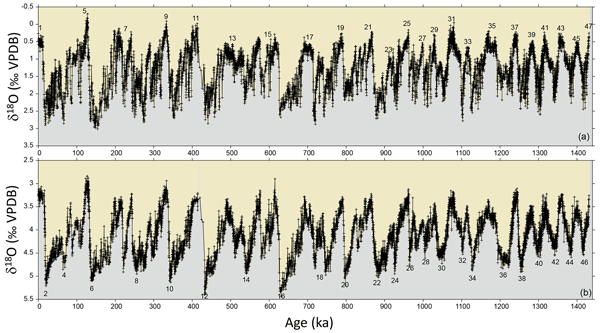
We produced a 1.5-million-year-long history of climate change at International Ocean Discovery Program Site U1385 of the Iberian margin, a well-known location for rapidly accumulating sediments on the seafloor. Our record demonstrates that longer-term orbital changes in Earth's climate were persistently overprinted by abrupt millennial-to-centennial climate variability. The occurrence of abrupt climate change is modulated by the slower variations in Earth's orbit and climate background state.
Svetlana Radionovskaya, Mervyn Greaves, David J. R. Thornalley, and Luke C. Skinner
EGUsphere, https://doi.org/10.5194/egusphere-2026-3334, https://doi.org/10.5194/egusphere-2026-3334, 2026
Short summary
Short summary
We studied deep ocean conditions in the Northeast Atlantic during a transition into an ice age to understand how different climate states and forcings influence ocean circulation, using chemical signals preserved in tiny fossil shells. We found unexpectedly warm conditions and strong deep-water flow during rapid cold climatic events. These findings provide new insights into deep-water formation and ocean circulation under different climate states.
David A. Hodell and Arisa Seki
Proc. Int. Ocean Drill. Prog., 506S, 1, https://doi.org/10.5194/piodp-506S-1-2026, https://doi.org/10.5194/piodp-506S-1-2026, 2026
Short summary
Short summary
IODP3 Expedition 506S will integrate sediment core data from key North Atlantic drill sites, aligning records to build a regional climate history. The team will develop advanced computational tools for signal alignment and image analysis, improving correlations of past climatic shifts. The expedition will also create user-friendly resources to train new paleoclimate researchers, and all data and methods will be shared openly.
Biagio Giaccio, Bernd Wagner, Giovanni Zanchetta, Adele Bertini, Gian Paolo Cavinato, Roberto de Franco, Fabio Florindo, David A. Hodell, Thomas A. Neubauer, Sebastien Nomade, Alison Pereira, Laura Sadori, Sara Satolli, Polychronis C. Tzedakis, Paul Albert, Paolo Boncio, Cindy De Jonge, Alexander Francke, Christine Heim, Alessia Masi, Marta Marchegiano, Helen M. Roberts, Anders Noren, and the MEME team
Sci. Dril., 33, 249–266, https://doi.org/10.5194/sd-33-249-2024, https://doi.org/10.5194/sd-33-249-2024, 2024
Short summary
Short summary
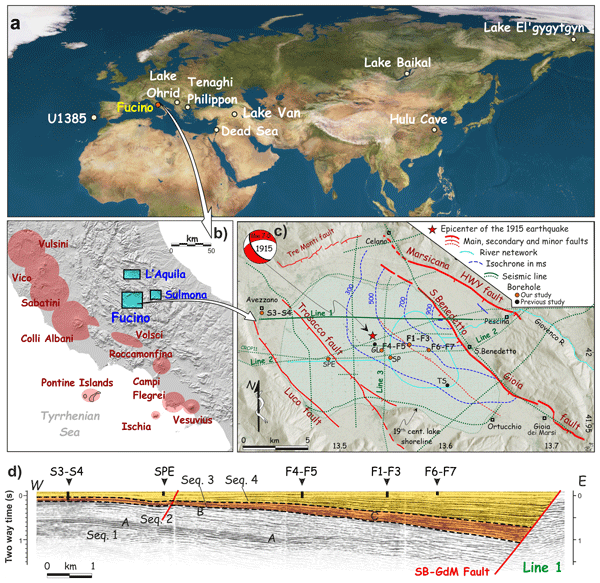
A total of 42 Earth scientists from 14 countries met in Gioia dei Marsi, central Italy, on 23 to 27 October 2023 to explore the potential for deep drilling of the thick lake sediment sequence of the Fucino Basin. The aim was to reconstruct the history of climate, ecosystem, and biodiversity changes and of the explosive volcanism and tectonics in central Italy over the last 3.5 million years, constrained by a detailed radiometric chronology.

Lauren E. Burton, Alan M. Haywood, Julia C. Tindall, Aisling M. Dolan, Daniel J. Hill, Erin L. McClymont, Sze Ling Ho, and Heather L. Ford
Clim. Past, 20, 1177–1194, https://doi.org/10.5194/cp-20-1177-2024, https://doi.org/10.5194/cp-20-1177-2024, 2024
Short summary
Short summary
The Pliocene (~ 3 million years ago) is of interest because its warm climate is similar to projections of the future. We explore the role of atmospheric carbon dioxide in forcing sea surface temperature during the Pliocene by combining climate model outputs with palaeoclimate proxy data. We investigate whether this role changes seasonally and also use our data to suggest a new estimate of Pliocene climate sensitivity. More data are needed to further explore the results presented.
Julia Homann, Niklas Karbach, Stacy A. Carolin, Daniel H. James, David Hodell, Sebastian F. M. Breitenbach, Ola Kwiecien, Mark Brenner, Carlos Peraza Lope, and Thorsten Hoffmann
Biogeosciences, 20, 3249–3260, https://doi.org/10.5194/bg-20-3249-2023, https://doi.org/10.5194/bg-20-3249-2023, 2023
Short summary
Short summary
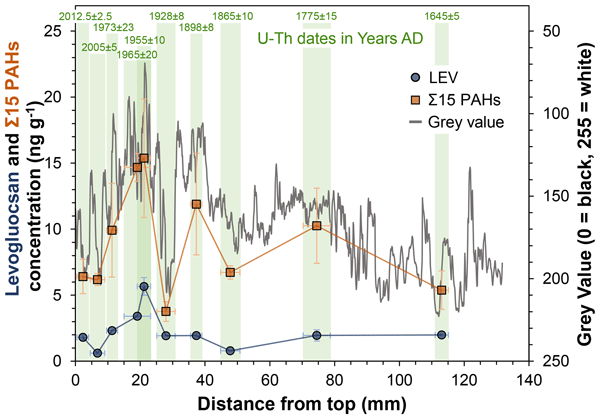
Cave stalagmites contain substances that can be used to reconstruct past changes in local and regional environmental conditions. We used two classes of biomarkers (polycyclic aromatic hydrocarbons and monosaccharide anhydrides) to detect the presence of fire and to also explore changes in fire regime (e.g. fire frequency, intensity, and fuel source). We tested our new method on a stalagmite from Mayapan, a large Maya city on the Yucatán Peninsula.
Rodrigo Martínez-Abarca, Michelle Abstein, Frederik Schenk, David Hodell, Philipp Hoelzmann, Mark Brenner, Steffen Kutterolf, Sergio Cohuo, Laura Macario-González, Mona Stockhecke, Jason Curtis, Flavio S. Anselmetti, Daniel Ariztegui, Thomas Guilderson, Alexander Correa-Metrio, Thorsten Bauersachs, Liseth Pérez, and Antje Schwalb
Clim. Past, 19, 1409–1434, https://doi.org/10.5194/cp-19-1409-2023, https://doi.org/10.5194/cp-19-1409-2023, 2023
Short summary
Short summary
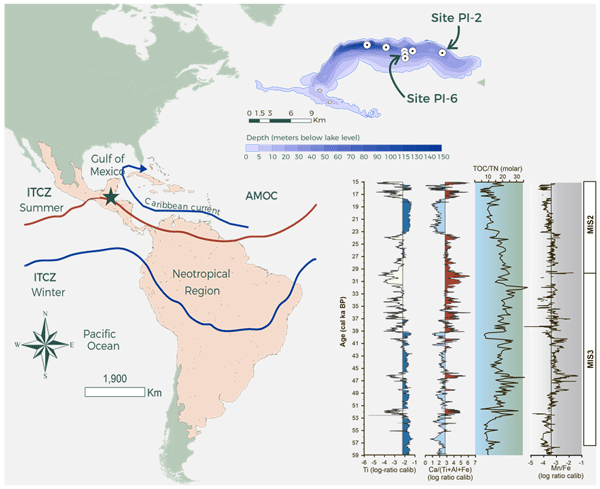
Lake Petén Itzá, northern Guatemala, is one of the oldest lakes in the northern Neotropics. In this study, we analyzed geochemical and mineralogical data to decipher the hydrological response of the lake to climate and environmental changes between 59 and 15 cal ka BP. We also compare the response of Petén Itzá with other regional records to discern the possible climate forcings that influenced them. Short-term climate oscillations such as Greenland interstadials and stadials are also detected.
David A. Hodell, Simon J. Crowhurst, Lucas Lourens, Vasiliki Margari, John Nicolson, James E. Rolfe, Luke C. Skinner, Nicola C. Thomas, Polychronis C. Tzedakis, Maryline J. Mleneck-Vautravers, and Eric W. Wolff
Clim. Past, 19, 607–636, https://doi.org/10.5194/cp-19-607-2023, https://doi.org/10.5194/cp-19-607-2023, 2023
Short summary
Short summary
We produced a 1.5-million-year-long history of climate change at International Ocean Discovery Program Site U1385 of the Iberian margin, a well-known location for rapidly accumulating sediments on the seafloor. Our record demonstrates that longer-term orbital changes in Earth's climate were persistently overprinted by abrupt millennial-to-centennial climate variability. The occurrence of abrupt climate change is modulated by the slower variations in Earth's orbit and climate background state.
Eric W. Wolff, Hubertus Fischer, Tas van Ommen, and David A. Hodell
Clim. Past, 18, 1563–1577, https://doi.org/10.5194/cp-18-1563-2022, https://doi.org/10.5194/cp-18-1563-2022, 2022
Short summary
Short summary
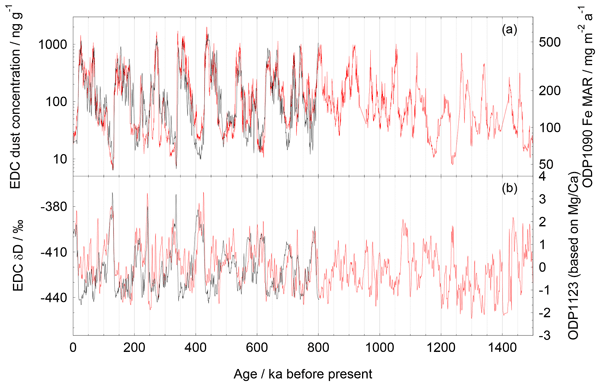
Projects are underway to drill ice cores in Antarctica reaching 1.5 Myr back in time. Dating such cores will be challenging. One method is to match records from the new core against datasets from existing marine sediment cores. Here we explore the options for doing this and assess how well the ice and marine records match over the existing 800 000-year time period. We are able to recommend a strategy for using marine data to place an age scale on the new ice cores.

Anna Joy Drury, Diederik Liebrand, Thomas Westerhold, Helen M. Beddow, David A. Hodell, Nina Rohlfs, Roy H. Wilkens, Mitchell Lyle, David B. Bell, Dick Kroon, Heiko Pälike, and Lucas J. Lourens
Clim. Past, 17, 2091–2117, https://doi.org/10.5194/cp-17-2091-2021, https://doi.org/10.5194/cp-17-2091-2021, 2021
Short summary
Short summary
We use the first high-resolution southeast Atlantic carbonate record to see how climate dynamics evolved since 30 million years ago (Ma). During ~ 30–13 Ma, eccentricity (orbital circularity) paced carbonate deposition. After the mid-Miocene Climate Transition (~ 14 Ma), precession (Earth's tilt direction) increasingly drove carbonate variability. In the latest Miocene (~ 8 Ma), obliquity (Earth's tilt) pacing appeared, signalling increasing high-latitude influence.
Cited articles
Adkins, J. F.: The role of deep ocean circulation in setting glacial climates, Paleoceanography, 28, 539–561, https://doi.org/10.1002/palo.20046, 2013.
Adkins, J. F., McIntyre, K. and Schrag, D. P.: The salinity, temperature, and δ18O of the glacial deep ocean. Science, 298, 1769–1773, https://doi.org/10.1126/science.1076252, 2002.
Ahn, S., Khider, D., Lisiecki, L. E., and Lawrence, C. E.: A probabilistic Pliocene–Pleistocene stack of benthic δ18O using a profile hidden Markov model, Dyn. Stat. Clim. Syst., 2, 1–16, https://doi.org/10.1093/climsys/dzx002, 2017.
An, Z., Zhou, W., Zhang, Z., Zhang, X., Liu, Z., Sun, Y., Clemens, S. C., Wu, L., Zhao, J., Shi, Z., Ma, X., Yan, H., Li, G., Cai, Y., Yu, J., Sun, Y., Li, S., Zhang, Y., Stepanek, C., Lohmann, G., Dong, G., Cheng, H., Liu, Y., Jin, Z., Li, T., Hao, Y., Lei, J., and Cai, W.: Mid-Pleistocene climate transition triggered by Antarctic Ice Sheet growth, Science, 385, 560–565, https://doi.org/10.1126/science.abn4861, 2024.
Barker, S., Greaves, M., and Elderfield, H.: A study of cleaning procedures used for foraminiferal
Barrientos, N., Lear, C. H., Jakobsson, M., Stranne, C., O'Regan, M., Cronin, T. M., Gukov, A. Y., and Coxall, H. K.: Arctic Ocean benthic foraminifera Mg/Ca ratios and global Mg/Ca-temperature calibrations: New constraints at low temperatures, Geochim. Cosmochim. Ac., 236, 240–259, https://doi.org/10.1016/j.gca.2018.02.036, 2018.
Basak, C., Kapuge, A. K. I. U., Farmer, J. R., Symes, E., Middleton, J. L., Gottschalk, J., Arz, H. W., Lamy, F., Winckler, G., and Cruz, A. P. S.: Southern Hemisphere initiation of the mid-Pleistocene transition, Sci. Adv., 12, https://doi.org/10.1126/sciadv.aea6811, 2026.
Bereiter, B., Eggleston, S., Schmitt, J., Nehrbass-Ahles, C., Stocker, T. F., Fischer, H., Kipfstuhl, S., and Chappellaz, J.: Revision of the EPICA Dome C CO2 record from 800 to 600 kyr before present, Geophys. Res. Lett., 42, 542–549, https://doi.org/10.1002/2014GL061957, 2015.
Berends, C. J., Köhler, P., Lourens, L. J., and van de Wal, R. S. W.: On the cause of the mid-Pleistocene transition, Rev. Geophys., 59, 1–20, https://doi.org/10.1029/2020RG000727, 2021a.
Berends, C. J., de Boer, B., and van de Wal, R. S. W.: Reconstructing the evolution of ice sheets, sea level, and atmospheric CO2 during the past 3.6 million years, Clim. Past, 17, 361–377, https://doi.org/10.5194/cp-17-361-2021, 2021b.
Berger, A., Li, X. S., and Loutre, M. F.: Modelling Northern Hemisphere ice volume over the last 3 Ma, Quat. Sci. Rev., 18, 1–11, https://doi.org/10.1016/S0277-3791(98)00033-X, 1999.
Billups, K., York, K., and Bradtmiller, L. I.: Water column stratification in the Antarctic Zone of the Southern Ocean during the Mid-Pleistocene Climate Transition, Paleoceanogr. Paleoclimatol., 33, 432–442, https://doi.org/10.1029/2018PA003327, 2018.
Bintanja, R. and van de Wal, R. S. W.: North American ice-sheet dynamics and the onset of 100 000-year glacial cycles, Nature, 454, 869–872, https://doi.org/10.1038/nature07158, 2008.
Birner, B., Hodell, D. A., Tzedakis, P. C., and Skinner, L. C.: Similar millennial climate variability on the Iberian Margin during two early Pleistocene glacials and MIS 3, Paleoceanography, 31, 203–217, https://doi.org/10.1002/2015PA002868, 2016.
Boiteau, R., Greaves, M., and Elderfield, H.: Authigenic uranium in foraminiferal coatings: A proxy for ocean redox chemistry, Paleoceanography, 27, 1–8, https://doi.org/10.1029/2012PA002335, 2012.
Broecker, W. S. and Peng, T. H.: Tracers in the sea, Eldigio Press, Palisades, N.Y., https://search.worldcat.org/title/Tracers-in-the-sea/oclc/803229079 (last access: 13 August 2026), 1982.
Broecker, W. S. and Peng, T.-H. (Eds): Greenhouse Puzzles: Keeling's world, Martin's world, Walker's world, 2nd edn., Eldigio Press, Palisades, N.Y., https://search.worldcat.org/title/43531254?oclcNum=43531254 (last access: 13 August 2026), 1998.
Butcher, S., King, T., and Zalewski, L., Apocrita – High Performance Computing Cluster for Queen Mary University of London: London, Queen Mary University of London Technical Report, 2 pp., https://doi.org/10.5281/zenodo.438045, 2017.
Chalk, T. B., Hain, M. P., Foster, G. L., Rohling, E. J., Sexton, P. F., Badger, M. P. S., Cherry, S. G., Hasenfratz, A. P., Haug, G. H., Jaccard, S. L., Martínez-García, A., Pälike, H., Pancost, R. D., and Wilson, P. A.: Causes of ice age intensification across the Mid-Pleistocene Transition, Proc. Natl. Acad. Sci., 114, 13114–13119, https://doi.org/10.1073/pnas.1702143114, 2017.
Chalk, T. B., Foster, G. L., and Wilson, P. A.: Dynamic storage of glacial CO2 in the Atlantic Ocean revealed by boron [CO
Chandler, D. M. and Langebroek, P. M.: Glacial-interglacial Circumpolar Deep Water temperatures during the last 800 000 years: estimates from a synthesis of bottom water temperature reconstructions, Clim. Past, 20, 2055–2080, https://doi.org/10.5194/cp-20-2055-2024, 2024.
Chandler, M., Zilberman, N. V, and Sprintall, J.: The Deep Western Boundary Current of the Southwest Pacific Basin: insights from DeepArgo, J. Geophys. Res.-Ocean., 129, https://doi.org/10.1029/2024JC021098, 2024.
Clark, P. U. and Pollard, D.: Origin of the Middle Pleistocene Transition by ice sheet erosion of regolith, Paleoceanography, 13, 1–9, https://doi.org/10.1029/97PA02660, 1998.
Clark, P. U., Archer, D., Pollard, D., Blum, J. D., Rial, J. A., Brovkin, V., Mix, A. C., Pisias, N. G., and Roy, M.: The Middle Pleistocene Transition: characteristics, mechanisms, and implications for long-term changes in atmospheric pCO2, Quat. Sci. Rev., 25, 3150–3184, https://doi.org/10.1016/j.quascirev.2006.07.008, 2006.
Clark, P. U., Shakun, J. D., Rosenthal, Y., Köhler, P., and Bartlein, P. J.: Global and regional temperature change over the past 4.5 million years, Science, 383, 884–890, https://doi.org/10.1126/science.adi1908, 2024.
Clark, P. U., Shakun, J. D., Rosenthal, Y., Zhu, C., Bartlein, P. J., Gregory, J. M., Köhler, P., Liu, Z., and Schrag, D. P.: Mean ocean temperature change and decomposition of the benthic δ18O record over the past 4.5 million years, Clim. Past, 21, 973–1000, https://doi.org/10.5194/cp-21-973-2025, 2025a.
Clark, P. U., Shakun, J. D., Rosenthal, Y., Pollard, D., Hostetler, S. W., Köhler, P., Bartlein, P. J., Gregory, J. M., Zhu, C., Schrag, D. P., Liu, Z., and Pisias, N. G.: Global mean sea level over the past 4.5 million years, Science, 390, 260–271, https://doi.org/10.1126/science.adv8389, 2025b.
de Lange, G. J., van Os, B., and Poorter, R.: Geochemical composition and inferred accretion rates of sediments and managanese nodules from a submarine hill in the Madeira Abyssal Plain, eastern North Atlantic, Mar. Geol., 109, 171–194, https://doi.org/10.1016/0025-3227(92)90227-9, 1992.
de Villiers, S., Greaves, M., and Elderfield, H.: An intensity ratio calibration method for the accurate determination of
Diz, P., Cobelo-García, A., Hernández-Almeida, I., Corbí, H., and Bernasconi, S. M.: Persistent East Equatorial Pacific carbon storage at the Middle Pleistocene Transition, Paleoceanogr. Paleoclimatol., 35, https://doi.org/10.1029/2019PA003789, 2020.
Dyez, K. A., Hönisch, B., and Schmidt, G. A.: Early Pleistocene obliquity-scale pCO2 variability at ∼ 1.5 million years ago, Paleoceanogr. Paleoclimatol., 33, 1270–1291, https://doi.org/10.1029/2018PA003349, 2018.
Elderfield, H., Yu, J., Anand, P., Kiefer, T., and Nyland, B.: Calibrations for benthic foraminiferal
Elderfield, H., Greaves, M., Barker, S., Hall, I. R., Tripati, A., Ferretti, P., Crowhurst, S., Booth, L., and Daunt, C.: A record of bottom water temperature and seawater δ18O for the Southern Ocean over the past 440 kyr based on
Elderfield, H., Ferretti, P., Greaves, M., Crowhurst, S. J., McCave, I. N., Hodell, D., and Piotrowski, A. M.: Evolution of ocean temperature and ice volume through the Mid-Pleistocene Climate Transition, Science, 337, 704–709, https://doi.org/10.1126/science.1221294, 2012.
Farmer, J. R., Hönisch, B., Haynes, L. L., Kroon, D., Jung, S., Ford, H. L., Raymo, M. E., Jaume-Seguí, M., Bell, D. B., Goldstein, S. L., Pena, L. D., Yehudai, M., and Kim, J.: Deep Atlantic Ocean carbon storage and the rise of 100 000-year glacial cycles, Nat. Geosci., 12, 350–360, https://doi.org/10.1038/s41561-019-0334-6, 2019.
Ferrari, R., Jansen, M. F., Adkins, J. F., Burke, A., Stewart, A. L., and Thompson, A. F.: Antarctic sea ice control on ocean circulation in present and glacial climates, Proc. Natl. Acad. Sci. USA, 111, 8753–8758, https://doi.org/10.1073/pnas.1323922111, 2014.
Ford, H. L. and Raymo, M. E.: Regional and global signals in seawater δ18O records across the Mid-Pleistocene Transition, Geology, 48, 113–117, https://doi.org/10.1130/G46546.1, 2020.
Ford, H. L., Sosdian, S. M., Rosenthal, Y., and Raymo, M. E.: Gradual and abrupt changes during the Mid-Pleistocene Transition, Quat. Sci. Rev., 148, 222–233, https://doi.org/10.1016/j.quascirev.2016.07.005, 2016.
Frew, R. D., Dennis, P. F., Heywood, K. J., Meredith, M. P., and Boswell, S. M.: The oxygen isotope composition of water masses in the northern North Atlantic, Deep-Sea Res. Oceanogr. Res. Pap., 47, 2265–2286, https://doi.org/10.1016/S0967-0637(00)00023-6, 2000.
Ganopolski, A.: Toward generalized Milankovitch theory (GMT), Clim. Past, 20, 151–185, https://doi.org/10.5194/cp-20-151-2024, 2024.
Gildor, H. and Tziperman, E.: Physical mechanisms behind biogeochemical glacial-interglacial CO2 variations, Geophys. Res. Lett., 28, 2421–2424, https://doi.org/10.1029/2000GL012571, 2001.
Grant, K. M., Rohling, E. J., Bar-Matthews, M., Ayalon, A., Medina-Elizalde, M., Ramsey, C. B., Satow, C., and Roberts, A. P.: Rapid coupling between ice volume and polar temperature over the past 150 000 years, Nature, 491, 744–747, https://doi.org/10.1038/nature11593, 2012.
Grant, K. M., Rohling, E. J., Bronk Ramsey, C., Cheng, H., Edwards, R. L., Florindo, F., Heslop, D., Marra, F., Roberts, A. P., Tamisiea, M. E., and Williams, F.: Sea-level variability over five glacial cycles, Nat. Commun., 5, https://doi.org/10.1038/ncomms6076, 2014.
Greaves, M., Caillon, N., Rebaubier, H., Bartoli, G., Bohaty, S., Cacho, I., Clarke, L., Cooper, M., Daunt, C., Delaney, M., DeMenocal, P., Dutton, A., Eggins, S., Elderfield, H., Garbe-Schoenberg, D., Goddard, E., Green, D., Groeneveld, J., Hastings, D., Hathorne, E., Kimoto, K., Klinkhammer, G., Labeyrie, L., Lea, D. W., Marchitto, T., Martínez-Botí, M. A., Mortyn, P. G., Ni, Y., Nuernberg, D., Paradis, G., Pena, L., Quinn, T., Rosenthal, Y., Russel, A., Sagawa, T., Sosdian, S., Stott, L., Tachikawa, K., Tappa, E., Thunell, R., and Wilson, P. A.: Interlaboratory comparison study of calibration standards for foraminiferal
Greaves, M. J.: Trace Elements in Marine Biogenic Carbonates: Analysis and Application to Past Ocean Chemistry, PhD thesis, University of Southampton 194 pp., https://eprints.soton.ac.uk/63291/ (last access: 13 August 2026), 2008.
Grimmer, M., Baggenstos, D., Schmitt, J., Krauss, F., Shackleton, S., Severinghaus, J. P., and Fischer, H.: AMOC modulates ocean heat content during deglaciations, Geophys. Res. Lett., 52, 1–12, https://doi.org/10.1029/2024GL114415, 2025.
Hall, I. R., McCave, I. N., Shackleton, N. J., Weedon, G. P., and Harris, S. E.: Intensified deep Pacific inflow and ventilation in Pleistocene glacial times, Nature, 412, 809–812, https://doi.org/10.1038/35090552, 2001.
Hasenfratz, A. P., Martínez-García, A., Jaccard, S. L., Vance, D., Wälle, M., Greaves, M., and Haug, G. H.: Determination of the
Hasenfratz, A. P., Jaccard, S. L., Martínez-García, A., Sigman, D. M., Hodell, D. A., Vance, D., Bernasconi, S. M., Kleiven, H. (Kikki) F., Haumann, F. A., and Haug, G. H.: The residence time of Southern Ocean surface waters and the 100 000-year ice age cycle, Science, 363, 1080–1084, https://doi.org/10.1126/science.aat7067, 2019.
Herbert, T. D.: The Mid-Pleistocene Climate Transition, Annu. Rev. Earth Planet. Sci., 51, 389–418, https://doi.org/10.1146/annurev-earth-032320-104209, 2023.
Higgins, J. A., Kurbatov, A. V., Spaulding, N. E., Brook, E., Introne, D. S., Chimiak, L. M., Yan, Y., Mayewski, P. A., and Bender, M. L.: Atmospheric composition 1 million years ago from blue ice in the Allan Hills, Antarctica, Proc. Natl. Acad. Sci., 112, 6887–6891, https://doi.org/10.1073/pnas.1420232112, 2015.
Hines, S. K. V., Charles, C. D., Starr, A., Goldstein, S. L., Hemming, S. R., Hall, I. R., Lathika, N., Passacantando, M., and Bolge, L.: Revisiting the mid-Pleistocene transition ocean circulation crisis, Science, 386, 681–686, https://doi.org/10.1126/science.adn4154, 2024.
Hodell, D. A., Venz, K. A., Charles, C. D., and Ninnemann, U. S.: Pleistocene vertical carbon isotope and carbonate gradients in the South Atlantic sector of the Southern Ocean, Geochem. Geophys. Geosyst., 4, 1–19, https://doi.org/10.1029/2002GC000367, 2003.
Hodell, D. A., Elderfield, H., Greaves, M., McCave, I. N., Skinner, L., Thomas, A., and White, N.: The JC089 scientific party, JC089 cruise report – IODP site survey of the Shackleton sites, SW Iberian Margin, British Oceanographic Data Centre, https://www.bodc.ac.uk/resources/inventories/cruise_inventory/report/13392/ (last access: 13 August 2026), 2014.
Hodell, D., Lourens, L., Crowhurst, S., Konijnendijk, T., Tjallingii, R., Jimenez-Espejo, F., Skinner, L., Tzedakis, P. C., Abrantes, F., Acton, G. D., Alvarez Zarikian, C. A., Bahr, A., Balestra, B., Barranco, E. L., Carrara, G., Ducassou, E., Flood, R. D., Flores, J.-A., Furota, S., Grimalt, J., Grunert, P., Hernandez- Molina, J., Kim, J. K., Krissek, L. A., Kuroda, J., Li, B., Lofi, J., Margari, V., Martrat, B., Miller, M. D., Nanayama, F., Nishida, N., Richter, C., Rodrigues, T., Rodríguez-Tovar, F. J., Roque, A. C. F., Sanchez Goni, M. F., Sierro Sanchez, F. J., Singh, A. D., Sloss, C. R., Stow, D. A., Takashimizu, Y., Tzanova, A., Voelker, A., Xuan, C., and Williams, T.: A reference time scale for Site U1385 (Shackleton Site) on the SW Iberian Margin, Glob. Planet. Change, 133, 49–64, https://doi.org/10.1016/j.gloplacha.2015.07.002, 2015.
Hodell, D. A., Crowhurst, S. J., Lourens, L., Margari, V., Nicolson, J., Rolfe, J. E., Skinner, L. C., Thomas, N. C., Tzedakis, P. C., Mleneck-Vautravers, M. J., and Wolff, E. W.: A 1.5-million-year record of orbital and millennial climate variability in the North Atlantic, Clim. Past, 19, 607–636, https://doi.org/10.5194/cp-19-607-2023, 2023a.
Hodell, D. A., Crowhurst, S. J., Lourens, L. J., Margari, V., Nicolson, J., Rolfe, J. E., Skinner, L. C., Thomas, N. C., Tzedakis, P. C., Mleneck-Vautravers, M. J., and Wolff, E. W.: Benthic and planktonic oxygen and carbon isotopes and XRF data at IODP Site U1385 and core MD01-2444 from 0 to 1.5 Ma, PANGAEA [data set], https://doi.org/10.1594/PANGAEA.951401, 2023b.
Hodell, D. A., Abrantes, F., Alvarez Zarikian, C. A., Herbert, T. D., Du, M., Crowhurst, S. J., Mleneck-Vautravers, M., Rolfe, J. E., Chen, X., Brooks, H. L., Clark, W. B., Dauchy-Tric, L. F. B., Dos Santos Rocha, V., Flores, J. A., Hines, S. K. V., Huang, H. H. M., Ikeda, H., Kaboth-Bahr, S., Kuroda, J., Link, J. M., McManus, J. F., Mitsunaga, B. A., Yobo, L. N., Pallone, C. T., Pang, X., Péral, M. Y., Salgueiro, E., Sanchez, S., Verma, K., Wu, J., Xuan, C., Yu, J., Haygood, L. A., Liebrand, D., Magalhães, V., Alonso-Garcia, M., Duque-Castaño, M., Ferreira, F., Freitas, M., Cordeiro, L. G., Gil, I., González-Martín, M., Lopes, A., Lopes, C., Margari, V., Martín-García, L., Matos, L., Mega, A., Molina, G., Naughton, F., Oliveira, D., Rebotim, A., Rodrigues, T., Santana, A., Trejos-Tamayo, R., and Tzedakis, P. C.: Onset of millennial climate variability with the intensification of Northern Hemisphere glaciation, Science, 392, 57–62, https://doi.org/10.1126/science.ady7970, 2026.
Hoogakker, B., Elderfield, H., Oliver, K., and Crowhurst, S.: Benthic foraminiferal oxygen isotope offsets over the last glacial-interglacial cycle, Paleoceanography, 25, 1–11, https://doi.org/10.1029/2009PA001870, 2010.
Hönisch, B., Hemming, N. G., Archer, D., Siddall, M., and McManus, J. F.: Atmospheric carbon dioxide concentration across the Mid-Pleistocene Transition, Science, 324, 1551–1554, https://doi.org/10.1126/science.1171477, 2009.
Imbrie, J., Hays, J. D., Martinson, D. G., McIntyre, A., Mix, A. C., Morley, J. J., Pisias, N. G., Prell, W. L., and Shackleton, N. J.: The orbital theory of Pleistocene climate: support from a revised chronology of the marine δ18O record, in: Milankovitch and climate, Part 1, edited by: Berger, A. L., Imbrie, J., Hays, J., Kukla, G., Saltzman, B., D. Reidel Publishing Company, Dordrecht, 269–305, https://doi.org/10.1007/978-94-017-4841-4_11, 1984.
Insua, T. L., Spivach, A. J., Graham, D., D'Hondt, S., and Moran, K.: Reconstruction of Pacific Ocean bottom water salinity during the Last Glacial Maximum, Geophys. Res. Lett., 41, 2914–2920, https://doi.org/10.1002/2014GL059575, 2014.
Jaccard, S. L., Hayes, C. T., Martínez-García, A., Hodell, D. A., Anderson, R. F., Sigman, D. M., and Haug, G. H.: Two modes of change in Southern Ocean productivity over the past million years, Science, 339, 1419–1423, https://doi.org/10.1126/science.1227545, 2013.
Jansen, M. F.: Glacial ocean circulation and stratification explained by reduced atmospheric temperature, Proc. Natl. Acad. Sci. USA, 114, 45–50, https://doi.org/10.1073/pnas.1610438113, 2017.
Kim, H. and Timmermann, A.: Seawater oxygen isotopes as a tool for monitoring future meltwater from the Antarctic ice-sheet, Commun. Earth Environ., 5, 1–11, https://doi.org/10.1038/s43247-024-01514-4, 2024.
Kim, J., Goldstein, S. L., Pena, L. D., Jaume-Seguí, M., Knudson, K. P., Yehudai, M., and Bolge, L.: North Atlantic Deep Water during Pleistocene interglacials and glacials, Quat. Sci. Rev., 269, 1–19, https://doi.org/10.1016/j.quascirev.2021.107146, 2021.
Knorr, G., Barker, S., Zhang, X., Lohmann, G., Gong, X., Gierz, P., Stepanek, C., and Stap, L. B.: A salty deep ocean as a prerequisite for glacial termination, Nat. Geosci., 14, 930–936, https://doi.org/10.1038/s41561-021-00857-3, 2021.
Lamy, F., Winckler, G., Arz, H. W., Farmer, J. R., Gottschalk, J., Lembke-Jene, L., Middleton, J. L., van der Does, M., Tiedemann, R., Alvarez Zarikian, C., Basak, C., Brombacher, A., Dumm, L., Esper, O. M., Herbert, L. C., Iwasaki, S., Kreps, G., Lawson, V. J., Lo, L., Malinverno, E., Martinez-Garcia, A., Michel, E., Moretti, S., Moy, C. M., Ravelo, A. C., Riesselman, C. R., Saavedra-Pellitero, M., Sadatzki, H., Seo, I., Singh, R. K., Smith, R. A., Souza, A. L., Stoner, J. S., Toyos, M., de Oliveira, I. M. V. P., Wan, S., Wu, S., and Zhao, X.: Five million years of Antarctic Circumpolar Current strength variability, Nature, 627, 789–796, https://doi.org/10.1038/s41586-024-07143-3, 2024.
Lang, D. C., Bailey, I., Wilson, P. A., Chalk, T. B., Foster, G. L., and Gutjahr, M.: Incursions of southern-sourced water into the deep North Atlantic during late Pliocene glacial intensification, Nat. Geosci., 9, 375–379, https://doi.org/10.1038/ngeo2688, 2016.
Larsson, V. and Jung, S.: Persistent contamination in benthic-foraminifera-based
Lawrence, K. T., Herbert, T. D., Brown, C. M., Raymo, M. E., and Haywood, A. M.: High-amplitude variations in North Atlantic sea surface temperature during the early Pliocene warm period, Paleoceanography, 24, 1–15, https://doi.org/10.1029/2008PA001669, 2009.
Lear, C. H., Rosenthal, Y., and Wright, J. D.: The closing of a seaway: Ocean water masses and global climate change, Earth Planet. Sci. Lett., 210, 425–436, https://doi.org/10.1016/S0012-821X(03)00164-X, 2003.
Lear, C. H., Billups, K., Rickaby, R. E. M., Diester-Haass, L., Mawbey, E. M., and Sosdian, S. M.: Breathing more deeply: Deep ocean carbon storage during the mid-Pleistocene climate transition, Geology, 44, 1035–1038, https://doi.org/10.1130/G38636.1, 2016.
Legrain, E., Parrenin, F., and Capron, E.: A gradual change is more likely to have caused the Mid-Pleistocene Transition than an abrupt event, Commun. Earth Environ., 4, 1–10, 2023.
LeGrande, A. N. and Schmidt, G. A.: Global gridded data set of the oxygen isotopic composition in seawater, Geophys. Res. Lett., 33, L12604, https://doi.org/10.1029/2006GL026011, 2006.
Li, K., Tian, J., Zhao, N., Du, J., Liu, Z., Du, J., and Huang, E.: Stable Pacific deep circulation punctuated by episodic intensification during the Mid-Pleistocene Transition, Glob. Planet. Change, 257, https://doi.org/10.1016/j.gloplacha.2025.105229, 2026.
Liautaud, P.: Causes, evolution, and dynamics of ice ages in the last 3 million years, PhD thesis, Harvard University Graduate School of Arts and Sciences, https://nrs.harvard.edu/URN-3:HUL.INSTREPOS:37371116 (last access: 13 August 2026), 2021.
Liautaud, P. R., Hodell, D. A., and Huybers, P. J.: Detection of significant climatic precession variability in early Pleistocene glacial cycles, Earth Planet. Sci. Lett., 536, https://doi.org/10.17863/CAM.49020, 2020.
Lin, L., Khider, D., Lisiecki, L. E., and Lawrence, C. E.: Probabilistic sequence alignment of stratigraphic records, Paleoceanography, 29, 976–989, https://doi.org/10.1002/2014PA002713, 2014.
Lisiecki, L. E.: Atlantic overturning responses to obliquity and precession over the last 3 Myr, Paleoceanography, 29, 71–86, https://doi.org/10.1002/2013PA002505, 2014.
Lisiecki, L. E. and Raymo, M. E.: A Pliocene-Pleistocene stack of 57 globally distributed benthic δ18O records, Paleoceanography, 20, PA1003, https://doi.org/10.1029/2004PA001071, 2005.
Lisiecki, L. E. and Stern, J. V.: Regional and global benthic δ18O stacks for the last glacial cycle, Paleoceanography, 31, 1368–1394, https://doi.org/10.1002/2016PA003002, 2016.
Liu, M. and Tanhua, T.: Water masses in the Atlantic Ocean: characteristics and distributions, Ocean Sci., 17, 463–486, https://doi.org/10.5194/os-17-463-2021, 2021.
Marinov, I., Gnanadesikan, A., Toggweiler, J. R., and Sarmiento, J. L.: The Southern Ocean biogeochemical divide, Nature, 441, 964–967, https://doi.org/10.1038/nature04883, 2006.
Marinov, I., Gnanadesikan, A., Sarmiento, J. L., Toggweiler, J. R., Follows, M., and Mignone, B. K.: Impact of oceanic circulation on biological carbon storage in the ocean and atmospheric pCO2, Global Biogeochem. Cycles, 22, 1–15, https://doi.org/10.1029/2007GB002958, 2008.
Marks-Peterson, J., Shackleton, S., Higgins, J., Severinghaus, J., Yan, Y., Buizert, C., Kalk, M., Beaudette, R., Hishamunda, V., Eves, D., Carter, A., Kurbatov, A., Epifanio, J., Morgan, J., Nesbitt, I., Bender, M., and Brook, E.: Broadly stable atmospheric CO2 and CH4 levels over the past 3 million years, Nature, 651, 647–651, https://doi.org/10.1038/s41586-025-10032-y, 2026.
Martínez-Garcia, A., Rosell-Melé, A., McClymont, E. L., Gersonde, R., and Haug, G. H.: Subpolar link to the emergence of the modern equatorial pacific cold tongue, Science, 328, 1550–1553, https://doi.org/10.1126/science.1184480, 2010.
Martínez-Garcia, A., Rosell-Melé, A., Jaccard, S. L., Geibert, W., Sigman, D. M., and Haug, G. H.: Southern Ocean dust-climate coupling over the past four million years, Nature, 476, 312–315, https://doi.org/10.1038/nature10310, 2011.
McClymont, E. L., Rosell-Melé, A., Haug, G. H., and Lloyd, J. M.: Expansion of subarctic water masses in the North Atlantic and Pacific oceans and implications for mid-Pleistocene ice sheet growth, Paleoceanography, 23, 1–12, https://doi.org/10.1029/2008PA001622, 2008.
McClymont, E. L., Sosdian, S. M., Rosell-Melé, A., and Rosenthal, Y.: Pleistocene sea-surface temperature evolution: Early cooling, delayed glacial intensification, and implications for the mid-Pleistocene climate transition, Earth-Sci. Rev., 123, 173–193, https://doi.org/10.1016/j.earscirev.2013.04.006, 2013.
McKay, R., Naish, T., Powell, R., Barrett, P., Scherer, R., Talarico, F., Kyle, P., Monien, D., Kuhn, G., Jackolski, C., and Williams, T.: Pleistocene variability of Antarctic Ice Sheet extent in the Ross Embayment, Quat. Sci. Rev., 34, 93–112, https://doi.org/10.1016/j.quascirev.2011.12.012, 2012.
Pena, L. D. and Goldstein, S. L.: Thermohaline circulation crisis and impacts during the mid-Pleistocene transition, Science, 345, 318–322, https://doi.org/10.1126/science.1249770, 2014.
Peng, Z., Wang, R., Xiao, W., Jin, X., Dang, H., Ye, S., Wu, L., Wang, X., Liu, F., and Dang, S.: Sustained increase in Southwest Pacific Antarctic Intermediate Water carbon storage across the Mid-Pleistocene Transition, Glob. Planet. Change, 262, https://doi.org/10.1016/j.gloplacha.2026.105470, 2026.
Pérez-Montero, S., Alvarez-Solas, J., Swierczek-Jereczek, J., Moreno-Parada, D., Robinson, A., and Montoya, M.: Exploring the Mid-Pleistocene transition with a simple physical model, Clim. Past, 22, 625–646, https://doi.org/10.5194/cp-22-625-2026, 2026.
Pisias, N. G. and Moore, T. C.: The evolution of Pleistocene climate: A timeseries approach, Earth Planet. Sci. Lett., 52, 450–458, https://doi.org/10.1016/0012-821X(81)90197-7, 1981.
Poirier, R. K., Gaetano, M. Q., Acevedo, K., Schaller, M. F., Raymo, M. E., and Kozdon, R.: Quantifying diagenesis, contributing factors, and resulting isotopic bias in benthic foraminifera using the Foraminiferal Preservation Index: Implications for geochemical proxy records, Paleoceanogr. Paleoclimatol., 36, https://doi.org/10.1029/2020PA004110, 2021.
Pöppelmeier, F., Blaser, P., Gutjahr, M., Jaccard, S. L., Frank, M., Max, L., and Lippold, J.: Northern-sourced water dominated the Atlantic Ocean during the Last Glacial Maximum, Geology, 48, 826–829, https://doi.org/10.1130/g47628.1, 2020.
Pöppelmeier, F., Lippold, J., Blaser, P., Gutjahr, M., Frank, M., and Stocker, T. F.: Neodymium isotopes as a paleo-water mass tracer: A model-data reassessment, Quat. Sci. Rev., 279, https://doi.org/10.1016/j.quascirev.2022.107404, 2022.
Qin, B., Jia, Q., Xiong, Z., Li, T., Algeo, T. J., and Dang, H.: Sustained deep Pacific carbon storage after the Mid-Pleistocene Transition linked to enhanced Southern Ocean stratification, Geophys. Res. Lett., 49, https://doi.org/10.1029/2021GL097121, 2022.
Raymo, M. E., Oppo, D. W., and Curry, W.: The mid-Pleistocene climate transition: A deep sea carbon isotopic perspective, Paleoceanography, 12, 546–559, https://doi.org/10.1029/97PA01019, 1997.
Raymo, M. E., Lisiecki, L. E., and Nisancioglu, K. H.: Plio-Pleistocene ice volume, Antarctic climate, and the global δ18O record, Science, 313, 492–495, https://doi.org/10.1126/science.1123296, 2006.
Raymo, M. E., Kozdon, R., Evans, D., Lisiecki, L., and Ford, H. L.: The accuracy of Mid-Pliocene δ18O-based ice volume and sea level reconstructions, Earth-Sci. Rev., 177, 291–302, https://doi.org/10.1016/j.earscirev.2017.11.022, 2018.
Rohling, E. J., Yu, J., Heslop, D., Foster, G. L., Opdyke, B., and Roberts, A. P.: Sea level and deep-sea temperature reconstructions suggest quasi-stable states and critical transitions over the past 40 million years, Sci. Adv., 7, 1–7, https://doi.org/10.1126/sciadv.abf5326, 2021.
Schlitzer, R.: Ocean Data View, http://odv.awi.de (last access: 7 July 2026), 2026.
Shackleton, N.: Oxygen Isotope Analyses and Pleistocene Temperatures Re-assessed, Nature, 215, 15–17, https://doi.org/10.1038/215015a0, 1967.
Shackleton, N. J.: The 100 000-year ice-age cycle identified and found to lag temperature, carbon dioxide, and orbital eccentricity, Science, 289, 1897–1902, https://doi.org/10.1126/science.289.5486.1897, 2000.
Shackleton, N. J. and Opdyke, N. D.: Oxygen isotope and palaeomagnetic stratigraphy of Equatorial Pacific core V28-238: Oxygen isotope temperatures and ice volumes on a 105 year and 106 year scale, Quat. Res., 3, 39–55, https://doi.org/10.1016/0033-5894(73)90052-5, 1973.
Shackleton, N. J. and Opdyke, N. D.: Oxygen-isotope and paleomagnetic stratigraphy of Pacific core V28-239 late Pliocene to latest Pleistocene, Mem. Geol. Soc. Am., 145, 449–464, https://doi.org/10.1130/MEM145-p449, 1976.
Shackleton, S., Seltzer, A., Baggenstos, D., and Lisiecki, L. E.: Benthic δ18O records Earth's energy imbalance, Nat. Geosci., 16, 797–802, https://doi.org/10.1038/s41561-023-01250-y, 2023.
Shackleton, S., Hishamunda, V., Yan, Y., Carter, A., Morgan, J., Severinghaus, J., Aarons, S., Marks-Peterson, J., Epifanio, J., Buizert, C., Brook, E., Kurbatov, A. V., Bender, M. L., and Higgins, J.: Global ocean heat content over the past 3 million years, Nature, 651, 653–657, https://doi.org/10.1038/s41586-026-10116-3, 2026.
Siddall, M., Hönisch, B., Waelbroeck, C., and Huybers, P.: Changes in deep Pacific temperature during the mid-Pleistocene transition and Quaternary, Quat. Sci. Rev., 29, 170–181, https://doi.org/10.1016/j.quascirev.2009.05.011, 2010.
Sigman, D. M., Hain, M. P., and Haug, G. H.: The polar ocean and glacial cycles in atmospheric CO2 concentration, Nature, 466, 47–55, https://doi.org/10.1038/nature09149, 2010.
Sigman, D. M., Fripiat, F., Studer, A. S., Kemeny, P. C., Martínez-García, A., Hain, M. P., Ai, X., Wang, X., Ren, H., and Haug, G. H.: The Southern Ocean during the ice ages: A review of the Antarctic surface isolation hypothesis, with comparison to the North Pacific, Quat. Sci. Rev., 254, 106732, https://doi.org/10.1016/j.quascirev.2020.106732, 2021.
Skinner, L. C. and Elderfield, H.: Rapid fluctuations in the deep North Atlantic heat budget during the last glacial period, Paleoceanography, 22, PA1205, https://doi.org/10.1029/2006PA001338, 2007.
Skinner, L. C., Shackleton, N. J., and Elderfield, H.: Millennial-scale variability of deep-water temperature and δ18Odw indicating deep-water source variations in the Northeast Atlantic, 0–34 cal. ka BP, Geochem. Geophys. Geosyst., 4, 1098, https://doi.org/10.1029/2003GC000585, 2003.
Skinner, L. C., Elderfield, H., and Hall, M.: Phasing of millennial climate events and Northeast Atlantic Deep-Water temperature change since 50 ka BP, in: Ocean Circulation: Mechanisms and Impacts – Past and Future Changes of Meridional Overturning, edited by: Schmittner, A., Chiang, J. C. H., and Hemming, S. R., American Geophysical Union, 197–208, https://doi.org/10.1029/173GM14, 2007.
Song, Z., Latif, M., Park, W., and Zhang, Y.: Southern Ocean influence on Atlantic Meridional Overturning Circulation across climate states, Nat. Commun., 16, https://doi.org/10.1038/s41467-025-64268-3, 2025.
Sosdian, S. and Rosenthal, Y.: Deep-sea temperature and ice volume changes across the Pliocene-Pleistocene climate transitions, Science, 325, 306–310, https://doi.org/10.1126/science.1169938, 2009.
Sosdian, S. and Rosenthal, Y.: Response to Comment on “Deep-sea temperature and ice volume changes across the Pliocene-Pleistocene climate transitions”, Science, 328, https://doi.org/10.1126/science.1186768, 2010.
Starr, A., Hall, I., Barker, S., Rackow, T., Zhang, X., Hemming, S., van der Lubbe, H., Knorr, G., Berke, M., Bigg, G. R., Cartagena-Sierra, A., Jiménez-Espejo, F. J., Gong, X., Gruetzner, J., Lathika, N., LeVay, L. J., Robinson, R. S., and Ziegler, M.: Antarctic icebergs reorganise ocean circulation during Pleistocene glacials, Nature, 589, 236–241, https://doi.org/10.1038/s41586-020-03094-7, 2021.
Sun, S., Eisenman, I., and Stewart, A. L.: The influence of Southern Ocean surface buoyancy forcing on glacial-interglacial changes in the global deep ocean stratification, Geophys. Res. Lett., 43, 8124–8132, https://doi.org/10.1002/2016GL070058, 2016.
Talley, L. D.: Closure of the global overturning circulation through the Indian, Pacific, and Southern Oceans: Schematics and transports., Oceanography, 26, 80–97, https://doi.org/10.5670/oceanog.2013.07, 2013.
Thirumalai, K., Quinn, T. M., and Marino, G.: Constraining past seawater δ18O and temperature records developed from foraminiferal geochemistry, Paleoceanography, 31, 1409–1422, https://doi.org/10.1002/2016PA002970, 2016.
Thomas, N. C., Bradbury, H. J., and Hodell, D. A.: Changes in North Atlantic deep-water oxygenation across the Middle Pleistocene Transition, Science, 377, 654–659, https://doi.org/10.1126/science.abj7761, 2022.
Thomas, N. C., Ford, H. L., Greaves, M., and Hodell, D. A.: IODP Site U1385 paired benthic δ18O and
Toyota, T., Smith, I. J., Gough, A. J., Langhorne, P. J., Leonard, G. H., Van Hale, R. J., Mahoney, A. R., and Haskell, T. G.: Oxygen isotope fractionation during the freezing of sea water, J. Glaciol., 59, 697–710, https://doi.org/10.3189/2013JoG12J163, 2013.
van Dijk, I., Mouret, A., Oron, S., Evans, D., Boer, W., and Barras, C.: Species-specific offsets in manganese incorporation in hyaline foraminiferal calcite across a gradient of seawater [Mn], Geochem. Geophys. Geosyst., 26, 1–22, https://doi.org/10.1029/2025GC012363, 2025.
Waelbroeck, C., Labeyrie, L., Michel, E., Duplessy, J. C., McManus, J. F., Lambeck, K., Balbon, E., and Labracherie, M.: Sea-level and deep water temperature changes derived from benthic foraminifera isotopic records, Quat. Sci. Rev., 21, 295–305, https://doi.org/10.1016/S0277-3791(01)00101-9, 2002.
Weldeab, S., Arce, A., and Kasten, S.:
Willeit, M., Ganopolski, A., Calov, R., and Brovkin, V.: Mid-Pleistocene transition in glacial cycles explained by declining CO2 and regolith removal, Sci. Adv., 5, 1–9, https://doi.org/10.1126/sciadv.aav7337, 2019.
Williams, T. J., Piotrowski, A. M., Howe, J. N. W., Hillenbrand, C-D., Allen, C. S., and Clegg, J. A.: The role of ocean circulation and regolith removal in triggering the Mid-Pleistocene Transition: Insights from authigenic Nd isotopes, Quat. Sci. Rev., 345, 109055, https://doi.org/10.1016/j.quascirev.2024.109055, 2024.
Wirths, C., Hermant, A., Stepanek, C., Stocker, T. F., and Sutter, J. C. R.: Sequence of abrupt transitions in Antarctic drainage basins before and during the Mid-Pleistocene Transition, Nat. Commun., 16, 10391, https://doi.org/10.1038/s41467-025-65375-x, 2025.
Wolff, E. W., Fischer, H., van Ommen, T., and Hodell, D. A.: Stratigraphic templates for ice core records of the past 1.5 Myr, Clim. Past, 18, 1563–1577, https://doi.org/10.5194/cp-18-1563-2022, 2022.
Yan, Y., Bender, M. L., Brook, E. J., Clifford, H. M., Kemeny, P. C., Kurbatov, A. V., Mackay, S., Mayewski, P. A., Ng, J., Severinghaus, J. P., and Higgins, J. A.: Two-million-year-old snapshots of atmospheric gases from Antarctic ice, Nature, 574, 663–666, https://doi.org/10.1038/s41586-019-1692-3, 2019.
Yang, Z., Lear, C. H., Barker, S., Elsey, J., Gasson, E., Rosenthal, Y., Slater, S. M., and Thomas-Sparkes, A.: Major sea level fall during the Pliocene M2 glaciation, Nat. Commun., 16, 7641, https://doi.org/10.1038/s41467-025-62446-x, 2025.
Yehudai, M., Kim, J., Pena, L. D., Jaume-Segui, M., Knudson, K. P., Bolge, L., Malinverno, A., Bickert, T., and Goldstein, S. L.: Evidence for a Northern Hemispheric trigger of the 100 000-y glacial cyclicity, Proc. Natl. Acad. Sci. USA, 118, https://doi.org/10.1073/pnas.2020260118, 2021.
Yu, J. and Broecker, W. S.: Comment on “Deep-sea temperature and ice volume changes across the Pliocene-Pleistocene Climate Transitions”, Science, 328, 1480, https://doi.org/10.1126/science.1186544, 2010.
Yun, K. and Timmermann, A.: Increased sensitivity of the Antarctic Ice Sheet to decreasing CO2 across the Mid-Pleistocene Transition, Nat. Geosci., 19, 683–690, https://doi.org/10.1038/s41561-026-01979-2, 2026.
Zhao, N., Oppo, D. W., Huang, K. F., Howe, J. N. W., Blusztajn, J., and Keigwin, L. D.: Glacial–interglacial Nd isotope variability of North Atlantic Deep Water modulated by North American ice sheet, Nat. Commun., 10, 5773, https://doi.org/10.1038/s41467-019-13707-z, 2019.
Short summary
We reconstruct interbasinal temperature and salinity gradients using stacked Mg/Ca and benthic δ¹⁸O records for the past 1.5 Myr. Across the Middle Pleistocene Transition, the deep Atlantic cooled and the Pacific became more saline, increasing deep ocean density stratification. The glacial ocean became a more effective carbon trap, which lowered atmospheric pCO2, and led to the growth of larger ice sheets. Results support a physical role for abyssal ocean stratification in explaining the MPT.
We reconstruct interbasinal temperature and salinity gradients using stacked Mg/Ca and...


