
Articles | Volume 22, issue 8
https://doi.org/10.5194/cp-22-1441-2026
© Author(s) 2026. This work is distributed under
the Creative Commons Attribution 4.0 License.
the Creative Commons Attribution 4.0 License.
https://doi.org/10.5194/cp-22-1441-2026
© Author(s) 2026. This work is distributed under
the Creative Commons Attribution 4.0 License.
the Creative Commons Attribution 4.0 License.
Research article
| 
04 Aug 2026
Research article |
| 04 Aug 2026
| 04 Aug 2026
Atmospheric pressure and anemological conditions in south-western Greenland in the second half of the 18th century
Konrad Chmist
CORRESPONDING AUTHOR

Faculty of Earth Sciences and Spatial Management, Nicolaus Copernicus University in Toruń, Toruń, Poland
Garima Singh
Faculty of Earth Sciences and Spatial Management, Nicolaus Copernicus University in Toruń, Toruń, Poland
Andrzej Araźny
Faculty of Earth Sciences and Spatial Management, Nicolaus Copernicus University in Toruń, Toruń, Poland
Centre for Climate Change Research, Nicolaus Copernicus University in Toruń, Toruń, Poland
Rajmund Przybylak
Faculty of Earth Sciences and Spatial Management, Nicolaus Copernicus University in Toruń, Toruń, Poland
Centre for Climate Change Research, Nicolaus Copernicus University in Toruń, Toruń, Poland
Przemysław Wyszyński
Faculty of Earth Sciences and Spatial Management, Nicolaus Copernicus University in Toruń, Toruń, Poland
Centre for Climate Change Research, Nicolaus Copernicus University in Toruń, Toruń, Poland
Related authors
Garima Singh, Rajmund Przybylak, Andrzej Araźny, Konrad Chmist, and Przemysław Wyszyński
EGUsphere, https://doi.org/10.5194/egusphere-2026-4842, https://doi.org/10.5194/egusphere-2026-4842, 2026
This preprint is open for discussion and under review for Climate of the Past (CP).
Short summary
Short summary
This study aims to determine the thermal conditions on the Labrador coast during the late 19th and early 20th centuries, which is crucial for understanding past Arctic climate change and its causes. It also helps estimate natural climate variability and distinguish it from human influence on present and future climate change. The analysis shows clear warming from the historical periods to the present.
Rajmund Przybylak, Andrzej Araźny, Przemysław Wyszyński, Garima Singh, and Konrad Chmist
Clim. Past, 22, 957–974, https://doi.org/10.5194/cp-22-957-2026, https://doi.org/10.5194/cp-22-957-2026, 2026
Short summary
Short summary
This study presents and analyses a newly discovered unique series of meteorological measurements from Greenland, covering the period 1806–1813. This record, the longest instrumental dataset from the Arctic before 1840, provides valuable information for improving knowledge about the climate of that period. The analysis shows that it was one of the coldest intervals in the past two millennia. Intense volcanic activity and low solar activity are proposed as the main reasons for this cold period.
Garima Singh, Rajmund Przybylak, Przemysław Wyszyński, Andrzej Araźny, and Konrad Chmist
Clim. Past, 21, 877–895, https://doi.org/10.5194/cp-21-877-2025, https://doi.org/10.5194/cp-21-877-2025, 2025
Short summary
Short summary
This study aims to determine the nature of the climate in Labrador in historical times (late 18th century), which is crucial to understanding past climate changes in the Arctic and their causes. It is equally important to estimate the range of natural climate variability, which can help in correctly recognizing the causes of present and future climate changes – especially the influence of humans on climate. The analysis shows a significant warming from historical to present times.
Rajmund Przybylak, Garima Singh, Przemysław Wyszyński, Andrzej Araźny, and Konrad Chmist
Clim. Past, 20, 1451–1470, https://doi.org/10.5194/cp-20-1451-2024, https://doi.org/10.5194/cp-20-1451-2024, 2024
Short summary
Short summary
The purpose of this study is to recognise the nature of the climate in historical times (second half of 18th century) in Greenland. Such knowledge is important for validating Greenland temperature reconstructions based on both modelling works and various proxies. The two unique series of old meteorological observations from Greenland we used indicated that temperature in the study period was comparable to that of the early 20th-century Arctic warming but lower than that of the present day.
Garima Singh, Rajmund Przybylak, Andrzej Araźny, Konrad Chmist, and Przemysław Wyszyński
EGUsphere, https://doi.org/10.5194/egusphere-2026-4842, https://doi.org/10.5194/egusphere-2026-4842, 2026
This preprint is open for discussion and under review for Climate of the Past (CP).
Short summary
Short summary
This study aims to determine the thermal conditions on the Labrador coast during the late 19th and early 20th centuries, which is crucial for understanding past Arctic climate change and its causes. It also helps estimate natural climate variability and distinguish it from human influence on present and future climate change. The analysis shows clear warming from the historical periods to the present.
Babak Ghazi, Rajmund Przybylak, and Piotr Oliński
EGUsphere, https://doi.org/10.5194/egusphere-2026-4965, https://doi.org/10.5194/egusphere-2026-4965, 2026
This preprint is open for discussion and under review for Climate of the Past (CP).
Short summary
Short summary
This study presents the first comprehensive assessment of heavy and extreme precipitation in Poland from the 12th to 18th centuries based on historical written records. We identified 477 events, most frequently in summer and in Silesia and northern Poland. Many caused damage without reported flooding. The findings provide a long-term perspective on past precipitation extremes and a valuable baseline for assessing present and future rainfall risks.
Rajmund Przybylak, Aleksandra Pospieszyńska, and Piotr Oliński
Clim. Past, 22, 1383–1400, https://doi.org/10.5194/cp-22-1383-2026, https://doi.org/10.5194/cp-22-1383-2026, 2026
Short summary
Short summary
The article discusses (i) a recently discovered series of meteorological measurements (air temperature, precipitation, pressure, humidity, wind direction, and force) taken in Wrocław, South-Western Poland, from 1773–81, and (ii) an analysis of air temperature. This unique, quality-controlled series, verified against data from Silesia (Żagań and Jelenia Góra) and Warsaw, extends Wrocław's regular temperature records back to 1773, previously starting in 1791.
Rajmund Przybylak, Piotr Oliński, Marcin Koprowski, Waldemar Chorążyczewski, Elżbieta Szychowska-Krąpiec, Marek Krąpiec, and Aleksandra Pospieszyńska
Clim. Past, 22, 1255–1275, https://doi.org/10.5194/cp-22-1255-2026, https://doi.org/10.5194/cp-22-1255-2026, 2026
Short summary
Short summary
The paper provides an updated analysis of Poland's climate, focusing on the 16th century using a multiproxy approach (documentary evidence and dendrochronological data). Newly gathered historical sources and dendrochronological data helped reconstruct five updated mean air temperature series: decadal winter and summer means from documentary evidence, and annual means for winter and late winter–early spring derived from dendrochronological data.
Rajmund Przybylak, Janusz Filipiak, Piotr Oliński, Babak Ghazi, and Andrzej Araźny
EGUsphere, https://doi.org/10.5194/egusphere-2026-3524, https://doi.org/10.5194/egusphere-2026-3524, 2026
Short summary
Short summary
This article extends the database of strong wind events in Poland (1001–1600) using 17th-century documentary evidence. A total of 525 events were identified, most occurring in the second half of the century. Strong winds were least frequent in summer, while their occurrence was relatively similar across the other seasons. Temporal variability in the frequency of strong wind events in Poland in the 17th century was more consistent with patterns observed in Northern Europe than in Southern Europe.
Rajmund Przybylak, Andrzej Araźny, Przemysław Wyszyński, Garima Singh, and Konrad Chmist
Clim. Past, 22, 957–974, https://doi.org/10.5194/cp-22-957-2026, https://doi.org/10.5194/cp-22-957-2026, 2026
Short summary
Short summary
This study presents and analyses a newly discovered unique series of meteorological measurements from Greenland, covering the period 1806–1813. This record, the longest instrumental dataset from the Arctic before 1840, provides valuable information for improving knowledge about the climate of that period. The analysis shows that it was one of the coldest intervals in the past two millennia. Intense volcanic activity and low solar activity are proposed as the main reasons for this cold period.

Peter Stucki, Stefan Brönnimann, Noemi Imfeld, Lucas Pfister, Conall E. Ruth, Yannis V. Schmutz, Yuri Brugnara, Martin Wegmann, Rajmund Przybylak, and Janusz Filipiak
Clim. Past, 22, 517–540, https://doi.org/10.5194/cp-22-517-2026, https://doi.org/10.5194/cp-22-517-2026, 2026
Short summary
Short summary
We test nine reconstructions of Europe’s hot summer of 1807, using weather records, reanalyses, machine-learning (ML), and data assimilation. Most approaches match observed temperature and pressure well. Approaches based on physics of atmospheric flow capture weather patterns well, while ML approaches better reflect station records. Ingestion of accurate records from new regions improves the reconstructions markedly. In all, the approaches provide new insights to pre-industrial extreme weather.
Rajmund Przybylak, Andrzej Araźny, Janusz Filipiak, Piotr Oliński, Przemysław Wyszyński, and Artur Szwaba
Clim. Past, 21, 1501–1519, https://doi.org/10.5194/cp-21-1501-2025, https://doi.org/10.5194/cp-21-1501-2025, 2025
Short summary
Short summary
A comprehensive database of strong winds up until AD 1600 was created based on documentary evidence for the area within the modern-day borders of Poland. Three types of documentary sources were used: handwritten and unpublished, published, and “secondary” literature. The database contains detailed information about occurrences of strong wind (the location, time, duration and indexation for intensity, extent and character of damage) and the exact textual content of the original weather note.
Garima Singh, Rajmund Przybylak, Przemysław Wyszyński, Andrzej Araźny, and Konrad Chmist
Clim. Past, 21, 877–895, https://doi.org/10.5194/cp-21-877-2025, https://doi.org/10.5194/cp-21-877-2025, 2025
Short summary
Short summary
This study aims to determine the nature of the climate in Labrador in historical times (late 18th century), which is crucial to understanding past climate changes in the Arctic and their causes. It is equally important to estimate the range of natural climate variability, which can help in correctly recognizing the causes of present and future climate changes – especially the influence of humans on climate. The analysis shows a significant warming from historical to present times.
Rajmund Przybylak, Garima Singh, Przemysław Wyszyński, Andrzej Araźny, and Konrad Chmist
Clim. Past, 20, 1451–1470, https://doi.org/10.5194/cp-20-1451-2024, https://doi.org/10.5194/cp-20-1451-2024, 2024
Short summary
Short summary
The purpose of this study is to recognise the nature of the climate in historical times (second half of 18th century) in Greenland. Such knowledge is important for validating Greenland temperature reconstructions based on both modelling works and various proxies. The two unique series of old meteorological observations from Greenland we used indicated that temperature in the study period was comparable to that of the early 20th-century Arctic warming but lower than that of the present day.
Rajmund Przybylak, Piotr Oliński, Marcin Koprowski, Elżbieta Szychowska-Krąpiec, Marek Krąpiec, Aleksandra Pospieszyńska, and Radosław Puchałka
Clim. Past, 19, 2389–2408, https://doi.org/10.5194/cp-19-2389-2023, https://doi.org/10.5194/cp-19-2389-2023, 2023
Short summary
Short summary
The present paper upgrades our knowledge of Poland’s climate in the period 1001–1500 using multiproxy data. Four new climate reconstructions have been constructed – three based on dendrochronological data (since the 12th century) and one on documentary evidence (since the 15th century). The results should help improve the knowledge of climate change in Europe, particularly in central Europe.
Duncan Pappert, Mariano Barriendos, Yuri Brugnara, Noemi Imfeld, Sylvie Jourdain, Rajmund Przybylak, Christian Rohr, and Stefan Brönnimann
Clim. Past, 18, 2545–2565, https://doi.org/10.5194/cp-18-2545-2022, https://doi.org/10.5194/cp-18-2545-2022, 2022
Short summary
Short summary
We present daily temperature and sea level pressure fields for Europe for the severe winter 1788/1789 based on historical meteorological measurements and an analogue reconstruction approach. The resulting reconstruction skilfully reproduces temperature and pressure variations over central and western Europe. We find intense blocking systems over northern Europe and several abrupt, strong cold air outbreaks, demonstrating that quantitative weather reconstruction of past extremes is possible.
Duncan Pappert, Yuri Brugnara, Sylvie Jourdain, Aleksandra Pospieszyńska, Rajmund Przybylak, Christian Rohr, and Stefan Brönnimann
Clim. Past, 17, 2361–2379, https://doi.org/10.5194/cp-17-2361-2021, https://doi.org/10.5194/cp-17-2361-2021, 2021
Short summary
Short summary
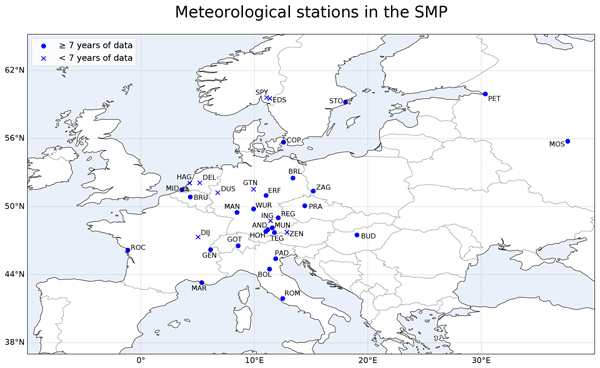
This paper presents temperature and pressure measurements from the 37 stations of the late 18th century network of the Societas Meteorologica Palatina, in addition to providing an inventory of the available observations, most of which have been digitised. The quality of the recovered series is relatively good, as demonstrated by two case studies. Early instrumental data such as these will help to explore past climate and weather extremes in Europe in greater detail.
Cited articles
Araźny, A.: Temporal and spatial variability of thermal and humidity stimuli in the Hornsund area (Svalbard), Pol. Polar Res., 40, 29–53, https://doi.org/10.24425/ppr.2019.126346, 2019.
Araźny, A., Chmist, K., Przybylak, R., Wyszyński, P., and Singh, G.: Comparative study of bioclimatic conditions in southwestern Greenland between the late 18th century and the present, Int. J. Biometeorol., 70, 82, https://doi.org/10.1007/s00484-026-03132-5, 2026.
Baumann, G. H.: Grönlad-Flug von Gronau 1931, in: Beiträge zur Meteorologie des Luftweges über Grönland (Arch. Deut. Seewarte), edited by: Becker, R. and Baumann, G. H., 52, 31–48, https://digitale-bibliothek.bsh.bund.de/viewer/image/141501/190/ (last access: 15 July 2026), 1933.
Borm, J., Kodzik, J., and Charbit, S.: Producing and communicating natural history in the long 18th century: Moravian observations concerning greenland's climate in unpublished sources, Polar Rec., 57, e23, 1–10, https://doi.org/10.1017/S0032247421000218, 2021.
Cappelen, J.: DMI monthly climate data collection 1768–2008, Denmark, The Faroe Islands and Greenland, Technical Report 09-05, Dan. Meteorol. Inst., https://www.dmi.dk/fileadmin/Rapporter/TR/tr09-05.pdf (last access: 15 July 2026), 2009.
Cappelen, J. and Drost Jensen, C.: Climatological Standard Normals 1991–2020 – Greenland, DMI Report 21-12, Dan. Meteorol. Inst., https://www.dmi.dk/fileadmin/Rapporter/2021/DMI_report_21_12_Greenland.pdf (last access: 15 July 2026), 2021.
Cassou, C., Terray, L., Hurrell, J. W., and Deser, C.: North Atlantic Winter Climate Regimes: Spatial Asymmetry, Stationarity with Time, and Oceanic Forcing, J. Climate, 17, 1055–1068, https://doi.org/10.1175/1520-0442(2004)017<1055:NAWCRS>2.0.CO;2, 2004.
Chmist, K., Singh, G., Araźny, A., Przybylak, R., and Wyszyński, P.: Subdaily records of atmospheric pressure, wind speed and direction, and air temperature in southwest Greenland during the latter half of the 18th century, RepOD, V1 [data set], https://doi.org/10.18150/XGCONO, 2025a.
Chmist, K., Araźny, A., Przybylak, R., Wyszyński, P., and Singh, G.: Changes in bioclimatic conditions on the coast of the Labrador Peninsula in the second half of the 18th century, Clim. Change, 178, 46, https://doi.org/10.1007/s10584-025-03883-x, 2025b.
Cullather, R. I. and Lynch, A. H.: The annual cycle and interannual variability of atmospheric pressure in the vicinity of the North Pole, Int. J. Clim., 23, 1161–1183, https://doi.org/10.1002/joc.942, 2003.
Demarée, G. R. and Ogilvie, A. E. J.: The Moravian missionaries at the Labrador coast and their centuries-long contribution to instrumental meteorological observations, Clim. Change, 91, 423–450, https://doi.org/10.1007/s10584-008-9420-2, 2008.
Demarée, G. R. and Ogilvie, A. E. J.: Missionary activity in Greenland and in Labrador: the context for early meteorological observations, in: Legacies of David Cranz's `Historie von Grönland' (1765), Christianity in the Trans-Atlantic World, edited by: Jensz, F. and Petterson, C., Springer, 141–164, https://doi.org/10.1007/978-3-030-63998-37, 2021.
Demarée, G. R., Ogilvie, A. E. J, and Mailier, P.: Early meteorological observations in Greenland and Labrador in the 18th century: a contribution of the Moravian Brethren, in: Proceedings of the 35th international symposium on the Okhotsk sea and Polar oceans, Mombetsu, Japan, 16–19 February 2020, 35–38 pp., 2020.
García-Herrera, R., Prieto, L., Gallego, D., Hernández, E., Gimeno, L., Können, G. P., Koek, F. B., Wheeler, D. A., Wilkinson, C., Prieto, M. R., Báez, C., and Woodruff, S.: CLIWOC multilingual meteorological dictionary, EU contract EVK2-CT-2000-00090, 2003.
IPCC: Climate Change: The physical science basis, in: Contribution of working group I to the Sixth assessment report of the intergovernmental panel on climate change, edited by: Masson-Delmotte, V., Zhai, P., Pirani, A., Connors, S. L., Péan, C., Berger, S., Caud, N., Chen, Y., Goldfarb, L., Gomis, M. I., Huang, M., Leitzell, K., Lonnoy, E., Matthews, J. B. R., Maycock, T. K., Waterfield, T., Yelekçi, O., Yu, R., and Zhou, B., Cambridge University Press, Cambridge and New York, 2391, https://doi.org/10.1017/9781009157896, 2021.
Jeffries, M. O., Overland, J. E., and Perovich, D. K.: The Arctic shifts to a new normal, Phys. Today, 66, 35–40, https://doi.org/10.1063/PT.3.2147, 2013.
Koch, N. E.: Greenland, Rowman & Littlefield, https://books.google.pl/books?id=RXfREAAAQBAJ&lpg=PA5&ots=UnIX5BGssi&dq=Koch%2C%20N.%20E.%3A%20Greenland%2C%20Rowman%20%26%20Littlefield%2C%202023.&lr&hl=pl&pg=PA5#v=onepage&q&f=false (last access: 15 July 2026), 2023.
Können, G. P., Zaiki, M., Baede, A. P. M., Mikami, T., Jones, P. D., and Tsukahara, T.: Pre-1872 extension of the Japanese instrumental meteorological observation series back to 1819, J. Clim., 16, 118–131, https://doi.org/10.1175/1520-0442(2003)016<0118:PEOTJI>2.0.CO;2, 2003.
Kottek, M., Grieser, J., Beck, C., Rudolf, B., and Rubel, F.: World map of the Köppen-Geiger climate classification updated, Meteorol. Z., 15, 259–263, 2006.
Lamb, H. H.: Ancient units used by the pioneers of meteorological measurements, Weather, 41, 230–233, 1986.
Loewe, F.: Das Klima des Grönlandischen Inlandeises, Handbuch der Klimatologie, 2(K), 67–101, 1935.
Loewe, F.: The Greenland ice cap as seen by a meteorologist, Quart. J. Roy. Meteorol. Soc., 62, 359–377, 1936.
Miller, G. H., Brigham-Grette, J., Alley, R. B., Anderson, L., Bauch, H. A., Douglas, M. S. V., Edwards, M. E., Elias, S. A., Finney, B. P., Fitzpatrick, J. J., Funder, S. V., Herbert, T. D., Hinzman, L. D., Kaufman, D. S., MacDonald, G. M., Polyak, L., Robock, A., Serreze, M. C., Smol, J. P., Spielhagen, R., White, J. W. C., Wolfe, A. P., and Wolff, E. W.: Temperature and precipitation history of the Arctic, Quat. Sci. Rev., 29, 1679–1715, https://doi.org/10.1016/j.quascirev.2010.03.001, 2010.
Møller, E. B. and Helgason, J.: Weather and indoor climate in Greenland, J. Phys. Conference Series, 2069, 012073, https://doi.org/10.1088/1742-6596/2069/1/012073, 2021.
Nordli, Ø., Przybylak, R., Ogilvie, A. E. J., and Isaksen, K.: Long term temperature trends and variability on Spitsbergen: the extended Svalbard Airport temperature series, 1898–2012, Polar Res., 33, 21349, https://doi.org/10.3402/polar.v33.21349, 2014.
Nordli, Ø., Wyszyński, P., Gjelten, H. M., Isaksen, K., Łupikasza, E., Niedźwiedź, T., and Przybylak, R.: Revisiting the extended Svalbard Airport monthly temperature series, and the compiled corresponding daily series 1898–2018, Polar Res., 39, 3614, https://doi.org/10.33265/polar.v39.3614, 2020.
Panagiotopoulos, F., Shahgedanova, M., Hannachi, A., and Stephenson, D.B.: Observed Trends and Teleconnections of the Siberian High: A Recently Declining Center of Action, J. Clim., 18, 1411–1422, https://doi.org/10.1175/JCLI3352.1, 2005.
Petersen, H.: Das Klima der Küsten von Grönland, Handbuch der Klimatologie, 2(K), 33–65, 1935.
Polyakov, I. V., Bekryaev, R. V., Alekseev, G. V., Bhatt, U. S., Colony, R. L., Johnson, M. A., Maskshtas, A. P., and Walsh, D.: Variability and Trends of Air Temperature and Pressure in the Maritime Arctic, 1875–2000, J. Clim., 16, 2067–2077, https://doi.org/10.1175/1520-0442(2003)016<2067:VATOAT>2.0.CO;2, 2003.
Przybylak, R.: Temporal and spatial variation of air temperature over the period of instrumental observations in the Arctic, Int. J. Climatol., 20, 587–614, https://doi.org/10.1002/(SICI)1097-0088(200005)20:6<587::AID-JOC480>3.0.CO;2-H, 2000.
Przybylak, R.: Contemporary climate change in the Arctic, in: Climate change in the Arctic and Antarctic in the last fifty years of the 20th century and their environmental implications, edited by: Marsz, A. and Styszyńska, A., Maritime Univ. Publ. House, Gdynia, 93–110, https://klimatolodzy.pl/images/attachements/Arktyka-Antarktyka/04-Przybylak_aa2007.pdf (last access: 15 July 2026), 2007.
Przybylak, R. and Vízi, Z.: Air temperature changes in the Canadian Arctic from the early instrumental period to modern times, Int. J. Climatol., 25, 1507–1522, https://doi.org/10.1002/joc.1213, 2005.
Przybylak, R. and Wyszyński, P.: Air temperature in Novaya Zemlya Archipelago and Vaygach Island from 1832 to 1920 in the light of early instrumental data, Int. J. Climatol., 37, 3491–3508, https://doi.org/10.1002/joc.4934, 2017.
Przybylak, R. and Wyszyński, P.: Air temperature changes in the Arctic in the period 1951–2015 in the light of observational and reanalysis data, Theoret. Appl. Climatol., 139, 75–94, https://doi.org/10.1007/s00704-019-02952-3, 2020.
Przybylak, R., Vizi, Z., and Wyszyński, P.: Air temperature changes in the Arctic from 1801 to 1920, Int. J. Climatol., 30, 791–812, https://doi.org/10.1002/joc.1918, 2010.
Przybylak, R., Wyszyński, P., Vizi, Z., and Jankowska, J.: Atmospheric pressure changes in the Arctic, from 1801 to 1920, Int. J. Climatol., 33, 1730–1760, https://doi.org/10.1002/joc.3546, 2013.
Przybylak, R., Wyszyński, P., Nordli, Ø., and Strzyżewski, T.: Air temperature changes in Svalbard and the surrounding seas from 1865 to 1920, Int. J. Climatol., 36, 2899–2916, https://doi.org/10.1002/joc.4527, 2016.
Przybylak, R., Wyszyński, P., and Araźny, A.: Comparison of Early Twentieth Century Arctic Warming and Contemporary Arctic Warming in the light of daily and sub-daily data, J. Climate, 35, 2269–2290, https://doi.org/10.1175/JCLI-D-21-0162.1, 2022.
Przybylak, R., Singh, G., Wyszyński, P., Araźny, A., and Chmist, K.: Air temperature changes in SW Greenland in the second half of the 18th century, Clim. Past, 20, 1451–1470, https://doi.org/10.5194/cp-20-1451-2024, 2024.
Putnins, P.: The climate of Greenland, in: Climates of the Polar Regions, World Survey of Climatology, edited by: Orvig, S., Elsevier Pobl. Comp., Amsterdam–Londyn–New York, 14, 3–128, https://klimatolodzy.pl/images/attachements/Arktyka-Antarkt (last access: 15 July 2026), 1970.
Serreze, M. C., Box, J. E., Barry, R. G., and Walsh, J. E.: Characteristics of Arctic synoptic activity, 1952–1989, Meteorol. Atmos. Phys., 51, 147–164, https://doi.org/10.1007/BF01030491, 1993.
Serreze, M. C., Carse, F., Barry, R. G., and Rogers, J. C.: Icelandic Low Cyclone Activity: Climatological Features, Linkages with the NAO, and Relationships with Recent Changes in the Northern Hemisphere Circulation, J. Climate, 10, 453–464, https://doi.org/10.1175/1520-0442(1997)010<0453:ILCACF>2.0.CO;2, 1997.
Singh, G., Przybylak, R., Wyszyński, P., Araźny, A., and Chmist, K.: Thermal conditions on the coast of Labrador during the late 18th century, Clim. Past, 21, 877–895, https://doi.org/10.5194/cp-21-877-2025, 2025.
Turner, J., Overland, J. E., and Walsh, J. E.: An Arctic and Antarctic perspective on recent climate change, Int. J. Clim., 27, 277–293, https://doi.org/10.1002/joc.1406, 2007.
Vinther, B. M., Andersen, K. K., Jones, P. D., Briffa, K. R., and Cappelen, J.: Extending Greenland temperature records into the late eighteenth century, J. Geophys. Res., 111, D11105, https://doi.org/10.1029/2005JD006810, 2006.
Vizi, Z.: Variability of the American Arctic climate in the 19th century, PhD thesis, Nicolaus Copernicus University in Toruń, 2008.
Walsh, J. E., Chapman, W. L., and Shy, T. L.: Recent Decrease of Sea Level Pressure in the Central Arctic, J. Climate, 9, 480–486, https://doi.org/10.1175/1520-0442(1996)009<0480:RDOSLP>2.0.CO;2, 1996.
Walsh, J. E., Overland, J. E., Groisman, P. Y., and Rudolf, B.: Ongoing climate change in the arctic, Ambio, 40, 6–16, https://doi.org/10.1007/s13280-011-0211-z, 2011.
Wang, J. and Ikeda, M.: Arctic oscillation and Arctic sea-ice oscillation, Geophys. Res. Lett., 27, 1287–1290, https://doi.org/10.1029/1999GL002389, 2000.
Wood, K. R. and Overland, J. E.: Accounts from 19th-century Canadian Arctic explorers' logs reflect present climate conditions, EOS, 84, 410–412, 2003.
Wood, K. R. and Overland, J. E.: Climate lessons from the first International Polar Year, Bull. Am. Meteorol. Soc., 87, 1685–1697, https://doi.org/10.1175/BAMS-87-12-1685, 2006.
Wood, K. R. and Overland, J. E.: Early 20th century Arctic warming in retrospect, Int. J. Climatol., 30, 1269–1279, https://doi.org/10.1002/joc.1973, 2010.
Wyszyński, P.: Meteorological conditions in the Arctic during the first International Polar Year1882/1883 and their comparison with present conditions, PhD thesis, Nicolaus Copernicus University in Toruń, 2011.
Short summary
The currently observed climate changes are most intense in the Arctic region. This study utilized some of the oldest existing meteorological measurement series in this region. Atmospheric pressure and anemological conditions were analysed and then compared with contemporary measurements. This showed that the weakest low and strongest high systems occur in the same months. Prevailing wind directions have also remained unchanged, while the northerly wind carries less frigid air than in the past.
The currently observed climate changes are most intense in the Arctic region. This study...


