
the Creative Commons Attribution 4.0 License.
the Creative Commons Attribution 4.0 License.
 | 27 Jul 2026
Air temperature changes in Wrocław (southwestern Poland) in 1773–1781 based on recently discovered early-instrumental meteorological measurements
Piotr Oliński
The article presents a description of an early-instrumental series of meteorological measurements made in Wrocław (SW Poland) in 1773–1781 and its importance for improving knowledge of climate and climate change in Silesia, Poland, and Central Europe. The series is the third-oldest available for Wrocław and is based on observations made by Johann Ephraim Scheibel on the premises of the Gymnasium that belonged to the Church of St. Elizabeth (central Wrocław). Meteorological observations of air temperature were made three times a day: in the morning immediately after sunrise; in the afternoon between 1 and 2 o'clock; and in the evening 1 or 2 h after sunset and were published in the newspaper Oekonomische Nachrichten der Patriotischen Gesellschaft in Schlesien, issued weekly in Wrocław in the years 1773–1781. The quality of the original sub-daily temperature data was assessed in accordance with WMO recommendations. In addition, mean daily and monthly values were compared and validated against time series from other sites located near Wrocław (Żagań, Jelenia Góra, Prague, Berlin and Warsaw). Air temperatures in Wrocław during the period 1773–1781 were 1.4 and 0.5 °C warmer than in the respective equivalent periods 100 and 200 years later (i.e., 1873–1881 and 1973–1981) but 1.9 °C colder than in the most recent period (2013–2021). The increase in temperature between the study period and the most recent period was greatest in summer (2.7 °C) and winter (2.4 °C) and smallest in autumn (0.8 °C).
- Article
(12657 KB) - Full-text XML
-
Supplement
(438 KB) - BibTeX
- EndNote


Historical climatology is a dynamically evolving discipline of science, particularly in recent decades (for details, see, e.g., Brázdil et al., 2005; Brönnimann et al., 2018, 2019). One of its main goals is to find, in libraries and archives, historical sources (e.g., written records such as sagas, chronicles, maps and early-instrumental measurements) that contain meteorological measurements or weather descriptions and then to record them, preferably in digital form. Such activity, often referred to as “data rescue activity”, significantly enhances existing meteorological databases, thereby improving knowledge about weather and climate in historical periods (i.e., before the beginning of regular observations) for many regions around the world. Early-instrumental measurements, including the late-18th-century series of air temperatures from Wrocław analysed here, are primarily important for deepening our understanding of climate and its variability, as well as for calibrating existing climate reconstructions derived from proxy data and models.
In Poland, knowledge about historical climate has increased significantly since the 1990s (e.g., Sadowski, 1991; Majorowicz et al., 2004; Przybylak et al., 2005, 2010, 2020, 2023; Filipiak and Miętus, 2010; Przybylak, 2010, 2011, 2016; Przybylak and Marciniak, 2010; Hernández-Almeida et al., 2015, 2016; Filipiak et al., 2019; Ghazi et al., 2023a, b, 2024, 2025). Thorough and comprehensive reviews of the work on this topic have recently been published by Przybylak (2010, 2016), Przybylak et al. (2010) and Opała-Owczarek et al. (2021). The analysis of these works reveals that the search for early-instrumental observations in Poland has spanned more than a hundred years and intensified at the beginning of the 20th century. From the most important published articles at this time, we should mention those of, e.g., Romer (1910), Merecki (1917), Birkenmajer and Birkenmajer (1918), Hellmann (1918), Pawłowski (1919) and Gorczyński (1922). According to Rojecki (1966), the first outline of the history of meteorological observations was presented by Baranowski (1858) in a foreword he wrote to the Polish translation of P. Foissac's book. Following World War II, Polish scientists continued the search for early meteorological data. Of the numerous available publications, the most valuable results are presented in works written by Rojecki (1956, 1966). In the first of these two articles, Rojecki's Table 1 presents a list of 30 places where observations were made before the end of the 18th century. In line with expectations, within that period, meteorological measurements were taken most abundantly in the 18th century. Note, however, that we have information that some measurements were conducted in certain places and for certain years, but we still have not found those data. This failure is due, for example, to not all sources in archives being precisely catalogued – or to some sources having been destroyed (or lost) due to the frequent wars that have plagued Poland's history.
The area of interest in the present paper is Wrocław, where instrumental meteorological observations began very early, i.e. at the beginning of the 18th century. For this period, we have two long-term series of observations: April 1710–December 1721 (David von Grebner) and 1717–1730 (Johann Kanold/A. E. Büchner) (see Munzar, 2003; Pyka, 2003; Przybylak, 2010; Przybylak and Pospieszyńska, 2010). For the subsequent period lasting until the end of January 1791, there was no information in any of the above-cited literature items (old or modern) regarding the availability of meteorological observations. Regular observations (thrice-daily) in Wrocław started in February 1791 at the Astronomical Observatory, based in the Mathematics Tower of the Universitatis Leopoldinae Vratislaviensis (the Latin name for Wrocław University, founded by the Jesuits) (Bryś and Bryś, 2010a, b). The series of air temperature measurements is the second-longest series of such data in Poland (after Warsaw, where they started in 1779).
From this brief review of the state of knowledge about the climate of the historical period in Poland, and despite over 100 years of many Polish researchers and climatologists searching for early-instrumental meteorological observations, no one has yet found evidence of meteorological observations in Wrocław between 1730 and 1790. Only our archival and library research conducted while realising the research project, The occurrence of extreme weather, climate and water phenomena in Poland from the 11th to the 18th century in the light of multiproxy data, resulted in the discovery of a new, extremely important long-term series of meteorological observations made in the centre of Wrocław in the years 1773–1781. Therefore, the primary objective of this article is to present the recently discovered series of observations to a broader scientific audience and to report the initial climate analysis results, albeit limited to the description of air temperature conditions and changes in Wrocław at that time. The secondary goal is to compare air temperature in the period 1773–1781 (9 years) against more recent sets of nine-year data, including data from the contemporary period, (1873–1881, 1973–1981 and 2013–2021), as well as against the longer reference period 1961–1990 used in the ModE-RA paleo-reanalysis (Valler et al., 2024). Additionally, a spatial coherence of air temperature in this period was analysed using data series available for Silesia (Żagań and Jelenia Góra) and the other three closest stations (Prague, Warsaw and Berlin) located in central Europe.
The 1773–1781 meteorological observations were made by Johann Ephraim Scheibel on the premises of St. Elizabeth's High School, which belongs to the Church of St. Elizabeth (central Wrocław) (Fig. 1). Johann Ephraim Scheibel (b. 1736, d. 31 May 1809) seems to be a typical representative of 18th-century scientists. Raised in a protestant family, he spent his life in Wrocław. There, he studied, at age 23 becoming a professor at St. Elizabeth's in Wrocław. Typically for that time, he showed interest in numerous scientific disciplines. His dissertation concerned the friction of solids; he focused on mathematics, astronomy, physics, and logic; he also dealt with meteorological phenomena such as rainbows; however, he was also interested in theology and described ancient manuscripts, as exemplified by his publication Codex Quatuor Evangeliorum Latinus Rehdigerianus (Scheibel, 1763). He was published in recognised scientific journals of the time, including Oekonomische Nachrichten der Patriotischen Gesellschaft in Schlesien. In 1791, he became an external member of the Prussian Academy of Sciences. In 1794, he was also elected as a corresponding member of the Göttingen Academy of Sciences (Günther, 1890). These honours were certainly awarded to him in connection with his intensive scientific activity within the Patriotic Society in Silesia (orig. Patriotische Gesellschaft in Schlesien), of which he was a prominent member.
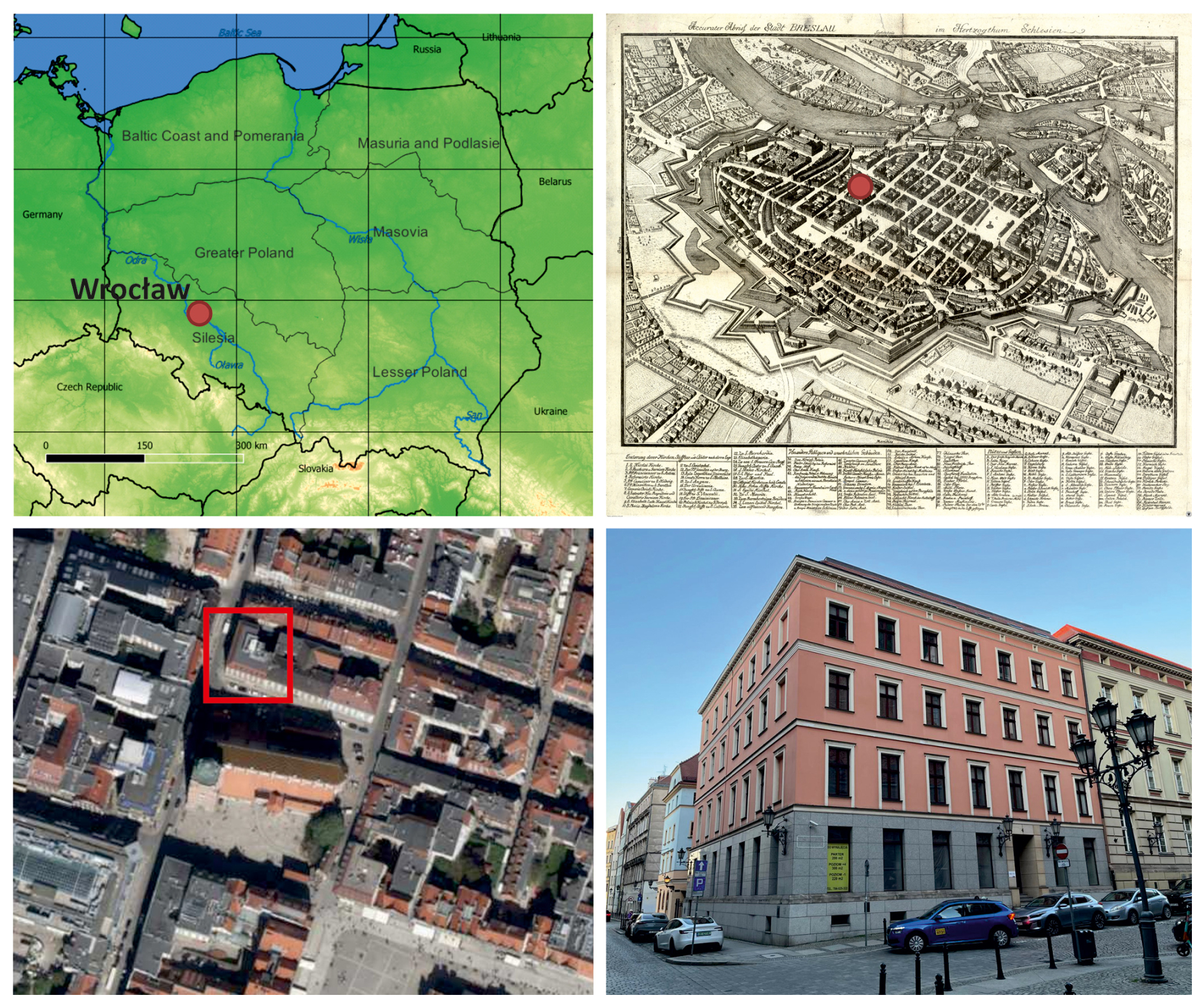
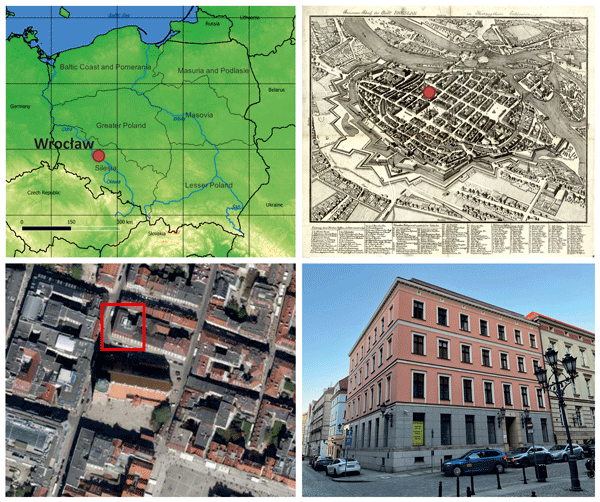
Figure 1Location of the site of meteorological observations conducted by Johann Ephraim Scheibel in Wrocław in the period 1773–1781: (upper left) location of Wrocław within Poland; (upper right) location of the Gymnasium on a historical plan of Wrocław from the period 1776–1780 (source of map: https://polska-org.pl/7719498,foto.html?idEntity=554891, last access: 13 May 2025); (bottom left) location of historical observation site on a contemporary orthophotomap (source of map: https://geoportal-krajowy.pl/, last access: 13 May 2025); (bottom right) St. Elizabeth's High School (4, St. Elizabeth St.) and the Rector's apartment where Scheibel lived and probably made observations (photo by Rajmund Przybylak).
The Patriotic Society in Silesia existed in Wrocław from 1772–1790 and was supported by the Prussian government. Initially, this association had economic objectives, stemming from the Schlesische Landschaft, which provided loans to local nobility and agriculture. The organisation's primary goal was to help agricultural reforms, which was also served by scientific research conducted in the spirit of the Enlightenment (Harasimowicz and Suleja, 2006, p. 858). These studies were published in Oekonomische Nachrichten der Patriotischen Gesellschaft in Schlesien, to which Scheibel also contributed significantly. From the perspective of the subject of this article, we note that the Society organised and coordinated weather and climatic research in Silesia. The Society established several meteorological observation sites in the area, taking into account, among other factors, various landforms (valleys and ridges). The main aim of this network of stations was to provide data for investigating the impact of weather and climate on social activities, particularly agriculture.
Throughout the entire period of observation, meteorological measurements of air temperature were taken in Wrocław using a mercury thermometer with Fahrenheit scale (in °F) three times a day – in the morning, midday, and evening (see Fig. 2). The other variables were first measured twice a day (morning and evening) and then, from 1 January 1774, three times a day. Thrice-daily observations began earlier (i.e., on 30 April 1773) only for wind direction (8 directions) and wind force (a 7° scale). The following variables were measured: atmospheric precipitation (in French inches, stating the category: rain or snow), atmospheric pressure using a mercury barometer (in French inches) and humidity (using a hygrometer invented by Prof. Johann Heinrich Lambert from Berlin). Atmospheric phenomena and weather were also described (Fig. 2). It should be noted that, to our knowledge, these air humidity measurements are the first to have been conducted in Poland.

Figure 2Example of meteorological observations made on 8–14 January 1773 and published on page 9 of the newspaper Oekonomische Nachrichten der Patriotischen Gesellschaft in Schlesien on 16 January 1773. Key to content by column: 1. day of the month and abbreviated day of the week; 2. brief weather descriptions; 3. measurements of precipitation; 4. observed wind direction and force; 5. phase of lunar and calendar; 6. observations of atmospheric phenomena; 7. temperature measurements; 8. atmospheric pressure measurements; 9. humidity measurements; Mo – morning; Mi – midday, Ab – evening.
The newspaper Oekonomische Nachrichten der Patriotischen Gesellschaft in Schlesien began publishing meteorological data from Wrocław on 9 January 1773 (i.e., in the very first edition of the newspaper). The data published in this issue were for the period 1–7 January 1773. The quality of this first issue of the newspaper is poor (the text on the reverse side shows through), so we attach an example of the second issue of the newspaper (published on 16 January 1773) (Fig. 2). All of the meteorological data from Wrocław were published in the newspaper Oekonomische Nachrichten der Patriotischen Gesellschaft in Schlesien issued in Wrocław in the years 1773–1781 (https://www.deutsche-digitale-bibliothek.de/searchresults?query=Oekonomische+Nachrichten+der+Patriotischen+Gesellschaft+in+Schlesien, last access: 15 April 2026). In the years 1773–1776, meteorological data were published in tabular form in each weekly edition of the newspaper (usually seven days of observations starting on Friday and ending on Thursday; the newspaper was issued on Saturday). From 1777 onwards, data were published for the entire month and, in the last two years, in three-month blocks. Besides measurements, in the same source, J. E. Scheibel also published between one and three pages of weather descriptions for each month or block of two or three months. The weather description for the first three years (1773–June 1775) was wider and also covered (in addition to Wrocław) other areas of Silesia, with observations being conducted simultaneously at several locations (e.g., Żagań, Jelenia Góra, Miłowice). For these locations, Scheibel published monthly tabulated results, including data from Wrocław (Scheibel, 1773b [pp. 130–131, pp. 314–316], 1774 [pp. 245–247, pp. 265–267, pp. 317–319], and 1775b [pp. 205–207, pp. 393–398, pp. 417–422]). This network of meteorological stations operating in Silesia was organised and coordinated by the Patriotic Society in Silesia – and probably by Scheibel in person (or at least as one of those responsible). The newspaper's numerous texts describing weather conditions in Silesia often emphasise that observations were conducted in accordance with detailed instructions for meteorological observations issued to the observers (who probably were often Society members). Presumably, the Society also equipped some observation points with meteorological instruments or recommended the use of appropriate, best-available instruments. Observers were obligated to perform their measurements reliably and precisely, provide detailed descriptions, and submit them to the Society in an appropriately designed format. Professor Scheibel constantly monitored the observations and, in the event of inaccuracies, corrected erroneous measurements by comparing results obtained in parallel at several stations.
In one of his last texts, he also specifies the observation times more precisely than those given in the Tables with data (Fig. 2). “The observations are recorded three times daily: in the morning immediately after sunrise, if possible; in the afternoon between 1 and 2 o'clock; and in the evening one or two hours after sunset” (Scheibel, 1780, p. 62). With this information, we determined the approximate observation times based on the average sunrise and sunset times in Wrocław for each month of the year (local solar time, LST, was used), see Table S1 in the Supplement.
In the newspaper's first issue, published on 9 January 1773, Scheibel reports that wind direction was estimated from the movement of the flag on the tower of St. Elizabeth's Church, indicating the tower was visible from the meteorological measurement site. Our visit to Wrocław's city centre, the site where Scheibel made his observations, confirms this conclusion. From the windows of the building that once housed St. Elizabeth's High School, we can see the tower of St. Elizabeth's Church with a little flag on top, which allows us to judge the wind direction (Fig. 3).

Figure 3St. Elizabeth's Church with a little flag on the top of the tower, which allowed Scheibel to estimate wind direction. View from the side of the former St. Elizabeth's High School building (photo by Rajmund Przybylak).
The attention paid to the quality of meteorological observations was extremely high. In addition to the information provided earlier, the following information should also be given. In 1774, Prof. Scheibel wrote in the newspaper, “All observations were made according to the instructions so that complete and accurate data could be obtained using thermometers …” In turn, in a 1775 edition (p. 203) (which probably was read by observers), he wrote, “For accurate measurements, use a well-calibrated thermometer placed in a sheltered location away from direct sunlight and other heat sources to obtain reliable results.” Other important excerpts documenting the reliability and precision of meteorological observations and their documentation can be found in the following texts: (i) “Data were organised into tables and registers, enabling subsequent analysis of results and the drawing of conclusions” and (ii) “The results were intended to be used both for local meteorological observations and for broader academic research” (Scheibel, 1773a, pp. 2–4); (iii) “Temperature measurements and observations of atmospheric conditions should be carried out daily and recorded at set intervals in the successive months” (Scheibel, 1775a, p. 34); (iv) “The data were compared with measurements from other locations to obtain a unified summary of atmospheric conditions. Thermometers recorded temperatures, which were then compared with measurements from previous days, excluding extreme temperatures” (Scheibel, 1775a, p. 34). “All barometer and thermometer observations, if both instruments are not properly adjusted, are of no use to us, no matter how much we would like them to be.” (Scheibel, 1775b, p. 204). The above quotes show that the observers, who were members of the Silesian Patriotic Society, were trained and equipped with calibrated instruments and with instructions on making observations. (Some of the quoted texts are only fragments of these instructions.) Members of this Society (including Scheibel) studied scientific literature on an ongoing basis, including information on the latest meteorological instruments and their applications. The information provided here clearly demonstrates that Scheibel and other members of the Society were exceptionally diligent researchers who meticulously and continually analysed their measurements. Therefore, we find no basis upon which to doubt the reliability of the meteorological data presented and published in the Oekonomische Nachrichten der Patriotischen Gesellschaft in Schlesien, including the air temperature analysed in this article.
Nevertheless, to further assure the reliability of the data, we carried out an independent data quality check. In the first stage, two digitisers collaborated with the authors of this article in identifying potential anomalous values, which were verified by analysing in detail the associated weather conditions (flow direction and changes, cloud cover, and atmospheric pressure). This preliminary analysis resulted in only two values being corrected that were due to obvious typographical errors. The second stage involved a more detailed (quantitative) check. To identify outliers in the temperature data, we calculated the differences between all series (midday minus morning, roughly DTR [diurnal temperature range]; midday minus evening; and evening minus morning), as well as day-to-day differences across all three series. For the first category of calculations, 3 SD (standard deviation) were used as the threshold value for temperature differences, i.e., 15.9, 11.7, and 13.8 °C, respectively. In any of the analysed series, no values were found to exceed the threshold. Despite this result, we further verified the feasibility of differences slightly below 3 SD (the highest calculated differences were 13.3, 11.1, and 12.8 °C, respectively) by analysing air-mass inflow directions, cloud cover, and atmospheric pressure.
None of these differences provided robust evidence upon which to doubt the reliability of the data, however – given that each difference is explicable as resulting from changes in these meteorological elements. For example, large winter warming was usually caused by a shift in circulation from the eastern or northern sector to the western or southern sector. Toward the end of winter, this also occurred on cloudless days (anticyclones) with no advection, or with weak advection from the south or west. The solar factor in late winter shows the greatest differences when it is associated with small advection occurring from the northern or eastern sectors. Cooling in winter, on the other hand, was caused by the opposite circulation conditions to those described above. Such large temperature differences also occur in summer, when circulation changing from the southern/eastern sectors to the western/northern sectors produces cooling, and the opposite for warming. A similar effect is also observed due to solar radiation during cloudless days (great warming) and night georadiation. In summer, large differences between observation dates occurred when the circulation shifted from southern/eastern sectors to western/northern sectors (cooling) or vice versa (warming). The effects of low cloud cover and intense solar radiation in anticyclonic situations are similar to those in winter.
As mentioned above, we also examined day-to-day changes in the three analysed air temperature series (morning, midday, and evening). For this purpose, we again used the 3 SD threshold, but this time we calculated it for each month separately. This is necessary because of significant SD changes throughout the annual cycle. The SD values were taken from Table 2. We found 23 cases exceeding 3 SD. All of them were checked using the same procedure described earlier for checking temperature changes within days. Only for one value did we find no justification in the analysis of the weather conditions preceding and following it. This value was therefore deemed to be an error (more likely one of manual typesetting than measurement-related) and, accordingly, was corrected by looking at neighbouring values.
In the third stage, we compared temperature observations in Wrocław with data from other stations in Silesia (Jelenia Góra and Żagań), for which Scheibel also provided mean monthly data for 1773, 1774, and mid-1775. The annual courses of all these data series are very similar (not shown), with a correlation of 0.99. In addition, we also compared the series of mean daily data from 1779–1781 with those from Warsaw. These also showed very high convergence and no significant deviations, with a correlation of 0.97. That correlation is even higher than that between the data from Żagań (near Wrocław) and Warsaw for the period 1781–1792, for which the observations originated from the Mannheim network (see Przybylak et al., 2014).
In summary, the quality control of the Wrocław data presented here verified that the data are high-quality, reliable and accurate. This confirms that Professor Scheibel's efforts to ensure that the meteorological observations he conducted in Wrocław and at other stations in Silesia (under his supervision) were reliable and credible and yielded robust results.
In this paper, we present air temperature conditions in Wrocław from 1773–1781 based on both sub-daily data (morning, midday and evening) and mean daily values. The latter were calculated using the weighted mean: (i) and (ii) using reconstructed probable hours of observations (see Tables S1 and S2 in the Supplement, formulas MDAT12-MDAT15). In the next step, using hourly temperature data from the contemporary period (2013–2021), we calculated average monthly temperature differences between daily means based on three and 24 measurements per day (the so-called real daily mean). The differences obtained were (separately for each month; see Table S2) used to estimate the range of biases for the formulas MDAT-2-MDAT11 (unknown precise measurement times) and to correct the historical daily averages calculated from the three measurement times for which probable hours of observations were reconstructed (formulas MDAT12-MDAT15). For correction, mean biases from formulas MDAT12-MDAT15 were used (see Table S2). We have applied this method many times (inc., recently, Przybylak et al., 2024, 2026). It is also recommended by WMO (Aguilar et al., 2003). These corrected data were then used for further statistical analysis, including comparisons with contemporary data. The reliability of the corrected series of (daily, monthly, etc.) average data was also verified by comparison against the analogical data obtained using the three unknown measurement times.
The lack of information on the exact times of observations for each individual day in the historical period may introduce some inaccuracy when comparing their results to averages calculated for the later nine-year periods (1873–1881, 1973–1981 and 2013–2021). For the first comparative period, the exact observation times (morning, midday and evening) are also unknown, whereas, for the other two periods, we calculated daily means using weighted averages based on data from 06:00, 12:00 and 21:00 LT. All original historical measurements from the late 18th century were converted to the thermometric scale currently in use, i.e., °C. The data, thus processed, are available in the repository of Nicolaus Copernicus University: https://doi.org/10.18150/PYVVWU (Przybylak et al., 2025). Three series of raw data were taken from this database to calculate standard statistics describing climate (daily, monthly, seasonal and annual means, and standard deviations based on sub-daily and daily data; boxplots and frequencies of occurrence of temperatures stratified into 1 °C intervals). The historical data were compared against newer data of similar duration (from the 19th, 20th and 21st centuries) taken from different times of the day, representing morning, midday and evening hours. For the purposes of comparison against other neighbouring series (Berlin and Prague) and against data taken for Wrocław but from the ModE-RA paleo-reanalysis (Valler et al., 2024), the corrected historical series of daily weighted mean temperatures were used. If the historical observations were made within the times 06:00–07:00, 12:00–13:00 and 20:00–21:00 LT (formulas 7–10), then the biases are very small and on average do not exceed ±0.2 °C (see Table S2). On the other hand, maximum biases range from 0.1 °C (December and January) to −0.5 °C (August–October). The Prague series was homogenised, while the Berlin series was probably not homogenised from the 18th century to the mid-19th century, due to the various relocations of stations and changes in instruments without proper documentation (see Cubash and Kadow, 2011).
Note that the research results presented for Wrocław for the historical period still contain some uncertainties that are difficult to determine due to the lack of information on the thermometer's exposure. However, the thermometer was probably placed on the north-west side of the High School building, where Scheibel lived as the Rector of the school (Fig. 1).
The recently discovered series of meteorological measurements for Wrocław for the historical period 1773–1781 is the third-longest series available for the 18th century. Alongside being the third-longest, this is also, as we mentioned earlier, the third-oldest time series of weather observations for this place, and, more importantly, the new data partly fill the data gap in Wrocław that, prior to this study, covered the period 1731–1790. The series of data described here allows for an approximate characterisation of climate conditions at this time. In this article, we begin our exploration of climatic conditions by examining air temperature, the most important climate variable in moderate latitudes, including Poland. Other meteorological elements will be analysed in a subsequent article.
3.1 Yearly, seasonal and monthly resolution
The annual cycle of air temperature changes in Wrocław in the studied historical period is presented using monthly means (calculated for all three sub-daily measurement times) and average daily values corrected using LST (Tables 1 and S3 in the Supplement, Fig. 4). On average, in line with expectations, the warmest month was July (20.5 °C), and the coldest was January (−2.9 °C). August (20.0 °C) was only slightly colder than July. On the other hand, the other two winter months (December and February) were much warmer than January, with even positive temperatures of 0.9 and 0.6 °C, respectively (Table S3, Fig. 4). The warmest summers occurred in 1775 and 1781, with average temperature of 21.6 °C (Table 1, Fig. 5), whereas the coldest occurred in 1777 (18.6 °C). Winters were warmest and coldest in, respectively, 1779 (1.7 °C) and 1780 (−2.8 °C). On average, the winter temperature was only slightly below freezing (−0.6 °C), whereas the mean summer temperature reached 19.8 °C. The annual temperature ranged between 8.5 °C (1777) and 10.8 °C (1773), with a nine-year average of 9.5 °C (Tables 1 and S3, Fig. 5).
Table 1Monthly, seasonal and annual mean air temperature (°C) in Wrocław for three measurement times (morning, midday and evening) and weighted daily mean (uncorrected, and corrected using LST), 1773–1781.
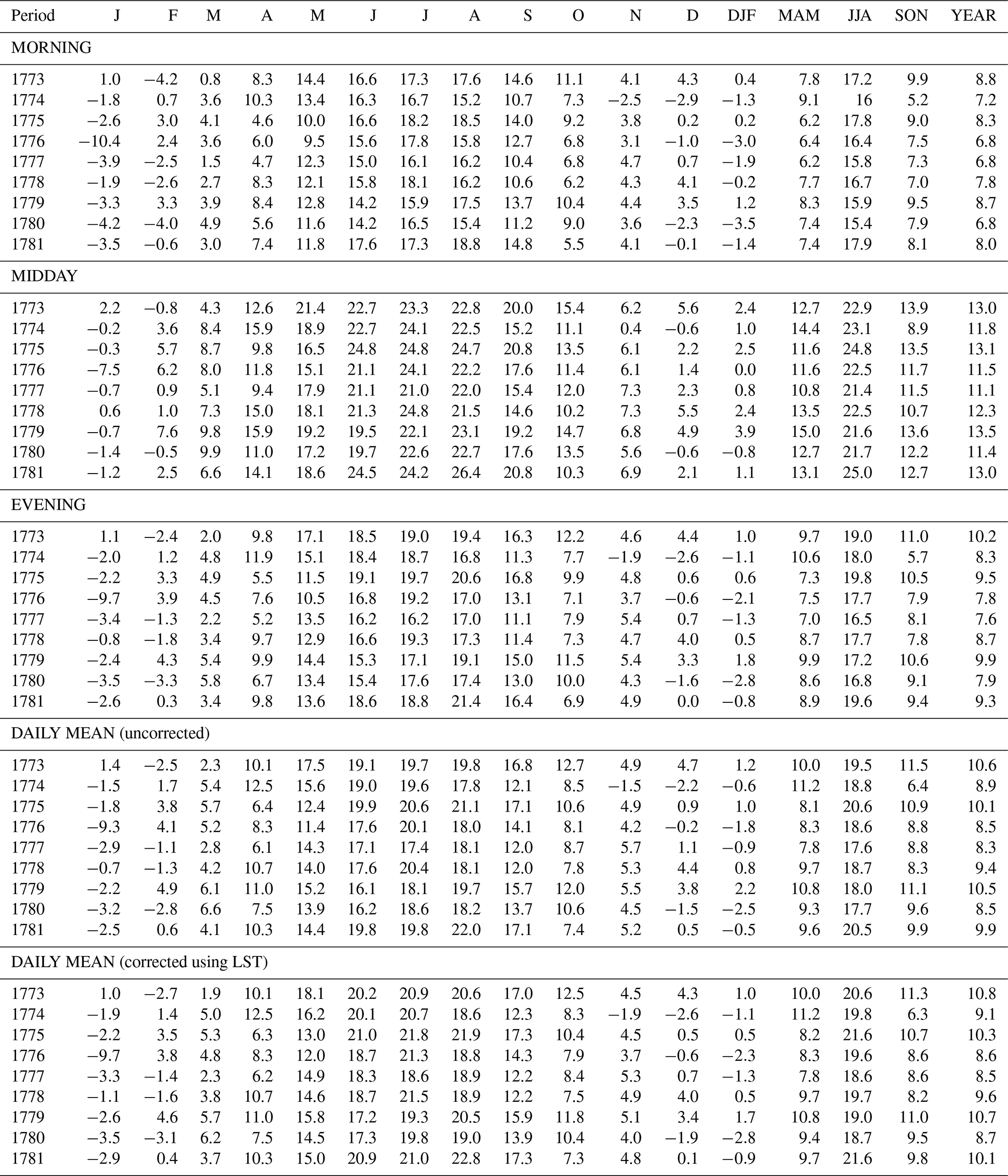
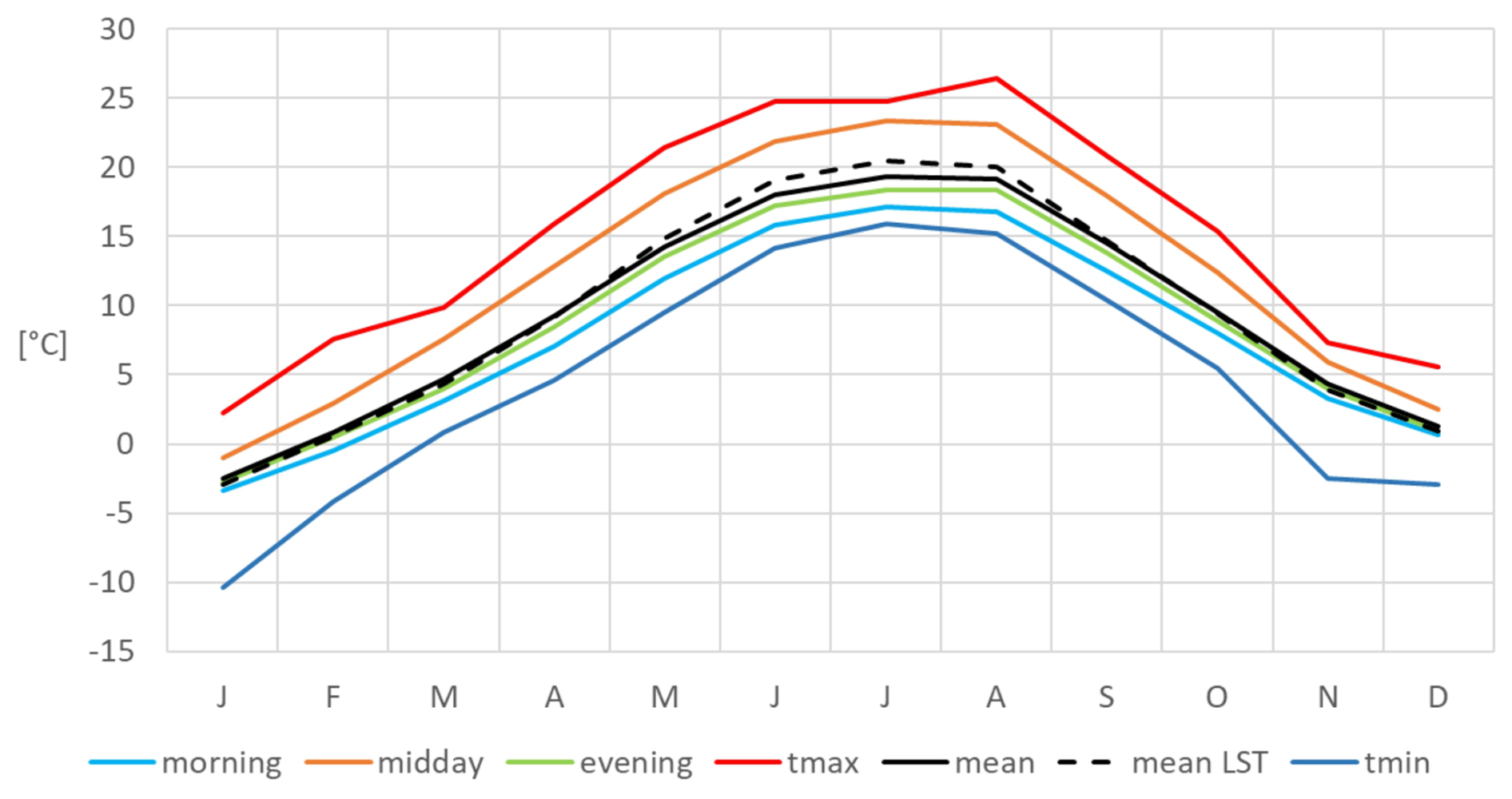
Figure 4Annual cycle of monthly means of air temperature (°C) in Wrocław for three measurement times (morning, midday and evening) and for daily means: uncorrected (mean), and corrected using LST (mean LST), 1773–1781. Key: tmax – highest monthly, seasonal and annual value extracted from three measurement times; tmin – lowest monthly, seasonal and annual value extracted from three measurement times.
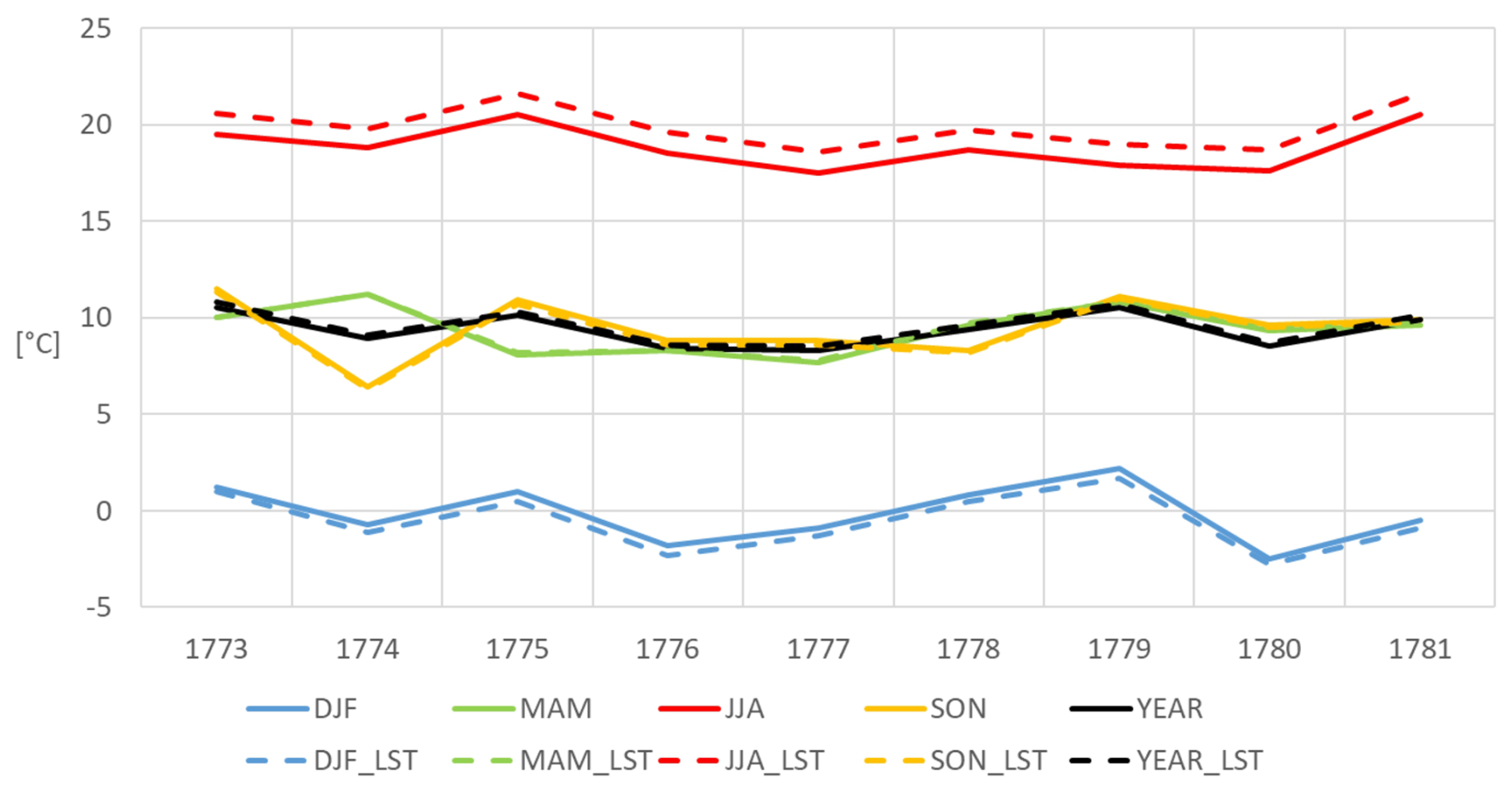
Figure 5Year-to-year changes in seasonal and annual mean air temperature in Wrocław, 1773–1781. Key: solid lines – uncorrected data; dashed lines – data corrected using LST.
Table S3 and Fig. 4 present the annual cycles of air temperature at three sub-daily measurement times, along with their highest and lowest mean monthly values. The courses of curves are generally similar to the mean annual temperature cycle described earlier. The average annual air temperatures at specific measurement times (morning, midday and evening) were 7.7, 12.3 and 8.8 °C, respectively. The annual cycle based on mean monthly temperature values is clearly better approximated by the temperature observed in evening hours, particularly from November to February (±0.1 °C), but significantly less in summer months (mean monthly values ∼2 °C greater than evening values; see Table S3, Fig. 4). For all measurement times, the highest temperature was recorded in July and the lowest in January. The annual range between the highest and lowest temperatures was clearly greatest for midday measurements (24.4 °C) and smallest for morning measurements (20.5 °C). The absolute range between mean monthly values measured at midday and morning hours reached 36.8 °C. The monthly mean temperature was highest (26.4 °C) for August 1781 (midday) and lowest (−10.4 °C) for January 1776 (morning) (Table 1). On the other hand, the highest single temperature measurement (33.9 °C) was recorded for midday of 4 July 1781 and the lowest (−22.8 °C) in the morning of 27 January 1776. The preliminary analysis of the values and approximate observation times provided by Scheibel revealed that data from midday can be treated as the maximum observed value for most cases. On the other hand, the morning observation appears to represent approximately the minimum temperature for the day.
3.2 Daily and sub-daily resolution
The courses of curves representing the different times of day (morning, midday and evening) and the course of daily means show very good correspondence in Wrocław during the study period (Fig. 6). Midday temperatures were markedly higher than morning and evening values on almost all days, with the size of the positive temperature differences being especially large during the summer months. This is mainly due to changes in the Sun's height during the day being greater in summer than in winter.
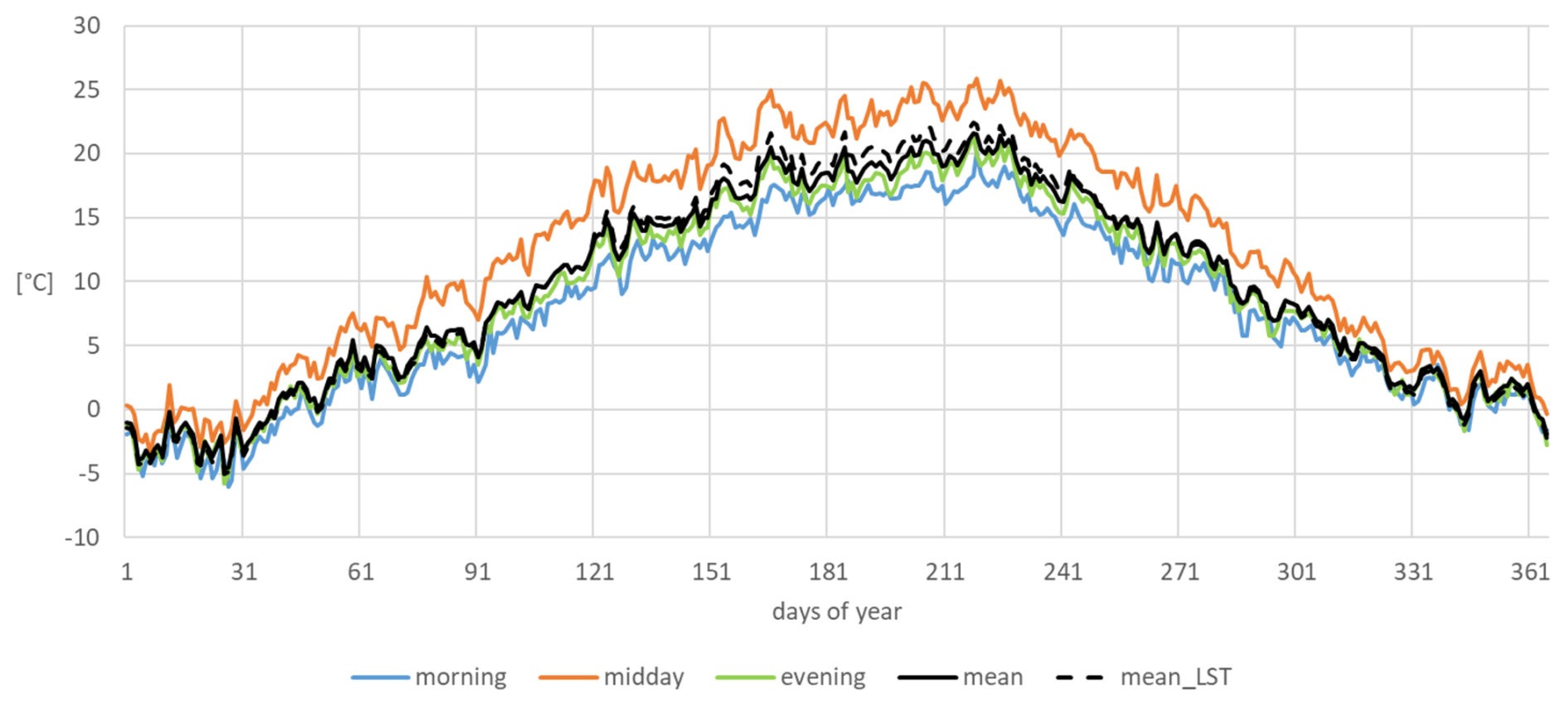
Figure 6Annual cycle of average air temperature in Wrocław based on sub-daily (morning, midday and evening) and daily means (mean and mean_LST), 1773–1781. Key: solid black line – uncorrected data; dashed black line – data corrected using LST.
The highest long-term (1773–1781) mean daily air temperatures in Wrocław during the study period were recorded from approximately 5–15 August (>20 °C), while the coldest temperatures were clearly noted in the second half of January (from about −2 to −4 °C). Furthermore, the temperature is, on most days, lowest in the morning, whereas the evening temperature most closely approximates the daily mean (Fig. 6).
The range of change in the annual cycle of the average temperature at noon (midday) varied in the study period from <0 °C in January to >20 °C, and on some days even >25 °C in July and (especially) August (Fig. 6). Morning air temperatures exceeded 15 °C (but not 20 °C) in summer, whereas, in winter, they usually ranged between 0 and −5 °C. Thermal winter (mean daily temperature <0 °C) extended only from the end of December to about 10 February (i.e., <50 d). On the other hand, on average, thermal summer (mean daily temperature >15 °C) started on 1st June and ended on about 10 September (i.e., summer was about twice as long as winter) (Fig. 6).
More details about the distributions of all the studied series of air temperatures are presented in Fig. 7. Discounting absolute values, all months are roughly similar to one another in terms of the range and distribution of groups of analysed temperature data. This similarity holds even when including the distributions of outliers (the dots in the boxplots). In all series, the majority of outliers occurred from November to January. It is also worth noting that cold outliers are significantly more numerous than warm ones. In most cases, the monthly median values are centrally located in the boxes, and the lengths of the whiskers are similar, except in the winter months (Fig. 7).
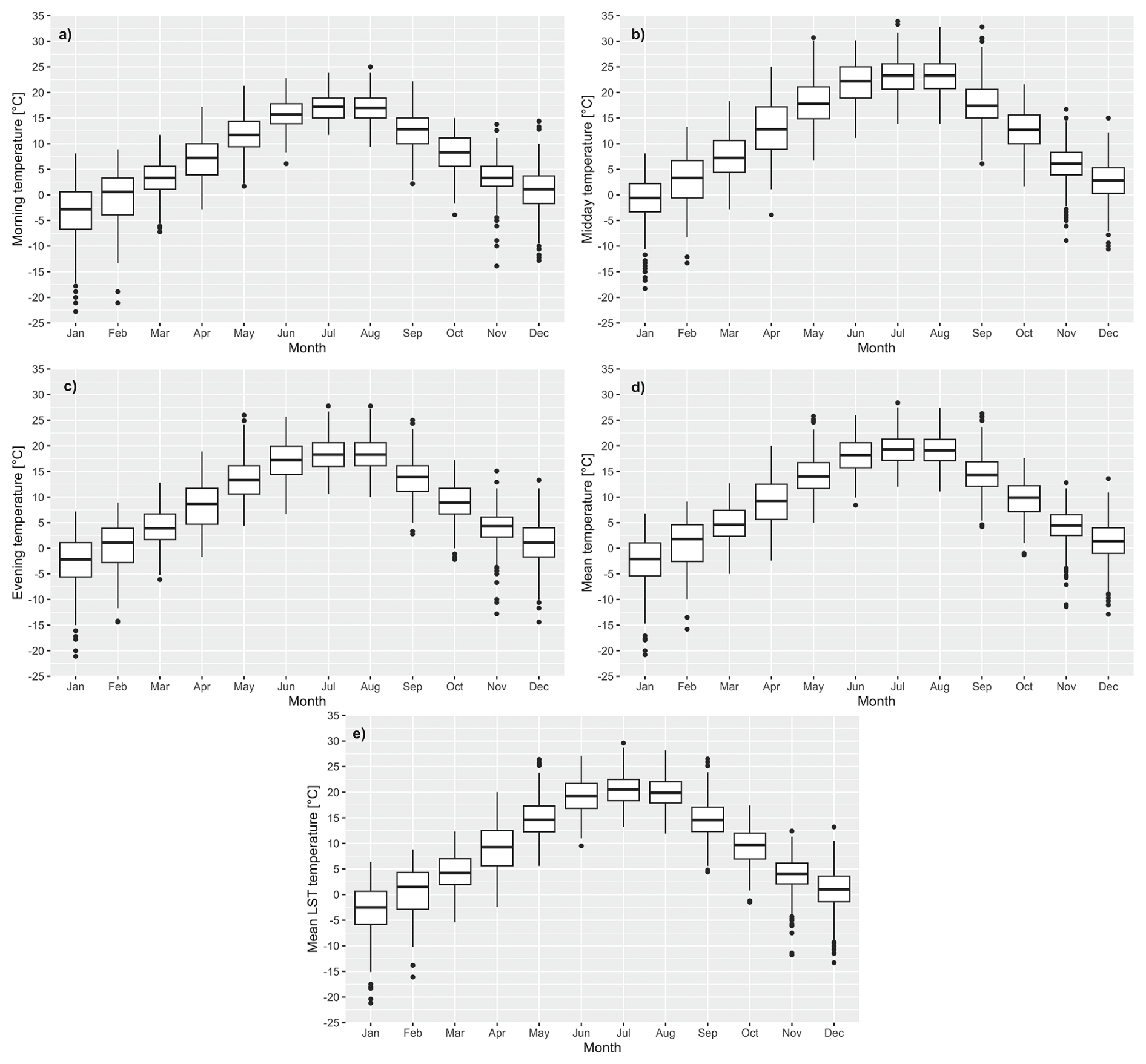
Figure 7Boxplots of the distribution of: morning (a), midday (b), evening (c) air temperatures; and mean daily (uncorrected, d, corrected using LST, e) air temperatures in Wrocław, 1773–1781.
The extent to which the individual daily values measured in three measurement times (morning, midday and evening) and mean daily values differ from their monthly mean values was assessed in terms of the standard deviation (SD, Table 2). In line with expectations, the day-to-day variability in daily mean temperatures is smaller than the analogous changes in temperature between the three measurement times studied.
Table 2Mean monthly, seasonal and annual standard deviations (SD) of air temperature (°C) in Wrocław for three measurement times (morning, midday and evening) and daily mean, 1773–1781.

Key: Tdaily mean – uncorrected data; Tdaily mean LST – data corrected using LST.
On average, the highest SDs (greatest variability) of corrected daily mean occurred in winter and spring (3.5 °C) and the lowest in summer (2.8 °C). In the annual cycle, the mean monthly SD was greatest in January (4.0 °C) and April (3.8 °C) and smallest in July and August (2.8 °C). In the daily cycle, mean annual day-to-day variability was greatest at midday (3.7 °C) and smallest in the morning (3.4 °C). In the annual cycle, variability is greatest at midday from March to October, whereas, in the remaining months, it is greatest in the morning (Table 2). Finally, we should mention the great instability of day-to-day temperatures in April and May, which, although seen in the evening, is particularly evident for midday observation hours.
At all times of observations, the range of air temperature was greater in winter and autumn (35–40 °C) than in spring and markedly greater than in summer (when it was about 25–30 °C). One exception here is the midday spring temperatures, which ranged by approximately 35 °C (Fig. 8). The shapes of the temperature distributions for the transitional seasons are very similar to one another, particularly in the morning and evening. In summer, the predominant temperature values, grouped in intervals of 1 °C, are those from 15–20 °C during morning and evening observation times, whereas for midday they range from 22–26 °C. In line with expectations, the distribution of mean daily temperatures is more regular and closer-to-normal than the distribution of morning, midday and evening 1 °C intervals of air temperature values (Fig. 8). The distribution of all analysed frequencies of occurrence of air temperature series is close to normal, particularly in summer and autumn (see values of skewness and kurtosis rarely exceeding ±1).
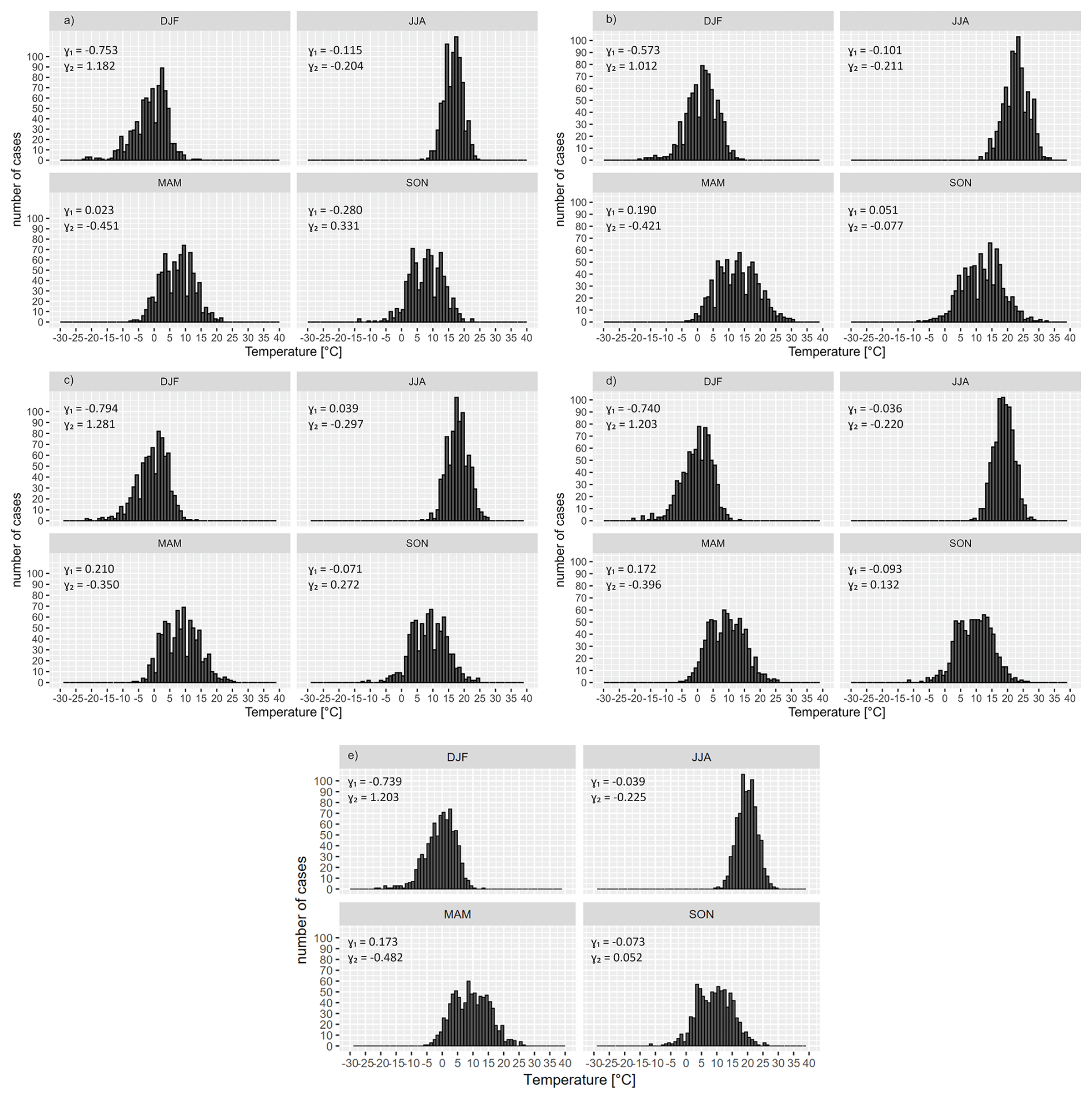
Figure 8Frequency of seasonal (DJF, MAM, etc.) occurrence of: morning (a), midday (b), evening (c) air temperature; and mean daily (uncorrected, d; corrected using LST, e) air temperature in Wrocław from 1773– to 1781 stratified according to 1 °C intervals. Key: γ1 – skewness, γ2 - kurtosis.
To check whether the period 1773–1781 was warm or cool, average monthly temperature values were compared against the nine-year periods starting 100, 200 and 240 years later (Fig. 9a). Only the most recent period (2013–2021) was warmer (by, on average, 1.9 °C) than the analysed historical period. In the annual cycle, the differences between these two periods were greatest in summer (2.7 °C) and winter (2.4 °C) and smallest in autumn (0.8 °C) (Fig. 9b). The two other comparison periods, i.e. 1873–1881 and 1973–1981, were colder (by, on average 1.4 and 0.5 °C, respectively). The only month that was colder in the historical period than in the other comparison periods was January (Fig. 9).
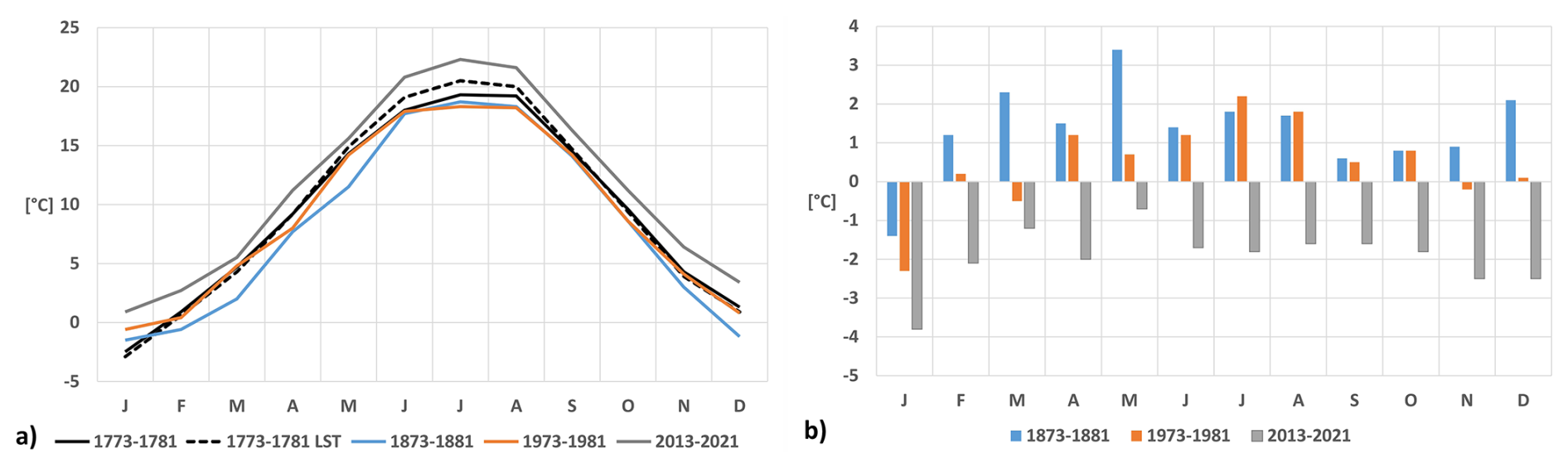
Figure 9Comparison of the annual cycle of air temperature in Wrocław (SW Poland) in historical time (1773–1781) against other more modern periods (a) and their differences (b). Key: Means for the compared periods were calculated based on data from three measurement times: 1873–1881 (unknown hours), 1973–1981 and 2013–2021 (06:00, 12:00, and 21:00 LT). Air temperatures from the modern period were subtracted from those from the historical period.
The discovery of a new series of meteorological observations made in Wrocław (Poland, central Europe) clearly demonstrates that, even today, there is a need to visit archives and libraries to search for early-instrumental meteorological observations. The significance of the described and analysed series of measurements extends not only to a better understanding of the region's climate during the period under study, but also to the future possible extension of the currently available series of continuous measurements in Wrocław (which currently starts at 1791) back to 1773. This is possible because meteorological data for Żagań near Wrocław are available for the period 1781–1792 (see Przybylak et al., 2014; Pappert et al., 2021). (This station was called Sagan [in Latin] within the Mannheim network of stations established for Europe and North America by the Palatine Meteorological Society founded in 1780). This means that, for two years (1791–1792), parallel meteorological observations were conducted in Wrocław and Żagań. Przybylak et al. (2014) used mean daily air temperature data from these years to calculate correlation coefficients (r), which were very high, ranging from 0.91 in summer to 0.97 in spring and autumn. After extending it to 1773, the air temperature series from Wrocław will be the longest in Poland; it will be six years longer than the currently longest series, which is for Warsaw (Lorenc, 2000) and extends back to 1779.
For the entire period examined in this article, therefore, no other air temperature data exist for south-west Poland, making a direct comparison impossible. However, it is possible to compare them against the closest series of measured temperatures available for the study period for Berlin and Prague (Fig. 10). Mean seasonal and annual air temperatures from the period 1961–1990 at both stations correlate strongly with those from Wrocław, e.g. correlation coefficients exceed 0.9, except for summer temperature in Berlin (r=0.85). For the period 1773–1781, there are also data from Gdańsk, located on the Baltic coast (Filipiak and Miętus, 2010; Przybylak, 2010; Filipiak et al., 2019); however, the correlation with the Wrocław data is clearly weaker, particularly in summer (r=0.76) and in autumn (r=0.8), and these data were therefore omitted from the comparison. Additionally, as shown in Fig. 11, the pattern of temperature change between the historical and contemporary periods, according to the ModE-RA paleo-reanalysis (Valler et al., 2024), differed between northern Poland and south-western Poland, particularly in winter and spring (as also evident in the annual values). In Sect. 2, we mentioned also the existence of temperature data for two short sub-periods of the analysed period 1773–1781, i.e., 1773 and 1774 (Jelenia Góra, Żagań) and 1779–1781 (Warsaw), which were used to check the quality and reliability of this series (high correlation coefficients were found).
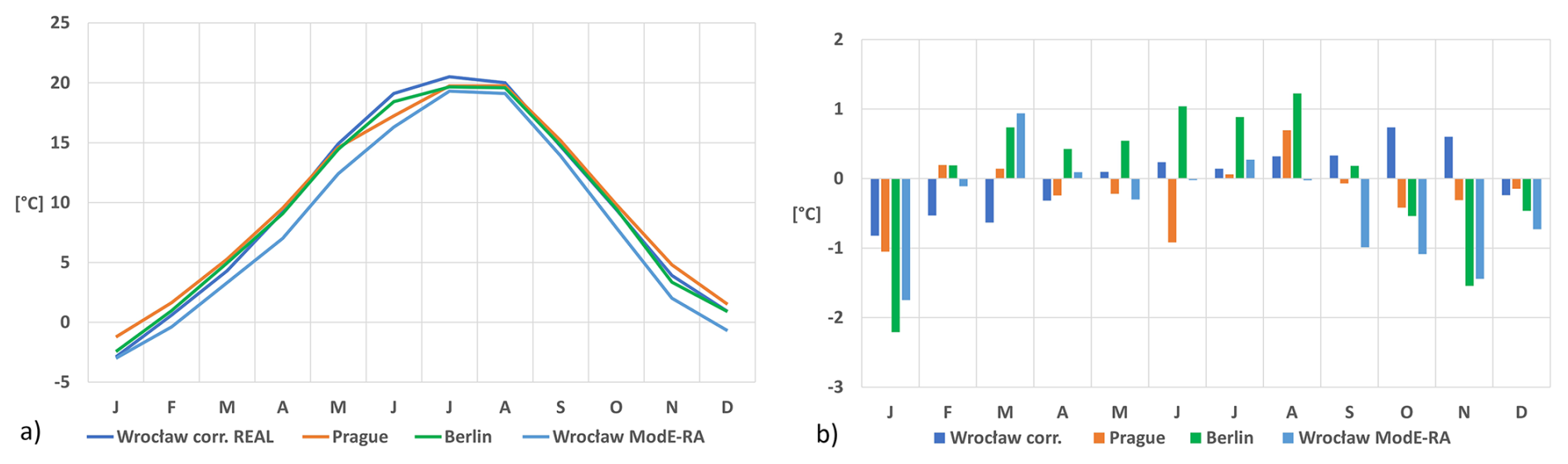
Figure 10Comparison of the annual cycle of air temperature in Wrocław in historical time (1773–1781) against other available series in central Europe (a), and their differences in relation to the 1961–1990 reference period (b). Key: Air temperatures from the reference period were subtracted from those of the historical period.

Figure 11Seasonal and annual mean air temperature anomalies in the European–Atlantic region in the period 1783–1781 relative to 1961–1990 according to the ModE-RA paleo-reanalysis (ClimeApp – Valler et al., 2024). Black, green, and purple dots mark Wrocław, Berlin, and Prague, respectively.
Temperature data from this paleo-reanalysis for Wrocław for the period 1773–1781 were compared against the instrumental observations analysed in this paper (see Fig. 10a). It can be seen that all monthly means reconstructed by the ModE-RA paleo-reanalysis were colder than the measured values, with a maximum difference above 2 °C from April to June and minimum in January (0.1 °C). On average, the annual temperature was 1.5 °C colder. The question arises as to the reason for these discrepancies. They are certainly attributable both to the imperfection of the paleo-reanalysis for Poland and to still-possible biases in the air temperature series analysed here. It appears that one of the important weaknesses of the temperatures reconstructed by the ModE-RA paleo-reanalysis for Poland, including the Wrocław area, lies in its limited use of proxy data sources from Poland in the temperature reconstruction. Between 1773 and 1778, there were only three records for the warm half-year (two documentary sources from central and south-western Poland and one instrumental series from Gdańsk) and four for the cold half-year (in addition to the aforementioned records, information was available on sea-ice coverage in the Baltic Sea). Additionally, instrumental observations from Warsaw were assimilated into the model between 1779 and 1781. Therefore, we suggest some caution in using the reconstructed temperatures in the ModE-RA paleo-reanalysis for Poland (including Wrocław). The presented homogenised early-instrumental series from Wrocław, despite still entailing some uncertainties should, when assimilated into the model used for reconstructing temperature, help improve the quality of this paleo-reanalysis.
Taking into account the above-mentioned reservations regarding possible inaccuracies in the reconstruction of air temperature in Wrocław taken from ModE-RA, as well as possible biases in the analysed instrumental series related to, among others, the lack of knowledge about the exact exposure of thermometers, we also present their comparison against temperatures from the closest stations, i.e. Berlin and Prague (Fig. 10). Data from these stations for the study period (1773–1781) were assimilated into the model used for European temperature reconstructions by the ModE-RA paleo-reanalysis. There is good correspondence between the corrected series from Wrocław and the series shown for Berlin and Prague. Wrocław is usually a little colder in the cold half of the year and warmer in the summer months (Fig. 10a). The average long-term temperature in Wrocław was 9.6 °C, which was 0.2 °C lower/higher than in Prague and Berlin, respectively. On the other hand, the Wrocław temperature from ModERA was evidently colder than the measured data in all analysed instrumental series.
Figure 10b shows the change in air temperature in central Europe (western Czech Republic, south-western Poland, eastern Germany), represented by stations in Prague, Wrocław and Berlin, between the historical period (1773–1781) and the contemporary period (1961–1990). The reference period (1961–1990) was the same as that used in the ModE-RA paleo-reanalysis, which allows for direct comparison of results. The following pattern of temperature changes is observed: generally (with some exceptions), in the historical period, warmer conditions dominated from February to September, with a maximum in the summer months, particularly in Berlin and Wrocław, whereas all other months were colder, particularly January (Fig. 10b). More consistent relations exist when seasonal and mean data are taken into account. According to the instrumental data presented, the mean annual air temperature between the two periods changed very little. During the historical period, temperatures in Wrocław and Berlin were, respectively, 0.7 and 0.1 °C higher than now; whereas Prague was 0.2 °C colder. The temperature changes between the two studied periods correspond most closely for winter and autumn. In Berlin, Wrocław and Prague, the winter mean temperature was colder in historical times than at present (by 0.8, 0.1 and 0.3 °C, respectively). On the other hand, the summer mean temperature in the historical period was higher than at present in Berlin (1.0 °C) and in Wrocław (2.0 °C), while Prague was slightly (0.1 °C) colder. Very good coherence between seasonal means (winter and autumn) is seen between the Prague and Wrocław stations (differences range from 0.0 to −0.3 °C). On the other hand, in the warm-half year, more similar changes were noted between Wrocław and Berlin, particularly in spring (Fig. 10b).
Generally, the results presented here for temperature changes from the historical period (1773–1781) to the present period (1961–1990) based on instrumental measurements are in good agreement, at least in some months (e.g., January, March, and November), with the change derived from reconstructions available in the ModE-RA paleo-reanalysis (compare Figs. 10b and 11). Comparison of data from Wrocław reveals significant discrepancies between results, particularly in summer and autumn (Fig. 10b). In other months (particularly January, March, and April), the differences are smaller. We should assume that the instrumental data are of higher quality than the reconstructed temperature presented in the ModE-RA paleo-reanalysis and in other reconstructions based on proxy data (e.g., historical and dendrochronological data). Moreover, they have several important advantages over proxy data. For example, instrumental data provide much higher temporal resolution (daily and even sub-daily) and capture the full seasonal cycle. Proxy series are restricted to specific parts of the year (most often to summer or part of it). Therefore, it seems reasonable to state that assimilating the instrumental air temperature series presented here will improve the temperature reconstructions available from the ModE-RA paleo-reanalysis for the study's historical period. We hope that such an adjustment will be carried out in the future, and that this series of early-instrumental meteorological data, “extracted” and digitised from archival and library sources, will be helpful.
Summary of key results
The Patriotic Society in Silesia established a local network of meteorological stations in the years 1773–1781, i.e., several years before the network of stations organised by the Meteorological Society in Mannheim (1781–1792). The main aim of this initiative was to provide data for investigating the impact of weather and climate on social activities, particularly agriculture. Within this network, meteorological measurements in Wrocław were also conducted by Prof. J. E. Scheibel. In the present paper, we analysed one of the main components of climate, i.e. air temperature. Other meteorological elements will be analysed in subsequent articles.
Analysis of available metadata on instrumental air temperature measurements in Wrocław and other sites in Silesia allows for an unequivocal statement that the analysed air temperature data series (sub-daily and daily) is homogeneous and of high quality, as demonstrated also by detailed statistical analyses. That series covering the late 18th century is unique and very valuable, not only for the mentioned reasons, but also because there is no other instrumental data for the years 1773–1778 for southern and central Poland (the Warsaw series starts at 1779; Lorenc, 2000). The study of the Wrocław series provides a credible description of the climate in SW Poland during the late 18th century. It will also allow us to extend the available temperature series for Wrocław (from 1791) back to 1773. This will be possible because, for the period 1781–1792, air temperature series are available for Żagań near Wrocław (Przybylak et al., 2014; Pappert et al., 2021). An important result of this work is the demonstration that, if air temperature observations were made in historical time immediately after sunrise and sunset and during the afternoon hours (13:00–14:00 LT), a daily average can be calculated with a good approximation using the so-called weighted average. Particularly good results were noted in all months, except the summer months, when the temperature had a cold bias (see Figs. 4–6).
The air temperature in Wrocław during the period 1773–1781 was 1.4 and 0.5 °C warmer than in the respective equivalent periods 100 and 200 years later (i.e., 1873–1881 and 1973–1981) but 1.9 °C colder than in the most recent period (2013–2021). The greatest increase in temperature between the studied period and the latter period occurred in summer (2.7 °C) and winter (2.4 °C) and the smallest in autumn (0.8 °C) (Fig. 9). The highest monthly temperature (22.8 °C) was calculated for August 1781 and the lowest (−9.7 °C) for January 1776 (Table 1). On the other hand, the highest temperature (33.9 °C) was recorded at midday on 4 July 1781 and the lowest (−22.8 °C) on the morning of 27 January 1776. During the study period, the mean seasonal and annual air temperatures show no trend. The mean annual temperature is close to the mean temperature for spring and autumn (Table S3, Fig. 5). On average, in line with expectations, the warmest month was July (20.5 °C), and the coldest was January (−2.9 °C) (Table S3, Fig. 4).
Datasets for this research were derived from the following public domain resources:
-
Repository for Open Data (RepOD), Nicolaus Copernicus University Centre for Climate Change Research collection, https://doi.org/10.18150/PYVVWU (Przybylak et al., 2025), as cited in Przybylak and Pospieszyńska (2025).
-
Wrocław – 1873–1881 (https://doi.org/10.12775/bgeo-2010-0007, Bryś and Bryś 2010b); 1961–1990, 1973–1981 and 2013-2021 – Public database of Institute of Meteorology and Water Management – National Research Institute (IMGW-PIB).
-
Berlin – 1773–1781 (https://doi.org/10.1594/PANGAEA.870862, Kadow et al., 2017), Berlin Tempelhof 1961–1990, https://opendata.dwd.de/climate_environment/CDC/observations_germany/climate/monthly/kl/historical/ (last access: 15 January 2025).
-
Prague – 1773–1781 – Meteorologická pozorování v Praze-Klementinu 1775–1900, 1976, HMU Praha and Marciniak K., Kożuchowski K., 1990, Aneks (Kożuchowski, 1990).
-
ModE-RA – ClimeApp (Valler et al., 2024).
The supplement related to this article is available online at https://doi.org/10.5194/cp-22-1383-2026-supplement.
Study design by RP. Source analysis by PO, AP and RP. Data collection and selection by AP and RP. Data curation by AP and RP. Literature review by RP. Statistical analysis and visualisation by AP and RP. Interpretation of results by RP and AP. Preparation of the manuscript by RP with contributions from all co-authors.
The contact author has declared that none of the authors has any competing interests.
Publisher's note: Copernicus Publications remains neutral with regard to jurisdictional claims made in the text, published maps, institutional affiliations, or any other geographical representation in this paper. The authors bear the ultimate responsibility for providing appropriate place names. Views expressed in the text are those of the authors and do not necessarily reflect the views of the publisher.
The authors thank Ms. Zuzanna Sobierajska and Mr. Tomasz Jaworski for digitising the original data. We also thank the reviewers – Professor Stefan Brönnimann, Professor Christian Pfister, Dr. Thomas Pliemon and one anonymous contributor – for their constructive and helpful suggestions and comments, which significantly helped to improve the article.
This research has been supported by the Narodowe Centrum Nauki (grant no. 2020/37/B/ST10/00710).
This paper was edited by Jürg Luterbacher and reviewed by Christian Pfister, Thomas Pliemon, Stefan Bronnimann, and one anonymous referee.
Aguilar, E., Auer, I., Brunet, N., Peterson, T. C., and Wieringa, J.: Guidelines on climate metadata and homogenization, WCDMP-No. 53, WMO/TD No. 1186, 50 pp., https://library.wmo.int/idurl/4/36913 (last access: 15 June 2025), 2003.
Baranowski, J.: Przedmowa tłumacza [do polskiego wydania P. Foissac, Meteorologia czyli nauka o zjawiskach w powietrzu dostrzegalnych, o ich związku i wpływie na królestwo organiczne, a głównie na człowieka, Tom pierwszy], Warszawa, https://rcin.org.pl/igipz/dlibra/publication/15135/edition/48630 (last access: 30 June 2025), 1858.
Birkenmajer, L. and Birkenmajer, A.: Najważniejsze dezyderaty nauki polskiej w zakresie nauk matematycznych, Nauka polska, I., Warszawa, https://polona.pl/item-view/71a89461-35fc-4f78-aa82-6179e71d5e02 (last access: 25 June 2025), 1918.
Brázdil, R., Pfister, C., Wanner, H., von Storch, H., and Luterbacher, J.: Historical climatology in Europe – the state of the art, Climatic Change, 70, 363–430, https://doi.org/10.1007/s10584-005-5924-1, 2005.
Brönnimann, S., Brugnara, Y., Allan, A., Brunet, M., Compo, G. P., Crouthamel, R. I., Jones, P. D., Jourdain, S., Luterbacher, J., Siegmund, P., Valente, M. A., and Wilkinson, C. V.: A roadmap to climate data rescue services, Geosci. Data J., 5, 28–39, https://doi.org/10.1002/gdj3.56, 2018.
Brönnimann, S., Allan, R., Ashcroft, L., Baer, S., Barriendos, M., Brázdil, R., Brugnara, Y., Brunet, M., Brunetti, M., Chimani, B., Cornes, R., Domínguez-Castro, F., Filipiak, J., Founda, D., Herrera, R., Gergis, J., Grab, S., Hannak, L., Huhtamaa, H., Jacobsen, K., Jones, P., Jourdain, S., Kiss, A., Lin, K., Lorrey, A., Lundstad, E., Luterbacher, J., Mauelshagen, F., Maugeri, M., Maughan, N., Moberg, A., Neukom, R., Nicholson, S., Noone, S., Nordli, Ø., Ólafsdóttir, K., Pearce, P., Pfister, L., Pribyl, K., Przybylak, R., Pudmenzky, C., Rasol, D., Reichenbach, D., Rezničková, L., Rodrigo, F., Rohr, C., Skrynyk, O., Slonosky, V., Thorne, P., Valente, M., Vaquero, J., Westcott, N., Williamson, F., and Wyszyński, P.: Unlocking pre-1850 instrumental meteorological records: A global inventory, B. Am. Meteorol. Soc., 100, ES389–ES413, https://doi.org/10.1175/BAMSD-19-0040.1, 2019.
Bryś, K. and Bryś, T.: The first one hundred years (1791–1890) of the “Wrocław temperature series”, in: The Polish Climate in the European context: An Historical Overview, edited by: Przybylak, R., Majorowicz, J., Brázdil, R., and Kejna, M., Springer, Dordrecht, 485–524, https://doi.org/10.1007/978-90-481-3167-9_25, 2010a.
Bryś, K. and Bryś, T.: Reconstruction of the 217 year (1791–2007) Wrocław air temperature and precipitation series, Bull. Geogr. – Phys. Geogr. Ser., 3, 121–171, https://doi.org/10.12775/bgeo-2010-0007, 2010b.
Cubash, U. and Kadow, C.: Global climate change and aspects of regional climate change in the Berlin–Brandenburg region, DIE ERDE – Journal of the Geographical Society of Berlin, 142, 3–20, 2011.
Filipiak, J. and Miętus, M.: History of the Gdańsk Pre-Instrumental and Instrumental Record of Meteorological Observations and Analysis of Selected Air Pressure Observations, in: The Polish Climate in the European context: An Historical Overview, edited by: Przybylak, R., Majorowicz, J., Brázdil, R., and Kejna, M., Springer, Dordrecht, 267–293, https://doi.org/10.1007/978-90-481-3167-9_12, 2010.
Filipiak, J., Przybylak, R., and Oliński, P.: The longest one-man weather chronicle (1721–1786) by Gottfried Reyger for Gdańsk, Poland as a source for improved understanding of past climate variability, Int. J. Climatol., 39, 828–842, https://doi.org/10.1002/joc.5845, 2019.
Ghazi, B., Przybylak, R., Oliński, P., Bogdańska, K., and Pospieszyńska, A.: The frequency, intensity, and origin of floods in Poland in the 11th–15th centuries based on documentary evidence, J. Hydrol., 623, 129778, https://doi.org/10.1016/j.jhydrol.2023.129778, 2023a.
Ghazi, B., Przybylak, R., Oliński, P., Chorążyczewski, W., and Pospieszyńska, A.: An assessment of flood occurrences in Poland in the 16th century, Journal of Hydrology: Regional Studies, 50, 101597, https://doi.org/10.1016/j.ejrh.2023.101597, 2023b.
Ghazi, B., Przybylak, R., Oliński, P., Targowski, M., Filipiak, J., and Pospieszyńska, A.: A comprehensive study of floods in Poland in the 17th–18th centuries, Journal of Hydrology: Regional Studies, 53, 101796, https://doi.org/10.1016/j.ejrh.2024.101796, 2024.
Ghazi, B., Przybylak, R., Oliński, P., and Pospieszyńska, A.: Flood occurrences and characteristics in Poland (Central Europe) in the last millennium, Global Planet. Change, 246, 104706, https://doi.org/10.1016/j.gloplacha.2025.104706, 2025.
Gorczyński W.: O najdawniejszych spostrzeżeniach i drukach meteorologicznych ze szczególnym uwzględnieniem Polski, Wiadomości Meteorologiczne, 8–9, https://polona.pl/preview/a0193c56-adff-49d3-9426-ee864914acf8 (last access: 1 June 2025), 1922.
Günther: Scheibel: Johann Ephraim, in: Allgemeine Deutsche Biographie, Bd. 30, Leipzig, 693–699, https://www.deutsche-biographie.de/gnd117193062.html#adbcontent (last access: 15 April 2026), 1890.
Harasimowicz, J. and Suleja, W.: Patriotic Society, Encyklopedia Wrocławia, Wydawnictwo Dolnośląskie, Wrocław, 858 pp., ISBN 978-83-7384-561-9, 2006.
Hellmann, G.: Die ältesten meteorologischen Beobachtungen in Polen, Z. d. Geselsch. F. Erdkunde zu Berlin, Nr. 5/6 ex, 352–353, https://n2t.net/ark:/13960/s2xvh051qpd (last access: 10 June 2025), 1918.
Hernandez-Almeida, I., Grosjean, M., Przybylak, R., and Tylmann, W.: A chrysophyte-based quantitative reconstruction of winter severity from varved lake sediments in NE Poland during the past millennium and its relationship to natural climate variability, Quaternary Sci. Rev., 122, 74–88, https://doi.org/10.1016/j.quascirev.2015.05.029, 2015.
Hernández-Almeida, I., Grosjean, M., Gómez-Navarro, J. J., Larocque-Tobler, I., Bonk, A., Enters, D., Ustrzycka, A., Piotrowska, N., Przybylak, R., Wacnik, A., Witak, M., and Tylmann, W.: Resilience, rapid transitions and regime shifts: Fingerprinting the responses of Lake Żabińskie (NE Poland) to climate variability and human disturbance since AD 1000, Holocene, 1–13, https://doi.org/10.1177/0959683616658529, 2016.
Kadow, C., Wentzel, B., Jaekel, I., Bahlo, M., and Cubasch, U.: Berlin Climate Record – Inner City – 1766–1934, Institut für Meteorologie, Freie Universität Berlin, PANGAEA [data set], https://doi.org/10.1594/PANGAEA.870862, 2017.
Kożuchowski, K. (Ed.): Materiały do poznania historii klimatu w okresie obserwacji instrumentalnych, wyd. Uniw. Łódzkiego, Łódź, 302–452, ISBN 83-7016-434-X, 1990.
Lorenc, H.: Studia nad 220-letnią (1779–1998) serią temperatury powietrza w Warszawie oraz ocena jej wiekowych tendencji, Materiały Badawcze, Seria Meteorologia, 31, 3–104, 2000.
Majorowicz, J., Šafanda, J., Przybylak, R., and Wójcik, G.: Ground surface temperature history in Poland in the 16th–20th centuries derived from the inversion of geothermal profiles, Pure Appl. Geophys., 161, 351–363, https://doi.org/10.1007/s00024-003-2439-4, 2004.
Merecki, R.: Meteorologia, Poradnik dla samouków, wydanie nowe, tom II, Warszawa, 411–470 and 487, https://jbc.bj.uj.edu.pl/dlibra/publication/402341/edition/379666 (last access: 18 June 2025), 1917.
Munzar, J.: Contribution of the Wrocław (Breslau) meteorological network from the years 1717–1730 to a better knowledge about weather conditions in Central Europe. Acta Univ. Wratisl., 2542, Studia Geogr., 75, 23–30, 2003.
Oekonomische Nachrichten der Patriotischen Gesellschaft in Schlesien, Wrocław, http://resolver.sub.uni-goettingen.de/purl?PPN625447506 (last access: 15 January 2025), 1773–1781.
Opała-Owczarek, M., Niedźwiedź, T., Przybylak, R., and Tylmann, W.: Climate Change Before Instrumental Measurements, in: Climate Change in Poland, edited by: Falarz, M., Springer Climate, 71–119, https://doi.org/10.1007/978-3-030-70328-8_5, 2021.
Pappert, D., Brugnara, Y., Jourdain, S., Pospieszyńska, A., Przybylak, R., Rohr, C., and Brönnimann, S.: Unlocking weather observations from the Societas Meteorologica Palatina (1781–1792), Clim. Past, 17, 2361–2379, https://doi.org/10.5194/cp-17-2361-2021, 2021.
Pawłowski, S.: Przyczynek do dziejów spostrzeżeń meteorologicznych w Polsce, Przegląd Geograficzny, 1, 106–107, 1919.
Przybylak, R.: The Climate of Poland in Recent Centuries: A Synthesis of Current Knowledge: Instrumental observations, in: The Polish Climate in the European Context: An Historical Overview, edited by: Przybylak, R., Majorowicz, J., Brázdil, R., and Kejna, M., Springer, Berlin, Heidelberg, New York, 129–166, https://doi.org/10.1007/978-90-481-3167-9_5, 2010.
Przybylak, R.: Changes in Poland's climate over the last millennium, Czasopismo Geograficzne, 82, 23–48, 2011.
Przybylak, R.: Poland's Climate in the Last Millennium, Oxford Research Encyclopedia, Climate Science, Oxford University Press USA, 36 pp., https://doi.org/10.1093/acrefore/9780190228620.013.2, 2016.
Przybylak, R. and Marciniak, K.: Climate Changes in the Central and North-eastern Parts of the Polish–Lithuanian Commonwealth from 1656 to 1685, in: The Polish Climate in the European Context: An Historical Overview, edited by: Przybylak, R., Majorowicz, J., Brázdil, R., and Kejna, M., Springer, Berlin, Heidelberg, New York, 423–443, https://doi.org/10.1007/978-90-481-3167-9_21, 2010.
Przybylak, R. and Pospieszyńska, A.: Air temperature in Wroclaw (Breslau) in the period 1710–1721 based on measurements made by David Von Grebner, Acta Agrophysica, 184, 35–43, 2010.
Przybylak, R. and Pospieszyńska, A.: Air temperature data in Wrocław (SW Poland) in 1773–1781 based on a newly discovered series of meteorological measurements, RepOD [data set], https://doi.org/10.18150/PYVVWU, 2025.
Przybylak, R., Majorowicz, J., Wójcik, G., Zielski, A., Chorążyczewski, W., Marciniak, K. Nowosad, W., Oliński, P., and Syta, K.: Temperature changes in Poland from the 16th to the 20th centuries, Int. J. Climatol., 25, 773–791, https://doi.org/10.1002/joc.1149, 2005.
Przybylak, R., Oliński, P., Chorążyczewski, W., Nowosad, W., and Syta, K.: The Climate of Poland in Recent Centuries: A Synthesis of Current Knowledge: Documentary evidence, in: The Polish Climate in the European Context: An Historical Overview, edited by: Przybylak, R., Majorowicz, J., Brázdil, R., and Kejna, M., Springer, Berlin, Heidelberg, New York, 167–190, https://doi.org/10.1007/978-90-481-3167-9_6, 2010.
Przybylak, R., Pospieszyńska, Wyszyński, P., and Nowakowski, M.: Air temperature changes in Żagań (Poland) in the period from 1781 to 1792, Int. J. Climatol., 34, 2408–2426, https://doi.org/10.1002/joc.3847, 2014.
Przybylak, R., Oliński, P., Koprowski, M., Filipiak, J., Pospieszyńska, A., Chorążyczewski, W., Puchałka, R., and Dąbrowski, H. P.: Droughts in the area of Poland in recent centuries in the light of multi-proxy data, Clim. Past, 16, 627–661, https://doi.org/10.5194/cp-16-627-2020, 2020.
Przybylak, R., Oliński, P., Koprowski, M., Szychowska-Krąpiec, E., Krąpiec, M., Pospieszyńska, A., and Puchałka, R.: The climate in Poland (central Europe) in the first half of the last millennium, revisited, Clim. Past, 19, 2389–2408, https://doi.org/10.5194/cp-19-2389-2023, 2023.
Przybylak, R., Singh, G., Wyszyński, P., Araźny, A., and Chmist, K.: Air temperature changes in SW Greenland in the second half of the 18th century, Clim. Past, 20, 1451–1470, https://doi.org/10.5194/cp-20-1451-2024, 2024.
Przybylak, R., Pospieszyńska, A., and Sobierajska, Z.: Air temperature data in Wrocław (SW Poland) in 1773–1781 based on a newly discovered series of meteorological measurements, V2, RepOD [data set], https://doi.org/10.18150/PYVVWU, 2025.
Przybylak, R., Araźny, A., Wyszyński, P., Singh, G., and Chmist, K.: Newly recovered series of meteorological measurements in SW Greenland (Nuuk) in the period 1806–1813, Clim. Past, 22, 957–974, https://doi.org/10.5194/cp-22-957-2026, 2026.
Pyka, J.: Meteorological observations and measurements in Wrocław, Acta Univ. Wratisl. 2542, Studia Geogr., 75, 11–22, 2003.
Rojecki, A.: O najdawniejszych obserwacjach meteorologicznych na ziemiach polskich, Przegląd Geofizyczny, 1, 253–257, 1956.
Rojecki, A.: The traditions of meteorology in Poland, from the 15th to 19th century, Acta Geophysica Polonica, XIV, 3–10, 1966.
Romer, E.: Esquisse climatique de l'ancienne Pologne, Bull. de la Soc. Vaudoise de Sc. Natur., Lausanne, XLVI, 203–233, 1910.
Sadowski, M.: Variability of extreme climatic events in Central Europe since the 13th century, Z. Meteorol., 41, 350–356, 1991.
Scheibel, J. E.: Codex Quatuor Evangeliorum Latinus Rehdigerianus, Matthaeus et Marcus, cum textu graeco et editione Vulgata collates, Vratislaviae (Wrocław), https://n2t.net/ark:/13960/t02z1430f (last access: 15 June 2026), 1763.
Scheibel, J. E.: Kurze Anweisung, wie diese Tafel zu verstehen und zu lesen sey, Oekonomische Nachrichten der Patriotischen Gesellschaft in Schlesien, pp. 2–4, https://www.deutsche-digitale-bibliothek.de/searchresults?query=Oekonomische+Nachrichten+der+Patriotischen+Gesellschaft+in+Schlesien (last access: 15 April 2026), 1773a.
Scheibel, J. E.: Oekonomische Nachrichten der Patriotischen Gesellschaft in Schlesien, pp. 130–131, 314–316, https://www.deutsche-digitale-bibliothek.de/searchresults?query=Oekonomische+Nachrichten+der+Patriotischen+Gesellschaft+in+Schlesien (last access: 15 April 2026), 1773b.
Scheibel, J. E.: Oekonomische Nachrichten der Patriotischen Gesellschaft in Schlesien, pp. 245–247, 265–267, 317–319, https://www.deutsche-digitale-bibliothek.de/searchresults?query=Oekonomische+Nachrichten+der+Patriotischen+Gesellschaft+in+Schlesien (last access: 15 April 2026), 1774.
Scheibel, J. E.: Oekonomische Nachrichten der Patriotischen Gesellschaft in Schlesien, p. 34, https://www.deutsche-digitale-bibliothek.de/searchresults?query=Oekonomische+Nachrichten+der+Patriotischen+Gesellschaft+in+Schlesien (last access: 15 April 2026), 1775a.
Scheibel, J. E.: Oekonomische Nachrichten der Patriotischen Gesellschaft in Schlesien, pp. 205–207, 393–398, 417–422, https://www.deutsche-digitale-bibliothek.de/searchresults?query=Oekonomische+Nachrichten+der+Patriotischen+Gesellschaft+in+Schlesien (last access: 15 April 2026), 1775b.
Scheibel, J. E.: Oekonomische Nachrichten der Patriotischen Gesellschaft in Schlesien, p. 62, https://www.deutsche-digitale-bibliothek.de/searchresults?query=Oekonomische+Nachrichten+der+Patriotischen+Gesellschaft+in+Schlesien (last access: 15 April 2026), 1780.
Valler, V., Franke, J., Brugnara, Y., Samakinwa, E., Hand, R., Lundstad, E., Burgdorf, A.-M., Lipfert, L., Friedman, A. R., and Brönnimann, S.: ModE-RA: a global monthly paleo-reanalysis of the modern era 1421 to 2008, Sci. Data, 11, 36, https://doi.org/10.1038/s41597-023-02733-8, 2024.