
Articles | Volume 22, issue 4
https://doi.org/10.5194/cp-22-861-2026
© Author(s) 2026. This work is distributed under
the Creative Commons Attribution 4.0 License.
the Creative Commons Attribution 4.0 License.
https://doi.org/10.5194/cp-22-861-2026
© Author(s) 2026. This work is distributed under
the Creative Commons Attribution 4.0 License.
the Creative Commons Attribution 4.0 License.
Research article
| 
22 Apr 2026
Research article |
| 22 Apr 2026
| 22 Apr 2026
The Late Pliocene jet stream: Changes and drivers of the mean state and variability

School of Earth and Environment, University of Leeds, Woodhouse Lane, Leeds, West Yorkshire, LS2 9JT, UK
Alan M. Haywood
School of Earth and Environment, University of Leeds, Woodhouse Lane, Leeds, West Yorkshire, LS2 9JT, UK
Julia C. Tindall
School of Earth and Environment, University of Leeds, Woodhouse Lane, Leeds, West Yorkshire, LS2 9JT, UK
Stephen J. Hunter
School of Earth and Environment, University of Leeds, Woodhouse Lane, Leeds, West Yorkshire, LS2 9JT, UK
Aisling M. Dolan
School of Earth and Environment, University of Leeds, Woodhouse Lane, Leeds, West Yorkshire, LS2 9JT, UK
Daniel J. Hill
School of Earth and Environment, University of Leeds, Woodhouse Lane, Leeds, West Yorkshire, LS2 9JT, UK
Related authors
Abigail E. C. Buchan, Alan M. Haywood, Aisling M. Dolan, Daniel J. Hill, and Julia C. Tindall
EGUsphere, https://doi.org/10.5194/egusphere-2026-4616, https://doi.org/10.5194/egusphere-2026-4616, 2026
Short summary
Short summary
Examining Late Pliocene climate provides an opportunity to understand how the climate system behaves in a warmer state. Using multiple climate models, we look at the North Atlantic Oscillation (NAO) in the Late Pliocene. These models show that the NAO index is more positive on average, but there is a large spread of responses. We also look at precipitation in Europe and find that there is a shift towards more precipitation in Northern Europe, although this change may not be driven by the NAO.
Abigail E. C. Buchan, Alan M. Haywood, Aisling M. Dolan, Daniel J. Hill, and Julia C. Tindall
EGUsphere, https://doi.org/10.5194/egusphere-2026-4616, https://doi.org/10.5194/egusphere-2026-4616, 2026
Short summary
Short summary
Examining Late Pliocene climate provides an opportunity to understand how the climate system behaves in a warmer state. Using multiple climate models, we look at the North Atlantic Oscillation (NAO) in the Late Pliocene. These models show that the NAO index is more positive on average, but there is a large spread of responses. We also look at precipitation in Europe and find that there is a shift towards more precipitation in Northern Europe, although this change may not be driven by the NAO.
Natalie J. Burls, Nicky M. Wright, R. Paul Acosta, Catherine D. Bradshaw, Edward Gasson, Lennert B. Stap, Gilles Ramstein, Anna Ruth W. Halberstadt, Agatha M. De Boer, Funda Akgün, David J. Cantrill, Manuel Casas-Gallego, Nela Doláková, Boglarka Erdei, Alex Farnsworth, Sarah Feakins, Ran Feng, Tamara Fletcher, Frédéric Fluteau, J. A. Mattias Green, Anna S. von der Heydt, Matthew Huber, David K. Hutchinson, Dimiter Ivanov, Mine Sezgül Kayseri-Özer, Gregor Knorr, Marianna Kováčová, Caroline H. Lear, Allegra N. LeGrande, Shufeng Li, Xiaoqing Liu, Daniel J. Lunt, Katrin Meissner, Yunfa Miao, Trusha J. Naik, Javier B. Navarro, Joseph B. Novak, Diana Ochoa, Guy J.G. Paxman, Matthew J. Pound, James W. B. Rae, Tammo Reichgelt, Martin Renoult, Francesca Sangiorgi, Anta-Clarisse Sarr, Diane Segalla, Pierre Sepulchre, Amelia Shevenell, Sebastian Steinig, Eivind Straume, Caroline A. E. Strömberg, Clay Tabor, Torsten Utescher, Julia E. Weiffenbach, Elżbieta Worobiec, Yurui Zhang, Feng Zhu, Jiang Zhu, Alexandra Auderset, Florence Colleoni, Aisling Dolan, Rachel Havranek, Ann Holbourn, Nicholas Herold, Daeun Lee, James W. Marschalek, Bryce Mitsunaga, Sevi Modestou, Lina Perez-Angel, Mae Saslaw, Sinda Sosdian, Elena Stiles, Yong Sun, Ning Tan, Zhongshi Zhang, and Yan Zhao
EGUsphere, https://doi.org/10.5194/egusphere-2026-3595, https://doi.org/10.5194/egusphere-2026-3595, 2026
This preprint is open for discussion and under review for Geoscientific Model Development (GMD).
Short summary
Short summary
Simulating warm paleoclimates increases our understanding of the mechanisms that drive climatic change and tipping points. The Miocene Epoch, specifically the Miocene Climatic Optimum, has been identified as a particularly valuable past warm climate to simulate, meriting the design of a coordinated Miocene Model Intercomparison Project. Here we synthesize the latest available literature and present the experimental design for coordinated Miocene simulations and sensitivity studies.

Lauren E. Burton, Alan M. Haywood, Julia C. Tindall, Aisling M. Dolan, Daniel J. Hill, Erin L. McClymont, Sze Ling Ho, and Heather L. Ford
Clim. Past, 20, 1177–1194, https://doi.org/10.5194/cp-20-1177-2024, https://doi.org/10.5194/cp-20-1177-2024, 2024
Short summary
Short summary
The Pliocene (~ 3 million years ago) is of interest because its warm climate is similar to projections of the future. We explore the role of atmospheric carbon dioxide in forcing sea surface temperature during the Pliocene by combining climate model outputs with palaeoclimate proxy data. We investigate whether this role changes seasonally and also use our data to suggest a new estimate of Pliocene climate sensitivity. More data are needed to further explore the results presented.
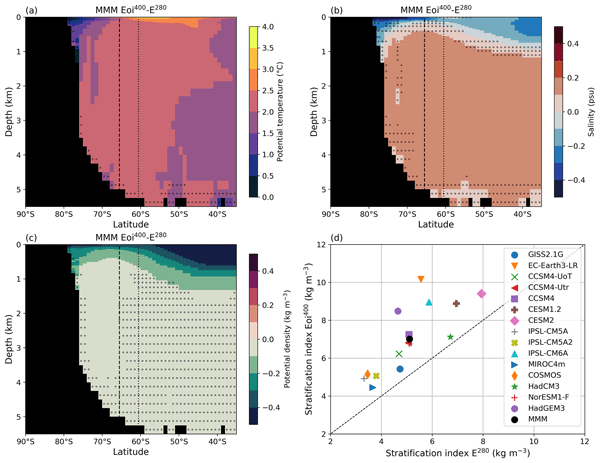
Julia E. Weiffenbach, Henk A. Dijkstra, Anna S. von der Heydt, Ayako Abe-Ouchi, Wing-Le Chan, Deepak Chandan, Ran Feng, Alan M. Haywood, Stephen J. Hunter, Xiangyu Li, Bette L. Otto-Bliesner, W. Richard Peltier, Christian Stepanek, Ning Tan, Julia C. Tindall, and Zhongshi Zhang
Clim. Past, 20, 1067–1086, https://doi.org/10.5194/cp-20-1067-2024, https://doi.org/10.5194/cp-20-1067-2024, 2024
Short summary
Short summary
Elevated atmospheric CO2 concentrations and a smaller Antarctic Ice Sheet during the mid-Pliocene (~ 3 million years ago) cause the Southern Ocean surface to become fresher and warmer, which affects the global ocean circulation. The CO2 concentration and the smaller Antarctic Ice Sheet both have a similar and approximately equal impact on the Southern Ocean. The conditions of the Southern Ocean in the mid-Pliocene could therefore be analogous to those in a future climate with smaller ice sheets.
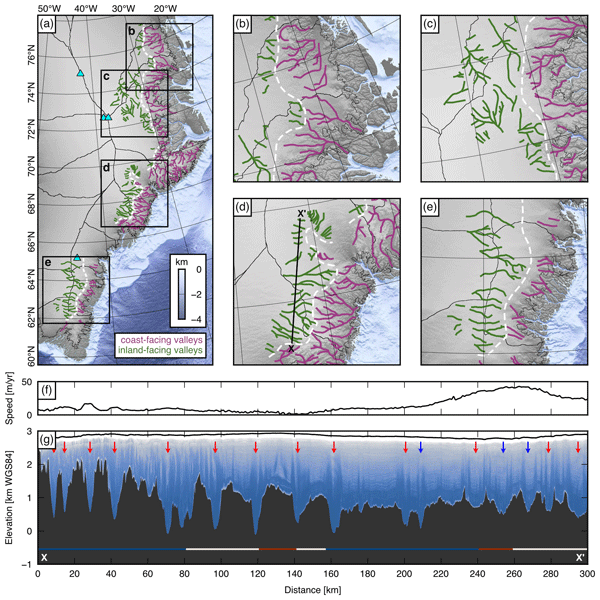
Guy J. G. Paxman, Stewart S. R. Jamieson, Aisling M. Dolan, and Michael J. Bentley
The Cryosphere, 18, 1467–1493, https://doi.org/10.5194/tc-18-1467-2024, https://doi.org/10.5194/tc-18-1467-2024, 2024
Short summary
Short summary
This study uses airborne radar data and satellite imagery to map mountainous topography hidden beneath the Greenland Ice Sheet. We find that the landscape records the former extent and configuration of ice masses that were restricted to areas of high topography. Computer models of ice flow indicate that valley glaciers eroded this landscape millions of years ago when local air temperatures were at least 4 °C higher than today and Greenland’s ice volume was < 10 % of that of the modern ice sheet.
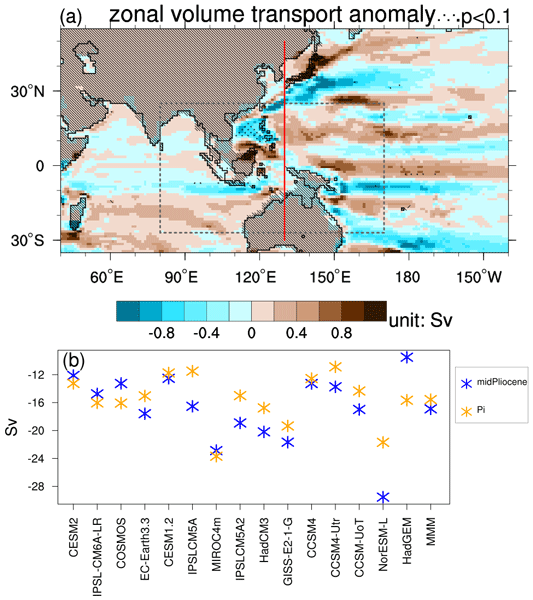
Xin Ren, Daniel J. Lunt, Erica Hendy, Anna von der Heydt, Ayako Abe-Ouchi, Bette Otto-Bliesner, Charles J. R. Williams, Christian Stepanek, Chuncheng Guo, Deepak Chandan, Gerrit Lohmann, Julia C. Tindall, Linda E. Sohl, Mark A. Chandler, Masa Kageyama, Michiel L. J. Baatsen, Ning Tan, Qiong Zhang, Ran Feng, Stephen Hunter, Wing-Le Chan, W. Richard Peltier, Xiangyu Li, Youichi Kamae, Zhongshi Zhang, and Alan M. Haywood
Clim. Past, 19, 2053–2077, https://doi.org/10.5194/cp-19-2053-2023, https://doi.org/10.5194/cp-19-2053-2023, 2023
Short summary
Short summary
We investigate the Maritime Continent climate in the mid-Piacenzian warm period and find it is warmer and wetter and the sea surface salinity is lower compared with preindustrial period. Besides, the fresh and warm water transfer through the Maritime Continent was stronger. In order to avoid undue influence from closely related models in the multimodel results, we introduce a new metric, the multi-cluster mean, which could reveal spatial signals that are not captured by the multimodel mean.
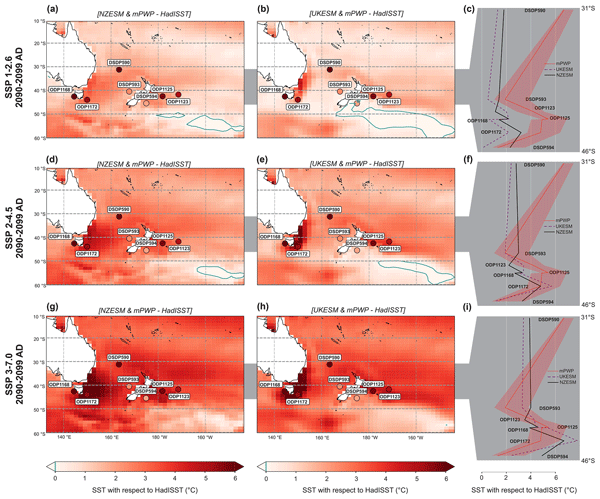
Georgia R. Grant, Jonny H. T. Williams, Sebastian Naeher, Osamu Seki, Erin L. McClymont, Molly O. Patterson, Alan M. Haywood, Erik Behrens, Masanobu Yamamoto, and Katelyn Johnson
Clim. Past, 19, 1359–1381, https://doi.org/10.5194/cp-19-1359-2023, https://doi.org/10.5194/cp-19-1359-2023, 2023
Short summary
Short summary
Regional warming will differ from global warming, and climate models perform poorly in the Southern Ocean. We reconstruct sea surface temperatures in the south-west Pacific during the mid-Pliocene, a time 3 million years ago that represents the long-term outcomes of 3 °C warming, which is expected for the future. Comparing these results to climate model simulations, we show that the south-west Pacific region will warm by 1 °C above the global average if atmospheric CO2 remains above 350 ppm.
Xiaofang Huang, Shiling Yang, Alan Haywood, Julia Tindall, Dabang Jiang, Yongda Wang, Minmin Sun, and Shihao Zhang
Clim. Past, 19, 731–745, https://doi.org/10.5194/cp-19-731-2023, https://doi.org/10.5194/cp-19-731-2023, 2023
Short summary
Short summary
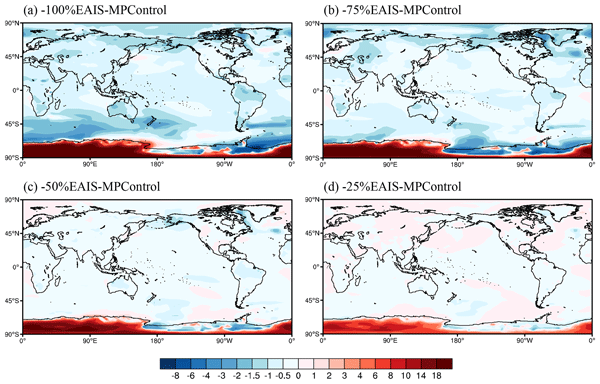
The sensitivity of climate to the height changes of the East Antarctic ice sheet (EAIS) during the mid-Pliocene has been assessed using the HadCM3 model. The results show that the height reduction of the EAIS leads to a warmer and wetter East Antarctica. However, unintuitively, both the surface air temperature and the sea surface temperature decrease over the rest of the globe. These findings could provide insights into future changes caused by warming-induced decay of the Antarctic ice sheet.
Lauren E. Burton, Alan M. Haywood, Julia C. Tindall, Aisling M. Dolan, Daniel J. Hill, Ayako Abe-Ouchi, Wing-Le Chan, Deepak Chandan, Ran Feng, Stephen J. Hunter, Xiangyu Li, W. Richard Peltier, Ning Tan, Christian Stepanek, and Zhongshi Zhang
Clim. Past, 19, 747–764, https://doi.org/10.5194/cp-19-747-2023, https://doi.org/10.5194/cp-19-747-2023, 2023
Short summary
Short summary
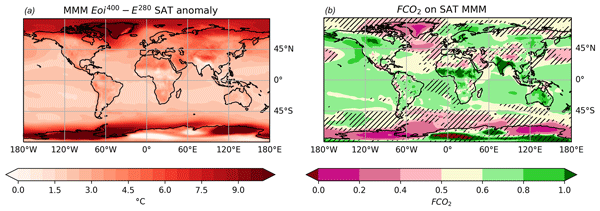
Warm climates of the Pliocene (~ 3 million years ago) are similar to projections of the near future. We find elevated concentrations of atmospheric carbon dioxide to be the most important forcing for driving changes in Pliocene surface air temperature, sea surface temperature, and precipitation. However, changes caused by the nature of Pliocene ice sheets and orography are also important, affecting the extent to which we can use the Pliocene as an analogue for our warmer future.
Suzanne Robinson, Ruza F. Ivanovic, Lauren J. Gregoire, Julia Tindall, Tina van de Flierdt, Yves Plancherel, Frerk Pöppelmeier, Kazuyo Tachikawa, and Paul J. Valdes
Geosci. Model Dev., 16, 1231–1264, https://doi.org/10.5194/gmd-16-1231-2023, https://doi.org/10.5194/gmd-16-1231-2023, 2023
Short summary
Short summary
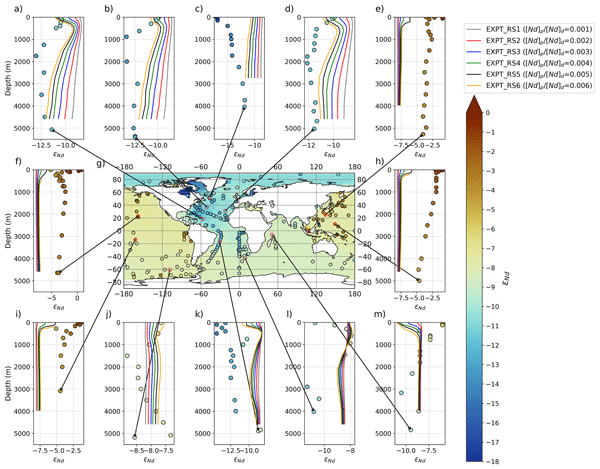
We present the implementation of neodymium (Nd) isotopes into the ocean model of FAMOUS (Nd v1.0). Nd fluxes from seafloor sediment and incorporation of Nd onto sinking particles represent the major global sources and sinks, respectively. However, model–data mismatch in the North Pacific and northern North Atlantic suggest that certain reactive components of the sediment interact the most with seawater. Our results are important for interpreting Nd isotopes in terms of ocean circulation.
Julia E. Weiffenbach, Michiel L. J. Baatsen, Henk A. Dijkstra, Anna S. von der Heydt, Ayako Abe-Ouchi, Esther C. Brady, Wing-Le Chan, Deepak Chandan, Mark A. Chandler, Camille Contoux, Ran Feng, Chuncheng Guo, Zixuan Han, Alan M. Haywood, Qiang Li, Xiangyu Li, Gerrit Lohmann, Daniel J. Lunt, Kerim H. Nisancioglu, Bette L. Otto-Bliesner, W. Richard Peltier, Gilles Ramstein, Linda E. Sohl, Christian Stepanek, Ning Tan, Julia C. Tindall, Charles J. R. Williams, Qiong Zhang, and Zhongshi Zhang
Clim. Past, 19, 61–85, https://doi.org/10.5194/cp-19-61-2023, https://doi.org/10.5194/cp-19-61-2023, 2023
Short summary
Short summary
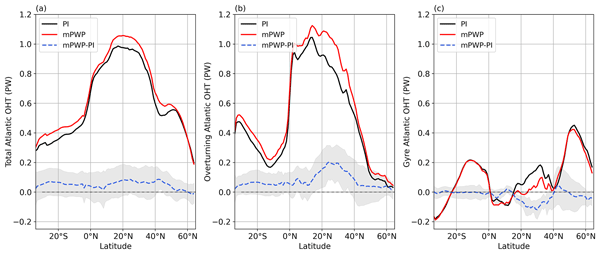
We study the behavior of the Atlantic Meridional Overturning Circulation (AMOC) in the mid-Pliocene. The mid-Pliocene was about 3 million years ago and had a similar CO2 concentration to today. We show that the stronger AMOC during this period relates to changes in geography and that this has a significant influence on ocean temperatures and heat transported northwards by the Atlantic Ocean. Understanding the behavior of the mid-Pliocene AMOC can help us to learn more about our future climate.
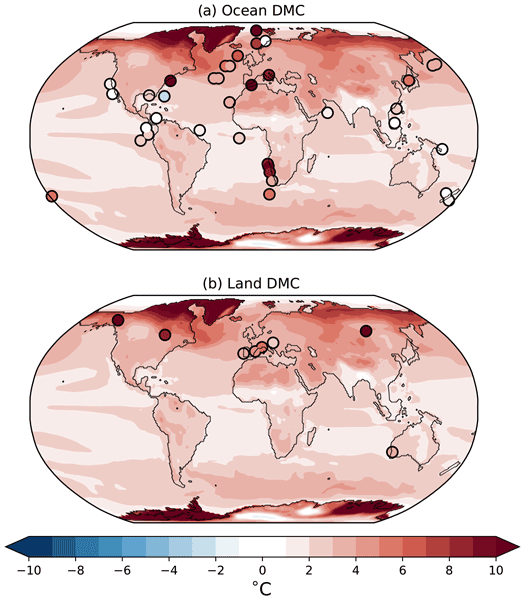
Julia C. Tindall, Alan M. Haywood, Ulrich Salzmann, Aisling M. Dolan, and Tamara Fletcher
Clim. Past, 18, 1385–1405, https://doi.org/10.5194/cp-18-1385-2022, https://doi.org/10.5194/cp-18-1385-2022, 2022
Short summary
Short summary
The mid-Pliocene (MP; ∼3.0 Ma) had CO2 levels similar to today and average temperatures ∼3°C warmer. At terrestrial high latitudes, MP temperatures from climate models are much lower than those reconstructed from data. This mismatch occurs in the winter but not the summer. The winter model–data mismatch likely has multiple causes. One novel cause is that the MP climate may be outside the modern sample, and errors could occur when using information from the modern era to reconstruct climate.
Zixuan Han, Qiong Zhang, Qiang Li, Ran Feng, Alan M. Haywood, Julia C. Tindall, Stephen J. Hunter, Bette L. Otto-Bliesner, Esther C. Brady, Nan Rosenbloom, Zhongshi Zhang, Xiangyu Li, Chuncheng Guo, Kerim H. Nisancioglu, Christian Stepanek, Gerrit Lohmann, Linda E. Sohl, Mark A. Chandler, Ning Tan, Gilles Ramstein, Michiel L. J. Baatsen, Anna S. von der Heydt, Deepak Chandan, W. Richard Peltier, Charles J. R. Williams, Daniel J. Lunt, Jianbo Cheng, Qin Wen, and Natalie J. Burls
Clim. Past, 17, 2537–2558, https://doi.org/10.5194/cp-17-2537-2021, https://doi.org/10.5194/cp-17-2537-2021, 2021
Short summary
Short summary
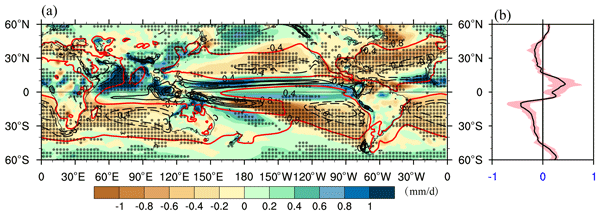
Understanding the potential processes responsible for large-scale hydrological cycle changes in a warmer climate is of great importance. Our study implies that an imbalance in interhemispheric atmospheric energy during the mid-Pliocene could have led to changes in the dynamic effect, offsetting the thermodynamic effect and, hence, altering mid-Pliocene hydroclimate cycling. Moreover, a robust westward shift in the Pacific Walker circulation can moisten the northern Indian Ocean.
Arthur M. Oldeman, Michiel L. J. Baatsen, Anna S. von der Heydt, Henk A. Dijkstra, Julia C. Tindall, Ayako Abe-Ouchi, Alice R. Booth, Esther C. Brady, Wing-Le Chan, Deepak Chandan, Mark A. Chandler, Camille Contoux, Ran Feng, Chuncheng Guo, Alan M. Haywood, Stephen J. Hunter, Youichi Kamae, Qiang Li, Xiangyu Li, Gerrit Lohmann, Daniel J. Lunt, Kerim H. Nisancioglu, Bette L. Otto-Bliesner, W. Richard Peltier, Gabriel M. Pontes, Gilles Ramstein, Linda E. Sohl, Christian Stepanek, Ning Tan, Qiong Zhang, Zhongshi Zhang, Ilana Wainer, and Charles J. R. Williams
Clim. Past, 17, 2427–2450, https://doi.org/10.5194/cp-17-2427-2021, https://doi.org/10.5194/cp-17-2427-2021, 2021
Short summary
Short summary
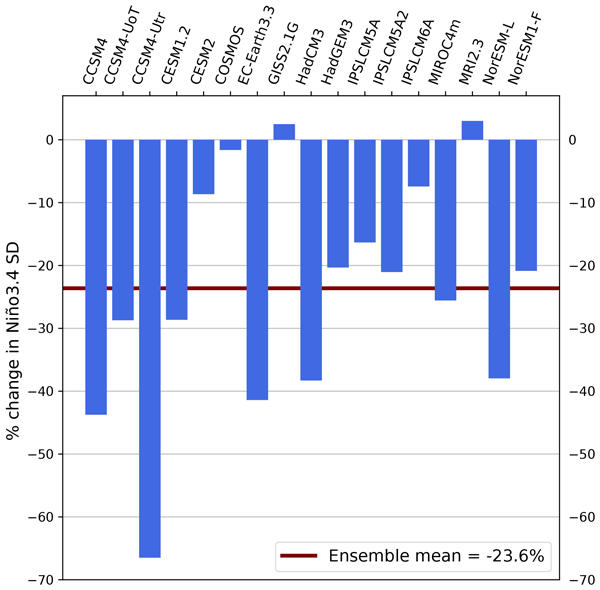
In this work, we have studied the behaviour of El Niño events in the mid-Pliocene, a period of around 3 million years ago, using a collection of 17 climate models. It is an interesting period to study, as it saw similar atmospheric carbon dioxide levels to the present day. We find that the El Niño events were less strong in the mid-Pliocene simulations, when compared to pre-industrial climate. Our results could help to interpret El Niño behaviour in future climate projections.
Cited articles
Abell, J., Winckler, G., Anderson, R., and Herbert, T.: Poleward and weakened westerlies during Pliocene warmth, Nature, 589, 70–75, https://doi.org/10.1038/s41586-020-03062-1, 2021. a, b, c
Anstey, J. A., Davini, P., Gray, L. J., Woollings, T. J., Butchart, N., Cagnazzo, C., Christiansen, B., Hardiman, S. C., Osprey, S. M., and Yang, S.: Multi-model analysis of Northern Hemisphere winter blocking: Model biases and the role of resolution, J. Geophys. Res.-Atmos., 118, 3956–3971, https://doi.org/10.1002/jgrd.50231, 2013. a
Athanasiadis, P. J., Ogawa, F., Omrani, N.-E., Keenlyside, N., Schiemann, R., Baker, A. J., Vidale, P. L., Bellucci, A., Ruggieri, P., Haarsma, R., Roberts, M., Roberts, C., Novak, L., and Gualdi, S.: Mitigating Climate Biases in the Midlatitude North Atlantic by Increasing Model Resolution: SST Gradients and Their Relation to Blocking and the Jet, J. Climate, 35, 6985–7006, https://doi.org/10.1175/JCLI-D-21-0515.1, 2022. a
Bonfils, C. J. W., Phillips, T. J., Lawrence, D. M., Cameron-Smith, P., Riley, W. J., and Subin, Z. M.: On the influence of shrub height and expansion on northern high latitude climate, Environ. Res. Lett., 7, 015503, https://doi.org/10.1088/1748-9326/7/1/015503, 2012. a
Buchan, A.: HadCM3 forcing factorisation experiment output, Zenodo [data set], https://doi.org/10.5281/zenodo.19470973, 2026. a
Buehler, T., Raible, C. C., and Stocker, T. F.: The relationship of winter season North Atlantic blocking frequencies to extreme cold or dry spells in the ERA-40, Tellus A, 63, 212–222, https://doi.org/10.1111/j.1600-0870.2010.00492.x, 2011. a
Burke, K. D., Williams, J. W., Chandler, M. A., Haywood, A. M., Lunt, D. J., and Otto-Bliesner, B. L.: Pliocene and Eocene provide best analogs for near-future climates, P. Natl. Acad. Sci. USA, 115, 13288–13293, https://doi.org/10.1073/pnas.1809600115, 2018. a, b
Burton, L. E., Haywood, A. M., Tindall, J. C., Dolan, A. M., Hill, D. J., Abe-Ouchi, A., Chan, W.-L., Chandan, D., Feng, R., Hunter, S. J., Li, X., Peltier, W. R., Tan, N., Stepanek, C., and Zhang, Z.: On the climatic influence of CO2 forcing in the Pliocene, Clim. Past, 19, 747–764, https://doi.org/10.5194/cp-19-747-2023, 2023. a
Burton, L. E., Oldeman, A. M., Haywood, A. M., Tindall, J. C., Dolan, A. M., Hill, D. J., von der Heydt, A., and Baatsen, M. L.: An assessment of the Pliocene as an analogue for our warmer future, Global Planet. Change, 252, 104860, https://doi.org/10.1016/j.gloplacha.2025.104860, 2025. a
Chan, W.-L. and Abe-Ouchi, A.: Pliocene Model Intercomparison Project (PlioMIP2) simulations using the Model for Interdisciplinary Research on Climate (MIROC4m), Clim. Past, 16, 1523–1545, https://doi.org/10.5194/cp-16-1523-2020, 2020. a
Chandan, D. and Peltier, W. R.: Regional and global climate for the mid-Pliocene using the University of Toronto version of CCSM4 and PlioMIP2 boundary conditions, Clim. Past, 13, 919–942, https://doi.org/10.5194/cp-13-919-2017, 2017. a
Chandan, D. and Peltier, W. R.: On the mechanisms of warming the mid-Pliocene and the inference of a hierarchy of climate sensitivities with relevance to the understanding of climate futures, Clim. Past, 14, 825–856, https://doi.org/10.5194/cp-14-825-2018, 2018. a
Cohen, J., Screen, J., Furtado, J., Barlow, M., Whittleston, D., Coumou, D., Francis, J., Dethloff, K., Entekhabi, D., Overland, J., and Jones, J.: Recent Arctic amplification and extreme mid-latitude weather, Nat. Geosci., 7, 627–637, https://doi.org/10.1038/ngeo2234, 2014. a
Cohen, J., Zhang, X., Francis, J., Jung, T., Kwok, R., Overland, J., Ballinger, T., Bhatt, U., Chen, H., Coumou, D., Feldstein, S., Gu, H., Handorf, D., Henderson, G., Ionita, M., Kretschmer, M., Laliberté, F., Lee, S., Linderholm, H., and Yoon, J.-H.: Divergent consensuses on Arctic amplification influence on midlatitude severe winter weather, Nat. Clim. Change, 10, 1–10, https://doi.org/10.1038/s41558-019-0662-y, 2019. a
de Boer, B., Dolan, A. M., Bernales, J., Gasson, E., Goelzer, H., Golledge, N. R., Sutter, J., Huybrechts, P., Lohmann, G., Rogozhina, I., Abe-Ouchi, A., Saito, F., and van de Wal, R. S. W.: Simulating the Antarctic ice sheet in the late-Pliocene warm period: PLISMIP-ANT, an ice-sheet model intercomparison project, The Cryosphere, 9, 881–903, https://doi.org/10.5194/tc-9-881-2015, 2015. a
De La Vega, E., Chalk, T., Wilson, P., Bysani, R., and Foster, G.: Atmospheric CO2 during the Mid-Piacenzian Warm Period and the M2 glaciation, Sci. Rep.-UK, 10, https://doi.org/10.1038/s41598-020-67154-8, 2020. a
Dolan, A. M., Hunter, S. J., Hill, D. J., Haywood, A. M., Koenig, S. J., Otto-Bliesner, B. L., Abe-Ouchi, A., Bragg, F., Chan, W.-L., Chandler, M. A., Contoux, C., Jost, A., Kamae, Y., Lohmann, G., Lunt, D. J., Ramstein, G., Rosenbloom, N. A., Sohl, L., Stepanek, C., Ueda, H., Yan, Q., and Zhang, Z.: Using results from the PlioMIP ensemble to investigate the Greenland Ice Sheet during the mid-Pliocene Warm Period, Clim. Past, 11, 403–424, https://doi.org/10.5194/cp-11-403-2015, 2015. a
Dowsett, H., Dolan, A., Rowley, D., Moucha, R., Forte, A. M., Mitrovica, J. X., Pound, M., Salzmann, U., Robinson, M., Chandler, M., Foley, K., and Haywood, A.: The PRISM4 (mid-Piacenzian) paleoenvironmental reconstruction, Clim. Past, 12, 1519–1538, https://doi.org/10.5194/cp-12-1519-2016, 2016. a, b, c
Feng, R., Otto-Bliesner, B. L., Brady, E. C., and Rosenbloom, N.: Increased Climate Response and Earth System Sensitivity From CCSM4 to CESM2 in Mid-Pliocene Simulations, J. Adv. Model. Earth Sy., 12, e2019MS002033, https://doi.org/10.1029/2019MS002033, 2020. a, b
Francis, J. and Vavrus, S.: Evidence for a wavier jet stream in response to rapid Arctic warming, Environ. Res. Lett., 10, https://doi.org/10.1088/1748-9326/10/1/014005, 2015. a
García-Burgos, M., Ayarzagüena, B., Barriopedro, D., and García-Herrera, R.: Jet Configurations Leading to Extreme Winter Temperatures Over Europe, J. Geophys. Res.-Atmos., 128, e2023JD039304, https://doi.org/10.1029/2023JD039304, 2023. a
Gordon, C., Cooper, C., Senior, C. A., Banks, H., Gregory, J. M., Johns, T. C., Mitchell, J. F. B., and Wood, R. A.: The Simulation of SST, Sea Ice Extents and Ocean Heat Transports in a Version of the Hadley Centre Coupled Model Without Flux Adjustments, Clim. Dynam., 16, 147–168, https://doi.org/10.1007/s003820050010, 2000 a
Haywood, A., Tindall, J., Burton, L., Chandler, M., Dolan, A., Dowsett, H., Feng, R., Fletcher, T., Foley, K., Hill, D., Hunter, S., Otto-Bliesner, B., Lunt, D., Robinson, M., and Salzmann, U.: Pliocene Model Intercomparison Project Phase 3 (PlioMIP3) – Science plan and experimental design, Global Planet. Change, 232, 104316, https://doi.org/10.1016/j.gloplacha.2023.104316, 2024. a, b, c
Haywood, A. M., Dowsett, H. J., Dolan, A. M., Rowley, D., Abe-Ouchi, A., Otto-Bliesner, B., Chandler, M. A., Hunter, S. J., Lunt, D. J., Pound, M., and Salzmann, U.: The Pliocene Model Intercomparison Project (PlioMIP) Phase 2: scientific objectives and experimental design, Clim. Past, 12, 663–675, https://doi.org/10.5194/cp-12-663-2016, 2016. a, b, c, d, e, f, g
Haywood, A. M., Tindall, J. C., Dowsett, H. J., Dolan, A. M., Foley, K. M., Hunter, S. J., Hill, D. J., Chan, W.-L., Abe-Ouchi, A., Stepanek, C., Lohmann, G., Chandan, D., Peltier, W. R., Tan, N., Contoux, C., Ramstein, G., Li, X., Zhang, Z., Guo, C., Nisancioglu, K. H., Zhang, Q., Li, Q., Kamae, Y., Chandler, M. A., Sohl, L. E., Otto-Bliesner, B. L., Feng, R., Brady, E. C., von der Heydt, A. S., Baatsen, M. L. J., and Lunt, D. J.: The Pliocene Model Intercomparison Project Phase 2: large-scale climate features and climate sensitivity, Clim. Past, 16, 2095–2123, https://doi.org/10.5194/cp-16-2095-2020, 2020. a, b, c, d, e, f, g, h
Hersbach, H., Bell, B., Berrisford, P., Hirahara, S., Horányi, A., Muñoz-Sabater, J., Nicolas, J., Peubey, C., Radu, R., Schepers, D., Simmons, A., Soci, C., Abdalla, S., Abellan, X., Balsamo, G., Bechtold, P., Biavati, G., Bidlot, J., Bonavita, M., De Chiara, G., Dahlgren, P., Dee, D., Diamantakis, M., Dragani, R., Flemming, J., Forbes, R., Fuentes, M., Geer, A., Haimberger, L., Healy, S., Hogan, R. J., Hólm, E., Janisková, M., Keeley, S., Laloyaux, P., Lopez, P., Lupu, C., Radnoti, G., de Rosnay, P., Rozum, I., Vamborg, F., Villaume, S., and Thépaut, J.-N.: The ERA5 global reanalysis, Q. J. Roy. Meteor. Soc., 146, 1999–2049, https://doi.org/10.1002/qj.3803, 2020. a
Hersbach, H., Bell, B., Berrisford, P., Biavati, G., Horányi, A., Muñoz Sabater, J., Nicolas, J., Peubey, C., Radu, R., Rozum, I., Schepers, D., Simmons, A., Soci, C., Dee, D., and Thépaut, J.-N.: ERA5 monthly averaged data on pressure levels from 1940 to present, Copernicus Climate Change Service (C3S) Climate Data Store (CDS) [data set], https://doi.org/10.24381/cds.6860a573, 2023. a
Jenkins, M. and Dai, A.: The Impact of Sea-Ice Loss on Arctic Climate Feedbacks and Their Role for Arctic Amplification, Geophys. Res. Lett., 48, e2021GL094599, https://doi.org/10.1029/2021GL094599, e2021GL094599 2021GL094599, 2021. a
Kamae, Y., Yoshida, K., and Ueda, H.: Sensitivity of Pliocene climate simulations in MRI-CGCM2.3 to respective boundary conditions, Clim. Past, 12, 1619–1634, https://doi.org/10.5194/cp-12-1619-2016, 2016. a
Kodra, E. and Ganguly, A. R.: Asymmetry of projected increases in extreme temperature distributions, Sci. Rep.-UK, 4, https://doi.org/10.1038/srep05884, 2014. a
Lan, X., Tans, P., and Thoning, K. W.: Trends in globally-averaged CO2 determined from NOAA Global Monitoring Laboratory measurements, NOAA [data set], https://doi.org/10.15138/9N0H-ZH07, 2025. a
Lorenz, D. J. and DeWeaver, E. T.: Tropopause height and zonal wind response to global warming in the IPCC scenario integrations, J. Geophys. Res.-Atmos., 112, https://doi.org/10.1029/2006JD008087, 2007. a
Lurton, T., Balkanski, Y., Bastrikov, V., Bekki, S., Bopp, L., Braconnot, P., Brockmann, P., Cadule, P., Contoux, C., Cozic, A., Cugnet, D., Dufresne, J.-L., Éthé, C., Foujols, M.-A., Ghattas, J., Hauglustaine, D., Hu, R.-M., Kageyama, M., Khodri, M., Lebas, N., Levavasseur, G., Marchand, M., Ottlé, C., Peylin, P., Sima, A., Szopa, S., Thiéblemont, R., Vuichard, N., and Boucher, O.: Implementation of the CMIP6 Forcing Data in the IPSL-CM6A-LR Model, J. Adv. Model. Earth Sy., 12, e2019MS001940, https://doi.org/10.1029/2019MS001940, 2020. a
Martin, J. E.: Recent Trends in the Waviness of the Northern Hemisphere Wintertime Polar and Subtropical Jets, J. Geophys. Res.-Atmos., 126, e2020JD033668, https://doi.org/10.1029/2020JD033668, 2021. a
McClymont, E. L., Ford, H. L., Ho, S. L., Tindall, J. C., Haywood, A. M., Alonso-Garcia, M., Bailey, I., Berke, M. A., Littler, K., Patterson, M. O., Petrick, B., Peterse, F., Ravelo, A. C., Risebrobakken, B., De Schepper, S., Swann, G. E. A., Thirumalai, K., Tierney, J. E., van der Weijst, C., White, S., Abe-Ouchi, A., Baatsen, M. L. J., Brady, E. C., Chan, W.-L., Chandan, D., Feng, R., Guo, C., von der Heydt, A. S., Hunter, S., Li, X., Lohmann, G., Nisancioglu, K. H., Otto-Bliesner, B. L., Peltier, W. R., Stepanek, C., and Zhang, Z.: Lessons from a high-CO2 world: an ocean view from ∼3 million years ago, Clim. Past, 16, 1599–1615, https://doi.org/10.5194/cp-16-1599-2020, 2020. a, b
McCrystall, M., Stroeve, J., Serreze, M., Forbes, B., and Screen, J.: New climate models reveal faster and larger increases in Arctic precipitation than previously projected, Nat. Commun., 12, https://doi.org/10.1038/s41467-021-27031-y, 2021. a
Menemenlis, S., Lora, J. M., Lofverstrom, M., and Chandan, D.: Influence of stationary waves on mid-Pliocene atmospheric rivers and hydroclimate, Global Planet. Change, 204, 103557, https://doi.org/10.1016/j.gloplacha.2021.103557, 2021. a, b, c
O'ishi, R. and Abe-Ouchi, A.: Influence of dynamic vegetation on climate change and terrestrial carbon storage in the Last Glacial Maximum, Clim. Past, 9, 1571–1587, https://doi.org/10.5194/cp-9-1571-2013, 2013. a
O'ishi, R., Chan, W.-L., Abe-Ouchi, A., Sherriff-Tadano, S., Ohgaito, R., and Yoshimori, M.: PMIP4/CMIP6 last interglacial simulations using three different versions of MIROC: importance of vegetation, Clim. Past, 17, 21–36, https://doi.org/10.5194/cp-17-21-2021, 2021. a
Oldeman, A. M., Baatsen, M. L. J., von der Heydt, A. S., Dijkstra, H. A., Tindall, J. C., Abe-Ouchi, A., Booth, A. R., Brady, E. C., Chan, W.-L., Chandan, D., Chandler, M. A., Contoux, C., Feng, R., Guo, C., Haywood, A. M., Hunter, S. J., Kamae, Y., Li, Q., Li, X., Lohmann, G., Lunt, D. J., Nisancioglu, K. H., Otto-Bliesner, B. L., Peltier, W. R., Pontes, G. M., Ramstein, G., Sohl, L. E., Stepanek, C., Tan, N., Zhang, Q., Zhang, Z., Wainer, I., and Williams, C. J. R.: Reduced El Niño variability in the mid-Pliocene according to the PlioMIP2 ensemble, Clim. Past, 17, 2427–2450, https://doi.org/10.5194/cp-17-2427-2021, 2021. a
Oldeman, A. M., Baatsen, M. L. J., von der Heydt, A. S., van Delden, A. J., and Dijkstra, H. A.: Mid-Pliocene not analogous to high-CO2 climate when considering Northern Hemisphere winter variability, Weather Clim. Dynam., 5, 395–417, https://doi.org/10.5194/wcd-5-395-2024, 2024. a, b, c, d, e, f, g
Otto-Bliesner, B. L., Jahn, A., Feng, R., Brady, E. C., Hu, A., and Löfverström, M.: Amplified North Atlantic warming in the late Pliocene by changes in Arctic gateways, Geophys. Res. Lett., 44, 957–964, https://doi.org/10.1002/2016GL071805, 2017. a
Overland, J., Francis, J. A., Hall, R., Hanna, E., Kim, S.-J., and Vihma, T.: The Melting Arctic and Midlatitude Weather Patterns: Are They Connected?, J. Climate, 28, 7917–7932, https://doi.org/10.1175/JCLI-D-14-00822.1, 2015. a
O’Gorman, P. A.: Precipitation Extremes Under Climate Change, Current Climate Change Reports, 1, 49–59, https://doi.org/10.1007/s40641-015-0009-3, 2015. a
Pelly, J. L. and Hoskins, B. J.: A New Perspective on Blocking, J. Atmos. Sci., 60, 743–755, https://doi.org/10.1175/1520-0469(2003)060<0743:ANPOB>2.0.CO;2, 2003. a
Pithan, F., Shepherd, T. G., Zappa, G., and Sandu, I.: Climate model biases in jet streams, blocking and storm tracks resulting from missing orographic drag, Geophys. Res. Lett., 43, 7231–7240, https://doi.org/10.1002/2016GL069551, 2016. a
Pontes, G., Taschetto, A., Sen Gupta, A., Santoso, A., Wainer, I., Haywood, A., Chan, W.-L., Abe-Ouchi, A., Stepanek, C., Lohmann, G., Hunter, S., Tindall, J., Chandler, M., Sohl, L., Peltier, W., Chandan, D., Kamae, Y., Nisancioglu, K., Zhang, Z., and Oldeman, A.: Mid-Pliocene El Niño/Southern Oscillation suppressed by Pacific intertropical convergence zone shift, Nat. Geosci., 15, https://doi.org/10.1038/s41561-022-00999-y, 2022. a
Rantanen, M., Karpechko, A., Lipponen, A., Nordling, K., Hyvarinen, O., Ruosteenoja, K., Vihma, T., and Laaksonen, A.: The Arctic has warmed nearly four times faster than the globe since 1979, Communications Earth and Environment, 3, 168, https://doi.org/10.1038/s43247-022-00498-3, 2022. a
Robinson, A., Lehmann, J., Barriopedro, D., Rahmstorf, S., and Coumou, D.: Increasing heat and rainfall extremes now far outside the historical climate, npj Climate and Atmospheric Science, 4, 45, https://doi.org/10.1038/s41612-021-00202-w, 2021. a
Röthlisberger, M., Pfahl, S., and Martius, O.: Regional-scale jet waviness modulates the occurrence of midlatitude weather extremes, Geophys. Res. Lett., 43, 10989–10997, https://doi.org/10.1002/2016GL070944, 2016. a
Screen, J., Deser, C., Smith, D., Zhang, X., Blackport, R., Kushner, P., Oudar, T., McCusker, K., and Sun, L.: Consistency and discrepancy in the atmospheric response to Arctic sea-ice loss across climate models, Nat. Geosci., 11, https://doi.org/10.1038/s41561-018-0059-y, 2018. a
Sillmann, J. and Croci-Maspoli, M.: Present and future atmospheric blocking and its impact on European mean and extreme climate, Geophys. Res. Lett., 36, https://doi.org/10.1029/2009GL038259, 2009. a
Slivinski, L. C., Compo, G. P., Sardeshmukh, P. D., Whitaker, J. S., McColl, C., Allan, R. J., Brohan, P., Yin, X., Smith, C. A., Spencer, L. J., Vose, R. S., Rohrer, M., Conroy, R. P., Schuster, D. C., Kennedy, J. J., Ashcroft, L., Brönnimann, S., Brunet, M., Camuffo, D., Cornes, R., Cram, T. A., Domínguez-Castro, F., Freeman, J. E., Gergis, J., Hawkins, E., Jones, P. D., Kubota, H., Lee, T. C., Lorrey, A. M., Luterbacher, J., Mock, C. J., Przybylak, R. K., Pudmenzky, C., Slonosky, V. C., Tinz, B., Trewin, B., Wang, X. L., Wilkinson, C., Wood, K., and Wyszyński, P.: An Evaluation of the Performance of the Twentieth Century Reanalysis Version 3, J. Climate, 34, 1417–1438, https://doi.org/10.1175/JCLI-D-20-0505.1, 2021. a
Smith, D. M., Eade, R., Andrews, M. B., Ayres, H., Clark, A., Chripko, S., Deser, C., Dunstone, N. J., García-Serrano, J., Gastineau, G., Graff, L. S., Hardiman, S. C., He, B., Hermanson, L., Jung, T., Knight, J., Levine, X., Magnusdottir, G., Manzini, E., Matei, D., Mori, M., Msadek, R., Ortega, P., Peings, Y., Scaife, A. A., Screen, J. A., Seabrook, M., Semmler, T., Sigmond, M., Streffing, J., Sun, L., and Walsh, A.: Robust but weak winter atmospheric circulation response to future Arctic sea ice loss, Nat. Commun., 13, 727580 https://doi.org/10.1038/s41467-022-28283-y, 2022 a, b, c
Stepanek, C., Samakinwa, E., Knorr, G., and Lohmann, G.: Contribution of the coupled atmosphere–ocean–sea ice–vegetation model COSMOS to the PlioMIP2, Clim. Past, 16, 2275–2323, https://doi.org/10.5194/cp-16-2275-2020, 2020. a, b
Tan, N., Contoux, C., Ramstein, G., Sun, Y., Dumas, C., Sepulchre, P., and Guo, Z.: Modeling a modern-like pCO2 warm period (Marine Isotope Stage KM5c) with two versions of an Institut Pierre Simon Laplace atmosphere–ocean coupled general circulation model, Clim. Past, 16, 1–16, https://doi.org/10.5194/cp-16-1-2020, 2020. a, b
Tindall, J. C., Haywood, A. M., Salzmann, U., Dolan, A. M., and Fletcher, T.: The warm winter paradox in the Pliocene northern high latitudes, Clim. Past, 18, 1385–1405, https://doi.org/10.5194/cp-18-1385-2022, 2022. a
Valdes, P. J., Armstrong, E., Badger, M. P. S., Bradshaw, C. D., Bragg, F., Crucifix, M., Davies-Barnard, T., Day, J. J., Farnsworth, A., Gordon, C., Hopcroft, P. O., Kennedy, A. T., Lord, N. S., Lunt, D. J., Marzocchi, A., Parry, L. M., Pope, V., Roberts, W. H. G., Stone, E. J., Tourte, G. J. L., and Williams, J. H. T.: The BRIDGE HadCM3 family of climate models: HadCM3@Bristol v1.0, Geosci. Model Dev., 10, 3715–3743, https://doi.org/10.5194/gmd-10-3715-2017, 2017. a
Weiffenbach, J. E., Baatsen, M. L. J., Dijkstra, H. A., von der Heydt, A. S., Abe-Ouchi, A., Brady, E. C., Chan, W.-L., Chandan, D., Chandler, M. A., Contoux, C., Feng, R., Guo, C., Han, Z., Haywood, A. M., Li, Q., Li, X., Lohmann, G., Lunt, D. J., Nisancioglu, K. H., Otto-Bliesner, B. L., Peltier, W. R., Ramstein, G., Sohl, L. E., Stepanek, C., Tan, N., Tindall, J. C., Williams, C. J. R., Zhang, Q., and Zhang, Z.: Unraveling the mechanisms and implications of a stronger mid-Pliocene Atlantic Meridional Overturning Circulation (AMOC) in PlioMIP2, Clim. Past, 19, 61–85, https://doi.org/10.5194/cp-19-61-2023, 2023. a, b, c
White, R. H., Hilgenbrink, C., and Sheshadri, A.: The Importance of Greenland in Setting the Northern Preferred Position of the North Atlantic Eddy-Driven Jet, Geophys. Res. Lett., 46, 14126–14134, https://doi.org/10.1029/2019GL084780, 2019. a, b
Williams, C. J. R., Sellar, A. A., Ren, X., Haywood, A. M., Hopcroft, P., Hunter, S. J., Roberts, W. H. G., Smith, R. S., Stone, E. J., Tindall, J. C., and Lunt, D. J.: Simulation of the mid-Pliocene Warm Period using HadGEM3: experimental design and results from model–model and model–data comparison, Clim. Past, 17, 2139–2163, https://doi.org/10.5194/cp-17-2139-2021, 2021. a, b, c
Woollings, T.: Dynamical influences on European climate: an uncertain future, Philos. T. R. Soc. A, 368, 3733–3756, https://doi.org/10.1098/rsta.2010.0040, 2010. a
Woollings, T., Hannachi, A., and Hoskins, B.: Variability of the North Atlantic eddy-driven jet stream, Q. J. Roy. Meteor. Soc., 136, 856–868, https://doi.org/10.1002/qj.625, 2010. a
Woollings, T., Drouard, M., O'Reilly, C., Sexton, D., and Mcsweeney, C.: Trends in the atmospheric jet streams are emerging in observations and could be linked to tropical warming, Communications Earth and Environment, 4, https://doi.org/10.1038/s43247-023-00792-8, 2023. a, b
Zappa, G., Shaffrey, L. C., and Hodges, K. I.: The Ability of CMIP5 Models to Simulate North Atlantic Extratropical Cyclones, J. Climate, 26, 5379–5396, https://doi.org/10.1175/JCLI-D-12-00501.1, 2013. a
Zappa, G., Pithan, F., and Shepherd, T. G.: Multimodel Evidence for an Atmospheric Circulation Response to Arctic Sea Ice Loss in the CMIP5 Future Projections, Geophys. Res. Lett., 45, 1011–1019, https://doi.org/10.1002/2017GL076096, 2018. a
Zhang, Z., Li, X., Guo, C., Otterå, O. H., Nisancioglu, K. H., Tan, N., Contoux, C., Ramstein, G., Feng, R., Otto-Bliesner, B. L., Brady, E., Chandan, D., Peltier, W. R., Baatsen, M. L. J., von der Heydt, A. S., Weiffenbach, J. E., Stepanek, C., Lohmann, G., Zhang, Q., Li, Q., Chandler, M. A., Sohl, L. E., Haywood, A. M., Hunter, S. J., Tindall, J. C., Williams, C., Lunt, D. J., Chan, W.-L., and Abe-Ouchi, A.: Mid-Pliocene Atlantic Meridional Overturning Circulation simulated in PlioMIP2, Clim. Past, 17, 529–543, https://doi.org/10.5194/cp-17-529-2021, 2021. a, b
Zheng, J., Zhang, Q., Li, Q., Zhang, Q., and Cai, M.: Contribution of sea ice albedo and insulation effects to Arctic amplification in the EC-Earth Pliocene simulation, Clim. Past, 15, 291–305, https://doi.org/10.5194/cp-15-291-2019, 2019. a
Short summary
Studying the climate of the Late Pliocene (~ 3 million years ago) can help improve our knowledge of the climate system. We investigate how, and why the jet steam changes during this time. Using climate model simulations of the Late Pliocene we find a weaker, more variable and poleward shifted North Pacific jet stream which may impact the occurrence of extreme events. Using new simulations, we find the changes in the jet steam can be attributed to the orography boundary conditions.
Studying the climate of the Late Pliocene (~ 3 million years ago) can help improve our knowledge...


