Articles | Volume 22, issue 3
https://doi.org/10.5194/cp-22-647-2026
© Author(s) 2026. This work is distributed under
the Creative Commons Attribution 4.0 License.
https://doi.org/10.5194/cp-22-647-2026
© Author(s) 2026. This work is distributed under
the Creative Commons Attribution 4.0 License.
On the computation of several “insolation” quantities relevant to climatology or planetology

Didier Paillard
CORRESPONDING AUTHOR
Laboratoire des Sciences du Climat et de l'environnement, IPSL, CEA-CNRS-UVSQ, Gif-sur-Yvette, 91191, France
Related authors
Jean-Baptiste Brenner, Aurélien Quiquet, Didier M. Roche, Didier Paillard, and Pradeebane Vaittinada Ayar
Geosci. Model Dev., 19, 1075–1101, https://doi.org/10.5194/gmd-19-1075-2026, https://doi.org/10.5194/gmd-19-1075-2026, 2026
Short summary
Short summary
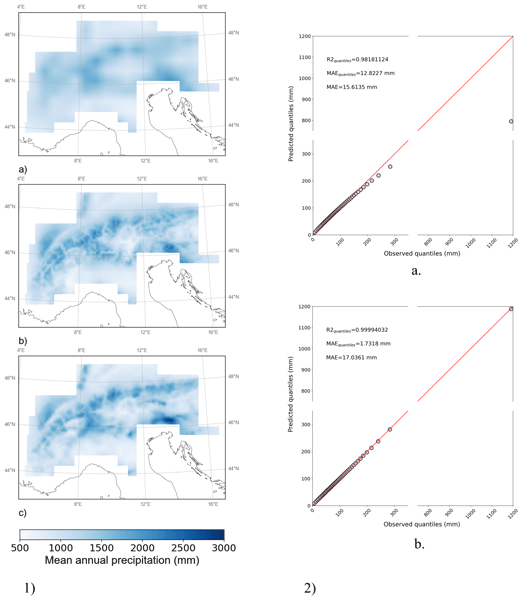
Due to the limited spatial and temporal coverage of observations, global models are essential tools to study climate. However, long-term climate data at fine spatial scale are difficult to obtain because of elevated computational costs such algorithms involve. This paper presents a simple model based on the description of climate/topography interactions to generate local precipitation fields at low cost. The objective is to provide a flexible and easy to use method for paleoclimate studies.
Quentin Pikeroen, Didier Paillard, and Karine Watrin
Geosci. Model Dev., 17, 3801–3814, https://doi.org/10.5194/gmd-17-3801-2024, https://doi.org/10.5194/gmd-17-3801-2024, 2024
Short summary
Short summary
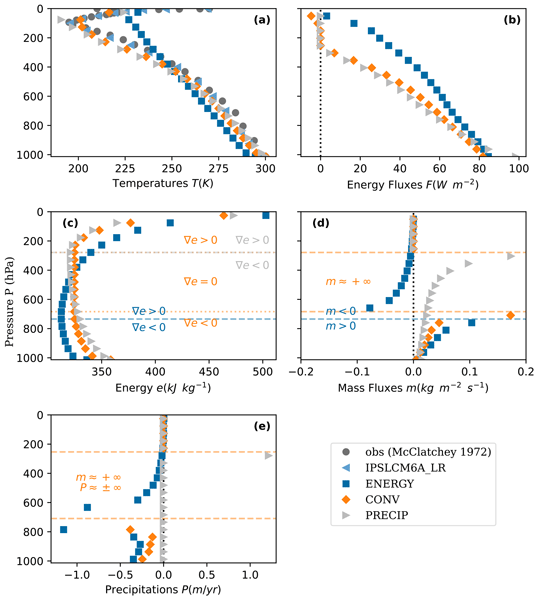
All accurate climate models use equations with poorly defined parameters, where knobs for the parameters are turned to fit the observations. This process is called tuning. In this article, we use another paradigm. We use a thermodynamic hypothesis, the maximum entropy production, to compute temperatures, energy fluxes, and precipitation, where tuning is impossible. For now, the 1D vertical model is used for a tropical atmosphere. The correct order of magnitude of precipitation is computed.
Nathaelle Bouttes, Fanny Lhardy, Aurélien Quiquet, Didier Paillard, Hugues Goosse, and Didier M. Roche
Clim. Past, 19, 1027–1042, https://doi.org/10.5194/cp-19-1027-2023, https://doi.org/10.5194/cp-19-1027-2023, 2023
Short summary
Short summary
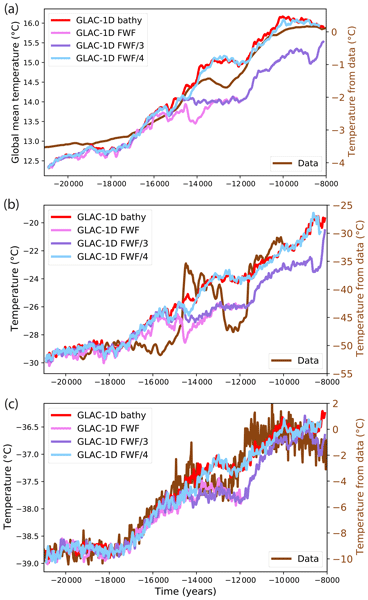
The last deglaciation is a period of large warming from 21 000 to 9000 years ago, concomitant with ice sheet melting. Here, we evaluate the impact of different ice sheet reconstructions and different processes linked to their changes. Changes in bathymetry and coastlines, although not often accounted for, cannot be neglected. Ice sheet melt results in freshwater into the ocean with large effects on ocean circulation, but the timing cannot explain the observed abrupt climate changes.
Gaëlle Leloup and Didier Paillard
Earth Syst. Dynam., 14, 291–307, https://doi.org/10.5194/esd-14-291-2023, https://doi.org/10.5194/esd-14-291-2023, 2023
Short summary
Short summary
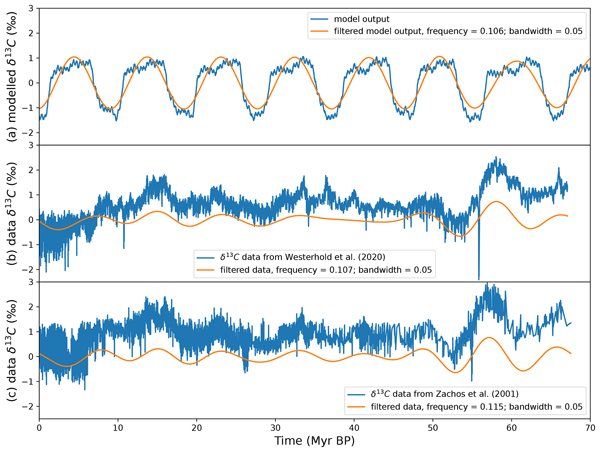
Records of past carbon isotopes exhibit oscillations. It is clear over very different time periods that oscillations of 400 kyr take place. Also, strong oscillations of approximately 8–9 Myr are seen over different time periods. While earlier modelling studies have been able to produce 400 kyr oscillations, none of them produced 8–9 Myr cycles. Here, we propose a simple model for the carbon cycle that is able to produce 8–9 Myr oscillations in the modelled carbon isotopes.
Gaëlle Leloup and Didier Paillard
Clim. Past, 18, 547–558, https://doi.org/10.5194/cp-18-547-2022, https://doi.org/10.5194/cp-18-547-2022, 2022
Short summary
Short summary
Over the last 2.6 Myr, the Quaternary period has been marked by the alternation of extended and reduced Northern Hemisphere ice sheets, known as glacial-interglacial cycles. With a simple model, we are able to reproduce the main features of the ice volume evolution, like the switch of periodicity, from 41 kyr cycles to 100 kyr cycles, observed in the data after 1 Ma. The quality of the model-data agreement depending on the input insolation and period considered is discussed.
Fanny Lhardy, Nathaëlle Bouttes, Didier M. Roche, Xavier Crosta, Claire Waelbroeck, and Didier Paillard
Clim. Past, 17, 1139–1159, https://doi.org/10.5194/cp-17-1139-2021, https://doi.org/10.5194/cp-17-1139-2021, 2021
Short summary
Short summary
Climate models struggle to simulate a LGM ocean circulation in agreement with paleotracer data. Using a set of simulations, we test the impact of boundary conditions and other modelling choices. Model–data comparisons of sea-surface temperatures and sea-ice cover support an overall cold Southern Ocean, with implications on the AMOC strength. Changes in implemented boundary conditions are not sufficient to simulate a shallower AMOC; other mechanisms to better represent convection are required.
Jean-Baptiste Brenner, Aurélien Quiquet, Didier M. Roche, Didier Paillard, and Pradeebane Vaittinada Ayar
Geosci. Model Dev., 19, 1075–1101, https://doi.org/10.5194/gmd-19-1075-2026, https://doi.org/10.5194/gmd-19-1075-2026, 2026
Short summary
Short summary
Due to the limited spatial and temporal coverage of observations, global models are essential tools to study climate. However, long-term climate data at fine spatial scale are difficult to obtain because of elevated computational costs such algorithms involve. This paper presents a simple model based on the description of climate/topography interactions to generate local precipitation fields at low cost. The objective is to provide a flexible and easy to use method for paleoclimate studies.
Quentin Pikeroen, Didier Paillard, and Karine Watrin
Geosci. Model Dev., 17, 3801–3814, https://doi.org/10.5194/gmd-17-3801-2024, https://doi.org/10.5194/gmd-17-3801-2024, 2024
Short summary
Short summary
All accurate climate models use equations with poorly defined parameters, where knobs for the parameters are turned to fit the observations. This process is called tuning. In this article, we use another paradigm. We use a thermodynamic hypothesis, the maximum entropy production, to compute temperatures, energy fluxes, and precipitation, where tuning is impossible. For now, the 1D vertical model is used for a tropical atmosphere. The correct order of magnitude of precipitation is computed.
Nathaelle Bouttes, Fanny Lhardy, Aurélien Quiquet, Didier Paillard, Hugues Goosse, and Didier M. Roche
Clim. Past, 19, 1027–1042, https://doi.org/10.5194/cp-19-1027-2023, https://doi.org/10.5194/cp-19-1027-2023, 2023
Short summary
Short summary
The last deglaciation is a period of large warming from 21 000 to 9000 years ago, concomitant with ice sheet melting. Here, we evaluate the impact of different ice sheet reconstructions and different processes linked to their changes. Changes in bathymetry and coastlines, although not often accounted for, cannot be neglected. Ice sheet melt results in freshwater into the ocean with large effects on ocean circulation, but the timing cannot explain the observed abrupt climate changes.
Gaëlle Leloup and Didier Paillard
Earth Syst. Dynam., 14, 291–307, https://doi.org/10.5194/esd-14-291-2023, https://doi.org/10.5194/esd-14-291-2023, 2023
Short summary
Short summary
Records of past carbon isotopes exhibit oscillations. It is clear over very different time periods that oscillations of 400 kyr take place. Also, strong oscillations of approximately 8–9 Myr are seen over different time periods. While earlier modelling studies have been able to produce 400 kyr oscillations, none of them produced 8–9 Myr cycles. Here, we propose a simple model for the carbon cycle that is able to produce 8–9 Myr oscillations in the modelled carbon isotopes.
Gaëlle Leloup and Didier Paillard
Clim. Past, 18, 547–558, https://doi.org/10.5194/cp-18-547-2022, https://doi.org/10.5194/cp-18-547-2022, 2022
Short summary
Short summary
Over the last 2.6 Myr, the Quaternary period has been marked by the alternation of extended and reduced Northern Hemisphere ice sheets, known as glacial-interglacial cycles. With a simple model, we are able to reproduce the main features of the ice volume evolution, like the switch of periodicity, from 41 kyr cycles to 100 kyr cycles, observed in the data after 1 Ma. The quality of the model-data agreement depending on the input insolation and period considered is discussed.
Fanny Lhardy, Nathaëlle Bouttes, Didier M. Roche, Xavier Crosta, Claire Waelbroeck, and Didier Paillard
Clim. Past, 17, 1139–1159, https://doi.org/10.5194/cp-17-1139-2021, https://doi.org/10.5194/cp-17-1139-2021, 2021
Short summary
Short summary
Climate models struggle to simulate a LGM ocean circulation in agreement with paleotracer data. Using a set of simulations, we test the impact of boundary conditions and other modelling choices. Model–data comparisons of sea-surface temperatures and sea-ice cover support an overall cold Southern Ocean, with implications on the AMOC strength. Changes in implemented boundary conditions are not sufficient to simulate a shallower AMOC; other mechanisms to better represent convection are required.
Cited articles
Berger, A.: Long-term variations of daily insolation and Quaternary climatic change, Journal of the Atmospheric Sciences, 35, 2362–2367, https://doi.org/10.1175/1520-0469(1978)035<2362:LTVODI>2.0.CO;2, 1978a.
Berger, A.: Long-Term Variations of Caloric Insolation Resulting from the Earth's Orbital Elements, Quaternary Research, 9, 139–16, https://doi.org/10.1016/0033-5894(78)90064-9, 1978b.
Berger, A., Loutre, M. F., and Tricot, C.: Insolation and Earth's orbital periods, Journal of Geophysical Research, 98, 10341–10362, https://doi.org/10.1029/93JD00222, 1993.
Berger, A., McIntyre, A., and Loutre, M. F.: Intertropical Latitudes and Precessional and Half-Precessional Cycles, Science, 278, 1476–1477, https://doi.org/10.1126/science.278.5342.1476, 1997.
Berger, A., Loutre, M. F., and Yin, Q.: Total irradiation during any time interval of the year using elliptic integrals, Quaternary Science Reviews, 29, 1968–1982, https://doi.org/10.1016/j.quascirev.2010.05.007, 2010.
Berger, A., Yin, Q., and Wu, Z.: Length of astronomical seasons, total and average insolation over seasons, Quaternary Science Reviews, 334, 108620, https://doi.org/10.1016/j.quascirev.2024.108620, 2024.
Bretagnon, P.: Termes à longues périodes dans le système solaire, Astronomy & Astrophysics, 30, 141–154, 1974.
Crucifix, M.: Palinsol: a R package to compute Incoming Solar Radiation (insolation) for palaeoclimate studies (v1.0 CRAN), Zenodo, https://doi.org/10.5281/zenodo.14893715, 2023.
Hevia-Cruz, F., Brockmann, P., Govin, A., Michel, E., and Paillard, D.: Reviving AnalySeries: PyAnalySeries, a modern and collaborative open-source tool for time-series analysis, Past Global Changes Magazine, 33, 74–75, 2025.
Huybers, P.: Early Pleistocene Glacial Cycles and the Integrated Summer Insolation Forcing, Science, 313, 508–511, https://doi.org/10.1126/science.1125249, 2006.
Laskar, J., Joutel, F., and Boudin, F.: Orbital, precessional, and insolation quantities for the Earth from −20 Myr to +10 Myr, Astronomy & Astrophysics, 270, 522–533, 1993.
Laskar, J., Correia, A. C. M., Gastineau, M., Joutel, F., Levrard, B., and Robutel, P.: Long term evolution and chaotic diffusion of the insolation quantities of Mars. Icarus, 170, 343–364, https://doi.org/10.1016/j.icarus.2004.04.005, 2004a.
Laskar, J., Robutel, P., Joutel, F., Gastineau, M., Correia, A. C. M., and Levrard, B.: A long-term numerical solution for the insolation quantities of the Earth, Astronomy & Astrophysics, 428, 261–285, doi:10.1051-0004-6361:20041335, 2004b.
Laskar, J., Fienga, A., Gastineau, M., and Manche, H.: La2010: a new orbital solution for the long-term motion of the Earth, Astronomy & Astrophysics, 532, A89, https://doi.org/10.1051/0004-6361/201116836, 2011.
Leloup, G. and Paillard, D.: Influence of the choice of insolation forcing on the results of a conceptual glacial cycle model, Clim. Past, 18, 547–558, https://doi.org/10.5194/cp-18-547-2022, 2022.
Lougheed, B.: Orbitalchime, GitHub, https://github.com/bryanlougheed/orbitalchime (last access: 5 March 2026), 2025.
Loutre, M.-F., Paillard, D., Vimeux, F., and Cortijo, E.: Does mean annual insolation have the potential to change the climate?, Earth and Planetary Science Letters, 221, 1–14, https://doi.org/10.1016/S0012-821X(04)00108-6, 2004.
McIntyre, A. and Molfino, B.: Forcing of Atlantic Equatorial and Subpolar Millennial Cycles by Precession, Science, 274, 1867, https://doi.org/10.1126/science.274.5294.1867, 1996.
Milankovitch, M.: Théorie Mathématique des Phénomènes Thermiques Produits par la Radiation Solaire. Académie Yougoslave des Sciences et des Arts de Zagreb, Gauthier Villars, Paris, France, 1920.
Milankovitch, M.: Canon of insolation and the ice-age problem (Kanon der Erdbestrahlung und seine Andwendung auf das Eiszeitenproblem), Zavod za udzbenike, Beograd, 1941.
Oliveira, E. D.: Daily INSOLation (DINSOL-v1.0): an intuitive tool for classrooms and specifying solar radiation boundary conditions, Geosci. Model Dev., 16, 2371–2390, https://doi.org/10.5194/gmd-16-2371-2023, 2023.
Paillard, D.: Climate and the orbital parameters of the Earth, Comptes Rendus Geoscience, 342, 273–285, https://doi.org/10.1016/j.crte.2009.12.006, 2010.
Paillard, D.: Quaternary glaciations: from observations to theories, Quaternary Science Reviews, 107, 11–24, https://doi.org/10.1016/j.quascirev.2014.10.002, 2015.
Paillard, D.: dpaillard/Insolation: v1.0 (v1.0), Zenodo [code], https://doi.org/10.5281/zenodo.15682056, 2025.
Paillard, D. and Brockmann, P.: dpaillard/Insolation: v1.1 (v1.1), Zenodo [code], https://doi.org/10.5281/zenodo.17640396, 2025.
Paillard, D., Labeyrie, L., and Yiou, P.: Macintosh Program Performs Time-Series Analysis. Eos, Transactions, American Geophysical Union, 77, 379, https://doi.org/10.1029/96EO00259, 1996.
Pilgrim, L.: Versuch einer rechnerischen Behandlung der Eiszeitalters, Jahresshefte des Vereins für Vaterländische Naturkunde in Württemberg, 60, 26–117, https://www.zobodat.at/pdf/Jh-Ver--vaterl-Naturkunde-Wuerttemberg_60_0026-0117.pdf (last access: 5 March 2026) 1904.
Stockwell, J. N.: Memoir of the secular variations of the orbits of the eight principal planets: Mercury, Venus, the Earth, Mars, Jupiter, Saturn, Uranus, and Neptune; with tables of the same; together with the obliquity of the ecliptic, and the precession of the equinoxes in both longitude and right ascension. Smithsonian contributions to knowledge, XVIII, Smithsonian Institution publication 232, Smithsonian Institution, Washington, 199 p., 1873.
Virtanen, P., et al.: SciPy 1.0: Fundamental Algorithms for Scientific Computing in Python, Nature Methods, 17, 261–272, https://doi.org/10.1038/s41592-019-0686-2, 2020.
Short summary
This paper presents classical and new mathematical formulas to compute various "flavors" of the insolation forcing used to interpret paleoclimatic series, or to simulate climate at different times. It provides a description of the usual concepts while insisting on the difficulties associated with them, like the definition of a calendar. Then it presents novel formulas to compute extrema of insolation for a given latitude. It thus presents a new open-source software package available online.
This paper presents classical and new mathematical formulas to compute various "flavors" of the...