
Articles | Volume 22, issue 8
https://doi.org/10.5194/cp-22-1457-2026
© Author(s) 2026. This work is distributed under
the Creative Commons Attribution 4.0 License.
the Creative Commons Attribution 4.0 License.
https://doi.org/10.5194/cp-22-1457-2026
© Author(s) 2026. This work is distributed under
the Creative Commons Attribution 4.0 License.
the Creative Commons Attribution 4.0 License.
Research article
| 
05 Aug 2026
Research article |
| 05 Aug 2026
| 05 Aug 2026
The influence of glacial Northern Hemisphere ice sheets on atmospheric circulation
Himadri Saini
CORRESPONDING AUTHOR

Climate Change Research Centre, University of New South Wales, Sydney, New South Wales, Australia
The Australian Centre for Excellence in Antarctic Science, University of New South Wales, Sydney, New South Wales, Australia
School of Geography, Earth and Atmospheric Sciences, University of Melbourne, Melbourne, Victoria, Australia
Australian Research Council Centre of Excellence for Weather of the 21st Century, University of Melbourne, Melbourne, Victoria, Australia
David K. Hutchinson
Climate Change Research Centre, University of New South Wales, Sydney, New South Wales, Australia
The Australian Centre for Excellence in Antarctic Science, University of New South Wales, Sydney, New South Wales, Australia
Australian Research Council Centre of Excellence for Weather of the 21st Century, University of New South Wales, Sydney, New South Wales, Australia
Josephine R. Brown
School of Geography, Earth and Atmospheric Sciences, University of Melbourne, Melbourne, Victoria, Australia
Australian Research Council Centre of Excellence for Weather of the 21st Century, University of Melbourne, Melbourne, Victoria, Australia
Russell N. Drysdale
School of Geography, Earth and Atmospheric Sciences, University of Melbourne, Melbourne, Victoria, Australia
Yanxuan Du
School of Geography, Earth and Atmospheric Sciences, University of Melbourne, Melbourne, Victoria, Australia
Australian Research Council Centre of Excellence for Weather of the 21st Century, University of Melbourne, Melbourne, Victoria, Australia
Laurie Menviel
Climate Change Research Centre, University of New South Wales, Sydney, New South Wales, Australia
The Australian Centre for Excellence in Antarctic Science, University of New South Wales, Sydney, New South Wales, Australia
Related authors
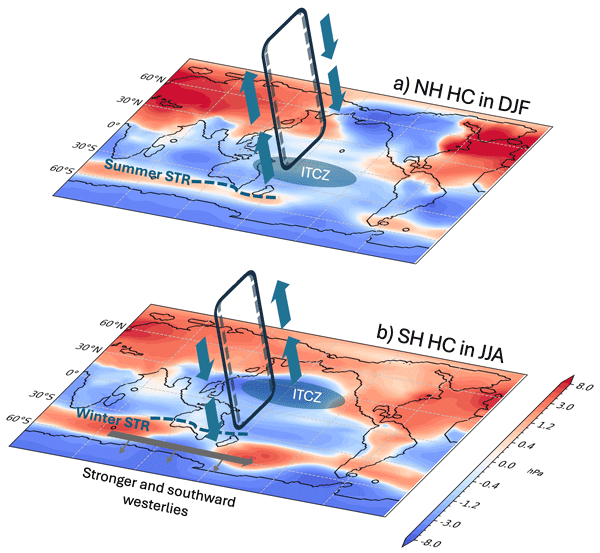
Yanxuan Du, Josephine R. Brown, Laurie Menviel, Himadri Saini, Russell N. Drysdale, David K. Hutchinson, and Calla N. Gould-Whaley
Clim. Past, 22, 1105–1124, https://doi.org/10.5194/cp-22-1105-2026, https://doi.org/10.5194/cp-22-1105-2026, 2026
Short summary
Short summary
This study examines the climate response to different magnitudes of Atlantic Meridional Overturning Circulation (AMOC) weakening under glacial conditions using the Australian Earth System Model. A potential threshold is identified between linear AMOC slowdown and nonlinear shutdown, driven by a critical change in ocean heat loss that induces a nonlinear atmospheric response governed by energetic constraints.
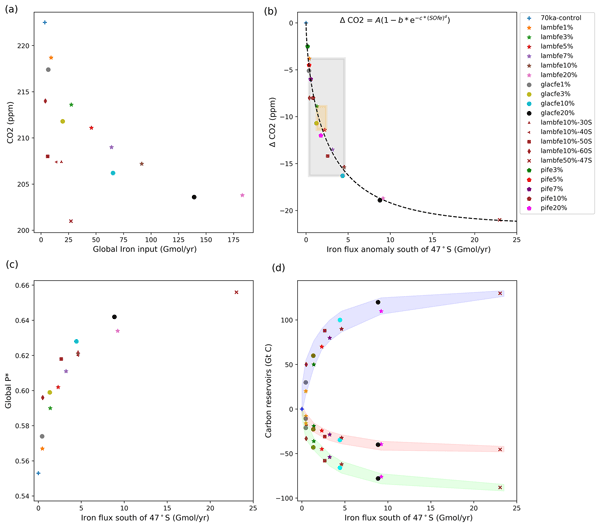
Himadri Saini, Katrin J. Meissner, Laurie Menviel, and Karin Kvale
Clim. Past, 19, 1559–1584, https://doi.org/10.5194/cp-19-1559-2023, https://doi.org/10.5194/cp-19-1559-2023, 2023
Short summary
Short summary
Understanding the changes in atmospheric CO2 during the last glacial cycle is crucial to comprehend the impact of climate change in the future. Previous research has hypothesised a key role of greater aeolian iron input into the Southern Ocean in influencing the global atmospheric CO2 levels by impacting the changes in the marine phytoplankton response. In our study, we test this iron hypothesis using climate modelling and constrain the impact of ocean iron supply on global CO2 decrease.
Natalie J. Burls, Nicky M. Wright, R. Paul Acosta, Catherine D. Bradshaw, Edward Gasson, Lennert B. Stap, Gilles Ramstein, Anna Ruth W. Halberstadt, Agatha M. De Boer, Funda Akgün, David J. Cantrill, Manuel Casas-Gallego, Nela Doláková, Boglarka Erdei, Alex Farnsworth, Sarah Feakins, Ran Feng, Tamara Fletcher, Frédéric Fluteau, J. A. Mattias Green, Anna S. von der Heydt, Matthew Huber, David K. Hutchinson, Dimiter Ivanov, Mine Sezgül Kayseri-Özer, Gregor Knorr, Marianna Kováčová, Caroline H. Lear, Allegra N. LeGrande, Shufeng Li, Xiaoqing Liu, Daniel J. Lunt, Katrin Meissner, Yunfa Miao, Trusha J. Naik, Javier B. Navarro, Joseph B. Novak, Diana Ochoa, Guy J.G. Paxman, Matthew J. Pound, James W. B. Rae, Tammo Reichgelt, Martin Renoult, Francesca Sangiorgi, Anta-Clarisse Sarr, Diane Segalla, Pierre Sepulchre, Amelia Shevenell, Sebastian Steinig, Eivind Straume, Caroline A. E. Strömberg, Clay Tabor, Torsten Utescher, Julia E. Weiffenbach, Elżbieta Worobiec, Yurui Zhang, Feng Zhu, Jiang Zhu, Alexandra Auderset, Florence Colleoni, Aisling Dolan, Rachel Havranek, Ann Holbourn, Nicholas Herold, Daeun Lee, James W. Marschalek, Bryce Mitsunaga, Sevi Modestou, Lina Perez-Angel, Mae Saslaw, Sinda Sosdian, Elena Stiles, Yong Sun, Ning Tan, Zhongshi Zhang, and Yan Zhao
EGUsphere, https://doi.org/10.5194/egusphere-2026-3595, https://doi.org/10.5194/egusphere-2026-3595, 2026
This preprint is open for discussion and under review for Geoscientific Model Development (GMD).
Short summary
Short summary
Simulating warm paleoclimates increases our understanding of the mechanisms that drive climatic change and tipping points. The Miocene Epoch, specifically the Miocene Climatic Optimum, has been identified as a particularly valuable past warm climate to simulate, meriting the design of a coordinated Miocene Model Intercomparison Project. Here we synthesize the latest available literature and present the experimental design for coordinated Miocene simulations and sensitivity studies.
Liam J. Cassidy, Andrew D. King, Josephine R. Brown, and Tilo Ziehn
EGUsphere, https://doi.org/10.5194/egusphere-2026-3644, https://doi.org/10.5194/egusphere-2026-3644, 2026
Short summary
Short summary
Human emissions of greenhouse gases have warmed the planet rapidly, and without reductions in emissions, it is likely that Earth will exceed 2°C global warming by 2100. Periods of net-negative emissions may be required to satisfy Paris Agreement goals. We explore climate change under net-zero and net-negative emissions using plausible future scenarios.
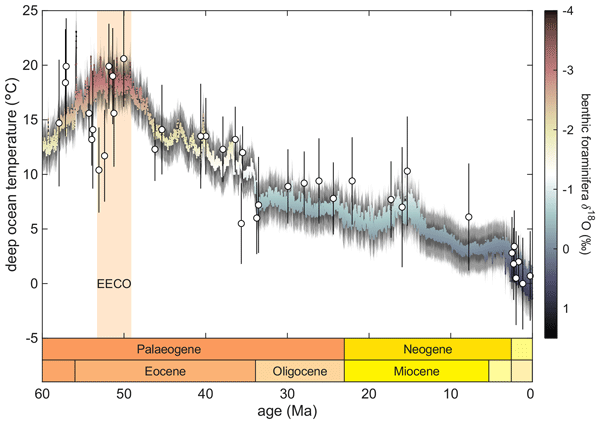
Daniel J. Lunt, Nicky M. Wright, Bram Vaes, Ulrich Salzmann, James W. B. Rae, Thomas Hickler, David K. Hutchinson, Julia Brugger, Jiang Zhu, Sebastian Steinig, A. Nele Meckler, Gordon N. Inglis, David Evans, Agatha M. de Boer, Bette L. Otto-Bliesner, Natalie Burls, Yurui Zhang, Appy Sluijs, Tammo Reichgelt, Igor Niezgodzki, Katrin Meissner, Jean-Baptiste Ladant, Fanni D. Kelemen, Matthew Huber, David R. Greenwood, Mattias Green, Flavia Boscolo-Galazzo, Manuel Tobias Blau, and Michiel Baatsen
Geosci. Model Dev., 19, 6143–6166, https://doi.org/10.5194/gmd-19-6143-2026, https://doi.org/10.5194/gmd-19-6143-2026, 2026
Short summary
Short summary
The early Eocene, about 50 million years ago, was a super-warm period of Earth's history, with high concentrations of carbon dioxide in the atmosphere. Here, we provide a framework and experimental design for climate modellers to carry out a coordinated project, simulating this period. This is the second phase of this project, and here we provide updated maps of the Earth's mountains and ocean floor, and vegetation, to enable more accurate modelling.
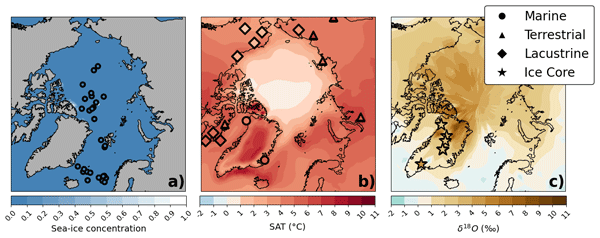
Louise C. Sime, Rachel Diamond, Christian Stepanek, Chris Brierley, David Schroeder, Masa Kageyama, Matthew Pollock, Irene Malmierca-Vallet, Ed Blockley, Alex West, Danny Feltham, Jeff Ridley, Pascale Braconnot, Charles J. R. Williams, Xiaoxu Shi, Bette L. Otto-Bliesner, Sophia I. Macarewich, Silvana Ramos Buarque, Qiong Zhang, Allegra LeGrande, Weipeng Zheng, Dabang Jiang, Polina Morozova, Chuncheng Guo, Zhongshi Zhang, Nicholas Yeung, Laurie Menviel, Sandeep Narayanasetti, Masakazu Yoshimori, Olivia Reeves, and Anni Zhao
Geosci. Model Dev., 19, 5881–5905, https://doi.org/10.5194/gmd-19-5881-2026, https://doi.org/10.5194/gmd-19-5881-2026, 2026
Short summary
Short summary
The Arctic may have lost its summer sea ice 127,000 years ago during a naturally warm period in Earth’s past. Climate models can be tested by recreating those conditions, with similar sunlight and greenhouse gas levels. Analysing the large sea ice changes in these simulations helps us understand how the Arctic might respond in the near future and improves how we test and trust our climate models.
Benjamin W. Anthonisz, David K. Hutchinson, Katrin J. Meissner, Samar Khatiwala, and Benoît Pasquier
EGUsphere, https://doi.org/10.5194/egusphere-2026-3378, https://doi.org/10.5194/egusphere-2026-3378, 2026
Short summary
Short summary
This paper uses a state-of-the-art climate model to investigate the role of elevated CO2 on rapid changes to ocean biogeochemistry in much hotter world. We find that circulation has to potential to dramatically change as a result of rapid warming, resulting in poor ocean ventilation but surprisingly limited oxygen loss in the deep ocean.
Yanxuan Du, Josephine R. Brown, Laurie Menviel, Himadri Saini, Russell N. Drysdale, David K. Hutchinson, and Calla N. Gould-Whaley
Clim. Past, 22, 1105–1124, https://doi.org/10.5194/cp-22-1105-2026, https://doi.org/10.5194/cp-22-1105-2026, 2026
Short summary
Short summary
This study examines the climate response to different magnitudes of Atlantic Meridional Overturning Circulation (AMOC) weakening under glacial conditions using the Australian Earth System Model. A potential threshold is identified between linear AMOC slowdown and nonlinear shutdown, driven by a critical change in ocean heat loss that induces a nonlinear atmospheric response governed by energetic constraints.
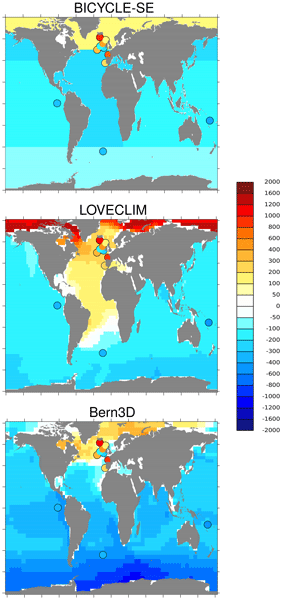
Peter Köhler, Laurie Menviel, Frerk Pöppelmeier, Timothy J. Heaton, Edouard Bard, and Luke C. Skinner
Clim. Past, 22, 729–746, https://doi.org/10.5194/cp-22-729-2026, https://doi.org/10.5194/cp-22-729-2026, 2026
Short summary
Short summary
Radiocarbon (14C) is decaying over time, which is used to determine the age of carbon-containing objects. Calibration curves are necessary to come from measured 14C values to calendar ages. We use different models in order to improve future calibration curves, especially around times of abrupt changes in the Atlantic meridional overturning circulation. We find that uncertainties during those times are underrepresented in present calibrations, especially in the Atlantic.
Didier Swingedouw, Laura Jackson, Aixue Hu, Anastasia Romanou, Nicole C. Laureanti, Wilbert Weijer, Sina Loriani, Bette Otto-Bliesner, Ayako Abe-Ouchi, Lucas Almeida, Alessio Bellucci, Reyk Börner, Gokhan Danabasoglu, Donovan P. Dennis, Marion Devilliers, Sybren Drijfhout, Jonathan Donges, Friederike Fröb, Thomas L. Frölicher, Guillaume Gastineau, Heiko Goelzer, Chuncheng Guo, Urs Hofmann, Anna Höse, Colin Jones, Torben Koenigk, Ann Kristin Klose, Valerio Lembo, Jose Licon-Salaiz, Ken Mankoff, Virna Meccia, Irina Melnikova, Oliver Mehling, Laurie Menviel, Juliette Mignot, Jon I. Robson, Gavin A. Schmidt, Robin Smith, Yuchen Sun, Irene Trombini, Matteo Willeit, Richard Wood, Fanghua Wu, Lin Zhaohui, and Ricarda Winkelmann
EGUsphere, https://doi.org/10.5194/egusphere-2026-1698, https://doi.org/10.5194/egusphere-2026-1698, 2026
Short summary
Short summary
This study presents a plan for climate model experiments to better understand how changes in freshwater in the North Atlantic affect major ocean currents. We designed coordinated simulations to test their response to warming, added freshwater, and possible recovery after weakening. Comparing results across models and past climate evidence helps improve confidence in projections and assess risks of large ocean circulation changes.

Maddalena Passelergue, Isabelle Couchoud, Russell N. Drysdale, John Hellstrom, Dirk L. Hoffmann, and Alan Greig
Clim. Past, 22, 315–338, https://doi.org/10.5194/cp-22-315-2026, https://doi.org/10.5194/cp-22-315-2026, 2026
Short summary
Short summary
The Holocene is marked at 8.2 ka by a North Atlantic freshening event. We investigate its climatic impact in SW France using high-resolution speleothem multiproxy analysis. While the event is seen in some European records, no clear signal appears in SW France. This may reflect either limited regional impact, and/or low speleothem sensitivity to this North Atlantic event, possibly masked by Mediterranean influences.
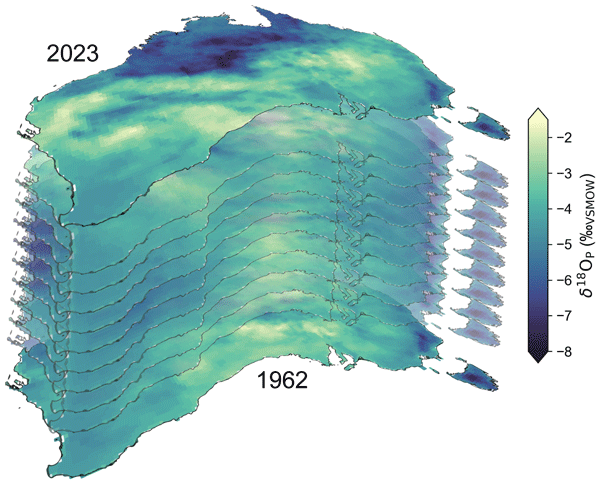
Georgina Falster, Gab Abramowitz, Sanaa Hobeichi, Catherine Hughes, Pauline Treble, Nerilie J. Abram, Michael I. Bird, Alexandre Cauquoin, Bronwyn Dixon, Russell Drysdale, Chenhui Jin, Niels Munksgaard, Bernadette Proemse, Jonathan J. Tyler, Martin Werner, and Carol V. Tadros
Hydrol. Earth Syst. Sci., 30, 289–315, https://doi.org/10.5194/hess-30-289-2026, https://doi.org/10.5194/hess-30-289-2026, 2026
Short summary
Short summary
We used a random forest approach to produce estimates of monthly precipitation stable isotope variability from 1962–2023, at high resolution across the entire Australian continent. Comprehensive skill and sensitivity testing shows that our random forest models skilfully predict precipitation isotope values in places and times that observations are not available. We make all outputs freely available, facilitating use in fields from ecology and hydrology to archaeology and forensic science.
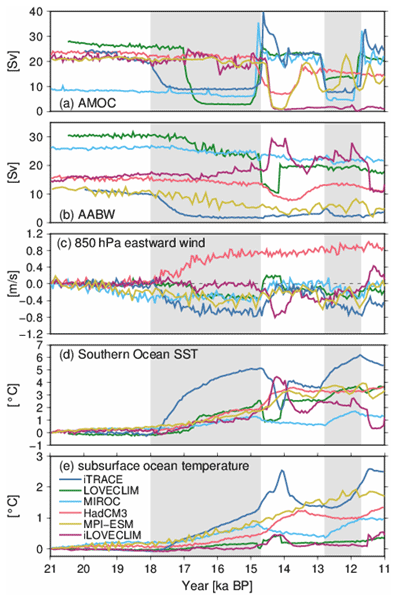
Takashi Obase, Laurie Menviel, Ayako Abe-Ouchi, Tristan Vadsaria, Ruza Ivanovic, Brooke Snoll, Sam Sherriff-Tadano, Paul J. Valdes, Lauren Gregoire, Marie-Luise Kapsch, Uwe Mikolajewicz, Nathaelle Bouttes, Didier Roche, Fanny Lhardy, Chengfei He, Bette Otto-Bliesner, Zhengyu Liu, and Wing-Le Chan
Clim. Past, 21, 1443–1463, https://doi.org/10.5194/cp-21-1443-2025, https://doi.org/10.5194/cp-21-1443-2025, 2025
Short summary
Short summary
This study analyses transient simulations of the last deglaciation performed by six climate models to understand the processes driving high-southern-latitude temperature changes. We find that atmospheric CO2 and AMOC (Atlantic Meridional Overturning Circulation) changes are the primary drivers of the warming and cooling during the middle stage of the deglaciation. The analysis highlights the model's sensitivity of CO2 and AMOC to meltwater and the meltwater history of temperature changes at high southern latitudes.
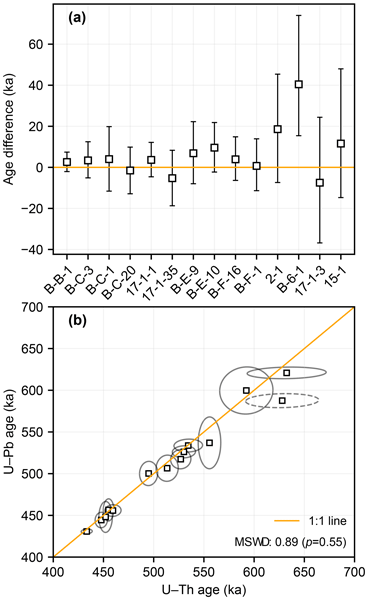
Timothy J. Pollard, Jon D. Woodhead, Russell N. Drysdale, R. Lawrence Edwards, Xianglei Li, Ashlea N. Wainwright, Mathieu Pythoud, Hai Cheng, John C. Hellstrom, Ilaria Isola, Eleonora Regattieri, Giovanni Zanchetta, and Dylan S. Parmenter
Geochronology, 7, 335–355, https://doi.org/10.5194/gchron-7-335-2025, https://doi.org/10.5194/gchron-7-335-2025, 2025
Short summary
Short summary
The uranium–thorium (U–Th) and uranium–lead (U–Pb) radiometric dating methods are both suitable for dating carbonate samples ranging in age from about 400 000 to 650 000 years. Here we test agreement between the two methods by dating speleothems (i.e. secondary cave mineral deposits) that are well-suited to both methods. We demonstrate excellent agreement between them and discuss their relative strengths and weaknesses.
Zanna Chase, Karen E. Kohfeld, Amy Leventer, David Lund, Xavier Crosta, Laurie Menviel, Helen C. Bostock, Matthew Chadwick, Samuel L. Jaccard, Jacob Jones, Alice Marzocchi, Katrin J. Meissner, Elisabeth Sikes, Louise C. Sime, and Luke Skinner
EGUsphere, https://doi.org/10.5194/egusphere-2025-3504, https://doi.org/10.5194/egusphere-2025-3504, 2025
Short summary
Short summary
The impact of recent dramatic declines in Antarctic sea ice on the Earth system are uncertain. We reviewed how sea ice affects ocean circulation, ice sheets, winds, and the carbon cycle by considering theory and modern observations alongside paleo-proxy reconstructions. We found evidence for connections between sea ice and these systems but also conflicting results, which point to missing knowledge. Our work highlights the complex role of sea ice in the Earth system.
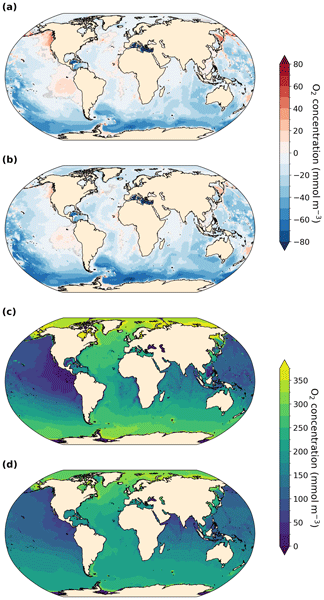
Bartholomé Duboc, Katrin J. Meissner, Laurie Menviel, Nicholas K. H. Yeung, Babette Hoogakker, Tilo Ziehn, and Matthew Chamberlain
Clim. Past, 21, 1093–1122, https://doi.org/10.5194/cp-21-1093-2025, https://doi.org/10.5194/cp-21-1093-2025, 2025
Short summary
Short summary
We use an earth system model to simulate ocean oxygen during two past warm periods, the Last Interglacial (∼ 129–115 ka) and Marine Isotope Stage (MIS) 9e (∼ 336–321 ka). The global ocean is overall less oxygenated compared to the preindustrial simulation. Large regions in the Mediterranean Sea are oxygen deprived in the Last Interglacial simulation, and to a lesser extent in the MIS 9e simulation, due to an intensification and expansion of the African monsoon and enhanced river runoff.
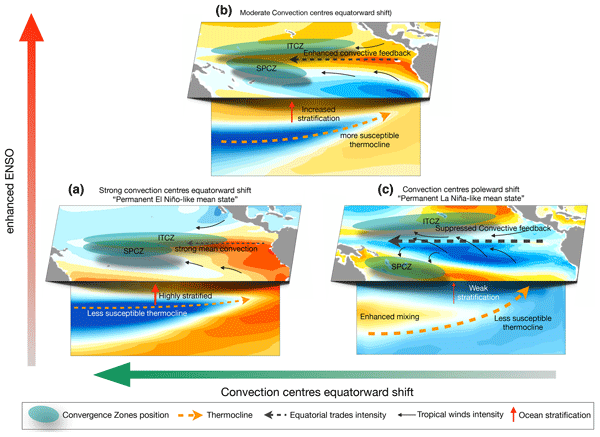
Gabriel M. Pontes, Pedro L. da Silva Dias, and Laurie Menviel
Clim. Past, 21, 1079–1091, https://doi.org/10.5194/cp-21-1079-2025, https://doi.org/10.5194/cp-21-1079-2025, 2025
Short summary
Short summary
El Niño events are the main drivers of year-to-year climate variability. Understanding how El Niño activity is affected by different climate states is of great relevance to agriculture, water, ecosystem, and climate risk management. Through analysis of past and future climate simulations, we show that the El Niño–Southern Oscillation (ENSO) sensitivity to mean state changes is nonlinear and, to some extent, shaped by atmospheric CO2 levels.
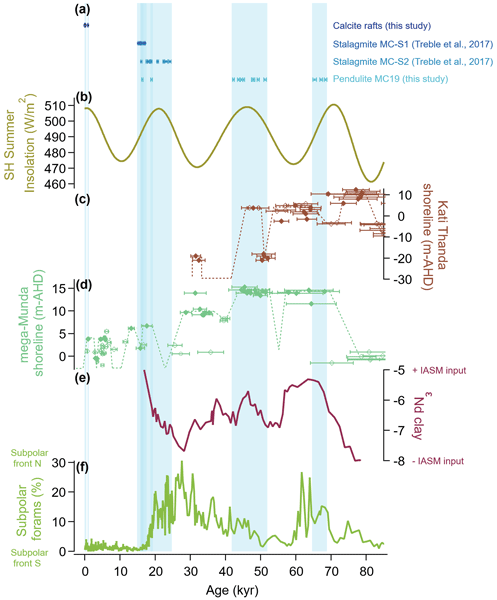
Calla N. Gould-Whaley, Russell N. Drysdale, Pauline C. Treble, Jan-Hendrik May, Stacey C. Priestley, John C. Hellstrom, Christopher R. Vardanega, and Clare C. Buswell
Clim. Past, 21, 857–876, https://doi.org/10.5194/cp-21-857-2025, https://doi.org/10.5194/cp-21-857-2025, 2025
Short summary
Short summary
Climate change is causing enhanced aridity across many regions of the globe, leading to increased reliance on groundwater resources. We need to understand how groundwater recharge behaves in arid regions over long timescales; unfortunately, arid landscapes tend to preserve very little evidence of their climatic past. We present evidence to suggest that carbonate formations that grow in groundwater can be used as archives of past groundwater recharge in Australia's arid zone.
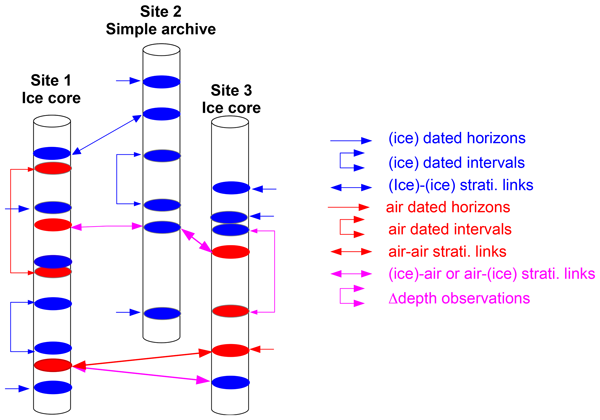
Frédéric Parrenin, Marie Bouchet, Christo Buizert, Emilie Capron, Ellen Corrick, Russell Drysdale, Kenji Kawamura, Amaëlle Landais, Robert Mulvaney, Ikumi Oyabu, and Sune Olander Rasmussen
Geosci. Model Dev., 17, 8735–8750, https://doi.org/10.5194/gmd-17-8735-2024, https://doi.org/10.5194/gmd-17-8735-2024, 2024
Short summary
Short summary
The Paleochrono-1.1 probabilistic dating model allows users to derive a common and optimized chronology for several paleoclimatic sites from various archives (ice cores, speleothems, marine cores, lake cores, etc.). It combines prior sedimentation scenarios with chronological information such as dated horizons, dated intervals, stratigraphic links and (for ice cores) Δdepth observations. Paleochrono-1.1 is available under an open-source license.
Andrew D. King, Tilo Ziehn, Matthew Chamberlain, Alexander R. Borowiak, Josephine R. Brown, Liam Cassidy, Andrea J. Dittus, Michael Grose, Nicola Maher, Seungmok Paik, Sarah E. Perkins-Kirkpatrick, and Aditya Sengupta
Earth Syst. Dynam., 15, 1353–1383, https://doi.org/10.5194/esd-15-1353-2024, https://doi.org/10.5194/esd-15-1353-2024, 2024
Short summary
Short summary
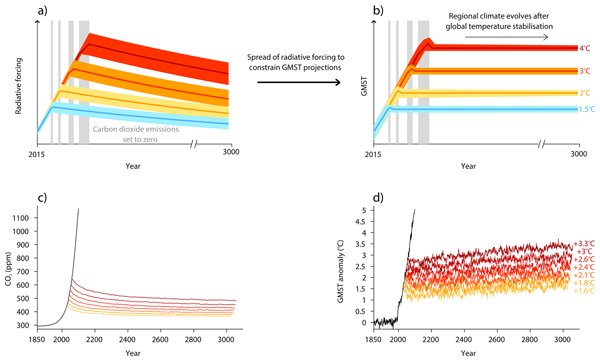
Governments are targeting net-zero emissions later this century with the aim of limiting global warming in line with the Paris Agreement. However, few studies explore the long-term consequences of reaching net-zero emissions and the effects of a delay in reaching net-zero. We use the Australian Earth system model to examine climate evolution under net-zero emissions. We find substantial changes which differ regionally, including continued Southern Ocean warming and Antarctic sea ice reduction.
Ana-Cristina Mârza, Laurie Menviel, and Luke C. Skinner
Geochronology, 6, 503–519, https://doi.org/10.5194/gchron-6-503-2024, https://doi.org/10.5194/gchron-6-503-2024, 2024
Short summary
Short summary
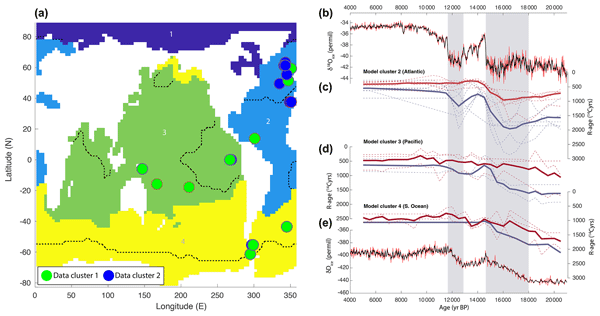
Radiocarbon serves as a powerful dating tool, but the calibration of marine radiocarbon dates presents significant challenges because the whole surface ocean cannot be represented by a single calibration curve. Here we use climate model outputs and data to assess a novel method for developing regional marine calibration curves. Our results are encouraging and point to a way forward for solving the marine radiocarbon age calibration problem without relying on model simulations of the past.
Brooke Snoll, Ruza Ivanovic, Lauren Gregoire, Sam Sherriff-Tadano, Laurie Menviel, Takashi Obase, Ayako Abe-Ouchi, Nathaelle Bouttes, Chengfei He, Feng He, Marie Kapsch, Uwe Mikolajewicz, Juan Muglia, and Paul Valdes
Clim. Past, 20, 789–815, https://doi.org/10.5194/cp-20-789-2024, https://doi.org/10.5194/cp-20-789-2024, 2024
Short summary
Short summary
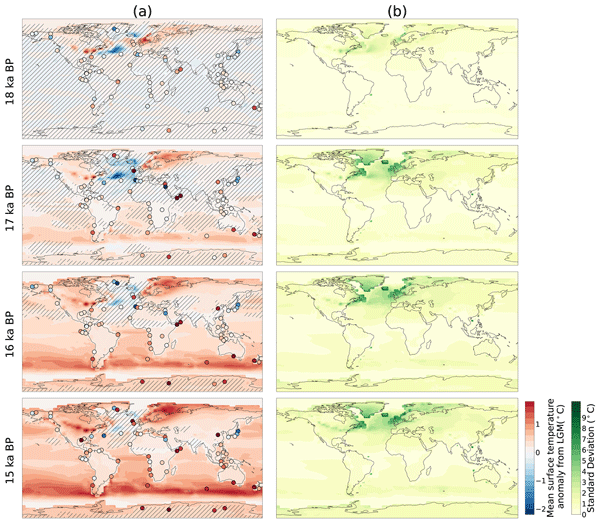
Geological records show rapid climate change throughout the recent deglaciation. The drivers of these changes are still misunderstood but are often attributed to shifts in the Atlantic Ocean circulation from meltwater input. A cumulative effort to understand these processes prompted numerous simulations of this period. We use these to explain the chain of events and our collective ability to simulate them. The results demonstrate the importance of the meltwater amount used in the simulation.
Yanxuan Du, Josephine R. Brown, and J. M. Kale Sniderman
Clim. Past, 20, 393–413, https://doi.org/10.5194/cp-20-393-2024, https://doi.org/10.5194/cp-20-393-2024, 2024
Short summary
Short summary
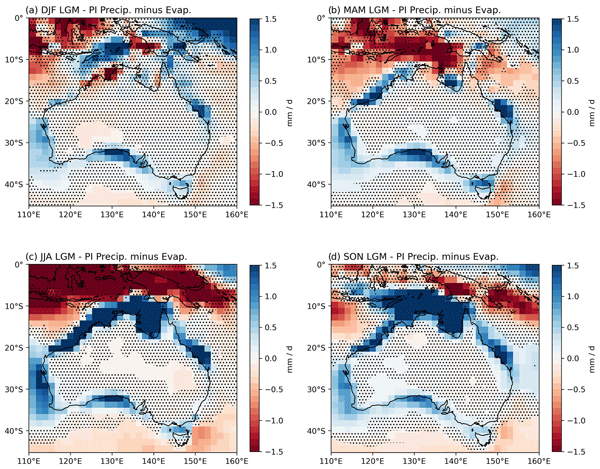
This study provides insights into regional Australian climate variations (temperature, precipitation, wind, and atmospheric circulation) during the Last Glacial Maximum (21 000 kyr ago) and the interconnections between climate variables in different seasons from climate model simulations. Model results are evaluated and compared with available palaeoclimate proxy records. Results show model responses diverge widely in both the tropics and mid-latitudes in the Australian region.
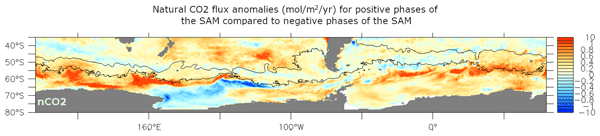
Laurie C. Menviel, Paul Spence, Andrew E. Kiss, Matthew A. Chamberlain, Hakase Hayashida, Matthew H. England, and Darryn Waugh
Biogeosciences, 20, 4413–4431, https://doi.org/10.5194/bg-20-4413-2023, https://doi.org/10.5194/bg-20-4413-2023, 2023
Short summary
Short summary
As the ocean absorbs 25% of the anthropogenic emissions of carbon, it is important to understand the impact of climate change on the flux of carbon between the ocean and the atmosphere. Here, we use a very high-resolution ocean, sea-ice, carbon cycle model to show that the capability of the Southern Ocean to uptake CO2 has decreased over the last 40 years due to a strengthening and poleward shift of the southern hemispheric westerlies. This trend is expected to continue over the coming century.
Himadri Saini, Katrin J. Meissner, Laurie Menviel, and Karin Kvale
Clim. Past, 19, 1559–1584, https://doi.org/10.5194/cp-19-1559-2023, https://doi.org/10.5194/cp-19-1559-2023, 2023
Short summary
Short summary
Understanding the changes in atmospheric CO2 during the last glacial cycle is crucial to comprehend the impact of climate change in the future. Previous research has hypothesised a key role of greater aeolian iron input into the Southern Ocean in influencing the global atmospheric CO2 levels by impacting the changes in the marine phytoplankton response. In our study, we test this iron hypothesis using climate modelling and constrain the impact of ocean iron supply on global CO2 decrease.
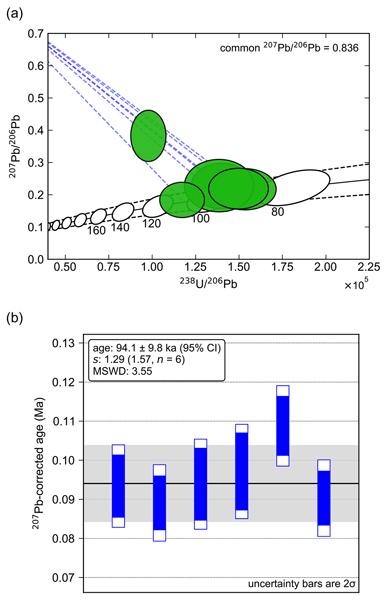
Timothy Pollard, Jon Woodhead, John Hellstrom, John Engel, Roger Powell, and Russell Drysdale
Geochronology, 5, 181–196, https://doi.org/10.5194/gchron-5-181-2023, https://doi.org/10.5194/gchron-5-181-2023, 2023
Short summary
Short summary
When using the uranium–lead (U–Pb) radiometric dating method on very young materials (e.g. Quaternary age zircon and carbonate minerals), it is important to accurately account for the production and decay of intermediate
daughterisotopes in the uranium-series decay chain. DQPB is open-source software that allows users to easily perform such calculations for a variety of sample types and produce publication-ready graphical outputs of the resulting age information.
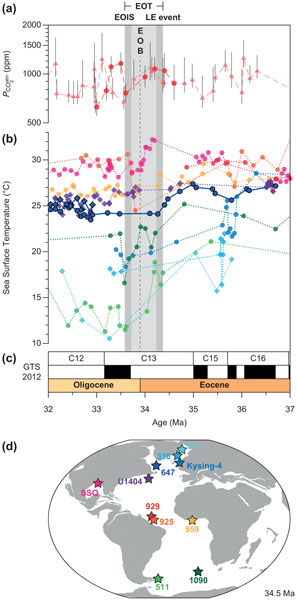
Kasia K. Śliwińska, Helen K. Coxall, David K. Hutchinson, Diederik Liebrand, Stefan Schouten, and Agatha M. de Boer
Clim. Past, 19, 123–140, https://doi.org/10.5194/cp-19-123-2023, https://doi.org/10.5194/cp-19-123-2023, 2023
Short summary
Short summary
We provide a sea surface temperature record from the Labrador Sea (ODP Site 647) based on organic geochemical proxies across the late Eocene and early Oligocene. Our study reveals heterogenic cooling of the Atlantic. The cooling of the North Atlantic is difficult to reconcile with the active Atlantic Meridional Overturning Circulation (AMOC). We discuss possible explanations like uncertainty in the data, paleogeography and atmospheric CO2 boundary conditions, model weaknesses, and AMOC activity.

Hege Kilhavn, Isabelle Couchoud, Russell N. Drysdale, Carlos Rossi, John Hellstrom, Fabien Arnaud, and Henri Wong
Clim. Past, 18, 2321–2344, https://doi.org/10.5194/cp-18-2321-2022, https://doi.org/10.5194/cp-18-2321-2022, 2022
Short summary
Short summary
The analysis of stable carbon and oxygen isotopic ratios, trace element ratios, and growth rate from a Spanish speleothem provides quantitative information on past hydrological conditions during the early Holocene in south-western Europe. Our data show that the cave site experienced increased effective recharge during the 8.2 ka event. Additionally, the oxygen isotopes indicate a change in the isotopic composition of the moisture source, associated with the meltwater flux to the North Atlantic.

Zuorui Liu, Amy Prendergast, Russell Drysdale, and Jan-Hendrik May
E&G Quaternary Sci. J., 71, 227–241, https://doi.org/10.5194/egqsj-71-227-2022, https://doi.org/10.5194/egqsj-71-227-2022, 2022
Short summary
Short summary
Past studies used two sampling strategies, the "bulk" and "sequential" drilling methods, for stable isotopic analysis of mammoth tooth enamel and paleoenvironmental reconstruction. This study applied both methods to the same enamel ridges of multiple mammoth teeth and compared their respective δ18O values. Offsets were detected between the bulk and average sequential δ18O values. The potential reasons for the offsets and their impacts on cross-method data comparison were discussed.
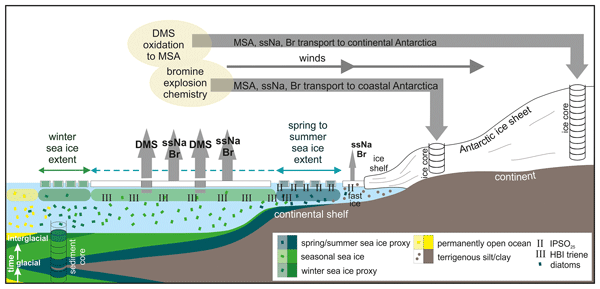
Xavier Crosta, Karen E. Kohfeld, Helen C. Bostock, Matthew Chadwick, Alice Du Vivier, Oliver Esper, Johan Etourneau, Jacob Jones, Amy Leventer, Juliane Müller, Rachael H. Rhodes, Claire S. Allen, Pooja Ghadi, Nele Lamping, Carina B. Lange, Kelly-Anne Lawler, David Lund, Alice Marzocchi, Katrin J. Meissner, Laurie Menviel, Abhilash Nair, Molly Patterson, Jennifer Pike, Joseph G. Prebble, Christina Riesselman, Henrik Sadatzki, Louise C. Sime, Sunil K. Shukla, Lena Thöle, Maria-Elena Vorrath, Wenshen Xiao, and Jiao Yang
Clim. Past, 18, 1729–1756, https://doi.org/10.5194/cp-18-1729-2022, https://doi.org/10.5194/cp-18-1729-2022, 2022
Short summary
Short summary
Despite its importance in the global climate, our knowledge of Antarctic sea-ice changes throughout the last glacial–interglacial cycle is extremely limited. As part of the Cycles of Sea Ice Dynamics in the Earth system (C-SIDE) Working Group, we review marine- and ice-core-based sea-ice proxies to provide insights into their applicability and limitations. By compiling published records, we provide information on Antarctic sea-ice dynamics over the past 130 000 years.
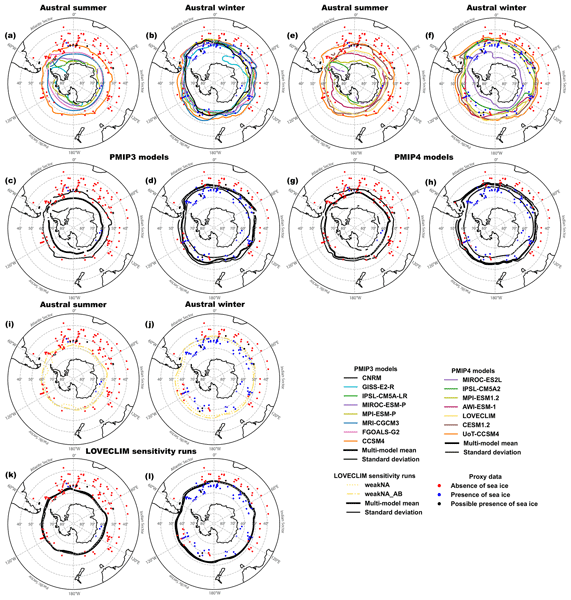
Ryan A. Green, Laurie Menviel, Katrin J. Meissner, Xavier Crosta, Deepak Chandan, Gerrit Lohmann, W. Richard Peltier, Xiaoxu Shi, and Jiang Zhu
Clim. Past, 18, 845–862, https://doi.org/10.5194/cp-18-845-2022, https://doi.org/10.5194/cp-18-845-2022, 2022
Short summary
Short summary
Climate models are used to predict future climate changes and as such, it is important to assess their performance in simulating past climate changes. We analyze seasonal sea-ice cover over the Southern Ocean simulated from numerical PMIP3, PMIP4 and LOVECLIM simulations during the Last Glacial Maximum (LGM). Comparing these simulations to proxy data, we provide improved estimates of LGM seasonal sea-ice cover. Our estimate of summer sea-ice extent is 20 %–30 % larger than previous estimates.
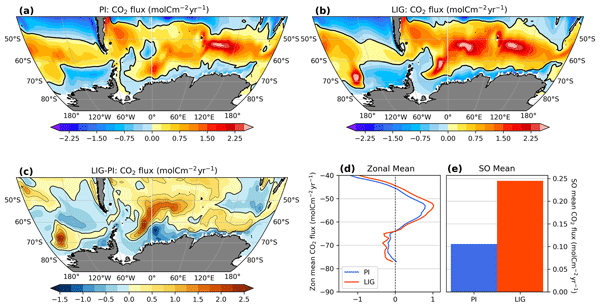
Dipayan Choudhury, Laurie Menviel, Katrin J. Meissner, Nicholas K. H. Yeung, Matthew Chamberlain, and Tilo Ziehn
Clim. Past, 18, 507–523, https://doi.org/10.5194/cp-18-507-2022, https://doi.org/10.5194/cp-18-507-2022, 2022
Short summary
Short summary
We investigate the effects of a warmer climate from the Earth's paleoclimate (last interglacial) on the marine carbon cycle of the Southern Ocean using a carbon-cycle-enabled state-of-the-art climate model. We find a 150 % increase in CO2 outgassing during this period, which results from competition between higher sea surface temperatures and weaker oceanic circulation. From this we unequivocally infer that the carbon uptake by the Southern Ocean will reduce under a future warming scenario.
Cited articles
Allen, J. R., Forrest, M., Hickler, T., Singarayer, J. S., Valdes, P. J., and Huntley, B.: Global vegetation patterns of the past 140 000 years, J. Biogeogr., 47, 2073–2090, https://doi.org/10.1111/jbi.13930, 2020. a
Bakker, P., Rogozhina, I., Merkel, U., and Prange, M.: Hypersensitivity of glacial summer temperatures in Siberia, Clim. Past, 16, 371–386, https://doi.org/10.5194/cp-16-371-2020, 2020. a
Berger, A.: Long-term variations of caloric insolation resulting from the Earth's orbital elements, Quaternary Res., 9, 139–167, https://doi.org/10.1016/0033-5894(78)90064-9, 1978. a, b
Böhm, E., Lippold, J., Gutjahr, M., Frank, M., Blaser, P., Antz, B., Fohlmeister, J., Frank, N., Andersen, M., and Deininger, M.: Strong and deep Atlantic meridional overturning circulation during the last glacial cycle, Nature, 517, 73–76, https://doi.org/10.1038/nature14059, 2015. a
Braconnot, P., Otto-Bliesner, B., Harrison, S., Joussaume, S., Peterchmitt, J.-Y., Abe-Ouchi, A., Crucifix, M., Driesschaert, E., Fichefet, Th., Hewitt, C. D., Kageyama, M., Kitoh, A., Laîné, A., Loutre, M.-F., Marti, O., Merkel, U., Ramstein, G., Valdes, P., Weber, S. L., Yu, Y., and Zhao, Y.: Results of PMIP2 coupled simulations of the Mid-Holocene and Last Glacial Maximum – Part 1: experiments and large-scale features, Clim. Past, 3, 261–277, https://doi.org/10.5194/cp-3-261-2007, 2007. a
Brandefelt, J., Kjellström, E., Näslund, J.-O., Strandberg, G., Voelker, A. H. L., and Wohlfarth, B.: A coupled climate model simulation of Marine Isotope Stage 3 stadial climate, Clim. Past, 7, 649–670, https://doi.org/10.5194/cp-7-649-2011, 2011. a, b, c
Brayshaw, D. J., Hoskins, B., and Blackburn, M.: The basic ingredients of the North Atlantic storm track. Part I: Land–sea contrast and orography, J. Atmos. Sci., 66, 2539–2558, https://doi.org/10.1175/2009JAS3078.1, 2009. a
Broccoli, A. and Manabe, S.: The influence of continental ice, atmospheric CO2, and land albedo on the climate of the last glacial maximum, Clim. Dynam., 1, 87–99, https://doi.org/10.1007/bf01054478, 1987. a
Brown, N. and Galbraith, E. D.: Hosed vs. unhosed: interruptions of the Atlantic Meridional Overturning Circulation in a global coupled model, with and without freshwater forcing, Clim. Past, 12, 1663–1679, https://doi.org/10.5194/cp-12-1663-2016, 2016. a
Byrne, M. P. and O'Gorman, P. A.: Land–ocean warming contrast over a wide range of climates: Convective quasi-equilibrium theory and idealized simulations, J. Climate, 26, 4000–4016, https://doi.org/10.1175/JCLI-D-12-00262.1, 2013. a
Calvo, E., Pelejero, C., Herguera, J. C., Palanques, A., and Grimalt, J. O.: Insolation dependence of the southeastern Subtropical Pacific sea surface temperature over the last 400 kyrs, Geophys. Res. Lett., 28, 2481–2484, https://doi.org/10.1029/2000GL012024, 2001. a
Caniupán, M., Lamy, F., Lange, C. B., Kaiser, J., Arz, H., Kilian, R., Baeza Urrea, O., Aracena, C., Hebbeln, D., Kissel, C., Laj, C., Mollenhauer, G., and Tiedemann, R.: Millennial-scale sea surface temperature and Patagonian Ice Sheet changes off southernmost Chile (53 S) over the past 60 kyr, Paleoceanography, 26, https://doi.org/10.1029/2010PA002049, 2011. a
Ceppi, P., Hwang, Y.-T., Liu, X., Frierson, D. M., and Hartmann, D. L.: The relationship between the ITCZ and the Southern Hemispheric eddy-driven jet, J. Geophys. Res.-Atmos., 118, 5136–5146, 2013. a
Chiang, J. C. and Bitz, C. M.: Influence of high latitude ice cover on the marine Intertropical Convergence Zone, Clim. Dynam., 25, 477–496, 2005. a
Clark, P. U., Dyke, A. S., Shakun, J. D., Carlson, A. E., Clark, J., Wohlfarth, B., Mitrovica, J. X., Hostetler, S. W., and McCabe, A. M.: The Last Glacial Maximum, Science, 325, 710–714, https://doi.org/10.1126/science.1172873, 2009. a
Craig, A., Valcke, S., and Coquart, L.: Development and performance of a new version of the OASIS coupler, OASIS3-MCT_3.0, Geosci. Model Dev., 10, 3297–3308, https://doi.org/10.5194/gmd-10-3297-2017, 2017. a
Duboc, B., Meissner, K. J., Menviel, L., Yeung, N. K. H., Hoogakker, B., Ziehn, T., and Chamberlain, M.: Simulated ocean oxygenation during the interglacials MIS 5e and MIS 9e, Clim. Past, 21, 1093–1122, https://doi.org/10.5194/cp-21-1093-2025, 2025. a
EPICA community members: One-to-one coupling of glacial climate variability in Greenland and Antarctica, Nature, 444, 195–198, https://doi.org/10.1038/nature05301, 2006. a
Feldberg, M. J. and Mix, A. C.: Planktonic foraminifera, sea surface temperatures, and mechanisms of oceanic change in the Peru and south equatorial currents, 0–150 ka BP, Paleoceanography, 18, https://doi.org/10.1029/2001PA000740, 2003. a
Griem, L., Voelker, A. H., Berben, S. M., Dokken, T. M., and Jansen, E.: Insolation and glacial meltwater influence on sea-ice and circulation variability in the northeastern Labrador Sea during the Last Glacial period, Paleoceanography and Paleoclimatology, 34, 1689–1709, https://doi.org/10.1029/2019PA003605, 2019. a
Griffies, S. M.: Elements of the modular ocean model (MOM), GFDL Ocean Group Tech. Rep, 7, 47, 2012. a
Henry, L., McManus, J., Curry, W., Roberts, N., Piotrowski, A., and Keigwin, L.: North Atlantic ocean circulation and abrupt climate change during the last glaciation, Science, 353, 470–474, https://doi.org/10.1126/science.aaf5529, 2016. a
Hu, A., Meehl, G. A., Han, W., Otto-Bliestner, B., Abe-Ouchi, A., and Rosenbloom, N.: Effects of the Bering Strait closure on AMOC and global climate under different background climates, Prog. Oceanogr., 132, 174–196, https://doi.org/10.1016/j.pocean.2014.02.004, 2015. a, b
Huber, C., Leuenberger, M., Spahni, R., Flückiger, J., Schwander, J., Stocker, T. F., Johnsen, S., Landais, A., and Jouzel, J.: Isotope calibrated Greenland temperature record over Marine Isotope Stage 3 and its relation to CH4, Earth Planet. Sc. Lett., 243, 504–519, https://doi.org/10.1016/j.epsl.2006.01.002, 2006. a, b
Hunke, E. C., Lipscomb, W. H., Turner, A. K., Jeffery, N., and Elliott, S.: CICE: The Los Alamos sea ice model documentation and software user's manual version 4.1 la-cc-06-012, T-3 Fluid Dynamics Group, Los Alamos National Laboratory, 675, 500, 2010. a
Izumi, K., Valdes, P., Ivanovic, R., and Gregoire, L.: Impacts of the PMIP4 ice sheets on Northern Hemisphere climate during the last glacial period, Clim. Dynam., 60, 2481–2499, https://doi.org/10.1007/s00382-022-06456-1, 2023. a
Kageyama, M., Albani, S., Braconnot, P., Harrison, S. P., Hopcroft, P. O., Ivanovic, R. F., Lambert, F., Marti, O., Peltier, W. R., Peterschmitt, J.-Y., Roche, D. M., Tarasov, L., Zhang, X., Brady, E. C., Haywood, A. M., LeGrande, A. N., Lunt, D. J., Mahowald, N. M., Mikolajewicz, U., Nisancioglu, K. H., Otto-Bliesner, B. L., Renssen, H., Tomas, R. A., Zhang, Q., Abe-Ouchi, A., Bartlein, P. J., Cao, J., Li, Q., Lohmann, G., Ohgaito, R., Shi, X., Volodin, E., Yoshida, K., Zhang, X., and Zheng, W.: The PMIP4 contribution to CMIP6 – Part 4: Scientific objectives and experimental design of the PMIP4-CMIP6 Last Glacial Maximum experiments and PMIP4 sensitivity experiments, Geosci. Model Dev., 10, 4035–4055, https://doi.org/10.5194/gmd-10-4035-2017, 2017. a
Kageyama, M., Harrison, S. P., Kapsch, M.-L., Lofverstrom, M., Lora, J. M., Mikolajewicz, U., Sherriff-Tadano, S., Vadsaria, T., Abe-Ouchi, A., Bouttes, N., Chandan, D., Gregoire, L. J., Ivanovic, R. F., Izumi, K., LeGrande, A. N., Lhardy, F., Lohmann, G., Morozova, P. A., Ohgaito, R., Paul, A., Peltier, W. R., Poulsen, C. J., Quiquet, A., Roche, D. M., Shi, X., Tierney, J. E., Valdes, P. J., Volodin, E., and Zhu, J.: The PMIP4 Last Glacial Maximum experiments: preliminary results and comparison with the PMIP3 simulations, Clim. Past, 17, 1065–1089, https://doi.org/10.5194/cp-17-1065-2021, 2021. a, b, c, d
Kaiser, J., Lamy, F., and Hebbeln, D.: A 70-kyr sea surface temperature record off southern Chile (Ocean Drilling Program Site 1233), Paleoceanography, 20, https://doi.org/10.1029/2005PA001146, 2005. a
Kemp, C., Tibby, J., Arnold, L., and Barr, C.: Australian hydroclimate during Marine Isotope Stage 3: a synthesis and review, Quaternary Sci. Rev., 204, 94–104, https://doi.org/10.1016/j.quascirev.2018.11.016, 2019. a, b
Kindler, P., Guillevic, M., Baumgartner, M., Schwander, J., Landais, A., and Leuenberger, M.: Temperature reconstruction from 10 to 120 kyr b2k from the NGRIP ice core, Clim. Past, 10, 887–902, https://doi.org/10.5194/cp-10-887-2014, 2014. a
Klockmann, M., Mikolajewicz, U., and Marotzke, J.: Two AMOC states in response to decreasing greenhouse gas concentrations in the coupled climate model MPI-ESM, J. Climate, 31, 7969–7984, https://doi.org/10.1175/JCLI-D-17-0859.1, 2018. a
Köhler, P., Nehrbass-Ahles, C., Schmitt, J., Stocker, T. F., and Fischer, H.: A 156 kyr smoothed history of the atmospheric greenhouse gases CO2, CH4, and N2O and their radiative forcing, Earth Syst. Sci. Data, 9, 363–387, https://doi.org/10.5194/essd-9-363-2017, 2017. a, b, c
Kowalczyk, E., Stevens, L., Law, R., Dix, M., Wang, Y., Harman, I., Haynes, K., Srbinovsky, J., Pak, B., and Ziehn, T.: The land surface model component of ACCESS: description and impact on the simulated surface climatology, Aust. Meteorol. Ocean., 63, 65–82, https://doi.org/10.1071/ES13005, 2013. a
Lambeck, K., Rouby, H., Purcell, A., Sun, Y., and Sambridge, M.: Sea level and global ice volumes from the Last Glacial Maximum to the Holocene, P. Natl. Acad. Sci. USA, 111, 15296–15303, https://doi.org/10.1073/pnas.1411762111, 2014. a
Lauterbach, S., Andersen, N., Wang, Y. V., Blanz, T., Larsen, T., and Schneider, R. R.: An ∼ 130 kyr record of surface water temperature and δ18O from the northern Bay of Bengal: Investigating the linkage between Heinrich events and Weak Monsoon Intervals in Asia, Paleoceanography and Paleoclimatology, 35, e2019PA003646, https://doi.org/10.1029/2019PA003646, 2020. a
Lea, D. W., Pak, D. K., and Spero, H. J.: Climate impact of late Quaternary equatorial Pacific sea surface temperature variations, Science, 289, 1719–1724, https://doi.org/10.1126/science.289.5485.1719, 2000. a
Liakka, J. and Lofverstrom, M.: Arctic warming induced by the Laurentide Ice Sheet topography, Clim. Past, 14, 887–900, https://doi.org/10.5194/cp-14-887-2018, 2018. a
Liu, Y., Lo, L., Shi, Z., Wei, K.-Y., Chou, C.-J., Chen, Y.-C., Chuang, C.-K., Wu, C.-C., Mii, H.-S., Peng, Z., Amakawa, H., Burr, G. S., Lee, S.-Y., DeLong, K. L., Elderfield, H., and Shen, C.-C.: Obliquity pacing of the western Pacific Intertropical Convergence Zone over the past 282,000 years, Nat. Commun., 6, 10018, https://doi.org/10.1038/ncomms10018, 2015. a
Mackallah, C., Chamberlain, M., Law, R., Dix, M., Ziehn, T., Bi, D., Bodman, R., Brown, J., Dobrohotoff, P., Druken, K., Evans, B., Harman, I., Hayashida, H., Holmes, R., Kiss, A., Lenton, A., Liu, Y., Marsland, S., Meissner, K., Menviel, L., O'Farrell, S., Rashid, H., Ridzwan, S., Savita, A., Srbinovsky, J., Sullivan, A., Trenham, C., Vohralik, P., Wang, Y., Williams, G., Woodhouse, M., and Yeung, N.: ACCESS datasets for CMIP6: methodology and idealised experiments, Journal of Southern Hemisphere Earth Systems Science, 72, 93–116, https://doi.org/10.1071/ES21031, 2022. a
Malmierca-Vallet, I., Sime, L. C., and the D–O community members: Dansgaard–Oeschger events in climate models: review and baseline Marine Isotope Stage 3 (MIS3) protocol, Clim. Past, 19, 915–942, https://doi.org/10.5194/cp-19-915-2023, 2023. a, b
Manabe, S. and Broccoli, A.: The influence of continental ice sheets on the climate of an ice age, J. Geophys. Res.-Atmos., 90, 2167–2190, https://doi.org/10.1029/JD090iD01p02167, 1985. a
Mantsis, D. F., Lintner, B. R., Broccoli, A. J., Erb, M. P., Clement, A. C., and Park, H.-S.: The response of large-scale circulation to obliquity-induced changes in meridional heating gradients, J. Climate, 27, 5504–5516, https://doi.org/10.1175/JCLI-D-13-00526.1, 2014. a
Martin, G., Milton, S., Senior, C., Brooks, M., Ineson, S., Reichler, T., and Kim, J.: Analysis and reduction of systematic errors through a seamless approach to modeling weather and climate, J. Climate, 23, 5933–5957, https://doi.org/10.1175/2010JCLI3541.1, 2010. a
Martínez, I., Keigwin, L., Barrows, T. T., Yokoyama, Y., and Southon, J.: La Niña-like conditions in the eastern equatorial Pacific and a stronger Choco jet in the northern Andes during the last glaciation, Paleoceanography, 18, https://doi.org/10.1029/2002PA000877, 2003. a
Martrat, B., Grimalt, J. O., Shackleton, N. J., de Abreu, L., Hutterli, M. A., and Stocker, T. F.: Four climate cycles of recurring deep and surface water destabilizations on the Iberian margin, Science, 317, 502–507, https://doi.org/10.1126/science.1139994, 2007. a
Menviel, L., Timmermann, A., Mouchet, A., and Timm, O.: Meridional reorganizations of marine and terrestrial productivity during Heinrich events, Paleoceanography, 23, https://doi.org/10.1029/2007PA001445, 2008. a
Menviel, L. C., Skinner, L. C., Tarasov, L., and Tzedakis, P. C.: An ice–climate oscillatory framework for Dansgaard–Oeschger cycles, Nat. Rev. Earth Environ., 1, 677–693, https://doi.org/10.1038/s43017-020-00106-y, 2020. a, b, c
Merkel, U., Prange, M., and Schulz, M.: ENSO variability and teleconnections during glacial climates, Quaternary Sci. Rev., 29, 86–100, https://doi.org/10.1016/j.quascirev.2009.11.006, 2010. a, b, c, d
Muglia, J. and Schmittner, A.: Glacial Atlantic overturning increased by wind stress in climate models, Geophys. Res. Lett., 42, 9862–9868, https://doi.org/10.1002/2015GL064583, 2015. a
Oke, P. R., Griffin, D. A., Schiller, A., Matear, R. J., Fiedler, R., Mansbridge, J., Lenton, A., Cahill, M., Chamberlain, M. A., and Ridgway, K.: Evaluation of a near-global eddy-resolving ocean model, Geosci. Model Dev., 6, 591–615, https://doi.org/10.5194/gmd-6-591-2013, 2013. a
Pahnke, K., Zahn, R., Elderfield, H., and Schulz, M.: 340,000-year centennial-scale marine record of Southern Hemisphere climatic oscillation, Science, 301, 948–952, https://doi.org/10.1126/science.1084451, 2003. a
Peltier, W. R.: Global glacial isostasy and the surface of the ice-age Earth: the ICE-5G (VM2) model and GRACE, Annu. Rev. Earth Planet. Sci., 32, 111–149, https://doi.org/10.1146/annurev.earth.32.082503.144359, 2004. a, b
Saini, H., Meissner, K. J., Menviel, L., and Kvale, K.: Transient response of Southern Ocean ecosystems during Heinrich stadials, Paleoceanography and Paleoclimatology, 39, e2023PA004754, https://doi.org/10.1029/2023PA004754, 2024. a
Saini, H., Hutchinson, D. K., Brown, J. R., Drysdale, R. N., Du, Y., and Menviel, L.: ACCESS model outputs for simulations performed under MIS 3 boundary conditions, Dryad [data set], https://doi.org/10.5061/dryad.37pvmcw1m, 2026. a
Seager, R., Battisti, D. S., Yin, J., Gordon, N., Naik, N., Clement, A. C., and Cane, M. A.: Is the Gulf Stream responsible for Europe's mild winters?, Quarterly Journal of the Royal Meteorological Society: A journal of the atmospheric sciences, Applied Meteorology and Physical Oceanography, 128, 2563–2586, https://doi.org/10.1256/qj.01.128, 2002. a
Shakun, J. D., Lea, D. W., Lisiecki, L. E., and Raymo, M. E.: An 800-kyr record of global surface ocean δ18O and implications for ice volume-temperature coupling, Earth Planet. Sc. Lett., 426, 58–68, https://doi.org/10.1016/j.epsl.2015.05.042, 2015. a, b
Sherriff-Tadano, S., Abe-Ouchi, A., Yoshimori, M., Oka, A., and Chan, W.-L.: Influence of glacial ice sheets on the Atlantic meridional overturning circulation through surface wind change, Clim. Dynam., 50, 2881–2903, https://doi.org/10.1007/s00382-017-3780-0, 2018. a
Stadelmaier, K. H., Ludwig, P., Pinto, J. G., and Újvári, G.: Changes in Atmospheric Dynamics Over Dansgaard-Oeschger Climate Oscillations Around 40 ka and Their Impact on Europe, J. Geophys. Res.-Atmos., 129, e2023JD040247, https://doi.org/10.1029/2023JD040247, 2024. a
The HadGEM2 Development Team: G. M. Martin, Bellouin, N., Collins, W. J., Culverwell, I. D., Halloran, P. R., Hardiman, S. C., Hinton, T. J., Jones, C. D., McDonald, R. E., McLaren, A. J., O'Connor, F. M., Roberts, M. J., Rodriguez, J. M., Woodward, S., Best, M. J., Brooks, M. E., Brown, A. R., Butchart, N., Dearden, C., Derbyshire, S. H., Dharssi, I., Doutriaux-Boucher, M., Edwards, J. M., Falloon, P. D., Gedney, N., Gray, L. J., Hewitt, H. T., Hobson, M., Huddleston, M. R., Hughes, J., Ineson, S., Ingram, W. J., James, P. M., Johns, T. C., Johnson, C. E., Jones, A., Jones, C. P., Joshi, M. M., Keen, A. B., Liddicoat, S., Lock, A. P., Maidens, A. V., Manners, J. C., Milton, S. F., Rae, J. G. L., Ridley, J. K., Sellar, A., Senior, C. A., Totterdell, I. J., Verhoef, A., Vidale, P. L., and Wiltshire, A.: The HadGEM2 family of Met Office Unified Model climate configurations, Geosci. Model Dev., 4, 723–757, https://doi.org/10.5194/gmd-4-723-2011, 2011. a
Timmermann, A., Friedrich, T., Timm, O. E., Chikamoto, M. O., Abe-Ouchi, A., and Ganopolski, A.: Modeling obliquity and CO2 effects on Southern Hemisphere climate during the past 408 ka, J. Climate, 27, 1863–1875, https://doi.org/10.1175/JCLI-D-13-00311.1, 2014. a
Ullman, D. J., LeGrande, A. N., Carlson, A. E., Anslow, F. S., and Licciardi, J. M.: Assessing the impact of Laurentide Ice Sheet topography on glacial climate, Clim. Past, 10, 487–507, https://doi.org/10.5194/cp-10-487-2014, 2014. a, b, c, d
Van Meerbeeck, C. J., Renssen, H., and Roche, D. M.: How did Marine Isotope Stage 3 and Last Glacial Maximum climates differ? – Perspectives from equilibrium simulations, Clim. Past, 5, 33–51, https://doi.org/10.5194/cp-5-33-2009, 2009. a
WAIS Divide Project Members: Precise interpolar phasing of abrupt climate change during the last ice age, Nature, 520, 661–665, https://doi.org/10.1038/nature14401, 2015. a
Wang, N., Jiang, D., and Lang, X.: Northern westerlies during the Last Glacial Maximum: Results from CMIP5 simulations, J. Climate, 31, 1135–1153, https://doi.org/10.1175/JCLI-D-17-0314.1, 2018. a
Wang, Y. P., Law, R. M., and Pak, B.: A global model of carbon, nitrogen and phosphorus cycles for the terrestrial biosphere, Biogeosciences, 7, 2261–2282, https://doi.org/10.5194/bg-7-2261-2010, 2010. a
Weij, R., Sniderman, J. K., Woodhead, J. D., Hellstrom, J. C., Brown, J. R., Drysdale, R. N., Reed, E., Bourne, S., and Gordon, J.: Elevated Southern Hemisphere moisture availability during glacial periods, Nature, 626, 319–326, https://doi.org/10.1038/s41586-023-06989-3, 2024. a
Yeung, N. K.-H., Menviel, L., Meissner, K. J., Taschetto, A. S., Ziehn, T., and Chamberlain, M.: Land–sea temperature contrasts at the Last Interglacial and their impact on the hydrological cycle, Clim. Past, 17, 869–885, https://doi.org/10.5194/cp-17-869-2021, 2021. a
Zhang, P., Xu, J., Holbourn, A., Kuhnt, W., Xiong, Z., and Li, T.: Obliquity induced latitudinal migration of the Intertropical Convergence Zone during the past 410 kyr, Geophys. Res. Lett., 49, e2022GL100039, https://doi.org/10.1029/2022GL100039, 2022. a
Zhang, X., Lohmann, G., Knorr, G., and Purcell, C.: Abrupt glacial climate shifts controlled by ice sheet changes, Nature, 512, 290–294, https://doi.org/10.1038/nature13592, 2014a. a, b, c
Zhang, X., Prange, M., Merkel, U., and Schulz, M.: Instability of the Atlantic overturning circulation during Marine Isotope Stage 3, Geophys. Res. Lett., 41, 4285–4293, https://doi.org/10.1002/2014GL060321, 2014b. a, b
Ziehn, T., Chamberlain, M. A., Law, R. M., Lenton, A., Bodman, R. W., Dix, M., Stevens, L., Wang, Y.-P., and Srbinovsky, J.: The Australian earth system model: ACCESS-ESM1.5, Journal of Southern Hemisphere Earth Systems Science, 70, 193–214, https://doi.org/10.22033/ESGF/CMIP6.4248, 2020. a, b
Short summary
During the last ice age, Northern Hemisphere ice sheets reshaped global climate. They shifted North Atlantic winds southward, increasing summer rainfall across Eurasia. They also altered tropical and Southern Hemisphere weather patterns, affecting rainfall far beyond the ice-covered regions. Our results show that the height and shape of the ice sheets had a much greater influence on global wind and rainfall patterns than changes in Earth’s orbit, greenhouse gases, or surface reflectivity.
During the last ice age, Northern Hemisphere ice sheets reshaped global climate. They shifted...


