
Articles | Volume 22, issue 5
https://doi.org/10.5194/cp-22-1037-2026
© Author(s) 2026. This work is distributed under
the Creative Commons Attribution 4.0 License.
the Creative Commons Attribution 4.0 License.
https://doi.org/10.5194/cp-22-1037-2026
© Author(s) 2026. This work is distributed under
the Creative Commons Attribution 4.0 License.
the Creative Commons Attribution 4.0 License.
Research article
| 
22 May 2026
Research article |
| 22 May 2026
| 22 May 2026
A multimillennial Alpine ice core chronology synchronized with an accurately dated Arctic Pb record
Paolo Gabrielli
CORRESPONDING AUTHOR

Italian Glaciological Committee c/o University of Turin, Turin, Italy
now at: Metropolitan Water District of Southern California, 700 Moreno Ave, La Verne, CA, 91750, USA
Center for Energy and Environmental Sciences, Paul Scherrer Institut, 5232 Villigen PSI, Switzerland
Oeschger Centre for Climate Change Research, University of Bern, 3012 Bern, Switzerland
Michele Bertó
Department of Environmental Sciences, Informatics and Statistics,Ca' Foscari University of Venice, Venice-Mestre, 30170, Italy
Giuliano Dreossi
Department of Environmental Sciences, Informatics and Statistics,Ca' Foscari University of Venice, Venice-Mestre, 30170, Italy
Daniela Festi
Institute for Botany, University of Innsbruck, Innsbruck, 6020, Austria
Werner Kofler
Institute for Botany, University of Innsbruck, Innsbruck, 6020, Austria
Mai Winstrup
DTU Space, Technical University of Denmark, Kongens Lyngby, 2800, Denmark
Klaus Oeggl
Institute for Botany, University of Innsbruck, Innsbruck, 6020, Austria
Margit Schwikowski
Center for Energy and Environmental Sciences, Paul Scherrer Institut, 5232 Villigen PSI, Switzerland
Oeschger Centre for Climate Change Research, University of Bern, 3012 Bern, Switzerland
Department of Chemistry and Biochemistry and Pharmaceutical Sciences, University of Bern, 3012 Bern, Switzerland
Barbara Stenni
Department of Environmental Sciences, Informatics and Statistics,Ca' Foscari University of Venice, Venice-Mestre, 30170, Italy
Department of Environmental Sciences, Informatics and Statistics,Ca' Foscari University of Venice, Venice-Mestre, 30170, Italy
Institute of Polar Sciences-CNR, Venice-Mestre, 30170, Italy
Related authors
Tiziana Lazzarina Zendrini, Luca Carturan, Michael Lehning, Mathias Bavay, Federico Cazorzi, Paolo Gabrielli, Nander Wever, and Giancarlo Dalla Fontana
The Cryosphere, 20, 5199–5224, https://doi.org/10.5194/tc-20-5199-2026, https://doi.org/10.5194/tc-20-5199-2026, 2026
Short summary
Short summary
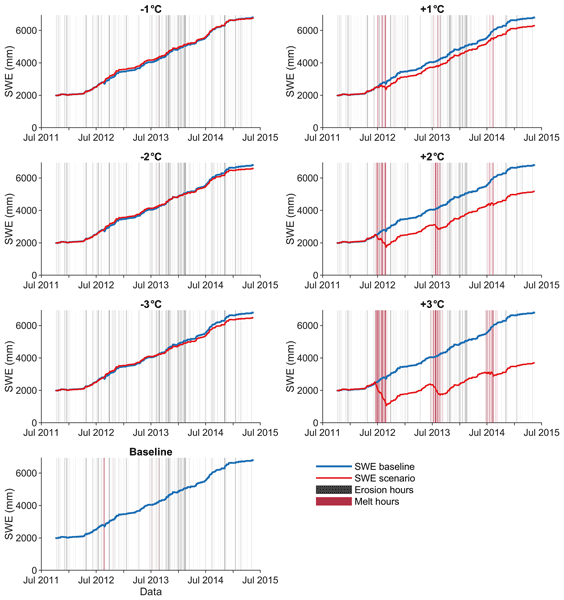
By combining in situ mass balance data with a physics‐based snow model at Mt. Ortles, in the Italian Alps, we investigate snow accumulation, erosion and melt processes, and their sensitivity to air temperature. We found that wind erosion is currently the major ablation process at this high-elevation site, whereas melt plays a minor role. Quickly rising air temperature is affecting this partitioning and suggests a future shift from an erosion-dominated to a melt-dominated mass balance regime.
Sibylle Boxho, Aubry Vanderstraeten, Nadine Mattielli, Goulven G. Laruelle, Aloys Bory, Paolo Gabrielli, and Steeve Bonneville
Clim. Past, 22, 1655–1674, https://doi.org/10.5194/cp-22-1655-2026, https://doi.org/10.5194/cp-22-1655-2026, 2026
Short summary
Short summary
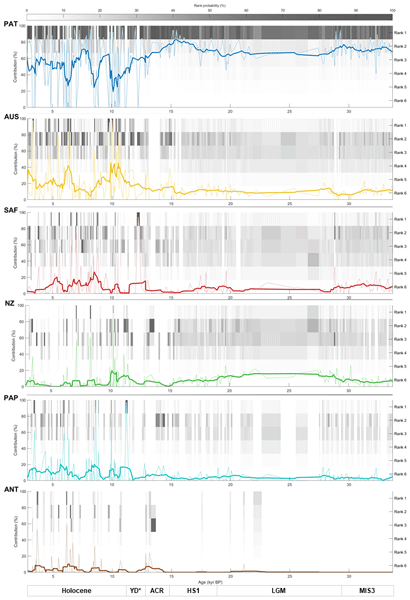
We present a high-resolution, quantitative reconstruction of dust provenance in the EPICA Dome C ice core (33.7–2.8 kyr BP) using Rare Earth Elements (REE). Dust was mainly sourced from Patagonia during glacial periods, shifting toward Australia, Southern Africa, and the Puna-Altiplano after 14.5 kyr BP due to sea-level rise and hydrological rearrangement in Patagonia. These changes also reflect major reorganizations of Southern Hemisphere atmospheric circulation.
Noah Liguori-Bills, Catherine E. Scott, Ken S. Carslaw, Natalie Kehrwald, Stijn Hantson, Susan Kaspari, Carlo Barbante, Elena Barbaro, Paolo Gabrielli, Roberta Zangrando, Lonnie G. Thompson, and Douglas S. Hamilton
EGUsphere, https://doi.org/10.5194/egusphere-2026-2728, https://doi.org/10.5194/egusphere-2026-2728, 2026
Short summary
Short summary
Ice cores preserve changes in landscape fires and human-caused combustion. In this study, we compared ice core data from every continent, except Oceania, to computer model simulations of fire. We found a large disagreement in the 1850 CE to 1980 CE black carbon ratio. After exploring changes in emissions, transport, and aerosol microphysical processes as potential reasons for this disagreement, our results suggested that fire emission input datasets for climate models are the primary cause.
Luca Carturan, Alexander C. Ihle, Federico Cazorzi, Tiziana Lazzarina Zendrini, Fabrizio De Blasi, Giancarlo Dalla Fontana, Giuliano Dreossi, Daniela Festi, Bryan Mark, Klaus Dieter Oeggl, Roberto Seppi, Barbara Stenni, and Paolo Gabrielli
The Cryosphere, 19, 3443–3458, https://doi.org/10.5194/tc-19-3443-2025, https://doi.org/10.5194/tc-19-3443-2025, 2025
Short summary
Short summary
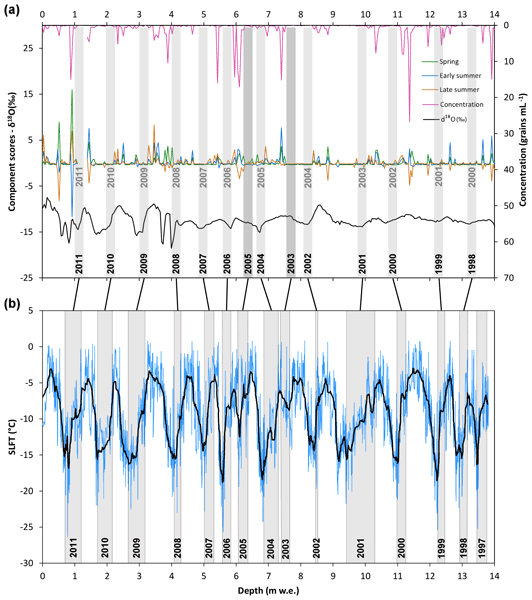
Paleoclimatic glacial archives in low-latitude mountains are increasingly affected by melt, causing heavy percolation and removing snow and firn accumulated across months, seasons, or even years. Here we present a proxy system model that explicitly accounts for melt in ice and firn cores. Compared to traditional annual layer counting, the model significantly improved the interpretation and annual dating of the Mt Ortles firn core, in the Italian Alps, which includes the very warm summer of 2003.
Luca Carturan, Fabrizio De Blasi, Roberto Dinale, Gianfranco Dragà, Paolo Gabrielli, Volkmar Mair, Roberto Seppi, David Tonidandel, Thomas Zanoner, Tiziana Lazzarina Zendrini, and Giancarlo Dalla Fontana
Earth Syst. Sci. Data, 15, 4661–4688, https://doi.org/10.5194/essd-15-4661-2023, https://doi.org/10.5194/essd-15-4661-2023, 2023
Short summary
Short summary
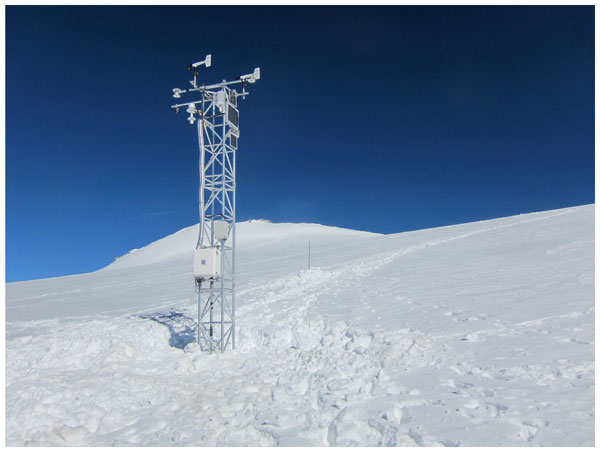
This paper presents a new dataset of air, englacial, soil surface and rock wall temperatures collected between 2010 and 2016 on Mt Ortles, which is the highest summit of South Tyrol, Italy. Details are provided on instrument type and characteristics, field methods, and data quality control and assessment. The obtained data series are available through an open data repository. This is a rare dataset from a summit area lacking observations on permafrost and glaciers and their climatic response.
Paolo Gabrielli, Theo Manuel Jenk, Michele Bertó, Giuliano Dreossi, Daniela Festi, Werner Kofler, Mai Winstrup, Klaus Oeggl, Margit Schwikowski, Barbara Stenni, and Carlo Barbante
Clim. Past Discuss., https://doi.org/10.5194/cp-2022-20, https://doi.org/10.5194/cp-2022-20, 2022
Revised manuscript not accepted
Short summary
Short summary
We present a methodology that reduces the chronological uncertainty of an Alpine ice core record from the glacier Alto dell’Ortles, Italy. This chronology will allow the constraint of the Holocene climatic and environmental histories emerging from this archive of Central Europe. This method will allow to obtain accurate chronologies also from other ice cores from-low latitude/high-altitude glaciers that typically suffer from larger dating uncertainties compared with well dated polar records.
João Gomes Ilha, Manoela Brum Poitevin Portella, Oscar Vilca Gomez, Filipe Gaudie Lindau, Mariusz Potocki, Elena Barbaro, Susan Kaspari, Carlo Barbante, Jefferson Cardia Simões, and Paul Andrew Mayewski
EGUsphere, https://doi.org/10.5194/egusphere-2026-4779, https://doi.org/10.5194/egusphere-2026-4779, 2026
This preprint is open for discussion and under review for The Cryosphere (TC).
Short summary
Short summary
Glaciers preserve records of past climate, but melting is rapidly damaging this information. We examined a new ice core from the Quelccaya Ice Cap in Peru by comparing a variety of chemical markers and using statistical tools. We found that melting has altered the archive mainly where water accumulated and near a fracture, rather than throughout the core. Much of the ice still preserves valuable climate information. Our approach can help assess other threatened glacier records around the world.
Tiziana Lazzarina Zendrini, Luca Carturan, Michael Lehning, Mathias Bavay, Federico Cazorzi, Paolo Gabrielli, Nander Wever, and Giancarlo Dalla Fontana
The Cryosphere, 20, 5199–5224, https://doi.org/10.5194/tc-20-5199-2026, https://doi.org/10.5194/tc-20-5199-2026, 2026
Short summary
Short summary
By combining in situ mass balance data with a physics‐based snow model at Mt. Ortles, in the Italian Alps, we investigate snow accumulation, erosion and melt processes, and their sensitivity to air temperature. We found that wind erosion is currently the major ablation process at this high-elevation site, whereas melt plays a minor role. Quickly rising air temperature is affecting this partitioning and suggests a future shift from an erosion-dominated to a melt-dominated mass balance regime.

François Burgay, Haley Derrod, Tobias Erhardt, Federico Scoto, Delia Segato, Niccolò Maffezzoli, Federico Dallo, Daniele Zannoni, Azzurra Spagnesi, Helle-Astrid Kjær, Hubertus Fischer, Cristiano Varin, Carlo Barbante, and Andrea Spolaor
Clim. Past, 22, 1675–1689, https://doi.org/10.5194/cp-22-1675-2026, https://doi.org/10.5194/cp-22-1675-2026, 2026
Short summary
Short summary
Ice-core measurements from Greenland suggest that atmospheric iron deposition played a smaller role than previously thought in regulating marine productivity in the iron-limited North Pacific. Despite a strong increase in total iron deposition, the fraction of iron more likely to be available to phytoplankton rose only modestly, pointing to sea-ice extent and sedimentary iron remobilization as potentially more important factors during the last glacial transition.
Sibylle Boxho, Aubry Vanderstraeten, Nadine Mattielli, Goulven G. Laruelle, Aloys Bory, Paolo Gabrielli, and Steeve Bonneville
Clim. Past, 22, 1655–1674, https://doi.org/10.5194/cp-22-1655-2026, https://doi.org/10.5194/cp-22-1655-2026, 2026
Short summary
Short summary
We present a high-resolution, quantitative reconstruction of dust provenance in the EPICA Dome C ice core (33.7–2.8 kyr BP) using Rare Earth Elements (REE). Dust was mainly sourced from Patagonia during glacial periods, shifting toward Australia, Southern Africa, and the Puna-Altiplano after 14.5 kyr BP due to sea-level rise and hydrological rearrangement in Patagonia. These changes also reflect major reorganizations of Southern Hemisphere atmospheric circulation.
Akash M. Patil, Christoph Mayer, Theo M. Jenk, Astrid Lambrecht, Thorsten Seehaus, Alexander R. Groos, and Michelle Worek
The Cryosphere, 20, 4927–4955, https://doi.org/10.5194/tc-20-4927-2026, https://doi.org/10.5194/tc-20-4927-2026, 2026
Short summary
Short summary
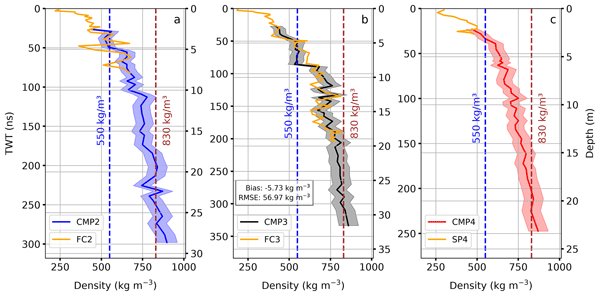
Our study focused on understanding how a warming climate affects the Aletsch Glacier accumulation area. We used multi-year radar measurements and direct firn‑core analyses to estimate changes in density and compaction rate of snow-to-ice over a year. Our results show that the upper layers of the glacier are changing faster due to stronger summer melt in the lower parts of the accumulation zone. Our findings help to improve firn densification models and glacier mass-balance estimation.
Adrien Ooms, Mathieu Casado, Sonja Wahl, Thomas Laepple, Alexandra Zuhr, Pete Akers, Ghislain Picard, Laurent Arnaud, Joel Savarino, Kira Rehfeld, Barbara Stenni, Giuliano Dreossi, Mauro Masiol, Amaelle Landais, and Valérie Masson-Delmotte
EGUsphere, https://doi.org/10.5194/egusphere-2026-4801, https://doi.org/10.5194/egusphere-2026-4801, 2026
This preprint is open for discussion and under review for Climate of the Past (CP).
Short summary
Short summary
This work presents new insights in the archival process of multi-annual climatic signal in the near surface firn at Concordia Station, East-Antarctica, from the new data set of high resolution stable water isotope profiles measured in a snow trench. The dated isotopic profiles covering 20 years are compared against overlapping precipitation and surface snow observations. This highlights the strong contribution of stratigraphic noise and post depositional effects to individual trench profiles.
Natalia H. Andersen, Sebastian B. Simonsen, Karina Nielsen, Mai Winstrup, Baptiste Vandecrux, Hui Gao, Beata Csatho, Anton Schenk, and Louise Sandberg Sørensen
The Cryosphere, 20, 4327–4344, https://doi.org/10.5194/tc-20-4327-2026, https://doi.org/10.5194/tc-20-4327-2026, 2026
Short summary
Short summary
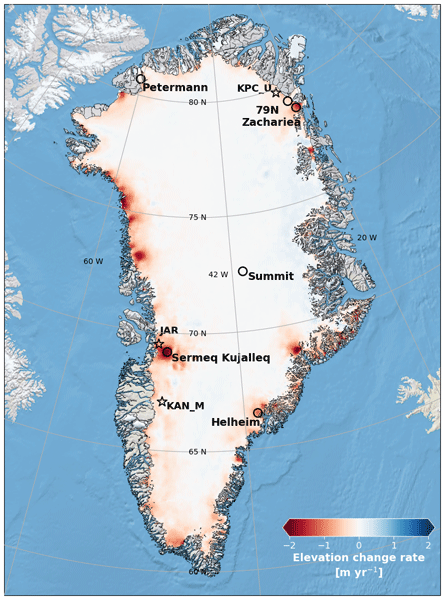
We developed a new statistical approach to track monthly changes in the surface height of the Greenland Ice Sheet using radar data from the CryoSat-2 satellite (2011–2025). The method lets seasonal and long-term variations emerge directly from the data, creating a consistent record of elevation change that helps reveal how Greenland responds to ongoing climate change.
Noah Liguori-Bills, Catherine E. Scott, Ken S. Carslaw, Natalie Kehrwald, Stijn Hantson, Susan Kaspari, Carlo Barbante, Elena Barbaro, Paolo Gabrielli, Roberta Zangrando, Lonnie G. Thompson, and Douglas S. Hamilton
EGUsphere, https://doi.org/10.5194/egusphere-2026-2728, https://doi.org/10.5194/egusphere-2026-2728, 2026
Short summary
Short summary
Ice cores preserve changes in landscape fires and human-caused combustion. In this study, we compared ice core data from every continent, except Oceania, to computer model simulations of fire. We found a large disagreement in the 1850 CE to 1980 CE black carbon ratio. After exploring changes in emissions, transport, and aerosol microphysical processes as potential reasons for this disagreement, our results suggested that fire emission input datasets for climate models are the primary cause.
Michelle Marie Worek, David Wachs, Anja Eichler, Matthias Huss, Raphael Moser, Sabina Brütsch, Sönke Szidat, Margit Schwikowski, and Theo Manuel Jenk
EGUsphere, https://doi.org/10.5194/egusphere-2026-3356, https://doi.org/10.5194/egusphere-2026-3356, 2026
Short summary
Short summary
To assess whether current glacier loss in the Alps is unprecedented, we drilled ice cores from the Tödi summit glacier in Switzerland. We dated the ice with radionuclides and modelling, finding that the surface ice is from about 1960, and the deepest ice is 10,000 years old. Our results show that summit glaciers can preserve very old ice through warm periods, indicating local factors matter more than elevation, and some cold-based glaciers at risk of melting may preserve ancient climate data.
Agnese Petteni, Mathieu Casado, Christophe Leroy-Dos Santos, Amaelle Landais, Niels Dutrievoz, Cécile Agosta, Pete D. Akers, Joel Savarino, Andrea Spolaor, Massimo Frezzotti, and Barbara Stenni
The Cryosphere, 20, 3581–3598, https://doi.org/10.5194/tc-20-3581-2026, https://doi.org/10.5194/tc-20-3581-2026, 2026
Short summary
Short summary
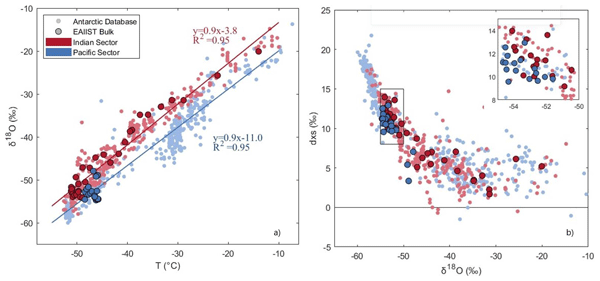
We investigated the isotopic composition of surface snow in a previously unexplored region of East Antarctica to understand how differences in air mass origin influence its variability. By comparing observations with model data, we validated the model and quantified the impact of post-depositional processes at the snow–atmosphere interface. Our results offer valuable insights for reconstructing past temperatures from ice cores.
David Wachs, Azzurra Spagnesi, Pascal Bohleber, Andrea Fischer, Martin Stocker-Waldhuber, Alexander Junkermann, Carl Kindermann, Linus Langenbacher, Niclas Mandaric, Joshua Marks, Florian Meienburg, Theo M. Jenk, Markus K. Oberthaler, and Werner Aeschbach
Clim. Past, 22, 173–185, https://doi.org/10.5194/cp-22-173-2026, https://doi.org/10.5194/cp-22-173-2026, 2026
Short summary
Short summary
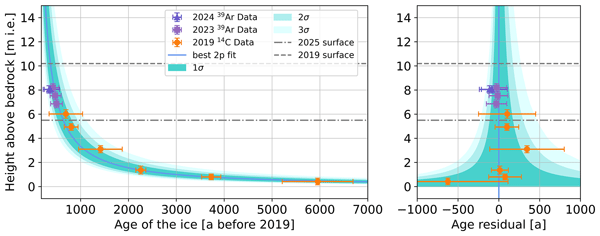
This study presents an age profile of the summit glacier of Weißseespitze in the Austrian Alps. The ages were obtained by combining 14C dating with the novel atom trap trace analysis for 39Ar. The data was used to constrain glacier age models. The results show that the surface ice is ~400 a old due to recent ice loss. The remaining ice continuously covers ages up to 6000 a. This work underscores the utility of 39Ar dating in glaciology, enabling precise reconstruction of age-depth relationships.
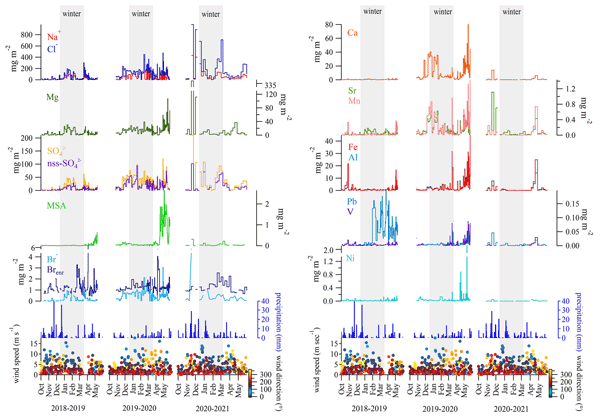
Azzurra Spagnesi, Elena Barbaro, Matteo Feltracco, Federico Scoto, Marco Vecchiato, Massimiliano Vardè, Mauro Mazzola, François Burgay, Federica Bruschi, Clara Jule Marie Hoppe, Allison Bailey, Andrea Gambaro, Carlo Barbante, and Andrea Spolaor
Atmos. Chem. Phys., 25, 16215–16232, https://doi.org/10.5194/acp-25-16215-2025, https://doi.org/10.5194/acp-25-16215-2025, 2025
Short summary
Short summary
Svalbard is ideal for studying how warming affects snow’s seasonal chemistry. By comparing the snow chemical composition of the 2019–2020 season with 2018–2019 and 2020–2021, we provide an overview of the seasonal and interannual variability of several chemical species on the Svalbard snowpack, furnishing insights into the interplay between short-term meteorological variability and the long-term climatic impacts of climate changes.
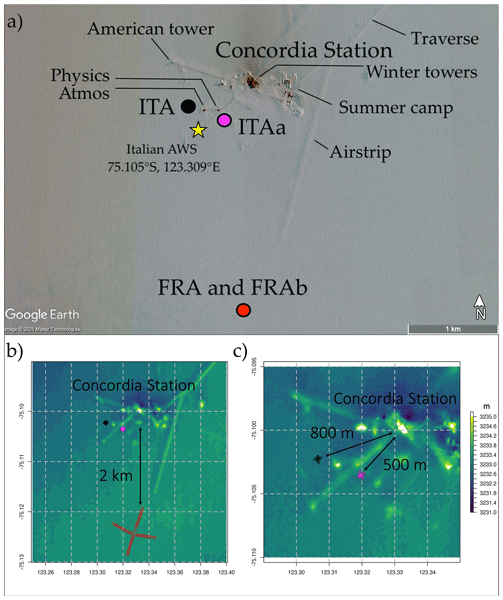
Claudio Stefanini, Barbara Stenni, Mauro Masiol, Giuliano Dreossi, Vincent Favier, Francesca Becherini, Claudio Scarchilli, Virginia Ciardini, Gabriele Carugati, and Massimo Frezzotti
The Cryosphere, 19, 5781–5799, https://doi.org/10.5194/tc-19-5781-2025, https://doi.org/10.5194/tc-19-5781-2025, 2025
Short summary
Short summary
This study analyzes snow accumulation near Concordia Station in Antarctica (3233 m) to estimate yearly snow accumulation. Data from Italian and French stake farms show strong variation due to wind and surface features. On average, 7–8 cm of snow accumulate yearly near the Station. The study also compares results with climate models and explores whether the station buildings affect measurements.
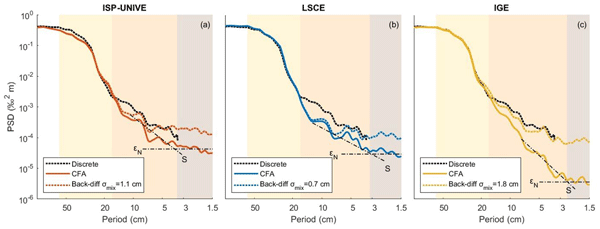
Agnese Petteni, Elise Fourré, Elsa Gautier, Azzurra Spagnesi, Roxanne Jacob, Pete D. Akers, Daniele Zannoni, Jacopo Gabrieli, Olivier Jossoud, Frédéric Prié, Amaëlle Landais, Titouan Tcheng, Barbara Stenni, Joel Savarino, Patrick Ginot, and Mathieu Casado
Atmos. Meas. Tech., 18, 5435–5455, https://doi.org/10.5194/amt-18-5435-2025, https://doi.org/10.5194/amt-18-5435-2025, 2025
Short summary
Short summary
Our research compares three systems of continuous flow analysis coupled with cavity ring-down spectrometry (CFA-CRD) from Venice, Paris, and Grenoble laboratories for measuring water isotopes in ice cores, crucial for reconstructing past climate. We quantify each system’s mixing and measurement noise effects, which impact the achievable resolution of isotope continuous records. Our findings reveal specific configurations and procedures to enhance measurement accuracy, providing a framework to optimise water isotope analysis.
Luca Carturan, Alexander C. Ihle, Federico Cazorzi, Tiziana Lazzarina Zendrini, Fabrizio De Blasi, Giancarlo Dalla Fontana, Giuliano Dreossi, Daniela Festi, Bryan Mark, Klaus Dieter Oeggl, Roberto Seppi, Barbara Stenni, and Paolo Gabrielli
The Cryosphere, 19, 3443–3458, https://doi.org/10.5194/tc-19-3443-2025, https://doi.org/10.5194/tc-19-3443-2025, 2025
Short summary
Short summary
Paleoclimatic glacial archives in low-latitude mountains are increasingly affected by melt, causing heavy percolation and removing snow and firn accumulated across months, seasons, or even years. Here we present a proxy system model that explicitly accounts for melt in ice and firn cores. Compared to traditional annual layer counting, the model significantly improved the interpretation and annual dating of the Mt Ortles firn core, in the Italian Alps, which includes the very warm summer of 2003.
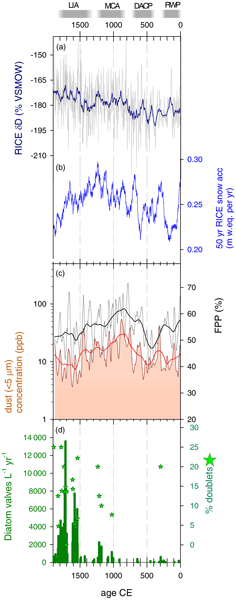
Serena Lagorio, Barbara Delmonte, Dieter Tetzner, Elisa Malinverno, Giovanni Baccolo, Barbara Stenni, Massimo Frezzotti, Valter Maggi, and Nancy Bertler
Clim. Past, 21, 1323–1341, https://doi.org/10.5194/cp-21-1323-2025, https://doi.org/10.5194/cp-21-1323-2025, 2025
Short summary
Short summary
Aeolian diatoms and dust in the Antarctic Roosevelt Island Climate Evolution project (RICE) ice core allow the reconstruction of atmospheric circulation and climate variability in the Eastern Ross Sea over the past 2 millennia. Since about 1470 CE and during the Little Ice Age, the site experienced a rapid atmospheric circulation reorganization related to the development of the Roosevelt Island polynya, the eastward protrusion of the Ross Sea polynya that significantly impacted the regional climate dynamics of the Ross Sea area.
Yalalt Nyamgerel, Yeongcheol Han, Soon Do Hur, Hyemi Kim, Songyi Kim, Jangil Moon, Barbara Stenni, and Jeonghoon Lee
EGUsphere, https://doi.org/10.5194/egusphere-2025-2408, https://doi.org/10.5194/egusphere-2025-2408, 2025
Short summary
Short summary
This research explores climate patterns recorded in Antarctic ice over the past two centuries. By analyzing ice layers, we identified connections between Antarctica's climate and tropical ocean conditions. Results show changing influences over time and highlight the Indian Ocean's key role in Antarctic snowfall. This improves understanding of how polar and tropical climates interact, crucial for future climate predictions.
Niccolò Maffezzoli, Eric Rignot, Carlo Barbante, Troels Petersen, and Sebastiano Vascon
Geosci. Model Dev., 18, 2545–2568, https://doi.org/10.5194/gmd-18-2545-2025, https://doi.org/10.5194/gmd-18-2545-2025, 2025
Short summary
Short summary
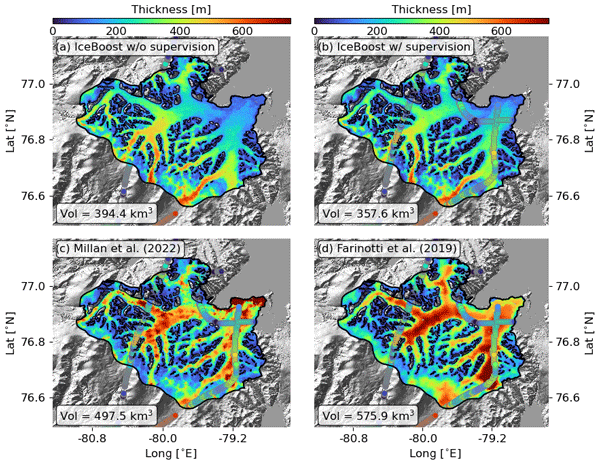
In this work we introduce IceBoost, a machine learning framework to model the ice thickness distribution of all the world's glaciers with greater accuracy than state-of-the-art methods. The model is trained on 3.7 million measurements globally available and provides skilful estimates across all regions. This advancement will help in better assessing future sea level changes and freshwater resources, with significance for both the scientific community and society at large.
Piers Larkman, Rachael H. Rhodes, Nicolas Stoll, Carlo Barbante, and Pascal Bohleber
The Cryosphere, 19, 1373–1390, https://doi.org/10.5194/tc-19-1373-2025, https://doi.org/10.5194/tc-19-1373-2025, 2025
Short summary
Short summary
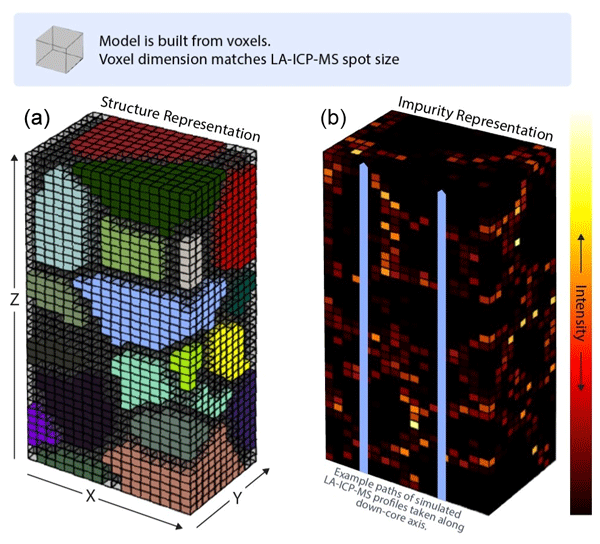
Impurities in ice cores can be preferentially located at the boundaries between crystals of ice, impacting the interpretation of high-resolution data collected from ice core samples. Through use of a modelling framework, we demonstrate that one-dimensional signals can be significantly affected by this association, meaning high-resolution measurements must be carefully designed. Accounting for this effect is important for interpreting ice core data, especially for deep ice samples.
Andrea Securo, Costanza Del Gobbo, Giovanni Baccolo, Carlo Barbante, Michele Citterio, Fabrizio De Blasi, Marco Marcer, Mauro Valt, and Renato R. Colucci
The Cryosphere, 19, 1335–1352, https://doi.org/10.5194/tc-19-1335-2025, https://doi.org/10.5194/tc-19-1335-2025, 2025
Short summary
Short summary
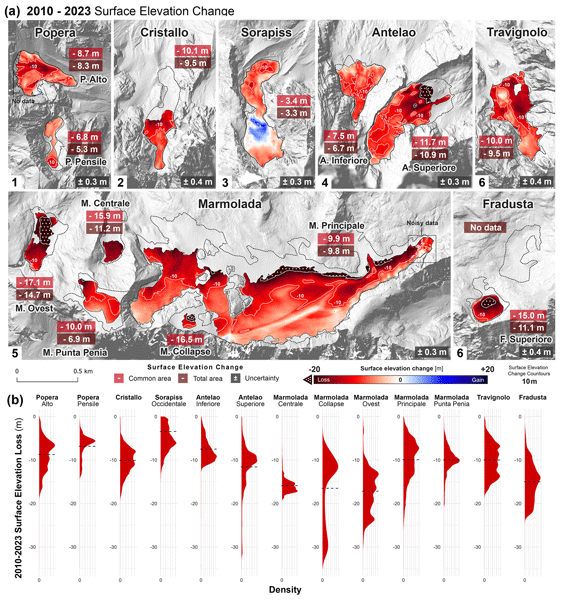
We have reconstructed the multi-decadal (1980s–2023) ice mass changes for all the current mountain glaciers in the Dolomites. We used historical aerial photographs, drone surveys, and lidar to fill the glaciological data gap for the region. We observed an alarming decline in both glacier area and volume, with some of the glaciers showing smaller losses due to local topography and debris cover feedback. We strongly recommend more specific monitoring of these glaciers.
Johanna Schäfer, Anja Beschnitt, François Burgay, Thomas Singer, Margit Schwikowski, and Thorsten Hoffmann
Atmos. Meas. Tech., 18, 421–430, https://doi.org/10.5194/amt-18-421-2025, https://doi.org/10.5194/amt-18-421-2025, 2025
Short summary
Short summary
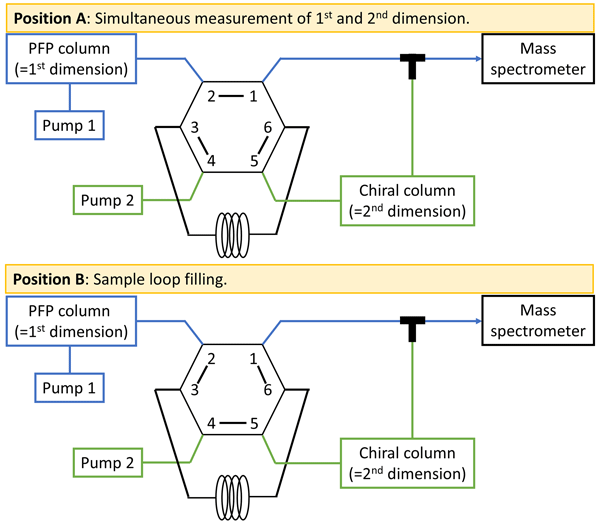
Glaciers preserve organic compounds from atmospheric aerosols, which can serve as markers for emission sources. Most studies overlook the enantiomers of chiral compounds. We developed a two-dimensional liquid chromatography method to determine the chiral ratios of the monoterpene oxidation products cis-pinic acid and cis-pinonic acid in ice-core samples. Applied to samples from the Belukha Glacier (1870–1970 CE), the method revealed fluctuating chiral ratios for the analytes.
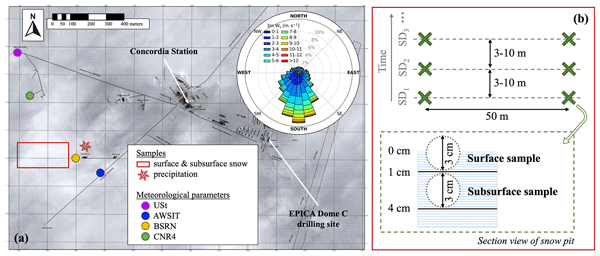
Inès Ollivier, Hans Christian Steen-Larsen, Barbara Stenni, Laurent Arnaud, Mathieu Casado, Alexandre Cauquoin, Giuliano Dreossi, Christophe Genthon, Bénédicte Minster, Ghislain Picard, Martin Werner, and Amaëlle Landais
The Cryosphere, 19, 173–200, https://doi.org/10.5194/tc-19-173-2025, https://doi.org/10.5194/tc-19-173-2025, 2025
Short summary
Short summary
The role of post-depositional processes taking place at the ice sheet's surface on the water stable isotope signal measured in polar ice cores is not fully understood. Using field observations and modelling results, we show that the original precipitation isotopic signal at Dome C, East Antarctica, is modified by post-depositional processes and provide the first quantitative estimation of their mean impact on the isotopic signal observed in the snow.
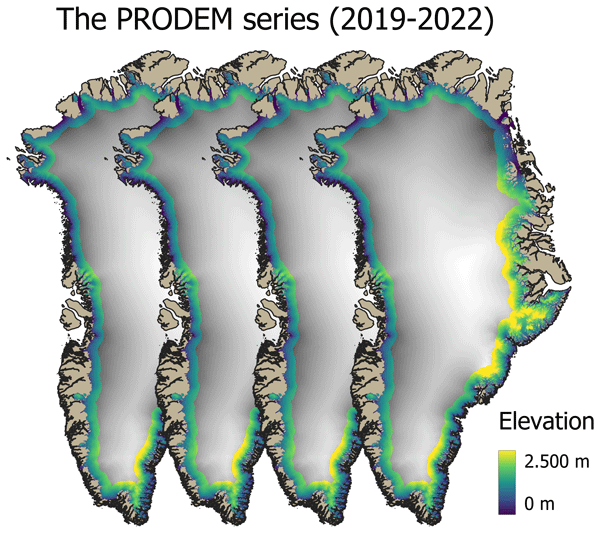
Mai Winstrup, Heidi Ranndal, Signe Hillerup Larsen, Sebastian B. Simonsen, Kenneth D. Mankoff, Robert S. Fausto, and Louise Sandberg Sørensen
Earth Syst. Sci. Data, 16, 5405–5428, https://doi.org/10.5194/essd-16-5405-2024, https://doi.org/10.5194/essd-16-5405-2024, 2024
Short summary
Short summary
Surface topography across the marginal zone of the Greenland Ice Sheet is constantly evolving. Here we present an annual series (2019–2022) of summer digital elevation models (PRODEMs) for the Greenland Ice Sheet margin, covering all outlet glaciers from the ice sheet. The PRODEMs are based on fusion of CryoSat-2 radar altimetry and ICESat-2 laser altimetry. With their high spatial and temporal resolution, the PRODEMs will enable detailed studies of the changes in marginal ice sheet elevations.
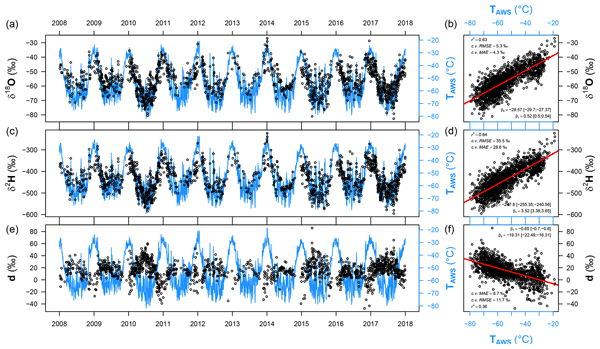
Giuliano Dreossi, Mauro Masiol, Barbara Stenni, Daniele Zannoni, Claudio Scarchilli, Virginia Ciardini, Mathieu Casado, Amaëlle Landais, Martin Werner, Alexandre Cauquoin, Giampietro Casasanta, Massimo Del Guasta, Vittoria Posocco, and Carlo Barbante
The Cryosphere, 18, 3911–3931, https://doi.org/10.5194/tc-18-3911-2024, https://doi.org/10.5194/tc-18-3911-2024, 2024
Short summary
Short summary
Oxygen and hydrogen stable isotopes have been extensively used to reconstruct past temperatures, with precipitation representing the input signal of the isotopic records in ice cores. We present a 10-year record of stable isotopes in daily precipitation at Concordia Station: this is the longest record for inland Antarctica and represents a benchmark for quantifying post-depositional processes and improving the paleoclimate interpretation of ice cores.
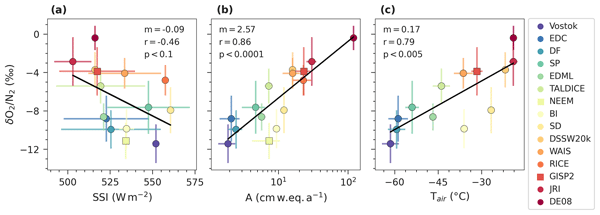
Romilly Harris Stuart, Amaëlle Landais, Laurent Arnaud, Christo Buizert, Emilie Capron, Marie Dumont, Quentin Libois, Robert Mulvaney, Anaïs Orsi, Ghislain Picard, Frédéric Prié, Jeffrey Severinghaus, Barbara Stenni, and Patricia Martinerie
The Cryosphere, 18, 3741–3763, https://doi.org/10.5194/tc-18-3741-2024, https://doi.org/10.5194/tc-18-3741-2024, 2024
Short summary
Short summary
Ice core δO2/N2 records are useful dating tools due to their local insolation pacing. A precise understanding of the physical mechanism driving this relationship, however, remain ambiguous. By compiling data from 15 polar sites, we find a strong dependence of mean δO2/N2 on accumulation rate and temperature in addition to the well-documented insolation dependence. Snowpack modelling is used to investigate which physical properties drive the mechanistic dependence on these local parameters.
Elena Di Stefano, Giovanni Baccolo, Massimiliano Clemenza, Barbara Delmonte, Deborah Fiorini, Roberto Garzonio, Margit Schwikowski, and Valter Maggi
The Cryosphere, 18, 2865–2874, https://doi.org/10.5194/tc-18-2865-2024, https://doi.org/10.5194/tc-18-2865-2024, 2024
Short summary
Short summary
Rising temperatures are impacting the reliability of glaciers as environmental archives. This study reports how meltwater percolation affects the distribution of tritium and cesium, which are commonly used as temporal markers in dating ice cores, in a temperate glacier. Our findings challenge the established application of radionuclides for dating mountain ice cores and indicate tritium as the best choice.
Horst Machguth, Anja Eichler, Margit Schwikowski, Sabina Brütsch, Enrico Mattea, Stanislav Kutuzov, Martin Heule, Ryskul Usubaliev, Sultan Belekov, Vladimir N. Mikhalenko, Martin Hoelzle, and Marlene Kronenberg
The Cryosphere, 18, 1633–1646, https://doi.org/10.5194/tc-18-1633-2024, https://doi.org/10.5194/tc-18-1633-2024, 2024
Short summary
Short summary
In 2018 we drilled an 18 m ice core on the summit of Grigoriev ice cap, located in the Tien Shan mountains of Kyrgyzstan. The core analysis reveals strong melting since the early 2000s. Regardless of this, we find that the structure and temperature of the ice have changed little since the 1980s. The probable cause of this apparent stability is (i) an increase in snowfall and (ii) the fact that meltwater nowadays leaves the glacier and thereby removes so-called latent heat.
Laura Melling, Amber Leeson, Malcolm McMillan, Jennifer Maddalena, Jade Bowling, Emily Glen, Louise Sandberg Sørensen, Mai Winstrup, and Rasmus Lørup Arildsen
The Cryosphere, 18, 543–558, https://doi.org/10.5194/tc-18-543-2024, https://doi.org/10.5194/tc-18-543-2024, 2024
Short summary
Short summary
Lakes on glaciers hold large volumes of water which can drain through the ice, influencing estimates of sea level rise. To estimate water volume, we must calculate lake depth. We assessed the accuracy of three satellite-based depth detection methods on a study area in western Greenland and considered the implications for quantifying the volume of water within lakes. We found that the most popular method of detecting depth on the ice sheet scale has higher uncertainty than previously assumed.
Andrea Spolaor, Federico Scoto, Catherine Larose, Elena Barbaro, Francois Burgay, Mats P. Bjorkman, David Cappelletti, Federico Dallo, Fabrizio de Blasi, Dmitry Divine, Giuliano Dreossi, Jacopo Gabrieli, Elisabeth Isaksson, Jack Kohler, Tonu Martma, Louise S. Schmidt, Thomas V. Schuler, Barbara Stenni, Clara Turetta, Bartłomiej Luks, Mathieu Casado, and Jean-Charles Gallet
The Cryosphere, 18, 307–320, https://doi.org/10.5194/tc-18-307-2024, https://doi.org/10.5194/tc-18-307-2024, 2024
Short summary
Short summary
We evaluate the impact of the increased snowmelt on the preservation of the oxygen isotope (δ18O) signal in firn records recovered from the top of the Holtedahlfonna ice field located in the Svalbard archipelago. Thanks to a multidisciplinary approach we demonstrate a progressive deterioration of the isotope signal in the firn core. We link the degradation of the δ18O signal to the increased occurrence and intensity of melt events associated with the rapid warming occurring in the archipelago.
Emma Nilsson, Carmen Paulina Vega, Dmitry Divine, Anja Eichler, Tonu Martma, Robert Mulvaney, Elisabeth Schlosser, Margit Schwikowski, and Elisabeth Isaksson
EGUsphere, https://doi.org/10.5194/egusphere-2023-3156, https://doi.org/10.5194/egusphere-2023-3156, 2024
Preprint withdrawn
Short summary
Short summary
To project future climate change it is necessary to understand paleoclimate including past sea ice conditions. We have investigated methane sulphonic acid (MSA) in Antarctic firn and ice cores to reconstruct sea ice extent (SIE) and found that the MSA – SIE as well as the MSA – phytoplankton biomass relationship varies across the different firn and ice cores. These inconsistencies in correlations across records suggest that MSA in Fimbul Ice Shelf cores does not reliably indicate regional SIE.
Luca Carturan, Fabrizio De Blasi, Roberto Dinale, Gianfranco Dragà, Paolo Gabrielli, Volkmar Mair, Roberto Seppi, David Tonidandel, Thomas Zanoner, Tiziana Lazzarina Zendrini, and Giancarlo Dalla Fontana
Earth Syst. Sci. Data, 15, 4661–4688, https://doi.org/10.5194/essd-15-4661-2023, https://doi.org/10.5194/essd-15-4661-2023, 2023
Short summary
Short summary
This paper presents a new dataset of air, englacial, soil surface and rock wall temperatures collected between 2010 and 2016 on Mt Ortles, which is the highest summit of South Tyrol, Italy. Details are provided on instrument type and characteristics, field methods, and data quality control and assessment. The obtained data series are available through an open data repository. This is a rare dataset from a summit area lacking observations on permafrost and glaciers and their climatic response.
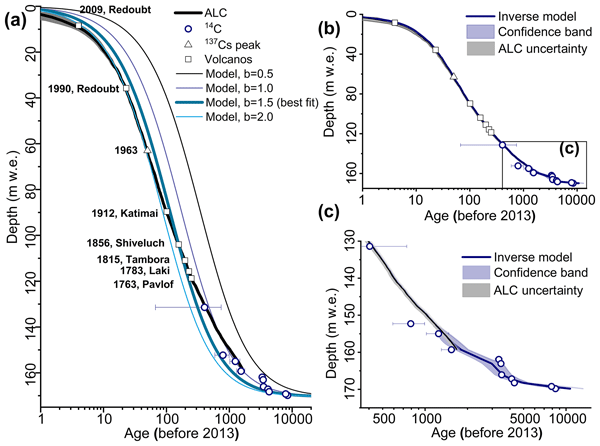
Ling Fang, Theo M. Jenk, Dominic Winski, Karl Kreutz, Hanna L. Brooks, Emma Erwin, Erich Osterberg, Seth Campbell, Cameron Wake, and Margit Schwikowski
The Cryosphere, 17, 4007–4020, https://doi.org/10.5194/tc-17-4007-2023, https://doi.org/10.5194/tc-17-4007-2023, 2023
Short summary
Short summary
Understanding the behavior of ocean–atmosphere teleconnections in the North Pacific during warm intervals can aid in predicting future warming scenarios. However, majority ice core records from Alaska–Yukon region only provide data for the last few centuries. This study introduces a continuous chronology for Denali ice core from Begguya, Alaska, using multiple dating methods. The early-Holocene-origin Denali ice core will facilitate future investigations of hydroclimate in the North Pacific.
Azzurra Spagnesi, Pascal Bohleber, Elena Barbaro, Matteo Feltracco, Fabrizio De Blasi, Giuliano Dreossi, Martin Stocker-Waldhuber, Daniela Festi, Jacopo Gabrieli, Andrea Gambaro, Andrea Fischer, and Carlo Barbante
EGUsphere, https://doi.org/10.5194/egusphere-2023-1625, https://doi.org/10.5194/egusphere-2023-1625, 2023
Preprint archived
Short summary
Short summary
We present new data from a 10 m ice core drilled in 2019 and a 8.4 m parallel ice core drilled in 2021 at the summit of Weißseespitze glacier. In a new combination of proxies, we discuss profiles of stable water isotopes, major ion chemistry as well as a full profile of microcharcoal and levoglucosan. We find that the chemical and isotopic signals are preserved, despite the ongoing surface mass loss. This is not be to expected considering what has been found at other glaciers at similar locations.
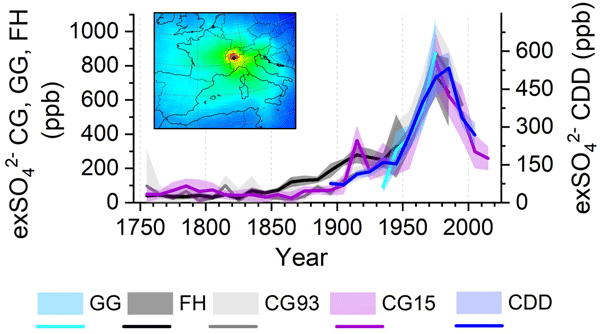
Anja Eichler, Michel Legrand, Theo M. Jenk, Susanne Preunkert, Camilla Andersson, Sabine Eckhardt, Magnuz Engardt, Andreas Plach, and Margit Schwikowski
The Cryosphere, 17, 2119–2137, https://doi.org/10.5194/tc-17-2119-2023, https://doi.org/10.5194/tc-17-2119-2023, 2023
Short summary
Short summary
We investigate how a 250-year history of the emission of air pollutants (major inorganic aerosol constituents, black carbon, and trace species) is preserved in ice cores from four sites in the European Alps. The observed uniform timing in species-dependent longer-term concentration changes reveals that the different ice-core records provide a consistent, spatially representative signal of the pollution history from western European countries.
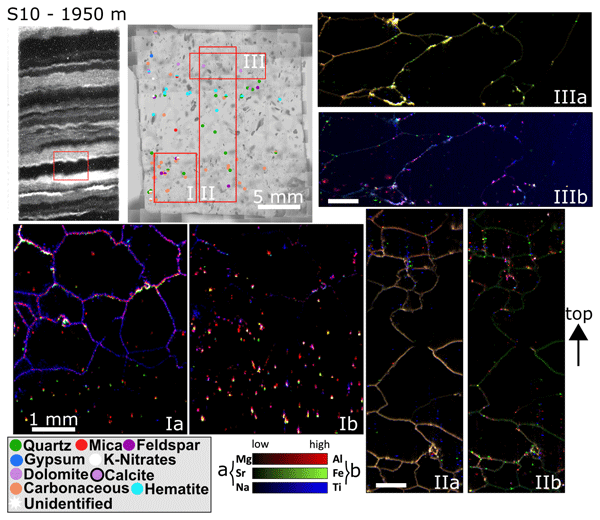
Nicolas Stoll, Julien Westhoff, Pascal Bohleber, Anders Svensson, Dorthe Dahl-Jensen, Carlo Barbante, and Ilka Weikusat
The Cryosphere, 17, 2021–2043, https://doi.org/10.5194/tc-17-2021-2023, https://doi.org/10.5194/tc-17-2021-2023, 2023
Short summary
Short summary
Impurities in polar ice play a role regarding its climate signal and internal deformation. We bridge different scales using different methods to investigate ice from the Last Glacial Period derived from the EGRIP ice core in Greenland. We characterise different types of cloudy bands, i.e. frequently occurring milky layers in the ice, and analyse their chemistry with Raman spectroscopy and 2D imaging. We derive new insights into impurity localisation and deposition conditions.
Simone Ventisette, Samuele Baldini, Claudio Artoni, Silvia Becagli, Laura Caiazzo, Barbara Delmonte, Massimo Frezzotti, Raffaello Nardin, Joel Savarino, Mirko Severi, Andrea Spolaor, Barbara Stenni, and Rita Traversi
EGUsphere, https://doi.org/10.5194/egusphere-2023-393, https://doi.org/10.5194/egusphere-2023-393, 2023
Preprint archived
Short summary
Short summary
The paper reports the spatial variability of concentration and fluxes of chemical impurities in superficial snow over unexplored area of the East Antarctic ice sheet. Pinatubo and Puyehue-Cordón Caulle volcanic eruptions in non-sea salt sulfate and dust snow pits record were used to achieve the accumulation rates. Deposition (wet, dry and uptake from snow surface) and post deposition processes are constrained. These knowledges are fundamental in Antarctic ice cores stratigraphies interpretation.
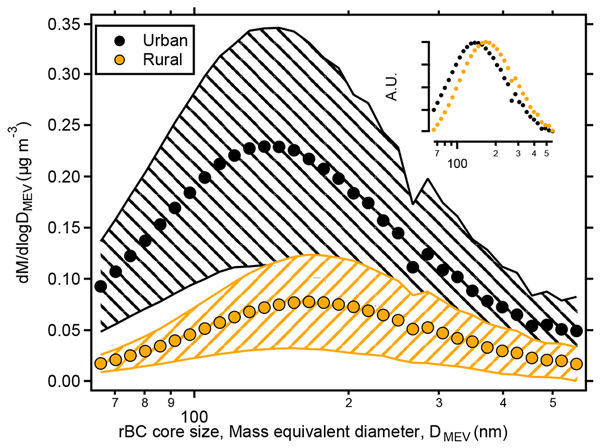
Erik Ahlberg, Stina Ausmeel, Lovisa Nilsson, Mårten Spanne, Julija Pauraite, Jacob Klenø Nøjgaard, Michele Bertò, Henrik Skov, Pontus Roldin, Adam Kristensson, Erik Swietlicki, and Axel Eriksson
Atmos. Chem. Phys., 23, 3051–3064, https://doi.org/10.5194/acp-23-3051-2023, https://doi.org/10.5194/acp-23-3051-2023, 2023
Short summary
Short summary
To investigate the properties and origin of black carbon particles in southern Sweden during late summer, we performed measurements both at a rural site and the nearby city of Malmö. We found that local traffic emissions of black carbon led to concentrations around twice as high as those at the rural site. Modeling show that these emissions are not clearly distinguishable at the rural site, unless meteorology was favourable, which shows the importance of long-range transport and processing.
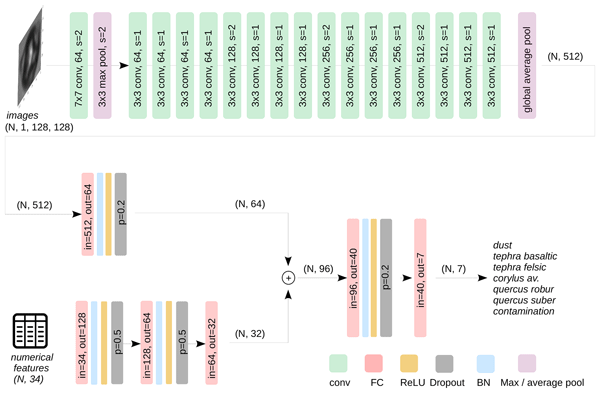
Niccolò Maffezzoli, Eliza Cook, Willem G. M. van der Bilt, Eivind N. Støren, Daniela Festi, Florian Muthreich, Alistair W. R. Seddon, François Burgay, Giovanni Baccolo, Amalie R. F. Mygind, Troels Petersen, Andrea Spolaor, Sebastiano Vascon, Marcello Pelillo, Patrizia Ferretti, Rafael S. dos Reis, Jefferson C. Simões, Yuval Ronen, Barbara Delmonte, Marco Viccaro, Jørgen Peder Steffensen, Dorthe Dahl-Jensen, Kerim H. Nisancioglu, and Carlo Barbante
The Cryosphere, 17, 539–565, https://doi.org/10.5194/tc-17-539-2023, https://doi.org/10.5194/tc-17-539-2023, 2023
Short summary
Short summary
Multiple lines of research in ice core science are limited by manually intensive and time-consuming optical microscopy investigations for the detection of insoluble particles, from pollen grains to volcanic shards. To help overcome these limitations and support researchers, we present a novel methodology for the identification and autonomous classification of ice core insoluble particles based on flow image microscopy and neural networks.
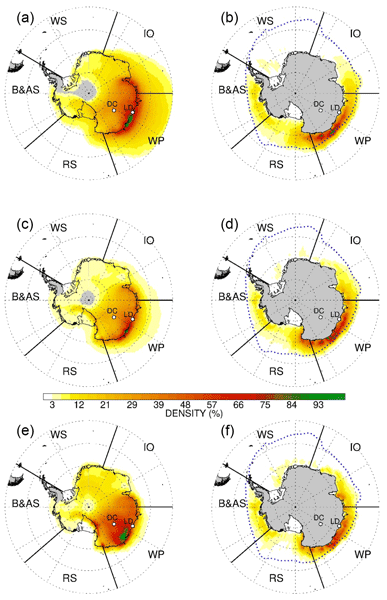
François Burgay, Rafael Pedro Fernández, Delia Segato, Clara Turetta, Christopher S. Blaszczak-Boxe, Rachael H. Rhodes, Claudio Scarchilli, Virginia Ciardini, Carlo Barbante, Alfonso Saiz-Lopez, and Andrea Spolaor
The Cryosphere, 17, 391–405, https://doi.org/10.5194/tc-17-391-2023, https://doi.org/10.5194/tc-17-391-2023, 2023
Short summary
Short summary
The paper presents the first ice-core record of bromine (Br) in the Antarctic plateau. By the observation of the ice core and the application of atmospheric chemical models, we investigate the behaviour of bromine after its deposition into the snowpack, with interest in the effect of UV radiation change connected to the formation of the ozone hole, the role of volcanic deposition, and the possible use of Br to reconstruct past sea ice changes from ice core collect in the inner Antarctic plateau.

Antoine Grisart, Mathieu Casado, Vasileios Gkinis, Bo Vinther, Philippe Naveau, Mathieu Vrac, Thomas Laepple, Bénédicte Minster, Frederic Prié, Barbara Stenni, Elise Fourré, Hans Christian Steen-Larsen, Jean Jouzel, Martin Werner, Katy Pol, Valérie Masson-Delmotte, Maria Hoerhold, Trevor Popp, and Amaelle Landais
Clim. Past, 18, 2289–2301, https://doi.org/10.5194/cp-18-2289-2022, https://doi.org/10.5194/cp-18-2289-2022, 2022
Short summary
Short summary
This paper presents a compilation of high-resolution (11 cm) water isotopic records, including published and new measurements, for the last 800 000 years from the EPICA Dome C ice core, Antarctica. Using this new combined water isotopes (δ18O and δD) dataset, we study the variability and possible influence of diffusion at the multi-decadal to multi-centennial scale. We observe a stronger variability at the onset of the interglacial interval corresponding to a warm period.
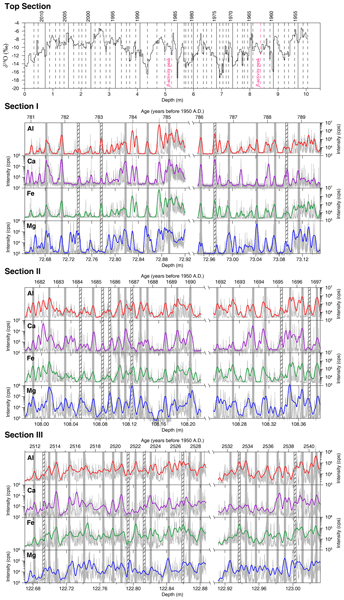
Wangbin Zhang, Shugui Hou, Shuang-Ye Wu, Hongxi Pang, Sharon B. Sneed, Elena V. Korotkikh, Paul A. Mayewski, Theo M. Jenk, and Margit Schwikowski
The Cryosphere, 16, 1997–2008, https://doi.org/10.5194/tc-16-1997-2022, https://doi.org/10.5194/tc-16-1997-2022, 2022
Short summary
Short summary
This study proposes a quantitative method to reconstruct annual precipitation records at the millennial timescale from the Tibetan ice cores through combining annual layer identification based on LA-ICP-MS measurement with an ice flow model. The reliability of this method is assessed by comparing our results with other reconstructed and modeled precipitation series for the Tibetan Plateau. The assessment shows that the method has a promising performance.
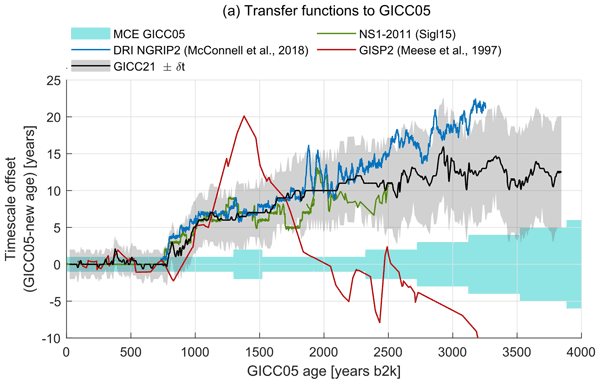
Giulia Sinnl, Mai Winstrup, Tobias Erhardt, Eliza Cook, Camilla Marie Jensen, Anders Svensson, Bo Møllesøe Vinther, Raimund Muscheler, and Sune Olander Rasmussen
Clim. Past, 18, 1125–1150, https://doi.org/10.5194/cp-18-1125-2022, https://doi.org/10.5194/cp-18-1125-2022, 2022
Short summary
Short summary
A new Greenland ice-core timescale, covering the last 3800 years, was produced using the machine learning algorithm StratiCounter. We synchronized the ice cores using volcanic eruptions and wildfires. We compared the new timescale to the tree-ring timescale, finding good alignment both between the common signatures of volcanic eruptions and of solar activity. Our Greenlandic timescales is safe to use for the Late Holocene, provided one uses our uncertainty estimate.
Paolo Gabrielli, Theo Manuel Jenk, Michele Bertó, Giuliano Dreossi, Daniela Festi, Werner Kofler, Mai Winstrup, Klaus Oeggl, Margit Schwikowski, Barbara Stenni, and Carlo Barbante
Clim. Past Discuss., https://doi.org/10.5194/cp-2022-20, https://doi.org/10.5194/cp-2022-20, 2022
Revised manuscript not accepted
Short summary
Short summary
We present a methodology that reduces the chronological uncertainty of an Alpine ice core record from the glacier Alto dell’Ortles, Italy. This chronology will allow the constraint of the Holocene climatic and environmental histories emerging from this archive of Central Europe. This method will allow to obtain accurate chronologies also from other ice cores from-low latitude/high-altitude glaciers that typically suffer from larger dating uncertainties compared with well dated polar records.
Raffaello Nardin, Mirko Severi, Alessandra Amore, Silvia Becagli, Francois Burgay, Laura Caiazzo, Virginia Ciardini, Giuliano Dreossi, Massimo Frezzotti, Sang-Bum Hong, Ishaq Khan, Bianca Maria Narcisi, Marco Proposito, Claudio Scarchilli, Enricomaria Selmo, Andrea Spolaor, Barbara Stenni, and Rita Traversi
Clim. Past, 17, 2073–2089, https://doi.org/10.5194/cp-17-2073-2021, https://doi.org/10.5194/cp-17-2073-2021, 2021
Short summary
Short summary
The first step to exploit all the potential information buried in ice cores is to produce a reliable age scale. Based on chemical and isotopic records from the 197 m Antarctic GV7(B) ice core, accurate dating was achieved and showed that the archive spans roughly the last 830 years. The relatively high accumulation rate allowed us to use the non-sea-salt sulfate seasonal pattern to count annual layers. The accumulation rate reconstruction exhibited a slight increase since the 18th century.
Cited articles
Bertò, M., Barbante, C., and Gabrielli, P.: Pb concentrations in the Alto dell'Ortles ice cores, Zenodo [data set], https://doi.org/10.5281/zenodo.19026035, 2026.
Bohleber, P., Schwikowski, M., Stocker-Waldhuber, M., Fang, L., and Fischer, A.: New glacier evidence for ice-free summits during the life of the Tyrolean Iceman, Sci. Rep., 10, 20513, https://doi.org/10.1038/s41598-020-77518-9, 2020.
Bortenschlager, S. and Bortenschlager, I.: Änderung des Pollenflugs durch die Klimaerwärmung – Vergleichende Untersuchung Innsbruck/Obergurgl über den Zeitraum 1980–2001, Ber. nat.-med. Ver. Innsbruck, 90, 41–61, 2003.
Breitenbach, S. F. M., Rehfeld, K., Goswami, B., Baldini, J. U. L., Ridley, H. E., Kennett, D. J., Prufer, K. M., Aquino, V. V., Asmerom, Y., Polyak, V. J., Cheng, H., Kurths, J., and Marwan, N.: COnstructing Proxy Records from Age models (COPRA), Clim. Past, 8, 1765–1779, https://doi.org/10.5194/cp-8-1765-2012, 2012.
Bronk Ramsey, C.: Bayesian Analysis of Radiocarbon Dates, Radiocarbon, 51, 337–360, https://doi.org/10.1017/S0033822200033865, 2009.
Buchardt, S. L. and Dahl-Jensen, D.: At what depth is the Eemian layer expected to be found at NEEM?, Ann. Glaciol., 48, 100–102, https://doi.org/10.3189/172756408784700617, 2008.
Buiron, D., Chappellaz, J., Stenni, B., Frezzotti, M., Baumgartner, M., Capron, E., Landais, A., Lemieux-Dudon, B., Masson-Delmotte, V., Montagnat, M., Parrenin, F., and Schilt, A.: TALDICE-1 age scale of the Talos Dome deep ice core, East Antarctica, Clim. Past, 7, 1–16, https://doi.org/10.5194/cp-7-1-2011, 2011.
Cuffey, K. and Paterson, W. S. B.: The Physics of Glaciers, 4th Academic Press, Amsterdam, ISBN 978-0-12-369461-4, 2006.
Dansgaard, W. and Johnsen, S. J.: A Flow Model and a Time Scale for the Ice Core from Camp Century, Greenland, J. Glaciol., 8, 215–223, https://doi.org/10.3189/S0022143000031208, 1969.
Dreossi, G.: Oxygen isotope data from the Alto dell'Ortles ice cores (South Tyrol, Italy), Zenodo [data set], https://doi.org/10.5281/zenodo.18339907, 2026.
Eichler, A., Legrand, M., Jenk, T. M., Preunkert, S., Andersson, C., Eckhardt, S., Engardt, M., Plach, A., and Schwikowski, M.: Consistent histories of anthropogenic western European air pollution preserved in different Alpine ice cores, The Cryosphere, 17, 2119–2137, https://doi.org/10.5194/tc-17-2119-2023, 2023.
Fahnestock, M., Abdalati, W., Luo, S., and Gogineni, S.: Internal layer tracing and age-depth-accumulation relationships for the northern Greenland ice sheet, J. Geophys. Res., 106, 33789–33797, https://doi.org/10.1029/2001JD900200, 2001.
Festi, D., Kofler, W., Bucher, E., Mair, V., Gabrielli, P., Carturan, L., and Oeggl, K.: A novel pollen-based method to detect seasonality in ice cores: a case study from the Ortles Glacier, South Tyrol, Italy, J. Glaciol., 61, 815–824, 2015.
Festi, D., Carturan, L., Kofler, W., dalla Fontana, G., de Blasi, F., Cazorzi, F., Bucher, E., Mair, V., Gabrielli, P., and Oeggl, K.: Linking pollen deposition and snow accumulation on the Alto dell'Ortles glacier (South Tyrol, Italy) for sub-seasonal dating of a firn temperate core, The Cryosphere, 11, 937–948, https://doi.org/10.5194/tc-11-937-2017, 2017.
Festi, D., Kofler, W., and Oeggl, K.: Pollen occurrence in the Alto dell'Ortles ice core #1, Zenodo [data set], https://doi.org/10.5281/zenodo.18384389, 2026a.
Festi, D., Kofler, W., and Oeggl, K.: Pollen counts of the Alto dell'Ortles ice core #1, Zenodo [data set], https://doi.org/10.5281/zenodo.18384281, 2026b.
Festi, D., Kofler, W., and Oeggl, K.: DOY32, DOY46 and DOY match record pollen data from the Alto dell'Ortles glacier ice core #1 from the surface to a depth of 45.023 m w.e., Zenodo [data set], https://doi.org/10.5281/zenodo.18384151, 2026c.
Gabrieli, J.: Trace elements and Polycyclic Aromatic Hydrocarbons (PAHs) in snow and ice sampled at Colle Gnifetti, Monte Rosa (4450 m), during the last 10 000 years: environmental and climatic implication, PhD thesis, Department of Environmental Science, University of Venice, Venice, 178 pp., 2008.
Gabrieli, J. and Barbante, C.: The Alps in the age of the Anthropocene: the impact of human activities on the cryosphere recorded in the Colle Gnifetti glacier, Rend. Fis. Acc. Lincei, 25, 71–83, https://doi.org/10.1007/s12210-014-0292-2, 2014.
Gabrieli, J., Cozzi, G., Vallelonga, P., Schwikowski, M., Sigl, M., Eickenberg, J., Wacker, L., Boutron, C., Gäggeler, H., Cescon, P., and Barbante, C.: Contamination of Alpine snow and ice at Colle Gnifetti, Swiss/Italian Alps, from nuclear weapons tests, Atmos. Environ., 45, 587–593, https://doi.org/10.1016/j.atmosenv.2010.10.039, 2011.
Gabrielli, P., Carturan, L., Gabrieli, J., Dinale, R., Krainer, K., Hausmann, H., Davis, M., Zagorodnov, V. S., Seppi, R., Barbante, C., Dalla Fontana, G., and Thompson, L. G.: Atmospheric warming threatens the untapped glacial archive of Ortles mountain, South Tyrol, J. Glaciol., 56, 843–853, https://doi.org/10.4461/GFDQ.2012.35.10, 2010.
Gabrielli, P., Barbante, C., Carturan, L., Cozzi, G., Dalla Fontana, G., Dinale, R., Draga, G., Gabrieli, J., Kehrwald, N., Mair, V., Mikhalenko, V. N., Piffer, G., Rinaldi, M., Seppi, R., Spolaor, A., Thompson, L. G., and Tonidandel, D.: Discovery of cold ice in a new drilling site in the Eastern European Alps, Geogr. Fis. Dinam. Quat., 35, 101–105, 2012.
Gabrielli, P., Barbante, C., Bertagna, G., Bertó, M., Binder, D., Carton, A., Carturan, L., Cazorzi, F., Cozzi, G., Dalla Fontana, G., Davis, M., De Blasi, F., Dinale, R., Dragà, G., Dreossi, G., Festi, D., Frezzotti, M., Gabrieli, J., Galos, S. P., Ginot, P., Heidenwolf, P., Jenk, T. M., Kehrwald, N., Kenny, D., Magand, O., Mair, V., Mikhalenko, V., Lin, P. N., Oeggl, K., Piffer, G., Rinaldi, M., Schotterer, U., Schwikowski, M., Seppi, R., Spolaor, A., Stenni, B., Tonidandel, D., Uglietti, C., Zagorodnov, V., Zanoner, T., and Zennaro, P.: Age of the Mt. Ortles ice cores, the Tyrolean Iceman and glaciation of the highest summit of South Tyrol since the Northern Hemisphere Climatic Optimum, The Cryosphere, 10, 2779–2797, https://doi.org/10.5194/tc-10-2779-2016, 2016.
Gabrielli, P., Jenk, T., and Barbante, C.: Calculated data sets from Gabrielli et al., Climate of the Past, 2026, in: Climate of the Past, Zenodo [data set], https://doi.org/10.5281/zenodo.19543480, 2026.
Gäggeler, H. W., Tobler, L., Schwikowski, M., and Jenk, T. M.: Application of the radionuclide 210Pb in glaciology – an overview, J. Glaciol., 66, 447–456, https://doi.org/10.1017/jog.2020.19, 2020.
Herren, P.-A., Eichler, A., Machguth, H., Papina, T., Tobler, L., Zapf, A., and Schwikowski, M.: The onset of Neoglaciation 6000 years ago in western Mongolia revealed by an ice core from the Tsambagarav mountain range, Quat. Sci. Rev., 69, 59–68, https://doi.org/10.1016/j.quascirev.2013.02.025, 2013.
Hoffmann, H., Preunkert, S., Legrand, M., Leinfelder, D., Bohleber, P., Friedrich, R., and Wagenbach, D.: A New Sample Preparation System for Micro-14C Dating of Glacier Ice with a First Application to a High Alpine Ice Core from Colle Gnifetti (Switzerland), Radiocarbon, 60, 517–533, https://doi.org/10.1017/RDC.2017.99, 2018.
Jenk, T. M., Szidat, S., Bolius, D., Sigl, M., Gäggeler, H. W., Wacker, L., Ruff, M., Barbante, C., Boutron, C. F., and Schwikowski, M.: A novel radiocarbon dating technique applied to an ice core from the Alps indicating late Pleistocene ages, J. Geophys. Res. Atmos., 114, https://doi.org/10.1029/2009JD011860, 2009.
Legrand, M., McConnell, J. R., Preunkert, S., Wachs, D., Chellman, N. J., Rehfeld, K., Bergametti, G., Wensman, S. M., Oberthaler, M. K., and Friedrich, N.: Alpine ice core record of large changes in dust, sea-salt, and biogenic aerosol over Europe during deglaciation, PNAS Nexus, 4, 186, https://doi.org/10.1093/pnasnexus/pgaf186, 2025.
Lüthi, M. and Funk, M.: Dating ice cores from a high Alpine glacier with a flow model for cold firn, Ann. Glaciol., 31, 69–79, https://doi.org/10.3189/172756400781820381, 2000.
Magny, M., Peyron, O., Gauthier, E., Vannière, B., Millet, L., and Vermot-Desroches, B.: Quantitative estimates of temperature and precipitation changes over the last millennium from pollen and lake-level data at Lake Joux, Swiss Jura Mountains, Quat. Res., 75, 45–54, https://doi.org/10.1016/j.yqres.2010.11.001, 2011.
McConnell, J. R., Chellman, N. J., Wilson, A. I., Stohl, A., Arienzo, M. M., Eckhardt, S., Fritzsche, D., Kipfstuhl, S., Opel, T., Place Philip, F., and Steffensen Jørgen, P.: Pervasive Arctic lead pollution suggests substantial growth in medieval silver production modulated by plague, climate, and conflict, Proc. Natl. Acad. Sci., 116, 14910–14915, https://doi.org/10.1073/pnas.1904515116, 2019.
McConnell, J. R., Chellman, N. J., Plach, A., Wensman, S. M,. Plunkett, G., Stohl, A., Smith, N., Møllesøe Vinther, B., Dahl-Jensen, D., Steffensen, J. P., Fritzsche, D., Camara-Brugger, S. O., McDonald, B. T., and Wilson, A. I.: Pan-European atmospheric lead pollution, enhanced blood lead levels, and cognitive decline from Roman-era mining and smelting, Proc. Natl. Acad. Sci. USA, 122, e2419630121, https://doi.org/10.1073/pnas.2419630121, 2025.
Osman, M. B., Smith, B. E., Trusel, L. D., Das, S. B., McConnell, J. R., Chellman, N., Arienzo, M., and Sodemann, H.: Abrupt Common Era hydroclimate shifts drive west Greenland ice cap change, Nat. Geo., 14, 756–761, https://doi.org/10.1038/s41561-021-00818-w, 2021.
PAGES 2k Consortium: Continental-scale temperature variability during the past two millennia, Nat. Geosci., 6, 339–346, https://doi.org/10.1038/ngeo1797, 2013.
Paillard, D., Labeyrie, L., and Yiou, P.: Macintosh Program performs time-series analysis, Eos, Transactions American Geophysical Union, 77, 379–379, https://doi.org/10.1029/96EO00259, 1996.
Parrenin, F., Barnola, J.-M., Beer, J., Blunier, T., Castellano, E., Chappellaz, J., Dreyfus, G., Fischer, H., Fujita, S., Jouzel, J., Kawamura, K., Lemieux-Dudon, B., Loulergue, L., Masson-Delmotte, V., Narcisi, B., Petit, J.-R., Raisbeck, G., Raynaud, D., Ruth, U., Schwander, J., Severi, M., Spahni, R., Steffensen, J. P., Svensson, A., Udisti, R., Waelbroeck, C., and Wolff, E.: The EDC3 chronology for the EPICA Dome C ice core, Clim. Past, 3, 485–497, https://doi.org/10.5194/cp-3-485-2007, 2007.
Preunkert, S., McConnell, J. R., Hoffmann, H., Legrand, M., Wilson, A. I., Eckhardt, S., Stohl, A., Chellman, N. J., Arienzo, M. M., and Friedrich, R.: Lead and Antimony in Basal Ice From Col du Dome (French Alps) Dated With Radiocarbon: A Record of Pollution During Antiquity, Geoph. Res. Let., 46, 4953–4961, https://doi.org/10.1029/2019GL082641, 2019.
Ramsey, C. B.: OxCal 4.4.4 calibration program, https://c14.arch.ox.ac.uk/oxcal/OxCal.html (last access: March 2026), 2021.
Reimer, P. J., Austin, W. E. N., Bard, E., Bayliss, A., Blackwell, P. G., Bronk Ramsey, C., Butzin, M., Cheng, H., Edwards, R. L., Friedrich, M., Grootes, P. M., Guilderson, T. P., Hajdas, I., Heaton, T. J., Hogg, A. G., Hughen, K. A., Kromer, B., Manning, S. W., Muscheler, R., Palmer, J. G., Pearson, C., van der Plicht, J., Reimer, R. W., Richards, D. A., Scott, E. M., Southon, J. R., Turney, C. S. M., Wacker, L., Adolphi, F., Büntgen, U., Capano, M., Fahrni, S. M., Fogtmann-Schulz, A., Friedrich, R., Köhler, P., Kudsk, S., Miyake, F., Olsen, J., Reinig, F., Sakamoto, M., Sookdeo, A., and Talamo, S.: The IntCal20 Northern Hemisphere Radiocarbon Age Calibration Curve (0–55 cal kBP), Radiocarbon, 62, 725–757, https://doi.org/10.1017/RDC.2020.41, 2020.
Schwikowski, M., Eichler, A., Jenk, T. M., and Mariani, I.: Annually resolved climate signals in high-alpine ice cores, PAGES Mag., 22, 28–29, 2014.
Svensson, A., Dahl-Jensen, D., Steffensen, J. P., Blunier, T., Rasmussen, S. O., Vinther, B. M., Vallelonga, P., Capron, E., Gkinis, V., Cook, E., Kjær, H. A., Muscheler, R., Kipfstuhl, S., Wilhelms, F., Stocker, T. F., Fischer, H., Adolphi, F., Erhardt, T., Sigl, M., Landais, A., Parrenin, F., Buizert, C., McConnell, J. R., Severi, M., Mulvaney, R., and Bigler, M.: Bipolar volcanic synchronization of abrupt climate change in Greenland and Antarctic ice cores during the last glacial period, Clim. Past, 16, 1565–1580, https://doi.org/10.5194/cp-16-1565-2020, 2020.
Szidat, S., Salazar, G. A., Vogel, E., Battaglia, M., Wacker, L., Synal, H.-A., and Türler, A.: 14C Analysis and Sample Preparation at the New Bern Laboratory for the Analysis of Radiocarbon with AMS (LARA), Radiocarbon, 56, 561–566, https://doi.org/10.2458/56.17457, 2014.
Thompson, L. G., Yao, T., Mosley-Thompson, E., Davis, M., Henderson, K. A., and Lin, P. N.: A high-resolution millennial record of the South Asian Monsoon from Himalayan ice cores, Science, 289, 1916–1919, https://doi.org/10.1126/science.289.5486.1916, 2000.
Uglietti, C., Zapf, A., Jenk, T. M., Sigl, M., Szidat, S., Salazar, G., and Schwikowski, M.: Radiocarbon dating of glacier ice: overview, optimisation, validation and potential, The Cryosphere, 10, 3091–3105, https://doi.org/10.5194/tc-10-3091-2016, 2016.
Wedepohl, K. H.: The composition of the continental crust, Geochim. Cosmochim. Acta, 59, 1217–1232, 1995.
Winski, D., Osterberg, E., Ferris, D., Kreutz, K., Wake, C., Campbell, S., Hawley, R., Roy, S., Birkel, S., Introne, D., and Handley, M.: Industrial-age doubling of snow accumulation in the Alaska Range linked to tropical ocean warming, Sci. Rep., 7, 17869, https://doi.org/10.1038/s41598-017-18022-5, 2017.
Winstrup, M.: A Hidden Markov Model Approach to Infer Timescales for High-Resolution Climate Archives, 30th AAAI Conference on Artificial Intelligence and the 28th Innovative Applications of Artificial Intelligence Conference, Palo Alto, California, Phoenix, Arizona, USA, 4053, 2016, https://doi.org/10.1609/aaai.v30i2.19084, 2016.
Winstrup, M., Svensson, A. M., Rasmussen, S. O., Winther, O., Steig, E. J., and Axelrod, A. E.: An automated approach for annual layer counting in ice cores, Clim. Past, 8, 1881–1895, https://doi.org/10.5194/cp-8-1881-2012, 2012.
Short summary
A low latitude-high altitude Alpine ice core record was obtained in 2011 from the glacier Alto dell’Ortles (Eastern Alps, Italy) and provided evidence of one of the oldest Alpine ice core records spanning the last ~7000 years, back to the last Northern Hemisphere Climatic Optimum. Here we provide a new Alto dell’Ortles chronology of improved accuracy that will allow to constrain Holocene climatic and environmental histories emerging from this high-altitude glacial archive of Central Europe.
A low latitude-high altitude Alpine ice core record was obtained in 2011 from the glacier Alto...


