
Articles | Volume 22, issue 7
https://doi.org/10.5194/cp-22-1277-2026
© Author(s) 2026. This work is distributed under
the Creative Commons Attribution 4.0 License.
the Creative Commons Attribution 4.0 License.
https://doi.org/10.5194/cp-22-1277-2026
© Author(s) 2026. This work is distributed under
the Creative Commons Attribution 4.0 License.
the Creative Commons Attribution 4.0 License.
Research article
| 
08 Jul 2026
Research article |
| 08 Jul 2026
| 08 Jul 2026
Correcting a systematic bias in an ocean drilling project site 882 alkenone sea surface temperature record

Ocean Sciences Department, University of California, Santa Cruz, CA, USA
Department of Earth, Environmental and Planetary Sciences, Brown University, Providence, RI, USA
Rocío P. Caballero-Gill
Department of Atmospheric, Oceanic and Earth Sciences, George Mason University, Fairfax, VA, USA
Timothy D. Herbert
Department of Earth, Environmental and Planetary Sciences, Brown University, Providence, RI, USA
Harry J. Dowsett
U.S. Geological Survey, Florence Bascom Geoscience Center, Reston, VA, USA
Alfredo Martínez-García
Max Plank Institute for Chemistry, Mainz, Germany
Related authors
Natalie J. Burls, Nicky M. Wright, R. Paul Acosta, Catherine D. Bradshaw, Edward Gasson, Lennert B. Stap, Gilles Ramstein, Anna Ruth W. Halberstadt, Agatha M. De Boer, Funda Akgün, David J. Cantrill, Manuel Casas-Gallego, Nela Doláková, Boglarka Erdei, Alex Farnsworth, Sarah Feakins, Ran Feng, Tamara Fletcher, Frédéric Fluteau, J. A. Mattias Green, Anna S. von der Heydt, Matthew Huber, David K. Hutchinson, Dimiter Ivanov, Mine Sezgül Kayseri-Özer, Gregor Knorr, Marianna Kováčová, Caroline H. Lear, Allegra N. LeGrande, Shufeng Li, Xiaoqing Liu, Daniel J. Lunt, Katrin Meissner, Yunfa Miao, Trusha J. Naik, Javier B. Navarro, Joseph B. Novak, Diana Ochoa, Guy J.G. Paxman, Matthew J. Pound, James W. B. Rae, Tammo Reichgelt, Martin Renoult, Francesca Sangiorgi, Anta-Clarisse Sarr, Diane Segalla, Pierre Sepulchre, Amelia Shevenell, Sebastian Steinig, Eivind Straume, Caroline A. E. Strömberg, Clay Tabor, Torsten Utescher, Julia E. Weiffenbach, Elżbieta Worobiec, Yurui Zhang, Feng Zhu, Jiang Zhu, Alexandra Auderset, Florence Colleoni, Aisling Dolan, Rachel Havranek, Ann Holbourn, Nicholas Herold, Daeun Lee, James W. Marschalek, Bryce Mitsunaga, Sevi Modestou, Lina Perez-Angel, Mae Saslaw, Sinda Sosdian, Elena Stiles, Yong Sun, Ning Tan, Zhongshi Zhang, and Yan Zhao
EGUsphere, https://doi.org/10.5194/egusphere-2026-3595, https://doi.org/10.5194/egusphere-2026-3595, 2026
This preprint is open for discussion and under review for Geoscientific Model Development (GMD).
Short summary
Short summary
Simulating warm paleoclimates increases our understanding of the mechanisms that drive climatic change and tipping points. The Miocene Epoch, specifically the Miocene Climatic Optimum, has been identified as a particularly valuable past warm climate to simulate, meriting the design of a coordinated Miocene Model Intercomparison Project. Here we synthesize the latest available literature and present the experimental design for coordinated Miocene simulations and sensitivity studies.
Xiaodong Zhang, Brett J. Tipple, Jiang Zhu, William D. Rush, Christian A. Shields, Joseph B. Novak, and James C. Zachos
Clim. Past, 20, 1615–1626, https://doi.org/10.5194/cp-20-1615-2024, https://doi.org/10.5194/cp-20-1615-2024, 2024
Short summary
Short summary
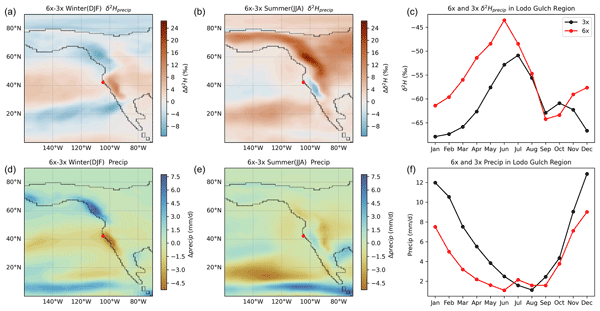
This study is motivated by the current anthropogenic-warming-forced transition in regional hydroclimate. We use observations and model simulations during the Paleocene–Eocene Thermal Maximum (PETM) to constrain the regional/local hydroclimate response. Our findings, based on multiple observational evidence within the context of model output, suggest a transition toward greater aridity and precipitation extremes in central California during the PETM.
Weimin Si, Timothy Herbert, and John R. Toggweiler
Clim. Past, 22, 1729–1740, https://doi.org/10.5194/cp-22-1729-2026, https://doi.org/10.5194/cp-22-1729-2026, 2026
Short summary
Short summary
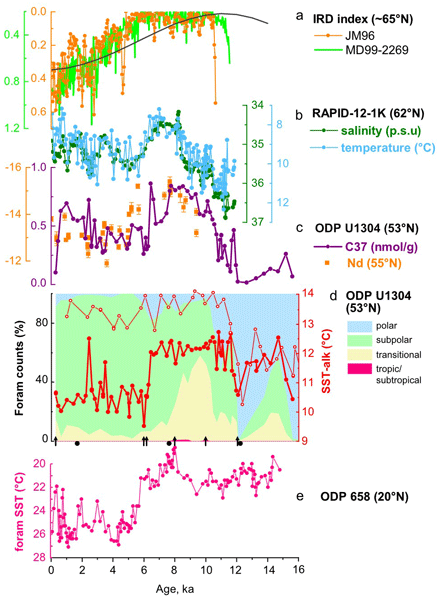
Transient climate models simulate warming over the past 5000 years due to a 20 ppm CO2 rise, yet paleo-proxies indicate cooling. In this study, we examine the mid-latitude North Atlantic, where model-data mismatch is largest. Our analysis links Late Holocene cooling to increased zonal SST (Sea Surface Temperature) asymmetry, likely from basin-scale reorganization of inter-gyre circulation. Transient models, however, do not to capture this spatial pattern and associated circulation changes.
Fernando Gázquez, Hubert Vonhof, Carlos Pérez-Mejías, Andrea Columbu, Alena Giesche, Hai Cheng, Alfredo Martínez-García, Brian DiMento, Eneko Iriarte, and José María Calaforra
EGUsphere, https://doi.org/10.5194/egusphere-2026-4435, https://doi.org/10.5194/egusphere-2026-4435, 2026
This preprint is open for discussion and under review for Climate of the Past (CP).
Short summary
Short summary
By studying mineral deposits formed in a cave in southern Spain, we reconstructed how climate changed between about 9,700 and 4,400 years ago. We found that a humid climate gradually gave way to much drier conditions, with the main transition occurring between 6,000 and 5,500 years ago. These results show how the end of a wet period in North Africa also affected southern Europe, improving our understanding of how regional climates respond to large-scale environmental change.
Natalie J. Burls, Nicky M. Wright, R. Paul Acosta, Catherine D. Bradshaw, Edward Gasson, Lennert B. Stap, Gilles Ramstein, Anna Ruth W. Halberstadt, Agatha M. De Boer, Funda Akgün, David J. Cantrill, Manuel Casas-Gallego, Nela Doláková, Boglarka Erdei, Alex Farnsworth, Sarah Feakins, Ran Feng, Tamara Fletcher, Frédéric Fluteau, J. A. Mattias Green, Anna S. von der Heydt, Matthew Huber, David K. Hutchinson, Dimiter Ivanov, Mine Sezgül Kayseri-Özer, Gregor Knorr, Marianna Kováčová, Caroline H. Lear, Allegra N. LeGrande, Shufeng Li, Xiaoqing Liu, Daniel J. Lunt, Katrin Meissner, Yunfa Miao, Trusha J. Naik, Javier B. Navarro, Joseph B. Novak, Diana Ochoa, Guy J.G. Paxman, Matthew J. Pound, James W. B. Rae, Tammo Reichgelt, Martin Renoult, Francesca Sangiorgi, Anta-Clarisse Sarr, Diane Segalla, Pierre Sepulchre, Amelia Shevenell, Sebastian Steinig, Eivind Straume, Caroline A. E. Strömberg, Clay Tabor, Torsten Utescher, Julia E. Weiffenbach, Elżbieta Worobiec, Yurui Zhang, Feng Zhu, Jiang Zhu, Alexandra Auderset, Florence Colleoni, Aisling Dolan, Rachel Havranek, Ann Holbourn, Nicholas Herold, Daeun Lee, James W. Marschalek, Bryce Mitsunaga, Sevi Modestou, Lina Perez-Angel, Mae Saslaw, Sinda Sosdian, Elena Stiles, Yong Sun, Ning Tan, Zhongshi Zhang, and Yan Zhao
EGUsphere, https://doi.org/10.5194/egusphere-2026-3595, https://doi.org/10.5194/egusphere-2026-3595, 2026
This preprint is open for discussion and under review for Geoscientific Model Development (GMD).
Short summary
Short summary
Simulating warm paleoclimates increases our understanding of the mechanisms that drive climatic change and tipping points. The Miocene Epoch, specifically the Miocene Climatic Optimum, has been identified as a particularly valuable past warm climate to simulate, meriting the design of a coordinated Miocene Model Intercomparison Project. Here we synthesize the latest available literature and present the experimental design for coordinated Miocene simulations and sensitivity studies.
Brianna Hoegler, Timothy D. Herbert, and Jamie Pahigian
Clim. Past, 22, 1241–1254, https://doi.org/10.5194/cp-22-1241-2026, https://doi.org/10.5194/cp-22-1241-2026, 2026
Short summary
Short summary
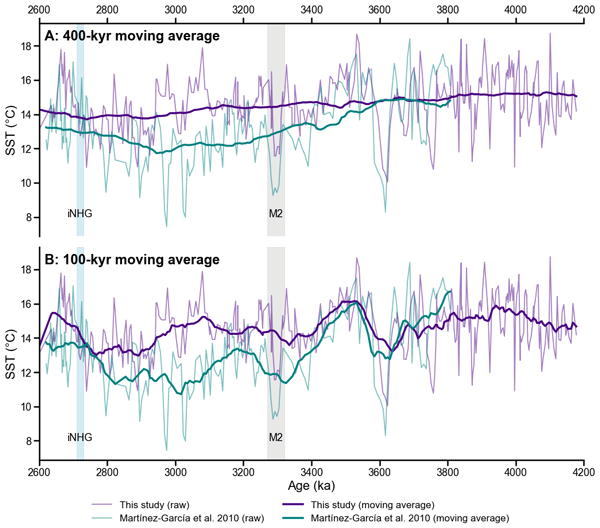
Studying the Pliocene (5.33–2.58 Ma) is key to understanding Earth’s climate under current atmospheric CO2 levels and the development of permanent Northern Hemisphere ice. We used ocean sediments and improved laboratory methods to reconstruct sea surface temperatures from Ocean Drilling Program Site 1090 (south Atlantic) from ~4.3–2.6 Ma. Our data suggests cooling patterns similar to those found worldwide, suggesting a global forcing, like decreased CO2, triggered the shift to the ice ages.
Heather M. Stoll, Clara Bolton, Madalina Jaggi, Alfredo Martinez-Garcia, and Stefano M. Bernasconi
Clim. Past, 21, 2189–2203, https://doi.org/10.5194/cp-21-2189-2025, https://doi.org/10.5194/cp-21-2189-2025, 2025
Short summary
Short summary
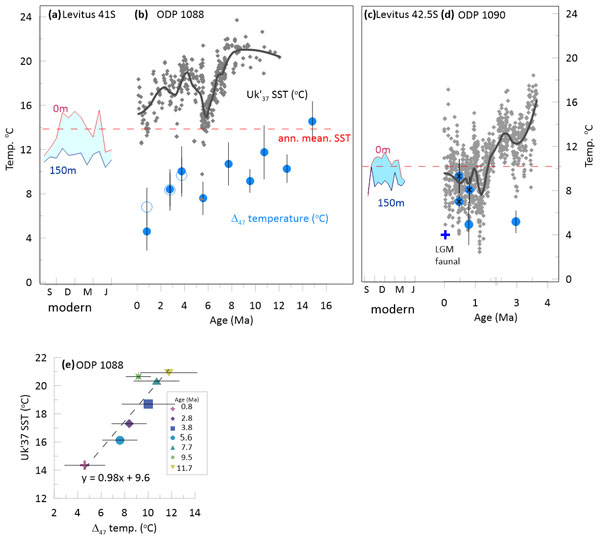
In periods of high atmospheric CO2 many proxies suggest more extreme past polar warming than is simulated by current coupled climate models. Providing new data on high latitude temperatures in the South Atlantic over the last 15 million years using clumped isotope thermometry, we show that absolute temperatures may not have been as warm as indicated by some biomarker based proxy climate records.
Alexandra Auderset, Sandi M. Smart, Yeongjun Ryu, Dario Marconi, Haojia Abby Ren, Lena Heins, Hubert Vonhof, Ralf Schiebel, Janne Repschläger, Daniel M. Sigman, Gerald H. Haug, and Alfredo Martínez-García
Biogeosciences, 22, 1887–1905, https://doi.org/10.5194/bg-22-1887-2025, https://doi.org/10.5194/bg-22-1887-2025, 2025
Short summary
Short summary
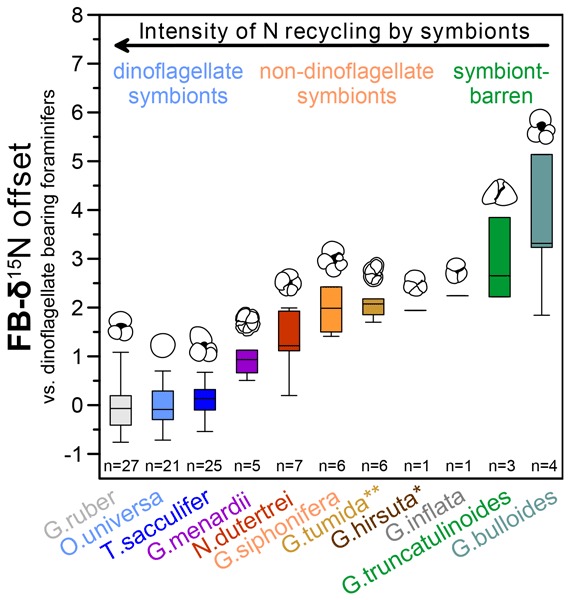
This study uses foraminifera-bound nitrogen isotopes (FB-δ15N) to investigate photosymbiosis in planktic foraminifera. The analysis of South Atlantic shells, compared to a global dataset, shows that FB-δ15N distinguishes species with certain algal symbionts (dinoflagellates), likely due to internal ammonium recycling. However, the studied site stands out with its larger-than-expected FB-δ15N offsets, highlighting influences on FB-δ15N signatures in regions with strong environmental gradients.
Babette A.A. Hoogakker, Catherine Davis, Yi Wang, Stephanie Kusch, Katrina Nilsson-Kerr, Dalton S. Hardisty, Allison Jacobel, Dharma Reyes Macaya, Nicolaas Glock, Sha Ni, Julio Sepúlveda, Abby Ren, Alexandra Auderset, Anya V. Hess, Katrin J. Meissner, Jorge Cardich, Robert Anderson, Christine Barras, Chandranath Basak, Harold J. Bradbury, Inda Brinkmann, Alexis Castillo, Madelyn Cook, Kassandra Costa, Constance Choquel, Paula Diz, Jonas Donnenfield, Felix J. Elling, Zeynep Erdem, Helena L. Filipsson, Sebastián Garrido, Julia Gottschalk, Anjaly Govindankutty Menon, Jeroen Groeneveld, Christian Hallmann, Ingrid Hendy, Rick Hennekam, Wanyi Lu, Jean Lynch-Stieglitz, Lélia Matos, Alfredo Martínez-García, Giulia Molina, Práxedes Muñoz, Simone Moretti, Jennifer Morford, Sophie Nuber, Svetlana Radionovskaya, Morgan Reed Raven, Christopher J. Somes, Anja S. Studer, Kazuyo Tachikawa, Raúl Tapia, Martin Tetard, Tyler Vollmer, Xingchen Wang, Shuzhuang Wu, Yan Zhang, Xin-Yuan Zheng, and Yuxin Zhou
Biogeosciences, 22, 863–957, https://doi.org/10.5194/bg-22-863-2025, https://doi.org/10.5194/bg-22-863-2025, 2025
Short summary
Short summary
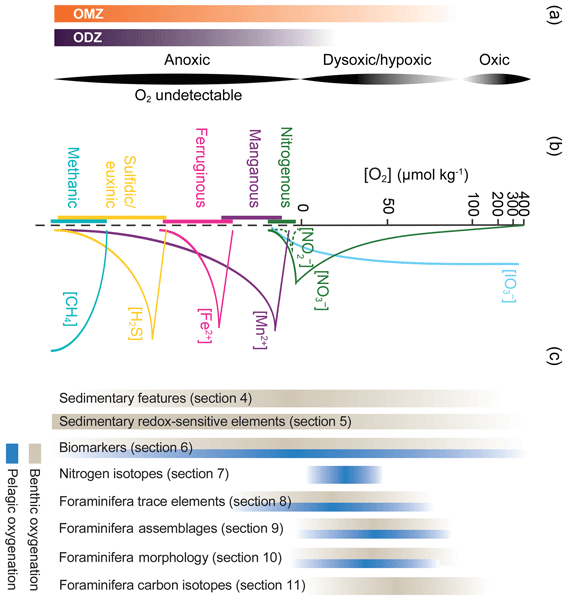
Paleo-oxygen proxies can extend current records, constrain pre-anthropogenic baselines, provide datasets necessary to test climate models under different boundary conditions, and ultimately understand how ocean oxygenation responds on longer timescales. Here we summarize current proxies used for the reconstruction of Cenozoic seawater oxygen levels. This includes an overview of the proxy's history, how it works, resources required, limitations, and future recommendations.
Xiaodong Zhang, Brett J. Tipple, Jiang Zhu, William D. Rush, Christian A. Shields, Joseph B. Novak, and James C. Zachos
Clim. Past, 20, 1615–1626, https://doi.org/10.5194/cp-20-1615-2024, https://doi.org/10.5194/cp-20-1615-2024, 2024
Short summary
Short summary
This study is motivated by the current anthropogenic-warming-forced transition in regional hydroclimate. We use observations and model simulations during the Paleocene–Eocene Thermal Maximum (PETM) to constrain the regional/local hydroclimate response. Our findings, based on multiple observational evidence within the context of model output, suggest a transition toward greater aridity and precipitation extremes in central California during the PETM.
Paul D. Zander, Daniel Böhl, Frank Sirocko, Alexandra Auderset, Gerald H. Haug, and Alfredo Martínez-García
Clim. Past, 20, 841–864, https://doi.org/10.5194/cp-20-841-2024, https://doi.org/10.5194/cp-20-841-2024, 2024
Short summary
Short summary
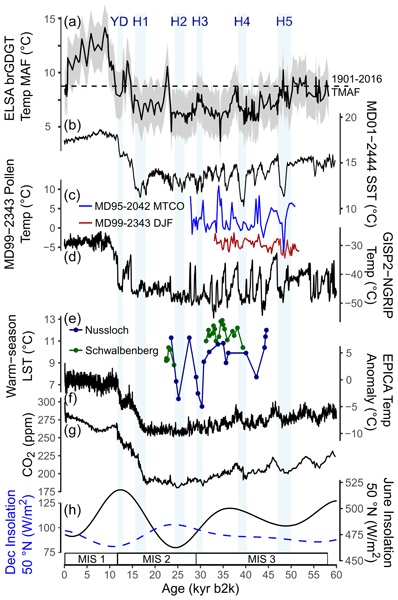
Bacterial lipids (branched glycerol dialkyl glycerol tetraethers; brGDGTs) extracted from lake sediments were used to reconstruct warm-season temperatures in central Europe during the past 60 kyr. Modern samples were used to test and correct for bias related to varying sources of brGDGTs. The temperature reconstruction is significantly correlated with other temperature reconstructions but features less millennial-scale variability, which is attributed to the seasonal signal of the proxy.
Cited articles
Abell, J. T., Winckler, G., Anderson, R. F., and Herbert, T. D.: Poleward and weakened westerlies during Pliocene warmth, Nature, 589, 70–75, https://doi.org/10.1038/s41586-020-03062-1, 2021.
Annan, J. D., Hargreaves, J. C., Mauritsen, T., McClymont, E., and Ho, S. L.: Can we reliably reconstruct the mid-Pliocene Warm Period with sparse data and uncertain models?, Clim. Past, 20, 1989–1999, https://doi.org/10.5194/cp-20-1989-2024, 2024.
Banzon, V., Smith, T. M., Liu, C., and Hankins, W.: A long-term record of blended satellite and in situ sea-surface temperature for climate monitoring, modeling and environmental studies, Earth Syst. Sci. Data, 8, 165–176, https://doi.org/10.5194/essd-8-165-2016, 2016.
Bendle, J. and Rosell-Melé, A.: Distributions of
Brassell, S. C., Eglinton, G., Marlowe, I. T., Pflaumann, U., and Sarnthein, M.: Molecular stratigraphy: A new tool for climatic assessment, Nature, 320, 129–133, https://doi.org/10.1038/320129a0, 1986.
Brennan, P. R., Bhattacharya, T., Feng, R., Tierney, J. E., and Jorgensen, E. M.: Patterns and Mechanisms of Northeast Pacific Temperature Response to Pliocene Boundary Conditions, Paleoceanogr. Paleoclimatol., 37, https://doi.org/10.1029/2021PA004370, 2022.
Burls, N. J., Fedorov, A. V., Sigman, D. M., Jaccard, S. L., Tiedemann, R., and Haug, G. H.: Active Pacific meridional overturning circulation (PMOC) during the warm Pliocene, Sci. Adv., 3, 1–13, https://doi.org/10.1126/sciadv.1700156, 2017.
Burls, N. J., Bradshaw, C. D., De Boer, A. M., Herold, N., Huber, M., Pound, M., Donnadieu, Y., Farnsworth, A., Frigola, A., Gasson, E., von der Heydt, A. S., Hutchinson, D. K., Knorr, G., Lawrence, K. T., Lear, C. H., Li, X., Lohmann, G., Lunt, D. J., Marzocchi, A., Prange, M., Riihimaki, C. A., Sarr, A. C., Siler, N., and Zhang, Z.: Simulating Miocene Warmth: Insights From an Opportunistic Multi-Model Ensemble (MioMIP1), Paleoceanogr. Paleoclimatol., 36, 1–40, https://doi.org/10.1029/2020PA004054, 2021.
Chaler, R., Grimalt, J. O., Pelejero, C., and Calvo, E.: Sensitivity Effects in
Chaler, R., Villanueva, J., and Grimalt, J. O.: Non-linear effects in the determination of paleotemperature
Clark, P. U., Shakun, J. D., Rosenthal, Y., Köhler, P., and Bartlein, P. J.: Global and regional temperature change over the past 4.5 million years, Science, 383, 884–890, https://doi.org/10.1126/science.adi1908, 2024.
Clark, P. U., Shakun, J. D., Rosenthal, Y., Pollard, D., Hostetler, S. W., Köhler, P., Bartlein, P. J., Gregory, J. M., Zhu, C., Schrag, D. P., Liu, Z., and Pisias, N. G.: Global mean sea level over the past 4.5 million years, Science, 390, https://doi.org/10.1126/science.adv8389, 2025.
Conte, M. H., Sicre, M. A., Rühlemann, C., Weber, J. C., Schulte, S., Schulz-Bull, D., and Blanz, T.: Global temperature calibration of the alkenone unsaturation index (
Dowsett, H. J., Robinson, M. M., Foley, K. M., and Herbert, T. D.: PRISM late Pliocene (Piacenzian) alkenone-derived SST data, US Geological Survey (USGS) Data Release, 378, https://doi.org/10.5066/F7959G1S, 2017.
Durham, E., Maslin, M., Platzman, E., Rosell-Melé, A., Marlow, J., Leng, M., Lowry, D., and Burns, S.: Reconstructingt he climatic history of the western coast of Africa over the past 1.5
Feistel, R.: Thermodynamic properties of seawater, ice and humid air: TEOS-10, before and beyond, Ocean Sci., 14, 471–502, https://doi.org/10.5194/os-14-471-2018, 2018.
Ford, H. L., Burls, N. J., Jacobs, P., Jahn, A., Caballero-Gill, R. P., Hodell, D. A., and Fedorov, A. V: Sustained mid-Pliocene warmth led to deep water formation in the North Pacific, Nat. Geosci., 15, 658–663, https://doi.org/10.1038/s41561-022-00978-3, 2022.
Harada, N., Katsuki, K., Nakagawa, M., Matsumoto, A., Seki, O., Addison, J. A., Finney, B. P., and Sato, M.: Holocene sea surface temperature and sea ice extent in the Okhotsk and Bering Seas, Prog. Oceanogr., 126, 242–253, https://doi.org/10.1016/j.pocean.2014.04.017, 2014.
Haug, G. H.: Zur Paläo-Ozeanographie und Sedimentationsgeschichte im Nordwest-Pazifik während der letzten 6 Millionen Jahre (ODP-Site 882), PhD, Christian-Albrechts-Universität zu Kiel, Kiel, 1995.
Haug, G. H. and Sarnthein, M.: Uk37, Sea surface temperature and pigment data of ODP Site 145-882, PANGAEA [data set], https://doi.org/10.1594/PANGAEA.315092, 2005.
Haug, G. H., Ganopolski, A., Sigman, D. M., Rosell-Mele, A., Swann, G. E. A., Tiedemann, R., Jaccard, S. L., Bollmann, J., Maslin, M. A., Leng, M. J., and Eglinton, G.: North Pacific seasonality and the glaciation of North America 2.7 million years ago, Nature, 433, 821–825, https://doi.org/10.1038/nature03332, 2005.
Haywood, A. M., Dowsett, H. J., and Dolan, A. M.: Integrating geological archives and climate models for the mid-Pliocene warm period, Nat. Commun., 7, https://doi.org/10.1038/ncomms10646, 2016.
Haywood, A. M., Tindall, J. C., Dowsett, H. J., Dolan, A. M., Foley, K. M., Hunter, S. J., Hill, D. J., Chan, W.-L., Abe-Ouchi, A., Stepanek, C., Lohmann, G., Chandan, D., Peltier, W. R., Tan, N., Contoux, C., Ramstein, G., Li, X., Zhang, Z., Guo, C., Nisancioglu, K. H., Zhang, Q., Li, Q., Kamae, Y., Chandler, M. A., Sohl, L. E., Otto-Bliesner, B. L., Feng, R., Brady, E. C., von der Heydt, A. S., Baatsen, M. L. J., and Lunt, D. J.: The Pliocene Model Intercomparison Project Phase 2: large-scale climate features and climate sensitivity, Clim. Past, 16, 2095–2123, https://doi.org/10.5194/cp-16-2095-2020, 2020.
Hefter, J.: Analysis of Alkenone Unsaturation Indices with Fast Gas Chromatography/Time-of-Flight Mass Spectrometry, Anal. Chem., 80, 2161–2170, https://doi.org/10.1021/ac702194m, 2008.
Herbert, T. D.: Alkenone Paleotemperature Determinations, Treatise on Geochemistry, 6, 391–432, https://doi.org/10.1016/B0-08-043751-6/06115-6, 2003.
Herbert, T. D., Lawrence, K. T., Tzanova, A., Peterson, L. C., Caballero-Gill, R., and Kelly, C. S.: Late Miocene global cooling and the rise of modern ecosystems, Nat. Geosci., 9, 843–847, https://doi.org/10.1038/ngeo2813, 2016.
Ho, S. L., Mollenhauer, G., Lamy, F., Martínez-garcia, A., Mohtadi, M., Gersonde, R., Hebbeln, D., Nunez-ricardo, S., Rosell-melé, A., and Tiedemann, R.: Sea surface temperature variability in the Pacific sector of the Southern Ocean over the past 700 kyr, Paleoceanography, 27, 1–16, https://doi.org/10.1029/2012PA002317, 2012.
Huber, M. and Caballero, R.: The early Eocene equable climate problem revisited, Clim. Past, 7, 603–633, https://doi.org/10.5194/cp-7-603-2011, 2011.
Judd, E. J., Tierney, J. E., Huber, B. T., Wing, S. L., Lunt, D. J., Ford, H. L., Inglis, G. N., McClymont, E. L., O'Brien, C. L., Rattanasriampaipong, R., Si, W., Staitis, M. L., Thirumalai, K., Anagnostou, E., Cramwinckel, M. J., Dawson, R. R., Evans, D., Gray, W. R., Grossman, E. L., Henehan, M. J., Hupp, B. N., MacLeod, K. G., O'Connor, L. K., Sánchez Montes, M. L., Song, H., and Zhang, Y. G.: The PhanSST global database of Phanerozoic sea surface temperature proxy data, Sci. Data, 9, 753, https://doi.org/10.1038/s41597-022-01826-0, 2022.
Li, X., Jiang, D., Zhang, Z., Zhang, R., Tian, Z., and Yan, Q.: Mid-Pliocene westerlies from PlioMIP simulations, Adv. Atmos. Sci., 32, 909–923, https://doi.org/10.1007/s00376-014-4171-7, 2015.
Liao, S. and Huang, Y.: Group 2i Isochrysidales flourishes at exceedingly low growth temperatures (0 to 6 °C), Org. Geochem., 174, 104512, https://doi.org/10.1016/j.orggeochem.2022.104512, 2022.
Liao, S., Wang, K. J., and Huang, Y.: Unusually high production of C37:4 alkenone by an Arctic Gephyrocapsa huxleyi strain grown under nutrient-replete conditions, Org. Geochem., 177, 104539, https://doi.org/10.1016/j.orggeochem.2022.104539, 2023.
Longo, W. M., Dillon, J. T., Tarozo, R., Salacup, J. M., and Huang, Y.: Unprecedented separation of long chain alkenones from gas chromatography with a poly(trifluoropropylmethylsiloxane) stationary phase, Org. Geochem., 65, 94–102, https://doi.org/10.1016/j.orggeochem.2013.10.011, 2013.
Madureira, L. A. S., van Kreveld, S. A., Eglinton, G., Conte, M. H., Ganssen, G., van Hinte, J. E., and Ottens, J. J.: Late Quaternary high-resolution biomarker and other sedimentary climate proxies in a Northeast Atlantic Core, Paleoceanography, 12, 255–269, https://doi.org/10.1029/96PA03120, 1997.
Marlowe, I. T., Brassell, S. C., Eglinton, G., and Green, J. C.: Long chain unsaturated ketones and esters in living algae and marine sediments, Org. Geochem., 6, 135–141, 1984.
Marlowe, I. T., Brassell, S. C., Eglinton, G., and Green, J. C.: Long-chain alkenones and alkyl alkenoates and the fossil coccolith record of marine sediments, Chem. Geol., 88, 349–375, https://doi.org/10.1016/0009-2541(90)90098-R, 1990.
Martínez-Garcia, A., Rosell-Melé, A., McClymont, E. L., Gersonde, R., and Haug, G. H.: Subpolar Link to the Emergence of the Modern Equatorial Pacific Cold Tongue, Science, 328, 1550–1553, https://doi.org/10.1126/science.1184480, 2010.
Max, L., Lembke-Jene, L., Zou, J., Shi, X., and Tiedemann, R.: Evaluation of reconstructed sea surface temperatures based on
McClymont, E. L. and Rosell-Melé, A.: Links between the onset of modern Walker circulation and the mid-Pleistocene climate transition, Geology, 33, 389, https://doi.org/10.1130/G21292.1, 2005.
McClymont, E. L., Rosell-Melé, A., Haug, G. H., and Lloyd, J. M.: Expansion of subarctic water masses in the North Atlantic and Pacific oceans and implications for mid-Pleistocene ice sheet growth, Paleoceanography, 23, https://doi.org/10.1029/2008PA001622, 2008.
McDougall, T. J. and Barker, P. M.: Getting started with TEOS-10 and the Gibbs Seawater (GSW) oceanographic toolbox, Scor/iapso WG, 127, 1–28, ISBN 978-0-646-55621-5, 2011.
Müller, P. J., Kirst, G., Ruhland, G., Von Storch, I., and Rosell-Melé, A.: Calibration of the alkenone paleotemperature index
Novak, J., Caballero-Gill, R., Herbert, T., Dowsett, H., andMartínez-García, A.: Supporting data for “Correcting a Systematic Bias in an Ocean Drilling Project Site 882 Alkenone Sea Surface Temperature Record”, Zenodo [data set], https://doi.org/10.5281/zenodo.18883167, 2026.
Novak, J., Mcgrath, S. M., Wang, K. J., Liao, S., Steven, C., Kuhnt, W., and Huang, Y.:
Novak, J. B., Caballero-Gill, R. P., Rose, R. M., Herbert, T. D., and Dowsett, H. J.: Isotopic evidence against North Pacific Deep Water formation during late Pliocene warmth, Nat. Geosci., 17, 795–802, https://doi.org/10.1038/s41561-024-01500-7, 2024.
Novak, J. B., Prokopenko, A. A., Tarasov, P. E., Russell, J. M., Lindemuth, E. R., Shichi, K., Kashiwaya, K., Peck, J., Vachula, R. S., Swann, G. E. A., and Polissar, P. J.: Early Pleistocene ecosystem turnover in South Siberia linked to abrupt regional cooling, Nat. Geosci., 19, 331–338, https://doi.org/10.1038/s41561-025-01914-x, 2026.
Osman, M. B., Tierney, J. E., Zhu, J., Tardif, R., Hakim, G. J., King, J., and Poulsen, C. J.: Globally resolved surface temperatures since the Last Glacial Maximum, Nature, 599, 239–244, https://doi.org/10.1038/s41586-021-03984-4, 2021.
Park, Y.-H., Yoon, J.-H., Youn, Y.-H., and Vivier, F.: Recent Warming in the Western North Pacific in Relation to Rapid Changes in the Atmospheric Circulation of the Siberian High and Aleutian Low Systems*, J. Climate, 25, 3476–3493, https://doi.org/10.1175/2011JCLI4142.1, 2012.
Prahl, F. G. and Wakeham, S. G.: Calibration of unsaturation patterns in long-chain ketone compositions for palaeotemperature assessment, Nature, 330, 367–369, 1987.
Prahl, F. G., Rontani, J. F., Zabeti, N., Walinsky, S. E., and Sparrow, M. A.: Systematic pattern in
Rea, D. K., Basov, I. A., Janecek, T. R., Palmer-Julson, A., and Shipboard Scientific, P.: Initial report: Site 882, in: Proceedings of the Ocean Drilling Program| 145 Initial Reports, Ocean Drilling Program, https://doi.org/10.2973/odp.proc.ir.145.106.1993, 1993a.
Rea, D. K., Basov, I. A., Janecek, T. R., Palmer-Julson, A., and Party, S. S.: Initial report: Site 883, Proceedings of the Ocean Drilling Program, Initial Reports, 145, https://doi.org/10.2973/odp.proc.ir.145.107.1993, 1993b.
Roberts, J., McCave, I. N., McClymont, E. L., Kender, S., Hillenbrand, C.-D., Matano, R., Hodell, D. A., and Peck, V. L.: Deglacial changes in flow and frontal structure through the Drake Passage, Earth Planet. Sc. Lett., 474, 397–408, https://doi.org/10.1016/j.epsl.2017.07.004, 2017.
Rosell-Mele, A., Carter, J. F., Parry, A. T., and Eglintont, G.: Determination of the
Rosell-Melé, A.: Interhemispheric appraisal of the value of alkenone indices as temperature and salinity proxies in high-latitude locations, Paleoceanography, 13, 694–703, https://doi.org/10.1029/98PA02355, 1998.
Rosell-Melé, A., Eglinton, G., Pflaumann, U., and Sarnthein, M.: Atlantic core-top calibration of the
Rosell-Melé, A., Bard, E., Emeis, K.-C., Grimalt, J. O., Müller, P., Schneider, R., Bouloubassi, I., Epstein, B., Fahl, K., Fluegge, A., Freeman, K., Goñi, M., Güntner, U., Hartz, D., Hellebust, S., Herbert, T., Ikehara, M., Ishiwatari, R., Kawamura, K., Kenig, F., de Leeuw, J., Lehman, S., Mejanelle, L., Ohkouchi, N., Pancost, R. D., Pelejero, C., Prahl, F., Quinn, J., Rontani, J.-F., Rostek, F., Rullkötter, J., Sachs, J., Blanz, T., Sawada, K., Schulz-Bull, D., Sikes, E., Sonzogni, C., Ternois, Y., Versteegh, G., Volkman, J. K., and Wakeham, S.: Precision of the current methods to measure the alkenone proxy
Rostek, F., Ruhlandt, G., Bassinot, F. C., Muller, P. J., Labeyrie, L. D., Lancelot, Y., and Bard, E.: Reconstructing sea surface temperature and salinity using δ18O and alkenone records, Nature, 364, 319–321, https://doi.org/10.1038/364319a0, 1993.
Sánchez-Montes, M. L., McClymont, E. L., Lloyd, J. M., Müller, J., Cowan, E. A., and Zorzi, C.: Late Pliocene Cordilleran Ice Sheet development with warm northeast Pacific sea surface temperatures, Clim. Past, 16, 299–313, https://doi.org/10.5194/cp-16-299-2020, 2020.
Sikes, E. L., Farrington, J. W., and Keigwin, L. D.: Use of the alkenone unsaturation ratio
Studer, A. S., Martínez-Garcia, A., Jaccard, S. L., Girault, F. E., Sigman, D. M., and Haug, G. H.: Enhanced stratification and seasonality in the Subarctic Pacific upon Northern Hemisphere Glaciation-New evidence from diatom-bound nitrogen isotopes, alkenones and archaeal tetraethers, Earth Planet. Sc. Lett., 351–352, 84–94, https://doi.org/10.1016/j.epsl.2012.07.029, 2012.
Sugimoto, S. and Hanawa, K.: Impact of Aleutian Low activity on the STMW formation in the Kuroshio recirculation gyre region, Geophys. Res. Lett., 37, https://doi.org/10.1029/2009GL041795, 2010.
Talley, L. D.: Distribution and Formation of North Pacific Intermediate Water, American Meteorological Society, 23, 517–537, 1993.
Tierney, J. E. and Tingley, M. P.: BAYSPLINE: A New Calibration for the Alkenone Paleothermometer, Paleoceanogr. Paleoclimatol., 33, 281–301, https://doi.org/10.1002/2017PA003201, 2018.
Tierney, J. E., Haywood, A. M., Feng, R., Bhattacharya, T., and Otto-Bliesner, B. L.: Pliocene Warmth Consistent With Greenhouse Gas Forcing, Geophys. Res. Lett., 46, 9136–9144, https://doi.org/10.1029/2019GL083802, 2019.
Tierney, J. E., Poulsen, C. J., Montañez, I. P., Bhattacharya, T., Feng, R., Ford, H. L., Hönisch, B., Inglis, G. N., Petersen, S. V., Sagoo, N., Tabor, C. R., Thirumalai, K., Zhu, J., Burls, N. J., Foster, G. L., Goddéris, Y., Huber, B. T., Ivany, L. C., Kirtland Turner, S., Lunt, D. J., McElwain, J. C., Mills, B. J. W., Otto-Bliesner, B. L., Ridgwell, A., and Zhang, Y. G.: Past climates inform our future, Science, 370, https://doi.org/10.1126/science.aay3701, 2020.
Tierney, J. E., Judd, E. J., Osman, M. B., King, J. M., Truax, O. J., Steiger, N. J., Amrhein, D. E., and Anchukaitis, K. J.: Advances in Paleoclimate Data Assimilation, Annu. Rev. Earth Pl. Sc., 53, 625–650, https://doi.org/10.1146/annurev-earth-032320-064209, 2025a.
Tierney, J. E., King, J., Osman, M. B., Abell, J. T., Burls, N. J., Erfani, E., Cooper, V. T., and Feng, R.: Pliocene Warmth and Patterns of Climate Change Inferred From Paleoclimate Data Assimilation, AGU Advances, 6, https://doi.org/10.1029/2024AV001356, 2025b.
van Dommelen, N., McNally, C., and Herbert, T. D.: Plio–Pleistocene Evolution of the Benguela and Agulhas Currents, Paleoceanogr. Paleoclimatol., 41, https://doi.org/10.1029/2024PA004960, 2026.
Villanueva, J. and Grimalt, J. O.: Pitfalls in the chromatographic determination of the alkenone
Villanueva, J. and Grimalt, J. O.: Gas Chromatographic Tuning of the
Villanueva, J., Pelejero, C., and Grimalt, J. O.: Clean-up procedures for the unbiased estimation of C37 alkenone sea surface temperatures and terrigenous n-alkane inputs in paleoceanography, J. Chromatogr. A, 757, 145–151, https://doi.org/10.1016/S0021-9673(96)00669-3, 1997.
Wakita, M., Watanabe, S., Murata, A., Tsurushima, N., and Honda, M.: Decadal change of dissolved inorganic carbon in the subarctic western North Pacific Ocean, Tellus B, 62, 608, https://doi.org/10.1111/j.1600-0889.2010.00476.x, 2010.
Wang, K. J., Huang, Y., Majaneva, M., Belt, S. T., Liao, S., Novak, J., Kartzinel, T. R., Herbert, T. D., Richter, N., and Cabedo-sanz, P.: Group 2i Isochysidales produce characteristic alkenones reflecting sea ice distribution, Nat. Commun., 1–10, https://doi.org/10.1038/s41467-020-20187-z, 2021.
Wang, K. J., Huang, Y., Kartzinel, T., Majaneva, M., Richter, N., Liao, S., Andresen, C. S., and Vermassen, F.: Group 2i Isochrysidales thrive in marine and lacustrine systems with ice cover, Sci. Rep., 14, 11449, https://doi.org/10.1038/s41598-024-62162-4, 2024.
Wang, Y.-L. and Wu, C.-R.: Enhanced Warming and Intensification of the Kuroshio Extension, 1999–2013, Remote Sens.-Basel, 11, 101, https://doi.org/10.3390/rs11010101, 2019.
Weaver, P. P. E., Chapman, M. R., Eglinton, G., Zhao, M., Rutledge, D., and Read, G.: Combined coccolith, foraminiferal, and biomarker reconstruction of paleoceanographic conditions over the past 120 kyr in the northern North Atlantic (59° N, 23° W), Paleoceanography, 14, 336–349, https://doi.org/10.1029/1999PA900009, 1999.
Yamamoto, M. and Kobayashi, D.: Surface ocean cooling in the subarctic North Pacific during the late Pliocene suggests an atmospheric reorganization prior to extensive Northern Hemisphere glaciation, Deep-Sea Res. Pt. II, 125–126, 177–183, https://doi.org/10.1016/j.dsr2.2015.03.005, 2016.
Zheng, Y., Tarozo, R., and Huang, Y.: Optimizing chromatographic resolution for simultaneous quantification of long chain alkenones, alkenoates and their double bond positional isomers, Org. Geochem., 111, 136–143, https://doi.org/10.1016/j.orggeochem.2017.06.013, 2017.
Zhou, G.: Atmospheric Response to Sea Surface Temperature Anomalies in the Mid-latitude Oceans: A Brief Review, Atmos. Ocean, 57, 319–328, https://doi.org/10.1080/07055900.2019.1702499, 2019.
Short summary
Accurate information about the surface ocean temperatures are important for understanding Earth's climate history. Here, we correct a sea surface temperature record from the critical subarctic North Pacific region for systematic biases introduced into the algal-biomarker-based geologic temperature estimates by the analytical method used by the original study.
Accurate information about the surface ocean temperatures are important for understanding...


