
Articles | Volume 22, issue 7
https://doi.org/10.5194/cp-22-1255-2026
© Author(s) 2026. This work is distributed under
the Creative Commons Attribution 4.0 License.
the Creative Commons Attribution 4.0 License.
https://doi.org/10.5194/cp-22-1255-2026
© Author(s) 2026. This work is distributed under
the Creative Commons Attribution 4.0 License.
the Creative Commons Attribution 4.0 License.
Research article
| 
06 Jul 2026
Research article |
| 06 Jul 2026
| 06 Jul 2026
Climate variability in Poland (Central Europe) in the 16th century based on multiproxy data

Department of Meteorology and Climatology, Faculty of Earth Sciences and Spatial Management, Nicolaus Copernicus University, Toruń, Poland
Centre for Climate Change Research, Nicolaus Copernicus University, Toruń, Poland
Piotr Oliński
Department of Medieval History, Institute of History and Archival Sciences, Faculty of History, Nicolaus Copernicus University, Toruń, Poland
Centre for Climate Change Research, Nicolaus Copernicus University, Toruń, Poland
Marcin Koprowski
Department of Ecology and Biogeography, Faculty of Biology and Environmental Protection, Nicolaus Copernicus University, Toruń, Poland
Centre for Climate Change Research, Nicolaus Copernicus University, Toruń, Poland
Waldemar Chorążyczewski
Department of Archival Science and Records Management, Institute of History and Archival Sciences, Faculty of History, Nicolaus Copernicus University, Toruń, Poland
Centre for Climate Change Research, Nicolaus Copernicus University, Toruń, Poland
Elżbieta Szychowska-Krąpiec
Department of Environmental Analysis, Geological Mapping and Economic Geology, Faculty of Geology, Geophysics and Environmental Protection, AGH University of Kraków, Kraków, Poland
Marek Krąpiec
Department of General Geology and Geotourism, Faculty of Geology, Geophysics and Environmental Protection, AGH University of Kraków, Kraków, Poland
Department of Meteorology and Climatology, Faculty of Earth Sciences and Spatial Management, Nicolaus Copernicus University, Toruń, Poland
Centre for Climate Change Research, Nicolaus Copernicus University, Toruń, Poland
Related authors
Garima Singh, Rajmund Przybylak, Andrzej Araźny, Konrad Chmist, and Przemysław Wyszyński
EGUsphere, https://doi.org/10.5194/egusphere-2026-4842, https://doi.org/10.5194/egusphere-2026-4842, 2026
This preprint is open for discussion and under review for Climate of the Past (CP).
Short summary
Short summary
This study aims to determine the thermal conditions on the Labrador coast during the late 19th and early 20th centuries, which is crucial for understanding past Arctic climate change and its causes. It also helps estimate natural climate variability and distinguish it from human influence on present and future climate change. The analysis shows clear warming from the historical periods to the present.
Babak Ghazi, Rajmund Przybylak, and Piotr Oliński
EGUsphere, https://doi.org/10.5194/egusphere-2026-4965, https://doi.org/10.5194/egusphere-2026-4965, 2026
This preprint is open for discussion and under review for Climate of the Past (CP).
Short summary
Short summary
This study presents the first comprehensive assessment of heavy and extreme precipitation in Poland from the 12th to 18th centuries based on historical written records. We identified 477 events, most frequently in summer and in Silesia and northern Poland. Many caused damage without reported flooding. The findings provide a long-term perspective on past precipitation extremes and a valuable baseline for assessing present and future rainfall risks.
Konrad Chmist, Garima Singh, Andrzej Araźny, Rajmund Przybylak, and Przemysław Wyszyński
Clim. Past, 22, 1441–1455, https://doi.org/10.5194/cp-22-1441-2026, https://doi.org/10.5194/cp-22-1441-2026, 2026
Short summary
Short summary
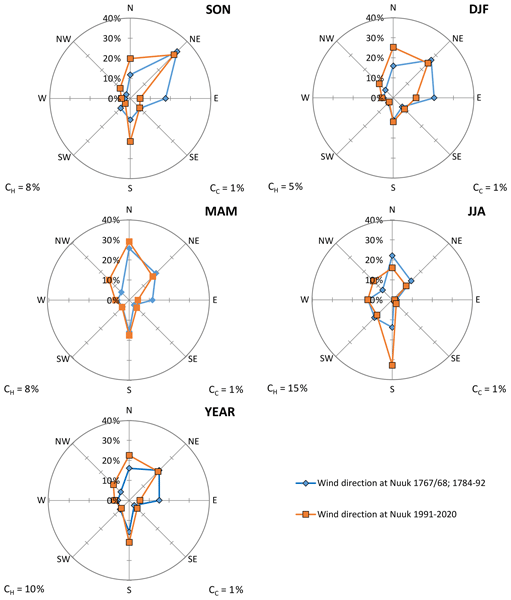
The currently observed climate changes are most intense in the Arctic region. This study utilized some of the oldest existing meteorological measurement series in this region. Atmospheric pressure and anemological conditions were analysed and then compared with contemporary measurements. This showed that the weakest low and strongest high systems occur in the same months. Prevailing wind directions have also remained unchanged, while the northerly wind carries less frigid air than in the past.
Rajmund Przybylak, Aleksandra Pospieszyńska, and Piotr Oliński
Clim. Past, 22, 1383–1400, https://doi.org/10.5194/cp-22-1383-2026, https://doi.org/10.5194/cp-22-1383-2026, 2026
Short summary
Short summary
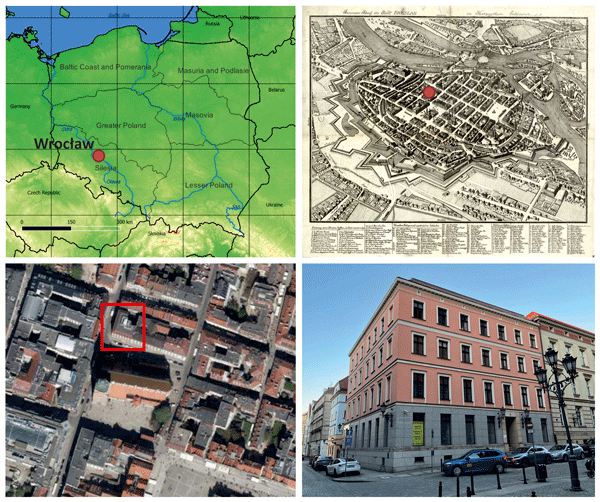
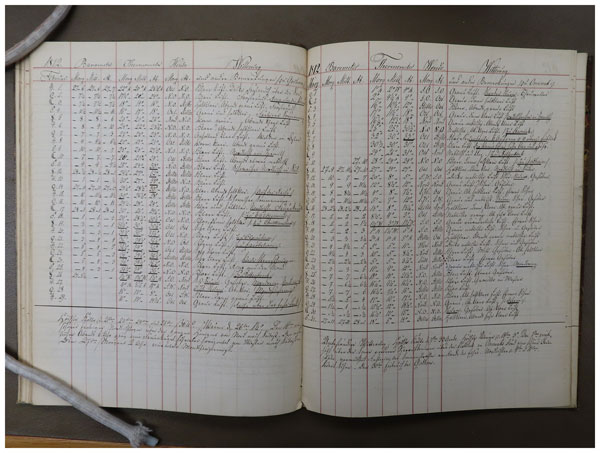
The article discusses (i) a recently discovered series of meteorological measurements (air temperature, precipitation, pressure, humidity, wind direction, and force) taken in Wrocław, South-Western Poland, from 1773–81, and (ii) an analysis of air temperature. This unique, quality-controlled series, verified against data from Silesia (Żagań and Jelenia Góra) and Warsaw, extends Wrocław's regular temperature records back to 1773, previously starting in 1791.
Rajmund Przybylak, Janusz Filipiak, Piotr Oliński, Babak Ghazi, and Andrzej Araźny
EGUsphere, https://doi.org/10.5194/egusphere-2026-3524, https://doi.org/10.5194/egusphere-2026-3524, 2026
Short summary
Short summary
This article extends the database of strong wind events in Poland (1001–1600) using 17th-century documentary evidence. A total of 525 events were identified, most occurring in the second half of the century. Strong winds were least frequent in summer, while their occurrence was relatively similar across the other seasons. Temporal variability in the frequency of strong wind events in Poland in the 17th century was more consistent with patterns observed in Northern Europe than in Southern Europe.
Rajmund Przybylak, Andrzej Araźny, Przemysław Wyszyński, Garima Singh, and Konrad Chmist
Clim. Past, 22, 957–974, https://doi.org/10.5194/cp-22-957-2026, https://doi.org/10.5194/cp-22-957-2026, 2026
Short summary
Short summary
This study presents and analyses a newly discovered unique series of meteorological measurements from Greenland, covering the period 1806–1813. This record, the longest instrumental dataset from the Arctic before 1840, provides valuable information for improving knowledge about the climate of that period. The analysis shows that it was one of the coldest intervals in the past two millennia. Intense volcanic activity and low solar activity are proposed as the main reasons for this cold period.

Peter Stucki, Stefan Brönnimann, Noemi Imfeld, Lucas Pfister, Conall E. Ruth, Yannis V. Schmutz, Yuri Brugnara, Martin Wegmann, Rajmund Przybylak, and Janusz Filipiak
Clim. Past, 22, 517–540, https://doi.org/10.5194/cp-22-517-2026, https://doi.org/10.5194/cp-22-517-2026, 2026
Short summary
Short summary
We test nine reconstructions of Europe’s hot summer of 1807, using weather records, reanalyses, machine-learning (ML), and data assimilation. Most approaches match observed temperature and pressure well. Approaches based on physics of atmospheric flow capture weather patterns well, while ML approaches better reflect station records. Ingestion of accurate records from new regions improves the reconstructions markedly. In all, the approaches provide new insights to pre-industrial extreme weather.
Rajmund Przybylak, Andrzej Araźny, Janusz Filipiak, Piotr Oliński, Przemysław Wyszyński, and Artur Szwaba
Clim. Past, 21, 1501–1519, https://doi.org/10.5194/cp-21-1501-2025, https://doi.org/10.5194/cp-21-1501-2025, 2025
Short summary
Short summary
A comprehensive database of strong winds up until AD 1600 was created based on documentary evidence for the area within the modern-day borders of Poland. Three types of documentary sources were used: handwritten and unpublished, published, and “secondary” literature. The database contains detailed information about occurrences of strong wind (the location, time, duration and indexation for intensity, extent and character of damage) and the exact textual content of the original weather note.
Garima Singh, Rajmund Przybylak, Przemysław Wyszyński, Andrzej Araźny, and Konrad Chmist
Clim. Past, 21, 877–895, https://doi.org/10.5194/cp-21-877-2025, https://doi.org/10.5194/cp-21-877-2025, 2025
Short summary
Short summary
This study aims to determine the nature of the climate in Labrador in historical times (late 18th century), which is crucial to understanding past climate changes in the Arctic and their causes. It is equally important to estimate the range of natural climate variability, which can help in correctly recognizing the causes of present and future climate changes – especially the influence of humans on climate. The analysis shows a significant warming from historical to present times.
Rajmund Przybylak, Garima Singh, Przemysław Wyszyński, Andrzej Araźny, and Konrad Chmist
Clim. Past, 20, 1451–1470, https://doi.org/10.5194/cp-20-1451-2024, https://doi.org/10.5194/cp-20-1451-2024, 2024
Short summary
Short summary
The purpose of this study is to recognise the nature of the climate in historical times (second half of 18th century) in Greenland. Such knowledge is important for validating Greenland temperature reconstructions based on both modelling works and various proxies. The two unique series of old meteorological observations from Greenland we used indicated that temperature in the study period was comparable to that of the early 20th-century Arctic warming but lower than that of the present day.
Rajmund Przybylak, Piotr Oliński, Marcin Koprowski, Elżbieta Szychowska-Krąpiec, Marek Krąpiec, Aleksandra Pospieszyńska, and Radosław Puchałka
Clim. Past, 19, 2389–2408, https://doi.org/10.5194/cp-19-2389-2023, https://doi.org/10.5194/cp-19-2389-2023, 2023
Short summary
Short summary
The present paper upgrades our knowledge of Poland’s climate in the period 1001–1500 using multiproxy data. Four new climate reconstructions have been constructed – three based on dendrochronological data (since the 12th century) and one on documentary evidence (since the 15th century). The results should help improve the knowledge of climate change in Europe, particularly in central Europe.
Duncan Pappert, Mariano Barriendos, Yuri Brugnara, Noemi Imfeld, Sylvie Jourdain, Rajmund Przybylak, Christian Rohr, and Stefan Brönnimann
Clim. Past, 18, 2545–2565, https://doi.org/10.5194/cp-18-2545-2022, https://doi.org/10.5194/cp-18-2545-2022, 2022
Short summary
Short summary
We present daily temperature and sea level pressure fields for Europe for the severe winter 1788/1789 based on historical meteorological measurements and an analogue reconstruction approach. The resulting reconstruction skilfully reproduces temperature and pressure variations over central and western Europe. We find intense blocking systems over northern Europe and several abrupt, strong cold air outbreaks, demonstrating that quantitative weather reconstruction of past extremes is possible.
Duncan Pappert, Yuri Brugnara, Sylvie Jourdain, Aleksandra Pospieszyńska, Rajmund Przybylak, Christian Rohr, and Stefan Brönnimann
Clim. Past, 17, 2361–2379, https://doi.org/10.5194/cp-17-2361-2021, https://doi.org/10.5194/cp-17-2361-2021, 2021
Short summary
Short summary
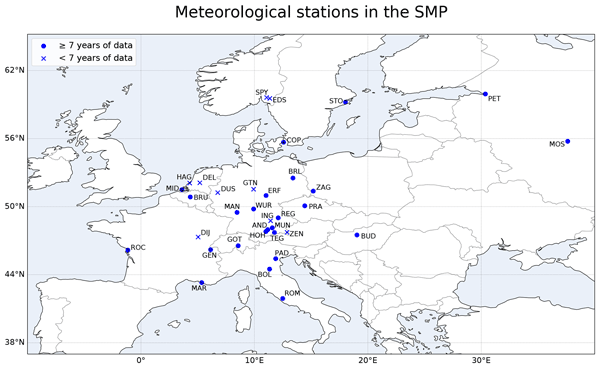
This paper presents temperature and pressure measurements from the 37 stations of the late 18th century network of the Societas Meteorologica Palatina, in addition to providing an inventory of the available observations, most of which have been digitised. The quality of the recovered series is relatively good, as demonstrated by two case studies. Early instrumental data such as these will help to explore past climate and weather extremes in Europe in greater detail.
Garima Singh, Rajmund Przybylak, Andrzej Araźny, Konrad Chmist, and Przemysław Wyszyński
EGUsphere, https://doi.org/10.5194/egusphere-2026-4842, https://doi.org/10.5194/egusphere-2026-4842, 2026
This preprint is open for discussion and under review for Climate of the Past (CP).
Short summary
Short summary
This study aims to determine the thermal conditions on the Labrador coast during the late 19th and early 20th centuries, which is crucial for understanding past Arctic climate change and its causes. It also helps estimate natural climate variability and distinguish it from human influence on present and future climate change. The analysis shows clear warming from the historical periods to the present.
Babak Ghazi, Rajmund Przybylak, and Piotr Oliński
EGUsphere, https://doi.org/10.5194/egusphere-2026-4965, https://doi.org/10.5194/egusphere-2026-4965, 2026
This preprint is open for discussion and under review for Climate of the Past (CP).
Short summary
Short summary
This study presents the first comprehensive assessment of heavy and extreme precipitation in Poland from the 12th to 18th centuries based on historical written records. We identified 477 events, most frequently in summer and in Silesia and northern Poland. Many caused damage without reported flooding. The findings provide a long-term perspective on past precipitation extremes and a valuable baseline for assessing present and future rainfall risks.
Konrad Chmist, Garima Singh, Andrzej Araźny, Rajmund Przybylak, and Przemysław Wyszyński
Clim. Past, 22, 1441–1455, https://doi.org/10.5194/cp-22-1441-2026, https://doi.org/10.5194/cp-22-1441-2026, 2026
Short summary
Short summary
The currently observed climate changes are most intense in the Arctic region. This study utilized some of the oldest existing meteorological measurement series in this region. Atmospheric pressure and anemological conditions were analysed and then compared with contemporary measurements. This showed that the weakest low and strongest high systems occur in the same months. Prevailing wind directions have also remained unchanged, while the northerly wind carries less frigid air than in the past.
Rajmund Przybylak, Aleksandra Pospieszyńska, and Piotr Oliński
Clim. Past, 22, 1383–1400, https://doi.org/10.5194/cp-22-1383-2026, https://doi.org/10.5194/cp-22-1383-2026, 2026
Short summary
Short summary
The article discusses (i) a recently discovered series of meteorological measurements (air temperature, precipitation, pressure, humidity, wind direction, and force) taken in Wrocław, South-Western Poland, from 1773–81, and (ii) an analysis of air temperature. This unique, quality-controlled series, verified against data from Silesia (Żagań and Jelenia Góra) and Warsaw, extends Wrocław's regular temperature records back to 1773, previously starting in 1791.
Rajmund Przybylak, Janusz Filipiak, Piotr Oliński, Babak Ghazi, and Andrzej Araźny
EGUsphere, https://doi.org/10.5194/egusphere-2026-3524, https://doi.org/10.5194/egusphere-2026-3524, 2026
Short summary
Short summary
This article extends the database of strong wind events in Poland (1001–1600) using 17th-century documentary evidence. A total of 525 events were identified, most occurring in the second half of the century. Strong winds were least frequent in summer, while their occurrence was relatively similar across the other seasons. Temporal variability in the frequency of strong wind events in Poland in the 17th century was more consistent with patterns observed in Northern Europe than in Southern Europe.
Rajmund Przybylak, Andrzej Araźny, Przemysław Wyszyński, Garima Singh, and Konrad Chmist
Clim. Past, 22, 957–974, https://doi.org/10.5194/cp-22-957-2026, https://doi.org/10.5194/cp-22-957-2026, 2026
Short summary
Short summary
This study presents and analyses a newly discovered unique series of meteorological measurements from Greenland, covering the period 1806–1813. This record, the longest instrumental dataset from the Arctic before 1840, provides valuable information for improving knowledge about the climate of that period. The analysis shows that it was one of the coldest intervals in the past two millennia. Intense volcanic activity and low solar activity are proposed as the main reasons for this cold period.
Peter Stucki, Stefan Brönnimann, Noemi Imfeld, Lucas Pfister, Conall E. Ruth, Yannis V. Schmutz, Yuri Brugnara, Martin Wegmann, Rajmund Przybylak, and Janusz Filipiak
Clim. Past, 22, 517–540, https://doi.org/10.5194/cp-22-517-2026, https://doi.org/10.5194/cp-22-517-2026, 2026
Short summary
Short summary
We test nine reconstructions of Europe’s hot summer of 1807, using weather records, reanalyses, machine-learning (ML), and data assimilation. Most approaches match observed temperature and pressure well. Approaches based on physics of atmospheric flow capture weather patterns well, while ML approaches better reflect station records. Ingestion of accurate records from new regions improves the reconstructions markedly. In all, the approaches provide new insights to pre-industrial extreme weather.
Rajmund Przybylak, Andrzej Araźny, Janusz Filipiak, Piotr Oliński, Przemysław Wyszyński, and Artur Szwaba
Clim. Past, 21, 1501–1519, https://doi.org/10.5194/cp-21-1501-2025, https://doi.org/10.5194/cp-21-1501-2025, 2025
Short summary
Short summary
A comprehensive database of strong winds up until AD 1600 was created based on documentary evidence for the area within the modern-day borders of Poland. Three types of documentary sources were used: handwritten and unpublished, published, and “secondary” literature. The database contains detailed information about occurrences of strong wind (the location, time, duration and indexation for intensity, extent and character of damage) and the exact textual content of the original weather note.
Garima Singh, Rajmund Przybylak, Przemysław Wyszyński, Andrzej Araźny, and Konrad Chmist
Clim. Past, 21, 877–895, https://doi.org/10.5194/cp-21-877-2025, https://doi.org/10.5194/cp-21-877-2025, 2025
Short summary
Short summary
This study aims to determine the nature of the climate in Labrador in historical times (late 18th century), which is crucial to understanding past climate changes in the Arctic and their causes. It is equally important to estimate the range of natural climate variability, which can help in correctly recognizing the causes of present and future climate changes – especially the influence of humans on climate. The analysis shows a significant warming from historical to present times.
Rajmund Przybylak, Garima Singh, Przemysław Wyszyński, Andrzej Araźny, and Konrad Chmist
Clim. Past, 20, 1451–1470, https://doi.org/10.5194/cp-20-1451-2024, https://doi.org/10.5194/cp-20-1451-2024, 2024
Short summary
Short summary
The purpose of this study is to recognise the nature of the climate in historical times (second half of 18th century) in Greenland. Such knowledge is important for validating Greenland temperature reconstructions based on both modelling works and various proxies. The two unique series of old meteorological observations from Greenland we used indicated that temperature in the study period was comparable to that of the early 20th-century Arctic warming but lower than that of the present day.
Rajmund Przybylak, Piotr Oliński, Marcin Koprowski, Elżbieta Szychowska-Krąpiec, Marek Krąpiec, Aleksandra Pospieszyńska, and Radosław Puchałka
Clim. Past, 19, 2389–2408, https://doi.org/10.5194/cp-19-2389-2023, https://doi.org/10.5194/cp-19-2389-2023, 2023
Short summary
Short summary
The present paper upgrades our knowledge of Poland’s climate in the period 1001–1500 using multiproxy data. Four new climate reconstructions have been constructed – three based on dendrochronological data (since the 12th century) and one on documentary evidence (since the 15th century). The results should help improve the knowledge of climate change in Europe, particularly in central Europe.
Rudolf Brázdil, Petr Dobrovolný, Christian Pfister, Katrin Kleemann, Kateřina Chromá, Péter Szabó, and Piotr Olinski
Clim. Past, 19, 1863–1890, https://doi.org/10.5194/cp-19-1863-2023, https://doi.org/10.5194/cp-19-1863-2023, 2023
Short summary
Short summary
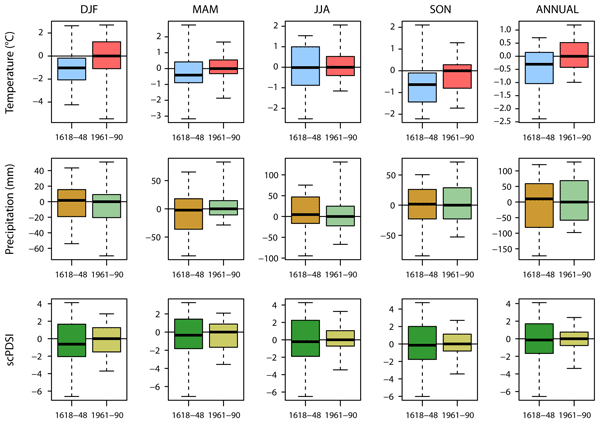
The Thirty Years' War (from 1618 to 1648 CE), an armed military conflict in Europe, brought extensive devastation to Europe. The paper analyses annual and seasonal temperature, precipitation, and drought patterns, as well as severe weather extremes, based particularly on documentary data, during this event in central Europe to demonstrate their broad impacts on human society and human responses in coincidence with weather and climate during this period of hardship.
Duncan Pappert, Mariano Barriendos, Yuri Brugnara, Noemi Imfeld, Sylvie Jourdain, Rajmund Przybylak, Christian Rohr, and Stefan Brönnimann
Clim. Past, 18, 2545–2565, https://doi.org/10.5194/cp-18-2545-2022, https://doi.org/10.5194/cp-18-2545-2022, 2022
Short summary
Short summary
We present daily temperature and sea level pressure fields for Europe for the severe winter 1788/1789 based on historical meteorological measurements and an analogue reconstruction approach. The resulting reconstruction skilfully reproduces temperature and pressure variations over central and western Europe. We find intense blocking systems over northern Europe and several abrupt, strong cold air outbreaks, demonstrating that quantitative weather reconstruction of past extremes is possible.
Duncan Pappert, Yuri Brugnara, Sylvie Jourdain, Aleksandra Pospieszyńska, Rajmund Przybylak, Christian Rohr, and Stefan Brönnimann
Clim. Past, 17, 2361–2379, https://doi.org/10.5194/cp-17-2361-2021, https://doi.org/10.5194/cp-17-2361-2021, 2021
Short summary
Short summary
This paper presents temperature and pressure measurements from the 37 stations of the late 18th century network of the Societas Meteorologica Palatina, in addition to providing an inventory of the available observations, most of which have been digitised. The quality of the recovered series is relatively good, as demonstrated by two case studies. Early instrumental data such as these will help to explore past climate and weather extremes in Europe in greater detail.
Cited articles
Balanzategui, D., Knorr, A., Heussner, K.-U., Wazny, T., Beck, W., Słowiński, M., Helle, G., Buras, A., Wilmking, M., Van Der Maaten, E., Scharnweber, T., Dorado-Liñán, I., and Heinrich, I.: An 810-year history of cold season temperature variability for northern Poland, Boreas, 47, 443–453, https://doi.org/10.1111/bor.12274, 2018.
Bokwa, A. and Limanówka, D.: Weather observations carried by Michałof Wiślica in Cracow in the years 1527–1551, Prace Geograficzne, 105, 9–17, 2000.
Bokwa, A., Limanówka, D., and Wibig, J.: Pre-instrumental weather observations in Poland in the 16th and 17th centuries, in: History and Climate, Memories of the Future, edited by: Jones, P. D., Ogilvie, A. E. J., Davies, T. D., and Briffa, K. R., Kluwer Academic Publishers, 9–28, https://doi.org/10.1007/978-1-4757-3365-5_2, 2001.
Bolychevtsev, V. G.: Godnichnyje sloi u duba kak pokazatel' vekovykh ciklov kolebanij klimata (Annual ring of oak as evidence of secular climatic cycles), Lesovedenie, 1, 15–23, 1970.
Bradley, R. S. and Jones, P. D.: “Little Ice Age” summer temperature variations: their nature and relevance to recent global warming trends, Holocene, 3, 367–376, 1993.
Bradley, R. S., Hughes, M. K., and Diaz, H. F.: Climate in Medieval time, Science, 302, 404–405, 2003.
Brázdil, R.: Climatic fluctuations in the Czech lands during the Last Millennium, GeoJournal, 32, 199–205, 1994.
Brázdil, R., Pfister, C., Wanner, H., von Storch, H., and Luterbacher, J.: Historical climatology in Europe – the state of the art, Clim. Change, 70, 363–430, https://doi.org/10.1007/s10584-005-5924-1, 2005.
Brázdil, R., Dobrovolný, P., Luterbacher, J., Moberg, A., Pfister, C., Wheeler, D., and Zorita, E.: European climate of the past 500 years: new challenges for historical climatology, Climatic Change, 101, 7–40, https://doi.org/10.1007/s10584-009-9783-z, 2010.
Briffa, K. R.: Interpreting high-resolution proxy climate data – the example of dendroclimatology, in: Analysis of Climate Variability, edited by: von Storch, H. and Navarra, A., Springer, Berlin, Heidelberg, 77–94, https://doi.org/10.1007/978-3-662-03167-4_5, 1995.
Briffa, K. R., Osborn, T. J., Schweingruber, F. H., Harris, I. C., Jones, P. D., Shiyatov, S. G., and Vaganov, E. A.: Low-frequency temperature variations from a northern tree ring density network, J. Geophys. Res., 106D, 2929–2941, 2001.
Brönnimann, S., Allan, R., Ashcroft, L., Baer, S., Barriendos, M., Brázdil, R., Brugnara, Y., Brunet, M., Brunetti, M., Chimani, B., Cornes, R., Domínguez-Castro, F., Filipiak, J., Founda, D., Herrera, R. D., Gergis, J., Grab, S., Hannak, L., Huhtamaa, H., Jacobsen, K. S., Jones, P., Jourdain, S., Kiss, A., Lin, K. E., Lorrey, A., Lundstad, E., Luterbacher, J., Mauelshagen, F., Maugeri, M., Maughan, N., Moberg, A., Neukom, R., Nicholson, S., Noone, S., Nordli, Ø., Ólafsdóttir, K. B., Pearce, P. R., Pfister, L., Pribyl, K., Przybylak, R., Pudmenzky, C., Rasol, D., Reichenbach, D., Řezníčková, L., Rodrigo, F. S., Rohr, C., Skrynyk, O., Slonosky, V., Thorne, P., Valente, M. A., Vaquero, J. M., Westcott, N. E., Williamson, F., and Wyszyński, P: Unlocking pre-1850 instrumental meteorological records: A global inventory, Bull. Am. Meteorol. Soc., 100, ES389–ES413, https://doi.org/10.1175/BAMS-D-19-0040.1, 2019.
Bunn, A. G.: A dendrochronology program library in R (dplR), Dendrochronologia, 26, 115–124, https://doi.org/10.1016/j.dendro.2008.01.002, 2008.
Büntgen, U., Raible, C., Frank, D., Helama, S., Cunningham, L., Hofer, D., Nievergelt, D., Verstege, A., Stenseth, N., and Esper, J.: Causes and consequences of past and projected Scandinavian summer temperatures, 500–2100 AD, PLoS ONE, 6, e25133, https://doi.org/10.1371/journal.pone.0025133, 2011.
Cook, E. and Kairiukstis, L.: Methods of dendrochronology. Applications in the environmental sciences, Springer, Dordrecht, 351 pp., https://doi.org/10.1007/978-94-015-7879-0, 1990.
Cook, E., Krusic, P., and Melvin, T. M.: Program RCSigFree, Lamont-Doherty Earth Observatory, Columbia University, Palisades, https://lamont.columbia.edu/ (last access: 10 June 2024), 2014.
Cook, E. R.: A Time Series Analysis Approach to Tree-ring Standardization, The University of Arizona, Tucson, 170 pp., https://ltrr.arizona.edu/sites/ltrr.arizona.edu/files/bibliodocs/CookER-Dissertation.pdf (last access: 17 November 2023), 1985.
Crowley, T. J. and Lowery, T. S.: How warm was the Medieval Warm Period?, Ambio, 29, 51–54, 2000.
Dobrovolný, P., Moberg, A., Brázdil, R., Pfister, C., Glaser, R., Wilson, R., van Engelen, A., Limanówka, D., Kiss, A., Halíčková, M., Macková, J., Riemann, D., Luterbacher, J., and Böhm, R.: Monthly, seasonal and annual temperature reconstructions for Central Europe derived from documentary evidence and instrumental records since AD 1500, Climatic Change, 101, 69–107, 2010.
Dujesiefken, D. and Bauch, J.: Biologische Charakterisierung von Eichenholz mit Mondringen, Holz Roh. Werkst., 45, 365–370, 1987.
Dujesiefken, D. and Liese W.: Vorkommen und Entstehung der mondringe (Quercus spp.), Forstwiss. Centralbl., 105, 137–155, 1986.
Dzbeński, W. and Krutul, D.: Fizyko-chemiczne właściwości drewna dębowego z wewnętrznym bielem, Materiały XVII Sympozjum “Ochrona drewna”, 127–134, 1994.
Esper, J., Krusic, P. J., Ljungqvist, F. C., Luterbacher, J. Carrer, M., Cook, E., Davi, N. K., Hartl-Meier, C., Kirdyanov, A., Konter, O., Myglan, V., Timonen, M., Treydte, K., Trouet, V., Villalba, R., Yang, B., and Büntgen, U.: Ranking of tree-ring based temperature reconstructions of the past millennium, Quaternary Sci. Rev., 145, 134–151, https://doi.org/10.1016/j.quascirev.2016.05.009, 2016.
Frank, D., Esper, J., and Cook, E.: Adjustment for proxy number and coherence in a large-scale temperature reconstruction, Geophys. Res. Lett., 34, L16709, https://doi.org/10.1029/2007GL030571, 2007.
Fritts, H. C.: Tree-ring and climate, Academic Press, London, New York, San Francisko, 567 pp., ISBN 978-1930665392, 1976.
Ghazi, B., Przybylak, R., Oliński, P., Chorążyczewski, W., and Pospieszyńska, A.: An assessment of flood occurrences in Poland in the 16th century, Journal of Hydrology: Regional Studies, 50, 101597, https://doi.org/10.1016/j.ejrh.2023.101597, 2023.
Ghazi, B., Przybylak, R., Oliński, P., and Pospieszyńska, A.: Flood occurrences and characteristics in Poland (Central Europe) in the last millennium, Global Planet. Change, 246, 104706, https://doi.org/10.1016/j.gloplacha.2025.104706, 2025.
Girguś, R. and Strupczewski, W.: Wyjątki ze źródeł historycznych o nadzwyczajnych zjawiskach hydrologiczno-meteorologicznych na ziemiach polskich w wiekach od X do XVI. Wydawnictwa Komunikacji i Łączności, Warszawa, https://tezeusz.pl/wyjatki-ze-zrodel-historycznych-o-nadzwyczajnych-zjawiskach-hydrologiczno-meteorologicznych-na-ziemiach-polskich-w-wiekach-od-x-do-xvi-r-girgus-oprac-7234885 (last access: 2 July 2026), 1965.
Glaser, R.: Klimageschichte Mitteleuropas: 1000 Jahre Wetter, Klima, Katastrophen, Primus Verlag, Darmstadt, 227 pp., ISBN 978-3-89678-405-6, 2001.
Glaser, R. and Riemann, D.: A thousand-year record of temperature variations for Germany and Central Europe based on documentary data, J. Quaternary Sci., 24, 437–449, https://doi.org/10.1002/jqs.1302, 2009.
Glaser, R., Brázdil, R., Pfister, C., Dobrovolný, P., Barriendos Vallvé, M., Bokwa, A., Camuffo, D., Kotyza, O., Limanówka, D., Rácz, L., and Rodrigo, F. S.: Seasonal temperature and precipitation fluctuations in selected parts of Europe during the sixteenth century, Clim. Change, 43, 169–200, 1999.
Gorczynski, L.: Sur le calcul du degré du continentalisme et son application dans la climatologie, Geogr. Ann., 2, 324–331, 1920.
Grove, J.: The onset of the Little Ice Age, in: History and Climate: Memories of the Future?, edited by: Jones, P. D., Ogilvie, A. E. J., Davies, T. D., and Briffa, K. R., Kluwer Academic/Plenum Publishers, New York, Boston, Dordrecht, London, Moscow, 153–185, ISBN 9781475733655, 2001.
Grove, J. M.: The Little Ice Age, Methuen & Co., London, 498 pp., ISBN 0-416-31540-2, 1988.
Guiot, J.: The combination of historical documents and biological data in the reconstruction of climate variations in space and time, in: European Climate Reconstructed from Documentary Data: Methods and Results, edited by: Frenzel, B., Pfister, C., and Gläser, B. Gustav Fischer Verlag, Stuttgart, Jena, New York, 93–104, ISBN 9781560813613, 1992.
Hernández-Almeida, I., Grosjean, M., Przybylak, R., and Tylmann, W.: A chrysophyte-based quantitative reconstruction of winter severity from varved lake sediments in NE Poland during the past millennium and its relationship to natural climate variability, Quat. Sci. Rev., 122, 74–88, https://doi.org/10.1016/j.quascirev.2015.05.029, 2015.
Hernández-Almeida, I., Grosjean, M., Gómez-Navarro, J. J., Larocque-Tobler, I., Bonk, A., Enters, D., Ustrzycka, A., Piotrowska, N., Przybylak, R., Wacnik, A., Witak, M., and Tylmann, W.: Resilience, rapid transitions and regime shifts: Fingerprinting the responses of Lake Żabińskie (NE Poland) to climate variability and human disturbance since AD 1000, Holocene, 27, 258–270, https://doi.org/10.1177/0959683616658529, 2017.
Holmes, R. L.: Computer-assisted quality control in tree-ring dating and measurement, Tree-Ring Bull., 43, 69–78, 1983.
Huber, B. and Giertz-Siebenlist, V.: Unsere tausendjährige Eichen-Jahrringchronologie durchschnittlich 57 (10–150) – fach belegt, Sitzungsberichte Österreichische Akad. der Wissenschaften, Math. Klasse, 57, 37–42, 1969.
Hughes, M. K. and Diaz, H. F. (Eds.): The Medieval Warm Period, Springer Netherlands, Dordrecht, https://doi.org/10.1007/978-94-011-1186-7, 1994.
Jones, P. D. and Mann, M. E.: Climate over past millennia, Rev. Geophys., 42, RG2002, https://doi.org/10.1029/2003RG000143, 2004.
Jones, P. D., Briffa, K. R., Barnett, T. P., and Tett, S. F. B.: High resolution palaeoclimatic records for the last millennium: interpretation, integration and comparison with General Circulation Model control-run temperatures, Holocene, 8, 455–471, 1998.
Jones, P. D., Osborn, T. J., and Briffa, K. R.: The evolution of climate over the last millennium, Science, 292, 662–667, https://doi.org/10.1126/science.1059126, 2001.
Koprowski, M., Przybylak, R., Zielski, A., and Pospieszyńska, A.: Tree rings of Scots pine (Pinus sylvestris L.) as a source of information about past climate in northern Poland, Int. J. Biometeorol., 56, 1–10, https://doi.org/10.1007/s00484-010-0390-5, 2012.
Kożuchowski, K. and Marciniak, K.: Zmiany kontynentalizmu termicznego klimatu Polski, Wiadomości IMGW, 1985.
Krąpiec, M.: Oak Dendrochronology of the Neoholocene in Poland, Folia Quarteria, 69, 5–133, 1998.
Krąpiec, M.: Occurrence of Moon Rings in Oak from Poland During the Holocene, in: Tree Ring Analysis, Biological, Methodological and Environmental Aspects, edited by: Wimmer, R. and Vetter, R., CAB Int., 193–203, ISBN 978-0851993126, 1999.
Kuhn, B. F.: Versuch für den Mechanismus der Gletscher, Hopfners Magazin, 1, 119–136, 1787.
Lamb, H.: Climate: Present, Past and Future, in: vol. 2: Climatic History and the Future, Methuen, London, 835 pp., ISBN 9780415682237, 1977.
Lamb, H.: Climate in the last thousand years: Natural climatic fluctuations and change, in: The Climate of Europe: Past, Present and Future, edited by: Flohn, H. and Fantechi, R., D. Reidel Publishing Company, Dordrecht, Boston, Lancaster, 25–64, ISBN 9027717451, 1984.
Lee, H. F. and Zhang, D. D.: Quantitative analysis of climate change and human crises in history, in: Space-Time Integration in Geography and GIScience, edited by: Richardson, K. M.-P., Wang, D., and Zhou, C., Springer Science+Business Media Dordrecht, 235–267, https://doi.org/10.1007/978-94-017-9205-9_14, 2015.
Limanówka, D.: Rekonstrukcja warunków klimatycznych Krakowa w pierwszej polowie XVI wieku, Instytut Meteorologii i Gospodarki Wodnej, Warszawa, Materiały Badawcze IMGW, Ser. Meteorologia, 33, 176 pp., ISBN 0239-6262, 2001.
Ljungqvist, F. C.: A new reconstruction of temperature variability in the extra-tropical Northern Hemisphere during the last two millennia, Geogr. Ann. Ser. A, Phys. Geogr., 92, 339–351, 2010.
Lorenc, H.: Studia nad 220-letnia (1779–1998) seria temperatury powietrza w Warszawie oraz ocena jej wiekowych tendencji (Studies on 220-year-old (1779–1998) series of air temperature in Warsaw and assessment of its tendencies), Materiały Badawcze IMGW, seria: Meteorologia, 31, 1–104, https://books.google.com/books/about/Studia_nad_220_letni%C4%85_1779_1998_seri%C4%85.html?id=wrAZHAAACAAJ (last access: 2 July 2026), 2000.
Luterbacher, J., Dietrich, D., Xoplaki, E., Grosjean, M., and Wanner, H.: European seasonal and annual temperature variability, trends and extremes since 1500, Science, 303, 1499–1503, https://doi.org/10.1126/science.1093877, 2004.
Luterbacher, J., Xoplaki, E., Kilttel, M., Zorita, E., Gonzalez-Rouco, J. F., Jones, P. D., Stossel, M., Rutishauser, T., Wanner, H., Wibig, J., and Przybylak, R.: Climate Change in Poland in the Past Centuries and Its Relationship to European Climate: Evidence From Reconstructions and Coupled Climate Models, in: The Polish Climate in the European Context: An Historical Overview, edited by: Przybylak, R., Majorowicz, J., Brázdil, R., and Kejna, M., Springer, Berlin, Heidelberg, New York, 3–39, https://doi.org/10.1007/978-90-481-3167-9, 2010.
Luterbacher, J., Werner, J. P., Smerdon, J. E., Fernández-Donado, L., González-Rouco, F. J., Barriopedro, D., Ljungqvist, F. C., Büntgen, U., Zorita, E., Wagner, S., Esper, J., McCarroll, D., Toreti, A., Frank, D., Jungclaus, J. H., Barriendos, M., Bertolin, C., Bothe, O., Brázdil, R., Camuffo, D., Dobrovolný, P., Gagen, M., García-Bustamante, E., Ge, Q., Gómez-Navarro, J. J., Guiot, J., Hao, Z., Hegerl, G. C., Holmgren, K., Klimenko, V. V, Martín-Chivelet, J., Pfister, C., Roberts, N., Schindler, A Schurer, A., Solomina, O., von Gunten, L., Wahl, E., Wanner, H., Wetter, O., Xoplaki, E., Yuan, N., Zanchettin, D., Zhang, H., and Zerefos, C.: European summer temperatures since Roman times, Environ. Res. Lett., 11, 24001, https://doi.org/10.1088/1748-9326/11/2/024001, 2016.
Majorowicz, J., Šafanda, J., Przybylak, R., and Wójcik, G.: Ground surface temperature history in Poland in the 16th–20th centuries derived from the inversion of geothermal profiles, Pure Appl. Geophys. 161, 351–363, 2004.
Mann, M. E., Bradley, R. S., and Hughes, M. K.: Northern hemisphere temperatures during the past millennium: Inferences, uncertainties, and limitations, Geophys. Res. Lett., 26, 759–762, https://doi.org/10.1029/1999GL900070, 1999.
Mann, M. E., Zhang, Z., Hughes, M. K., Bradley, R. S., Miller, S. K., Rutherford, S., and Ni, F.: Proxy-based reconstructions of hemispheric and global surface temperature variations over the past two millennia, P. Natl. Acad. Sci. USA, 105, 13252–13257, https://doi.org/10.1073/pnas.0805721105, 2008.
Mann, M. E., Zhang, Z., Rutherford, S., Bradley, R. S., Hughes, M. K., Shindell, D., Ammann, C., Faluvegi, G., and Ni, F.: Global signatures and dynamical origins of the Little Ice Age and medieval climate anomaly, Science, 326, 1256–1260, https://doi.org/10.1126/science.1177303, 2009.
Maruszczak, H.: Zmiany środowiska przyrodniczego kraju w czasach historycznych, in: Przemiany środowiska geograficznego, edited by Starkel, L., Wszechnica PAN, Ossolineum, 109–135, ISBN 8304027887, 1988.
Maruszczak, H.: Tendencje do zmian klimatu w ostatnim tysiącleciu, in: Geografia Polski – środowisko przyrodnicze, edited by: Starkel, L., PWN, Warszawa, 182–190, ISBN 83-01-09621-7, 1991.
Melvin, T. and Briffa, K.: A “signal-free” approach to dendroclimatic standardisation, Dendrochronologia, 26, 71–86, https://doi.org/10.1016/j.dendro.2007.12.001, 2008.
Moberg, A., Sonechkin, D. M., Holmgren, K., Datsenko, N. M., and Karlen, W.: Highly variable Northern Hemisphere temperatures reconstructed from low- and high-resolution proxy data, Nature, 433, 613–617, https://doi.org/10.1038/nature03265, 2005.
Niedźwiedź, T., Glaser, R., Hansson, D., Helama, S., Klimenko, V., Łupikasza, E., Małarzewski, Ł., Nordli, Ø., Przybylak, R., Riemann, D., and Solomina, O.: The historical time frame (past 1000 years), in: Second assessment of climate change for the Baltic Sea Basin, edited by: BACC_II_Author_Team, Springer, Berlin, Germany, 51–65, https://doi.org/10.1007/978-3-319-16006-1, 2015.
Nowosad, W. and Oliński, P.: The extreme year of 1540 in terms of climate variation from the perspective of historical sources derived from the Polish and Baltic territories, in: The dance of death in Late Medieval and Renaissance Europe, environmental stress, mortality and social response, edited by: Kiss, A. and Pribyl, K., Routledge, London, 146–155, ISBN 9780429956836, 2020.
Oliński, P.: Pogoda i klimat regionów południowobałtyckich od końca XIV wieku do początków XVI w. w źródłach narracyjnych, Wydawnictwo Naukowe Uniwersytetu Mikołaja Kopernika, 299 pp., ISBN 978-83-231-4935-4, https://doi.org/10.12775/978-83-231-4936-1, 2022.
Opała-Owczarek, M., Niedźwiedź, T., Przybylak, R., and Tylmann, W.: Climate Change Before Instrumental Measurements, in: Climate Change in Poland, edited by: Falarz, M., Springer, 71–119, https://doi.org/10.1007/978-3-030-70328-8_5, 2021.
Ortega, P., Lehner, F., Swingedouw, D., Masson-Delmotte, V., Raible, C., Casado, M., and Yiou, P.: A model-tested North Atlantic Oscillation reconstruction for the past millennium, Nature, 523, 71–74, https://doi.org/10.1038/nature14518, 2015.
Osborn, T. J., Briffa, K. R., and Jones, P. D.: Adjusting variance for sample-size in tree-ring chronologies and other regional-mean time series, Dendrochronologia, 15, 88–99, 1997.
Pfister, C.: The “Black Swan” of 1540: Aspects of a European Megadrought, in: Climatic Change and Cultural Transition in Europe, edited by: Leggewie, C. and Mauelshagen, F., Brill, Leiden, 156–193, https://doi.org/10.1163/9789004356825_007, 2018.
Pfister, C. and Brázdil, R.: Climatic variability in sixteenth-century Europe and its societal dimension: A synthesis, Climatic Change, 43, 5–53, https://doi.org/10.1023/A:1005585931899, 1999.
Pfister, C., Kington, J., Kleinlogel, G., Schule, H., and Siffert, E.: High resolution spatio-temporal reconstructions of past climate from direct meteorological observations and proxy-data, in: Climatic Trends and Anomalies in Europe 1675–1715, edited by: Frenzel, B. and Pfister, C., Gustav Fisher Verlag, Stuttgart, 329–375, ISBN 3437307746, 1994.
Pfister, C., Brázdil, R., Glaser, R., Bokwa, A., Holawe, F., Limanówka, D., Kotyza, O., Munzar, J., Rácz, L., Strömmer, E., and Schwarz-Zanetti,G.: Daily weather observations in sixteenth-century Europe, Clim. Change, 43, 111–150, https://doi.org/10.1023/A:1005505113244, 1999a.
Pfister, C., Brázdil, R., Glaser, R., Barriendos, M., Camuffo, D., Deutsch, M., Dobrovolný, P., Enzi, S., Guidoboni, E., Kotyza, O., Militzer, S., Rácz, L., and Rodrigo, F. S.: Documentary evidence on climate in sixteenth-century Europe, Clim. Change, 43, 55–110, https://doi.org/10.1023/A:1005540707792, 1999b.
Przybylak, R.: Changes in Poland's climate over the last millennium, Czas. Geogr., 82, 23–48, 2011.
Przybylak, R.: Poland's Climate in the Last Millennium, in: Oxford Research Encyclopedia, Climate Science, Oxford University Press, USA, https://doi.org/10.1093/acrefore/9780190228620.013.2, 2016.
Przybylak, R., Majorowicz, J., and Wójcik, G.: Changes of air temperature and atmospheric precipitation in Poland from the 16th to the 20th century, Prace i Stud. Geogr., 29, 79–92, 2001.
Przybylak, R., Wójcik, G., and Marciniak, K.: Wpływ Oscylacji Północnoatlantyckiej i Arktycznej na warunki termiczne chłodnej pory roku w Polsce w XVI-XX wiekach (The influence of the North Atlantic oscillation and Arctic oscillation on thermal conditions in the cold season in Poland from the 16th to 20th centuries), Przegląd Geofizyczny, XLVIII, 61–74, https://ptgeof.pl/wp-content/uploads/2024/01/PG-2003_1-2.pdf (last access: 2 July 2026), 2003.
Przybylak, R., Wójcik, G., Marciniak, K., Chorążyczewski, W., Nowosad, W., Oliński, P., and Syta, K.: Zmienność warunków termiczno-opadowych w Polsce w okresie 1501–1840 w świetle danych historycznych (Variability of thermal and precipitation conditions in Poland in the period 1501–1840 in the light of historical data), Przegląd Geograficzny, 76, 5–31, 2004.
Przybylak, R., Majorowicz, J., Wójcik, G., Zielski, A., Chorążyczewski, W., Marciniak, K., Nowosad, W., Oliński, P., and Syta, K.: Temperature changes in Poland from the 16th to the 20th centuries, Int. J. Climatol., 25, 773–791, https://doi.org/10.1002/joc.1149, 2005.
Przybylak, R., Pospieszyńska, A., Wyszyński, P., and Nowakowski, M.: Air temperature changes in Zagan (Poland) in the period from 1781 to 1792, Int. J. Climatol., 34, 2408–2426, 2014.
Przybylak, R., Oliński, P., Koprowski, M., Filipiak, J., Pospieszyńska, A., Chorążyczewski, W., Puchałka, R., and Dąbrowski, H. P.: Droughts in the area of Poland in recent centuries in the light of multi-proxy data, Clim. Past, 16, 627–661, https://doi.org/10.5194/cp-16-627-2020, 2020.
Przybylak, R., Oliński, P., Koprowski, M., Szychowska-Krąpiec, E., Krąpiec, M., Pospieszyńska, A., and Puchałka, R.: The climate in Poland (central Europe) in the first half of the last millennium, revisited, Clim. Past, 19, 2389–2408, https://doi.org/10.5194/cp-19-2389-2023, 2023.
Przybylak, R., Araźny, A., Filipiak, J., Oliński, P., Wyszyński, P., and Szwaba, A.: Strong wind occurrence in Poland from the 13th to 16th centuries based on documentary evidence, Clim. Past, 21, 1501–1519, https://doi.org/10.5194/cp-21-1501-2025, 2025.
Ptak, M., Przybylak, R., Wyszyński, P., and Sojka, M.: Twentieth Century Reanalysis version 3 as a source of information on long-term trends (1806–2022) in lake surface water temperature changes in Central Europe (Poland), Sci. Rep., 15, 43833, https://doi.org/10.1038/s41598-025-28581-7, 2025.
R CoreTeam: R: A language and environment for statistical computing, R Foundation for Statistical Computing, Vienna, Austria, http://www.R-project.org/ (last access: 17 November 2023), 2022.
Sadowski, M.: Variability of extreme climatic events in Central Europe since the 13th century, Z. Meteorol., 41, 350–356, 1991.
Schweingruber, F. H.: Event years and pointer years, Lundqua Rep., 34, 288–292, 1992.
Szychowska-Krąpiec, E.: Long-term chronologies of pine (Pinus sylvestris L.) and fir (Abies alba Mill.) from the Małopolska region and their palaeoclimatic interpretation, Folia Quat., 79, 1–124, 2010.
Toohey, M. and Sigl, M.: Reconstructed volcanic stratospheric sulfur injections and aerosol optical depth, 500 BCE to 1900 CE, version 2, World Data Center for Climate (WDCC) at DKRZ, https://doi.org/10.1594/WDCC/eVolv2k_v2, 2017.
Topolski, J.: Historia Polski, Wydawnictwo Poznańskie, Poznań, 384 pp., ISBN 978-83-7976-269-9, 2015.
Ustrnul, Z., Wypych, A., and Czekierda, D.: Air Temperature change, in: Climate Change in Poland: Past, Present, Future, edited by: Falarz, M., Springer, 275–330, https://doi.org/10.1007/978-3-030-70328-8_11, 2021.
Valler, V., Franke, J., Brugnara, Y., Samakinwa, E., Hand, R., Lundstad, E., Burgdorf, A.-M., Lipfert, L., Friedman, A. R., and Brönnimann S.: ModE-RA: a global monthly paleoreanalysis of the modern era 1421 to 2008, Sci. Data, 11, 36, https://doi.org/10.1038/s41597-023-02733-8, 2024.
van Engelen, A. F., Buisman, V. J., and Ijnsen, F.: A millennium of weather, winds and water in the Low Countries, in: History and Climate, edited by: Jones, P. D. and Ogilvie, A., Kluwer Academic/Plenum Publishers, 101–124, https://doi.org/10.1007/978-1-4757-3365-5_6, 2001.
Walawender, A.: Kronika klęsk elementarnych w Polsce i w krajach sąsiednich w l. 1450–1586, Kasa im. Rektora J. Mianowskiego – Instytut Popierania Polskiej Twórczości Naukowej, Lwów, Warszawa, https://kpbc.umk.pl/dlibra/publication/265489/edition/262862?language=en (last access: 2 July 2026), 1932.
Waszak, N., Robertson, I., Puchałka, R., Przybylak, R., Pospieszyńska, A., and Koprowski, M.: Investigating the Climate – Growth Response of Scots Pine (Pinus sylvestris L.) in Northern Poland, Atmosphere, 12, 1690, https://doi.org/10.3390/atmos12121690, 2021.
White, S., Pfister, C., and Mauelshagen, F. (Eds.): The Palgrave Handbook of Climate History, Palgrave Macmillan, London, ISBN 978-1-137-43019-9, https://doi.org/10.1057/978-1-137-43020-5, 2018.
Wigley, T., Briffa, K., and Jones, P.: On the average value of correlated time series, with applications in dendroclimatology and hydrometeorology, J. Clim. Appl. Meteorol., 23, 201–213, 1984.
Wójcik, G., Majorowicz, J., Marciniak, K., Przybylak, R., Šafanda, J., and Zielski, A.: The last millennium climate change in northern Poland derived from well temperature profiles, tree-rings and instrumental data, Przegląd. Geograficzny, 107, 137–148, 2000.
Wyczański, A.: Polska – Rzeczą Pospolitą Szlachecką 1454-1764, Państwowe Wydawnictwo Naukowe, Warszawa, 452 pp., ISBN 83-01-10044-3, 1965.
Xoplaki, E., Luterbacher, J., Paeth, H., Dietrich, D., Steiner N., Grosjean, M., and Wanner, H.: European spring and autumn temperature variability and change of extremes over the last half millennium, Geophys. Res. Lett., 32, L15713, https://doi.org/10.1029/2005GL023424, 2005.
Zang, C. and Biondi, F.: treeclim: an R package for the numerical calibration of proxy-climate relationships, Ecography, 38, 431–436, https://doi.org/10.1111/ecog.01335, 2015.
Zander, P. D., Żarczyński, M., Tylmann, W., Vogel, H., and Grosjean, M.: Subdecadal Holocene warm-season temperature variability in Central Europe recorded by biochemical varves, Geophys. Res. Lett., 51, e2024GL110871, https://doi.org/10.1029/2024GL110871, 2024.
Zielony, R. and Kliczkowska A.: Regionalizacja przyrodniczo-leśna Polski, Centrum Informacyjne Lasów Państwowych, Warszawa, ISBN 978-83-61633-62-4, 2012.
Zielski, A.: Uwarunkowania środowiskowe przyrostów radialnych sosny zwyczajnej (Pinus sylvestris L.) w Polsce północnej na podstawie wielowiekowej chronologii, Wydawnictwo UMK, 127 pp., ISBN 83-231-0930-6, 1997.
Zielski, A. and Krąpiec, M.: Dendrochronologia, PWN, Warszawa, 328 pp., ISBN 978-83-01-14226-1, 2004.
Zielski, A., Krąpiec, M., and Koprowski, M.: Dendrochronological Data, in: The Polish Climate in the European Context: An Historical Overview, edited by: Przybylak, R., Majorowicz, J., Brázdil, R., and Kejna, M., Springer, Dordrecht, 191–217, https://doi.org/10.1007/978-90-481-3167-9_7, 2010.
Związek, T., Guzowski, P., Poniat, R., Radomski, M. T., Kozłowska-Szyc, M., Panecki, T., Słowińska, S., Kruczkowska, B., Targowski, M., and Adamska, D.: On the economic impact of droughts in central Europe: the decade from 1531 to 1540 from the Polish perspective, Clim. Past, 18, 1541–1561, https://doi.org/10.5194/cp-18-1541-2022, 2022.
Short summary
The paper provides an updated analysis of Poland's climate, focusing on the 16th century using a multiproxy approach (documentary evidence and dendrochronological data). Newly gathered historical sources and dendrochronological data helped reconstruct five updated mean air temperature series: decadal winter and summer means from documentary evidence, and annual means for winter and late winter–early spring derived from dendrochronological data.
The paper provides an updated analysis of Poland's climate, focusing on the 16th century using a...


