
the Creative Commons Attribution 4.0 License.
the Creative Commons Attribution 4.0 License.
 | 08 Oct 2026
Antarctic sea ice over the past 130 000 years – Part 2: A review of its role in the Earth system

Karen E. Kohfeld
Amy Leventer
David Lund
Xavier Crosta
Laurie Menviel
Helen C. Bostock
Matthew Chadwick
Samuel L. Jaccard
Jacob Jones
Alice Marzocchi
Katrin J. Meissner
Elisabeth Sikes
Louise C. Sime
Luke Skinner
Antarctic sea-ice cover reached historically low levels in 2023, consistent with the simulated decline in sea-ice extent in response to anthropogenic warming. As Antarctic sea ice is closely linked to multiple components of the Earth system, its demise could precipitate widespread, cascading changes across the cryosphere, atmosphere, and ocean. However, the nature and strength of these interconnections remain poorly understood and are often inadequately represented in models. In this review, we combine modern observations, models, and paleoclimate archives spanning the last glacial cycle to examine how reductions in sea ice may affect other components of the Earth system. We review how Antarctic sea ice interacts with ocean and atmosphere circulation, ice sheets and ice shelves, marine productivity, and the carbon cycle. We find evidence from theory and models that Antarctic sea ice exerts important influences on the Earth system. Paleo-proxy reconstructions provide examples in which changes in sea ice co-occur with changes in the carbon cycle, marine productivity, and ocean circulation. However, isolating the specific impact of sea ice remains challenging in such a highly interconnected system.
- Article
(5541 KB) - Full-text XML
- Companion paper
- BibTeX
- EndNote


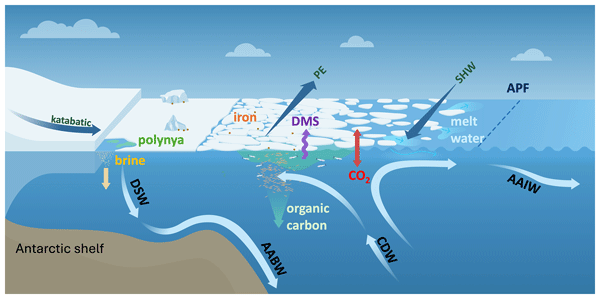
The year 2016 marked the onset of a low Antarctic sea-ice state following a multi-decadal period of increasing sea-ice extent that peaked in 2014 (Purich and Doddridge, 2023). These recent observed changes are consistent with the projected decline in sea ice under anthropogenic warming (e.g. Eayrs et al., 2021; Fox-Kemper et al., 2021). The impacts of ongoing and projected changes in Antarctic sea ice are likely to be widespread and to extend across many components of the Earth system (Abram et al., 2025). This is because sea ice is tightly coupled to the ocean, continental ice, atmosphere, and biosphere (Fig. 1) through large fluxes of heat, salt, and carbon. For example, the magnitude of the freshwater fluxes associated with the annual freeze-melt cycle of Antarctic sea ice exceeds the combined freshwater fluxes associated with precipitation minus evaporation and glacial ice melt in the Southern Ocean (Abernathey et al., 2016).
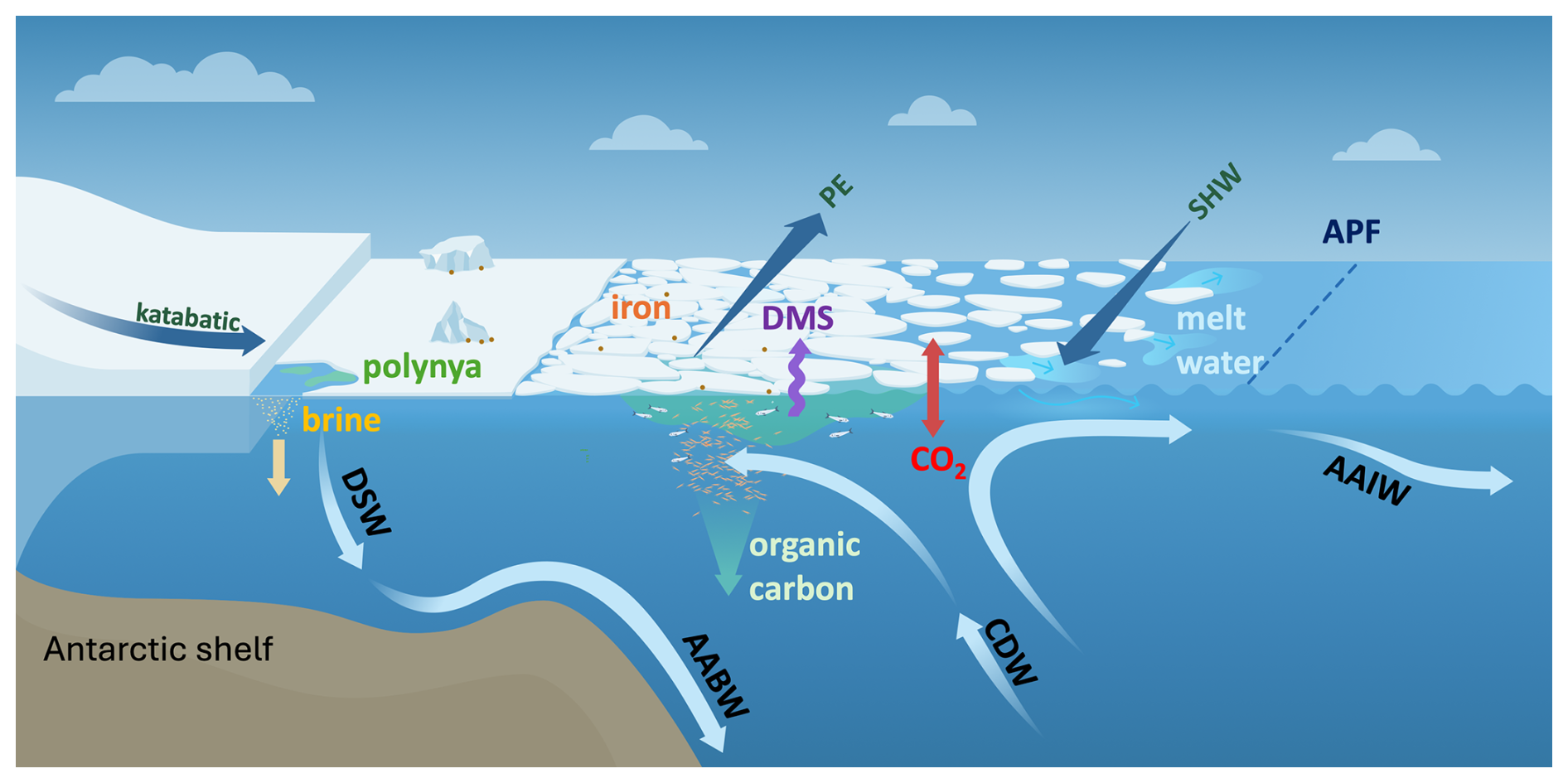
Figure 1Schematic overview of the role of Antarctic sea ice in the Earth system. Shown are major water masses discussed in the text: Circumpolar Deep Water (CDW), which upwells due to surface wind stress; dense shelf water (DSW), which forms Antarctic Bottom Water (AABW), produced through brine rejection during sea-ice production, Antarctic Intermediate Water (AAIW), which is freshened by sea-ice melt. Biogeochemical processes include ice-associated blooms and carbon export stimulated by continental iron delivered by glacial ice and sea ice, the release of dimethyl sulphide (DMS), and air–sea exchange of carbon dioxide (CO2). The major Antarctic wind systems, the katabatic winds, the Polar Easterlies and Southern Hemisphere Westerlies (SHW) are indicated, as well as the oceanic Antarctic Polar Front (APF).
Changes in Antarctic sea ice have been linked to a suite of physical and biogeochemical ocean processes (Fig. 1). Along the Antarctic coast, sea ice can stabilise ice shelves and their associated glaciers (Christie et al., 2022; Ochwat et al., 2024), while also buffering wave energy, thus limiting physical breakup of ice shelves (Massom et al., 2018; Teder et al., 2022, 2025). Through its influence on ocean circulation, changes in sea-ice formation and brine rejection can also affect the delivery of heat to ice-shelf cavities (e.g., Christie et al., 2022; Lauber et al., 2023; Sun et al., 2023). Changes in sea-ice extent and production rate influence the buoyancy fluxes that help drive the Southern Ocean overturning circulation through the formation of Antarctic Bottom Water (AABW) south of the Antarctic Polar Front (APF) and Antarctic Intermediate Water (AAIW) north of the APF (Fig. 1; Abernathey et al., 2016; Pellichero et al., 2018). Sea-ice extent can also affect atmospheric circulation through its influence on albedo and heat exchange between the ocean and atmosphere, thereby altering the position and intensity of the westerly winds (e.g., Raphael et al., 2011).
The influence of sea ice extends to the biosphere. Sea-ice extent and seasonal melt influence the timing and intensity of ice-edge phytoplankton blooms (Giddy et al., 2023), as well as nutrient cycling both locally (e.g., iron, Lannuzel et al., 2016) and remotely, by influencing intermediate water nutrient export to low latitudes (Sarmiento et al., 2004). Sea ice also exerts a capping effect, acting as a lid that reduces oceanic outgassing of carbon dioxide (CO2) (Stephens and Keeling, 2000; Morales Maqueda and Rahmstorf, 2002). Through these physical and biogeochemical processes, sea ice strongly influences ocean carbon uptake and the global carbon cycle (e.g., Gupta et al., 2020; Kurahashi-Nakamura et al., 2007; Shadwick et al., 2021).
Antarctic sea-ice extent is known to have changed dramatically on glacial-interglacial timescales (Chadwick et al., 2022c; Crosta et al., 2022). Marine proxies, largely diatom fossil assemblages, show that winter sea-ice cover around Antarctica expanded to approximately twice its current extent during the Last Glacial Maximum (LGM; 19 000–23 000 years ago or 19–23 ka) (Fig. 2; Gersonde et al., 2005; Lhardy et al., 2021), when sea surface temperatures (SSTs) were an estimated 3.9 ± 1.1 °C colder than present (Chandler and Langebroek, 2021). Summer sea-ice cover likely increased less during the LGM, leading to enhanced seasonality (Green et al., 2022; Lhardy et al., 2021). Diatom-based records provide information on the presence of sea ice through time at the location of the core sites. However, such records are only possible where sufficient diatoms are preserved in the sediment. As a result, no records are available south of the current summer sea-ice limit (Chadwick et al., 2022c). The number of records spanning the full last glacial cycle also remains limited, as does their temporal resolution. For example, the millennial-scale variability of Marine Isotope Stage 3 (MIS 3; 57–29 ka), recorded in Antarctic ice cores and other marine sediment archives (e.g. Anderson et al., 2024), is not reflected in any sediment-derived sea-ice record.
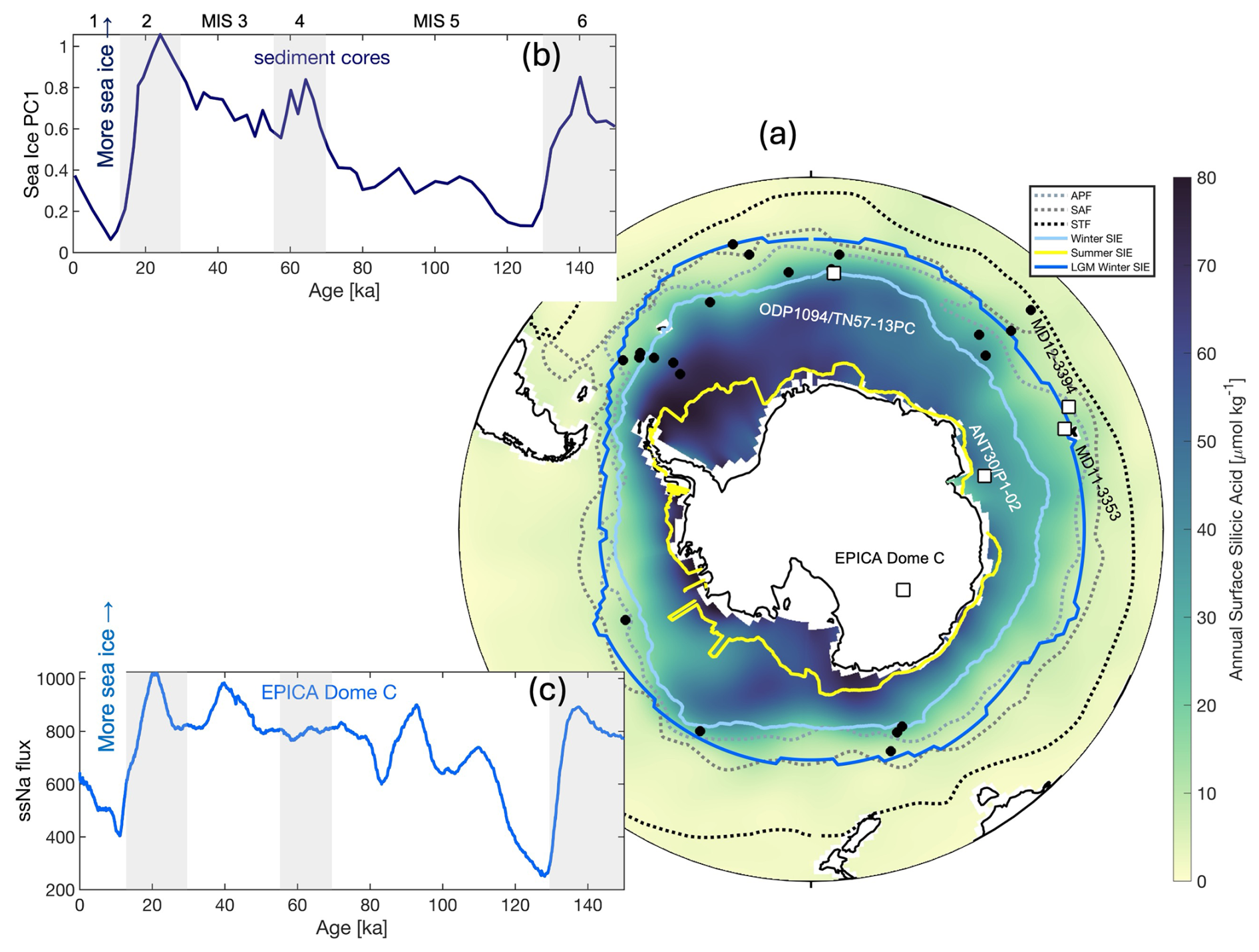
Figure 2Key Southern Ocean features and proxy records discussed in this paper. (a) Location map showing European Project for Ice Coring in Antarctica (EPICA) Dome C (Wolff et al., 2010), ANT30/P1-02 (Wu et al., 2018), ODP 1094/TN57-13PC (Jaccard et al., 2013), MD11-3353 and MD12-3394 (Ai et al., 2020). The cores used in the sea-ice compilation of Chadwick et al. (2022c) are indicated by black circles. From north to south, the modern locations of the Subtropical Front (STF), Subantarctic Front (SAF) and Antarctic Polar Front (APF) (Orsi et al., 1995) are indicated by dashed grey lines. The modern August (winter) and February (summer) sea-ice edges are shown in light blue and yellow, respectively, derived from the biogeochemical Southern Ocean State Estimate as used in Weis et al. (2024). The estimated August sea-ice edge during the LGM, from Paul et al. (2021), is shown in dark blue. The background colour is the annual average surface silicic acid concentration [µmol kg−1] from the World Ocean Atlas (Reagan et al., 2023), showing how this nutrient is “trapped” in the Southern Ocean sea-ice zone. Insets show (b) principal component 1 (PC1) of the sea-ice records from Chadwick et al. (2022c), indicating the dominant temporal trend, and (c) the ice core sea-ice proxy, sea salt sodium (ssNa) flux, in units of from EPICA Dome C from Wolff et al. (2010).
Sea salt sodium (ssNa) measurements in Antarctic ice cores have also been interpreted to reflect winter sea-ice extent in the proximal ocean region (Fig. 2c; Wolff et al., 2010). As with the diatom-based records, the ssNa record suggests sea ice reached its largest extent of the past 130 ka during the LGM. However, the ssNa record implies a much earlier expansion of sea ice over the course of the last glacial cycle compared to the diatom-based reconstructions (Fig. 2). This earlier response may reflect saturation of the ssNa signal, causing it to become less sensitive as sea-ice expands to full glacial conditions (Levine et al., 2014).
Sea salt sodium measurements in Antarctic ice cores (Fig. 2c; Wolff et al., 2010) suggest Antarctic sea-ice extent was substantially reduced during the last interglacial (LIG; 130–116 ka), also known as Marine Isotope Stage 5e (MIS 5e). This proxy suggests a 36 % reduction in Antarctic sea ice during MIS 5e relative to the Holocene (0–11.7 ka). Although this reduction is not apparent in the statistical compilation of diatom-based reconstructions shown in Fig. 2b, reconstructions based on individual marine sediment cores (Chadwick et al., 2020, 2022b, c, 2023) and SST reconstructions (Capron et al., 2017; Chadwick et al., 2022a; Chandler and Langebroek, 2021; Hoffman et al., 2017) are also consistent with substantial Southern Ocean warming and sea-ice loss during the peak of the LIG. South of 40° S, annual mean reconstructed SSTs were 2.2 to 2.7 °C warmer than pre-industrial temperatures, while summer SSTs were 1.2 to 2.2 °C higher than the preindustrial period, depending on the reconstruction (Gao et al., 2025). Models further suggest that winter sea-ice area during MIS 5e was reduced by 40 %–60 % relative to pre-industrial simulations (Holloway et al., 2016, 2017; Gao et al., 2025; Sime et al., 2025).
Marine and ice core records covering the last glacial cycle provide evidence of periods with more (LGM) or less (LIG) sea ice than today, thereby offering an opportunity to examine how sea-ice changes may have affected ocean and atmospheric circulation, ice shelves, marine productivity, nutrient cycling, and the carbon cycle. This paper is the second of two review papers presented by the Cycles of Sea Ice Dynamics in the Earth system (C-SIDE) PAGES Working Group, examining changes in Antarctic sea ice over the last full glacial-interglacial cycle. The first review (Crosta et al., 2022) described the marine and ice-core proxies used to reconstruct sea-ice changes over the last glacial cycle. This second review describes how changes in Antarctic sea ice are linked to physical and biogeochemical processes in the ocean, atmosphere, and cryosphere over this interval. We review how sea ice in the Southern Ocean coordinates climate/carbon-cycle feedbacks via direct and indirect impacts on grounded ice, biology, the atmosphere, and the ocean. More specifically, we identify five key aspects of this coordinating role: ocean circulation, ice shelves, winds, marine biological productivity, and the integrated effects of these impacts on marine carbon storage.
This review is structured around the five coordinating roles, with each section following a similar format. We begin with an overview of the processes involved in each interaction, focusing on how sea ice affects the Earth system component in question. Here, we draw on evidence from diverse disciplines and approaches, including modern observations, theory, and modelling. We then review marine sediment and ice core proxy evidence (Fig. 2) to provide examples of how these interactions played out across the last glacial cycle. Each section concludes with a discussion of key knowledge gaps.
Our philosophy in presenting this review rests on two main points. First, we recognise that paleoceanographic reconstructions inherently involve uncertainty: interpretations do not always agree with one another or with our current understanding of physical or biogeochemical processes. While potentially challenging, this uncertainty also provides an opportunity to critically examine our understanding from the perspective of a time period with different boundary conditions. In some cases, this requires a re-examination of specific paleo-proxies; in others, it allows us to test the robustness of modern interpretations. Paleo-perspectives have, for example, previously improved our understanding of abrupt climate change (e.g. Alley, 2000), the Atlantic Meridional Overturning Circulation (e.g. Broeker, 1991), and sea level (e.g. Berends et al., 2021). Second, we recognise that feedbacks between sea ice and Earth system components operate in both directions. For example, while sea ice influences the Southern Ocean upper and lower overturning cells, ocean circulation also affects where and how much sea ice forms (e.g. Marshall and Speer, 2012). While recognising this two-way feedback, in order to keep the scope of this review manageable, here we approach sea-ice feedbacks primarily from the perspective of how sea ice influences the Earth system.
2.1 Southern Ocean water masses and circulation: overview of processes and link to sea ice
The dominant water mass in the Southern Ocean is Circumpolar Deep Water (CDW), a mixture of deep waters entering the Southern Ocean from the different ocean basins, including North Atlantic Deep Water (NADW), Indian Deep Water, and Pacific Deep Water, that are entrained and mixed within the Antarctic Circumpolar Current (Fig. 3; Talley, 2013). Ekman divergence driven by the Southern Hemisphere westerlies, in interaction with bathymetry (Tamsitt et al., 2017), causes CDW to upwell to the surface, where it splits into southern and northern branches (Fig. 3; Rintoul et al., 2001). The upwelling of warm CDW plays an important role in determining the northern limit of Antarctic sea ice extent (Marshall and Speer, 2012). In turn, sea-ice formation and melting exert a substantial influence on the strength and location of water-mass formation in the Southern Ocean (Chen et al., 2025). Both branches of upwelled CDW are transformed by sea-ice processes into new water masses (Chen et al., 2025).
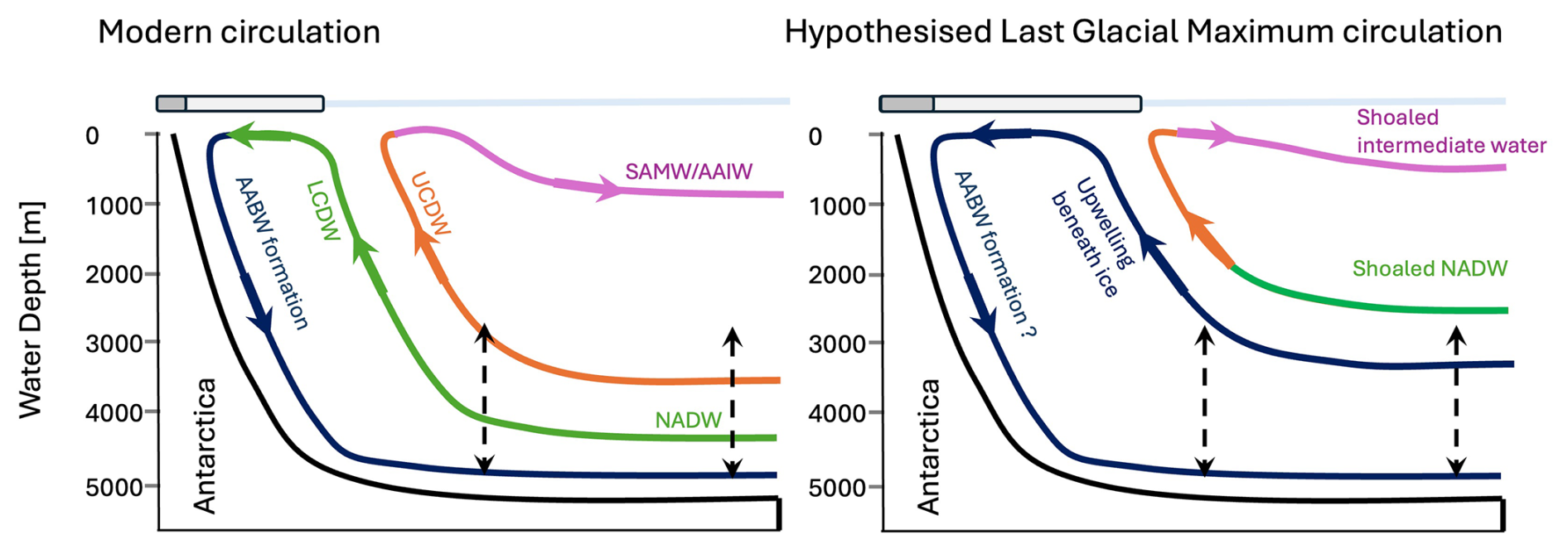
Figure 3Schematic illustrating the modern Southern Ocean overturning circulation (left) and hypothesised Last Glacial Maximum (LGM) circulation (right). Under present-day conditions, there is mixing (dashed arrows) between the lower branch of the North Atlantic Deep Water (NADW) and the Antarctic Bottom Water (AABW) (vertical arrows). Under conditions of expanded sea-ice extent, the boundary between NADW and AABW shoals, causing less exchange between the two water masses. Greater sea-ice cover particularly in winter (light grey lid) during the LGM is hypothesised to have produced denser bottom waters through more intense brine rejection. The LGM circulation becomes two closed cells rather than the “figure-8” pattern observed in the modern ocean. CDW also upwells mostly under winter sea ice and is transformed into AABW with little air–sea gas exchange (Ferrari et al., 2014). Other water masses pictured are Lower and Upper Circumpolar Deep Water (LCDW and UCDW), Subantarctic Mode Water (SAMW), and Antarctic Intermediate Water (AAIW). Figure after Talley (2013), Sikes et al. (2017), Shub et al. (2024), Hines et al. (2019), and Ronge et al. (2015).
The northern branch is transported equatorward and gains buoyancy from surface warming, sea-ice melt, and precipitation, resulting in water masses of intermediate density that are subducted to form Subantarctic Mode Water (SAMW) and Antarctic Intermediate Water (AAIW) (Abernathey et al., 2016; Orsi et al., 1995; Pellichero et al., 2018; Saenko et al., 2002). The upper cell of the meridional overturning circulation, which includes SAMW and AAIW (Marshall and Speer, 2012), forms far from the Antarctic continent but is strongly influenced by sea-ice melt. The water mass transformation analysis of Abernathey et al. (2016) suggests that increased sea-ice formation and northward transport may increase the rate at which CDW is transformed into more buoyant, low-salinity waters of the upper cell. Modelling studies also highlight the importance of wind-driven sea-ice transport and melt for AAIW formation (Saenko and Weaver, 2001) and predict a shoaling of AAIW together with a northward shift of the latitude of AAIW subduction during periods of sea-ice expansion (e.g., Fig. 3; Li et al., 2021; Ronge et al., 2015). Interestingly, Li et al. (2021) found that in Coupled Model Intercomparison Project 5 (CMIP5) models, AAIW also shoals under a global warming scenario owing to increasing temperature and decreasing density, despite a southward shift in the latitude of subduction. In their analysis of CMIP6 models, Almeida et al. (2024) found that the formation and northward transport of AAIW decrease under warming scenarios, although the formation regions remain unchanged relative to historical runs. Overall, important challenges remain in understanding the processes governing the formation of intermediate and mode waters, their link to sea ice and their accurate representation in climate models.
The southern branch, in contrast, flows poleward, where it experiences surface buoyancy loss through cooling and brine rejection during sea-ice formation. This contributes to the formation of Dense Shelf Water (DSW), which in turn gives rise to AABW (Naveira Garabato et al., 2002; Talley, 2013; Whitworth and Nowlin, 1987) and forms part of the lower cell of the meridional overturning (Marshall and Speer, 2012). Today, coastal polynyas act as important sea-ice factories and focal regions for DSW formation (Nihashi and Ohshima, 2015; Ohshima et al., 2016). Changes in sea-ice production and polynyas might thus impact DSW formation and, by extension, AABW.
2.2 Paleo insights into sea ice and the overturning circulation
The LGM provides a useful test bed for understanding the relationship between sea ice and ocean circulation, owing to the northward expansion of sea-ice cover during this interval (Chadwick et al., 2022c; Gersonde et al., 2005; Green et al., 2022) and the extensive proxy and modelling studies of LGM oceanic circulation.
Past changes in the depth of AAIW can be inferred using a suite of sediment cores collected across a range of water depths, thereby providing a vertical profile of water mass properties. The characteristics of subsurface water can then be inferred using the δ13C of dissolved inorganic carbon (DIC) reconstructed from benthic foraminifera and the Nd isotopic composition (ϵNd) of bottom waters reconstructed using ferro-manganese coatings extracted from foraminifera, fish debris, or bulk sediment. In the southwest Pacific Ocean, evidence from δ13C and ϵNd suggests that AAIW was shallower during glacial periods (Hu et al., 2016; Pahnke and Zahn, 2005; Ronge et al., 2015), consistent with greater sea-ice melt during austral summer and reduced density of Antarctic surface waters subducted to form AAIW (Green et al., 2022). Jones et al. (2022) further demonstrated a link between periods of sea-ice expansion and AAIW shoaling in the southwest Pacific Ocean, specifically during the middle (MIS 4) and peak (MIS 2) stages of the last glacial cycle. The response of AAIW in the southeast Pacific Ocean during glacial periods is less clear. Evidence from δ13C and redox elements implies increased oxygen content and deepening/thickening of AAIW during the LGM (Martínez-Méndez et al., 2013; Muratli et al., 2010). In contrast, more recent work based on foraminiferal assemblages, δ13C, and δ18O suggests instead that AAIW in the southeast Pacific Ocean shoaled and that its subduction region shifted northward (Haddam et al., 2020), consistent with the pattern observed in the southwest Pacific Ocean (Hu et al., 2016) and the modelled response to sea-ice expansion (Li et al., 2021).
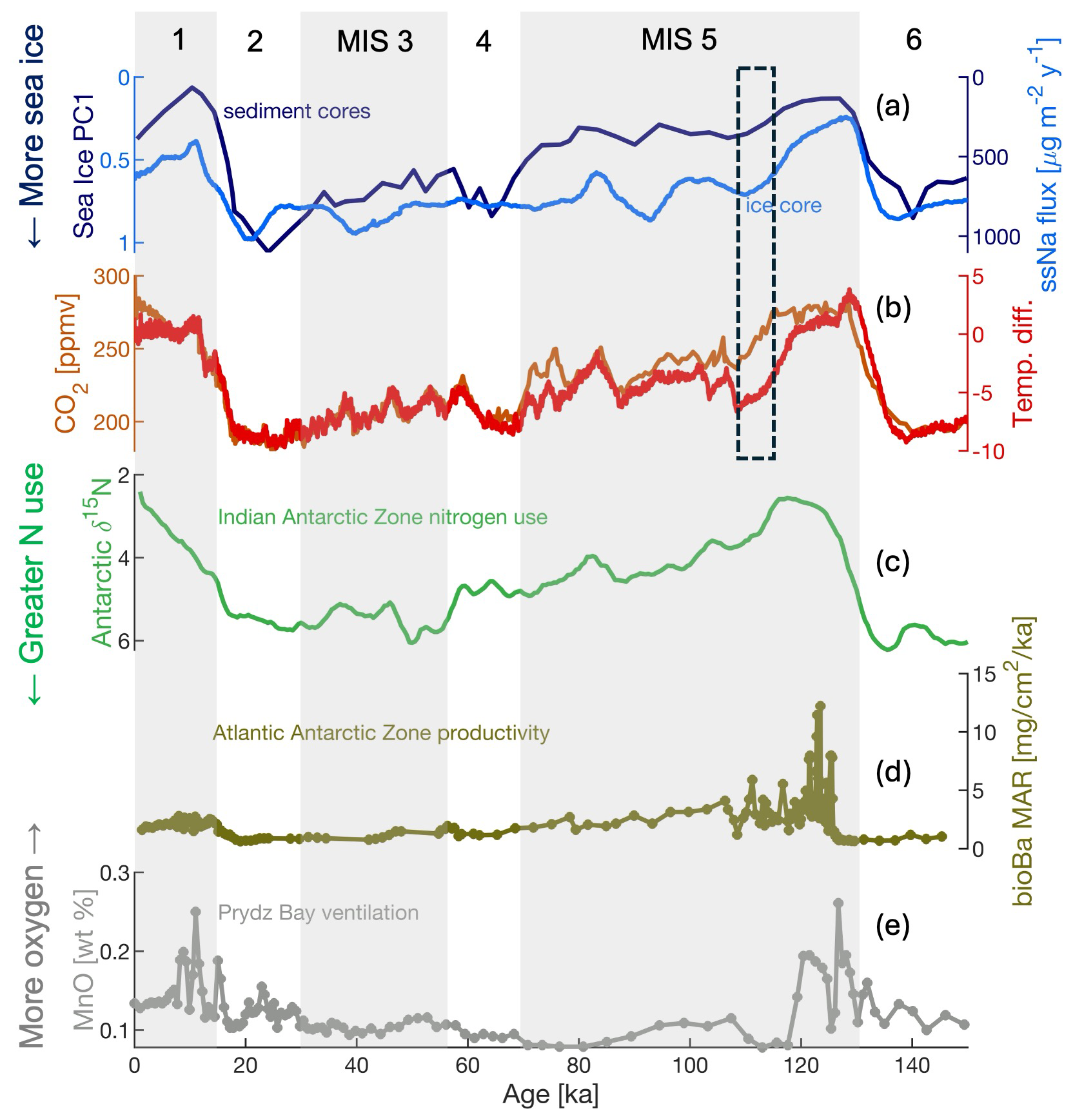
Figure 4Sea ice and related changes in the Southern Ocean and Antarctica over the past 150 ka. (a) Principal Component 1 of sedimentary sea-ice records (Chadwick et al., 2022c) and the EPICA Dome C sea-ice proxy, ssNa, (Wolff et al., 2010). (b) Antarctic composite CO2 (Bereiter et al., 2015) and stack of Antarctic surface air temperatures, defined as an anomaly relative to pre-industrial conditions (Parrenin et al., 2013). (c) The mean of the diatom-bound nitrogen isotopic composition from cores MD12-3394 and MD11-3353 from the Antarctic Zone of the Indian Sector (Ai et al., 2020). (d) The biogenic barium flux from ODP 1094/TN67-13PC in the Antarctic Zone of the Atlantic Sector (Jaccard et al., 2013). (e) The weight percent of manganese oxide from core ANT30/P1-02 off Prydz Bay (Wu et al., 2018), an indicator of bottom water ventilation and proxy for AABW formation. Locations of records are shown in Fig. 2. Marine Isotope Stage (MIS) numbers, as indicated by the oxygen isotopic records of marine carbonates (Lisiecki and Raymo, 2005), are listed along the upper x axis. Glacial stages are highlighted by grey vertical bars. The dashed box in panels a and b indicates the period of rapidly decreasing CO2 during the glacial inception, which occurred after Antarctic surface air temperature started to decrease and after a substantial increase in ssNa flux from the interglacial low.
Very high AABW salinity at the LGM has been inferred from porewater chlorinity (Adkins et al., 2002), consistent with an intensified sea-ice cycle and more brine production. Given the expansion of the Antarctic Ice Sheet across much of the continental shelf during the LGM (Bentley et al., 2014; Mackintosh et al., 2014), one puzzle is whether this intensified brine rejection occurred in the open ocean or whether AABW continued to form on the shelf as it does today, but within small ice-free pockets.
Polynyas at the continental shelf edge may have allowed brine production and deep-water formation to occur over the continental slope during the LGM. Gordon (2014) suggests the northward expansion of the Antarctic air mass during the LGM may have blocked precipitation from mid-latitude storms (analogous to the negative Southern Annular Mode – SAM), thereby producing slightly saltier surface water. This could have weakened stratification and enabled deep water convection driven by heat loss, analogous to the large winter-long Weddell Sea polynyas of the mid 1970s. Most global-scale ocean climate models do not have the resolution or representation of sea ice and glacial ice processes required to accurately form AABW through DSW formation on the shelf (Aguiar et al., 2025). Instead, AABW formation is typically represented as an open ocean process, similar to that associated with the Weddell Sea polynyas of the mid 1970s. This makes it difficult to assess the implications of changes in the mode or location of AABW production, or to determine what proxy signature would be expected from different modes of AABW formation.
Some proxy evidence suggests that polynyas and DSW formation persisted during the LGM. Based on sedimentological and microfossil evidence, Caburlotto et al. (2010) argue that dense water continued forming in Adelie Land during the LGM, potentially associated with a smaller, more northerly polynya. Additionally, Smith et al. (2010) interpret benthic and planktonic foraminiferal deposits in the northwest Weddell Sea as evidence for the intermittent presence of a polynya during the LGM and suggest polynyas were widespread around Antarctica at that time, including in the Ross Sea, SE Weddell Sea, and Dronning Maud Land. In the latter region, the presence of coastal polynyas during part of MIS 2 is supported by analyses of snow petrel deposits on land (McClymont et al., 2022).
A range of proxy data implies that southern-sourced waters probably filled a larger volume of the Atlantic basin during the LGM. Benthic δ13C, δ18O, Cd Ca, and radiocarbon records from the Atlantic Ocean suggest that the upper Atlantic (< 2 km) was occupied by a well-ventilated, nutrient-poor water mass, while the lower Atlantic (> 2 km) was occupied by a 13C-depleted, high Cd, poorly ventilated, nutrient-rich water mass (Curry and Oppo, 2005; Hoffman and Lund, 2012; Lynch-Stieglitz et al., 2007; Oppo et al., 2018; Rafter et al., 2022). Model-data comparisons and inversion studies suggest the LGM Atlantic water mass geometry resulted from a shoaling of NADW (Fig. 3; Menviel et al., 2017; Oppo et al., 2018; Pöppelmeier et al., 2023; Tagliabue et al., 2009), and likely also from a (moderate) weakening of NADW production (Blaser et al., 2025; Meissner et al., 2003; Menviel et al., 2017; Pöppelmeier et al., 2023).
Mechanistically, Ferrari et al. (2014) proposed that the northward migration of the summer sea-ice edge at the LGM could have contributed to the shoaling of the water mass boundary between NADW and AABW (Fig. 3). They suggest this occurred through a northward shift in the latitude separating the upper and lower cells – that is, the latitude separating the region of buoyancy loss to the south from that of buoyancy gain to the north. If AABW volume is directly related to this latitude, which corresponds approximately to the summer Antarctic sea-ice extent, then the volume of AABW should expand during glacial intervals and contract during interglacial intervals, as suggested by the proxy record. In idealised model experiments, the observed LGM water-mass geometry can be reproduced by increasing either the extent or the production rate of Antarctic sea ice (Jansen and Nadeau, 2016; Nadeau et al., 2019). However, LGM simulations as part of PMIP3 and PMIP4 show no direct relationship between the summer sea-ice extent, and thus perennial sea-ice cover, and the water mass boundary between NADW and AABW (Green et al., 2022). In addition, simulations by Hines et al. (2019) suggest that the depth of the water mass boundary between NADW and AABW is controlled by the density of NADW, which in turn is set by meltwater input in the North Atlantic, rather than by Antarctic sea-ice extent.
The proxy record also raises questions about the link between sea ice and water-mass geometry. First, sea-ice proxy evidence suggests that summer sea-ice expansion during the LGM was limited (Crosta et al., 2022; Gersonde et al., 2005). The idealised modelling introduced above (Ferrari et al., 2014; Jansen and Nadeau, 2016) has generally not considered the seasonal cycle in sea-ice coverage. It therefore remains unclear how an intensified seasonal sea-ice cycle would affect the location of the transition from negative to positive buoyancy forcing, given that there is only evidence for a significant shift in the summer sea-ice edge in the Atlantic sector (Gersonde et al., 2005; Ghadi et al., 2020). Furthermore, while ample evidence suggests that the boundary between NADW and AABW deepened during glacial Termination I (i.e., the MIS 2/1 transition) as the summer ice edge retreated, benthic δ18O results from the Brazil margin in the South Atlantic Ocean suggest the NADW-AABW boundary shoaled during Termination II (i.e., the MIS 6/5e transition) (Shub et al., 2024). If anything, we would instead expect the boundary to deepen under the more limited Southern Ocean sea-ice extent during MIS 5e, particularly in the Atlantic sector (Crosta et al., 2022; Holloway et al., 2017). If the Brazil Margin results can be confirmed at other locations, this would imply the link between sea-ice extent and AABW volume is more complex than previously assumed.
Regardless of whether it can be attributed to expanded sea ice, the proxy evidence summarised above indicates that glacial AABW (sometimes called southern component water) occupied a greater volume relative to NADW during the LGM. However, this does not necessarily imply that AABW was produced at a greater rate. Indeed, a reduced rate of AABW production during the LGM has been inferred from peaks in the concentration of the redox-sensitive metal Mn in deglacial sediments offshore three major sites of AABW production: North of the Weddell Sea (Jaccard et al., 2016), off Cape Darnley (Fig. 4e; Wu et al., 2018) and off the Adelie Land margin (Jimenez-Espejo et al., 2020). A low rate of AABW production during the LGM may have decreased oxygen delivery to these sites, such that a subsequent increase in AABW production and oxygen supply preserved a relic sedimentary Mn peak. Reduced oxygen delivery by AABW is consistent with evidence for widespread deep ocean oxygen depletion throughout the deep Pacific (Anderson et al., 2019; Pavia et al., 2021) and global deep ocean (Jaccard and Galbraith, 2012; Wang et al., 2024) during the LGM. However, the inferred changes in deep ocean oxygen, even proximal to Antarctica, cannot be uniquely attributed to decreased AABW production. Greater Antarctic sea-ice may instead have lowered the preformed oxygen content of AABW by inhibiting air-sea gas exchange during AABW formation, a possibility we explore in more detail, from the perspective of the carbon cycle, in Sect. 6.
2.3 Knowledge gaps: sea ice and the overturning circulation
While the position of the winter sea-ice edge is relatively well constrained, particularly during the LGM, substantial uncertainty remains regarding the extent of summer sea ice during glacial periods, owing to both the scarcity of proxy records (Chadwick et al., 2022c) and to the large spread in model results (Green et al., 2022). The temporal evolution of Southern Ocean sea-ice extent remains uncertain, particularly during the early phase of the last glacial cycle. Notably, the increase in sea-ice extent inferred from ice-core records is not reflected in marine-based reconstructions (Chadwick et al., 2022c), likely because of the relatively northerly location of the marine sediment cores. A more complete understanding of the link between sea-ice extent and water mass geometry will require additional multi-proxy reconstructions of deep ocean properties and their temporal evolution. Proxy records provide insights into properties of individual water masses, but variations in water-mass formation and transport cannot yet be quantified. While recent observations of sea ice and water mass properties have improved our understanding of underlying processes, the observational record remains too short to capture their full variability. The paleo record, by contrast, can encompass this full range of variability, but the inferred properties (e.g. ice extent, salinity, temperature) are less well constrained than the observational record. Finally, while numerical models are valuable tools for exploring interactions between sea ice and the overturning circulation, their results must be carefully evaluated against observations and paleo-proxy data to ensure that key processes are realistically represented despite limitations in parameterization and resolution.
A complex suite of interconnected processes influences the relationship between sea ice, ice shelves, and ice sheets (Fig. 5). These complex relationships include the potential for sea ice to enhance ice shelf stability, and in some cases promote ice shelf growth. A sea-ice barrier can dampen ocean swell and wave action at the ice shelf front, thereby reducing mechanical stress and providing additional protection to the ice shelf (Massom et al., 2018). Conversely, the loss of sea ice may have consequences for ice shelf weakening. Decreased summer sea-ice cover can allow for surface ocean warming; if that warm water is advected underneath an ice shelf, it can lead to melting of the underside of the floating glacial ice (Naughten et al., 2018). Decreased winter sea-ice formation and the associated decrease in brine rejection, and consequent stratification of the water column, can provide a pathway for the intrusion of warmer water beneath ice shelves, also facilitating melting of the glacial ice. Of key importance when considering these interconnections is the role of ice shelves in “holding back” grounded glacial ice upstream of the ice shelf (Scambos et al., 2004; Gudmundsson, 2013; Fürst et al., 2016). Finally, basal melting of ice shelves, driven by warming deep ocean temperatures, can lead to sea-ice expansion, as the freshwater input and associated stratification cool the ocean surface (e.g. Purich et al., 2018).
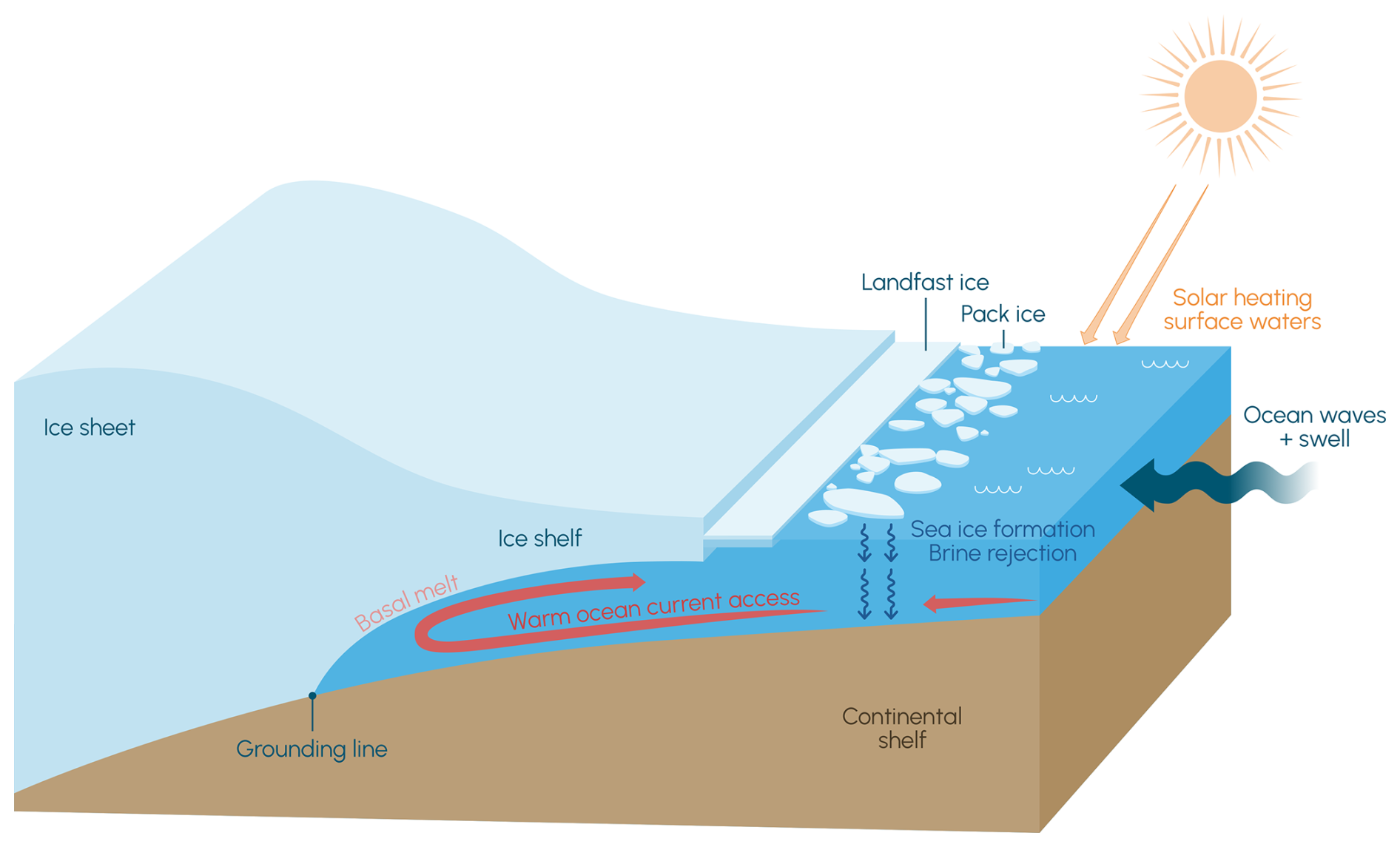
Figure 5Schematic representation of the Antarctic ice sheet, grounded to the underlying bedrock or sediment cover, ice shelves, the extension of glacial ice, and adjacent ocean processes.
3.1 Floating and grounded glacial ice stability: overview of processes and link to sea ice
The disintegration of many Antarctic ice shelves over the past several decades, resulting from warm ocean currents and rising atmospheric temperatures, has attracted considerable attention because of the important role ice shelves play in buttressing glacial ice, and the consequent implications for sea level rise (e.g. Miles and Bingham, 2024). Questions about the relationship between the presence or absence of sea ice and the maintenance, growth, or loss of glacial ice are thus important to answer. The presence of sea ice can protect an adjacent ice shelf from motion generated by waves and ocean swell (Bromirski et al., 2010; Lauber et al., 2023; Robinson and Haskell, 1990; Teder et al., 2022, 2025). Additionally, when direct buttressing is minimal, landfast sea ice may still influence glacier stability indirectly by reducing wave and swell impacts on ocean-terminating glaciers, through its role in bonding the “ice melange” (Sun et al., 2023; Surawy-Stepney et al., 2024). Ultimately, sea ice and/or calved ice debris at the ice front can slow or perhaps even halt the catastrophic collapse of marine ice cliffs (Bassis et al., 2021), a process that can cause rapid retreat of grounded ice sheets (DeConto and Pollard, 2016). In this case, the presence of a sea-ice margin may even facilitate ice shelf growth (Christie et al., 2022). Conversely, in the absence of sea ice and/or the ice melange, the motion of ocean waves and swell can weaken the ice shelf margin and lead to calving, ice sheet retreat, and ice shelf disintegration. However, not all ice shelves are alike; preconditioning by flooding and hydrofracturing can weaken ice shelves and make them more susceptible to the impact of proximal sea-ice loss (Massom et al., 2018).
3.2 Basal melting of ice shelves: overview of processes and link to sea ice
Changes in both summer and winter sea-ice cover have been shown to impact basal melting of ice shelves. For example, a decline in summer sea-ice cover exposes a greater fraction of the ocean surface to solar radiation and longwave radiation, leading to warming of surface waters. Regions that might be affected by this process include the Filchner, Larsen, and Wilkins Ice Shelves, the eastern half of the eastern Weddell region, the Australian sector of East Antarctica, and the Ross Ice Shelf front (Naughten et al., 2018). Solar heating of surface waters in front of ice shelves has been linked to their increased basal melting (Jacobs et al., 1992; Malyarenko et al., 2019; Naughten et al., 2018; Stern et al., 2013; Stewart et al., 2019). Although these warm waters are relatively buoyant, downwelling into the sub-ice shelf cavity, which must be driven by forcings external to the ice shelf, is thought to increase basal ice shelf melting, as observed in the Ross Ice Shelf cavity (Malyarenko et al., 2019; Stewart et al., 2019). This mechanism has been further explored through modelling work, which suggests that extreme warming events and associated reductions in coastal sea ice can lead to ice sheet mass loss. This occurs through increased intrusion of warm water across the continental shelf, allowing it to penetrate beneath ice shelves and enhance basal melting (Kusahara et al., 2023). Decreased sea-ice cover, and associated increase in solar heating at the ocean surface, might therefore play a role in future ice shelf stability.
Naughten et al. (2018) show that warming can also reduce winter sea-ice formation. The resulting reduction in brine rejection allows for increased stratification. This increased stratification can allow a warm bottom layer of CDW or modified CDW to penetrate beneath ice shelves, ultimately leading to increased basal melt. This process might play a role in the Amundsen Sea (Naughten et al., 2018) and the Weddell Sea (Timmermann and Hellmer, 2013). While stratification in the ocean can facilitate intrusion of CDW onto the continental shelf, other factors can also play a role, including offshore upwelling and the strength of the Antarctic Slope Current (Nakayama et al., 2021).
The presence of landfast sea ice can displace sea-ice formation offshore, as modelled for the Totten Glacier and the Moscow University Ice Shelf region, along the Sabrina Coast, East Antarctica (Van Achter et al., 2022). The presence of coastal fast ice at the sea surface results in a more stratified water column proximal to ice shelf cavities, since dense shelf water does not form and convect there. In their simulations, Van Achter et al. (2022) found that this reduced barrier to CDW intrusion can facilitate increased warm CDW influx. The warm water influx, in turn, is associated with increased basal ice shelf melt, which results in the retreat of the grounded ice sheet.
A suite of factors thus must be considered when addressing the complex relationship between sea ice and ice shelves. As noted above, given the role ice shelves have been shown to play in the larger Antarctic ice sheet stability (Scambos et al., 2004; Gudmundsson, 2013; Fürst et al., 2016), attention to sea-ice processes impacting ice shelf stability is warranted.
The coastal processes described above characterise the Antarctic continental shelf today. However, during glacial climates, when grounded ice advanced across the continental shelves around Antarctica (although grounded ice did not expand to the shelf edge in all regions of the margin, Bentley et al., 2014; Klages et al., 2017), continental margin polynyas like today may not have existed, as discussed in Sect. 2. Under glacial conditions, sea-ice formation and brine rejection forming dense waters may have shifted to an open-ocean mode of deep convection analogous to the Weddell Sea polynya of the mid 1970s (De Lavergne et al., 2014; Gordon, 2014) and 2016–2017 (Zhou et al., 2023). However, there is currently no paleo-evidence to confirm this hypothesised change in the style of AABW formation.
3.3 Paleo insights into interactions between sea ice and glacial ice
While detailed examination of the relationships between sea ice and ice shelves in the paleo record is limited, some studies have addressed the topic. Smith et al. (2019) provide a comprehensive review of the sedimentary signature of a retreating ice sheet/shelf, documenting key sedimentary features that are characteristic of the sub-ice shelf setting. The sequence of glacio-marine sediments (see Smith et al., 2019, Fig. 4) can be used to track the change from grounded ice to floating ice and, finally, to an open marine or seasonally sea-ice covered setting. However, determining the relationship between sea ice and ice shelves is complicated by difficulties in distinguishing the presence of ice shelves versus multi-year or perennial sea ice in the paleo-record (Hillenbrand et al., 2009). In both cases, light limitation in the underlying ocean precludes in situ primary production and, thus, the sediments have a limited to absent biological fingerprint. Studies often use the term “ice canopy” to describe a paleo-setting thought to reflect thick ice cover, without specifying whether that is land ice or sea ice (Lamping et al., 2020; Totten et al., 2015, 2022).
Changes in ice shelves in one region of Antarctica can have an indirect influence on sea ice downstream. Ashley et al. (2021) used diatom assemblages and biomarker data from a high-resolution Holocene sediment core from Wilkes Land margin, East Antarctica, to look at sea-ice changes and found an increase in sea ice at ∼ 4.5 ka. They suggested this sea-ice expansion was linked to the retreat of the grounding line in the Ross Sea, which resulted in the formation of a large sub-ice shelf cavity and a subsequent increase in basal melting and outflow of supercooled Ice Shelf Water. This outflow cooled the downstream waters along the Wilkes Land margin and facilitated the increased production of sea ice. Importantly, in smaller ice shelf cavities, such as in the Amundsen Sea, the opposite response may occur today. In these locations, melting is driven by the incursion of relatively warm CDW. The warming effect of this deep-water inflow exceeds the cooling influence of ice sheet meltwater, leading to a warmer sub-ice shelf cavity and reduced sea-ice cover near the ice shelf front (Jourdain et al., 2017).
An association between ice shelf melt and sea-ice cover during the Holocene is presented by Crosta et al. (2018). Using δ18O of diatoms as a proxy for ice shelf meltwater in sediment cores from the Antarctic Peninsula (Pike et al., 2013), Adélie Land (Crespin et al., 2014), and Prydz Bay, they inferred an increase in ice shelf melt and discharge around the Antarctic continental margin from ∼ 4 ka onward coeval with an increase in spring sea ice in coastal regions (Crosta et al., 2018). In a similar manner to the dominance of ocean-driven over atmospheric-driven melting of ice shelves today (Pritchard et al., 2012), the ice shelf melt inferred from ∼ 4 ka was not driven by air temperatures; ice cores show a cooling at this time, so the melt must have been driven by ocean warming. Proxy records of sub-surface ocean temperature (Etourneau et al., 2013; Kim et al., 2012; Shevenell et al., 2011) and water column mixing (Denis et al., 2010) suggest a period of enhanced CDW on the continental shelf. The resulting ice shelf melt increased freshwater input to the ocean at a time of decreasing spring insolation, which together promoted sea-ice formation. Weber et al. (2014) also modelled the impact of the Antarctic ice discharge event during the Antarctic Cold Reversal of the last deglaciation (14.8–14.4 ka). They found the freshwater input drove increased stratification and surface ocean cooling, leading to an expansion of sea ice.
While the preceding examples provide evidence of sea ice responding to changes in the ice sheet and ice shelves, there is little evidence in the paleo record for sea ice influencing glacial ice. One potential example is the relative timing of sea-ice decrease and ice-rafted debris increase during the last deglacial transition in the Adelie Land region of the Wilkes Land margin shelf (Pesjak et al., 2023). Here, as the climate warmed, sea-ice cover began to decrease before an increase in ice-rafted debris. If the increase in ice-rafted debris is interpreted as an acceleration of ice sheet retreat, this sequence of events is at least consistent with a role for decreased sea-ice cover in facilitating ice shelf disintegration, although other interpretations are possible.
The sensitivity of the Antarctic ice sheet to sea-ice extent (and vice versa) has been examined over longer time scales using model simulations combined with paleoclimate reconstructions from sediment cores recovered from the Antarctic margin (McKay et al., 2016). DeConto et al. (2007) modelled the relationship between the Cenozoic growth of the cryosphere and the development of sea ice surrounding the Antarctic continent. Their work illustrated that reductions in atmospheric greenhouse gas concentrations were required to initiate ice sheet growth, and this growth occurred prior to the significant presence of sea-ice cover. Once continental-scale ice sheets were established, sea ice developed, but its seasonal distribution around the Antarctic margin was strongly influenced by the configuration of the Antarctic ice mass, as well as by orbital forcing. In contrast, while the expanded sea-ice distribution impacted coastal regions of Antarctica, it had little impact on the ice sheet interior, suggesting the relatively low sensitivity of the Cenozoic Antarctic ice sheet to variability in sea ice.
3.4 Knowledge gaps: sea ice and glacial ice
Research expeditions to the Antarctic often are planned many years in advance, making rapid response to changes observed in sea ice and land ice, documented via satellite data, more difficult to study in real time with direct field-based sampling or monitoring. In some cases, observation of rapid change has precipitated the relatively quick development of interdisciplinary expeditions (Scambos et al., 2017; Wellner et al., 2019). However, smaller scale projects, investigating other areas of the Antarctic margin, are equally critical, and can involve both field-based and satellite-derived data acquisition. Additional spatial coverage examining the relationship between changes in sea ice and adjacent ice shelves, as done for the Larsen B region (Ochwat et al., 2024; Sun et al., 2023; Surawy-Stepney et al., 2024), will provide a deeper understanding of the impact of sea ice on ice shelf stability. Fürst et al.'s (2016) study of ice shelf buttressing of upstream grounded ice summarises ice shelf properties around the entire margin of the continent – all sites that could be targeted for study for associated changes in sea-ice extent. Temporally-resolved deglacial records from the shelf and slope could be used to test the scenario in which ocean warming initiates ice shelf retreat and enhanced freshwater discharge, which in turn promotes sea-ice expansion (e.g. Purich et al., 2018). Under such a scenario, sea-ice retreat should lag both deep-ocean warming and ice-sheet retreat during deglaciation. Continued and increased study of sites along the East Antarctic margin is recommended, given the sea level potential of the East Antarctic Ice Sheet.
Understanding how these relationships manifested in the past requires targeted study using marine sediment cores. Crosta et al. (2022), in a companion paper to this one, outline future directions for studies targeting sea-ice reconstruction, highlighting spatial and temporal gaps in our inventory of records. As they point out, most, though not all, continental shelf records are restricted to the Holocene, while more distal records from the continental slope and rise extend back farther in time. Generation of more multi-proxy data sets in transects of sediment cores from coastal sites most proximal to the ice margin to farther offshore is needed to track interactions of sea ice and land ice through time. In addition, these records must be coordinated with ice core records that include sea-ice proxy data and terrestrial and marine data sets that record changes in glacial ice distribution over time.
While sea-ice formation, transport, and melt are driven by ocean and atmospheric conditions, the presence of sea ice also affects the state of the ocean (Sect. 2) and atmosphere (this section). The atmospheric effects are both local, occurring immediately above the ice, and far-field, with impacts occurring from pole to pole (England et al., 2020). Sea ice blocks the exchange of heat and moisture between the ocean and the atmosphere, generally causing the atmosphere directly above sea ice to be cooler and drier than over an ice-free ocean (Maykut, 1986). Since the winter sea-ice edge sits in the atmospheric polar frontal zone, a region of uplift at the boundary between the polar and midlatitude (Ferrell) cells, even minor changes in Antarctic sea-ice extent can trigger significant shifts in atmospheric circulation (Raphael et al., 2011).
4.1 Atmospheric circulation: overview of processes and link to sea ice
The recent and projected decline of Antarctic sea-ice cover (Eayrs et al., 2021; Purich and Doddridge, 2023) has stimulated modelling efforts to understand the climate implications of sea-ice loss. Many model-based studies have noted shifts in the position and/or intensity of the Southern Hemisphere westerly winds (SHW) in response to sea-ice variability, with most finding an equatorward shift and weakening in the SHW when Antarctic sea-ice extent decreases (Fig. 6; Ayres et al., 2022; Raphael et al., 2011). This behaviour is consistent with the dynamics of the Southern Annular Mode (SAM), in which sea-ice feedbacks act as a reinforcing mechanism. During a negative phase of the SAM, Antarctic sea-ice extent contracts, exposing relatively warm ocean waters and warming the lower atmosphere adjacent to the Antarctic continent. This polar warming weakens the meridional atmospheric temperature gradient between high and mid-latitudes, which is associated with a weakening and equatorward shift of the Southern Hemisphere westerly winds (Fig. 6; Hall and Visbeck, 2002; Purich et al., 2026). It is worth noting that the equatorward shift of the SHW linked to declining sea ice is contrary to the overall model predictions for SHW behaviour under climate warming. These models uniformly suggest a poleward shift of the SHW as CO2 levels increase (Goyal et al., 2021; Yin, 2005). This is because the meridional temperature gradient steepens in response to strong warming in the tropics. The sea-ice effect, therefore, acts to offset the response of the winds to warming.
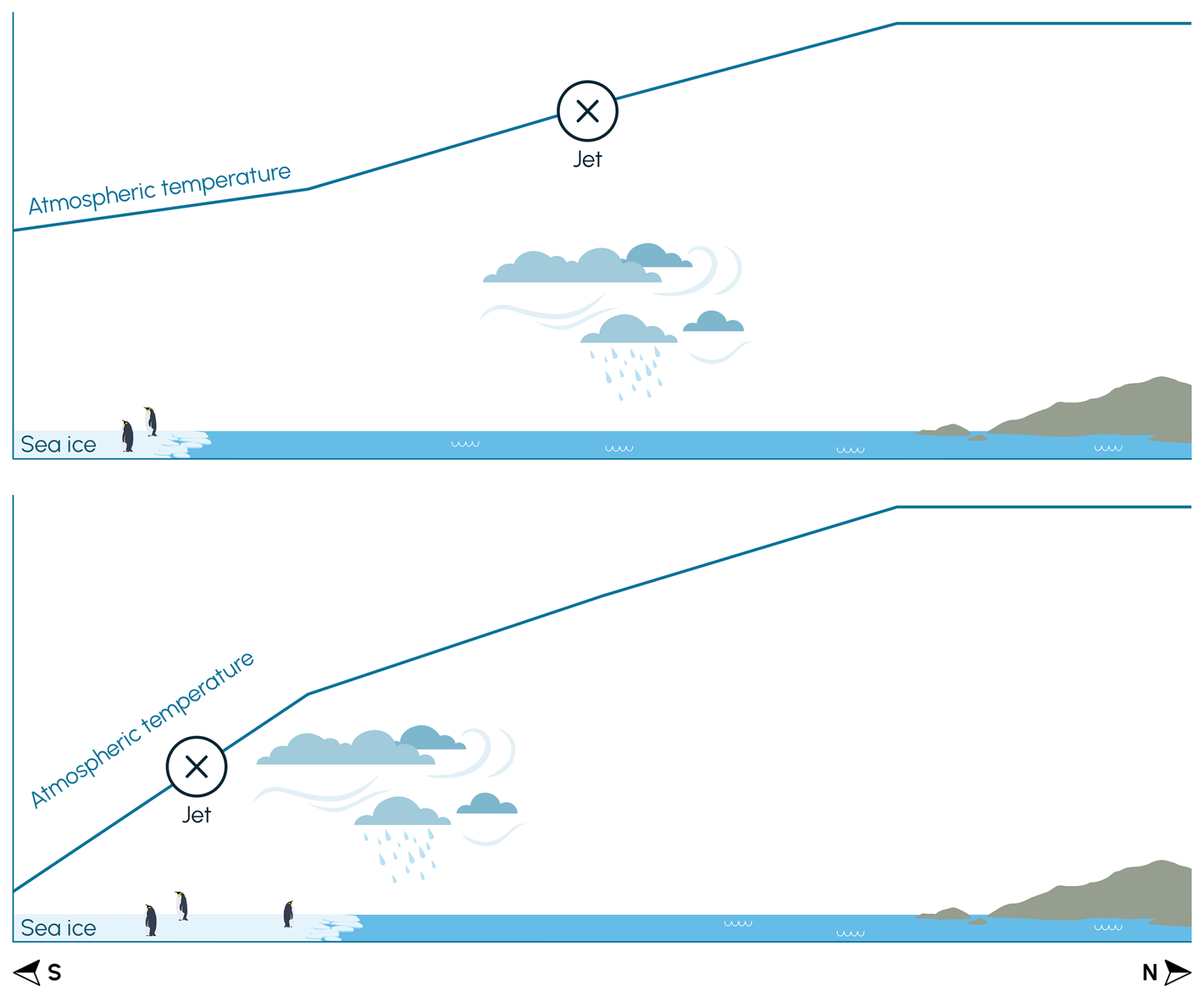
Figure 6Simplified depiction of the response of the Southern Hemisphere westerly winds to changes in sea-ice extent, which mimics the dynamics of the Southern Annular Mode (SAM). The upper panel depicts a low sea-ice state, or negative SAM anomaly, and the lower panel depicts an expanded sea-ice state, or positive SAM anomaly. The expanded sea ice steepens and shifts poleward the latitudinal temperature gradient between the high and mid latitudes, thus shifting the winds and storm systems south. The jet represents the core of the Southern hemisphere westerly winds, which is associated with the steepest temperature gradient.
A modelling framework known as “ghost flux” experiments has been used to infer a causal relationship between sea-ice variability and climate. The ghost flux experiments allow researchers to study the downstream impacts of sea-ice loss. This is achieved by introducing an additional heat flux to the sea-ice module of a climate model, which isolates the effects caused by sea-ice changes (Deser et al., 2015). However, the method does have limitations and was shown to overestimate heating associated with Arctic sea-ice loss (England et al., 2022). Ghost flux experiments with Antarctic sea-ice loss show large climate impacts that extend well beyond the sea-ice zone. These impacts includes a pole-to-pole response: a warming of the Antarctic interior (Ayres et al., 2022), an increase in katabatic winds, cloud cover, and precipitation over coastal Antarctica (Tewari et al., 2023), a decrease in Antarctic Circumpolar Current transport, an equatorward shift of the SHW, a warming of the equatorial Pacific SSTs (England et al., 2020), and even sea-ice loss in the Arctic (Ayres et al., 2022). The impact of sea ice on the SHW, and the far-field climate responses, are driven by ocean-atmosphere coupling (Ayres et al., 2022; England et al., 2020). Coupled ocean-atmosphere climate models are therefore necessary to fully quantify the impact of sea ice on the atmosphere.
A few studies have examined the response of the SHW to greater-than-present Antarctic sea-ice cover, none, however, using the ghost flux method. Raphael et al. (2011) studied the atmospheric response to imposed climatological maxima and minima in sea-ice extent and found a relatively symmetric response. The sea-ice minima were associated with an equatorward shift of the SHW and an expansion of the polar cell, while the opposite was found when sea-ice maxima were imposed. In contrast, Kidston et al. (2011) found an asymmetric response. While a decrease in sea-ice extent of 7° latitude, in either winter or summer, had a negligible impact on the winds, an increase in sea-ice extent of 7°, in winter only, caused a poleward shift of the SHW. The latter sea ice scenario is analogous to conditions during the LGM. The impact of sea-ice variability on winds thus appears sensitive to the latitude of the ice edge: when it is far from the polar jet, such as in summer, or under scenarios of decreased ice extent, the jet is minimally impacted by changes in sea-ice cover. More recent studies that have modelled the response to increased freshwater input from Antarctic ice melt also provide insight into the atmospheric impacts of expanding sea ice. These studies consistently find that increased freshwater input to the Southern Ocean leads to sea ice expansion. The atmospheric response is likewise robust across models and attributed primarily to sea ice expansion: A cooling of the troposphere south of 35° S and strengthening of the SHW (Xu et al., 2025).
4.2 Paleo insights into interactions between sea ice and winds: models
The response of the winds to increased sea-ice extent is model-dependent, with an important factor being the interaction between the jet and the ice edge. A CMIP5-PMIP3 model intercomparison study (Sime et al., 2016) found that, among models with an accurate representation of pre-industrial sea-ice extent, those with a greater increase in sea-ice extent during the LGM also had a greater poleward shift of the SHW. However, in models with an inaccurate pre-industrial sea-ice extent, where the ice edge was located far from the jet, changes in sea-ice extent did not impact the position of the jet. Without the effect of sea ice and associated sea-surface cooling near the modern-day jet (Fig. 6), models tended to simulate poleward-shifted westerlies in warm climates and equatorward-shifted westerlies in cold climates. However, in these simulations with a less-accurately placed modern-day sea-ice edge, the presence of expanded LGM sea ice reversed the equatorward trend in the westerlies in cold climates. Consequently, winds in LGM simulations were more likely to have been shifted slightly poleward. Thus, accurately reconstructing LGM sea-ice extent is the key to understanding LGM SHW wind changes. This state dependence may explain why, despite near uniform agreement among models that the winds will shift poleward in warming climate scenarios, there is disagreement among models about the sign and magnitude of the deglacial wind shifts. The offsetting effect of sea ice on winds, counteracting the climate warming signal, likely varies in strength across different models. This variation may lead to a wide range of predicted wind shifts when simulating the deglacial change. An open question is how important the sea-ice effect on the SHW is in the real climate system. The paleo record may provide clues.
4.3 Paleo insights into interactions between sea ice and winds: proxy records
Reliable paleo reconstructions of atmospheric attributes such as winds and precipitation are challenging to produce (Huiskamp and McGregor, 2021; Kohfeld et al., 2013; Shulmeister et al., 2004). On glacial-interglacial timescales, Kohfeld et al. (2013) compiled environmental reconstructions in the Southern Hemisphere that could plausibly be affected by a change in the SHW (e.g., moisture, dust, SST). They concluded that making inferences about wind shifts based on paleo-evidence alone is difficult, as the data are consistent with multiple scenarios. Kohfeld et al. (2013) found that a scenario with either stronger winds or an equatorward shift of the SHW during the LGM is consistent with most observations, but cautioned that no change, or even a poleward shift, could not be ruled out.
An alternative and more recent proxy approach to reconstructing SHW suggests the direct impact of sea ice on the SHW is of second order (Gray et al., 2023). This work inferred a poleward shift of the SHW during the last deglaciation from the latitude of the steepest SST gradient in the Southern Ocean, which they reconstructed from a compilation of planktonic δ18O measurements. Gray et al. (2023)'s reconstruction is consistent with the predicted wind direction response under future warming scenarios, but opposite in sign to the typical model-derived response to a decrease in sea ice described above. These results suggest that the decrease in sea ice during deglaciation (Crosta et al., 2022), which would on its own yield an equatorward shift in SHW, was not enough to offset the poleward tendency due to climate warming. Interestingly, the proxy-reconstructed wind shift is more than 4° of latitude greater than that predicted by any of the CMIP4/3 models investigated (Gray et al., 2023). There are many possible explanations for this discrepancy, including biases in the observational constraints. However, one possibility is that the sea-ice effect on SHW is too strong in the models, and overcompensates for the warming-driven trend that shifts SHW poleward.
Four ice core records show evidence of sea-ice decreases associated with millennial-scale Antarctic warming events during the last glacial cycle, although there are no ocean-based sea-ice records that resolve these millennial events. Abrupt decreases in ssNa, interpreted as a rapid decrease in sea-ice extent, are observed at the start of each Antarctic warming event in both the Dronning Maud Land (Fischer et al., 2007) and the Talos Dome Ice Cores (Buiron et al., 2012). These are followed by a gradual recovery of sea ice as Antarctica cooled. A similar trend is seen near the Ross Ice Shelf (Venugopal et al., 2023). Finally, near the centre of West Antarctica, less ssNa during the deglaciation was indicative of decreasing sea-ice extent and increasing δ18O was indicative of warming (WAIS Divide Project Members, 2013).
While sea ice extent clearly decreased in association with Antarctic warming events, the SHW appear to have responded to Northern Hemisphere millennial-scale warming. Using water isotopes in five Antarctic ice cores, Buizert et al. (2018) infer an equatorward shift of the SHW nearly synchronous with Northern Hemisphere warming events, rather than in association with Southern Hemisphere temperatures. The Antarctic sea-ice response thus tracked Antarctic surface air temperature, with a decrease in extent as Antarctica warmed, while the wind response was closely tied to Northern Hemisphere warming. The abrupt equatorward shift in the winds occurred against a backdrop of increasing Antarctic sea-ice extent and was associated with abrupt Northern Hemisphere warming rather than with any notable shift in Antarctic sea-ice dynamics. Rae et al. (2018) highlight a similar dynamic during millennial variability of the last deglaciation: Antarctic ice core deuterium suggests a northward shift of the SHW coinciding with abrupt Northern Hemisphere warming (Markle et al., 2017) and preceding the Southern Hemisphere cooling and increase in Antarctic sea-ice extent by about 200 years (Buizert et al., 2015). The observed changes in sea ice and SHWs over millennial scales, thus, suggest that the expected “sea-ice” effect on winds is a second-order process compared to other climate feedbacks associated with warming or cooling. In conclusion, the sign and timing of the reconstructed sea-ice changes, and their relationship to the inferred wind changes, do not support a strong link between changes in sea ice and changes in atmospheric circulation over millennial timescales.
4.4 Knowledge gaps: sea ice and winds
The available proxy records summarised above suggest sea ice does not play a primary role in driving SHW variability. However, this conclusion is tempered by the significant limitations of the wind proxies, the difficulty of discerning leads and lags, particularly in lower resolution marine records, and the diversity of model responses to greater than present sea-ice extent. Given the widespread teleconnections and far-field response to declining sea ice, an avenue for future research is to move beyond the response of the SHW to see if a diagnostic “Antarctic sea-ice fingerprint” can be found across multiple parts of the climate system associated with past periods of greater or lesser sea-ice extent. Such an approach would require examination of existing paleoclimate simulations to look for patterns beyond the SHW, new modelling efforts to isolate the climate signature associated with sea-ice variability in past climate states, both warmer and colder than present, paleo data synthesis of multiple affected proxies (e.g., precipitation, temperature and potentially wind systems), and generation of new proxy records from under sampled regions. Analysis of model output could help identify regions where atmospheric effects are particularly sensitive to Antarctic sea-ice variability.
Sea ice plays an important role in regulating biological productivity and in the cycling of climate-active gases in the Southern Ocean. It also affects biogeochemical cycles through its influence on Southern Ocean circulation (see Sect. 2), which governs the supply of nutrients to the productive surface ocean via upwelling, the residence time of surface water in contact with the atmosphere and sunlight, and the export of intermediate waters to the global ocean (Fig. 7). In this section, we review the role of sea ice across each of these domains, integrating findings from process studies, paleo-proxies, and modelling studies.
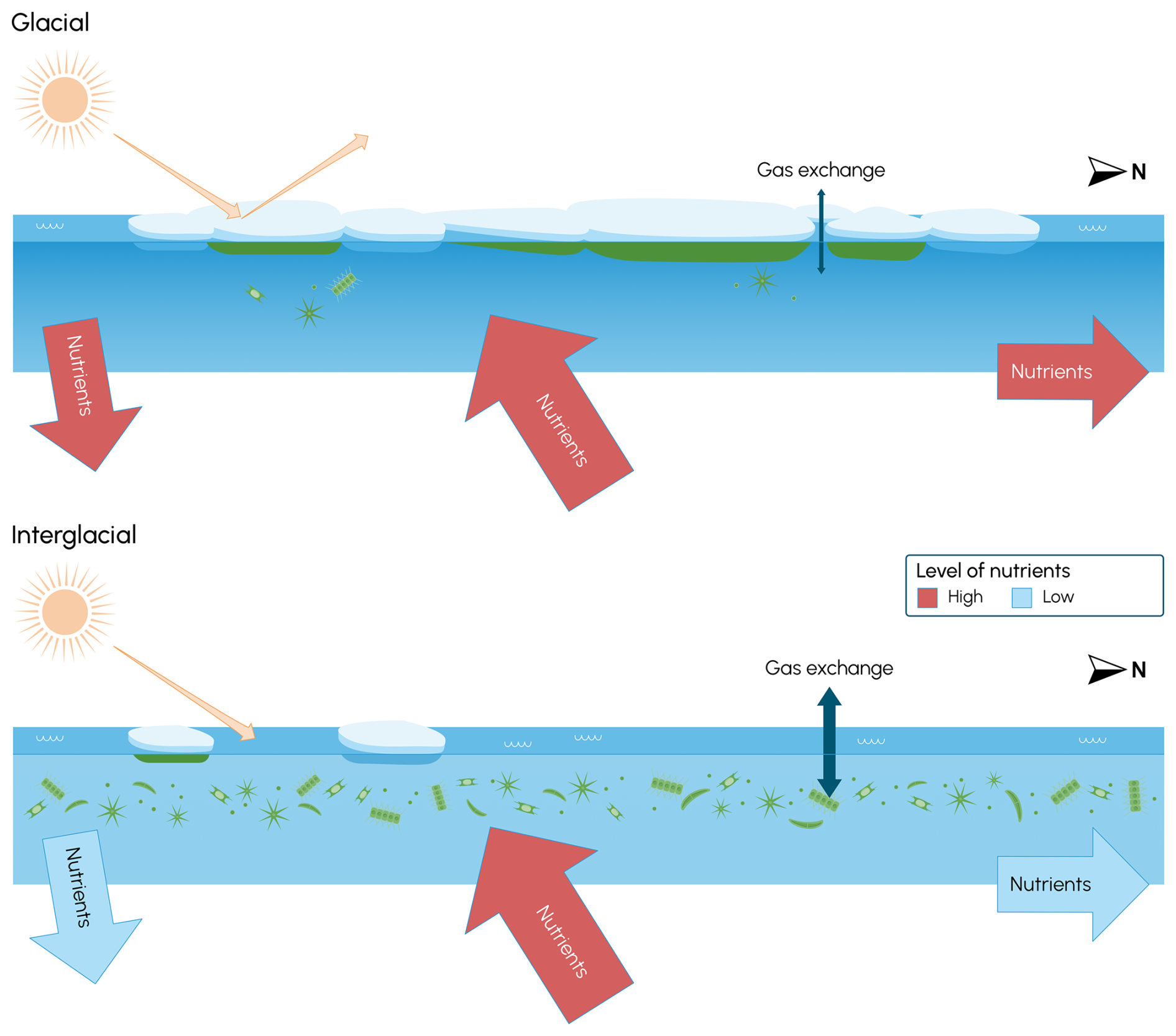
Figure 7Schematic representation of the impact of sea ice on productivity, air-sea gas exchange and nutrient consumption and export from the Antarctic Zone of the Southern Ocean. Under a glacial scenario of expanded sea-ice extent, lower light availability reduces productivity relative to interglacials. In theory, if the supply of nutrients via upwelling is assumed to be unchanged, in the glacial scenario, with less Antarctic zone nutrient uptake, there is a greater export of nutrients both into the Subantarctic Zone to the north and to the lower cell of the overturning circulation. The reduced gas exchange of the glacial scenario increases the air-sea disequilibrium for both oxygen and carbon.
5.1 Southern Ocean biogeochemistry: overview of processes and link to sea ice
The dominant role of sea ice in structuring Southern Ocean food webs is reflected in the long-standing use of sea ice, together with oceanographic fronts, to delimit ecological zones (Deppeler and Davidson, 2017; Tréguer and Jacques, 1992). According to this classification, the Southern Ocean is comprised of five zones, from farthest to closest to Antarctica (see Fig. 2): (1) the Subantarctic Zone (SAZ), between the Subtropical Front and the Subantarctic Front (SAF), (2) the Polar Frontal Zone (PFZ), between the SAF and the Antarctic Polar Front (APF), (3) the Permanently Open Ocean Zone (POOZ), between the APF and the northern limit of winter sea ice, (4) the Seasonal Sea Ice Zone (SSIZ), the region between the winter maximum and summer minimum in sea-ice extent, which includes the highly productive Marginal Ice Zone at its northern limit; and (5) the Antarctic Continental Shelf Zone, a small geographic zone that includes highly productive polynyas.
Within the sea-ice-impacted zones (i.e., poleward of the POOZ), sea ice directly influences primary productivity by modulating solar radiation, providing habitat for some species by acting as a source of phytoplankton to seed the marginal ice zone when the ice melts (Leventer, 1998), and delivering iron at a crucial time of the growth season (Lannuzel et al., 2023). Sea ice itself hosts a diverse microbial community that represents a concentrated food source for zooplankton (Swadling et al., 2023). The autotrophic community is dominated by diatoms, mainly large species, while also containing flagellates (Arrigo, 2014). Rates of annual primary productivity within sea ice are low, representing only about 1 % of the rates observed in the POOZ and SSIZ (Arrigo et al., 1997). However, productivity and biomass in sea ice are highly variable regionally, and vertically within the sea-ice column. Biomass within the deepest sea-ice layers (often attached to the base of the sea ice) can reach very high levels (Kattner et al., 2004), at times higher than in surrounding waters (McMinn et al., 2010; Van Leeuwe et al., 2018). High chlorophyll concentrations are observed seasonally in the Marginal Ice Zone, associated with the retreating ice edge (Moore and Abbott, 2000; Vernet et al., 2008). However, the annual productivity of these regions is lower than in the POOZ, because of the reduced light at higher latitudes (Moore and Abbott, 2000) and light limitation due to ice cover and snow cover on ice (Roukaerts et al., 2016). In some regions, including the Weddell Sea, years with greater sea-ice growth and melt are associated with elevated phytoplankton biomass in the following spring/summer, whereas this relationship is absent or reversed in other regions (Giddy et al., 2023). Very high phytoplankton biomass is present in polynyas, averaging twice the concentrations in the open Southern Ocean (Arrigo et al., 2015). Greater sea-ice cover tends to decrease productivity in polynyas while greater sea-ice melt increases productivity (Moreau et al., 2023).
Sea ice plays an important role in the cycling of the micronutrient iron in the Southern Ocean. Both pack ice and fast ice are enriched in iron by about an order of magnitude above surface Southern Ocean seawater concentrations. Fast ice, formed in closer proximity to continental iron sources such as glaciers, sediments and dust, has higher iron concentrations than pack ice (Lannuzel et al., 2016). Sea-ice melt in spring results in a large pulse of iron being released to seawater over a short period of time (Lannuzel et al., 2008). This springtime iron release coincides with increasing light levels, warming, and a stabilised water column, triggering algal blooms in the seasonal ice zone (Sedwick and DiTullio, 1997). In their modelling study, Person et al. (2021) show that including sea-ice iron increases carbon export in the Southern Ocean by 8 % relative to a control run with no sea-ice iron. On the other hand, inclusion of iron from continental ice increases carbon export by 4.5 %.
Biological processes associated with sea ice are important to the production of dimethyl sulphide (DMS), a semi-volatile sulphur compound. The oxidation of DMS produces sulphate aerosols, which act as cloud condensation nuclei and are, therefore, important in regulating precipitation and albedo (Charlson et al., 1987). DMS is produced in ocean surface waters primarily by the degradation of dimethylsulphoniopropionate (DMSP), a compound produced by algae in response to nutrient, light, thermal, and osmotic stress (Malin and Erst, 1997). Within the Southern Ocean, which is the largest natural source of DMS to the atmosphere (Lana et al., 2011), DMSP is produced by phytoplankton in both open ocean and sea-ice environments. Haptophytes, such as Phaeocystis spp., are considered strong producers of DMSP, while diatoms are believed to be weak producers (Kirst et al., 1991). Sea ice can accumulate high levels of DMS, due to high algal production rates of DMSP and high grazing rates that convert DMSP to DMS (Kirst et al., 1991). Sea-ice algae may also release DMSP during ice melt in response to rapidly decreasing salinity (Trevena and Jones, 2006). For these reasons, very large fluxes of DMS to the atmosphere can occur during the spring ice melt (Webb et al., 2019). High concentrations of DMS have also been observed in low salinity lenses associated with stratified conditions in sea-ice leads (Zemmelink et al., 2005), likely associated with similar biogeochemical conditions as found during the spring melt.
Even in the POOZ and SAZ, where sea ice is absent, sea ice can still indirectly affect productivity. The nitrogen isotopic composition of nitrate suggests that roughly half the nitrate supply to the SAZ is derived from the equatorward transport of Antarctic surface waters across the APF (Sigman et al., 1999). Sea-ice conditions in the SSIZ may therefore influence productivity farther north by modulating the degree of nutrient utilisation south of the APF, and the nutrients available to be transported across the APF. Longer sea-ice duration could reduce nutrient utilisation and, thereby, enhance the northward transport of unused nutrients to the SAZ (Matsumoto et al., 2014). Conversely, shorter sea-ice duration, as projected under climate warming, could reduce this nutrient leakage across the APF (Fig. 7). Sea-ice-induced changes in the overturning circulation could also affect nutrient availability north of the sea-ice limit, by modulating the rate of upwelling of CDW.
Across the Southern Ocean as a whole, sea ice appears to play a major role in regulating annual opal flux to the seafloor. Where sea ice is present for at least part of the year, the duration of the ice-free season is an important factor limiting how much opal is exported and ultimately buried in the underlying sediments (Chase et al., 2015; Ragueneau et al., 2000). Indeed, some of the earliest proxies of sea-ice extent were based on the association between the northern extent of the band of opal-rich sediments – the so-called opal belt – and the seasonal ice edge (Burckle and Cirilli, 1987; Cooke and Hays, 1982).
5.2 Paleo insights into interactions between sea ice and Southern Ocean biogeochemistry
Numerous marine proxy records suggest that productivity south of the APF was lower during the LGM than during interglacials (Amsler et al., 2022; Bareille et al., 1998; Chase et al., 2003; Jaccard et al., 2013; Kohfeld et al., 2005, 2013; Studer et al., 2015; Thöle et al., 2019). Given the sensitivity of opal flux to the duration of the sea-ice season (Chase et al., 2015), lower glacial export production could reasonably be linked to an expansion of sea ice and a shorter growing season (Ghadi et al., 2020) (Fig. 4). Productivity records, such as Ba Al or diatom abundances, are often used as stratigraphic markers in carbonate-poor Antarctic margin and slope sediment cores, because productivity was reliably low during glacial intervals (Holder et al., 2020; Jaccard et al., 2013; Presti et al., 2011). There is also evidence that productivity during the LIG was higher than during the Holocene (Fig. 4d; Jaccard et al., 2013), consistent with the smaller sea-ice extent during the LIG (see Sect. 1). However, these changes in productivity cannot be uniquely attributed to changes in sea-ice extent.
At some POOZ sites where glacial productivity was low relative to interglacial levels, sea ice appears to have been present only during winter, suggesting that direct light limitation by expanded sea ice was not the primary cause of reduced export productivity (Jaccard et al., 2013). In addition, higher nitrogen isotope ratios in glacial versus interglacial sediments from south of the APF indicate more complete nitrate consumption by the phytoplankton community (Ai et al., 2020; Francois et al., 1997; Robinson et al., 2014; Studer et al., 2015). The combination of more complete nitrate consumption and lower opal flux is inconsistent with simple light limitation, whether imposed by sea ice or by a deeper mixed layer. The nitrogen isotope evidence also argues against iron limitation – for example owing to reduced iceberg discharge (Barkley et al., 2024) – as the primary driver of low glacial productivity in the Antarctic Zone. Instead, these proxies point to a glacial reduction in the vertical supply of nitrate to surface waters, sometimes referred to as enhanced near-surface stratification (Francois et al., 1997; Sigman et al., 2020), caused either by a stronger halocline associated with a more intense sea-ice cycle (Shin et al., 2003) and/or by weaker or northward-shifted SHW that reduced upwelling (Anderson et al., 2009; Galbraith and de Lavergne, 2019; Toggweiler et al., 2006).
Ice core records of biogenic sulphate provide another means of reconstructing marine productivity. Intriguingly, records from both Dome C and Dronning Maud Land, which capture integrated productivity signals across the Indian and Atlantic sectors, respectively, suggest only minimal glacial-interglacial change in productivity in either region (Kaufmann et al., 2010), in contrast to the marine sediment evidence from south of the APF summarised above. However, because marine sediment records north of the APF consistently indicate higher glacial productivity in response to Fe fertilisation and frontal migrations (e.g., Jaccard et al., 2013; Kohfeld et al., 2005; Martinez-Garcia et al., 2014), the ice core signal may reflect an integration of opposing productivity trends across different Southern Ocean zones. There are also uncertainties in isolating the biogenic sulphate, associated with biological productivity, from other sulphate sources, including sea salt, mineral dust, and volcanic inputs.
A recent study combined sulphate concentration and isotopic data from the EPICA ice core in Dronning Maud Land to better constrain sulphate sources, concluding that biogenic sulphur dominates the budget and reflects productivity in the SSIZ of the Atlantic sector (Fischer et al., 2025). The authors found a 16 % reduction in biogenic sulphur production during the LIG compared to the penultimate glacial period (MIS 6), which they interpreted as a decrease in integrated biological productivity in the region south of ∼ 50° S in the Atlantic sector. They further note an “intermittent” and slight decline in biogenic sulphur production during the LIG around 126 ka, coinciding with peak warmth (Capron et al., 2014; Civel-Mazens et al., 2024; Schneider Mor et al., 2012), minimum sea-ice extent (Chadwick et al., 2022b), and evidence for a major reduction in AABW production (Hayes et al., 2014; Huang et al., 2020). They proposed a causal chain in which warmer-than-present temperatures during the early LIG reduced sea-ice production, weakened AABW production and thereby decreased the upwelling of nutrient-rich CDW. This finding of lower productivity during a sea-ice minimum is in contrast to the sediment core results described above, where lower productivity is associated with the glacial climate state, a sea-ice maximum. A major caveat is that biogenic sulphur is produced by only a subset of primary producers (see above), so may therefore not represent total productivity.
The biogenic sulphur ice core record also offers insight into the relationship between DMS production and sea-ice extent. Non-sea salt sulphate in Antarctic ice cores is derived primarily from the oxidation of marine biogenic DMS and shows no post-depositional loss, making it suitable for long-term reconstruction of DMS fluxes (Wolff et al., 2010). Remarkably, the flux of non-sea salt sulphate in the EPICA Dome C ice core is constant within 15 % over the past 800 000 years and shows no glacial-interglacial variability (Wolff et al., 2010). If this minimal variability is interpreted parsimoniously as indicating a constant efflux of DMS south of the APF across multiple glacial cycles, it suggests that DMS production was minimally impacted by sea-ice variability and was likely not important in climate feedbacks over this time (Wolff et al., 2006). However, a more recent and comprehensive study of sulphate sources in Dronning Maud Land ice core evidenced a slight (16 %) decrease in biogenic sulphur emissions from the Atlantic sector during the last interglacial compared to the last glacial period (Fischer et al., 2025). This observation is consistent with the expectation that DMS production is associated with sea ice, such that a decrease in sea-ice extent, as observed during the LIG, led to a decrease in DMS production. The climate implications of a glacial decrease in DMS production of this magnitude are not known.
5.3 Knowledge gaps: sea ice and biogeochemistry
The paucity of high-resolution sediment cores in the sea-ice zone, challenges in dating opal and siliciclastic-dominated sediments, and an incomplete understanding of the mechanistic links between sea ice and biological productivity mean that many questions remain about how sea ice influenced productivity in past climates. Multi-proxy studies from the SSIZ that combine reconstructions of carbon export, community composition (potentially using ancient sedimentary DNA; Armbrecht, 2020), nutrient utilisation and sea-ice cover at the same sites, are needed to better identify the biological response to sea-ice changes. Reconstructions of biogenic sulphur emissions (Fischer et al., 2025) across multiple glacial cycles will also help clarify the links among climate, sea ice, and DMS and help resolve the disagreement between ice-core- and sediment-core-based reconstructions of Antarctic Zone productivity.
Because Antarctic sea ice influences air-sea gas exchange, stratification, overturning circulation, and biological productivity in the Southern Ocean, it has the potential to modulate oceanic carbon storage and, in turn, atmospheric CO2 and climate. If the net effect of Antarctic sea ice is to enhance ocean carbon storage, then its ongoing decline could weaken the ocean sink for anthropogenic carbon and thereby reduce the remaining carbon budget (Lamboll et al., 2023). Here, we summarise current understanding of the relationship between sea ice and atmospheric CO2 on glacial-interglacial timescales.
6.1 Southern Ocean carbon cycling: overview of processes and link to sea ice
The most direct way in which sea ice can affect the carbon cycle is by restricting the sea-to-air flux of CO2 (Fig. 7). Laboratory experiments (Loose and Schlosser, 2011) and the 222Ra inventory method (Rutgers van der Loeff et al., 2014) show that, under conditions of near-complete ice cover, gas exchange is reduced by about an order of magnitude compared to open ocean conditions. However, uncertainty remains regarding how gas exchange proceeds in areas of open water adjacent to sea ice. Some studies suggest that gas exchange in surrounding open waters occurs at the same wind speed-dependent rate as in the absence of ice (Butterworth and Miller, 2016). Others report that gas exchange in open water near sea ice is enhanced by 50 %–70 % relative to ice-free open waters (Loose et al., 2014, 2016). Still others find that gas exchange in open water near sea ice is lower than in open waters with no ice present (Rutgers van der Loeff et al., 2014).
Sea ice also affects the carbon cycle indirectly, through its impact on watermass formation (Sect. 2), important for regulating the transport and storage of carbon, and productivity (Sect. 5), which regulates biological uptake of carbon. As discussed below, the relative importance of these effects is the subject of active research, with insights provided by both observational and modelling studies.
6.2 Paleo insights into the impact of sea ice on atmospheric CO2: models and mechanisms
The “capping” effect of Antarctic sea ice was first proposed by Stephens and Keeling (2000) as a mechanism to explain low glacial atmospheric CO2 concentrations. Using a box model, they showed that atmospheric CO2 could be reduced by 67 ppm if 90 % of the open ocean area south of the modern APF was permanently ice-covered. Several objections to the realism of this mechanism have been raised. First, such a large permanent sea-ice cover appears unrealistic, given that diatom proxy data indicate that glacial summer sea-ice extent was only slightly greater than today (Benz et al., 2016; Burckle et al., 1982; Gersonde et al., 2005; Lhardy et al., 2021). Additionally, the effectiveness of the capping mechanism is limited because greater sea-ice coverage raises surface-ocean DIC concentrations, thereby increasing the sea-to-air CO2 gradient and partially offsetting the reduction in gas exchange (Morales Maqueda and Rahmstorf, 2002). Subsequent work found that the sensitivity of atmospheric CO2 to Antarctic sea ice is much greater in box models than in ocean general circulation models (Archer et al., 2003; Gottschalk et al., 2019).
Another challenge to the capping hypothesis is that greater sea-ice cover would also reduce phytoplankton productivity and carbon uptake through enhanced light limitation, thereby offsetting the reduction in sea-to-air CO2 flux (Gupta et al., 2020; Kurahashi‐Nakamura et al., 2007; Sun and Matsumoto, 2010). As discussed in Sect. 5, proxy data show reduced carbon export in the Antarctic Zone during glacials (e.g., Kohfeld et al., 2005), which is consistent with the idea that the effects of sea ice on gas exchange and light availability may have partly offset each other. However, as discussed above, the combination of reduced export production and increased nutrient utilisation is not readily explained by light limitation alone and has instead been attributed to a reduction in the supply of nutrients to the surface (Francois et al., 1997; Jaccard et al., 2013; Sigman and Boyle, 2000). The proxy record is thus ambiguous as to whether greater sea ice cover contributed to low glacial productivity, and thereby offset the effect of sea ice acting as a cap to gas exchange.
A more active sea-ice cycle during glacial periods may have promoted surface stratification, reduced DIC and nutrient supply and favoured ocean carbon sequestration. One possibility is that an intensified sea-ice cycle generated a low-salinity lid in regions of net ice melt, thereby strengthening upper ocean density stratification (Francois et al., 1997; Sigman and Boyle, 2000, 2001). Greater summer stratification may have even supported a short but highly productive growing season, further limiting CO2 outgassing (Moore and Abbott, 2000). In addition, the production and vertical export of highly saline brines off the shelf may have freshened the surface and enhanced stratification even in regions of net ice production (Bouttes et al., 2010; Sigman et al., 2020). The combined effect of reduced supply and increased consumption of DIC would have acted to strongly limit the CO2 escape from the Antarctic Zone.
Increased brine rejection associated with a more active sea ice cycle may have also enhanced ocean carbon storage by strengthening deep-ocean stratification and reorganising deep-ocean circulation (Bouttes et al., 2010; Ferrari et al., 2014; Jansen, 2017; Jansen and Nadeau, 2016), as described Sect. 2. In idealised experiments, increasing either sea-ice extent or sea-ice formation rate leads to a reorganisation of the overturning circulation such that upwelling CDW reaches the surface beneath more extensive sea-ice cover, thereby reducing opportunities for air–sea gas exchange (Ferreira et al., 2018; Nadeau et al., 2019). In these experiments, the resulting increase in idealised water-mass age, a tracer sensitive to air-sea exchange, arises primarily from restricted gas exchange beneath sea ice rather than from slower overturning itself (Nadeau et al., 2019). This interpretation is consistent with radiocarbon evidence for a substantial increase in the global mean radiocarbon “age” of the ocean (Skinner et al., 2017), including an important contribution from increased preformed radiocarbon ages (Skinner et al., 2023). Unlike the original Stephens and Keeling (2000) capping hypothesis, this mechanism depends on coupling expanded sea ice to the reorganisation of overturning circulation, such that carbon-rich upwelling waters reach the surface mainly beneath sea ice and are therefore less able to release CO2 to the atmosphere.
Idealised modelling supports the capacity of coupled circulation and gas exchange changes to increase ocean carbon storage. Marzocchi and Jansen (2019) demonstrated that atmospheric cooling alone, through its impact on Antarctic sea-ice expansion, can lower atmospheric CO2 by 40 ppm in an idealised model. As in Ferreira et al. (2018), the dominant mechanism is strengthening of the “disequilibrium pump”, that is, the suppression of air-sea gas exchange beneath expanded sea ice. Crucially, this effect emerges only when glacial sea ice and circulation changes act in concert, so that DIC-rich waters upwell to the surface predominantly beneath sea ice (Marzocchi and Jansen, 2019; Nadeau et al., 2019). A related idea underpins the proposed water-mass “volumetric effect” on marine carbon sequestration (Skinner, 2009), whereby high disequilibrium of DIC is maintained in southern-sourced waters (Eggleston and Galbraith, 2018), in particular via sea-ice effects under glacial conditions (Galbraith and de Lavergne, 2019).
Results from more complex models show that the CO2 response to sea-ice is model-dependent. Analyses from a coarse-resolution Earth system model suggest that sea ice can substantially limit the release of CO2 from the upwelling of CDW (Stein et al., 2020). In this study, the authors explored the integrated effect of physical changes associated with orbital and greenhouse-gas forcing. They found a more vigorous Southern Ocean overturning circulation during glacial conditions, yet an overall 10-fold decrease in the exposure of deep Southern Ocean water to the atmosphere (that is, reduced “ventilation”). They attributed this to sea ice capping the upwelled water, together with enhanced poleward circulation that shortened the residence time of deep water at the surface. The magnitude of sea-ice-related carbon sequestration estimated by Stein et al. (2020) is broadly consistent with that estimated by Marzocchi and Jansen (2019) and Ferreira et al. (2018). In contrast, Khatiwala et al. (2019) used a more complex model to isolate the effect of individual mechanisms in driving CO2 changes between glacial and interglacial states. They found that imposing an expanded, LGM-like sea-ice field on a pre-industrial circulation resulted in a slight decrease in ocean carbon uptake. This was primarily due to a strong reduction in biological carbon uptake, as also suggested by Sun and Matsumoto (2010). Together, these results suggest it is not sea ice expansion alone, but its interaction with circulation changes, that is critical for modulating Southern Ocean carbon uptake.
6.3 Paleo insights into the impact of sea ice on atmospheric CO2: proxy records
Exploring the link between atmospheric CO2 and sea ice through the paleo record relies strongly on analysing the relative timing and magnitude of changes in the two parameters. While limited, such analyses provide several insights. The first observation is that the coupled effect of sea ice and circulation on atmospheric CO2 may help explain why the largest decrease in atmospheric CO2 occurred at the MIS 5-4 boundary, when both sea ice (Chadwick et al., 2022c) and circulation underwent large changes (Kohfeld and Chase, 2017). A similar argument may apply to the CO2 rise across the last deglaciation (e.g., Rae et al., 2018).
The glacial inception at the MIS5e to 5d boundary (115–125 ka) provides another example of the importance of coupled changes in sea ice and circulation for atmospheric CO2. Ai et al. (2020) noted that during the initiation of the most recent glacial cycle, Antarctic surface air temperature and sea ice (based on the ssNa ice core proxy) began to transition to glacial conditions (i.e., decreased temperature and increased sea ice) about 3 ka before CO2 began to decline (Fig. 4b). A similar lag of CO2 behind sea ice was reported across the last deglaciation (Shemesh et al., 2002). This lag suggests that the direct effect of sea ice in suppressing air-sea gas exchange is not, on its own, sufficient to lower atmospheric CO2, at least for moderate changes in sea-ice extent. However, it is worth noting that the sediment core-based sea-ice reconstruction diverges from the ice core-based reconstruction during glacial inception (Fig. 4a), with the sediment-based reconstruction showing a more gradual increase in sea ice that more closely tracks atmospheric CO2. This could suggest a role for sea ice in the absence of circulation changes. However, the limited number of marine records covering the glacial inception (n = 12; Chadwick et al., 2022c), together with age model limitations, means that this observation still requires verification. Taking a broader temporal perspective, evidence for progressively greater carbon storage in the deep South Atlantic during MIS 5d and again during the MIS 5-4 transition (Garity and Lund, 2025), both intervals of expanding sea-ice cover (Fig. 4), is consistent with the view that the sea ice changes contributed to glacial carbon storage when acting in concert with broader circulation changes.
6.4 Knowledge gaps: sea ice and the carbon cycle
A major caveat is that the models that show large impacts of sea ice on overturning circulation and ocean carbon storage, including those beyond simple box models, remain highly idealised. These models either lack a seasonal cycle, include a seasonal cycle (Ferreira et al., 2018) but simulate more summer sea ice than indicated by the proxy records (Gersonde et al., 2005), or do not adequately capture inter-basin differences.
Isolating the effects of sea ice in model experiments is challenging (Kohfeld and Ridgwell, 2009), and clearly there is substantial inter-model variability, even amongst models that appear consistent with the available (albeit sufficiently ambiguous) proxy evidence. Future sensitivity experiments and model-proxy comparison studies focused on the amount and seasonality of sea ice required to trigger changes in overturning circulation are needed to better constrain the impact of sea ice on the carbon cycle.
Additional sediment-based sea-ice reconstructions spanning the glacial inception, with improved age control, are needed to resolve the potential contribution of increasing sea ice to the associated CO2 decline. Efforts are also needed to better understand exactly what is reconstructed by the ice-core ssNa proxy.
This review has highlighted the central role of Antarctic sea ice across many components of the Earth system, including the atmosphere, ocean, cryosphere, biosphere and carbon cycle. Although we focus here on modern studies and paleo-records spanning the last glacial cycle (150–0 ka), many of the processes described are also relevant to more ancient climates and to future change. Taken together, the evidence reviewed here suggests that sea ice does not act in isolation, but instead influences the Earth system through coupled interactions with ocean circulation, air–sea exchange, ice shelves, nutrient supply and biological productivity. In several cases, its most important effects appear not from direct local impacts alone, but from its ability to reorganise broader physical and biogeochemical processes.
A recurring conclusion of this review is that many proposed sea-ice impacts depend on their coupling with changes in circulation and stratification. This is particularly clear for the overturning circulation and carbon cycle, where the influence of sea ice appears strongest when changes in sea-ice extent or seasonality occur together with changes in water-mass formation, upwelling, and air-sea gas exchange. In the biosphere, sea ice shapes productivity both directly, by affecting light, habitat and micronutrient supply, and indirectly, through its effects on circulation and nutrient transport. At the same time, paleo-records show that isolating the specific role of sea ice remains difficult in such a highly interconnected system.
Paleo-data provide a valuable foundation that supports understanding of the implications of the sea ice decline we are observing in the Southern Ocean today. What are the consequences of a reduced sea-ice cover for ocean and atmosphere circulation, nutrient distributions, and biological productivity, both in the Southern Ocean and farther afield? How will carbon fluxes and ocean carbon storage respond? Answers to these questions remain difficult because the underlying relationships are complex, often bidirectional and incompletely resolved. Existing datasets are still sparse in key regions and commonly yield ambiguous, underdetermined or apparently conflicting interpretations. Even so, paleoclimate data illuminate how these interactions have played out in the past, thereby strengthening our understanding of the processes involved and the interconnections between Antarctic sea ice and other components of the climate system.
Climate-system responses associated with sea-ice decline from a glacial to an interglacial state may not be identical to the response to current and future anthropogenic sea ice loss. To improve our understanding, we need paleo-records with higher temporal resolution, greater proxy integration, and better chronologic control, particularly in the Seasonal Sea Ice Zone. A focus on millennial-scale warming events and warmer-than-present interglacial periods is particularly relevant to future projections, whereas a focus on climate transitions, such as glacial inception and deglaciation, may help distinguish drivers from responses. Better chronological alignment across archives, together with multi-proxy studies from the same sites, will be critical for inferring the role of sea ice from the relative timing of changes in sea ice and other aspects of the Southern Ocean system.
Modelling studies, particularly when paired with strong observational and paleo-proxy constraints, can clarify the two-way feedbacks between sea ice and other components of the Earth system by systematically enabling and disabling individual feedback processes. As our understanding improves of Southern Ocean changes across the last glacial cycle and across multiple, interconnected components of the Earth system, we will build a more powerful benchmark against which to evaluate climate models and their projections of future change.
| Acronym | Meaning |
| AABW | Antarctic Bottom Water |
| AAIW | Antarctic Intermediate Water |
| APF | Antarctic Polar Front |
| CDW | Circumpolar Deep Water |
| CMIP | Coupled Model Intercomparison Project |
| C-SIDE | Cycles of Sea Ice Dynamics in the Earth system |
| DIC | Dissolved Inorganic Carbon |
| DMS | Dimethyl Sulphide |
| DMSP | Dimethylsulphoniopropionate |
| DSW | Dense Shelf Water |
| EPICA | European Project for Ice Coring in Antarctica |
| LGM | Last Glacial Maximum |
| MIS | Marine Isotope Stage |
| NADW | North Atlantic Deep Water |
| PAGES | Past Global Changes |
| PE | Polar Easterlies |
| PFZ | Polar Frontal Zone |
| PMIP | Paleoclimate Modelling Intercomparison Project |
| POOZ | Permanently Open Ocean Zone |
| SAZ | Subantarctic Zone |
| SAF | Subantarctic Front |
| SAM | Southern Annular Mode |
| SAMW | Subantarctic Mode Water |
| SHW | Southern Hemisphere Westerlies |
| SIE | Sea-Ice Extent |
| ssNa | Sea Salt Sodium |
| SSIZ | Seasonal Sea Ice Zone |
No data sets were used in this article.
ZC: conceptualization, visualization, writing – original draft, writing – review and editing; KEK: conceptualization, funding acquisition, project administration, writing – original draft, writing – review and editing; AL: conceptualization, funding acquisition, writing – original draft, writing – review and editing; DL: conceptualization, writing – original draft, writing – review and editing; XC: conceptualization, funding acquisition, writing – original draft, writing – review and editing; LM: conceptualization, writing – original draft, writing – review and editing; HCB: conceptualization, funding acquisition, writing – original draft, writing – review and editing; MC: conceptualization, writing – review and editing; SLJ: conceptualization, writing – review and editing; JJ: conceptualization, writing – review and editing; AM: conceptualization, funding acquisition, writing – review and editing; KJM: conceptualization, funding acquisition, writing – review and editing; ES: conceptualization; LCS: conceptualization, writing – original draft, writing – review and editing; LS: conceptualization, writing – review and editing.
At least one of the (co-)authors is a member of the editorial board of Climate of the Past. The peer-review process was guided by an independent editor, and the authors also have no other competing interests to declare.
Publisher's note: Copernicus Publications remains neutral with regard to jurisdictional claims made in the text, published maps, institutional affiliations, or any other geographical representation in this paper. The authors bear the ultimate responsibility for providing appropriate place names. Views expressed in the text are those of the authors and do not necessarily reflect the views of the publisher.
This work was conducted as part of the Cycles of Sea-Ice Dynamics in the Earth system (C-SIDE) Past Global Changes (PAGES) scientific working group; this paper benefited from discussions with participants at two C-SIDE workshops. We thank Stacey McCormack for her help drafting the figures and Will Hobbs for discussions.
Past Global Changes (PAGES) working group funding for PAGES. KEK has been supported by Canadian National Science and Engineering Research Council through Individual Discovery Grants RGPINs 2018-04201 and 2024-05557. AM has been supported by NERC (grant no. NE/Z504166/1). SLJ has been supported by the Swiss National Science Foundation (SNSF; grant nos. 200020_192361 and 200021E_214835). This project received grant funding from the Australian Government, and contributes to delivering the Australian Antarctic Science Decadal Strategy. This research was supported by the Australian Research Council Special Research Initiative, Australian Centre for Excellence in Antarctic Science (Project Number SR200100008).
This paper was edited by Irina Rogozhina and reviewed by two anonymous referees.
Abernathey, R. P., Cerovecki, I., Holland, P. R., Newsom, E., Mazloff, M., and Talley, L. D.: Water-mass transformation by sea ice in the upper branch of the Southern Ocean overturning, Nat. Geosci., 9, 596–601, https://doi.org/10.1038/ngeo2749, 2016.
Abram, N. J., Purich, A., England, M. H., McCormack, F. S., Strugnell, J. M., Bergstrom, D. M., Vance, T. R., Stål, T., Wienecke, B., Heil, P., Doddridge, E. W., Sallée, J.-B., Williams, T. J., Reading, A. M., Mackintosh, A., Reese, R., Winkelmann, R., Klose, A. K., Boyd, P. W., Chown, S. L., and Robinson, S. A.: Emerging evidence of abrupt changes in the Antarctic environment, Nature, 644, 621–633. https://doi.org/10.1038/s41586-025-09349-5, 2025.
Adkins, J. F., McIntyre, K., and Schrag, D. P.: The salinity, temperature, and delta18O of the glacial deep ocean, Science, 298, 1769–1773, https://doi.org/10.1126/science.1076252, 2002.
Aguiar, W., Morrison, A. K., Huneke, W. G. C., Hutchinson, D. K., Spence, P., Hogg, A. McC., Colombo, P., and Stewart, K. D.: Antarctic Dense Water Formation Sensitivity to Ocean Surface Cell Thickness, J. Adv. Model Earth Sy., 17, e2024MS004913, https://doi.org/10.1029/2024MS004913, 2025.
Ai, X. E., Studer, A. S., Sigman, D. M., Martínez-García, A., Fripiat, F., Schmitt, M., Oleynik, S., Jaccard, S. L., and Haug, G. H.: Southern Ocean upwelling, Earth's obliquity, and glacial-interglacial atmospheric CO2 change, Science, 370, 1348–1352, 2020.
Alley, R. B.: Ice-core evidence of abrupt climate changes, P. Natl. Acad. Sci. USA, 97, 1331–1334, https://doi.org/10.1073/pnas.97.4.1331, 2000.
Almeida, L., Mazloff, M. R., and Mata, M. M.: The Influence of Surface Fluxes on Export of Southern Ocean Intermediate and Mode Water in Coupled Climate Models, J. Geophys. Res.-Oceans, 129, e2024JC021841, https://doi.org/10.1029/2024JC021841, 2024.
Amsler, H. E., Thöle, L. M., Stimac, I., Geibert, W., Ikehara, M., Kuhn, G., Esper, O., and Jaccard, S. L.: Bottom water oxygenation changes in the southwestern Indian Ocean as an indicator for enhanced respired carbon storage since the last glacial inception, Clim. Past, 18, 1797–1813, https://doi.org/10.5194/cp-18-1797-2022, 2022.
Anderson, H. J., Chase, Z., Bostock, H. C., Noble, T. L., Shuttleworth, R., Taiapa, B., Chen, W. H., Ren, H., and Jacobsen, G. E.: Millennial‐scale carbon flux variability in the Subantarctic Pacific during Marine Isotope Stage 3 (57–29 ka), Paleoceanography and Paleoclimatology, 39, e2023PA004776, https://doi.org/10.1029/2023PA004776, 2024.
Anderson, R. F., Ali, S., Bradtmiller, L. I., Nielsen, S. H. H., Fleisher, M. Q., Anderson, B. E., and Burckle, L. H.: Wind-driven upwelling in the southern ocean and the deglacial rise in atmospheric CO2, Science, 323, 1443–1448, https://doi.org/10.1126/science.1167441, 2009.
Anderson, R. F., Sachs, J. P., Fleisher, M. Q., Allen, K. A., Yu, J., Koutavas, A., and Jaccard, S. L.: Deep-Sea oxygen depletion and ocean carbon sequestration during the last ice age, Global Biogeochem. Cy., 33, 301–317, https://doi.org/10.1029/2018GB006049, 2019.
Archer, D. E., Martin, P. A., Milovich, J., Brovkin, V., Plattner, G.-K., and Ashendel, C.: Model sensitivity in the effect of Antarctic sea ice and stratification on atmospheric pCO2, Paleoceanography, 18, https://doi.org/10.1029/2002PA000760, 2003.
Armbrecht, L. H.: The potential of sedimentary ancient DNA to reconstruct past ocean ecosystems, Oceanography, 33, 116–123, https://doi.org/10.5670/oceanog.2020.211, 2020.
Arrigo, K. R., Van Dijken, G. L., and Strong, A. L.: Environmental controls of marine productivity hot spots around Antarctica, J. Geophys. Res.-Oceans, 120, 5545–5565, https://doi.org/10.1002/2015JC010888, 2015.
Arrigo, K. R., Worthen, D. L., Lizotte, M. P., Dixon, P., and Dieckmann, G.: Primary production in Antarctic sea ice, Science, 276, 394–397, https://doi.org/10.1126/science.276.5311.394, 1997.
Arrigo, K. R.: Sea Ice Ecosystems, Annu. Rev. Mar. Sci., 6, 439–467, https://doi.org/10.1146/annurev-marine-010213-135103, 2014.
Ashley, K. E., McKay, R., Etourneau, J., Jimenez-Espejo, F. J., Condron, A., Albot, A., Crosta, X., Riesselman, C., Seki, O., Massé, G., Golledge, N. R., Gasson, E., Lowry, D. P., Barrand, N. E., Johnson, K., Bertler, N., Escutia, C., Dunbar, R., and Bendle, J. A.: Mid-Holocene Antarctic sea-ice increase driven by marine ice sheet retreat, Clim. Past, 17, 1–19, https://doi.org/10.5194/cp-17-1-2021, 2021.
Ayres, H. C., Screen, J. A., Blockley, E. W., and Bracegirdle, T. J.: The coupled atmosphere–ocean response to Antarctic sea ice loss, J. Climate, 35, 4665–4685, https://doi.org/10.1175/JCLI-D-21-0918.1, 2022.
Bareille, G., Labracherie, M., Bertrand, P., Labeyrie, L., Lavaux, G., and Dignan, M.: Glacial-interglacial changes in the accumulation rates of major biogenic components in Southern Indian Ocean sediments, J. Marine Syst., 17, 527–539, 1998.
Barkley, A. E., Winckler, G., Recasens, C., Kaplan, M. R., Koffman, B. G., Calabozo, F., Middleton, J. L., Anderson, R. F., Cai, Y., Bolge, L., Longman, J., and Goldstein, S. L.: Patagonian dust, Agulhas Current, and Antarctic ice-rafted debris contributions to the South Atlantic Ocean over the past 150,000 years, P. Natl. Acad. Sci. USA, 121, e2402120121, https://doi.org/10.1073/pnas.2402120121, 2024.
Bassis, J. N., Berg, B., Crawford, A. J., and Benn, D. I.: Transition to marine ice cliff instability controlled by ice thickness gradients and velocity, Science, 372, 1342–1344, https://doi.org/10.1126/science.abf6271, 2021.
Bentley, M. J., Ocofaigh, C., Anderson, J. B., Conway, H., Davies, B., Graham, A. G. C., Hillenbrand, C. D., Hodgson, D. A., Jamieson, S. S. R., Larter, R. D., Mackintosh, A., Smith, J. A., Verleyen, E., Ackert, R. P., Bart, P. J., Berg, S., Brunstein, D., Canals, M., Colhoun, E. A., Crosta, X., Dickens, W. A., Domack, E., Dowdeswell, J. A., Dunbar, R., Ehrmann, W., Evans, J., Favier, V., Fink, D., Fogwill, C. J., Glasser, N. F., Gohl, K., Golledge, N. R., Goodwin, I., Gore, D. B., Greenwood, S. L., Hall, B. L., Hall, K., Hedding, D. W., Hein, A. S., Hocking, E. P., Jakobsson, M., Johnson, J. S., Jomelli, V., Jones, R. S., Klages, J. P., Kristoffersen, Y., Kuhn, G., Leventer, A., Licht, K., Lilly, K., Lindow, J., Livingstone, S. J., Massé, G., McGlone, M. S., McKay, R. M., Melles, M., Miura, H., Mulvaney, R., Nel, W., Nitsche, F. O., O'Brien, P. E., Post, A. L., Roberts, S. J., Saunders, K. M., Selkirk, P. M., Simms, A. R., Spiegel, C., Stolldorf, T. D., Sugden, D. E., van der Putten, N., van Ommen, T., Verfaillie, D., Vyverman, W., Wagner, B., White, D. A., Witus, A. E., and Zwartz, D.: A community-based geological reconstruction of Antarctic Ice Sheet deglaciation since the Last Glacial Maximum, Quaternary Sci. Rev., 100, 1–9, https://doi.org/10.1016/j.quascirev.2014.06.025, 2014.
Benz, V., Esper, O., Gersonde, R., Lamy, F., and Tiedemann, R.: Last Glacial Maximum sea surface temperature and sea-ice extent in the Pacific sector of the Southern Ocean, Quaternary Sci. Rev., 146, 216–237, https://doi.org/10.1016/j.quascirev.2016.06.006, 2016.
Bereiter, B., Eggleston, S., Schmitt, J., Nehrbass-Ahles, C., Stocker, T. F., Fischer, H., Kipfstuhl, S., and Chappellaz, J.: Revision of the EPICA Dome C CO2 record from 800 to 600 kyr before present, Geophys. Res. Lett., 42, https://doi.org/10.1002/2014GL061957, 2015.
Berends, C. J., de Boer, B., and van de Wal, R. S. W.: Reconstructing the evolution of ice sheets, sea level, and atmospheric CO2 during the past 3.6 million years, Clim. Past, 17, 361–377, https://doi.org/10.5194/cp-17-361-2021, 2021.
Blaser, P., Waelbroeck, C., Thornalley, D. J. R., Lippold, J., Pöppelmeier, F., Kaboth-Bahr, S., Repschläger, J., and Jaccard, S. L.: Prevalent North Atlantic Deep Water during the Last Glacial Maximum and Heinrich Stadial 1, Nat. Geosci., 18, 410–416, https://doi.org/10.1038/s41561-025-01685-5, 2025.
Bouttes, N., Paillard, D., and Roche, D. M.: Impact of brine-induced stratification on the glacial carbon cycle, Clim. Past, 6, 575–589, https://doi.org/10.5194/cp-6-575-2010, 2010.
Broeker, W.: The Great Ocean Conveyor, Oceanography, 4, 79–89, https://doi.org/10.5670/oceanog.1991.07, 1991.
Bromirski, P. D., Sergienko, O. V., and MacAyeal, D. R.: Transoceanic infragravity waves impacting Antarctic ice shelves, Geophys. Res. Lett., 37, L02502, https://doi.org/10.1029/2009GL041488, 2010.
Buiron, D., Stenni, B., Chappellaz, J., Landais, A., Baumgartner, M., Bonazza, M., Capron, E., Frezzotti, M., Kageyama, M., Lemieux-Dudon, B., Masson-Delmotte, V., Parrenin, F., Schilt, A., Selmo, E., Severi, M., Swingedouw, D., and Udisti, R.: Regional imprints of millennial variability during the MIS 3 period around Antarctica, Quaternary Sci. Rev., 48, 99–112, https://doi.org/10.1016/j.quascirev.2012.05.023, 2012.
Buizert, C., Adrian, B., Ahn, J., Albert, M., Alley, R. B., Baggenstos, D., Bauska, T. K., Bay, R. C., Bencivengo, B. B., Bentley, C. R., Brook, E. J., Chellman, N. J., Clow, G. D., Cole-Dai, J., Conway, H., Cravens, E., Cuffey, K. M., Dunbar, N. W., Edwards, J. S., Fegyveresi, J. M., Ferris, D. G., Fitzpatrick, J. J., Fudge, T. J., Gibson, C. J., Gkinis, V., Goetz, J. J., Gregory, S., Hargreaves, G. M., Iverson, N., Johnson, J. A., Jones, T. R., Kalk, M. L., Kippenhan, M. J., Koffman, B. G., Kreutz, K., Kuhl, T. W., Lebar, D. A., Lee, J. E., Marcott, S. A., Markle, B. R., Maselli, O. J., McConnell, J. R., McGwire, K. C., Mitchell, L. E., Mortensen, N. B., Neff, P. D., Nishiizumi, K., Nunn, R. M., Orsi, A. J., Pasteris, D. R., Pedro, J. B., Pettit, E. C., Price, P. B., Priscu, J. C., Rhodes, R. H., Rosen, J. L., Schauer, A. J., Schoenemann, S. W., Sendelbach, P. J., Severinghaus, J. P., Shturmakov, A. J., Sigl, M., Slawny, K. R., Souney, J. M., Sowers, T. A., Spencer, M. K., Steig, E. J., Taylor, K. C., Twickler, M. S., Vaughn, B. H., Voigt, D. E., Waddington, E. D., Welten, K. C., Wendricks, A. W., White, J. W. C., Winstrup, M., Wong, G. J., and Woodruff, T. E.: Precise interpolar phasing of abrupt climate change during the last ice age, Nature, 520, 661–665, https://doi.org/10.1038/nature14401, 2015.
Buizert, C., Sigl, M., Severi, M., Markle, B. R., Wettstein, J. J., McConnell, J. R., Pedro, J. B., Sodemann, H., Goto-Azuma, K., Kawamura, K., Fujita, S., Motoyama, H., Hirabayashi, M., Uemura, R., Stenni, B., Parrenin, F., He, F., Fudge, T. J., and Steig, E. J.: Abrupt ice-age shifts in southern westerly winds and Antarctic climate forced from the north, Nature, 563, 681–685, https://doi.org/10.1038/s41586-018-0727-5, 2018.
Burckle, L. H. and Cirilli, J.: Origin of diatom ooze belt in the Southern Ocean: Implications for late Quaternary paleoceanography, Micropaleontology, 33, 82–86, 1987.
Burckle, L. H., Robinson, D., and Cooke, D.: Reappraisal of sea-ice distribution in Atlantic and Pacific sectors of the Southern Ocean at 18,000 yr BP, Nature, 299, 435–437, https://doi.org/10.1038/299435a0, 1982.
Butterworth, B. J. and Miller, S. D.: Air-Sea Carbon Dioxide Exchange in the Southern Ocean and Antarctic Sea Ice Zone, Geophys. Res. Lett., 43, 7223–7230, https://doi.org/10.1002/2016GL069581, 2016.
Caburlotto, A., Lucchi, R. G., de Santis, L., Macrì, P., and Tolotti, R.: Sedimentary processes on the Wilkes Land continental rise reflect changes in glacial dynamic and bottom water flow, Int. J. Earth Sci., 99, 909–926, https://doi.org/10.1007/s00531-009-0422-8, 2010.
Capron, E., Govin, A., Feng, R., Otto-Bliesner, B. L., and Wolff, E. W.: Critical evaluation of climate syntheses to benchmark CMIP6/PMIP4 127 ka Last Interglacial simulations in the high-latitude regions, Quaternary Sci. Rev., 168, 137–150, https://doi.org/10.1016/j.quascirev.2017.04.019, 2017.
Capron, E., Govin, A., Stone, E. J., Masson-Delmotte, V., Mulitza, S., Otto-Bliesner, B., Rasmussen, T. L., Sime, L. C., Waelbroeck, C., and Wolff, E. W.: Temporal and spatial structure of multi-millennial temperature changes at high latitudes during the Last interglacial, Quaternary Sci. Rev., 103, 116–133, https://doi.org/10.1016/j.quascirev.2014.08.018, 2014.
Chadwick, M., Allen, C. S., Sime, L. C., and Hillenbrand, C. D.: Analysing the timing of peak warming and minimum winter sea-ice extent in the Southern Ocean during MIS 5e, Quaternary Sci. Rev., 229, 106134–106134, https://doi.org/10.1016/j.quascirev.2019.106134, 2020.
Chadwick, M., Allen, C. S., Sime, L. C., Crosta, X., and Hillenbrand, C.-D.: How does the Southern Ocean palaeoenvironment during Marine Isotope Stage 5e compare to the modern?, Mar. Micropaleontol., 170, 102066, https://doi.org/10.1016/j.marmicro.2021.102066, 2022a.
Chadwick, M., Allen, C. S., Sime, L. C., Crosta, X., and Hillenbrand, C.-D.: Reconstructing Antarctic winter sea-ice extent during Marine Isotope Stage 5e, Clim. Past, 18, 129–146, https://doi.org/10.5194/cp-18-129-2022, 2022b.
Chadwick, M., Crosta, X., Esper, O., Thöle, L., and Kohfeld, K. E.: Compilation of Southern Ocean sea-ice records covering the last glacial-interglacial cycle (12–130 ka), Clim. Past, 18, 1815–1829, https://doi.org/10.5194/cp-18-1815-2022, 2022c.
Chadwick, M., Sime, L. C., Allen, C. S., and Guarino, M. ‐V.: Model‐Data Comparison of Antarctic Winter Sea‐Ice Extent and Southern Ocean Sea‐Surface Temperatures During Marine Isotope Stage 5e, Paleoceanography and Paleoclimatology, 38, e2022PA004600, https://doi.org/10.1029/2022PA004600, 2023.
Chandler, D. and Langebroek, P.: Southern Ocean sea surface temperature synthesis: Part 2. Penultimate glacial and last interglacial, Quaternary Sci. Rev., 271, 107190, https://doi.org/10.1016/j.quascirev.2021.107190, 2021.
Charlson, R. J., Lovelock, J. E., Andreae, M. O., and Warren, S. G.: Oceanic phytoplankton, atmospheric sulphur, cloud albedo and climate, Nature, 326, 655–661, https://doi.org/10.1038/326655a0, 1987.
Chase, Z., Anderson, R. F., Fleisher, M. Q., and Kubik, P. W.: Accumulation of biogenic and lithogenic material in the Pacific sector of the Southern Ocean during the past 40,000 years, Deep-Sea Res. Pt. II, 50, 799–832, https://doi.org/10.1016/S0967-0645(02)00595-7, 2003.
Chase, Z., Kohfeld, K. E., and Matsumoto, K.: Controls on biogenic silica burial in the Southern Ocean, Global Biogeochem. Cy., 29, https://doi.org/10.1002/2015GB005186, 2015.
Chen, Z., Hobbs, W., Chase, Z., and Zika, J.: The impact of Antarctic sea ice on Southern Ocean water mass transformation in coupled climate models, J. Geophys. Res.-Oceans, 130, e2025JC022445, https://doi.org/10.1029/2025JC022445, 2025.
Christie, F. D. W., Benham, T. J., Batchelor, C. L., Rack, W., Montelli, A., and Dowdeswell, J. A.: Antarctic ice-shelf advance driven by anomalous atmospheric and sea-ice circulation, Nat. Geosci., 15, 356–362, https://doi.org/10.1038/s41561-022-00938-x, 2022.
Civel-Mazens, M., Crosta, X., Cortese, G., Lowe, V., Itaki, T., Ikehara, M., and Kohfeld, K.: Subantarctic jet migrations regulate vertical mixing in the Southern Indian, Earth Planet. Sc. Lett., 642, 118877, https://doi.org/10.1016/j.epsl.2024.118877, 2024.
Cooke, D. W. and Hays, J. D.: Estimates of Antarctic Ocean seasonal sea-ice cover during glacial intervals, in: Antarctic geoscience, 3rd symposium on Antarctic geology and geophysics, Madison, August 1977, edited by: Craddock, C., University of Wisconsin Press, Madison, Wisconsin, 1017–1025, ISBN 10: 0299084108/ISBN 13: 9780299084103, 1982.
Crespin, J., Yam, R., Crosta, X., Massé, G., Schmidt, S., Campagne, P., and Shemesh, A.: Holocene glacial discharge fluctuations and recent instability in East Antarctica, Earth Planet. Sc. Lett., 394, 38–47, https://doi.org/10.1016/j.epsl.2014.03.009, 2014.
Crosta, X., Crespin, J., Swingedouw, D., Marti, O., Masson-Delmotte, V., Etourneau, J., Goosse, H., Braconnot, P., Yam, R., Brailovski, I., and Shemesh, A.: Ocean as the main driver of Antarctic ice sheet retreat during the Holocene, Global Planet. Change, 166, 62–74, https://doi.org/10.1016/j.gloplacha.2018.04.007, 2018.
Crosta, X., Kohfeld, K. E., Bostock, H. C., Chadwick, M., Du Vivier, A., Esper, O., Etourneau, J., Jones, J., Leventer, A., Müller, J., Rhodes, R. H., Allen, C. S., Ghadi, P., Lamping, N., Lange, C. B., Lawler, K.-A., Lund, D., Marzocchi, A., Meissner, K. J., Menviel, L., Nair, A., Patterson, M., Pike, J., Prebble, J. G., Riesselman, C., Sadatzki, H., Sime, L. C., Shukla, S. K., Thöle, L., Vorrath, M.-E., Xiao, W., and Yang, J.: Antarctic sea ice over the past 130 000 years – Part 1: a review of what proxy records tell us, Clim. Past, 18, 1729–1756, https://doi.org/10.5194/cp-18-1729-2022, 2022.
Curry, W. B. and Oppo, D. W.: Glacial water mass geometry and the distribution of δ13C of ΣCO2 in the western Atlantic Ocean, Paleoceanography, 20, 1–12, https://doi.org/10.1029/2004PA001021, 2005.
De Lavergne, C., Palter, J. B., Galbraith, E. D., Bernardello, R., and Marinov, I.: Cessation of deep convection in the open Southern Ocean under anthropogenic climate change, Nat. Clim. Change, 4, 278–282, https://doi.org/10.1038/nclimate2132, 2014.
DeConto, R. M. and Pollard, D.: Contribution of Antarctica to past and future sea-level rise, Nature, 531, 591–597, https://doi.org/10.1038/nature17145, 2016.
DeConto, R., Pollard, D., and Harwood, D.: Sea ice feedback and Cenozoic evolution of Antarctic climate and ice sheets, Paleoceanography, 22, 2006PA001350, https://doi.org/10.1029/2006PA001350, 2007.
Denis, D., Crosta, X., Barbara, L., Massé, G., Renssen, H., Ther, O., and Giraudeau, J.: Sea ice and wind variability during the Holocene in East Antarctica: insight on middle–high latitude coupling, Quaternary Sci. Rev., 29, 3709–3719, https://doi.org/10.1016/j.quascirev.2010.08.007, 2010.
Deppeler, S. L. and Davidson, A. T.: Southern Ocean phytoplankton in a changing climate, Frontiers in Marine Science, 4, 3228–3285, https://doi.org/10.3389/fmars.2017.00040, 2017.
Deser, C., Tomas, R. A., and Sun, L.: The Role of Ocean–Atmosphere Coupling in the Zonal-Mean Atmospheric Response to Arctic Sea Ice Loss, J. Climate, 28, 2168–2186, https://doi.org/10.1175/JCLI-D-14-00325.1, 2015.
Eayrs, C., Li, X., Raphael, M. N., and Holland, D. M.: Rapid decline in Antarctic sea ice in recent years hints at future change, Nat. Geosci., 14, 460–464, https://doi.org/10.1038/s41561-021-00768-3, 2021.
Eggleston, S. and Galbraith, E. D.: The devil's in the disequilibrium: multi-component analysis of dissolved carbon and oxygen changes under a broad range of forcings in a general circulation model, Biogeosciences, 15, 3761–3777, https://doi.org/10.5194/bg-15-3761-2018, 2018.
England, M. R., Polvani, L. M., Sun, L., and Deser, C.: Tropical climate responses to projected Arctic and Antarctic sea-ice loss, Nat. Geosci., 13, 275–281, https://doi.org/10.1038/s41561-020-0546-9, 2020.
England, M. R., Eisenman, I., and Wagner, T. J. W.: Spurious Climate Impacts in Coupled Sea Ice Loss Simulations, J. Climate, 35, 7401–7411, https://doi.org/10.1175/JCLI-D-21-0647.1, 2022.
Etourneau, J., Collins, L. G., Willmott, V., Kim, J.-H., Barbara, L., Leventer, A., Schouten, S., Sinninghe Damsté, J. S., Bianchini, A., Klein, V., Crosta, X., and Massé, G.: Holocene climate variations in the western Antarctic Peninsula: evidence for sea ice extent predominantly controlled by changes in insolation and ENSO variability, Clim. Past, 9, 1431–1446, https://doi.org/10.5194/cp-9-1431-2013, 2013.
Ferrari, R., Jansen, M. F., Adkins, J. F., Burke, A., Stewart, A. L., and Thompson, A. F.: Antarctic sea ice control on ocean circulation in present and glacial climates, P. Natl. Acad. Sci. USA, 111, 8753–8758, https://doi.org/10.1073/pnas.1323922111, 2014.
Ferreira, D., Marshall, J., Ito, T., and McGee, D.: Linking Glacial-Interglacial States to Multiple Equilibria of Climate, Geophys. Res. Lett., 45, 9160–9170, https://doi.org/10.1029/2018GL077019, 2018.
Fischer, H., Burke, A., Rae, J., Sugden, P. J., Erhardt, T., Twarloh, B., Hörhold, M., Freitag, J., Markle, B., Severi, M., Hansson, M., Savarino, J., Pryer, H., Doyle, E., and Wolff, E.: Limited decrease of Southern Ocean sulfur productivity across the penultimate termination, Nat. Geosci., 18, 160–166, https://doi.org/10.1038/s41561-024-01619-7, 2025.
Fischer, H., Fundel, F., Ruth, U., Twarloh, B., Wegner, A., Udisti, R., Becagli, S., Castellano, E., Morganti, A., Severi, M., Wolff, E., Littot, G., Röthlisberger, R., Mulvaney, R., Hutterli, M. A., Kaufmann, P., Federer, U., Lambert, F., Bigler, M., Hansson, M., Jonsell, U., De Angelis, M., Boutron, C., Siggaard-Andersen, M.-L., Steffensen, J. P., Barbante, C., Gaspari, V., Gabrielli, P., and Wagenbach, D.: Reconstruction of millennial changes in dust emission, transport and regional sea ice coverage using the deep EPICA ice cores from the Atlantic and Indian Ocean sector of Antarctica, Earth Planet. Sc. Lett., 260, 340–354, https://doi.org/10.1016/j.epsl.2007.06.014, 2007.
Fox-Kemper, B., H.T. Hewitt, C. Xiao, G. Aðalgeirsdóttir, S.S. Drijfhout, T.L. Edwards, N.R. Golledge, M. Hemer, R.E. Kopp, G. Krinner, A. Mix, D. Notz, S. Nowicki, I.S. Nurhati, L. Ruiz, J.-B. Sallée, A.B.A. Slangen, and Y. Yu, 2021: Ocean, Cryosphere and Sea Level Change, in: Climate Change 2021: The Physical Science Basis. Contribution of Working Group I to the Sixth Assessment Report of the Intergovernmental Panel on Climate Change, edited by: Masson-Delmotte, V., Zhai, P., Pirani, A., Connors, S. L., Péan, C., Berger, S., Caud, N., Chen, Y., Goldfarb, L., Gomis, M. I., Huang, M., Leitzell, K., Lonnoy, E., Matthews, J. B. R., Maycock, T. K., Waterfield, T., Yelekçi, O., Yu, R., and Zhou, B., Cambridge University Press, Cambridge, United Kingdom and New York, NY, USA, 1211–1362, https://doi.org/10.1017/9781009157896.011, 2021.
Francois, R., Altabet, M. A., Yu, E. F., Sigman, D. M., Bacon, M. P., Frank, M., Bohrmann, G., Bareille, G., and Labeyrie, L. D.: Contribution of Southern Ocean surface-water stratification to low atmospheric CO2 concentrations during the last glacial period, Nature, 389, 929–935, 1997.
Fürst, J. J., Durand, G., Gillet-Chaulet, F., Tavard, L., Rankl, M., Braun, M., and Gagliardini, O.: The safety band of Antarctic ice shelves, Nat. Clim. Change, 6, 479–482, https://doi.org/10.1038/nclimate2912, 2016.
Galbraith, E. and de Lavergne, C.: Response of a comprehensive climate model to a broad range of external forcings: relevance for deep ocean ventilation and the development of late Cenozoic ice ages, Clim.e Dynam., 52, 653–679, https://doi.org/10.1007/s00382-018-4157-8, 2019.
Gao, Q., Capron, E., Sime, L. C., Rhodes, R. H., Sivankutty, R., Zhang, X., Otto-Bliesner, B. L., and Werner, M.: Assessment of the southern polar and subpolar warming in the PMIP4 last interglacial simulations using paleoclimate data syntheses, Clim. Past, 21, 419–440, https://doi.org/10.5194/cp-21-419-2025, 2025.
Garity, M. L. and Lund, D. C.: Progressively greater biological carbon storage in the deep Atlantic during glacial inception, P. Natl. Acad. Sci. USA, 122, e2510171122, https://doi.org/10.1073/pnas.2510171122, 2025.
Gersonde, R., Crosta, X., Abelmann, A., and Armand, L.: Sea-surface temperature and sea ice distribution of the Southern Ocean at the EPILOG Last Glacial Maximum – a circum-Antarctic view based on siliceous microfossil records, Quaternary Sci. Rev., 24, 869–896, 2005.
Ghadi, P., Nair, A., Crosta, X., Mohan, R., Manoj, M. C., and Meloth, T.: Antarctic sea-ice and palaeoproductivity variation over the last 156,000 years in the Indian sector of Southern Ocean, Mar. Micropaleontol., 160, 101894–101894, https://doi.org/10.1016/j.marmicro.2020.101894, 2020.
Giddy, I. S., Nicholson, S.-A., Queste, B. Y., Thomalla, S., and Swart, S.: Sea-Ice Impacts Inter-Annual Variability of Phytoplankton Bloom Characteristics and Carbon Export in the Weddell Sea, Geophys. Res. Lett., 50, e2023GL103695, https://doi.org/10.1029/2023GL103695, 2023.
Gordon, A. L.: Oceanography: Southern Ocean polynya, Nat. Clim. Change, 4, 249–250, https://doi.org/10.1038/nclimate2179, 2014.
Gottschalk, J., Battaglia, G., Fischer, H., Frölicher, T. L., Jaccard, S. L., Jeltsch-Thömmes, A., Joos, F., Köhler, P., Meissner, K. J., Menviel, L., Nehrbass-Ahles, C., Schmitt, J., Schmittner, A., Skinner, L. C., and Stocker, T. F.: Mechanisms of millennial-scale atmospheric CO2 change in numerical model simulations, Quaternary Sci. Rev., 220, 30–74, https://doi.org/10.1016/j.quascirev.2019.05.013, 2019.
Goyal, R., Sen Gupta, A., Jucker, M., and England, M. H.: Historical and Projected Changes in the Southern Hemisphere Surface Westerlies, Geophys. Res. Lett., 48, e2020GL090849, https://doi.org/10.1029/2020GL090849, 2021.
Gray, W. R., De Lavergne, C., Jnglin Wills, R. C., Menviel, L., Spence, P., Holzer, M., Kageyama, M., and Michel, E.: Poleward Shift in the Southern Hemisphere Westerly Winds Synchronous With the Deglacial Rise in CO2, Paleoceanography and Paleoclimatology, 38, e2023PA004666, https://doi.org/10.1029/2023PA004666, 2023.
Green, R. A., Menviel, L., Meissner, K. J., Crosta, X., Chandan, D., Lohmann, G., Peltier, W. R., Shi, X., and Zhu, J.: Evaluating seasonal sea-ice cover over the Southern Ocean at the Last Glacial Maximum, Clim. Past, 18, 845–862, https://doi.org/10.5194/cp-18-845-2022, 2022.
Gudmundsson, G. H.: Ice-shelf buttressing and the stability of marine ice sheets, The Cryosphere, 7, 647–655, https://doi.org/10.5194/tc-7-647-2013, 2013.
Gupta, M., Follows, M. J., and Lauderdale, J. M.: The Effect of Antarctic Sea Ice on Southern Ocean Carbon Outgassing: Capping versus Light Attenuation, Global Biogeochem. Cy., 34, e2019GB006489, https://doi.org/10.1029/2019GB006489, 2020.
Haddam, N. A., Michel, E., Siani, G., Licari, L., and Dewilde, F.: Ventilation and Expansion of Intermediate and Deep Waters in the Southeast Pacific During the Last Termination, Paleoceanography and Paleoclimatology, 35, e2019PA003743, https://doi.org/10.1029/2019PA003743, 2020.
Hayes, C. T., Martínez-García, A., Hasenfratz, A. P., Jaccard, S. L., Hodell, D. A., Sigman, D. M., Haug, G. H., and Anderson, R. F.: A stagnation event in the deep south atlantic during the last interglacial period, Science, 346, 1514–1517, https://doi.org/10.1126/science.1256620, 2014.
Hillenbrand, C.-D., Kuhn, G., and Frederichs, T.: Record of a Mid-Pleistocene depositional anomaly in West Antarctic continental margin sediments: an indicator for ice-sheet collapse?, Quaternary Sci. Rev., 28, 1147–1159, https://doi.org/10.1016/j.quascirev.2008.12.010, 2009.
Hines, S. K. V., Thompson, A. F., and Adkins, J. F.: The Role of the Southern Ocean in Abrupt Transitions and Hysteresis in Glacial Ocean Circulation, Paleoceanography and Paleoclimatology, 34, 490–510, https://doi.org/10.1029/2018PA003415, 2019.
Hoffman, J. L. and Lund, D. C.: Refining the stable isotope budget for Antarctic Bottom Water: New foraminiferal data from the abyssal southwest Atlantic, Paleoceanography, 27, PA1213, https://doi.org/10.1029/2011PA002216, 2012.
Hoffman, J. S., Clark, P. U., Parnell, A. C., and He, F.: Regional and global sea-surface temperatures during the last interglaciation, Science, 355, 276–279, https://doi.org/10.1126/science.aai8464, 2017.
Holder, L., Duffy, M., Opdyke, B., Leventer, A., Post, A., O'Brien, P., and Armand, L. K.: Controls Since the mid‐Pleistocene Transition on Sedimentation and Primary Productivity Downslope of Totten Glacier, East Antarctica, Paleoceanography and Paleoclimatology, 35, e2020PA003981, https://doi.org/10.1029/2020PA003981, 2020.
Holloway, M. D., Sime, L. C., Singarayer, J. S., Tindall, J. C., Bunch, P., and Valdes, P. J.: Antarctic last interglacial isotope peak in response to sea ice retreat not ice-sheet collapse, Nat. Commun., 7, 12293, https://doi.org/10.1038/ncomms12293, 2016.
Holloway, M. D., Sime, L. C., Allen, C. S., Hillenbrand, C., Bunch, P., Wolff, E., and Valdes, P. J.: The Spatial Structure of the 128 ka Antarctic Sea Ice Minimum, Geophys. Res. Lett., 44, https://doi.org/10.1002/2017GL074594, 2017.
Hu, R., Piotrowski, A. M., Bostock, H. C., Crowhurst, S., and Rennie, V.: Variability of neodymium isotopes associated with planktonic foraminifera in the Pacific Ocean during the Holocene and Last Glacial Maximum, Earth Planet. Sc. Lett., 447, 130–138, https://doi.org/10.1016/j.epsl.2016.05.011, 2016.
Huang, H., Gutjahr, M., Eisenhauer, A., and Kuhn, G.: No detectable Weddell Sea Antarctic Bottom Water export during the Last and Penultimate Glacial Maximum, Nat. Commun., 11, 1–10, https://doi.org/10.1038/s41467-020-14302-3, 2020.
Huiskamp, W. and McGregor, S.: Quantifying Southern Annular Mode paleo-reconstruction skill in a model framework, Clim. Past, 17, 1819–1839, https://doi.org/10.5194/cp-17-1819-2021, 2021.
Jaccard, S. L. and Galbraith, E. D.: Large climate-driven changes of oceanic oxygen concentrations during the last deglaciation, Nat. Geosci., 5, 151–156, https://doi.org/10.1038/ngeo1352, 2012.
Jaccard, S. L., Hayes, C. T., Martínez-García, A., Hodell, D. A., Anderson, R. F., Sigman, D. M., and Haug, G. H.: Two modes of change in Southern Ocean productivity over the past million years, Science, 339, 1419–1423, https://doi.org/10.1126/science.1227545, 2013.
Jaccard, S. L., Galbraith, E. D., Martínez-Garciá, A., and Anderson, R. F.: Covariation of deep Southern Ocean oxygenation and atmospheric CO2 through the last ice age, Nature, 530, 207–210, https://doi.org/10.1038/nature16514, 2016.
Jacobs, S. S., Helmer, H. H., Doake, C. S. M., Jenkins, A., and Frolich, R. M.: Melting of ice shelves and the mass balance of Antarctica, J. Glaciol., 38, 375–387, https://doi.org/10.3189/S0022143000002252, 1992.
Jansen, M. F.: Glacial ocean circulation and stratification explained by reduced atmospheric temperature, P. Natl. Acad. Sci. USA, 114, 45–50, https://doi.org/10.1073/pnas.1610438113, 2017.
Jansen, M. F. and Nadeau, L. P.: The effect of Southern Ocean surface buoyancy loss on the deep-ocean circulation and stratification, J. Phys. Oceanogr., 46, 3455–3470, https://doi.org/10.1175/JPO-D-16-0084.1, 2016.
Jimenez-Espejo, F. J., Presti, M., Kuhn, G., Mckay, R., Crosta, X., Escutia, C., Lucchi, R. G., Tolotti, R., Yoshimura, T., Ortega Huertas, M., Macrì, P., Caburlotto, A., and De Santis, L.: Late Pleistocene oceanographic and depositional variations along the Wilkes Land margin (East Antarctica) reconstructed with geochemical proxies in deep-sea sediments, Global Planet. Change, 184, 103045–103045, https://doi.org/10.1016/j.gloplacha.2019.103045, 2020.
Jones, J., Kohfeld, K. E., Bostock, H., Crosta, X., Liston, M., Dunbar, G., Chase, Z., Leventer, A., Anderson, H., and Jacobsen, G.: Sea ice changes in the southwest Pacific sector of the Southern Ocean during the last 140 000 years, Clim. Past, 18, 465–483, https://doi.org/10.5194/cp-18-465-2022, 2022.
Jourdain, N. C., Mathiot, P., Merino, N., Durand, G., Le Sommer, J., Spence, P., Dutrieux, P., and Madec, G.: Ocean circulation and sea-ice thinning induced by melting ice shelves in the Amundsen Sea, J. Geophys. Res.-Oceans, 122, 2550–2573, https://doi.org/10.1002/2016JC012509, 2017.
Kattner, G., Thomas, D., Haas, C., Kennedy, H., and Dieckmann, G.: Surface ice and gap layers in Antarctic sea ice: highly productive habitats, Mar. Ecol. Prog. Ser., 277, 1–12, https://doi.org/10.3354/meps277001, 2004.
Kaufmann, P., Fundel, F., Fischer, H., Bigler, M., Ruth, U., Udisti, R., Hansson, M., de Angelis, M., Barbante, C., and Wolff, E. W.: Ammonium and non-sea salt sulfate in the EPICA ice cores as indicator of biological activity in the Southern Ocean, Quaternary Sci. Rev., 29, 313–323, https://doi.org/10.1016/j.quascirev.2009.11.009, 2010.
Khatiwala, S., Schmittner, A., and Muglia, J.: Air-sea disequilibrium enhances ocean carbon storage during glacial periods, Sci. Adv., 5, eaaw4981, https://doi.org/10.1126/sciadv.aaw4981, 2019.
Kidston, J., Taschetto, A. S., Thompson, D. W. J., and England, M. H.: The influence of Southern Hemisphere sea‐ice extent on the latitude of the mid‐latitude jet stream, Geophys. Res. Lett., 38, 2011GL048056, https://doi.org/10.1029/2011GL048056, 2011.
Kim, J. H., Crosta, X., Willmott, V., Renssen, H., Bonnin, J., Helmke, P., Schouten, S., and Sinninghe Damsté, J. S.: Holocene subsurface temperature variability in the eastern Antarctic continental margin, Geophys. Res. Lett., 39, L06705, https://doi.org/10.1029/2012GL051157, 2012.
Kirst, G. O., Thiel, C., Wolff, H., Nothnagel, J., Wanzek, M., and Ulmke, R.: Dimethylsulfoniopropionate (DMSP) in icealgae and its possible biological role, Mar. Chem., 35, 381–388, https://doi.org/10.1016/S0304-4203(09)90030-5, 1991.
Kohfeld, K. E. and Chase, Z.: Temporal evolution of mechanisms controlling ocean carbon uptake during the last glacial cycle, Earth Planet. Sci. Lett., 472, https://doi.org/10.1016/j.epsl.2017.05.015, 2017.
Kohfeld, K. E. and Ridgwell, A.: Glacial-Interglacial Variability in Atmospheric CO2, Geophysical Research Series, 187, 251–286, https://doi.org/10.1029/2008GM000845, 2009.
Kohfeld, K. E., Harrison, S. P., Que, C. L., Anderson, R. F., and Quere, C. L.: Role of Marine Biology in Glacial-Interglacial CO2 Cycles, Science, 308, 74–78, 2005.
Kohfeld, K. E., Graham, R. M., de Boer, A. M., Sime, L. C., Wolff, E. W., Le Quéré, C., and Bopp, L.: Southern Hemisphere westerly wind changes during the Last Glacial Maximum: Paleo-data synthesis, Quaternary Sci. Rev., 68, 76–95, https://doi.org/10.1016/j.quascirev.2013.01.017, 2013.
Kurahashi-Nakamura, T., Abe‐Ouchi, A., Yamanaka, Y., and Misumi, K.: Compound effects of Antarctic sea ice on atmospheric pCO2 change during glacial–interglacial cycle, Geophys. Res. Lett., 34, 2007GL030898, https://doi.org/10.1029/2007GL030898, 2007.
Kusahara, K., Tatebe, H., Hajima, T., Saito, F., and Kawamiya, M.: Antarctic Sea Ice Holds the Fate of Antarctic Ice-Shelf Basal Melting in a Warming Climate, J. Climate, 36, 713–743, https://doi.org/10.1175/JCLI-D-22-0079.1, 2023.
Lamboll, R. D., Nicholls, Z. R. J., Smith, C. J., Kikstra, J. S., Byers, E., and Rogelj, J.: Assessing the size and uncertainty of remaining carbon budgets, Nat. Clim. Change, 13, 1360–1367, https://doi.org/10.1038/s41558-023-01848-5, 2023.
Lamping, N., Müller, J., Esper, O., Hillenbrand, C.-D., Smith, J. A., and Kuhn, G.: Highly branched isoprenoids reveal onset of deglaciation followed by dynamic sea-ice conditions in the western Amundsen Sea, Antarctica, Quaternary Sci. Rev., 228, 106103, https://doi.org/10.1016/j.quascirev.2019.106103, 2020.
Lana, A., Bell, T. G., Simó, R., Vallina, S. M., Ballabrera-Poy, J., Kettle, A. J., Dachs, J., Bopp, L., Saltzman, E. S., Stefels, J., Johnson, J. E., and Liss, P. S.: An updated climatology of surface dimethlysulfide concentrations and emission fluxes in the global ocean, Global Biogeochem. Cy., 25, GB1004, https://doi.org/10.1029/2010GB003850, 2011.
Lannuzel, D., Fourquez, M., De Jong, J., Tison, J.-L., Delille, B., and Schoemann, V.: First report on biological iron uptake in the Antarctic sea-ice environment, Polar Biol., 46, 339–355, https://doi.org/10.1007/s00300-023-03127-7, 2023.
Lannuzel, D., Schoemann, V., De Jong, J., Chou, L., Delille, B., Becquevort, S., and Tison, J.-L.: Iron study during a time series in the western Weddell pack ice, Mar. Chem., 108, 85–95, https://doi.org/10.1016/j.marchem.2007.10.006, 2008.
Lannuzel, D., Vancoppenolle, M., Van Der Merwe, P., De Jong, J., Meiners, K. M., Grotti, M., Nishioka, J., and Schoemann, V.: Iron in sea ice: Review and new insights, Elementa, 4, 119–130, https://doi.org/10.12952/journal.elementa.000130, 2016.
Lauber, J., Hattermann, T., De Steur, L., Darelius, E., Auger, M., Nøst, O. A., and Moholdt, G.: Warming beneath an East Antarctic ice shelf due to increased subpolar westerlies and reduced sea ice, Nat. Geosci., 16, 877–885, https://doi.org/10.1038/s41561-023-01273-5, 2023.
Leventer, A.: The fate of sea ice diatoms and their use as paleoenvironmental indicators, in: American Geophysical Union Antarctic Research Series 73, Antarctic Sea Ice: Biological Processes, 73, 121–137, 1998.
Levine, J. G., Yang, X., Jones, A. E., and Wolff, E. W.: Sea salt as an ice core proxy for past sea ice extent: A process‐based model study, J. Geophys. Res.-Atmos., 119, 5737–5756, https://doi.org/10.1002/2013JD020925, 2014.
Lhardy, F., Bouttes, N., Roche, D. M., Crosta, X., Waelbroeck, C., and Paillard, D.: Impact of Southern Ocean surface conditions on deep ocean circulation during the LGM: a model analysis, Clim. Past, 17, 1139–1159, https://doi.org/10.5194/cp-17-1139-2021, 2021.
Li, L., Liu, Z., Zhu, C., He, C., and Otto-Bliesner, B.: Shallowing Glacial Antarctic Intermediate Water by Changes in Sea Ice and Hydrological Cycle, Geophys. Res. Lett., 48, e2021GL094317, https://doi.org/10.1029/2021GL094317, 2021.
Lisiecki, L. E. and Raymo, M. E.: A Pliocene-Pleistocene stack of 57 globally distributed benthic δ18O records, Paleoceanography, 20, 1–17, https://doi.org/10.1029/2004PA001071, 2005.
Loose, B. and Schlosser, P.: Sea ice and its effect on CO2 flux between the atmosphere and the Southern Ocean interior, J. Geophys. Res.-Oceans, 116, C11019, https://doi.org/10.1029/2010JC006509, 2011.
Loose, B., Lovely, A., Schlosser, P., Zappa, C., Mcgillis, W., and Perovich, D.: Currents and convection cause enhanced gas exchange in the ice-water boundary layer, Tellus B, 68, https://doi.org/10.3402/tellusb.v68.32803, 2016.
Loose, B., McGillis, W. R., Perovich, D., Zappa, C. J., and Schlosser, P.: A parameter model of gas exchange for the seasonal sea ice zone, Ocean Sci., 10, 17–28, https://doi.org/10.5194/os-10-17-2014, 2014.
Lynch-Stieglitz, J., Adkins, J. F., Curry, W. B., Dokken, T., Hall, I. R., Herguera, J. C., Hirschi, J. J.-M., Ivanova, E. V., Kissel, C., Marchal, O., Marchitto, T. M., McCave, I. N., McManus, J. F., Mulitza, S., Ninnemann, U., Peeters, F., Yu, E.-F., and Zahn, R.: Atlantic Meridional Overturning Circulation During the Last Glacial Maximum, Science, 316, 66–69, https://doi.org/10.1126/science.1137127, 2007.
Mackintosh, A. N., Verleyen, E., O'Brien, P. E., White, D. A., Jones, R. S., McKay, R., Dunbar, R., Gore, D. B., Fink, D., Post, A. L., Miura, H., Leventer, A., Goodwin, I., Hodgson, D. A., Lilly, K., Crosta, X., Golledge, N. R., Wagner, B., Berg, S., van Ommen, T., Zwartz, D., Roberts, S. J., Vyverman, W., and Masse, G.: Retreat history of the East Antarctic Ice Sheet since the Last Glacial Maximum, Quaternary Sci. Rev., 100, 10–30, https://doi.org/10.1016/j.quascirev.2013.07.024, 2014.
Malin, G. and Erst, G. O.: Algal production of dimethylsulfide and its atmospheric role, J. Phycol., 33, 889–896, https://doi.org/10.1111/j.0022-3646.1997.00889.x, 1997.
Malyarenko, A., Robinson, N. J., Williams, M. J. M., and Langhorne, P. J.: A Wedge Mechanism for Summer Surface Water Inflow Into the Ross Ice Shelf Cavity, J. Geophys. Res.-Oceans, 124, 1196–1214, https://doi.org/10.1029/2018JC014594, 2019.
Markle, B. R., Steig, E. J., Buizert, C., Schoenemann, S. W., Bitz, C. M., Fudge, T. J., Pedro, J. B., Ding, Q., Jones, T. R., White, J. W. C., and Sowers, T.: Global atmospheric teleconnections during Dansgaard–Oeschger events, Nat. Geosci., 10, 36–40, https://doi.org/10.1038/ngeo2848, 2017.
Marshall, J. and Speer, K.: Closure of the meridional overturning circulation through Southern Ocean upwelling, Nat. Geosci., 5, 171–180, https://doi.org/10.1038/ngeo1391, 2012.
Martinez-Garcia, Claquin, T., Roelandt, C., et al.: Iron Fertilization of the Subantarctic Ocean During the Last Ice Age, Science, 343, 1347–1350, https://doi.org/10.1126/science.1246848, 2014.
Martínez-Méndez, G., Hebbeln, D., Mohtadi, M., Lamy, F., De Pol-Holz, R., Reyes-Macaya, D., and Freudenthal, T.: Changes in the advection of Antarctic Intermediate Water to the northern Chilean coast during the last 970 kyr, Paleoceanography, 28, 607–618, https://doi.org/10.1002/palo.20047, 2013.
Marzocchi, A. and Jansen, M. F.: Global cooling linked to increased glacial carbon storage via changes in Antarctic sea ice, Nat. Geosci., 12, 1001–1005, https://doi.org/10.1038/s41561-019-0466-8, 2019.
Massom, R. A., Scambos, T. A., Bennetts, L. G., Reid, P., Squire, V. A., and Stammerjohn, S. E.: Antarctic ice shelf disintegration triggered by sea ice loss and ocean swell, Nature, 558, 383–389, https://doi.org/10.1038/s41586-018-0212-1, 2018.
Matsumoto, K., Chase, Z., and Kohfeld, K.: Different mechanisms of silicic acid leakage and their biogeochemical consequences, Paleoceanography, 29, https://doi.org/10.1002/2013PA002588, 2014.
Maykut, G.: The surface heat and mass balance, in: The geophysics of sea ice, edited by: Untersteiner, N., Plenum Press, NY, 489–549, https://doi.org/10.1007/978-1-4899-5352-0, 1986.
McClymont, E. L., Bentley, M. J., Hodgson, D. A., Spencer-Jones, C. L., Wardley, T., West, M. D., Croudace, I. W., Berg, S., Gröcke, D. R., Kuhn, G., Jamieson, S. S. R., Sime, L., and Phillips, R. A.: Summer sea-ice variability on the Antarctic margin during the last glacial period reconstructed from snow petrel (Pagodroma nivea) stomach-oil deposits, Clim. Past, 18, 381–403, https://doi.org/10.5194/cp-18-381-2022, 2022.
McKay, R. M., Barrett, P. J., Levy, R. S., Naish, T. R., Golledge, N. R., and Pyne, A.: Antarctic Cenozoic climate history from sedimentary records: ANDRILL and beyond, Phil. Trans. R. Soc. A., 374, 20140301, https://doi.org/10.1098/rsta.2014.0301, 2016.
McMinn, A., Pankowskii, A., Ashworth, C., Bhagooli, R., Ralph, P., and Ryan, K.: In situ net primary productivity and photosynthesis of Antarctic sea ice algal, phytoplankton and benthic algal communities, Mar. Biol., 157, 1345–1356, https://doi.org/10.1007/s00227-010-1414-8, 2010.
Meissner, K. J., Schmittner, A., Weaver, A. J., and Adkins, J. F.: Ventilation of the North Atlantic Ocean during the Last Glacial Maximum: A comparison between simulated and observed radiocarbon ages, Paleoceanography, 18, 2002PA000762, https://doi.org/10.1029/2002PA000762, 2003.
Menviel, L., Yu, J., Joos, F., Mouchet, A., Meissner, K. J., and England, M. H.: Poorly ventilated deep ocean at the Last Glacial Maximum inferred from carbon isotopes: A data-model comparison study, Paleoceanography, 32, 2–17, https://doi.org/10.1002/2016PA003024, 2017.
Miles, B. W. J. and Bingham, R. G.: Progressive unanchoring of Antarctic ice shelves since 1973, Nature, 626, 785–791, https://doi.org/10.1038/s41586-024-07049-0, 2024.
Moore, J. K. and Abbott, M. R.: Phytoplankton chlorophyll distributions and primary production in the Southern Ocean, J. Geophys. Res., 105, 28709–28722, 2000.
Morales Maqueda, M. A. and Rahmstorf, S.: Did Antarctic sea-ice expansion cause glacial CO2 decline?, Geophys. Res. Lett., 29, https://doi.org/10.1029/2001GL013240, 2002.
Moreau, S., Hattermann, T., de Steur, L., Kauko, H. M., Ahonen, H., Ardelan, M., Assmy, P., Chierici, M., Descamps, S., Dinter, T., Falkenhaug, T., Fransson, A., Grønningsæter, E., Hallfredsson, E. H., Huhn, O., Lebrun, A., Lowther, A., Lübcker, N., Monteiro, P., Peeken, I., Roychoudhury, A., Różańska, M., Ryan-Keogh, T., Sanchez, N., Singh, A., Simonsen, J. H., Steiger, N., Thomalla, S. J., van Tonder, A., Wiktor, J. M., and Steen, H.: Wind-driven upwelling of iron sustains dense blooms and food webs in the eastern Weddell Gyre, Nat. Commun., 14, 1303, https://doi.org/10.1038/s41467-023-36992-1, 2023.
Muratli, J. M., Chase, Z., Mix, A. C., and McManus, J.: Increased glacial-age ventilation of the Chilean margin by Antarctic Intermediate Water, Nat. Geosci., 3, https://doi.org/10.1038/ngeo715, 2010.
Nadeau, L. P., Ferrari, R., and Jansen, M. F.: Antarctic sea ice control on the depth of North Atlantic deep water, J. Climate, 32, 2537–2551, https://doi.org/10.1175/JCLI-D-18-0519.1, 2019.
Nakayama, Y., Cai, C., and Seroussi, H.: Impact of Subglacial Freshwater Discharge on Pine Island Ice Shelf, Geophys. Res. Lett., 48, e2021GL093923, https://doi.org/10.1029/2021GL093923, 2021.
Naughten, K. A., Meissner, K. J., Galton-Fenzi, B. K., England, M. H., Timmermann, R., and Hellmer, H. H.: Future Projections of Antarctic Ice Shelf Melting Based on CMIP5 Scenarios, J. Climate, 31, 5243–5261, https://doi.org/10.1175/JCLI-D-17-0854.1, 2018.
Naveira Garabato, A. C., McDonagh, E. L., Stevens, D. P., Heywood, K. J., and Sanders, R. J.: On the export of Antarctic Bottom Water from the Weddell Sea, Deep-Sea Res. Pt. II, 49, 4715–4742, https://doi.org/10.1016/S0967-0645(02)00156-X, 2002.
Nihashi, S. and Ohshima, K. I.: Circumpolar Mapping of Antarctic Coastal Polynyas and Landfast Sea Ice: Relationship and Variability, J. Climate, 28, 3650–3670, https://doi.org/10.1175/JCLI-D-14-00369.1, 2015.
Ochwat, N. E., Scambos, T. A., Banwell, A. F., Anderson, R. S., Maclennan, M. L., Picard, G., Shates, J. A., Marinsek, S., Margonari, L., Truffer, M., and Pettit, E. C.: Triggers of the 2022 Larsen B multi-year landfast sea ice breakout and initial glacier response, The Cryosphere, 18, 1709–1731, https://doi.org/10.5194/tc-18-1709-2024, 2024.
Ohshima, K. I., Nihashi, S., and Iwamoto, K.: Global view of sea-ice production in polynyas and its linkage to dense/bottom water formation, Geoscience Letters, 3, 13, https://doi.org/10.1186/s40562-016-0045-4, 2016.
Oppo, D. W., Gebbie, G., Huang, K. F., Curry, W. B., Marchitto, T. M., and Pietro, K. R.: Data Constraints on Glacial Atlantic Water Mass Geometry and Properties, Paleoceanography and Paleoclimatology, 33, 1013–1034, https://doi.org/10.1029/2018PA003408, 2018.
Orsi, A. H., Whitworth, T., and Worth, N.: On the meridional extent and fronts of the Antarctic Circumpolar Current, Deep-Sea Res. Pt. I, 42, 641–673, 1995.
Pahnke, K. and Zahn, R.: Southern Hemisphere Water Mass Conversion Linked with North Atlantic Climate Variability, Science, 307, 1741–1746, 2005.
Parrenin, F., Masson-Delmotte, V., Köhler, P., Raynaud, D., Paillard, D., Schwander, J., Barbante, C., Landais, A., Wegner, A., and Jouzel, J.: Synchronous Change of Atmospheric CO2 and Antarctic Temperature During the Last Deglacial Warming, Science, 339, 1060–1063, https://doi.org/10.1126/science.1226368, 2013.
Paul, A., Mulitza, S., Stein, R., and Werner, M.: A global climatology of the ocean surface during the Last Glacial Maximum mapped on a regular grid (GLOMAP), Clim. Past, 17, 805–824, https://doi.org/10.5194/cp-17-805-2021, 2021.
Pavia, F. J., Wang, S., Middleton, J., Murray, R. W., and Anderson, R. F.: Trace Metal Evidence for Deglacial Ventilation of the Abyssal Pacific and Southern Oceans, Paleoceanography and Paleoclimatology, 1–15, https://doi.org/10.1029/2021pa004226, 2021.
Pellichero, V., Sallée, J.-B., Chapman, C. C., and Downes, S. M.: The southern ocean meridional overturning in the sea-ice sector is driven by freshwater fluxes, Nat. Commun., 9, 1789, https://doi.org/10.1038/s41467-018-04101-2, 2018.
Person, R., Vancoppenolle, M., Aumont, O., and Malsang, M.: Continental and Sea Ice Iron Sources Fertilize the Southern Ocean in Synergy, Geophys. Res. Lett., 48, e2021GL094761, https://doi.org/10.1029/2021GL094761, 2021.
Pesjak, L., McMinn, A., Chase, Z., and Bostock, H.: Sea ice and productivity changes over the last glacial cycle in the Adélie Land region, East Antarctica, based on diatom assemblage variability, Clim. Past, 19, 419–437, https://doi.org/10.5194/cp-19-419-2023, 2023.
Pike, J., Swann, G. E. A., Leng, M. J., and Snelling, A. M.: Glacial discharge along the west Antarctic Peninsula during the Holocene, Nat. Geosci., 6, 199–202, https://doi.org/10.1038/ngeo1703, 2013.
Pöppelmeier, F., Jeltsch-Thömmes, A., Lippold, J., Joos, F., and Stocker, T. F.: Multi-proxy constraints on Atlantic circulation dynamics since the last ice age, Nat. Geosci., 16, 349–356, https://doi.org/10.1038/s41561-023-01140-3, 2023.
Presti, M., Barbara, L., Denis, D., Schmidt, S., De Santis, L., and Crosta, X.: Sediment delivery and depositional patterns off Adélie Land (East Antarctica) in relation to late Quaternary climatic cycles, Mar. Geol., 284, 96–113, https://doi.org/10.1016/j.margeo.2011.03.012, 2011.
Pritchard, H. D., Ligtenberg, S. R. M., Fricker, H. A., Vaughan, D. G., van den Broeke, M. R., and Padman, L.: Antarctic ice-sheet loss driven by basal melting of ice shelves, Nature, 484, 502–505, https://doi.org/10.1038/nature10968, 2012.
Purich, A. and Doddridge, E. W.: Record low Antarctic sea ice coverage indicates a new sea ice state, Communications Earth & Environment, 4, https://doi.org/10.1038/s43247-023-00961-9, 2023.
Purich, A., England, M. H., Cai, W., Sullivan, A., and Durack, P. J.: Impacts of Broad-Scale Surface Freshening of the Southern Ocean in a Coupled Climate Model, J. Climate, 31, 2613–2632, https://doi.org/10.1175/JCLI-D-17-0092.1, 2018.
Purich, A., Arblaster, J. M., Boschat, G., Gillett, Z. E., Hobbs, W., Jucker, M., Lim, E.-P., Udy, D., Abram, N., Campitelli, E., Doddridge, E., England, M. H., King, A., Menviel, L., Meyer, A., Ortiz Guzmán, V., Roy, R., Rudeva, I., Spence, P., Strutton, P. G., and Ziehn, T.: Southern Annular Mode dynamics, projections and impacts in a changing climate, Nature Reviews Earth & Environment, 7, 24–42, https://doi.org/10.1038/s43017-025-00746-y, 2026.
Rae, J. W. B., Burke, A., Robinson, L. F., Adkins, J. F., Chen, T., Cole, C., Greenop, R., Li, T., Littley, E. F. M., Nita, D. C., Stewart, J. A., and Taylor, B. J.: CO2 storage and release in the deep Southern Ocean on millennial to centennial timescales, Nature, 562, 569–573, https://doi.org/10.1038/s41586-018-0614-0, 2018.
Rafter, P. A., Gray, W. R., Hines, S. K. V., Burke, A., Costa, K. M., Gottschalk, J., Hain, M. P., Rae, J. W. B., Southon, J. R., Walczak, M. H., Yu, J., Adkins, J. F., and DeVries, T.: Global reorganization of deep-sea circulation and carbon storage after the last ice age, Sci. Adv., 8, eabq5434, https://doi.org/10.1126/sciadv.abq5434, 2022.
Ragueneau, O., Treguer, P., Leynaert, A., Anderson, R. F., Brzezinski, M. A., DeMaster, D. J., Dugdale, R. C., Dymond, J., Fischer, G., and Francois, R.: A review of the Si cycle in the modern ocean: recent progress and missing gaps in the application of biogenic opal as a paleoproductivity proxy, Global Planet. Change, 26, 317–365, 2000.
Raphael, M. N., Hobbs, W., and Wainer, I.: The effect of Antarctic sea ice on the Southern Hemisphere atmosphere during the southern summer, Clim. Dynam., 36, 1403–1417, https://doi.org/10.1007/s00382-010-0892-1, 2011.
Reagan, J. R., Boyer, T. P., García, H. E., Locarnini, R. A., Baranova, O. K., Bouchard, C., Cross, S. L., Mishonov, A. V., Paver, C. R., Seidov, D., Wang, Z., and Dukhovskoy, D.: World Ocean Atlas 2023 (NCEI Accession 0270533), NOAA National Centers for Environmental Information [data set], https://doi.org/10.25921/va26-hv25, 2023.
Rintoul, S., Hughes, C., and Olbers, D.: The Antarctic Circumpolar Current System, edited by: Siedler, G., Church, J. A., and Gould, J., Academic Press, 271 pp., https://doi.org/10.1002/ajp.20122, 2001.
Robinson, R. S., Brzezinski, M. A., Beucher, C. P., Horn, M. G. S., and Bedsole, P.: The changing roles of iron and vertical mixing in regulating nitrogen and silicon cycling in the Southern Ocean over the last glacial cycle, Paleoceanography, 29, 1179–1195, https://doi.org/10.1002/2014PA002686, 2014.
Robinson, W. and Haskell, T. G.: Calving of Erebus Glacier tongue, Nature, 346, 615–616, https://doi.org/10.1038/346615b0, 1990.
Ronge, T. A., Steph, S., Tiedemann, R., Prange, M., Merkel, U., Nürnberg, D., and Kuhn, G.: Pushing the boundaries: Glacial/interglacial variability of intermediate and deep waters in the southwest Pacific over the last 350,000 years, Paleoceanography, 30, 23–38, https://doi.org/10.1002/2014PA002727, 2015.
Roukaerts, A., Cavagna, A.-J., Fripiat, F., Lannuzel, D., Meiners, K. M., and Dehairs, F.: Sea-ice algal primary production and nitrogen uptake rates off East Antarctica, Deep-Sea Res. Pt. II, 131, 140–149, https://doi.org/10.1016/j.dsr2.2015.08.007, 2016.
Rutgers van der Loeff, M. M., Cassar, N., Nicolaus, M., Rabe, B., and Stimac, I.: The influence of sea ice cover on air-sea gas exchange estimated with radon-222 profiles, J. Geophys. Res.-Oceans, 119, 2735–2751, https://doi.org/10.1002/2013JC009321, 2014.
Saenko, O. A. and Weaver, A. J.: Importance of wind-driven sea ice motion for the formation of Antarctic Intermediate Water in a global climate model, Geophys. Res. Lett., 28, 4147–4150, https://doi.org/10.1029/2001GL013632, 2001.
Saenko, O. A., Schmittner, A., and Weaver, A. J.: On the Role of Wind-Driven Sea Ice Motion on Ocean Ventilation, J. Phys. Oceanogr., 32, 3376–3395, https://doi.org/10.1175/1520-0485(2002)032<3376:OTROWD>2.0.CO;2, 2002.
Sarmiento, J. L., Gruber, N., Brzezinski, M. A., and Dunne, J. P.: High-latitude controls of thermocline nutrients and low latitude biological productivity, Nature, 426, 56–60, 2004.
Scambos, T. A., Bell, R. E., Alley, R. B., Anandakrishnan, S., Bromwich, D. H., Brunt, K., Christianson, K., Creyts, T., Das, S. B., DeConto, R., Dutrieux, P., Fricker, H. A., Holland, D., MacGregor, J., Medley, B., Nicolas, J. P., Pollard, D., Siegfried, M. R., Smith, A. M., Steig, E. J., Trusel, L. D., Vaughan, D. G., and Yager, P. L.: How much, how fast?: A science review and outlook for research on the instability of Antarctica's Thwaites Glacier in the 21st century, Global Planet. Change, 153, 16–34, https://doi.org/10.1016/j.gloplacha.2017.04.008, 2017.
Scambos, T. A., Bohlander, J. A., Shuman, C. A., and Skvarca, P.: Glacier acceleration and thinning after ice shelf collapse in the Larsen B embayment, Antarctica, Geophys. Res. Lett., 31, 2004GL020670, https://doi.org/10.1029/2004GL020670, 2004.
Schneider Mor, A., Yam, R., Bianchi, C., Kunz-Pirrung, M., Gersonde, R., and Shemesh, A.: Variable sequence of events during the past seven terminations in two deep-sea cores from the Southern Ocean, Quaternary Res.h, https://doi.org/10.1016/j.yqres.2011.11.006, 2012.
Sedwick, P. N. and DiTullio, G. R.: Regulation of algal blooms in Antarctic shelf waters by the release of iron from melting sea ice, Geophys. Res. Lett., 24, 2515–2518, 1997.
Shadwick, E. H., De Meo, O. A., Schroeter, S., Arroyo, M. C., Martinson, D. G., and Ducklow, H.: Sea Ice Suppression of CO2 Outgassing in the West Antarctic Peninsula: Implications For The Evolving Southern Ocean Carbon Sink, Geophys. Res. Lett., 48, e2020GL091835, https://doi.org/10.1029/2020GL091835, 2021.
Shemesh, a., Hodell, D., Crosta, X., Kanfoush, S., Charles, C., and Guilderson, T.: Sequence of events during the last deglaciation in Southern Ocean sediments and Antarctic ice cores, Paleoceanography, 17, 8–7, https://doi.org/10.1029/2000PA000599, 2002.
Shevenell, A. E., Ingalls, A. E., Domack, E. W., and Kelly, C.: Holocene Southern Ocean surface temperature variability west of the Antarctic Peninsula, Nature, 470, 250–254, https://doi.org/10.1038/nature09751, 2011.
Shin, S., Liu, Z., Otto‐Bliesner, B. L., Kutzbach, J. E., and Vavrus, S. J.: Southern Ocean sea‐ice control of the glacial North Atlantic thermohaline circulation, Geophys. Res. Lett., 30, 2002GL015513, https://doi.org/10.1029/2002GL015513, 2003.
Shub, A. B., Lund, D. C., Oppo, D. W., and Garity, M. L.: Brazil Margin Stable Isotope Profiles for the Last Glacial Cycle: Implications for Watermass Geometry and Oceanic Carbon Storage, Paleoceanography and Paleoclimatology, 39, https://doi.org/10.1029/2023PA004635, 2024.
Shulmeister, J., Goodwin, I., Renwick, J., Harle, K., Armand, L., McGlone, M. S., Cook, E., Dodson, J., Hesse, P. P., Mayewski, P., and Curran, M.: The Southern Hemisphere westerlies in the Australasian sector over the last glacial cycle: a synthesis, Quaternary International, 118–119, 23–53, https://doi.org/10.1016/s1040-6182(03)00129-0, 2004.
Sigman, D. and Boyle, E. A.: Glacial/interglacial variations in atmospheric carbon dioxide, Nature, 407, 859–868, 2000.
Sigman, D. M. and Boyle, E. A.: Antarctic stratification and glacial CO2, Nature, 412, 606–606, https://doi.org/10.1038/35088132, 2001.
Sigman, D. M., Fripiat, F., Studer, A. S., Kemeny, P. C., Martínez-García, A., Hain, M. P., Ai, X., Wang, X., Ren, H., and Haug, G. H.: The Southern Ocean during the ice ages: A review of the Antarctic surface isolation hypothesis, with comparison to the North Pacific, Quaternary Sci. Rev., 254, 106732–106732, https://doi.org/10.1016/j.quascirev.2020.106732, 2020.
Sigman, O. M., Altabet, M. A., McCorkle, D. C., Francois, R., and Fischer, G.: The δ15N of nitrate in the Southern Ocean: Consumption of nitrate in surface waters, Global Biogeochem. Cy., 13, 1149–1166, https://doi.org/10.1029/1999GB900038, 1999.
Sikes, E. L., Allen, K. A., and Lund, D. C.: Enhanced δ13C and δ18O Differences Between the South Atlantic and South Pacific During the Last Glaciation: The Deep Gateway Hypothesis, Paleoceanography, 32, 1000–1017, https://doi.org/10.1002/2017PA003118, 2017.
Sime, L. C., Hodgson, D., Bracegirdle, T. J., Allen, C., Perren, B., Roberts, S., and de Boer, A. M.: Sea ice led to poleward-shifted winds at the Last Glacial Maximum: the influence of state dependency on CMIP5 and PMIP3 models, Clim. Past, 12, 2241–2253, https://doi.org/10.5194/cp-12-2241-2016, 2016.
Sime, L. C., Sivankutty, R., Malmierca-Vallet, I., Goursaud Oger, S., LeGrande, A. N., McClymont, E. L., de Boer, A., Cauquoin, A., and Werner, M.: H11 meltwater and standard 127 ka Last Interglacial simulations suggest more modest peak temperatures for both Greenland and Antarctica: a multi-model study of water isotopes, Clim. Past, 21, 1725–1753, https://doi.org/10.5194/cp-21-1725-2025, 2025.
Skinner, L. C., Primeau, F., Freeman, E., De La Fuente, M., Goodwin, P. A., Gottschalk, J., Huang, E., McCave, I. N., Noble, T. L., and Scrivner, A. E.: Radiocarbon constraints on the glacial ocean circulation and its impact on atmospheric CO2, Nat. Commun., 8, 16010, https://doi.org/10.1038/ncomms16010, 2017.
Skinner, L. C.: Glacial-interglacial atmospheric CO2 change: a possible “standing volume” effect on deep-ocean carbon sequestration, Clim. Past, 5, 537–550, https://doi.org/10.5194/cp-5-537-2009, 2009.
Skinner, L., Primeau, F., Jeltsch-Thömmes, A., Joos, F., Köhler, P., and Bard, E.: Rejuvenating the ocean: mean ocean radiocarbon, CO2 release, and radiocarbon budget closure across the last deglaciation, Clim. Past, 19, 2177–2202, https://doi.org/10.5194/cp-19-2177-2023, 2023.
Smith, J. A., Graham, A. G. C., Post, A. L., Hillenbrand, C. D., Bart, P. J., and Powell, R. D.: The marine geological imprint of Antarctic ice shelves, Nat. Commun., 10, 1–16, https://doi.org/10.1038/s41467-019-13496-5, 2019.
Smith, J. A., Hillenbrand, C. D., Pudsey, C. J., Allen, C. S., and Graham, A. G. C.: The presence of polynyas in the Weddell Sea during the Last Glacial Period with implications for the reconstruction of sea-ice limits and ice sheet history, Earth Planet. Sc. Lett., 296, 287–298, https://doi.org/10.1016/j.epsl.2010.05.008, 2010.
Stein, K., Timmermann, A., Kwon, E. Y., and Friedrich, T.: Timing and magnitude of Southern Ocean sea ice/carbon cycle feedbacks, P. Natl. Acad. Sci. USA, 117, 29240–29240, https://doi.org/10.1073/pnas.2020171117, 2020.
Stephens, B. B. and Keeling, R. F.: The influence of Antarctic sea ice on glacial-interglacial CO2 variations, Nature, 404, 171–174, 2000.
Stern, A. A., Dinniman, M. S., Zagorodnov, V., Tyler, S. W., and Holland, D. M.: Intrusion of warm surface water beneath the McMurdo Ice Shelf, Antarctica, J. Geophys. Res.-Oceans, 118, 7036–7048, https://doi.org/10.1002/2013JC008842, 2013.
Stewart, C. L., Christoffersen, P., Nicholls, K. W., Williams, M. J. M., and Dowdeswell, J. A.: Basal melting of Ross Ice Shelf from solar heat absorption in an ice-front polynya, Nat. Geosci., 12, 435–440, https://doi.org/10.1038/s41561-019-0356-0, 2019.
Studer, A. S., Sigman, D. M., Martínez-García, A., Benz, V., Winckler, G., Kuhn, G., Esper, O., Lamy, F., Jaccard, S. L., Wacker, L., Oleynik, S., Gersonde, R., and Haug, G. H.: Antarctic Zone nutrient conditions during the last two glacial cycles, Paleoceanography, 30, 845–862, https://doi.org/10.1002/2014PA002745, 2015.
Sun, X. and Matsumoto, K.: Effects of sea ice on atmospheric pCO2: A revised view and implications for glacial and future climates, J. Geophys. Res., 115, G02015, https://doi.org/10.1029/2009JG001023, 2010.
Sun, Y., Riel, B., and Minchew, B.: Disintegration and Buttressing Effect of the Landfast Sea Ice in the Larsen B Embayment, Antarctic Peninsula, Geophys. Res. Lett., 50, e2023GL104066, https://doi.org/10.1029/2023GL104066, 2023.
Surawy-Stepney, T., Hogg, A. E., Cornford, S. L., Wallis, B. J., Davison, B. J., Selley, H. L., Slater, R. A. W., Lie, E. K., Jakob, L., Ridout, A., Gourmelen, N., Freer, B. I. D., Wilson, S. F., and Shepherd, A.: The effect of landfast sea ice buttressing on ice dynamic speedup in the Larsen B embayment, Antarctica, The Cryosphere, 18, 977–993, https://doi.org/10.5194/tc-18-977-2024, 2024.
Swadling, K. M., Constable, A. J., Fraser, A. D., Massom, R. A., Borup, M. D., Ghigliotti, L., Granata, A., Guglielmo, L., Johnston, N. M., Kawaguchi, S., Kennedy, F., Kiko, R., Koubbi, P., Makabe, R., Martin, A., McMinn, A., Moteki, M., Pakhomov, E. A., Peeken, I., Reimer, J., Reid, P., Ryan, K. G., Vacchi, M., Virtue, P., Weldrick, C. K., Wongpan, P., and Wotherspoon, S. J.: Biological responses to change in Antarctic sea ice habitats, Front. Ecol. Evol., 10, https://doi.org/10.3389/fevo.2022.1073823, 2023.
Tagliabue, A., Bopp, L., Roche, D. M., Bouttes, N., Dutay, J.-C., Alkama, R., Kageyama, M., Michel, E., and Paillard, D.: Quantifying the roles of ocean circulation and biogeochemistry in governing ocean carbon-13 and atmospheric carbon dioxide at the last glacial maximum, Clim. Past, 5, 695–706, https://doi.org/10.5194/cp-5-695-2009, 2009.
Talley, L. D.: Closure of the global overturning circulation through the Indian, Pacific and Southern Oceans: schematics and transports, Oceanography, 53, 1689–1699, https://doi.org/10.1017/CBO9781107415324.004, 2013.
Tamsitt, V., Drake, H. F., Morrison, A. K., Talley, L. D., Dufour, C. O., Gray, A. R., Griffies, S. M., Mazloff, M. R., Sarmiento, J. L., Wang, J., and Weijer, W.: Spiraling pathways of global deep waters to the surface of the Southern Ocean, Nat. Commun., 8, 172, https://doi.org/10.1038/s41467-017-00197-0, 2017.
Teder, N. J., Bennetts, L. G., Reid, P. A., and Massom, R. A.: Sea ice-free corridors for large swell to reach Antarctic ice shelves, Environ. Res. Lett., 17, 045026, https://doi.org/10.1088/1748-9326/ac5edd, 2022.
Teder, N. J., Bennetts, L. G., Reid, P. A., Massom, R. A., Pitt, J. P. A., Scambos, T. A., and Fraser, A. D.: Large-scale ice-shelf calving events follow prolonged amplifications in flexure, Nat. Geosci., 18, 599–606, https://doi.org/10.1038/s41561-025-01713-4, 2025.
Tewari, K., Mishra, S. K., Salunke, P., Ozawa, H., and Dewan, A.: Potential effects of the projected Antarctic sea-ice loss on the climate system, Clim. Dynam., 60, 589–601, https://doi.org/10.1007/s00382-022-06320-2, 2023.
Thöle, L. M., Amsler, H. E., Moretti, S., Auderset, A., Gilgannon, J., Lippold, J., Vogel, H., Crosta, X., Mazaud, A., Michel, E., Martínez-García, A., and Jaccard, S. L.: Glacial-interglacial dust and export production records from the Southern Indian Ocean, Earth Planet. Sc. Lett., 525, 115716, https://doi.org/10.1016/j.epsl.2019.115716, 2019.
Timmermann, R. and Hellmer, H. H.: Southern Ocean warming and increased ice shelf basal melting in the twenty-first and twenty-second centuries based on coupled ice-ocean finite-element modelling, Ocean Dynam., 63, 1011–1026, https://doi.org/10.1007/s10236-013-0642-0, 2013.
Toggweiler, J. R., Russell, J. L., and Carson, S. R.: Midlatitude westerlies, atmospheric CO2, and climate change during the ice ages, Paleoceanography, 21, PA2005, https://doi.org/10.1029/2005PA001154, 2006.
Totten, R. L., Anderson, J. B., Fernandez, R., and Wellner, J. S.: Marine record of Holocene climate, ocean, and cryosphere interactions: Herbert Sound, James Ross Island, Antarctica, Quaternary Sci. Rev., 129, 239–259, https://doi.org/10.1016/j.quascirev.2015.09.009, 2015.
Totten, R. L., Fonseca, A. N. R., Wellner, J. S., Munoz, Y. P., Anderson, J. B., Tobin, T. S., and Lehrmann, A. A.: Oceanographic and climatic influences on Trooz Glacier, Antarctica during the Holocene, Quaternary Sci. Rev., 276, 107279, https://doi.org/10.1016/j.quascirev.2021.107279, 2022.
Tréguer, P. and Jacques, G.: Dynamics of nutrients and phytoplankton, and fluxes of carbon, nitrogen and silicon in the Antarctic Ocean, Polar Biol., 12, https://doi.org/10.1007/BF00238255, 1992.
Trevena, A. J. and Jones, G. B.: Dimethylsulphide and dimethylsulphoniopropionate in Antarctic sea ice and their release during sea ice melting, Mar. Chem., 98, 210–222, https://doi.org/10.1016/j.marchem.2005.09.005, 2006.
Van Achter, G., Fichefet, T., Goosse, H., Pelletier, C., Sterlin, J., Huot, P.-V., Lemieux, J.-F., Fraser, A. D., Haubner, K., and Porter-Smith, R.: Modelling landfast sea ice and its influence on ocean–ice interactions in the area of the Totten Glacier, East Antarctica, Ocean Model., 169, 101920, https://doi.org/10.1016/j.ocemod.2021.101920, 2022.
Van Leeuwe, M. A., Tedesco, L., Arrigo, K. R., Assmy, P., Campbell, K., Meiners, K. M., Rintala, J.-M., Selz, V., Thomas, D. N., and Stefels, J.: Microalgal community structure and primary production in Arctic and Antarctic sea ice: A synthesis, Elementa: Science of the Anthropocene, 6, 4, https://doi.org/10.1525/elementa.267, 2018.
Venugopal, A. U., Bertler, N. A. N., Severinghaus, J. P., Brook, E. J., Cortese, G., Lee, J. E., Blunier, T., Mayewski, P. A., Kjær, H. A., Carter, L., Weber, M. E., Levy, R. H., Pyne, R. L., and Vandergoes, M. J.: Antarctic evidence for an abrupt northward shift of the Southern Hemisphere westerlies at 32 ka BP, Nat. Commun., 14, 5432, https://doi.org/10.1038/s41467-023-40951-1, 2023.
Vernet, M., Martinson, D., Iannuzzi, R., Stammerjohn, S., Kozlowski, W., Sines, K., Smith, R., and Garibotti, I.: Primary production within the sea-ice zone west of the Antarctic Peninsula: I – Sea ice, summer mixed layer, and irradiance, Deep-Sea Res. Pt. II, 55, 2068–2085, https://doi.org/10.1016/j.dsr2.2008.05.021, 2008.
WAIS Divide Project Members: Onset of deglacial warming in West Antarctica driven by local orbital forcing, Nature, 500, 440–444, https://doi.org/10.1038/nature12376, 2013.
Wang, Y., Costa, K. M., Lu, W., Hines, S. K. V., and Nielsen, S. G.: Global oceanic oxygenation controlled by the Southern Ocean through the last deglaciation, Science Advances, 10, eadk2506, https://doi.org/10.1126/sciadv.adk2506, 2024.
Webb, A. L., van Leeuwe, M. A., den Os, D.., Meredith, M. P., J. Venables, H., and Stefels, J.: Extreme spikes in DMS flux double estimates of biogenic sulfur export from the Antarctic coastal zone to the atmosphere, Sci. Rep., 9, 2233, https://doi.org/10.1038/s41598-019-38714-4, 2019.
Weber, M. E., Clark, P. U., Kuhn, G., Timmermann, A., Sprenk, D., Gladstone, R., Zhang, X., Lohmann, G., Menviel, L., Chikamoto, M. O., Friedrich, T., and Ohlwein, C.: Millennial-scale variability in Antarctic ice-sheet discharge during the last deglaciation, Nature, 510, 134–138, 2014.
Weis, J., Chase, Z., Schallenberg, C., Strutton, P. G., Bowie, A. R., and Fiddes, S. L.: One-third of Southern Ocean productivity is supported by dust deposition, Nature, 629, 603–608, https://doi.org/10.1038/s41586-024-07366-4, 2024.
Wellner, J., Scambos, T., Domack, E., Vernet, M., Leventer, A., Balco, G., Brachfeld, S., Cape, M., Huber, B., Ishman, S., McCormick, M., Mosley-Thompson, E., Pettit, E., Smith, C., Truffer, M., Van Dover, C., and Yoo, K.-C.: The Larsen Ice Shelf System, Antarctica (LARISSA): Polar Systems Bound Together, Changing Fast, GSA Today, 29, 4–10, https://doi.org/10.1130/GSATG382A.1, 2019.
Whitworth III, T. and Nowlin Jr., W. D.: Water masses and currents of the Southern Ocean at the Greenwich Meridian, J. Geophys. Res., 92, 6462–6476, https://doi.org/10.1029/JC092iC06p06462, 1987.
Wolff, E. W., Barbante, C., Becagli, S., Bigler, M., Boutron, C. F., Castellano, E., de Angelis, M., Federer, U., Fischer, H., Fundel, F., Hansson, M., Hutterli, M., Jonsell, U., Karlin, T., Kaufmann, P., Lambert, F., Littot, G. C., Mulvaney, R., Röthlisberger, R., Ruth, U., Severi, M., Siggaard-Andersen, M. L., Sime, L. C., Steffensen, J. P., Stocker, T. F., Traversi, R., Twarloh, B., Udisti, R., Wagenbach, D., and Wegner, A.: Changes in environment over the last 800,000 years from chemical analysis of the EPICA Dome C ice core, Quaternary Sci. Rev., 29, 285–295, https://doi.org/10.1016/j.quascirev.2009.06.013, 2010.
Wolff, E. W., Fischer, H., Fundel, F., Ruth, U., Twarloh, B., Littot, G. C., Mulvaney, R., Röthlisberger, R., De Angelis, M., Boutron, C. F., Hansson, M., Jonsell, U., Hutterli, M. A., Lambert, F., Kaufmann, P., Stauffer, B., Stocker, T. F., Steffensen, J. P., Bigler, M., Siggaard-Andersen, M. L., Udisti, R., Becagli, S., Castellano, E., Severi, M., Wagenbach, D., Barbante, C., Gabrielli, P., and Gaspari, V.: Southern Ocean sea-ice extent, productivity and iron flux over the past eight glacial cycles, Nature, 440, 491–496, https://doi.org/10.1038/nature04614, 2006.
Wu, L., Wang, R., Xiao, W., Krijgsman, W., Li, Q., Ge, S., and Ma, T.: Late Quaternary Deep Stratification-Climate Coupling in the Southern Ocean: Implications for Changes in Abyssal Carbon Storage, Geochem. Geophy. Geosy., 19, 379–395, https://doi.org/10.1002/2017GC007250, 2018.
Xu, X., Martin, T., Beadling, R. L., Liu, J., Bischof, S., Hattermann, T., Huo, W., Li, Q., Marshall, J. C., Muilwijk, M., Pauling, A. G., Purich, A., Smith, I. J., Swart, N. C., and Thomas, M.: Robustness and mechanisms of the atmospheric response over the Southern Ocean to idealized freshwater input around Antarctica, Geophys. Res. Lett., 52, e2024GL113734, https://doi.org/10.1029/2024GL113734, 2025.
Yin, J. H.: A consistent poleward shift of the storm tracks in simulations of 21st century climate, Geophys. Res. Lett., 32, L18701, https://doi.org/10.1029/2005GL023684, 2005.
Zemmelink, H. J., Houghton, L., Dacey, J. W. H., Worby, A. P., and Liss, P. S.: Emission of dimethylsulfide from Weddell Sea leads, Geophys. Res. Lett., 32, L23610, https://doi.org/10.1029/2005GL024242, 2005.
Zhou, L., Heuzé, C., and Mohrmann, M.: Sea Ice Production in the 2016 and 2017 Maud Rise Polynyas, J. Geophys. Res.-Oceans, 128, e2022JC019148, https://doi.org/10.1029/2022JC019148, 2023.
- Abstract
- Introduction
- Sea ice and Southern Ocean water masses and circulation
- Interactions between sea ice and glacial ice
- Interactions between sea ice and atmospheric circulation
- Sea ice and Southern Ocean biogeochemistry
- Sea ice and glacial-interglacial changes in the carbon cycle
- Summary and perspective
- Appendix A
- Data availability
- Author contributions
- Competing interests
- Disclaimer
- Acknowledgements
- Financial support
- Review statement
- References
- Abstract
- Introduction
- Sea ice and Southern Ocean water masses and circulation
- Interactions between sea ice and glacial ice
- Interactions between sea ice and atmospheric circulation
- Sea ice and Southern Ocean biogeochemistry
- Sea ice and glacial-interglacial changes in the carbon cycle
- Summary and perspective
- Appendix A
- Data availability
- Author contributions
- Competing interests
- Disclaimer
- Acknowledgements
- Financial support
- Review statement
- References