Articles | Volume 22, issue 9
https://doi.org/10.5194/cp-22-1729-2026
© Author(s) 2026. This work is distributed under
the Creative Commons Attribution 4.0 License.
https://doi.org/10.5194/cp-22-1729-2026
© Author(s) 2026. This work is distributed under
the Creative Commons Attribution 4.0 License.
Middle to late Holocene cooling and increased zonal asymmetry in the mid-latitude North Atlantic

Earth, Environmental and Planetary Sciences, Brown University, Providence, RI, United States
Timothy Herbert
Earth, Environmental and Planetary Sciences, Brown University, Providence, RI, United States
John R. Toggweiler
Geophysical Fluid Dynamics Laboratory, National Oceanic and Atmospheric Administration, Princeton, NJ, 08540-6649, USA
Related authors
No articles found.
Joseph B. Novak, Rocío P. Caballero-Gill, Timothy D. Herbert, Harry J. Dowsett, and Alfredo Martínez-García
Clim. Past, 22, 1277–1290, https://doi.org/10.5194/cp-22-1277-2026, https://doi.org/10.5194/cp-22-1277-2026, 2026
Short summary
Short summary
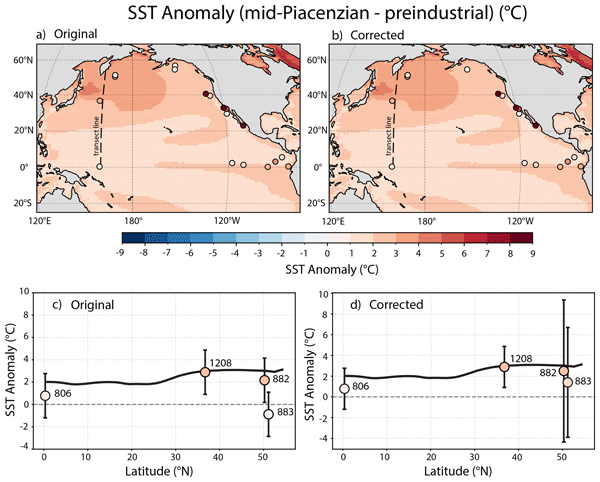
Accurate information about the surface ocean temperatures are important for understanding Earth's climate history. Here, we correct a sea surface temperature record from the critical subarctic North Pacific region for systematic biases introduced into the algal-biomarker-based geologic temperature estimates by the analytical method used by the original study.
Brianna Hoegler, Timothy D. Herbert, and Jamie Pahigian
Clim. Past, 22, 1241–1254, https://doi.org/10.5194/cp-22-1241-2026, https://doi.org/10.5194/cp-22-1241-2026, 2026
Short summary
Short summary
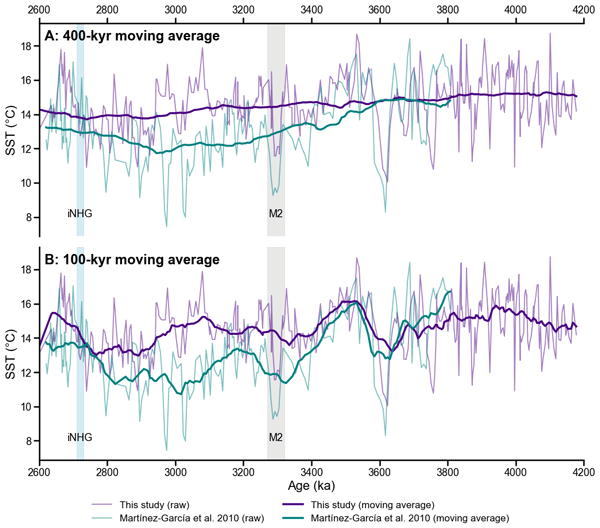
Studying the Pliocene (5.33–2.58 Ma) is key to understanding Earth’s climate under current atmospheric CO2 levels and the development of permanent Northern Hemisphere ice. We used ocean sediments and improved laboratory methods to reconstruct sea surface temperatures from Ocean Drilling Program Site 1090 (south Atlantic) from ~4.3–2.6 Ma. Our data suggests cooling patterns similar to those found worldwide, suggesting a global forcing, like decreased CO2, triggered the shift to the ice ages.
Cited articles
Andersson, C., Pausata, F. S. R., Jansen, E., Risebrobakken, B., and Telford, R. J.: Holocene trends in the foraminifer record from the Norwegian Sea and the North Atlantic Ocean, Clim. Past, 6, 179–193, https://doi.org/10.5194/cp-6-179-2010, 2010.
Bova, S., Rosenthal, Y., Liu, Z., Godad, S. P., and Yan, M.: Seasonal origin of the thermal maxima at the Holocene and the last interglacial, Nature, 589, 548–553, 2021.
Came, R. E., Oppo, D. W., and McManus, J. F.: Amplitude and timing of temperature and salinity variability in the subpolar North Atlantic over the past 10 ky, Geology, 35, 315–318, 2007.
Chassignet, E. P. and Marshall, D. P.: Gulf Stream separation in numerical ocean models, Geoph. Monog. Series, 177, 39–61, https://doi.org/10.1029/177GM05, 2008.
Chassignet, E. P. and Xu, X.: Impact of horizontal resolution (1/12 to 1/50) on Gulf Stream separation, penetration, and variability, J. Phys. Oceanogr., 47, 1999–2021, 2017.
Colin, C., Frank, N., Copard, K., and Douville, E.: Neodymium isotopic composition of deep-sea corals from the NE Atlantic: implications for past hydrological changes during the Holocene, Quaternary Sci. Rev., 29, 2509–2517, 2010.
Czaja, A. and Marshall, J.: Observations of atmosphere-ocean coupling in the North Atlantic, Q. J. Roy. Meteor. Soc., 127, 1893–1916, 2001.
deMenocal, P., Ortiz, J., Guilderson, T., Adkins, J., Sarnthein, M., Baker, L., and Yarusinsky, M.: Abrupt onset and termination of the African Humid Period: rapid climate responses to gradual insolation forcing, Quaternary Sci. Rev., 19, 347–361, 2000.
Emile-Geay, J., Cane, M. A., Naik, N., Seager, R., Clement, A. C., and van Geen, A.: Warren revisited: Atmospheric freshwater fluxes and “Why is no deep water formed in the North Pacific?”, J. Geophys. Res.-Oceans, 108, https://doi.org/10.1029/2001JC001058, 2003.
Erb, M. P., McKay, N. P., Steiger, N., Dee, S., Hancock, C., Ivanovic, R. F., Gregoire, L. J., and Valdes, P.: Reconstructing Holocene temperatures in time and space using paleoclimate data assimilation, Clim. Past, 18, 2599–2629, https://doi.org/10.5194/cp-18-2599-2022, 2022.
Filippova, A., Kienast, M., Frank, M., and Schneider, R.: Alkenone paleothermometry in the North Atlantic: A review and synthesis of surface sediment data and calibrations, Geochem. Geophy. Geosy., 17, 1370–1382, 2016.
Häkkinen, S. and Rhines, P. B.: Decline of subpolar North Atlantic circulation during the 1990s, Science, 304, 555–559, 2004.
Häkkinen, S., Rhines, P. B., and Worthen, D. L.: Warm and saline events embedded in the meridional circulation of the northern North Atlantic, J. Geophys. Res.-Oceans, 116, https://doi.org/10.1029/2010JC006275, 2011.
Häkkinen, S., Rhines, P. B., and Worthen, D. L.: Northern North Atlantic sea surface height and ocean heat content variability, J. Geophys. Res.-Oceans, 118, 3670–3678, 2013.
Hátún, H., Sandø, A. B., Drange, H., Hansen, B., and Valdimarsson, H.: Influence of the Atlantic subpolar gyre on the thermohaline circulation, Science, 309, 1841–1844, 2005.
Hátún, H., Azetsu-Scott, K., Somavilla, R., Rey, F., Johnson, C., Mathis, M., Mikolajewicz, U., Coupel, P., Tremblay, J.-É., and Hartman, S.: The subpolar gyre regulates silicate concentrations in the North Atlantic, Sci. Rep., 7, 1–9, 2017.
He, F.: Simulating transient climate evolution of the last deglaciation with CCSM3, PhD diss., University of Wisconsin–Madison, 2011.
He, F. and Clark, P. U.: Freshwater forcing of the atlantic meridional overturning circulation revisited, Nat. Clim. Change, 12, 449–454, 2022.
Heaton, T. J., Köhler, P., Butzin, M., Bard, E., Reimer, R. W., Austin, W. E., Ramsey, C. B., Grootes, P. M., Hughen, K. A., and Kromer, B.: Marine20 – the marine radiocarbon age calibration curve (0–55,000 cal BP), Radiocarbon, 62, 779–820, 2020.
Hirschi, J. J., Barnier, B., Böning, C., Biastoch, A., Blaker, A. T., Coward, A., Danilov, S., Drijfhout, S., Getzlaff, K., and Griffies, S. M.: The Atlantic meridional overturning circulation in high-resolution models, J. Geophys. Res.-Oceans, 125, e2019JC015522, 2020.
Hodell, D. A., Evans, H. F., Channell, J. E., and Curtis, J. H.: Phase relationships of North Atlantic ice-rafted debris and surface-deep climate proxies during the last glacial period, Quaternary Sci. Rev., 29, 3875–3886, 2010.
Hoskins, B.: On the existence and strength of the summer subtropical anticyclones: Bernhard Haurwitz memorial lecture, B. Am. Meteorol. Soc., 77, 1287–1292, 1996.
Huang, B., Liu, C., Banzon, V., Freeman, E., Graham, G., Hankins, B., Smith, T., and Zhang, H.-M.: Improvements of the daily optimum interpolation sea surface temperature (DOISST) version 2.1, J. Climate, 34, 2923–2939, 2021.
Jonkers, L. and Kučera, M.: Sensitivity to species selection indicates the effect of nuisance variables on marine microfossil transfer functions, Clim. Past, 15, 881–891, https://doi.org/10.5194/cp-15-881-2019, 2019.
Kaufman, D., McKay, N., Routson, C., Erb, M., Dätwyler, C., Sommer, P. S., Heiri, O., and Davis, B.: Holocene global mean surface temperature, a multi-method reconstruction approach, Sci. Data, 7, 1–13, 2020.
Kim, J.-H., Rimbu, N., Lorenz, S. J., Lohmann, G., Nam, S.-I., Schouten, S., Rühlemann, C., and Schneider, R. R.: North Pacific and North Atlantic sea-surface temperature variability during the Holocene, Quaternary Sci. Rev., 23, 2141–2154, 2004.
Koç, N., Jansen, E., and Haflidason, H.: Paleoceanographic reconstructions of surface ocean conditions in the Greenland, Iceland and Norwegian seas through the last 14 ka based on diatoms, Quaternary Sci. Rev., 12, 115–140, 1993.
Lacan, F. and Jeandel, C.: Subpolar Mode Water formation traced by neodymium isotopic composition, Geophys. Res. Lett., 31, https://doi.org/10.1029/2004GL019747, 2004.
Lawrence, K. T., Liu, Z., and Herbert, T. D.: Evolution of the eastern tropical Pacific through Plio-Pleistocene glaciation, 312, 79–83, 2006.
Leduc, G., Schneider, R., Kim, J.-H., and Lohmann, G.: Holocene and Eemian sea surface temperature trends as revealed by alkenone and Mg/Ca paleothermometry, Quaternary Sci. Rev., 29, 989–1004, https://doi.org/10.1016/j.quascirev.2010.01.004, 2010.
Linsley, B. K., Rosenthal, Y., and Oppo, D. W.: Holocene evolution of the Indonesian throughflow and the western Pacific warm pool, Nat. Geosci., 3, 578–583, 2010.
Liu, Y., Zhang, M., Liu, Z., Xia, Y., Huang, Y., Peng, Y., and Zhu, J.: A possible role of dust in resolving the Holocene temperature conundrum, Sci. Rep., 8, 1–9, 2018.
Liu, Z., Otto-Bliesner, B., He, F., Brady, E., Tomas, R., Clark, P., Carlson, A., Lynch-Stieglitz, J., Curry, W., and Brook, E.: Transient simulation of last deglaciation with a new mechanism for Bølling-Allerød warming, Science, 325, 310–314, 2009.
Liu, Z., Zhu, J., Rosenthal, Y., Zhang, X., Otto-Bliesner, B. L., Timmermann, A., Smith, R. S., Lohmann, G., Zheng, W., and Timm, O. E.: The Holocene temperature conundrum, P. Natl. Acad. Sci., 111, E3501–E3505, 2014.
Losa, S. N., Soppa, M. A., Dinter, T., Wolanin, A., Brewin, R. J., Bricaud, A., Oelker, J., Peeken, I., Gentili, B., and Rozanov, V.: Synergistic exploitation of hyper-and multi-spectral precursor sentinel measurements to determine phytoplankton functional types (SynSenPFT), Front. Mar. Sci., 4, 203, 2017.
Lougheed, B. C. and Obrochta, S.: A Rapid, Deterministic age-depth modeling routine for geological sequences with inherent depth uncertainty, Paleoceanogr. Paleoclimatol., 34, 122–133, 2019.
Maltrud, M. E. and McClean, J. L.: An eddy resolving global 1/10 ocean simulation, Ocean Model., 8, 31–54, 2005.
Mantsis, D. F., Clement, A. C., Kirtman, B., Broccoli, A. J., and Erb, M. P.: Precessional cycles and their influence on the North Pacific and North Atlantic summer anticyclones, J. Climate, 26, 4596–4611, 2013.
Marchal, O., Cacho, I., Stocker, T. F., Grimalt, J. O., Calvo, E., Martrat, B., Shackleton, N., Vautravers, M., Cortijo, E., and van Kreveld, S.: Apparent long-term cooling of the sea surface in the northeast Atlantic and Mediterranean during the Holocene, Quaternary Sci. Rev., 21, 455–483, 2002.
Marcott, S. A., Clark, P. U., Padman, L., Klinkhammer, G. P., Springer, S. R., Liu, Z., Otto-Bliesner, B. L., Carlson, A. E., Ungerer, A., and Padman, J.: Ice-shelf collapse from subsurface warming as a trigger for Heinrich events, P. Natl. Acad. Sci., 108, 13415–13419, 2011.
Marcott, S. A., Shakun, J. D., Clark, P. U., and Mix, A. C.: A reconstruction of regional and global temperature for the past 11,300 years, Science, 339, 1198–1201, 2013.
Marshall, J., Johnson, H., and Goodman, J.: A study of the interaction of the North Atlantic Oscillation with ocean circulation, J. Climate, 14, 1399–1421, 2001.
Marzocchi, A., Hirschi, J. J.-M., Holliday, N. P., Cunningham, S. A., Blaker, A. T., and Coward, A. C.: The North Atlantic subpolar circulation in an eddy-resolving global ocean model, J. Marine Syst., 142, 126–143, 2015.
McCarthy, G. D., Haigh, I. D., Hirschi, J. J.-M., Grist, J. P., and Smeed, D. A.: Ocean impact on decadal Atlantic climate variability revealed by sea-level observations, Nature, 521, 508–510, 2015.
Morley, A., Rosenthal, Y., and DeMenocal, P.: Ocean-atmosphere climate shift during the mid-to-late Holocene transition, Earth Planet. Sc. Lett., 388, 18–26, 2014.
Moros, M., Andrews, J. T., Eberl, D. D., and Jansen, E.: Holocene history of drift ice in the northern North Atlantic: Evidence for different spatial and temporal modes, Paleoceanography, 21, https://doi.org/10.1029/2005PA001214, 2006.
Moros, M., Jansen, E., Oppo, D. W., Giraudeau, J., and Kuijpers, A.: Reconstruction of the late-Holocene changes in the Sub-Arctic Front position at the Reykjanes Ridge, north Atlantic, The Holocene, 22, 877–886, 2012.
Moros, M., Lloyd, J. M., Perner, K., Krawczyk, D., Blanz, T., de Vernal, A., Ouellet-Bernier, M.-M., Kuijpers, A., Jennings, A. E., and Witkowski, A.: Surface and sub-surface multi-proxy reconstruction of middle to late Holocene palaeoceanographic changes in Disko Bugt, West Greenland, Quaternary Sci. Rev., 132, 146–160, 2016.
Müller, P. J., Kirst, G., Ruhland, G., Von Storch, I., and Rosell-Melé, A.: Calibration of the alkenone paleotemperature index U37K' based on core-tops from the eastern South Atlantic and the global ocean (60 N-60 S), Geochim. Cosmochim. Ac., 62, 1757–1772, 1998.
Newell, R. E. and Hsiung, J.: Factors Controlling Free Air and Ocean Temperature of the Last 30 Years and Extrapolation to the Past, in: Abrupt Climatic Change: Evidence and Implications, edited by: Berger, W. H. and Labeyrie, L. D., 67–87, Dordrecht, Springer Netherlands, https://doi.org/10.1007/978-94-009-3993-6_7, 1987.
Osman, M. B., Tierney, J. E., Zhu, J., Tardif, R., Hakim, G. J., King, J., and Poulsen, C. J.: Globally resolved surface temperatures since the Last Glacial Maximum, Nature, 599, 239–244, https://doi.org/10.1038/s41586-021-03984-4, 2021.
Park, H.-S., Kim, S.-J., Stewart, A. L., Son, S.-W., and Seo, K.-H.: Mid-Holocene Northern Hemisphere warming driven by Arctic amplification, Sci. Adv., 5, eaax8203, 2019.
Perner, K., Jennings, A. E., Moros, M., Andrews, J. T., and Wacker, L.: Interaction between warm Atlantic-sourced waters and the East Greenland Current in northern Denmark Strait (68 N) during the last 10 600 cal a BP, J. Quaternary Sci., 31, 472–483, 2016.
Raja, M. and Rosell-Melé, A.: Appraisal of sedimentary alkenones for the quantitative reconstruction of phytoplankton biomass, P. Natl. Acad. Sci., 118, https://doi.org/10.1073/pnas.2014787118, 2021.
Risebrobakken, B., Jansen, E., Andersson, C., Mjelde, E., and Hevrøy, K.: A high-resolution study of Holocene paleoclimatic and paleoceanographic changes in the Nordic Seas, Paleoceanography, 18, https://doi.org/10.1029/2002PA000764, 2003.
Rodwell, M. J. and Hoskins, B. J.: Subtropical anticyclones and summer monsoons, J. Climate, 14, 3192–3211, 2001.
Rossby, T.: The North Atlantic Current and surrounding waters: At the crossroads, Rev. Geophys., 34, 463–481, 1996.
Ruddiman, W. F.: Historical stability of the Gulf Stream meander belt: foraminiferal evidence, Deep-Sea Res. Oceanogr. Abstr., 137–148, https://doi.org/10.1016/0011-7471(68)90035-1, 1968.
Ruddiman, W. F. and Esmay, A.: A Streamlined Foraminiferal Transfer-function for the Subpolar North-Atlantic, Initial Rep. Deep Sea, 94, 1045–1057, 1987.
Sachs, J. P.: Cooling of Northwest Atlantic slope waters during the Holocene, Geophys. Res. Lett., 34, https://doi.org/10.1029/2006GL028495, 2007.
Salvigsen, O., Forman, S. L., and Miller, G. H.: Thermophilous molluscs on Svalbard during the Holocene and their paleoclimatic implications, Polar Res., 11, 1–10, 1992.
Schneider, B., Leduc, G., and Park, W.: Disentangling seasonal signals in Holocene climate trends by satellite-model-proxy integration, Paleoceanography, 25, https://doi.org/10.1029/2009PA001893, 2010.
Seager, R., Murtugudde, R., Naik, N., Clement, A., Gordon, N., and Miller, J.: Air–sea interaction and the seasonal cycle of the subtropical anticyclones, J. Climate, 16, 1948–1966, 2003.
Shuman, B. N. and Marsicek, J.: The structure of Holocene climate change in mid-latitude North America, Quaternary Sci. Rev., 141, 38–51, 2016.
Siegel, D., Doney, S., and Yoder, J.: The North Atlantic spring phytoplankton bloom and Sverdrup's critical depth hypothesis, Science, 296, 730–733, 2002.
Solignac, S., de Vernal, A., and Hillaire-Marcel, C.: Holocene sea-surface conditions in the North Atlantic – contrasted trends and regimes in the western and eastern sectors (Labrador Sea vs. Iceland Basin), Quaternary Sci. Rev., 23, 319–334, 2004.
Solignac, S., Grelaud, M., De Vernal, A., Giraudeau, J., Moros, M., McCave, I. N., and Hoogakker, B.: Reorganization of the upper ocean circulation in the mid-Holocene in the northeastern Atlantic, Can. J. Earth Sci., 45, 1417–1433, 2008.
Staines-Urías, F., Kuijpers, A., and Korte, C.: Evolution of subpolar North Atlantic surface circulation since the early Holocene inferred from planktic foraminifera faunal and stable isotope records, Quaternary Sci. Rev., 76, 66–81, 2013.
Thompson, A. J., Zhu, J., Poulsen, C. J., Tierney, J. E., and Skinner, C. B.: Northern Hemisphere vegetation change drives a Holocene thermal maximum, Sci. Adv., 8, eabj6535, https://doi.org/10.1126/sciadv.abj6535, 2022.
Thornalley, D. J., Elderfield, H., and McCave, I. N.: Holocene oscillations in temperature and salinity of the surface subpolar North Atlantic, Nature, 457, 711–714, 2009.
Thornalley, D. J., McCave, I. N., and Elderfield, H.: Tephra in deglacial ocean sediments south of Iceland: Stratigraphy, geochemistry and oceanic reservoir ages, J. Quaternary Sci., 26, 190–198, 2011.
Tierney, J. E. and Tingley, M. P.: BAYSPLINE: A new calibration for the alkenone paleothermometer, Paleoceanogr. Paleoclimatol., 33, 281–301, 2018.
Toggweiler, J. and Si, W.: A new role for the AMOC during the ice ages, Paleoceanogr. Paleoclimatol., 40, e2024PA004973, 2025.
Toggweiler, J., Druffel, E. R., Key, R. M., and Galbraith, E. D.: Upwelling in the ocean basins north of the ACC: 2. How cool subantarctic water reaches the surface in the tropics, J. Geophys. Res.-Oceans, 124, 2609–2625, 2019.
Volkov, D. L., Baringer, M., Smeed, D., Johns, W., and Landerer, F. W.: Teleconnection between the Atlantic meridional overturning circulation and sea level in the Mediterranean Sea, J. Climate, 32, 935–955, 2019.
Warren, B. A.: Why is no deep water formed in the North Pacific?, J. Mar. Res., 41, 327–347, 1983.
Werner, K., Spielhagen, R. F., Bauch, D., Hass, H. C., and Kandiano, E.: Atlantic Water advection versus sea-ice advances in the eastern Fram Strait during the last 9 ka: Multiproxy evidence for a two-phase Holocene, Paleoceanography, 28, 283–295, 2013.
Williams, R. G., McLaren, A. J., and Follows, M. J.: Estimating the convective supply of nitrate and implied variability in export production over the North Atlantic, Global Biogeochem. Cy., 14, 1299–1313, 2000.
Yang, H., Lohmann, G., Krebs-Kanzow, U., Ionita, M., Shi, X., Sidorenko, D., Gong, X., Chen, X., and Gowan, E. J.: Poleward shift of the major ocean gyres detected in a warming climate, Geophys. Res. Lett., 47, e2019GL085868, https://doi.org/10.1029/2019GL085868, 2020.
Short summary
Transient climate models simulate warming over the past 5000 years due to a 20 ppm CO2 rise, yet paleo-proxies indicate cooling. In this study, we examine the mid-latitude North Atlantic, where model-data mismatch is largest. Our analysis links Late Holocene cooling to increased zonal SST (Sea Surface Temperature) asymmetry, likely from basin-scale reorganization of inter-gyre circulation. Transient models, however, do not to capture this spatial pattern and associated circulation changes.
Transient climate models simulate warming over the past 5000 years due to a 20 ppm CO2 rise, yet...