Articles | Volume 22, issue 8
https://doi.org/10.5194/cp-22-1499-2026
© Author(s) 2026. This work is distributed under
the Creative Commons Attribution 4.0 License.
https://doi.org/10.5194/cp-22-1499-2026
© Author(s) 2026. This work is distributed under
the Creative Commons Attribution 4.0 License.
Amplified cooling of Snowball Earth from a salt-albedo feedback
Aksel Samuelsberg
CORRESPONDING AUTHOR
Department of Mathematics and Statistics, UiT – The Arctic University of Norway, Tromsø, Norway
Per Kristen Jakobsen
Department of Mathematics and Statistics, UiT – The Arctic University of Norway, Tromsø, Norway
Martin Rypdal
Department of Mathematics and Statistics, UiT – The Arctic University of Norway, Tromsø, Norway
Related authors
Aksel Samuelsberg and Per Kristen Jakobsen
Nonlin. Processes Geophys., 32, 23–33, https://doi.org/10.5194/npg-32-23-2025, https://doi.org/10.5194/npg-32-23-2025, 2025
Short summary
Short summary
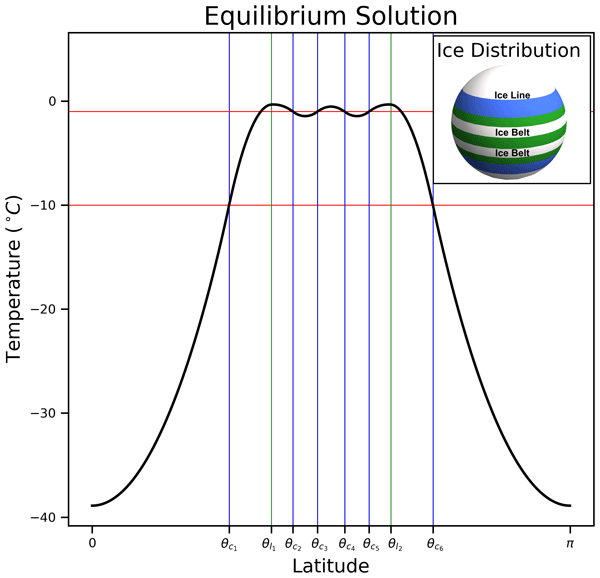
We explored a simplified climate model based on Earth's energy budget. One advantage of such models is that they are easier to study mathematically. Using a mathematical technique known as boundary integral methods, we present a new way to solve these climate models. This method is particularly useful for modeling climates very different from Earth's current state, such as those on other planets or during past ice ages.
Clara Hummel, Niklas Boers, and Martin Rypdal
Earth Syst. Dynam., 16, 2035–2062, https://doi.org/10.5194/esd-16-2035-2025, https://doi.org/10.5194/esd-16-2035-2025, 2025
Short summary
Short summary
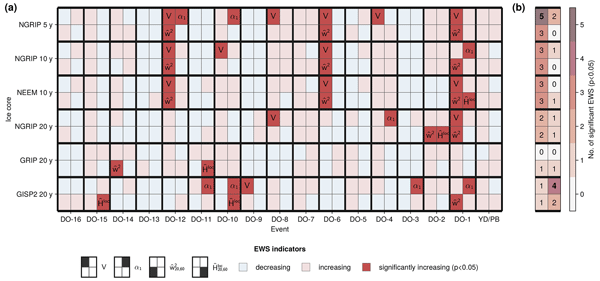
We revisit early warning signals (EWS) for past abrupt climate changes known as Dansgaard-Oeschger (DO) events. Using advanced statistical methods, we find fewer significant EWS than previously reported. While some signals appear consistent across Greenland ice core records, they are not enough to identify the still unknown mechanisms behind DO events. This study highlights the complexity of predicting climate changes and urges caution in interpreting (paleo-)climate data.
Eirik Myrvoll-Nilsen, Luc Hallali, and Martin Rypdal
Earth Syst. Dynam., 16, 1539–1556, https://doi.org/10.5194/esd-16-1539-2025, https://doi.org/10.5194/esd-16-1539-2025, 2025
Short summary
Short summary
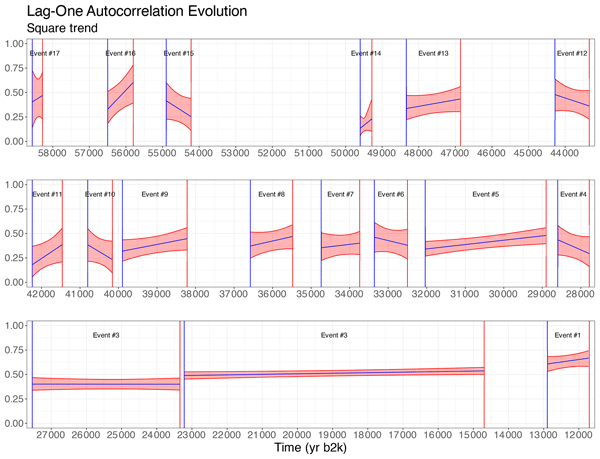
Before a climate component reaches a tipping point, there may be observable changes in its statistical properties. These are known as early warning signals and include increased fluctuation and correlation times. We present a Bayesian approach to detect these signals, using a model where the correlation parameter depends linearly on time for which the slope can be estimated directly from the data. The model is then applied to Dansgaard–Oeschger events using Greenland ice core data.
Anna Poltronieri, Nils Bochow, and Martin Rypdal
EGUsphere, https://doi.org/10.5194/egusphere-2025-1134, https://doi.org/10.5194/egusphere-2025-1134, 2025
Preprint archived
Short summary
Short summary
As Arctic sea ice shrinks, new shipping routes become more accessible. This study compares the effects of two main Arctic pathways: the Northern and the Transpolar Sea routes. Using a high-complexity climate model, we simulate black carbon emissions from ships. When deposited on sea ice, black carbon increases solar absorption, enhancing melt. We analyze absorbed solar radiation, sea ice extent, and air temperature, finding that the Transpolar Sea Route has a greater effect on Arctic sea ice.
Aksel Samuelsberg and Per Kristen Jakobsen
Nonlin. Processes Geophys., 32, 23–33, https://doi.org/10.5194/npg-32-23-2025, https://doi.org/10.5194/npg-32-23-2025, 2025
Short summary
Short summary
We explored a simplified climate model based on Earth's energy budget. One advantage of such models is that they are easier to study mathematically. Using a mathematical technique known as boundary integral methods, we present a new way to solve these climate models. This method is particularly useful for modeling climates very different from Earth's current state, such as those on other planets or during past ice ages.
Eirik Myrvoll-Nilsen, Keno Riechers, Martin Wibe Rypdal, and Niklas Boers
Clim. Past, 18, 1275–1294, https://doi.org/10.5194/cp-18-1275-2022, https://doi.org/10.5194/cp-18-1275-2022, 2022
Short summary
Short summary
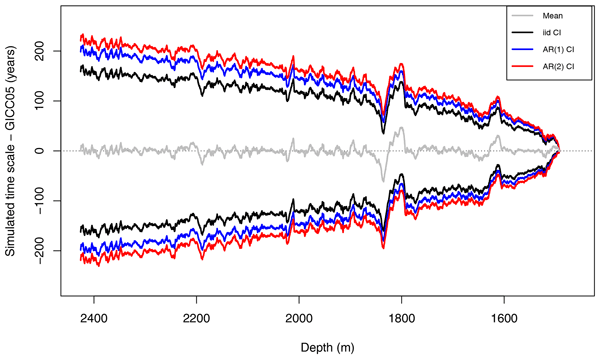
In layer counted proxy records each measurement is accompanied by a timestamp typically measured by counting periodic layers. Knowledge of the uncertainty of this timestamp is important for a rigorous propagation to further analyses. By assuming a Bayesian regression model to the layer increments we express the dating uncertainty by the posterior distribution, from which chronologies can be sampled efficiently. We apply our framework to dating abrupt warming transitions during the last glacial.
Cited articles
Abbot, D. S.: Resolved snowball Earth clouds, J. Climate, 27, 4391–4402, 2014. a
Abbot, D. S. and Pierrehumbert, R. T.: Mudball: Surface dust and snowball Earth deglaciation, J. Geophys. Res.-Atmos., 115, D03104, https://doi.org/10.1029/2009JD012007, 2010. a, b
Abbot, D. S., Voigt, A., Branson, M., Pierrehumbert, R. T., Pollard, D., Le Hir, G., and Koll, D. D.: Clouds and snowball Earth deglaciation, Geophys. Res. Lett., 39, L20711, https://doi.org/10.1029/2012GL052861, 2012. a
Bao, H., Lyons, J., and Zhou, C.: Triple oxygen isotope evidence for elevated CO2 levels after a Neoproterozoic glaciation, Nature, 453, 504–506, 2008. a
Bao, H., Fairchild, I. J., Wynn, P. M., and Spötl, C.: Stretching the envelope of past surface environments: Neoproterozoic glacial lakes from Svalbard, Science, 323, 119–122, 2009. a
Budyko, M. I.: The effect of solar radiation variations on the climate of the Earth, Tellus, 21, 611–619, 1969. a
Cahalan, R. F. and North, G. R.: A stability theorem for energy-balance climate models, J. Atmos. Sci., 36, 1178–1188, 1979. a
Dadic, R., Mullen, P. C., Schneebeli, M., Brandt, R. E., and Warren, S. G.: Effects of bubbles, cracks, and volcanic tephra on the spectral albedo of bare ice near the Transantarctic Mountains: Implications for sea glaciers on Snowball Earth, J. Geophys. Res.-Earth, 118, 1658–1676, 2013. a
Goodman, J. C.: Through thick and thin: Marine and meteoric ice in a “Snowball Earth” climate, Geophys. Res. Lett., 33, L16701, https://doi.org/10.1029/2006GL026840, 2006. a, b, c
Goodman, J. C. and Pierrehumbert, R. T.: Glacial flow of floating marine ice in “Snowball Earth”, J. Geophys. Res.-Oceans, 108, https://doi.org/10.1029/2002JC001471, 2003. a
Hoffman, P. F., Kaufman, A. J., Halverson, G. P., and Schrag, D. P.: A Neoproterozoic snowball earth, Science, 281, 1342–1346, 1998. a
Hoffman, P. F., Abbot, D. S., Ashkenazy, Y., Benn, D. I., Brocks, J. J., Cohen, P. A., Cox, G. M., Creveling, J. R., Donnadieu, Y., Erwin, D. H., Fairchild, I. J., Ferreira, D., Goodman, J. C., Halverson, G. P., Jansen, M. F., Le Hir, G., Love, G. D., Macdonald, F. A., Maloof, A. C., Partin, C. A., Ramstein, G., Rose, B. E. J., Rose, C. V., Sadler, P. M., Tziperman, E., Voigt, A., and Warren, S. G.: Snowball Earth climate dynamics and Cryogenian geology-geobiology, Sci. Adv., 3, e1600983, https://doi.org/10.1126/sciadv.1600983, 2017. a, b, c
Li, D. and Pierrehumbert, R. T.: Sea glacier flow and dust transport on Snowball Earth, Geophys. Res. Lett., 38, L17501, https://doi.org/10.1029/2011GL048991, 2011. a
Light, B., Brandt, R. E., and Warren, S. G.: Hydrohalite in cold sea ice: Laboratory observations of single crystals, surface accumulations, and migration rates under a temperature gradient, with application to “Snowball Earth”, J. Geophys. Res.-Oceans, 114, C07018, https://doi.org/10.1029/2008JC005211, 2009. a, b, c, d
Marion, G., Farren, R., and Komrowski, A.: Alternative pathways for seawater freezing, Cold Reg. Sci. Technol., 29, 259–266, 1999. a
Pierrehumbert, R. T.: Climate dynamics of a hard snowball Earth, J. Geophys. Res.-Atmos., 110, D01111, https://doi.org/10.1029/2004JD005162, 2005. a, b
Samuelsberg, A.: A salt-albedo feedback on Snowball Earth, Zenodo [computer software], https://doi.org/10.5281/zenodo.18469541, 2026. a
Samuelsberg, A. and Jakobsen, P. K.: Solving a North-type energy balance model using boundary integral methods, Nonlin. Processes Geophys., 32, 23–33, https://doi.org/10.5194/npg-32-23-2025, 2025a. a, b, c
Shields, A. L. and Carns, R. C.: Hydrohalite salt-albedo feedback could cool M-dwarf planets, Astrophys. J., 867, 11, https://doi.org/10.3847/1538-4357/aadcaa 2018. a
Vancoppenolle, M., Madec, G., Thomas, M., and McDougall, T. J.: Thermodynamics of sea ice phase composition revisited, J. Geophys. Res.-Oceans, 124, 615–634, 2019. a
Walsh, J.: Neoproterozoic glacial ages in a nonsmooth conceptual model, J. Phys. Commun., 2, 075020, https://doi.org/10.1088/2399-6528/aab748, 2018. a
Wu, J., Liu, Y., and Zhao, Z.: How should snowball Earth deglaciation start, J. Geophys. Res.-Atmos., 126, e2020JD033833, https://doi.org/10.1029/2020JD033833, 2021. a
Short summary
In this work we implement a feedback mechanism with proposed relevance for Snowball Earth in a simple climate model, a salt-albedo feedback. Our results show that this mechanism could have amplified cooling during the initial phase of Snowball Earth, suggesting it may have played an overlooked role in the climate evolution of Snowball Earth.
In this work we implement a feedback mechanism with proposed relevance for Snowball Earth in a...