
the Creative Commons Attribution 4.0 License.
the Creative Commons Attribution 4.0 License.
 | 06 Aug 2026
Amplified cooling of Snowball Earth from a salt-albedo feedback
Aksel Samuelsberg
Per Kristen Jakobsen
Martin Rypdal
It is believed that the atmospheric circulation on Snowball Earth produced a net ablation zone exposing bare sea ice. Under sufficiently low temperatures, salt begins to precipitate out of sea ice, forming a lag deposit of crystals with high albedo as the ice sublimates. This could have resulted in a salt-albedo feedback that has not previously been included in modeling studies of Snowball Earth. We implement a salt-albedo feedback in a simple climate model and show that, once initiated, this mechanism could have intensified global cooling in the initial phase of Snowball Earth. Our results suggest that salt precipitation may have played a role in shaping the early climate of Snowball Earth.
- Article
(1568 KB) - Full-text XML
- BibTeX
- EndNote


Modeling studies indicate a net ablation zone at lower latitudes on Snowball Earth, where annual mean sublimation exceeds precipitation (Pierrehumbert, 2005; Pierrehumbert et al., 2011; Abbot et al., 2011, 2013). This would have exposed sublimating bare sea ice under extremely cold temperatures for thousands of years during the global glaciation events of the late Neoproterozoic era (715–635 Ma). At sufficiently low temperatures, the salt in seawater becomes saturated and precipitates in crystal form (Light et al., 2009; Carns et al., 2015). In the net ablation zone on Snowball Earth, precipitated crystals at the surface could have accumulated a lag deposit as the ice sublimated (Light et al., 2009, 2016; Carns et al., 2015, 2016). Field studies (Carns et al., 2015) and laboratory experiments (Light et al., 2016; Carns et al., 2016) have shown that salt crystals have a high albedo, which can result in a salt-albedo feedback mechanism (Light et al., 2016; Shields and Carns, 2018). The effects of this salt-albedo feedback have not previously been implemented in a climate model for Snowball Earth.
We implemented a simplified salt-albedo feedback parameterization in a diffusive one-dimensional energy balance model (EBM) and solved it using analytical methods. The EBM describes the zonal mean surface temperature of the Earth, and its key features are meridional heat distribution through diffusion, the Planck response and a nonlinear albedo feedback. This is a well-known model that has been extensively studied in the literature (e.g. North, 1975; North et al., 1981). Using spherical coordinates, the model may be formulated as
where x is the co-latitude, ranging from x=0 at the North Pole to at the Equator. Here C is the heat capacity of the atmosphere–ocean column, Q is solar irradiance and the diffusion coefficient D scales the meridional heat transport. Solar radiation is distributed across latitudes according to the function s(x), and energy is radiated into outer space through the parametrization A+BT (Budyko, 1969). Additionally, the solution is subject to no-flux boundary conditions (North, 1975).
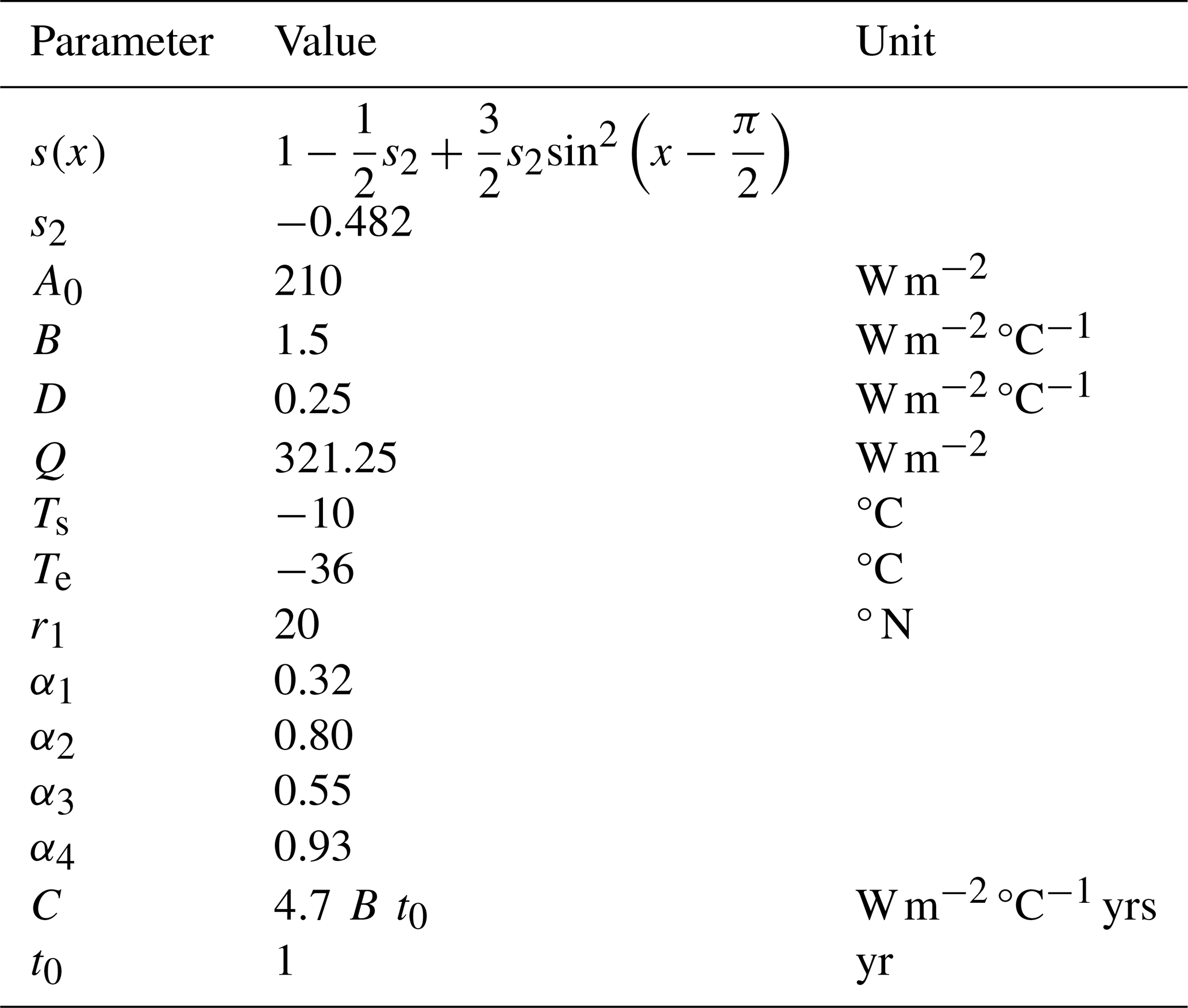
We adapted the albedo function a(x,T(x)) to include both an ice-albedo and a salt-albedo feedback mechanism. Following the standard approach for EBMs, we let latitudes with a zonal mean temperature below a specific isotherm Ts have an ice/snow cover albedo value denoted α2. This will be separate from the albedo value of ice-free latitudes denoted α1. The extent of the net ablation zone on Snowball Earth is denoted by the latitude r1. We let the snow/ice albedo take on a lower value α3 equatorward of r1 to reflect that of bare sea ice. This dynamic, known as the Jormungand mechanism, has been shown to produce Waterbelt states, i.e., a Snowball Earth with a tropical water belt, in several climate models (Abbot et al., 2011; Braun et al., 2022; Walsh, 2018; Samuelsberg and Jakobsen, 2025b). However, it is uncertain whether the Snowball Earth events could have been a Waterbelt state (Hoffman et al., 2017; Braun et al., 2022). We let the surface take a salt albedo value α4 for temperatures below some eutectic temperature Te in the bare sea ice region. The eutectic temperature refers to the temperature at which the salt in seawater becomes solid and starts to precipitate, and is about −36 °C for the entire seawater system (Marion et al., 1999; Light et al., 2016; Vancoppenolle et al., 2019). A lag deposit of precipitated salt crystals is expected to form at the surface when the sea ice sublimates (Light et al., 2016). This dynamic only operates in the net ablation zone. We initially set the eutectic temperature to °C. The albedo of hydrohalite salt crystals is extremely high at α4=0.93 (Light et al., 2016), and we used this value throughout this study. Other model parameters are given in Table 1. Mathematically, the proposed albedo function takes the form:
Here r1 refers to the latitude in spherical coordinates corresponding to the geographic latitude (in degrees north) listed in Table 1.
Table 1Model parameters in the EBM. A0, B, Q and s(x) are from Abbot et al. (2011). The critical isotherm for ice formation Ts and the heat capacity C are from North et al. (1981). D is take from Pierrehumbert et al. (2011). The eutectic temperature Te and the albedo of salt crystals α4 are from Light et al. (2016). The albedo over ice-free ocean α1 is from Braun et al. (2022), the snow albedo value α2 is from Abbot et al. (2011) and α3 is a plausible bare sea ice albedo based on the measurements in Dadic et al. (2013).
Equilibrium solutions to Eq. (1), with the albedo in Eq. (2), were found using boundary integrals. Here we briefly outline the main procedures of the method and how it is adapted to handle the salt-albedo feedback parametrization.
We non-dimensionalized Eq. (1) and introduced the dimensionless, equilibrium temperature field , where Ts is the ice line temperature. In Samuelsberg and Jakobsen (2025a), it was shown that u(x) satisfy the following relation on some interval (x1,x2) in the domain:
where g(x,s) is a Green's function associated with the problem and
Here the albedo function a(x,u(x)) takes dimensionless temperatures and the input is scaled to give the same albedo response as the function in Eq. (2). We used the Green's function from Samuelsberg and Jakobsen (2025a). The primary objective for any method for solving diffusive, one-dimensional EBMs with a step-function albedo response at the ice line, is to locate the ice line. In the model, the defining property of the ice line latitude, denoted xs, is that T(xs)=Ts, and it represents the transition between snow/ice and open ocean. We let the salt-albedo feedback take on a similar temperature response associated with the eutectic temperature Te. The salt-albedo feedback can therefore introduce a salt line, which is the transition latitude between salt cover and bare sea ice within the bare sea ice region equatorward of r1. We let xe denote the salt line latitude. Mathematically, the defining property of the salt line is that T(xe)=Te. We located the ice line and the salt line by developing a set of boundary integral equations. Details are left out here, but the approach was the same as in Samuelsberg and Jakobsen (2025a) and Samuelsberg and Jakobsen (2025b).
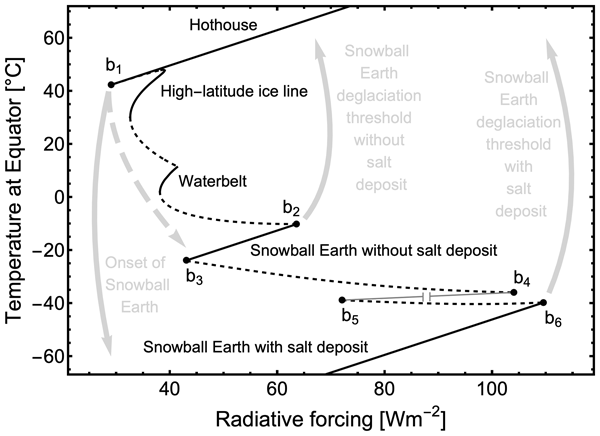
To understand the effects of the salt-albedo feedback mechanism on the system, we drew bifurcation diagrams for the equilibrium solutions to Eq. (1). Figure 1 shows a bifurcation diagram obtained using the model parameters from Table 1. Following Abbot et al. (2011), we let the bifurcation parameter be A, which controls the outgoing longwave radiation. The x axis in Fig. 1 show a deviation in the bifurcation parameter from the reference value A0 given in Table 1, such that radiative forcing . This represents forcing in the model as a reduction in A results in lower outgoing energy, e.g. due to increased atmospheric greenhouse gas concentrations. We chose to display the equatorial temperature on the y axis of the bifurcation diagram. In the literature on EBMs, bifurcation diagrams typically show ice line latitude on the y axis. However, in this study, we focused on alternative Snowball Earth states, and all states below the point b2 in the bifurcation diagram in Fig. 1 are fully ice-covered. To differentiate these states, we represented them using their equatorial temperature. Note that this projection partially obscures the small ice cap instability, and the branch labeled “High-latitude ice line” in Fig. 1 is not directly connected to the “Hothouse”-branch. Stability was determined using the slope stability theorem (Cahalan and North, 1979), which applies to the classical two-ice-line solutions of Eq. (1), and through simulations performed with the finite-difference code from Samuelsberg and Jakobsen (2025b). The transitions shown in Fig. 1 were verified using finite-difference simulations.
The salt-albedo feedback gave rise to new climatic states not previously seen in modeling studies (Fig. 1). It is well established that the EBM for an idealized aquaplanet has three stable states: the ice-free hothouse state, the high-latitude ice line state and the Snowball Earth state (North et al., 1981). We prescribe a lower bare sea ice albedo in the net ablation zone, which gives the EBM Waterbelt solutions as well (Abbot et al., 2011; Samuelsberg and Jakobsen, 2025b). The salt-albedo feedback most notably gives rise to two new, stable, coexisting Snowball Earth states: a Snowball Earth with a salt deposit (<b6 in Fig. 1) and a Snowball Earth without a salt deposit (b2−b3). The latter is characterized by global ice cover and equatorial bare sea ice. The salt-deposit Snowball Earth state is likewise fully ice covered, but with a salt deposit on the bare sea ice. In addition, several unstable states appeared, with two smaller salt deposits on the bare sea ice (b3−b4 and b5−b6 in Fig. 1) or with more than two deposits (b4−b5). We will not focus on these states here.
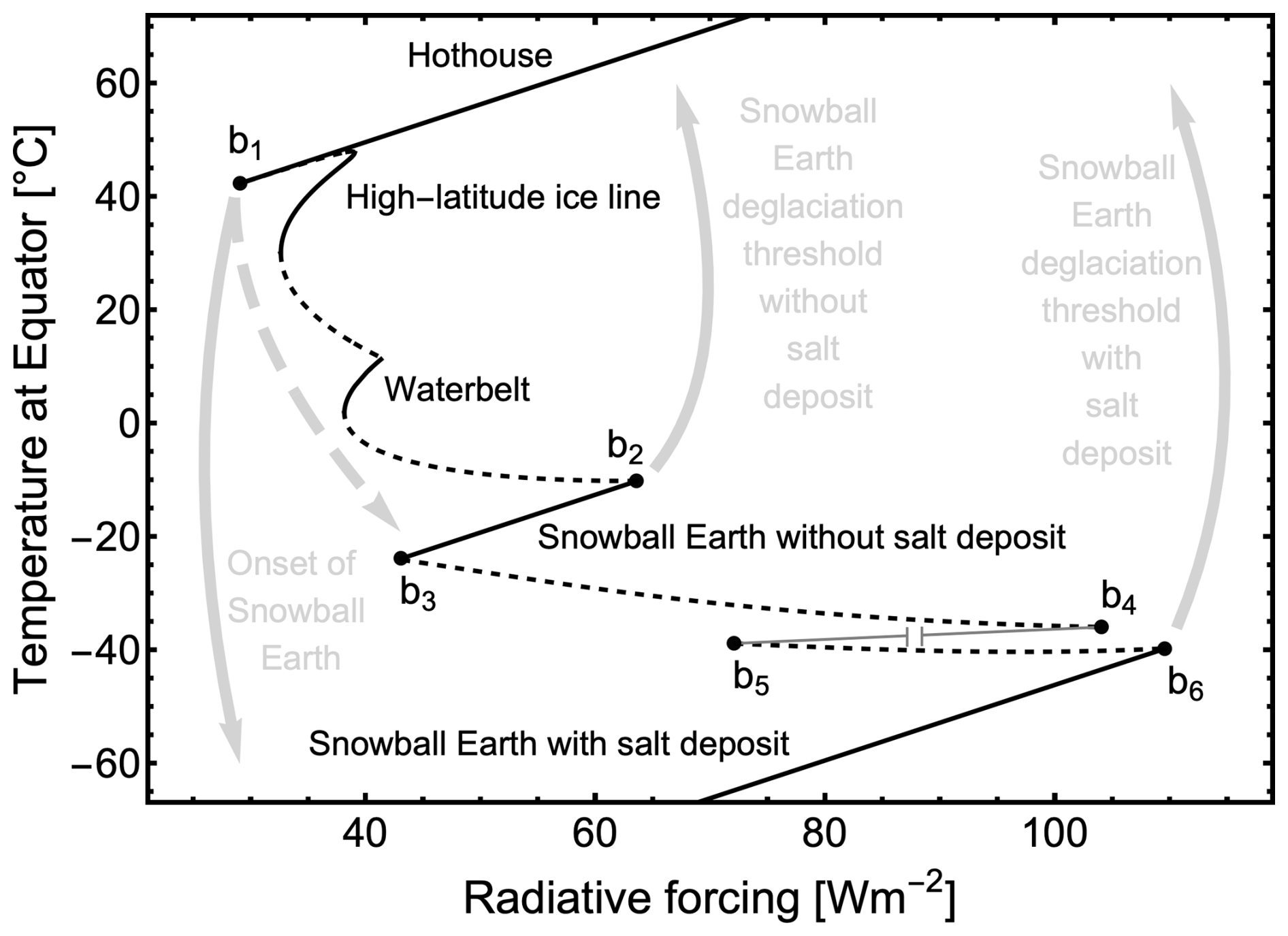
Figure 1Bifurcation diagram for the EBM with a salt-albedo feedback (Eq. 1 with the albedo function in Eq. 2). Radiative forcing on the x axis is defined as , where A0 is the reference value given in Table 1. Black solid lines indicate stable equilibrium states and dashed lines indicate unstable states. Stable climate states are labeled. The branch terminating at b6 extends beyond the plotted frame. Likewise, the branch originating in b1 extends beyond the frame. Gray solid arrows show transitions in the Snowball Earth hysteresis. The dashed arrow indicates the unfeasible transition from a warm climate to a Snowball Earth without salt deposits. Model parameters are given in Table 1. The gray line between point b4 and b5 represents a truncation where Snowball Earth states with multiple salt deposits are omitted, the situation here is analogous to the complicated ice distributions reported in Samuelsberg and Jakobsen (2025b). These solutions are unstable.
The presence of two new Snowball Earth states raises the question of which state is more likely to represent the climate of the Snowball Earth events in the Late Neoproterozoic. To assess this, we adopted an approach previously applied to assess Waterbelt states as an explanation to Neoproterozoic geology (Abbot et al., 2011; Braun et al., 2022). Namely, that the state had to be accessible from warm climates (Fig. 2) and had to exist over a large range of atmospheric CO2 concentrations. This is to determine which of the two new states is consistent with the well-established hysteresis loop associated with the Snowball Earth events (Hoffman et al., 1998, 2017). That is, from a warm climate to Snowball Earth and back again following a substantial increase in atmospheric CO2 concentrations. The peculiar aspect of the Neoproterozoic Snowball Earth events is the lack of evidence for ice sheets in 1.5 billion years leading up to these global glaciations, known as the Proterozoic glacial gap (Hoffman et al., 2017). Thus, the climate system must have rested in some warm, more or less ice-free equilibrium state prior to these events. In the EBM, such states exist in the upper branch of the bifurcation diagram in Fig. 1 and the bifurcation point b1 is associated with the onset of Snowball Earth. For the model parameters used in Fig. 1, the Snowball Earth without a salt deposit is not accessible because a parameter drift below b1 drives the system into the salt-deposit state. Therefore, the transition from a warm climate to a Snowball Earth without a salt deposit is not possible here.
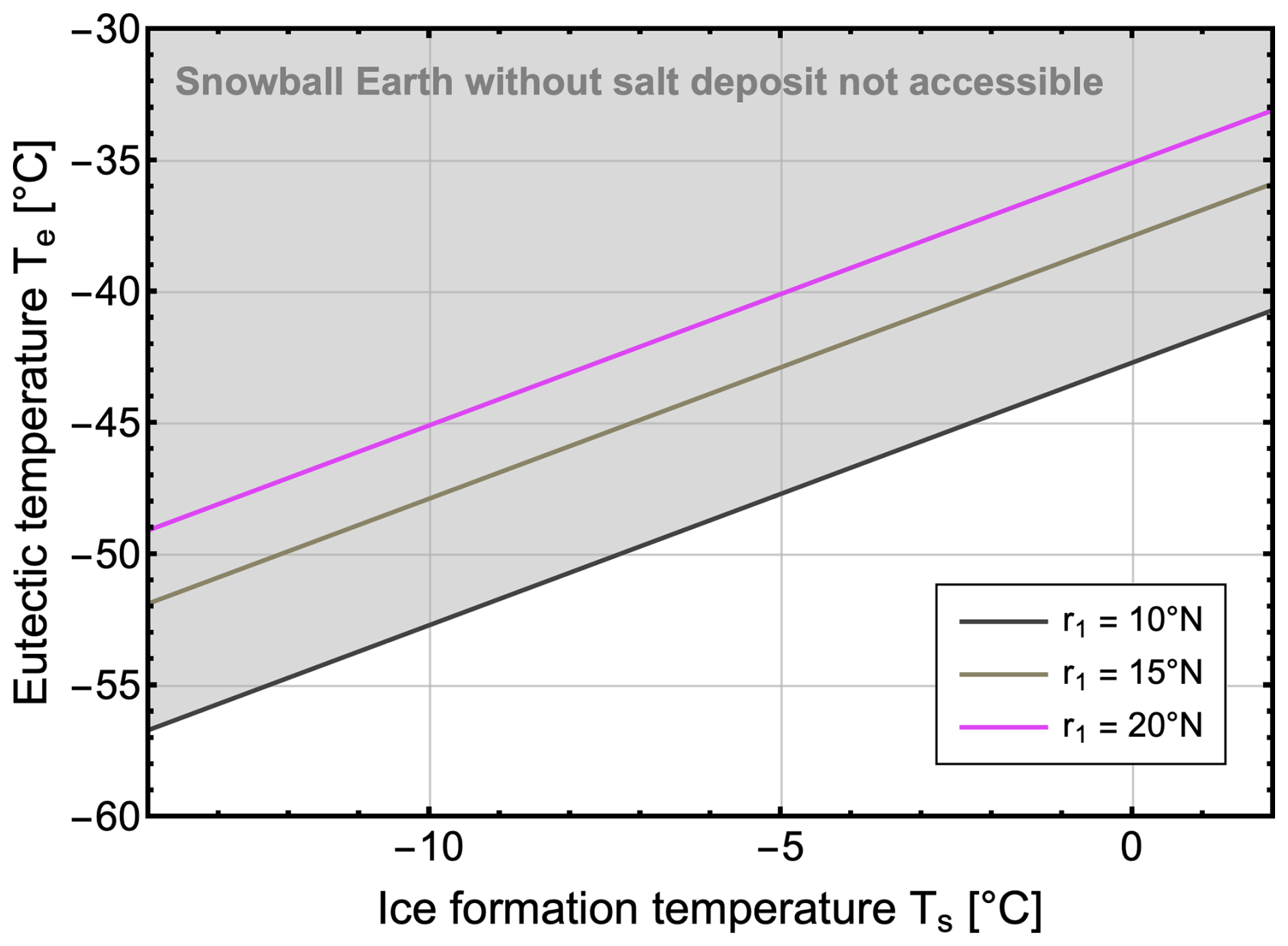
Figure 2Diagram showing the accessibility of the Snowball Earth without a salt deposit for different values of the critical temperatures Ts and Te. The lines represent the boundary between accessible and inaccessible regimes of the parameter space for different values of the bare sea ice extent r1=20° N, r1=15° N and r1=10° N. Above the lines the Snowball Earth without a salt deposit is inaccessible from warm climates. Other model parameters are given in Table 1.
The Snowball Earth without a salt deposit is inaccessible for plausible model parameters. The accessibility of the Snowball Earth state without a salt deposit depends most prominently on the eutectic temperature Te and the ice formation temperature Ts. Figure 3 shows a selection of bifurcation curves with different model parameters. A transition into the salt-deposit Snowball Earth from a warm, ice-free state is favored by higher diffusion rates (Fig. 3a) and larger albedo differences α2−α1 (Fig. 3c), whereas lower diffusions and albedo differences prevent a direct transition (pink curves in Fig. 3a and c). Assuming a direct transition to Snowball Earth, the parameters controlling whether such a transition sends the system into a Snowball Earth with or without a salt deposit are Te, Ts and r1 (see Fig. 3b and d). The curves in the (Te,Ts)-plane in Fig. 2 mark the boundary between the accessible and inaccessible regimes of the parameter space for r1=20° N, r1=15° N and r1=10° N. The extent of the net ablation zone, here denoted by the latitude r1, varies among general circulation models simulating Snowball Earth atmospheres (Abbot et al., 2013), therefore we investigate the sensitivity to this parameter. The Snowball Earth without a salt deposit is only accessible for large bare sea ice regions and extremely low eutectic temperatures, suggesting it is unlikely that Snowball Earth existed without salt deposits.
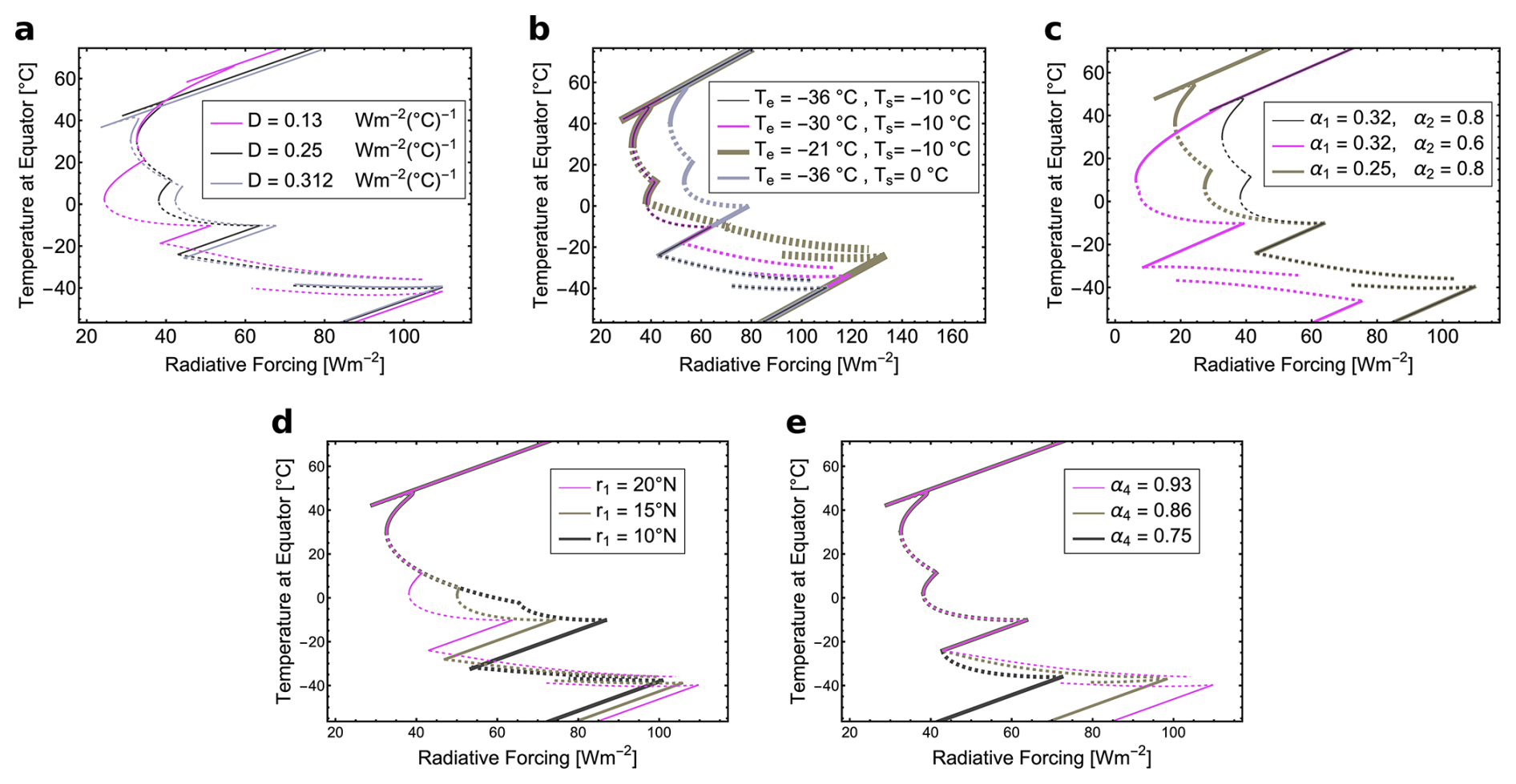
Figure 3Bifurcation diagram for the EBM in Eq. (1) with the albedo function in Eq. (2) and: (a) Different diffusion rates D. The numerical value D=0.312 gives the temperate solutions to the EBM a modern-day temperature field, and is taken from North et al. (1981). The value D=0.25 is taken from Pierrehumbert et al. (2011) and represents a cold climate diffusion. A lower diffusion rate with numerical value D=0.13 was also explored. (b) Different combinations of critical isotherms Ts and Te. (c) Different albedo values α1 and α2. (d) Different bare sea ice latitudes r1. (e) Different salt crystal albedo values α4. Other model parameters are given in Table 1. Solid lines indicate stable equilibrium solutions to Eq. (1) and dashed lines indicate unstable solutions. Solutions with multiple salt lines (see bifurcation points b4 and b5 in Fig. 1) are omitted here.
Based on this study, it is not possible to determine how long a salt deposit lasted on Snowball Earth. We observe that the range of atmospheric CO2 concentrations supporting Snowball Earth without a salt deposit in the model is limited. The physical interpretation of this is that there is a limited window where the temperature on Snowball Earth is high enough to avoid activating the salt-albedo feedback. However, the model includes no ice dynamics, and it is widely recognized that sea glaciers must have formed and flowed equatorwards on Snowball Earth (Goodman and Pierrehumbert, 2003; Goodman, 2006; Pierrehumbert et al., 2011). Thus, the ice within the net ablation zone would have become progressively fresher over time as meteoric ice (ice formed by precipitation) moved in from higher latitudes. This makes it difficult to assess the duration and extent of the salt deposit for the Snowball Earth events. Goodman (2006) found that only a narrow zonal band of marine ice (ice formed by basal freezing) remained near the Equator over million-year timescales. Consequently, the climatic effects of a salt deposit probably became less important towards the later stages of these glaciations. Furthermore, the model has no explicit CO2 input. The EBM is therefore not the optimal modeling framework to determine conditions for deglaciation, and we omit discussion of the range of atmospheric CO2 concentrations associated with the alternative Snowball Earth states.
Figure 1 illustrates why assessing the duration of the surface salt deposit is important for Snowball Earth. In the model, terminating the salt-deposit Snowball Earth requires a much higher atmospheric CO2 concentration than the classical Snowball Earth without a salt deposit. The deglaciation threshold for the salt-deposit Snowball Earth is the bifurcation point b6 in Fig. 1, and the radiative forcing required to trigger the melting is substantially higher than for the state without a salt deposit, b2. Perhaps the greatest challenge to the Snowball Earth hypothesis is explaining how deglaciation could occur within a realistic range of atmospheric CO2 concentrations consistent with the duration of these events. Several efforts (Abbot and Pierrehumbert, 2010; Li and Pierrehumbert, 2011; Wu et al., 2021; Abbot et al., 2012; Abbot, 2014) have been made to lower the CO2 deglaciation threshold in climate models to align with geochemical proxy data (Bao et al., 2008, 2009). If a salt deposit lasted for a significant time, the salt-albedo feedback may have provided an additional cooling element to Snowball Earth.
Our results indicate that the salt-albedo feedback could have played an important role in the initial phase of Snowball Earth by rapidly lowering temperatures due to the high albedo of salt crystals. Particularly since the full seawater system contains numerous species that precipitate, and initial precipitation of, e.g., mirabilite and hydrohalite occurs around −8 and −23 °C, respectively (Light et al., 2009), suggesting that some precipitation can be expected above . We note that our analysis only includes stationary states, and widespread glaciation must occur before a lag deposit of salt crystals forms. However, it is possible that the salt-albedo feedback promoted favorable conditions for the initiation of Snowball Earth by keeping sea ice albedo high as the Earth cooled. All states with partial salt deposits are unstable in the model. Once the initial salt deposits form, the system collapses into the Snowball Earth state with fully salt-covered deep tropics, given a warm pre-glacial climate. Moreover, it does not matter at what temperature this process begins, the system ultimately ends up in the fully salt-covered state (Fig. 2, for ). Although the causes of the Snowball Earth initiation remain uncertain, our results show that it is difficult to avoid activating the salt-albedo feedback shortly after global glaciation sets in.
There are some important caveats to our results. First, it is uncertain whether a lag deposit of salt will form and persist on Snowball Earth. The simplified parametrization used here neglects ice dynamics and may therefore provide an overly crude representation of this phenomenon. Accumulation of surface salt crystals ultimately depends on the rates of sublimation and the downward migration of liquid brine in the ice (Light et al., 2009), processes that are not explicitly included in this model. The spatial and temporal extent of saline marine ice, where salt precipitation could occur during Snowball Earth, is also uncertain (Goodman, 2006). Furthermore, our salt parametrization relies on the assumption that water evaporated in the tropics is largely transported poleward before falling as precipitation, as consistently found in GCM simulations of Snowball Earth atmospheres (Pierrehumbert, 2005; Pierrehumbert et al., 2011; Abbot et al., 2013). This leads to a tropical net ablation zone, exposing bare sea ice and subsequently the precipitated salt crystals. Second, the strength of the salt-albedo feedback is uncertain. This feedback may be weaker in a more comprehensive model where processes such as cloud and wind dynamics are included. Braun et al. (2022) found that clouds can mask the albedo effect of bare sea ice, and clouds may likewise mask the salt crystals. Surface dust (Abbot and Pierrehumbert, 2010) may also reduce the albedo by partially covering salt crystals over time. Moreover, wind-driven redistribution of salt crystals (Light et al., 2016) into regions with net precipitation may ensure larger areas of salt-free bare sea ice in the net ablation zone. We used a high salt crystal albedo value in this study, however a lower value merely shifts the location of the bifurcation points b4−b6 in Fig. 1 (see Fig. 3e). More research is needed to assess the strength of the salt-albedo feedback on Snowball Earth, and this study should be seen as an initial investigation into the possible impacts of a salt-albedo feedback.
The initial phase of Snowball Earth was likely marked by rapid cooling associated with both a salt-albedo feedback mechanism and the well-known ice-albedo feedback. We have shown that a salt-albedo feedback introduces two coexisting Snowball Earth states in a simple climate model, one with a lag deposit of salt crystals and one without, where the former is significantly colder. We find that the warmer state is unlikely to participate in the initial stage of the Snowball Earth hysteresis, suggesting that the colder state is consistent with Neoproterozoic geology. Although the persistence of the colder Snowball Earth state remains uncertain, our results highlight salt precipitation as an important physical process that warrants further research in future modeling studies of Snowball Earth.
Using boundary integrals, we derived an expression for the accessibility of Snowball Earth without a salt deposit. Specifically, we found an expression for when b1 and b3 from Fig. 1 take on the same A value, which represents the boundary between accessible and inaccessible regimes of the model parameter space.
Initially, we found the A value associated with the bifurcation point b1 in Fig. 1. An expression for the hothouse solution to the stationary, dimensionless form of Eq. (1) can be obtained by inserting x1=0 and in Eq. (3),
where
Here the boundary values vanish from Eq. (A1) because of the no-flux boundary conditions (North, 1975), i.e.,
The bifurcation point b1 in Fig. 1 is the A value where the temperature at the pole take the value for ice formation, T(0)=Ts. Let us denote the dimensionless ice formation temperature and ue denote the dimensionless eutectic temperature. Inserting u(0)=us into Eq. (A1) we get
We took a similar approach to determine the A value associated with the bifurcation point b3 in Fig. 1. The Snowball Earth without a salt deposit terminates when the temperature at the bare sea ice latitude r1 reaches the eutectic temperature, T(r1)=Te. An expression for the Snowball Earth solution without salt deposits was found by inserting x1=0 and x2=r1 in Eq. (3),
where
Given the value , we may find the A value associated with the bifurcation point b3 by inserting u(r1)=ue in Eq. (A5). In order to determine , we assumed hemispheric symmetry and extend the analysis beyond the equator, and applied Eq. (3) to the bare sea ice region (r1,r2), where ,
As the solution is symmetric about the equator we must have and at the bifurcation point b3. Inserting this and x=r1 into Eq. (A7), we solve for and get
Inserting u(r1)=ue and Eq. (A8) into Eq. (A5) we got an expression for the A value associated with the bifurcation point b3,
We solved Eq. (A4) for A and inserted this into Eq. (A9). The resulting expression is omitted for brevity, but it represents an expression for the boundary between the accessible and inaccessible regimes of the parameter space for the Snowball Earth without salt deposits, as shown in Fig. 2.
Figure B1 shows the solar radiation, albedo, and temperature for the two Snowball Earth states: with and without a salt deposit.
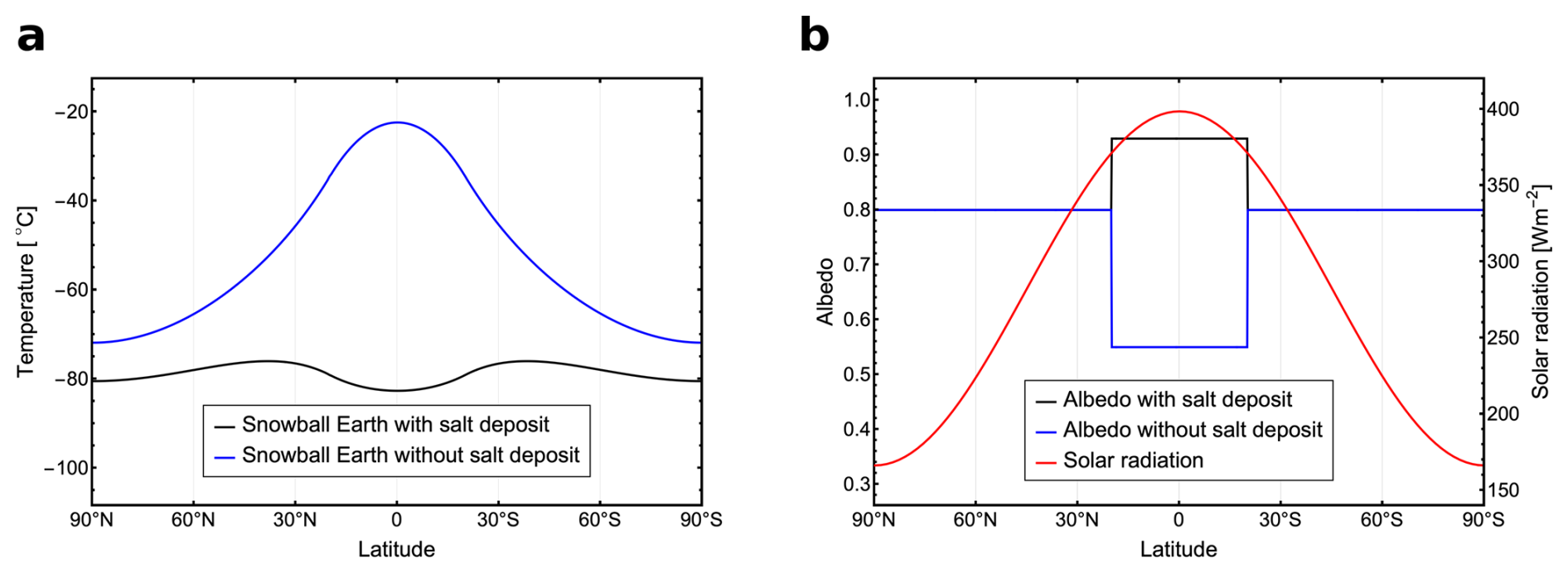
Figure B1(a) Temperature profiles for Snowball Earth with a salt deposit (black) and Snowball Earth without a salt deposit (blue) at radiative forcing level ΔA=45 in Fig. 1. Other model parameters are given in Table 1. (b) The ice/snow albedo functions () for Snowball Earth with a salt deposit (black) and Snowball Earth without a salt deposit (blue), together with the latitudinal distribution of Neoproterozoic solar radiation Qs(x) (red).
The code used to solve the stationary form of Eq. (1) is available on Zenodo at https://doi.org/10.5281/zenodo.18469541 (Samuelsberg, 2026).
No data sets were used in this article.
AS: Conceptualization, Methodology, Software, Writing – Original Draft, Writing – Review and Editing, Visualization. PKJ: Methodology, Writing – Review and Editing, Supervision. MR: Writing – Review and Editing, Supervision.
The contact author has declared that none of the authors has any competing interests.
Publisher's note: Copernicus Publications remains neutral with regard to jurisdictional claims made in the text, published maps, institutional affiliations, or any other geographical representation in this paper. The authors bear the ultimate responsibility for providing appropriate place names. Views expressed in the text are those of the authors and do not necessarily reflect the views of the publisher.
We would like to thank Steve Warren for useful discussions and insightful comments on an earlier version of this manuscript. We also thank the two anonymous reviewers for their valuable feedback, which improved this manuscript. AS acknowledges the assistance of an AI-based tool, ChatGPT, for the refinement of the language and grammar in parts of this manuscript.
This research has been supported by the Norges Forskningsråd (grant no. 314570).
This paper was edited by Julien Emile-Geay and reviewed by two anonymous referees.
Abbot, D. S.: Resolved snowball Earth clouds, J. Climate, 27, 4391–4402, 2014. a
Abbot, D. S. and Pierrehumbert, R. T.: Mudball: Surface dust and snowball Earth deglaciation, J. Geophys. Res.-Atmos., 115, D03104, https://doi.org/10.1029/2009JD012007, 2010. a, b
Abbot, D. S., Voigt, A., and Koll, D.: The Jormungand global climate state and implications for Neoproterozoic glaciations, J. Geophys. Res.-Atmos., 116, D18103, https://doi.org/10.1029/2011JD015927, 2011. a, b, c, d, e, f, g
Abbot, D. S., Voigt, A., Branson, M., Pierrehumbert, R. T., Pollard, D., Le Hir, G., and Koll, D. D.: Clouds and snowball Earth deglaciation, Geophys. Res. Lett., 39, L20711, https://doi.org/10.1029/2012GL052861, 2012. a
Abbot, D. S., Voigt, A., Li, D., Hir, G. L., Pierrehumbert, R. T., Branson, M., Pollard, D., and B. Koll, D. D.: Robust elements of Snowball Earth atmospheric circulation and oases for life, J. Geophys. Res.-Atmos., 118, 6017–6027, 2013. a, b, c
Bao, H., Lyons, J., and Zhou, C.: Triple oxygen isotope evidence for elevated CO2 levels after a Neoproterozoic glaciation, Nature, 453, 504–506, 2008. a
Bao, H., Fairchild, I. J., Wynn, P. M., and Spötl, C.: Stretching the envelope of past surface environments: Neoproterozoic glacial lakes from Svalbard, Science, 323, 119–122, 2009. a
Braun, C., Hörner, J., Voigt, A., and Pinto, J. G.: Ice-free tropical waterbelt for Snowball Earth events questioned by uncertain clouds, Nat. Geosci., 15, 489–493, 2022. a, b, c, d, e
Budyko, M. I.: The effect of solar radiation variations on the climate of the Earth, Tellus, 21, 611–619, 1969. a
Cahalan, R. F. and North, G. R.: A stability theorem for energy-balance climate models, J. Atmos. Sci., 36, 1178–1188, 1979. a
Carns, R. C., Brandt, R. E., and Warren, S. G.: Salt precipitation in sea ice and its effect on albedo, with application to Snowball Earth, J. Geophys. Res.-Oceans, 120, 7400–7412, 2015. a, b, c
Carns, R. C., Light, B., and Warren, S. G.: The spectral albedo of sea ice and salt crusts on the tropical ocean of Snowball Earth: II. Optical modeling, J. Geophys. Res.-Oceans, 121, 5217–5230, 2016. a, b
Dadic, R., Mullen, P. C., Schneebeli, M., Brandt, R. E., and Warren, S. G.: Effects of bubbles, cracks, and volcanic tephra on the spectral albedo of bare ice near the Transantarctic Mountains: Implications for sea glaciers on Snowball Earth, J. Geophys. Res.-Earth, 118, 1658–1676, 2013. a
Goodman, J. C.: Through thick and thin: Marine and meteoric ice in a “Snowball Earth” climate, Geophys. Res. Lett., 33, L16701, https://doi.org/10.1029/2006GL026840, 2006. a, b, c
Goodman, J. C. and Pierrehumbert, R. T.: Glacial flow of floating marine ice in “Snowball Earth”, J. Geophys. Res.-Oceans, 108, https://doi.org/10.1029/2002JC001471, 2003. a
Hoffman, P. F., Kaufman, A. J., Halverson, G. P., and Schrag, D. P.: A Neoproterozoic snowball earth, Science, 281, 1342–1346, 1998. a
Hoffman, P. F., Abbot, D. S., Ashkenazy, Y., Benn, D. I., Brocks, J. J., Cohen, P. A., Cox, G. M., Creveling, J. R., Donnadieu, Y., Erwin, D. H., Fairchild, I. J., Ferreira, D., Goodman, J. C., Halverson, G. P., Jansen, M. F., Le Hir, G., Love, G. D., Macdonald, F. A., Maloof, A. C., Partin, C. A., Ramstein, G., Rose, B. E. J., Rose, C. V., Sadler, P. M., Tziperman, E., Voigt, A., and Warren, S. G.: Snowball Earth climate dynamics and Cryogenian geology-geobiology, Sci. Adv., 3, e1600983, https://doi.org/10.1126/sciadv.1600983, 2017. a, b, c
Li, D. and Pierrehumbert, R. T.: Sea glacier flow and dust transport on Snowball Earth, Geophys. Res. Lett., 38, L17501, https://doi.org/10.1029/2011GL048991, 2011. a
Light, B., Brandt, R. E., and Warren, S. G.: Hydrohalite in cold sea ice: Laboratory observations of single crystals, surface accumulations, and migration rates under a temperature gradient, with application to “Snowball Earth”, J. Geophys. Res.-Oceans, 114, C07018, https://doi.org/10.1029/2008JC005211, 2009. a, b, c, d
Light, B., Carns, R. C., and Warren, S. G.: The spectral albedo of sea ice and salt crusts on the tropical ocean of Snowball Earth: 1. Laboratory measurements, J. Geophys. Res.-Oceans, 121, 4966–4979, 2016. a, b, c, d, e, f, g, h
Marion, G., Farren, R., and Komrowski, A.: Alternative pathways for seawater freezing, Cold Reg. Sci. Technol., 29, 259–266, 1999. a
North, G. R.: Analytical solution to a simple climate model with diffusive heat transport, J. Atmos. Sci., 32, 1301–1307, 1975. a, b, c
North, G. R., Cahalan, R. F., and Coakley Jr., J. A.: Energy balance climate models, Rev. Geophys., 19, 91–121, 1981. a, b, c, d
Pierrehumbert, R. T.: Climate dynamics of a hard snowball Earth, J. Geophys. Res.-Atmos., 110, D01111, https://doi.org/10.1029/2004JD005162, 2005. a, b
Pierrehumbert, R., Abbot, D. S., Voigt, A., and Koll, D.: Climate of the Neoproterozoic, Annu. Rev. Earth Pl. Sc., 39, 417–460, 2011. a, b, c, d, e
Samuelsberg, A.: A salt-albedo feedback on Snowball Earth, Zenodo [computer software], https://doi.org/10.5281/zenodo.18469541, 2026. a
Samuelsberg, A. and Jakobsen, P. K.: Solving a North-type energy balance model using boundary integral methods, Nonlin. Processes Geophys., 32, 23–33, https://doi.org/10.5194/npg-32-23-2025, 2025a. a, b, c
Samuelsberg, A. and Jakobsen, P. K.: Slushball Earth equilibria in a one-dimensional energy balance model, Physica D, 482, 134866, https://doi.org/10.1016/j.physd.2025.134866, 2025b. a, b, c, d, e
Shields, A. L. and Carns, R. C.: Hydrohalite salt-albedo feedback could cool M-dwarf planets, Astrophys. J., 867, 11, https://doi.org/10.3847/1538-4357/aadcaa 2018. a
Vancoppenolle, M., Madec, G., Thomas, M., and McDougall, T. J.: Thermodynamics of sea ice phase composition revisited, J. Geophys. Res.-Oceans, 124, 615–634, 2019. a
Walsh, J.: Neoproterozoic glacial ages in a nonsmooth conceptual model, J. Phys. Commun., 2, 075020, https://doi.org/10.1088/2399-6528/aab748, 2018. a
Wu, J., Liu, Y., and Zhao, Z.: How should snowball Earth deglaciation start, J. Geophys. Res.-Atmos., 126, e2020JD033833, https://doi.org/10.1029/2020JD033833, 2021. a
- Abstract
- Introduction
- Methods
- Results
- Conclusions
- Appendix A: Accessibility of Snowball Earth without a salt deposit
- Appendix B: Supplementary figure
- Code availability
- Data availability
- Author contributions
- Competing interests
- Disclaimer
- Acknowledgements
- Financial support
- Review statement
- References
- Abstract
- Introduction
- Methods
- Results
- Conclusions
- Appendix A: Accessibility of Snowball Earth without a salt deposit
- Appendix B: Supplementary figure
- Code availability
- Data availability
- Author contributions
- Competing interests
- Disclaimer
- Acknowledgements
- Financial support
- Review statement
- References