
Articles | Volume 22, issue 7
https://doi.org/10.5194/cp-22-1401-2026
© Author(s) 2026. This work is distributed under
the Creative Commons Attribution 4.0 License.
the Creative Commons Attribution 4.0 License.
https://doi.org/10.5194/cp-22-1401-2026
© Author(s) 2026. This work is distributed under
the Creative Commons Attribution 4.0 License.
the Creative Commons Attribution 4.0 License.
Research article
| 
29 Jul 2026
Research article |
| 29 Jul 2026
| 29 Jul 2026
Holocene temperatures in southwestern Greenland controlled by topography, ice sheet proximity, and oceanic conditions

Department of Earth Sciences, State University of New York at Buffalo, Buffalo, NY, USA
Allison A. Cluett
Department of Earth Sciences, State University of New York at Buffalo, Buffalo, NY, USA
Institute of Marine Sciences, University of California, Santa Cruz, CA, USA
Amy L. Grogan
Department of Earth Sciences, State University of New York at Buffalo, Buffalo, NY, USA
Jason P. Briner
Department of Earth Sciences, State University of New York at Buffalo, Buffalo, NY, USA
Isla S. Castañeda
University of Massachusetts Amherst, Amherst, MA, USA
Elizabeth K. Thomas
Department of Earth Sciences, State University of New York at Buffalo, Buffalo, NY, USA
Related authors
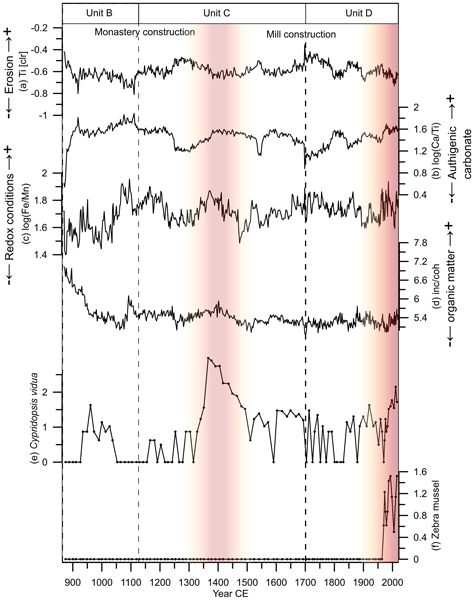
Sudip Acharya, Maximilian Prochnow, Thomas Kasper, Linda Langhans, Peter Frenzel, Paul Strobel, Marcel Bliedtner, Gerhard Daut, Christopher Berndt, Sönke Szidat, Gary Salazar, Antje Schwalb, and Roland Zech
E&G Quaternary Sci. J., 72, 219–234, https://doi.org/10.5194/egqsj-72-219-2023, https://doi.org/10.5194/egqsj-72-219-2023, 2023
Short summary
Short summary
This study presents a palaeoenvironmental record from Lake Höglwörth, Bavaria, Germany. Before 870 CE peat deposits existed. Erosion increased from 1240 to 1380 CE, followed by aquatic productivity and anoxia from 1310 to 1470 CE. Increased allochthonous input and a substantial shift in the aquatic community in 1701 were caused by construction of a mill. Recent anoxia has been observed since the 1960s.
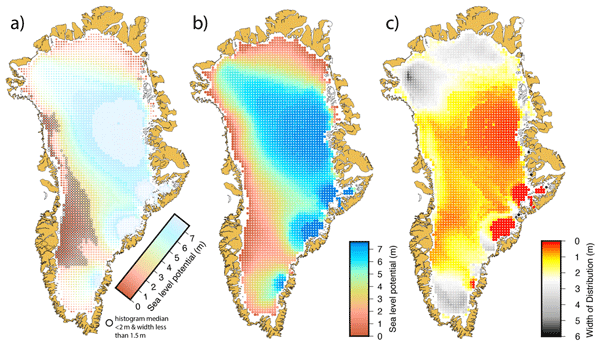
Benjamin A. Keisling, Joerg M. Schaefer, Robert M. DeConto, Jason P. Briner, Nicolás E. Young, Caleb K. Walcott-George, Gisela Winckler, Allie Balter-Kennedy, and Sridhar Anandakrishnan
The Cryosphere, 20, 2961–2976, https://doi.org/10.5194/tc-20-2961-2026, https://doi.org/10.5194/tc-20-2961-2026, 2026
Short summary
Short summary
Understanding how much the Greenland ice sheet melted in response to past warmth helps better predicting future sea-level change. Here we present a framework called sea-level potential for using numerical ice-sheet model simulations to provide constraints on how much mass the ice sheet loses before different areas become ice-free. As observations from subglacial archives become more abundant, this framework can guide future subglacial sampling efforts.
Rebecca G. Topness, Elizabeth K. Thomas, Michaela Fendrock, and Gerard A. Otiniano
EGUsphere, https://doi.org/10.5194/egusphere-2026-2322, https://doi.org/10.5194/egusphere-2026-2322, 2026
Short summary
Short summary
Lake models are powerful tools for disentangling complex past climate data preserved in sediments. These models can be hard to set-up for lakes that are not well-observed. We improve an existing model with code to simulate water runoff and establish guidelines for setting-up the model when data are scarce. Using our workflow, more scientists can apply this tool to more lakes and gain a better understanding of the climate histories stored in their sediments.
John Michael Aguilar, Elizabeth Thomas, Diana Aga, Paul Bierman, Jason Briner, Isla Castañeda, and Andrew Christ
EGUsphere, https://doi.org/10.5194/egusphere-2026-2378, https://doi.org/10.5194/egusphere-2026-2378, 2026
Short summary
Short summary
As the Arctic warms, the Greenland Ice Sheet is losing mass, with implications for global sea levels. We analyzed biomarkers from sediments beneath 1,387 m of ice at Camp Century, Greenland, deposited when the ice sheet was smaller. Reconstructed summer temperature and precipitation isotopes from ~400,000 years ago show summers ~4.7 °C warmer than today, with more local moisture from reduced ice. This result highlights that both how warm and how long warming lasts matter to reduce ice loss.
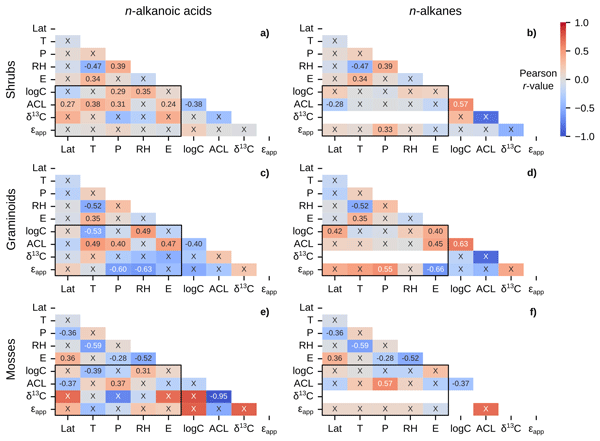
Kurt R. Lindberg, Elizabeth K. Thomas, Martha K. Raynolds, Helga Bültmann, and Jonathan H. Raberg
Biogeosciences, 23, 2503–2523, https://doi.org/10.5194/bg-23-2503-2026, https://doi.org/10.5194/bg-23-2503-2026, 2026
Short summary
Short summary
Plant waxes are an important tool for inferring past changes in vegetation and the water cycle. However, the mechanisms governing plant wax production and stable isotope values are not well understood in the Arctic. We found that terrestrial Arctic plant waxes are not significantly influenced by environmental parameters including latitude, temperature, precipitation amount, humidity, and elevation. These findings agree with our understanding of plant waxes in other regions of the world.
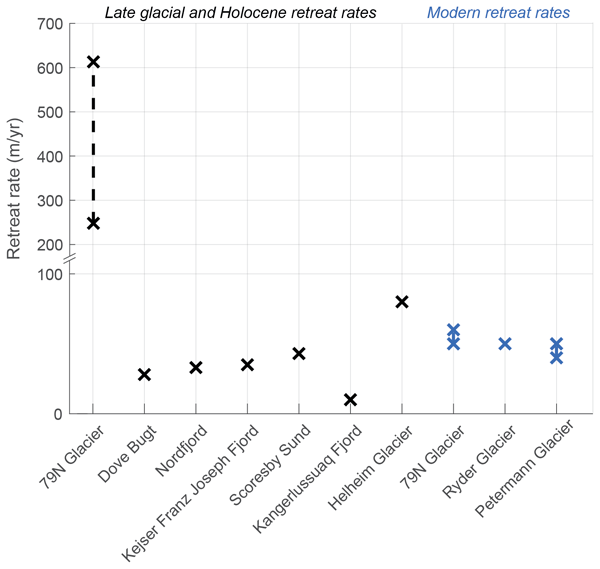
Jacob T. H. Anderson, Nicolás E. Young, Allie Balter-Kennedy, Karlee K. Prince, Caleb K. Walcott-George, Brandon L. Graham, Joanna Charton, Jason P. Briner, and Joerg M. Schaefer
Clim. Past, 21, 2263–2281, https://doi.org/10.5194/cp-21-2263-2025, https://doi.org/10.5194/cp-21-2263-2025, 2025
Short summary
Short summary
We investigated retreat of the Greenland Ice Sheet during the last deglaciation by dating glacial deposits exposed as the ice margin retreated. Our results from eastern and northeastern Greenland reveal ice margin retreat rates of 43 m/yr and 28 m/yr at two marine-terminating outlet glaciers. These retreat rates are consistent with late glacial and Holocene estimates across East Greenland, and are comparable to modern retreat rates observed in northeastern and northwestern Greenland.
Joseph P. Tulenko, Sophie A. Goliber, Renette Jones-Ivey, Justin Quinn, Abani Patra, Kristin Poinar, Sophie Nowicki, Beata M. Csatho, and Jason P. Briner
The Cryosphere, 19, 4327–4333, https://doi.org/10.5194/tc-19-4327-2025, https://doi.org/10.5194/tc-19-4327-2025, 2025
Short summary
Short summary
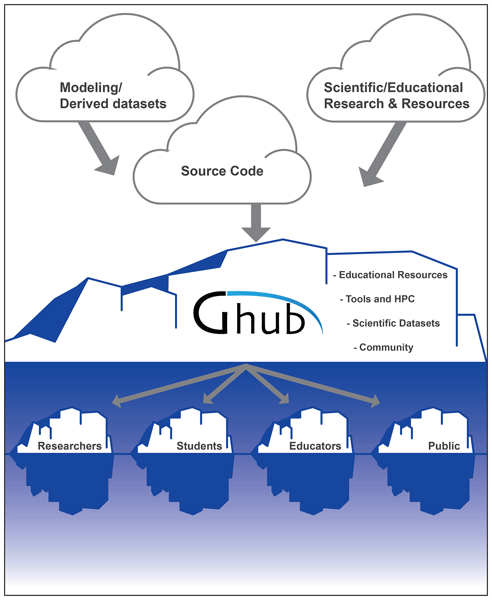
Ghub is an online platform that hosts tools, datasets, and educational resources related to ice sheet science. These resources are provided by ice sheet researchers and allow other researchers, students, educators, and interested members of the general public to analyze, visualize, and download datasets that researchers use to study past and present ice sheet behavior. We describe how users can interact with Ghub, showcase some available resources, and describe the future of the Ghub project.
Evan R. Collins, Troy M. Ferland, Isla S. Castañeda, R. Bernhart Owen, Tim K. Lowenstein, Andrew S. Cohen, Robin W. Renaut, Molly D. O'Beirne, and Josef P. Werne
Biogeosciences, 22, 3931–3948, https://doi.org/10.5194/bg-22-3931-2025, https://doi.org/10.5194/bg-22-3931-2025, 2025
Short summary
Short summary
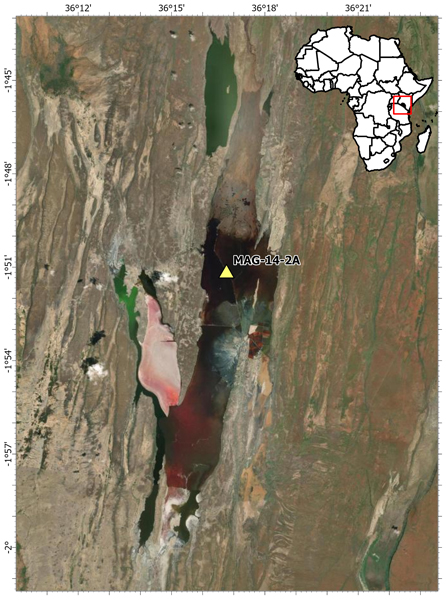
Archaeal molecular fossils (tetraethers) have been used around the globe to track changes in climate. Little is known about the archaeal response to environmental change in soda lakes, especially lakes influenced by hydrothermal inputs. For the first time in Lake Magadi, we show tetraethers tracking abrupt changes in methane and non-methane producers due to hydrothermal inputs to the lake. This study provides insight into the role of hydrothermal water and methane production in soda lakes.
Caleb K. Walcott-George, Allie Balter-Kennedy, Jason P. Briner, Joerg M. Schaefer, and Nicolás E. Young
The Cryosphere, 19, 2067–2086, https://doi.org/10.5194/tc-19-2067-2025, https://doi.org/10.5194/tc-19-2067-2025, 2025
Short summary
Short summary
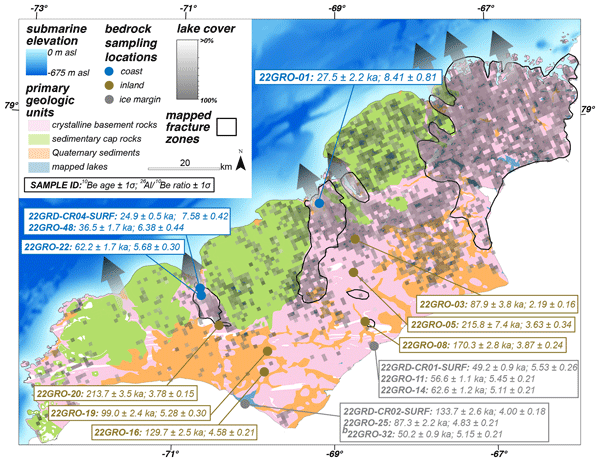
Understanding the history and drivers of Greenland Ice Sheet change is important for forecasting future ice sheet retreat. We combined geologic mapping and cosmogenic nuclide measurements to investigate how the Greenland Ice Sheet formed the landscape of Inglefield Land, northwestern Greenland. We found that Inglefield Land was covered by warm- and cold-based ice during multiple glacial cycles and that much of Inglefield Land is an ancient landscape.
Paul R. Bierman, Andrew J. Christ, Catherine M. Collins, Halley M. Mastro, Juliana Souza, Pierre-Henri Blard, Stefanie Brachfeld, Zoe R. Courville, Tammy M. Rittenour, Elizabeth K. Thomas, Jean-Louis Tison, and François Fripiat
The Cryosphere, 18, 4029–4052, https://doi.org/10.5194/tc-18-4029-2024, https://doi.org/10.5194/tc-18-4029-2024, 2024
Short summary
Short summary
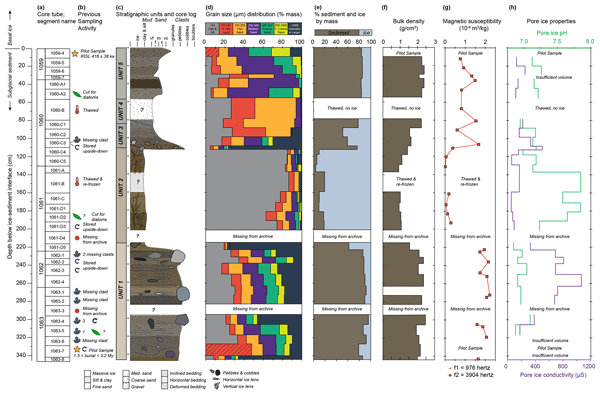
In 1966, the U.S. Army drilled through the Greenland Ice Sheet at Camp Century, Greenland; they recovered 3.44 m of frozen material. Here, we decipher the material’s history. Water, flowing during a warm interglacial when the ice sheet melted from northwest Greenland, deposited the upper material which contains fossil plant and insect parts. The lower material, separated by more than a meter of ice with some sediment, is till, deposited by the ice sheet during a prior cold period.
Karlee K. Prince, Jason P. Briner, Caleb K. Walcott, Brooke M. Chase, Andrew L. Kozlowski, Tammy M. Rittenour, and Erica P. Yang
Geochronology, 6, 409–427, https://doi.org/10.5194/gchron-6-409-2024, https://doi.org/10.5194/gchron-6-409-2024, 2024
Short summary
Short summary
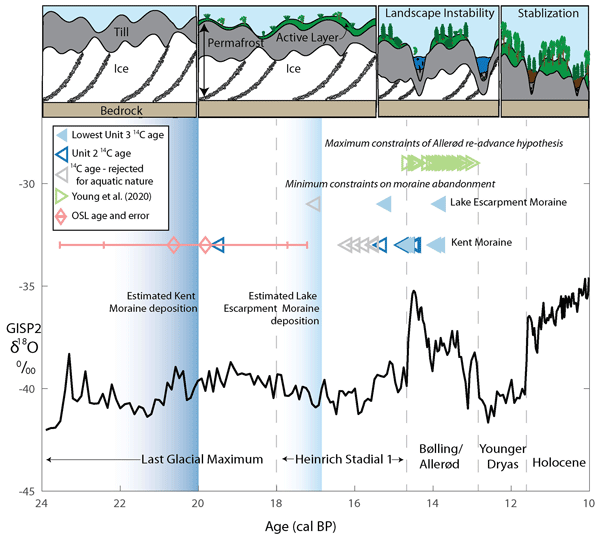
We fill a spatial data gap in the ice sheet retreat history of the Laurentide Ice Sheet after the Last Glacial Maximum and investigate a hypothesis that the ice sheet re-advanced into western New York, USA, at ~13 ka. With radiocarbon and optically stimulated luminescence (OSL) dating, we find that ice began retreating from its maximum extent after 20 ka, but glacial ice persisted in glacial landforms until ~15–14 ka when they finally stabilized. We find no evidence of a re-advance at ~13 ka.
Joseph P. Tulenko, Jason P. Briner, Nicolás E. Young, and Joerg M. Schaefer
Clim. Past, 20, 625–636, https://doi.org/10.5194/cp-20-625-2024, https://doi.org/10.5194/cp-20-625-2024, 2024
Short summary
Short summary
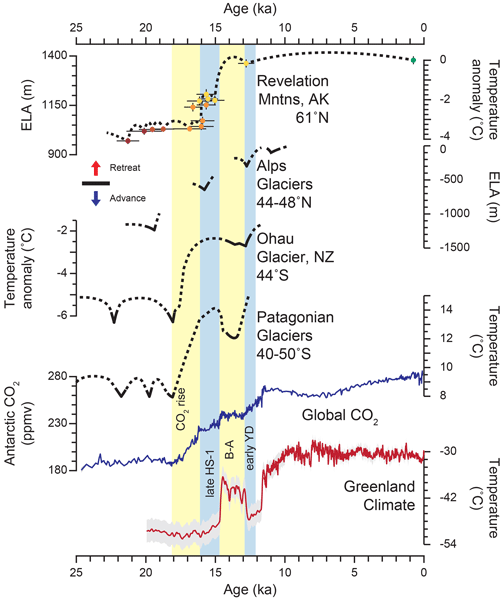
We take advantage of a site in Alaska – where climate records are limited and a former alpine glacier deposited a dense sequence of moraines spanning the full deglaciation – to construct a proxy summer temperature record. Building on age constraints for moraines in the valley, we reconstruct paleo-glacier surfaces and estimate the summer temperatures (relative to the Little Ice Age) for each moraine. The record suggests that the influence of North Atlantic climate forcing extended to Alaska.
Vera Dorothee Meyer, Jürgen Pätzold, Gesine Mollenhauer, Isla S. Castañeda, Stefan Schouten, and Enno Schefuß
Clim. Past, 20, 523–546, https://doi.org/10.5194/cp-20-523-2024, https://doi.org/10.5194/cp-20-523-2024, 2024
Short summary
Short summary
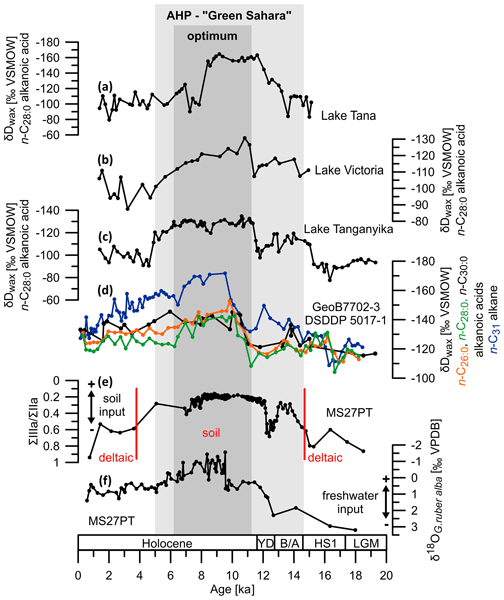
The climatic factors sustaining vegetation in the Sahara during the African humid period (AHP) are still not fully understood. Using biomarkers in a marine sediment core from the eastern Mediterranean, we infer variations in Mediterranean (winter) and monsoonal (summer) rainfall in the Nile river watershed around the AHP. We find that winter and summer rain enhanced during the AHP, suggesting that Mediterranean moisture supported the monsoon in sustaining the “green Sahara”.
Caleb K. Walcott, Jason P. Briner, Joseph P. Tulenko, and Stuart M. Evans
Clim. Past, 20, 91–106, https://doi.org/10.5194/cp-20-91-2024, https://doi.org/10.5194/cp-20-91-2024, 2024
Short summary
Short summary
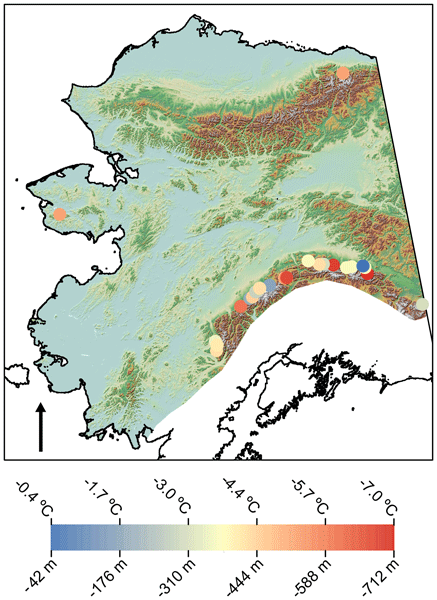
Available data suggest that Alaska was not as cold as many of the high-latitude areas of the Northern Hemisphere during the Last Ice Age. These results come from isolated climate records, climate models, and data synthesis projects. We used the extents of mountain glaciers during the Last Ice Age and Little Ice Age to show precipitation gradients across Alaska and provide temperature data from across the whole state. Our findings support a relatively warm Alaska during the Last Ice Age.
Gifford H. Miller, Simon L. Pendleton, Alexandra Jahn, Yafang Zhong, John T. Andrews, Scott J. Lehman, Jason P. Briner, Jonathan H. Raberg, Helga Bueltmann, Martha Raynolds, Áslaug Geirsdóttir, and John R. Southon
Clim. Past, 19, 2341–2360, https://doi.org/10.5194/cp-19-2341-2023, https://doi.org/10.5194/cp-19-2341-2023, 2023
Short summary
Short summary
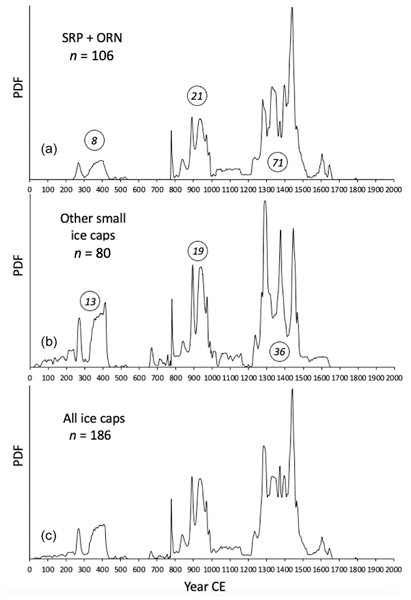
Receding Arctic ice caps reveal moss killed by earlier ice expansions; 186 moss kill dates from 71 ice caps cluster at 250–450, 850–1000 and 1240–1500 CE and continued expanding 1500–1880 CE, as recorded by regions of sparse vegetation cover, when ice caps covered > 11 000 km2 but < 100 km2 at present. The 1880 CE state approached conditions expected during the start of an ice age; climate models suggest this was only reversed by anthropogenic alterations to the planetary energy balance.
Sudip Acharya, Maximilian Prochnow, Thomas Kasper, Linda Langhans, Peter Frenzel, Paul Strobel, Marcel Bliedtner, Gerhard Daut, Christopher Berndt, Sönke Szidat, Gary Salazar, Antje Schwalb, and Roland Zech
E&G Quaternary Sci. J., 72, 219–234, https://doi.org/10.5194/egqsj-72-219-2023, https://doi.org/10.5194/egqsj-72-219-2023, 2023
Short summary
Short summary
This study presents a palaeoenvironmental record from Lake Höglwörth, Bavaria, Germany. Before 870 CE peat deposits existed. Erosion increased from 1240 to 1380 CE, followed by aquatic productivity and anoxia from 1310 to 1470 CE. Increased allochthonous input and a substantial shift in the aquatic community in 1701 were caused by construction of a mill. Recent anoxia has been observed since the 1960s.
Brandon L. Graham, Jason P. Briner, Nicolás E. Young, Allie Balter-Kennedy, Michele Koppes, Joerg M. Schaefer, Kristin Poinar, and Elizabeth K. Thomas
The Cryosphere, 17, 4535–4547, https://doi.org/10.5194/tc-17-4535-2023, https://doi.org/10.5194/tc-17-4535-2023, 2023
Short summary
Short summary
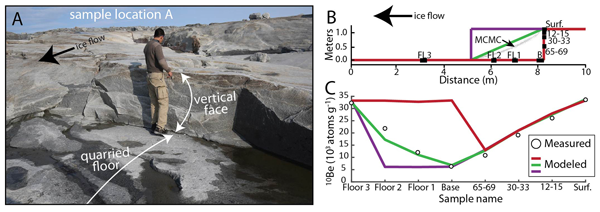
Glacial erosion is a fundamental process operating on Earth's surface. Two processes of glacial erosion, abrasion and plucking, are poorly understood. We reconstructed rates of abrasion and quarrying in Greenland. We derive a total glacial erosion rate of 0.26 ± 0.16 mm per year. We also learned that erosion via these two processes is about equal. Because the site is similar to many other areas covered by continental ice sheets, these results may be applied to many places on Earth.
Jason P. Briner, Caleb K. Walcott, Joerg M. Schaefer, Nicolás E. Young, Joseph A. MacGregor, Kristin Poinar, Benjamin A. Keisling, Sridhar Anandakrishnan, Mary R. Albert, Tanner Kuhl, and Grant Boeckmann
The Cryosphere, 16, 3933–3948, https://doi.org/10.5194/tc-16-3933-2022, https://doi.org/10.5194/tc-16-3933-2022, 2022
Short summary
Short summary
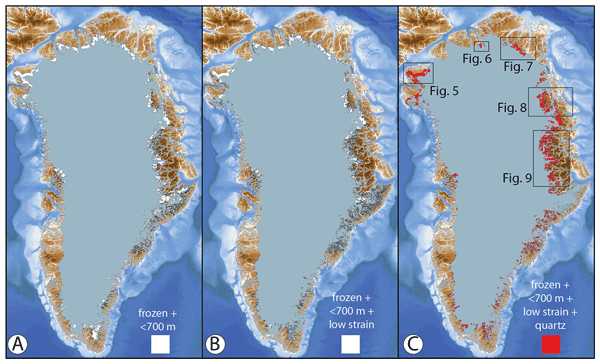
The 7.4 m of sea level equivalent stored as Greenland ice is getting smaller every year. The uncertain trajectory of ice loss could be better understood with knowledge of the ice sheet's response to past climate change. Within the bedrock below the present-day ice sheet is an archive of past ice-sheet history. We analyze all available data from Greenland to create maps showing where on the ice sheet scientists can drill, using currently available drills, to obtain sub-ice materials.

Joshua K. Cuzzone, Nicolás E. Young, Mathieu Morlighem, Jason P. Briner, and Nicole-Jeanne Schlegel
The Cryosphere, 16, 2355–2372, https://doi.org/10.5194/tc-16-2355-2022, https://doi.org/10.5194/tc-16-2355-2022, 2022
Short summary
Short summary
We use an ice sheet model to determine what influenced the Greenland Ice Sheet to retreat across a portion of southwestern Greenland during the Holocene (about the last 12 000 years). Our simulations, constrained by observations from geologic markers, show that atmospheric warming and ice melt primarily caused the ice sheet to retreat rapidly across this domain. We find, however, that iceberg calving at the interface where the ice meets the ocean significantly influenced ice mass change.
Caleb K. Walcott, Jason P. Briner, James F. Baichtal, Alia J. Lesnek, and Joseph M. Licciardi
Geochronology, 4, 191–211, https://doi.org/10.5194/gchron-4-191-2022, https://doi.org/10.5194/gchron-4-191-2022, 2022
Short summary
Short summary
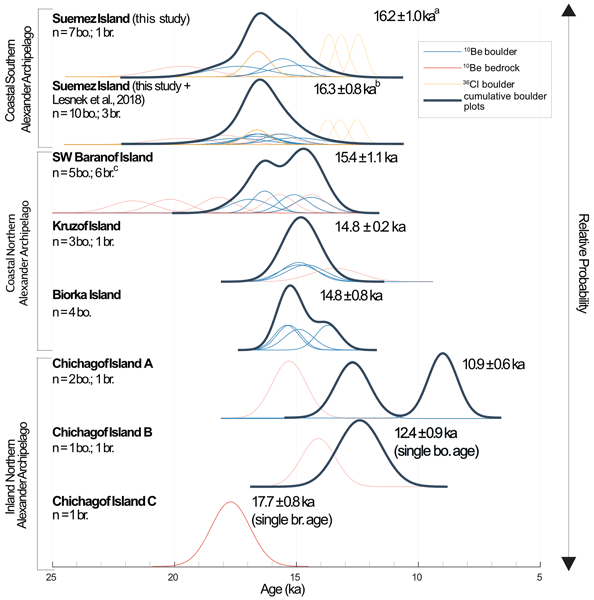
We present a record of ice retreat from the northern Alexander Archipelago, Alaska. During the last ice age (~ 26 000–19 000 years ago), these islands were covered by the Cordilleran Ice Sheet. We tested whether islands were ice-free during the last ice age for human migrants moving from Asia to the Americas. We found that these islands became ice-free between ~ 15 100 years ago and ~ 16 000 years ago, and thus these islands were not suitable for human habitation during the last ice age.
Cited articles
Acharya, S., Zech, R., Strobel, P., Bliedtner, M., Prochnow, M., and De Jonge, C.: Environmental controls on the distribution of GDGT molecules in Lake Höglwörth, Southern Germany, Org. Geochem., 186, 104689, https://doi.org/10.1016/j.orggeochem.2023.104689, 2023.
Acharya, S., Cluett, A. A., Grogan, A. L., Briner, J. P., Castañeda, I. S., and Thomas, E. K.: Greenland Lake Water Temperature Reconstructions and GDGT Data during the Holocene, NOAA [data set], https://doi.org/10.25921/dk6a-xe77, 2026.
Andresen, C. S., Björck, S., Bennike, O., and Bond, G.: Holocene climate changes in southern Greenland: evidence from lake sediments, J. Quaternary Sci., 19, 783–795, https://doi.org/10.1002/jqs.886, 2004.
Antoniades, D., Klanten, Y., Cameron, E., Garcia-Oteyza, J., Oliva, M., and Vincent, W. F.: Evidence of summer thermal stratification in extreme northern lakes, Arctic Science, 10, 225–232, https://doi.org/10.1139/as-2023-0037, 2024.
Axford, Y., Losee, S., Briner, J. P., Francis, D. R., Langdon, P. G., and Walker, I. R.: Holocene temperature history at the western Greenland Ice Sheet margin reconstructed from lake sediments, Quaternary Sci. Rev., 59, 87–100, https://doi.org/10.1016/j.quascirev.2012.10.024, 2013.
Axford, Y., De Vernal, A., and Osterberg, E. C.: Past Warmth and Its Impacts During the Holocene Thermal Maximum in Greenland, Annu. Rev. Earth Pl. Sc., 49, 279–307, https://doi.org/10.1146/annurev-earth-081420-063858, 2021.
Bashmachnikov, I. L., Raj, R. P., Golubkin, P., and Kozlov, I. E.: Heat Transport by Mesoscale Eddies in the Norwegian and Greenland Seas, J. Geophys. Res.-Oceans, 128, e2022JC018987, https://doi.org/10.1029/2022JC018987, 2023.
Bauersachs, T., Schubert, C. J., Mayr, C., Gilli, A., and Schwark, L.: Branched GDGT-based temperature calibrations from Central European lakes, Sci. Total Environ., 167724, https://doi.org/10.1016/j.scitotenv.2023.167724, 2023.
Baxter, A. J., van Bree, L. G. J., Peterse, F., Hopmans, E. C., Villanueva, L., Verschuren, D., and Sinninghe Damsté, J. S.: Seasonal and multi-annual variation in the abundance of isoprenoid GDGT membrane lipids and their producers in the water column of a meromictic equatorial crater lake (Lake Chala, East Africa), Quaternary Sci. Rev., 273, https://doi.org/10.1016/j.quascirev.2021.107263, 2021.
Bennike, O.: Palaeoecological studies of Holocene lake sediments from west Greenland, Palaeogeogr. Palaeoclim., 155, 285–304, https://doi.org/10.1016/S0031-0182(99)00121-2, 2000.
Bennike, O., Anderson, N. J., and McGowan, S.: Holocene palaeoecology of southwest Greenland inferred from macrofossils in sediments of an oligosaline lake, J. Paleolimnol., 43, 787–798, https://doi.org/10.1007/s10933-009-9368-x, 2010.
Bittner, L., De Jonge, C., Gil-Romera, G., Lamb, H. F., Russell, J. M., and Zech, M.: A Holocene temperature (brGDGT) record from Garba Guracha, a high-altitude lake in Ethiopia, Biogeosciences, 19, 5357–5374, https://doi.org/10.5194/bg-19-5357-2022, 2022.
Blaauw, M. and Christen, J. A.: Flexible Paleoclimate Age-Depth Models Using an Autoregressive Gamma Process, Bayesian Anal., 6, 457–474, https://doi.org/10.1214/ba/1339616472, 2011.
Blaga, C. I., Reichart, G.-J., Heiri, O., and Sinninghe Damsté, J. S.: Tetraether membrane lipid distributions in water-column particulate matter and sediments: a study of 47 European lakes along a north–south transect, J. Paleolimnol., 41, 523–540, https://doi.org/10.1007/s10933-008-9242-2, 2009.
Box, J. E., Nielsen, K. P., Yang, X., Niwano, M., Wehrlé, A., van As, D., Fettweis, X., Køltzow, M. A. Ø., Palmason, B., Fausto, R. S., van den Broeke, M. R., Huai, B., Ahlstrøm, A. P., Langley, K., Dachauer, A., and Noël, B.: Greenland ice sheet rainfall climatology, extremes and atmospheric river rapids, Meteorol. Appl., 30, e2134, https://doi.org/10.1002/met.2134, 2023.
Briner, J. P., Kaufman, D. S., Bennike, O., and Kosnik, M. A.: Amino acid ratios in reworked marine bivalve shells constrain Greenland Ice Sheet history during the Holocene, Geology, 42, 75–78, https://doi.org/10.1130/G34843.1, 2014.
Briner, J. P., McKay, N. P., Axford, Y., Bennike, O., Bradley, R. S., De Vernal, A., Fisher, D., Francus, P., Fréchette, B., Gajewski, K., Jennings, A., Kaufman, D. S., Miller, G., Rouston, C., and Wagner, B.: Holocene climate change in Arctic Canada and Greenland, Quaternary Sci. Rev., 147, 340–364, https://doi.org/10.1016/j.quascirev.2016.02.010, 2016.
Briner, J. P., Cuzzone, J. K., Badgeley, J. A., Young, N. E., Steig, E. J., Morlighem, M., Schlegel, N.-J., Hakim, G. J., Schaefer, J. M., Johnson, J. V., Lesnek, A. J., Thomas, E. K., Allan, E., Bennike, O., Cluett, A. A., Csatho, B., De Vernal, A., Downs, J., Larour, E., and Nowicki, S.: Rate of mass loss from the Greenland Ice Sheet will exceed Holocene values this century, Nature, 586, 70–74, https://doi.org/10.1038/s41586-020-2742-6, 2020.
Buckles, L. K., Weijers, J. W. H., Verschuren, D., and Sinninghe Damsté, J. S.: Sources of core and intact branched tetraether membrane lipids in the lacustrine environment: Anatomy of Lake Challa and its catchment, equatorial East Africa, Geochim. Cosmochim. Ac., 140, 106–126, https://doi.org/10.1016/j.gca.2014.04.042, 2014.
Castañeda, I. S. and Schouten, S.: A review of molecular organic proxies for examining modern and ancient lacustrine environments, Quaternary Sci. Rev., 30, 2851–2891, https://doi.org/10.1016/j.quascirev.2011.07.009, 2011.
Cluett, A. A., Thomas, E. K., Evans, S. M., and Keys, P. W.: Seasonal Variations in Moisture Origin Explain Spatial Contrast in Precipitation Isotope Seasonality on Coastal Western Greenland, J. Geophys. Res.-Atmos., 126, e2020JD033543, https://doi.org/10.1029/2020JD033543, 2021.
Cluett, A. A., Thomas, E. K., McKay, N. P., Cowling, O. C., Castañeda, I. S., and Morrill, C.: Lake Dynamics Modulate the Air Temperature Variability Recorded by Sedimentary Aquatic Biomarkers: A Holocene Case Study From Western Greenland, J. Geophys. Res.-Biogeo., 128, e2022JG007106, https://doi.org/10.1029/2022JG007106, 2023.
Corcoran, M. C., Thomas, E. K., and Morrill, C.: Using a Paired Chironomid δ18O and Aquatic Leaf Wax δ2H Approach to Reconstruct Seasonality on Western Greenland During the Holocene, Paleoceanog. Paleoclimatol., 36, e2020PA004169, https://doi.org/10.1029/2020PA004169, 2021.
Cronauer, S. L., Briner, J. P., Kelley, S. E., Zimmerman, S. R. H., and Morlighem, M.: 10Be dating reveals early-middle Holocene age of the Drygalski Moraines in central West Greenland, Quaternary Sci. Rev., 147, 59–68, https://doi.org/10.1016/j.quascirev.2015.08.034, 2016.
Dang, X., Ding, W., Yang, H., Pancost, R. D., Naafs, B. D. A., Xue, J., Lin, X., Lu, J., and Xie, S.: Different temperature dependence of the bacterial brGDGT isomers in 35 Chinese lake sediments compared to that in soils, Org. Geochem., 119, 72–79, https://doi.org/10.1016/j.orggeochem.2018.02.008, 2018.
Dee, S. G., Russell, J. M., Morrill, C., Chen, Z., and Neary, A.: PRYSM v2.0: A Proxy System Model for Lacustrine Archives, Paleoceanog. Paleoclimatol., 33, 1250–1269, https://doi.org/10.1029/2018PA003413, 2018.
Dokulil, M. T., de Eyto, E., Maberly, S. C., May, L., Weyhenmeyer, G. A., and Woolway, R. I.: Increasing maximum lake surface temperature under climate change, Climatic Change, 165, 56, https://doi.org/10.1007/s10584-021-03085-1, 2021.
Downs, J., Johnson, J., Briner, J., Young, N., Lesnek, A., and Cuzzone, J.: Western Greenland ice sheet retreat history reveals elevated precipitation during the Holocene thermal maximum, The Cryosphere, 14, 1121–1137, https://doi.org/10.5194/tc-14-1121-2020, 2020.
Druckenmiller, M. L., Thoman, R. L., and Moon, T. A.: NOAA Arctic Report Card 2025, https://doi.org/10.25923/nrzf-j897, 2025.
Dufour, A., Zolina, O., and Gulev, S. K.: Atmospheric Moisture Transport to the Arctic: Assessment of Reanalyses and Analysis of Transport Components, J. Climate, 29, 5061–5081, https://doi.org/10.1175/JCLI-D-15-0559.1, 2016.
Dutton, A., Carlson, A. E., Long, A. J., Milne, G. A., Clark, P. U., DeConto, R., Horton, B. P., Rahmstorf, S., and Raymo, M. E.: Sea-level rise due to polar ice-sheet mass loss during past warm periods, Science, 349, aaa4019, https://doi.org/10.1126/science.aaa4019, 2015.
Eggermont, H. and Heiri, O.: The chironomid-temperature relationship: expression in nature and palaeoenvironmental implications, Biol. Rev., 87, 430–456, https://doi.org/10.1111/j.1469-185X.2011.00206.x, 2012.
England, M. R., Eisenman, I., Lutsko, N. J., and Wagner, T. J. W.: The Recent Emergence of Arctic Amplification, Geophys. Res. Lett., 48, e2021GL094086, https://doi.org/10.1029/2021GL094086, 2021.
Feng, X., Zhao, C., D'Andrea, W. J., Liang, J., Zhou, A., and Shen, J.: Temperature fluctuations during the Common Era in subtropical southwestern China inferred from brGDGTs in a remote alpine lake, Earth Planet. Sc. Lett., 510, 26–36, https://doi.org/10.1016/j.epsl.2018.12.028, 2019.
Fisher, M., Stafford, T., Moon, T., and Thurber, A.: QGreenland, Zenodo, https://doi.org/10.5281/zenodo.8326507, 2023.
Fréchette, B. and de Vernal, A.: Relationship between Holocene climate variations over southern Greenland and eastern Baffin Island and synoptic circulation pattern, Clim. Past, 5, 347–359, https://doi.org/10.5194/cp-5-347-2009, 2009.
Frederikse, T., Landerer, F., Caron, L., Adhikari, S., Parkes, D., Humphrey, V. W., Dangendorf, S., Hogarth, P., Zanna, L., Cheng, L., and Wu, Y.-H.: The causes of sea-level rise since 1900, Nature, 584, 393–397, https://doi.org/10.1038/s41586-020-2591-3, 2020.
Fredskild, B.: Studies in the Vegetational History of Greenland, Palaeobotanical Investigations of some Holocene Lake and Bog deposits, Meddr. Grønland, 198, https://doi.org/10.7146/mog.v198.147748, 1973.
Fredskild, B.: The Holocene vegetational development of the Godthåbsfjord area, West Greenland, Meddelelser om Grønland. Geoscience, 10, 28 pp., https://doi.org/10.7146/moggeosci.v10i.140322, 1983.
Gajewski, K.: Quantitative reconstruction of Holocene temperatures across the Canadian Arctic and Greenland, Global Planet. Change, 128, 14–23, https://doi.org/10.1016/j.gloplacha.2015.02.003, 2015.
Gibb, O. T., Steinhauer, S., Fréchette, B., de Vernal, A., and Hillaire-Marcel, C.: Diachronous evolution of sea surface conditions in the Labrador Sea and Baffin Bay since the last deglaciation, The Holocene, 25, 1882–1897, https://doi.org/10.1177/0959683615591352, 2015.
Hansen, K. E., Giraudeau, J., Wacker, L., Pearce, C., and Seidenkrantz, M.-S.: Reconstruction of Holocene oceanographic conditions in eastern Baffin Bay, Clim. Past, 16, 1075–1095, https://doi.org/10.5194/cp-16-1075-2020, 2020.
Harning, D. J., Sacco, S., Raberg, J. H., Ardenghi, N., Sepúlveda, J., Shapiro, B., Miller, G. H., and Geirsdóttir, Á.: Both redox potential and climate control molecular proxies in Icelandic Holocene lake sediments, Commun. Earth Environ., 6, 763, https://doi.org/10.1038/s43247-025-02701-7, 2025.
Hopmans, E. C., Schouten, S., and Sinninghe Damsté, J. S.: The effect of improved chromatography on GDGT-based palaeoproxies, Org. Geochem., 93, 1–6, https://doi.org/10.1016/j.orggeochem.2015.12.006, 2016.
Hostetler, S. W. and Bartlein, P. J.: Simulation of lake evaporation with application to modeling lake level variations of Harney-Malheur Lake, Oregon, Water Resour. Res., 26, 2603–2612, https://doi.org/10.1029/WR026i010p02603, 1990.
IPCC: AR6 Climate Change 2021: The Physical Science Basis, Intergovernmental pannel on climate change, Geneva, https://doi.org/10.1017/9781009157896, 2021.
Jane, S. F., Mincer, J. L., Lau, M. P., Lewis, A. S. L., Stetler, J. T., and Rose, K. C.: Longer duration of seasonal stratification contributes to widespread increases in lake hypoxia and anoxia, Global Change Biol., 29, 1009–1023, https://doi.org/10.1111/gcb.16525, 2023.
Jensen, C. D., Jørgensen, B. V., Kern-Hansen, C., Laursen, E. V., Cappelen, J., Boas, L., Carstensen, L. S., and Wang, P. G.: Weather Observations from Greenland 1958–2024, 2025.
Kaplan, M. R., Wolfe, A. P., and Miller, G. H.: Holocene Environmental Variability in Southern Greenland Inferred from Lake Sediments, Quaternary Res., 58, 149–159, https://doi.org/10.1006/qres.2002.2352, 2002.
Karami, M., Hansen, B. U., Westergaard-Nielsen, A., Abermann, J., Lund, M., Schmidt, N. M., and Elberling, B.: Vegetation phenology gradients along the west and east coasts of Greenland from 2001 to 2015, Ambio, 46, 94–105, https://doi.org/10.1007/s13280-016-0866-6, 2017.
Kaufman, D.: Holocene thermal maximum in the western Arctic (0–180° W), Quaternary Sci. Rev., 23, 529–560, https://doi.org/10.1016/j.quascirev.2003.09.007, 2004.
Kaufman, D., McKay, N., Routson, C., Erb, M., Dätwyler, C., Sommer, P. S., Heiri, O., and Davis, B.: Holocene global mean surface temperature, a multi-method reconstruction approach, Sci. Data, 7, 201, https://doi.org/10.1038/s41597-020-0530-7, 2020.
Kettle, H., Thompson, R., Anderson, N. J., and Livingstone, D. M.: Empirical modeling of summer lake surface temperatures in southwest Greenland, Limnol. Oceanogr., 49, 271–282, https://doi.org/10.4319/lo.2004.49.1.0271, 2004.
Klanten, Y., Couture, R.-M., Christoffersen, K. S., Vincent, W. F., and Antoniades, D.: Oxygen Depletion in Arctic Lakes: Circumpolar Trends, Biogeochemical Processes, and Implications of Climate Change, Global Biogeochem. Cy., 37, e2022GB007616, https://doi.org/10.1029/2022GB007616, 2023.
Klanten, Y., MacIntyre, S., Fitzpatrick, C., Vincent, W. F., and Antoniades, D.: Regime Shifts in Lake Oxygen and Temperature in the Rapidly Warming High Arctic, Geophys. Res. Lett., 51, e2023GL106985, https://doi.org/10.1029/2023GL106985, 2024.
Kobashi, T., Menviel, L., Jeltsch-Thömmes, A., Vinther, B. M., Box, J. E., Muscheler, R., Nakaegawa, T., Pfister, P. L., Döring, M., Leuenberger, M., Wanner, H., and Ohmura, A.: Volcanic influence on centennial to millennial Holocene Greenland temperature change, Sci. Rep.-UK, 7, 1441, https://doi.org/10.1038/s41598-017-01451-7, 2017.
Larocca, L. J. and Axford, Y.: Arctic glaciers and ice caps through the Holocene:a circumpolar synthesis of lake-based reconstructions, Clim. Past, 18, 579–606, https://doi.org/10.5194/cp-18-579-2022, 2022.
Larocca, L. J., Axford, Y., Bjørk, A. A., Lasher, G. E., and Brooks, J. P.: Local glaciers record delayed peak Holocene warmth in south Greenland, Quaternary Sci. Rev., 241, 106421, https://doi.org/10.1016/j.quascirev.2020.106421, 2020.
Larsen, N. K., Kjær, K. H., Lecavalier, B., Bjørk, A. A., Colding, S., Huybrechts, P., Jakobsen, K. E., Kjeldsen, K. K., Knudsen, K.-L., Odgaard, B. V., and Olsen, J.: The response of the southern Greenland ice sheet to the Holocene thermal maximum, Geology, 43, 291–294, https://doi.org/10.1130/G36476.1, 2015.
Larsen, N. K., Strunk, A., Levy, L. B., Olsen, J., Bjørk, A., Lauridsen, T. L., Jeppesen, E., and Davidson, T. A.: Strong altitudinal control on the response of local glaciers to Holocene climate change in southwest Greenland, Quaternary Sci. Rev., 168, 69–78, https://doi.org/10.1016/j.quascirev.2017.05.008, 2017.
Lasher, G. E., Axford, Y., Masterson, A. L., Berman, K., and Larocca, L. J.: Holocene temperature and landscape history of southwest Greenland inferred from isotope and geochemical lake sediment proxies, Quaternary Sci. Rev., 239, 106358, https://doi.org/10.1016/j.quascirev.2020.106358, 2020.
Laskar, J., Robutel, P., Joutel, F., Gastineau, M., Correia, A. C. M., and Levrard, B.: A long-term numerical solution for the insolation quantities of the Earth, Astron. Astrophys., 428, 261–285, https://doi.org/10.1051/0004-6361:20041335, 2004.
Lazier, J., Hendry, R., Clarke, A., Yashayaev, I., and Rhines, P.: Convection and restratification in the Labrador Sea, 1990–2000, Deep-Sea Res. Pt I, 49, 1819–1835, https://doi.org/10.1016/S0967-0637(02)00064-X, 2002.
Leger, T. P. M., Clark, C. D., Huynh, C., Jones, S., Ely, J. C., Bradley, S. L., Diemont, C., and Hughes, A. L. C.: A Greenland-wide empirical reconstruction of paleo ice sheet retreat informed by ice extent markers: PaleoGrIS version 1.0, Clim. Past, 20, 701–755, https://doi.org/10.5194/cp-20-701-2024, 2024.
Lesnek, A. J., Briner, J. P., Young, N. E., and Cuzzone, J. K.: Maximum Southwest Greenland Ice Sheet Recession in the Early Holocene, Geophys. Res. Lett., 47, e2019GL083164, https://doi.org/10.1029/2019GL083164, 2020.
Liang, J., Chevalier, M., Liu, K., Perfumo, A., Wang, M., Xie, H., Hou, J., Herzschuh, U., and Chen, F.: Discrepancies in lacustrine bacterial lipid temperature reconstructions explained by microbial ecology, Commun. Earth Environ., 5, 1–14, https://doi.org/10.1038/s43247-024-01925-3, 2024.
Lindberg, K. R., Daniels, W. C., Castañeda, I. S., and Brigham-Grette, J.: Biomarker proxy records of Arctic climate change during the Mid-Pleistocene transition from Lake El'gygytgyn (Far East Russia), Clim. Past, 18, 559–577, https://doi.org/10.5194/cp-18-559-2022, 2022.
Lindborg, T., Rydberg, J., Tröjbom, M., Berglund, S., Johansson, E., Löfgren, A., Saetre, P., Nordén, S., Sohlenius, G., Andersson, E., Petrone, J., Borgiel, M., Kautsky, U., and Laudon, H.: Biogeochemical data from terrestrial and aquatic ecosystems in a periglacial catchment, West Greenland, Earth Syst. Sci. Data, 8, 439–459, https://doi.org/10.5194/essd-8-439-2016, 2016.
Liu, Z., Zhu, J., Rosenthal, Y., Zhang, X., Otto-Bliesner, B. L., Timmermann, A., Smith, R. S., Lohmann, G., Zheng, W., and Elison Timm, O.: The Holocene temperature conundrum, P. Natl. Acad. Sci. USA, 111, E3501-5, https://doi.org/10.1073/pnas.1407229111, 2014.
Longo, W. M., Huang, Y., Russell, J. M., Morrill, C., Daniels, W. C., Giblin, A. E., and Crowther, J.: Insolation and greenhouse gases drove Holocene winter and spring warming in Arctic Alaska, Quaternary Sci. Rev., 242, 106438, https://doi.org/10.1016/j.quascirev.2020.106438, 2020.
Loomis, S. E., Russell, J. M., Eggermont, H., Verschuren, D., and Sinninghe Damsté, J. S.: Effects of temperature, pH and nutrient concentration on branched GDGT distributions in East African lakes: Implications for paleoenvironmental reconstruction, Org. Geochem., 66, 25–37, https://doi.org/10.1016/j.orggeochem.2013.10.012, 2014.
Martin, C., Ménot, G., Thouveny, N., Davtian, N., Andrieu-Ponel, V., Reille, M., and Bard, E.: Impact of human activities and vegetation changes on the tetraether sources in Lake St Front (Massif Central, France), Org. Geochem., 135, 38–52, https://doi.org/10.1016/j.orggeochem.2019.06.005, 2019.
Martin, C., Ménot, G., Thouveny, N., Peyron, O., Andrieu-Ponel, V., Montade, V., Davtian, N., Reille, M., and Bard, E.: Early Holocene Thermal Maximum recorded by branched tetraethers and pollen in Western Europe (Massif Central, France), Quaternary Sci. Rev., 228, https://doi.org/10.1016/j.quascirev.2019.106109, 2020.
Martin, K. C., Buizert, C., Brook, E., Williams, O. L., Edwards, J. S., Riddell-Young, B., Fudge, T. J., Mederbel, F., Beaudette, R., Severinghaus, J., Oyabu, I., Kawamura, K., Kirk, M., Koldtoft, I., Steffensen, J. P., and Blunier, T.: Greenland Ice Cores Reveal a South-To-North Difference in Holocene Thermal Maximum Timings, Geophys. Res. Lett., 51, e2024GL111405, https://doi.org/10.1029/2024GL111405, 2024.
Martínez-Sosa, P., Tierney, J. E., Stefanescu, I. C., Dearing Crampton-Flood, E., Shuman, B. N., and Routson, C.: A global Bayesian temperature calibration for lacustrine brGDGTs, Geochim. Cosmochim. Ac., 305, 87–105, https://doi.org/10.1016/j.gca.2021.04.038, 2021.
Masson-Delmotte, V., Landais, A., Stievenard, M., Cattani, O., Falourd, S., Jouzel, J., Johnsen, S. J., Dahl-Jensen, D., Sveinsbjornsdottir, A., White, J. W. C., Popp, T., and Fischer, H.: Holocene climatic changes in Greenland: Different deuterium excess signals at Greenland Ice Core Project (GRIP) and NorthGRIP, J. Geophys. Res.-Atmos., 110, https://doi.org/10.1029/2004JD005575, 2005.
McKay, N. P., Emile-Geay, J., and Khider, D.: geoChronR – an R package to model, analyze, and visualize age-uncertain data, Geochronology, 3, 149–169, https://doi.org/10.5194/gchron-3-149-2021, 2021.
Miller, D. R., Habicht, M. H., Keisling, B. A., Castañeda, I. S., and Bradley, R. S.: A 900-year New England temperature reconstruction from in situ seasonally produced branched glycerol dialkyl glycerol tetraethers (brGDGTs), Clim. Past, 14, 1653–1667, https://doi.org/10.5194/cp-14-1653-2018, 2018.
Moon, T., Fisher, M., Stafford, T., and Harden, L.: QGreenland (3.0.0), https://doi.org/10.5281/zenodo.12823307, 2023.
Morrill, C., Meador, E., Livneh, B., Liefert, D. T., and Shuman, B. N.: Quantitative model-data comparison of mid-Holocene lake-level change in the central Rocky Mountains, Clim. Dynam., 53, 1077–1094, https://doi.org/10.1007/s00382-019-04633-3, 2019.
Muñoz Sabater, J.: ERA5-Land hourly data from 1950 to present, Copernicus Climate Change Service (C3S) Climate Data Store (CDS), https://doi.org/10.24381/cds.e2161bac, 2019.
Novak, J. B., Russell, J. M., Lindemuth, E. R., Prokopenko, A. A., Pérez-Angel, L., Zhao, B., Swann, G. E. A., and Polissar, P. J.: The Branched GDGT Isomer Ratio Refines Lacustrine Paleotemperature Estimates, Geochem. Geophy. Geosy., 26, e2024GC012069, https://doi.org/10.1029/2024GC012069, 2025.
Nusbaumer, J., Alexander, P. M., LeGrande, A. N., and Tedesco, M.: Spatial Shift of Greenland Moisture Sources Related to Enhanced Arctic Warming, Geophys. Res. Lett., 46, 14723–14731, https://doi.org/10.1029/2019GL084633, 2019.
Otiniano, G. A., Porter, T. J., Buceta, R. E., Bergman, M. E., and Phillips, M. A.: Climatic and environmentally driven variability in lacustrine brGDGT distributions at local to regional scales in Alaska and northwestern Canada, Org. Geochem., 181, https://doi.org/10.1016/j.orggeochem.2023.104604, 2023.
Otiniano, G. A., Porter, T. J., Phillips, M. A., Juutinen, S., Weckström, J. B., and Heikkilä, M. P.: Reconstructing warm-season temperatures using brGDGTs and assessing biases in Holocene temperature records in northern Fennoscandia, Quaternary Sci. Rev., 329, 108555, https://doi.org/10.1016/j.quascirev.2024.108555, 2024.
Otiniano, G. A., Thomas, E. K., Castañeda, I. S., Acharya, S., Sharma, Y., and Mark, S. Z.: chromatoPy: An Open-Source Tool for Chromatographic Peak Deconvolution and Integration Applied to Glycerol Dialkyl Glycerol Tetraethers, Paleoceanography and Paleoclimatology, 40, e2025PA005316, https://doi.org/10.1029/2025PA005316, 2025.
Ouellet-Bernier, M.-M., De Vernal, A., Hillaire-Marcel, C., and Moros, M.: Paleoceanographic changes in the Disko Bugt area, West Greenland, during the Holocene, The Holocene, 24, 1573–1583, https://doi.org/10.1177/0959683614544060, 2014.
Pepin, N., Bradley, R. S., Diaz, H. F., Baraer, M., Caceres, E. B., Forsythe, N., Fowler, H., Greenwood, G., Hashmi, M. Z., Liu, X. D., Miller, J. R., Ning, L., Ohmura, A., Palazzi, E., Rangwala, I., Schoner, W., Severskiy, I., Shahgedanova, M., Wang, M. B., Williamson, S. N., Yang, D. Q., and Mt Res Initiative EDW Working Grp: Elevation-dependent warming in mountain regions of the world, Nat. Clim. Change, 5, 424–430, https://doi.org/10.1038/Nclimate2563, 2015.
Perner, K., Moros, M., Jennings, A., Lloyd, J., and Knudsen, K.: Holocene palaeoceanographic evolution off West Greenland, The Holocene, 23, 374–387, https://doi.org/10.1177/0959683612460785, 2013.
Piccolroaz, S., Woolway, R. I., and Merchant, C. J.: Global reconstruction of twentieth century lake surface water temperature reveals different warming trends depending on the climatic zone, Climatic Change, 160, 427–442, https://doi.org/10.1007/s10584-020-02663-z, 2020.
Porter, C., Howat, I., Noh, M.-J., Husby, E., Khuvis, S., Danish, E., Tomko, K., Gardiner, J., Negrete, A., Yadav, B., Klassen, J., Kelleher, C., Cloutier, M., Bakker, J., Enos, J., Arnold, G., Bauer, G., and Morin, P.: ArcticDEM – Strips, Version 4.1 (V1), https://doi.org/10.7910/DVN/C98DVS, 2022.
Prowse, T., Alfredsen, K., Beltaos, S., Bonsal, B., Duguay, C., Korhola, A., McNamara, J., Pienitz, R., Vincent, W. F., Vuglinsky, V., and Weyhenmeyer, G. A.: Past and Future Changes in Arctic Lake and River Ice, Ambio, 40, 53–62, https://doi.org/10.1007/s13280-011-0216-7, 2011.
Raberg, J. H., Harning, D. J., Crump, S. E., de Wet, G., Blumm, A., Kopf, S., Geirsdóttir, Á., Miller, G. H., and Sepúlveda, J.: Revised fractional abundances and warm-season temperatures substantially improve brGDGT calibrations in lake sediments, Biogeosciences, 18, 3579–3603, https://doi.org/10.5194/bg-18-3579-2021, 2021.
Raberg, J. H., Miller, G. H., Geirsdóttir, Á., and Sepúlveda, J.: Near-universal trends in brGDGT lipid distributions in nature, Science Advances, 8, eabm7625, https://doi.org/10.1126/sciadv.abm7625, 2022.
Raberg, J. H., de Wet, G. A., Geirsdóttir, Á., Sepúlveda, J., and Miller, G. H.: Oxygen Depletion in Lake Waters May Skew brGDGT-Inferred Temperatures by More Than 10 °C, Geophys. Res. Lett., 52, e2024GL113562, https://doi.org/10.1029/2024GL113562, 2025.
Rantanen, M., Karpechko, A. Yu., Lipponen, A., Nordling, K., Hyvärinen, O., Ruosteenoja, K., Vihma, T., and Laaksonen, A.: The Arctic has warmed nearly four times faster than the globe since 1979, Commun. Earth Environ., 3, 168, https://doi.org/10.1038/s43247-022-00498-3, 2022.
Reyes, F. R. and Lougheed, V. L.: Rapid Nutrient Release from Permafrost Thaw in Arctic Aquatic Ecosystems, Arct. Antarct. Alp. Res., 47, 35–48, https://doi.org/10.1657/AAAR0013-099, 2015.
Russell, J. M., Hopmans, E. C., Loomis, S. E., Liang, J., and Sinninghe Damsté, J. S.: Distributions of 5- and 6-methyl branched glycerol dialkyl glycerol tetraethers (brGDGTs) in East African lake sediment: Effects of temperature, pH, and new lacustrine paleotemperature calibrations, Org. Geochem., 117, 56–69, https://doi.org/10.1016/j.orggeochem.2017.12.003, 2018.
Schneider, T., Castañeda, I. S., Zhao, B., Krüger, S., Salacup, J. M., and Bradley, R. S.: Tracing Holocene temperatures and human impact in a Greenlandic Lake: Novel insights from hyperspectral imaging and lipid biomarkers, Quaternary Sci. Rev., 339, 108851, https://doi.org/10.1016/j.quascirev.2024.108851, 2024.
Schouten, S., Hopmans, E. C., Schefuß, E., and Damste, J. S. S.: Distributional variations in marine crenarchaeotal membrane lipids: a new tool for reconstructing ancient sea water temperatures?, Earth Planet. Sc. Lett., 204, 265–274, 2002.
Schouten, S., Hopmans, E. C., and Damste, J. S. S.: The organic geochemistry of glycerol dialkyl glycerol tetraether lipids: A review, Org. Geochem., 54, 19–61, https://doi.org/10.1016/j.orggeochem.2012.09.006, 2013.
Schweinsberg, A. D., Briner, J. P., Miller, G. H., Bennike, O., and Thomas, E. K.: Local glaciation in West Greenland linked to North Atlantic Ocean circulation during the Holocene, Geology, 45, 195–198, https://doi.org/10.1130/G38114.1, 2017.
Schweinsberg, A. D., Briner, J. P., Licciardi, J. M., Bennike, O., Lifton, N. A., Graham, B. L., Young, N. E., Schaefer, J. M., and Zimmerman, S. H.: Multiple independent records of local glacier variability on Nuussuaq, West Greenland, during the Holocene, Quaternary Sci. Rev., 215, 253–271, https://doi.org/10.1016/j.quascirev.2019.05.007, 2019.
Seneviratne, S. I. and Hauser, M.: Regional Climate Sensitivity of Climate Extremes in CMIP6 Versus CMIP5 Multimodel Ensembles, Earths Future, 8, e2019EF001474, https://doi.org/10.1029/2019EF001474, 2020.
Shanahan, T. M., Hughen, K. A., and Van Mooy, B. A. S.: Temperature sensitivity of branched and isoprenoid GDGTs in Arctic lakes, Org. Geochem., 64, 119–128, https://doi.org/10.1016/j.orggeochem.2013.09.010, 2013.
Sinninghe Damsté, J. S., Hopmans, E. C., Pancost, R. D., Schouten, S., and Geenevasen, J. A.: Newly discovered non-isoprenoid glycerol dialkyl glycerol tetraether lipids in sediments, Chem. Commun., 1683–1684, https://doi.org/10.1039/B004517I, 2000.
Sinninghe Damsté, J. S., Weber, Y., Zopfi, J., Lehmann, M. F., and Niemann, H.: Distributions and sources of isoprenoidal GDGTs in Lake Lugano and other central European (peri-)alpine lakes: Lessons for their use as paleotemperature proxies, Quaternary Sci. Rev., 277, https://doi.org/10.1016/j.quascirev.2021.107352, 2022.
Sweeney, A. J., Fu, Q., Po-Chedley, S., Wang, H., and Wang, M.: Internal Variability Increased Arctic Amplification During 1980–2022, Geophys. Res. Lett., 50, e2023GL106060, https://doi.org/10.1029/2023GL106060, 2023.
Thomas, E. K., Briner, J. P., Ryan-Henry, J. J., and Huang, Y.: A major increase in winter snowfall during the middle Holocene on western Greenland caused by reduced sea ice in Baffin Bay and the Labrador Sea, Geophys. Res. Lett., 43, 5302–5308, https://doi.org/10.1002/2016GL068513, 2016.
Thomas, E. K., Castañeda, I. S., McKay, N. P., Briner, J. P., Salacup, J. M., Nguyen, K. Q., and Schweinsberg, A. D.: A Wetter Arctic Coincident With Hemispheric Warming 8,000 Years Ago, Geophys. Res. Lett., 45, https://doi.org/10.1029/2018GL079517, 2018.
Thomas, E. K., Hollister, K. V., Cluett, A. A., and Corcoran, M. C.: Reconstructing Arctic Precipitation Seasonality Using Aquatic Leaf Wax δ2H in Lakes With Contrasting Residence Times, Paleoceanogr. Paleoclimatology, 35, e2020PA003886, https://doi.org/10.1029/2020PA003886, 2020.
Thomas, E. K., Cluett, A. A., Erb, M. P., McKay, N. P., Briner, J. P., Castañeda, I. S., Corcoran, M. C., Cowling, O. C., Gorbey, D. B., Lindberg, K. R., Prince, K. K., and Salacup, J.: Early Holocene Laurentide Ice Sheet Retreat Influenced Summer Atmospheric Circulation in Baffin Bay, Geophys. Res. Lett., 50, https://doi.org/10.1029/2023gl103428, 2023.
Tierney, J. E., Schouten, S., Pitcher, A., Hopmans, E. C., and Sinninghe Damsté, J. S.: Core and intact polar glycerol dialkyl glycerol tetraethers (GDGTs) in Sand Pond, Warwick, Rhode Island (USA): Insights into the origin of lacustrine GDGTs, Geochim. Cosmochim. Ac., 77, 561–581, https://doi.org/10.1016/j.gca.2011.10.018, 2012.
Topness, R. G., Thomas, E. K., Fendrock, M., and Otiniano, G. A.: Calibration guidelines and a runoff-isotope module for lake proxy system modeling (PRYSM v2.0), EGUsphere [preprint], https://doi.org/10.5194/egusphere-2026-2322, 2026.
van Bree, L. G. J., Peterse, F., Baxter, A. J., De Crop, W., van Grinsven, S., Villanueva, L., Verschuren, D., and Sinninghe Damsté, J. S.: Seasonal variability and sources of in situ brGDGT production in a permanently stratified African crater lake, Biogeosciences, 17, 5443–5463, https://doi.org/10.5194/bg-17-5443-2020, 2020.
Vihma, T., Screen, J., Tjernström, M., Newton, B., Zhang, X., Popova, V., Deser, C., Holland, M., and Prowse, T.: The atmospheric role in the Arctic water cycle: A review on processes, past and future changes, and their impacts, J. Geophys. Res.-Biogeo., 121, 586–620, https://doi.org/10.1002/2015JG003132, 2016.
Weber, Y., De Jonge, C., Rijpstra, W. I. C., Hopmans, E. C., Stadnitskaia, A., Schubert, C. J., Lehmann, M. F., Sinninghe Damsté, J. S., and Niemann, H.: Identification and carbon isotope composition of a novel branched GDGT isomer in lake sediments: Evidence for lacustrine branched GDGT production, Geochim. Cosmochim. Ac., 154, 118–129, https://doi.org/10.1016/j.gca.2015.01.032, 2015.
Weber, Y., Sinninghe Damste, J. S., Zopfi, J., De Jonge, C., Gilli, A., Schubert, C. J., Lepori, F., Lehmann, M. F., and Niemann, H.: Redox-dependent niche differentiation provides evidence for multiple bacterial sources of glycerol tetraether lipids in lakes, P. Natl. Acad. Sci. USA, 115, 10926–10931, https://doi.org/10.1073/pnas.1805186115, 2018.
Westergaard-Nielsen, A., Hansen, B. U., Elberling, B., and Abermann, J.: Greenland Climates, in: Encyclopedia of the World's Biomes, edited by: Goldstein, M. I. and DellaSala, D. A., Elsevier, Oxford, 539–550, https://doi.org/10.1016/B978-0-12-409548-9.11750-6, 2020.
Wrona, F. J., Johansson, M., Culp, J. M., Jenkins, A., Mård, J., Myers-Smith, I. H., Prowse, T. D., Vincent, W. F., and Wookey, P. A.: Transitions in Arctic ecosystems: Ecological implications of a changing hydrological regime, J. Geophys. Res.-Biogeo., 121, 650–674, https://doi.org/10.1002/2015JG003133, 2016.
Wu, J., Yang, H., Pancost, R. D., Naafs, B. D. A., Qian, S., Dang, X., Sun, H., Pei, H., Wang, R., Zhao, S., and Xie, S.: Variations in dissolved O2 in a Chinese lake drive changes in microbial communities and impact sedimentary GDGT distributions, Chem. Geol., 579, https://doi.org/10.1016/j.chemgeo.2021.120348, 2021.
Yang, Q., Dixon, T. H., Myers, P. G., Bonin, J., Chambers, D., van den Broeke, M. R., Ribergaard, M. H., and Mortensen, J.: Recent increases in Arctic freshwater flux affects Labrador Sea convection and Atlantic overturning circulation, Nat. Commun., 7, 10525, https://doi.org/10.1038/ncomms10525, 2016.
Yao, Y., Zhao, J., Vachula, R. S., Werne, J. P., Wu, J., Song, X., and Huang, Y.: Correlation between the ratio of 5-methyl hexamethylated to pentamethylated branched GDGTs (HP5) and water depth reflects redox variations in stratified lakes, Org. Geochem., 147, https://doi.org/10.1016/j.orggeochem.2020.104076, 2020.
Young, N. E., Briner, J. P., Rood, D. H., Finkel, R. C., Corbett, L. B., and Bierman, P. R.: Age of the Fjord Stade moraines in the Disko Bugt region, western Greenland, and the 9.3 and 8.2 ka cooling events, Quaternary Sci. Rev., 60, 76–90, https://doi.org/10.1016/j.quascirev.2012.09.028, 2013.
Young, N. E., Briner, J. P., Miller, G. H., Lesnek, A. J., Crump, S. E., Thomas, E. K., Pendleton, S. L., Cuzzone, J., Lamp, J., Zimmerman, S., Caffee, M., and Schaefer, J. M.: Deglaciation of the Greenland and Laurentide ice sheets interrupted by glacier advance during abrupt coolings, Quaternary Sci. Rev., 229, 106091, https://doi.org/10.1016/j.quascirev.2019.106091, 2020.
Zhao, B., Castañeda, I. S., Bradley, R. S., Salacup, J. M., De Wet, G. A., Daniels, W. C., and Schneider, T.: Development of an in situ branched GDGT calibration in Lake 578, southern Greenland, Org. Geochem., 152, 104168, https://doi.org/10.1016/j.orggeochem.2020.104168, 2021.
Zhao, B., Russell, J. M., Tsai, V. C., Blaus, A., Parish, M. C., Liang, J., Wilk, A., Du, X., and Bush, M. B.: Evaluating global temperature calibrations for lacustrine branched GDGTs: Seasonal variability, paleoclimate implications, and future directions, Quaternary Sci. Rev., 310, 108124, https://doi.org/10.1016/j.quascirev.2023.108124, 2023.
Short summary
We generated five new and compiled previously published Holocene temperature timeseries from southwestern Greenland. We found temperature maxima between 7500 and 5000 years ago, with temperatures approx. 2–5 °C higher than 1994–2024. Afterward, temperatures gradually cooled towards the present, following maximum summer insolation. Local variations in the magnitude and timing of the thermal maximum are related to topography and proximity to the ice sheet and the ocean.
We generated five new and compiled previously published Holocene temperature timeseries from...


