
the Creative Commons Attribution 4.0 License.
the Creative Commons Attribution 4.0 License.
 | 02 Dec 2025
Penultimate glacial sea surface temperature and hydrologic variability in the tropical South Pacific from 150 ka Tahiti corals
Ryuji Asami
Thomas Felis
Ryuichi Shinjo
Masafumi Murayama
Yasufumi Iryu
Constraining climate models under extreme boundary conditions of the past on societally-relevant timescales is complicated by a common lack of high-resolution reconstructions of sea surface environmental variability for glacial periods. Here, we present subseasonally-resolved and oxygen isotope (δ18O) records from well-preserved fossil corals of the penultimate glacial and last glacial periods drilled by Integrated Ocean Drilling Program Expedition 310 “Tahiti Sea Level” in the central tropical South Pacific. The proxy records document the mean and seasonality of sea surface temperature (SST) and seawater δ18O (δ18Osw) at 153 and 148 ka, during Marine Isotope Stage (MIS) 6b, and around 30 ka during MIS 3a. Results show mean SST 2.8–4.0 °C lower than present for MIS 6b, and about 3.8 °C lower for MIS 3a. The MIS 6b SST differences are greater during the austral winter (3.7–4.4 °C lower) than during the austral summer (2.0–3.7 °C lower), indicating a greater SST seasonality relative to today during the penultimate glacial. A reconstructed higher mean δ18Osw for both MIS 6b and MIS 3a (+0.41 ‰ to +0.51 ‰ relative to today) suggest more saline surface waters in the central tropical South Pacific over the entire year. Our coral-based reconstructions of SST and hydrology may indicate a reduced mixed layer depth around Tahiti during the penultimate glacial and last glacial. A potential explanation is a westward-expanded South Pacific subtropical dry area relative to today, probably accompanied by lower activity and/or displacement of the South Pacific Convergence Zone.
- Article
(5782 KB) - Full-text XML
-
Supplement
(12919 KB) - BibTeX
- EndNote


Ocean-atmosphere interactions in the tropical Pacific Ocean play a substantial role in global climate on seasonal and interannual timescales. The Intertropical Convergence Zone (ITCZ) and the South Pacific Convergence Zone (SPCZ), areas of enhanced precipitation, are prominent features in the tropical-to-subtropical Pacific (Trenberth, 1976). Their activity and position change on seasonal and interannual timescales, partly related to the Western Pacific Warm Pool (WPWP) and the El Niño/Southern Oscillation (ENSO) (Vincent, 1994; Gouriou and Delcroix, 2002; Vincent et al., 2011). Knowledge of past ocean-atmosphere variability from geological archives is crucial for better understanding the natural range of Earth's climate system on these societally-relevant timescales. Especially, high-resolution sea surface temperature (SST) reconstructions for extreme climate conditions of the past (e.g., glacial periods) are essential to constrain numerical model simulations of past and future climate. However, widely-distributed foraminiferal and alkenone records from deep-sea sediments commonly document long-term variability of millennial to multimillennial seawater temperature changes for depths of <50–100 m, due to low sedimentation rates and bioturbation in the open ocean. This precludes seasonal reconstructions of past ocean-atmosphere variability. Furthermore, rare glacial temperature reconstructions from marine sediments in the tropical-to-subtropical South Pacific (0–20° S) result in large uncertainties and inconsistencies with climate model simulations (CLIMAP Project Members, 1976; MARGO Project Members, 2009; Tierney et al., 2020; Kageyama et al., 2021).
Corals are the most excellent archive for providing accurately dated high-resolution time series of ocean conditions near the sea surface (<20 m water depth). In the tropical Pacific, ITCZ and SPCZ variability during the 20th century are clearly recorded as SST and sea surface salinity (SSS) variations in modern coral records (Cole et al., 1993; Linsley et al., 2006; Juillet-Leclerc et al., 2006; Wu et al., 2013; Todorović et al., 2024). Paired measurements of and oxygen isotopes (δ18O) in skeletons of massive Porites corals provide monthly resolved time series of SST and seawater δ18O (δ18Osw) (Gagan et al., 1998; Felis et al., 2009; Felis, 2020). Fossil corals provide insights into the history of seasonal and interannual variations in thermal and hydrologic balance during the Quaternary (Felis et al., 2004; Ayling et al., 2006; Asami et al., 2013, 2020; Felis, 2020). In the tropical South Pacific, last deglacial changes in SST seasonality and/or mean SST were reconstructed from fossil corals drilled by Integrated Ocean Drilling Program (IODP) Expedition 310 off Tahiti (Asami et al., 2009; Inoue et al., 2010; Felis et al., 2012; Knebel et al., 2024) and IODP Expedition 325 at the Great Barrier Reef (GBR) (Felis et al., 2014; Brenner et al., 2020). In general, most climate proxy records of fossil corals are from the Holocene and the last deglaciation. Thus, little is known about seasonal and interannual SST and SSS variability in the Pacific Ocean during glacial periods, due to limitations and difficulties in recovering fossil corals from these periods of substantially lower sea level than today.
Here, we present new and δ18O records of fossil shallow-water corals recovered by IODP Expedition 310 (Camoin et al., 2007) off Tahiti in the central tropical South Pacific Ocean, aiming to reconstruct temperature and hydrology at the sea surface during past glacial conditions. These are the first monthly-to-bimonthly resolved coral proxy records of the penultimate glacial and the last glacial periods for the Pacific Ocean, and for the global ocean with respect to the penultimate glacial.
2.1 Study site
The island of Tahiti, located in the central South Pacific (17°41′ S, 149°27′ W), is part of French Polynesia and characterized by a tropical climate (Fig. 1). At present, monthly average SST varies from 28.7±0.5 °C in March to 26.5±0.5 °C in August, with an annual mean of 27.6±0.4 °C for 1979–2018 (1σ) (data from IRD and CRIOBE, Knebel et al., 2024). Monthly average SSS varies from 36.0±0.2 in August–November to 35.7±0.2 in March–May for 1980–2018 (data from SODA v.3, Carton et al., 2018). The climate of Tahiti is influenced by the SPCZ that extends south-eastwards from the WPWP toward the subtropical South Pacific. SPCZ activity is greater in austral summer than in winter (Brown et al., 2020) (Fig. 1). Oceanic areas affected by the SPCZ are characterized by high SST and enhanced precipitation, which results in a thicker mixed layer relative to the South Pacific Subtropical Gyre (de Boyer Montégut et al., 2004). In general, Tahiti has lower (higher) SST and higher (lower) SSS in austral winter (summer), related to contraction and weakening (expansion and strengthening) of the SPCZ (Locarnini et al., 2018; Zweng et al., 2018) (Fig. 1). On seasonal and interannual timescales, the activity and spatial extent of the SPCZ change in concert with variations of the ITCZ and ENSO (Meehl, 1987; Vincent, 1994; Juillet-Leclerc et al., 2006; Vincent et al., 2011).
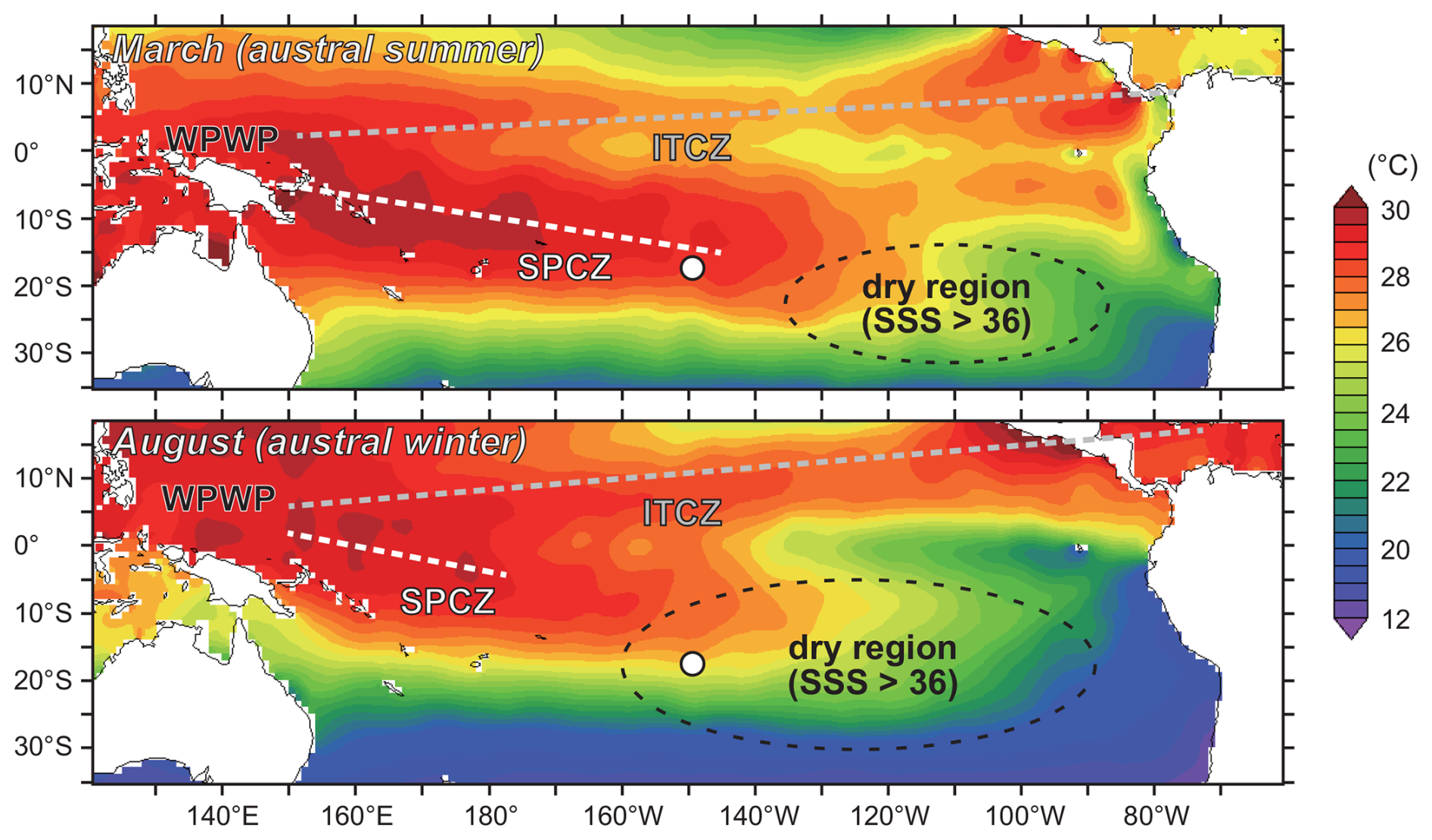
Figure 1Study site in the Pacific Ocean. The coral samples used in this study were drilled at the fore-reef slope off the northern coast of the island of Tahiti (white dot) by IODP Expedition 310 (Camoin et al., 2007). Modern mean SST distributions during austral summer (March) and winter (August) for 1981–2010, approximate mean positions of the WPWP, ITCZ (gray dashed line), SPCZ (white dashed line), and the subtropical dry region (black dashed circle) with high sea surface salinity of >36 are shown. SST data from World Ocean Atlas 2018 (National Centers for Environmental Information, NOAA) (Locarnini et al., 2018; Zweng et al., 2018).
2.2 Samples and mineralogical screening
The three fossil massive corals (Porites corals) used for this study were drilled offshore Tahiti (Tiarei) by IODP Expedition 310 (Camoin et al., 2007) (Fig. 2). Two penultimate glacial corals analyzed in this study (310-M0009D-25R-1W, 65–75 cm; 310-M0009D-25R-2W, 43–51 and 51–57 cm) were U-Th-dated at 148.1±0.9 and 152.7±0.7 to 153.4±0.5 ka (years before 1950 AD) (Thomas et al., 2009). A last glacial coral (310-M0009B-17R-1W, 44–53 cm) was located between two fossil corals in the core that yielded U-Th ages of 29.81±0.07 and 29.66±0.07 ka (Thomas et al., 2009). From the perspective of stratigraphic succession, the mean of these two ages is used as best estimate for the age of our last glacial coral because our sample is located between those two samples in the sediment core (Fig. 2). Hereinafter, the coral ages are referred to as 148 and 153 ka during Marine Isotope Stage (MIS) 6b, corresponding to a transitional phase preceding the penultimate glacial maximum (PGM), and 30 ka during MIS 3a, corresponding to a transitional phase preceding the Last Glacial Maximum (LGM).
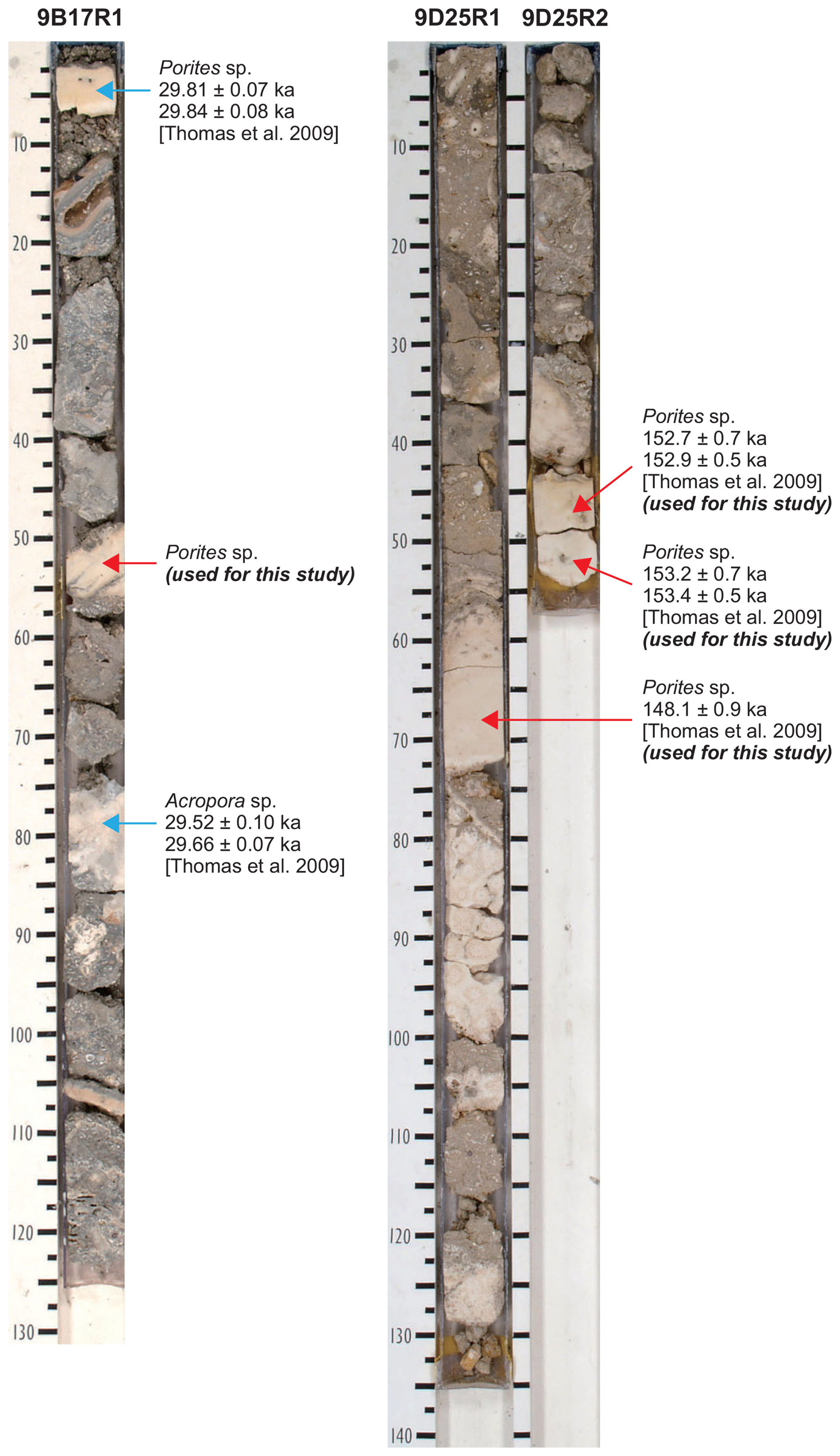
Figure 2Section photos of core 310-9B-17R-1, 310-9D-25R-1, and 310-9D-25R-2 drilled by IODP Expedition 310 (Camoin et al., 2007). Locations of coral samples dated in the previous study (Thomas et al., 2009) and used in this study are presented.
The samples were slabbed into ∼1 cm thick slices parallel to the coral growth axis, washed ultrasonically with milli-Q water, and dried in a clean booth at air temperature. X-radiographic images were taken using a multi soft X-ray film at Institute of Geology and Paleontology, Graduate School of Science, Tohoku University (IGPS, TU) (Fig. 3). For diagenesis screening, segment samples were taken at every ∼1 cm along the transect for geochemical analysis (see the rectangular areas with numbers in Fig. 3). We conducted X-ray diffraction (XRD) analysis with a Phillips X'pert-MPD PW3050 system and scanning electron microscope (SEM) observations with Keyence 3D VE-8800 to check whether the original coral mineralogy and skeletal microstructure were preserved, following previous studies (Asami et al., 2009, 2013, 2020). For identification of aragonite or calcite cements, SEM images of well-preserved aragonite skeleton of modern corals were used. Results of XRD analysis and SEM observation are summarized at Table S1 and in Fig. S1 (see the Supplement). The samples (Core 310-M0009B-17R-1W, 44–53 cm; 310-M0009D-25R-1W, 65–75 cm; and 310-M0009D-25R-2W, 43–51 and 51–57 cm) contain portions of well-preserved skeleton and secondary aragonite and/or calcite cements (Fig. S1). Consequently, we performed geochemical analyses on selected transects with well-preserved skeleton without any traces of diagenetic alteration (Fig. 3). Transects showing >0 % calcite or the presence of aragonite cements were excluded from geochemistry in this study. The geochemical profiles for the use of paleoclimate reconstructions (shown as the red-lined segments in Fig. 3) are actually shorter than the criteria based on the XRD analyses and SEM observations (Table S1) because inappropriate skeletal portions were additionally rejected due to irregular skeletal growth and/or randomly scattered aragonite cements at the micro-scale that were confirmed by results of stable isotope analyses.
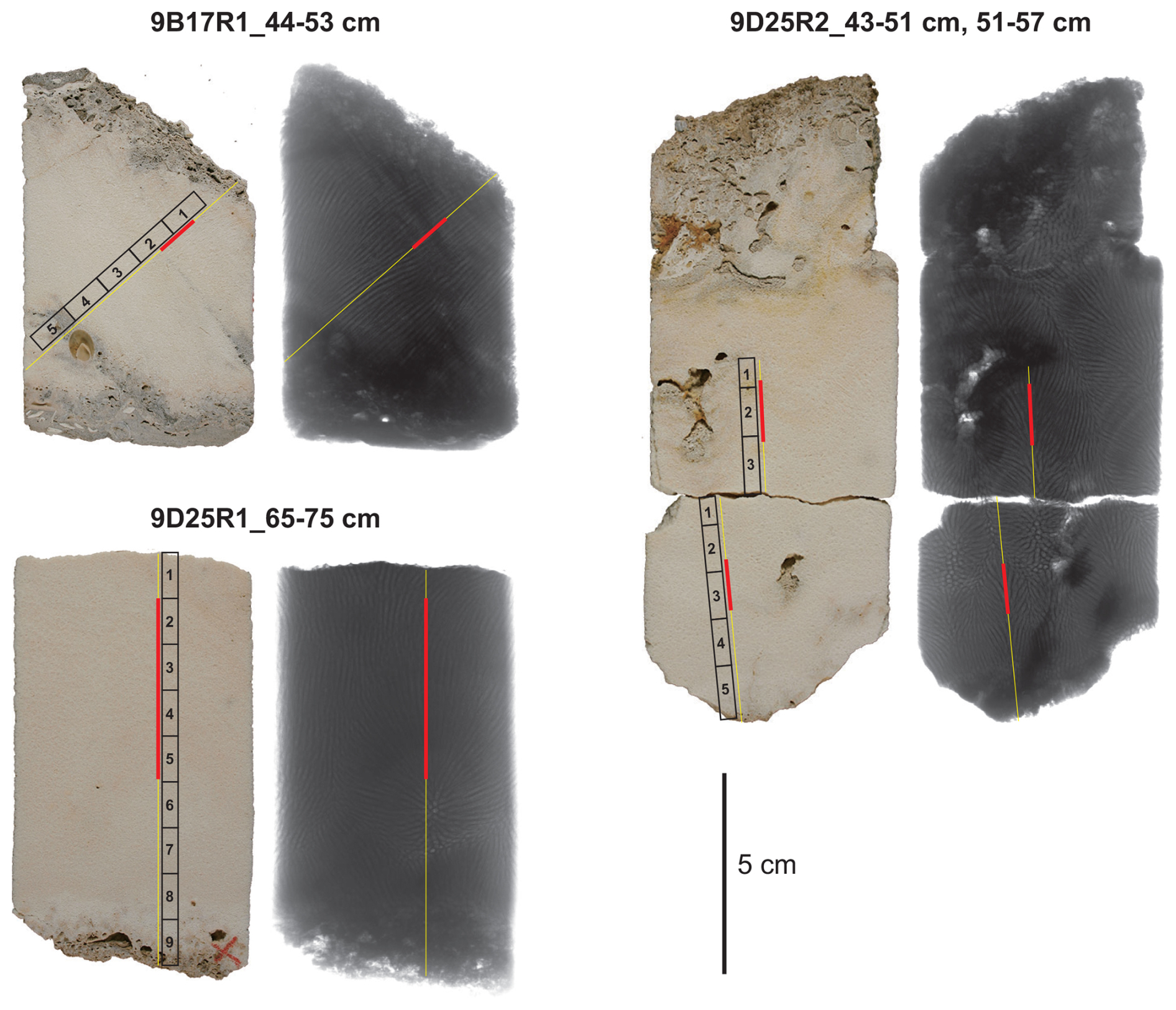
Figure 3Coral slab photos and X-radiographic images of sample 310-9B-17R-1, 310-9D-25R-1, and 310-9D-25R-2. Areas with numbers are investigated for diagenesis screening. Growth direction and sampling track with well-preserved skeleton are indicated by yellow and red lines, respectively.
2.3 Geochemical analyses
Powder samples from selected well-preserved skeletal portions with no evidence of diagenetic alteration were analyzed at 0.5 mm resolution for geochemistry. Carbon and oxygen isotope (δ13C and δ18O) analysis for coral samples was performed using automated Kiel carbonate devices (Kiel III, Finnigan MAT) attached to Finnigan MAT252 and MAT253 mass spectrometers at JOGMEC (Japan Oil, Gas, and Metals National Corporation) and Kochi University. Isotopic ratios were reported in the conventional δ notation relative to the Vienna Peedee belemnite (VPDB) standard for coral samples, which was calibrated to the NBS-19 international standards. Precision and accuracy throughout the analysis were evaluated by replicate isotopic measurements of GSJ/AIST JCp-1 (aragonite; Okai et al., 2002), yielding the respective δ13C and δ18O values of ‰ and ‰ (1σ, n=23). Replicate measurements of NBS-19 and JCp-1 standard materials ensured the analytical consistency between the two laboratories.
analysis was performed on splits of the coral powder samples for δ13C and δ18O analysis, using an inductively coupled plasma-mass spectrometer (XSeries II, ThermoFisher Scientific Inc.) at University of the Ryukyus. Each ∼0.2 mg coral powder sample was dissolved in 5 mL of 0.5 mol L−1 high-purity HNO3, prepared using ultrapure Milli-Q water. Internal standard elements (Sc, Y, and Yb) were added to all solutions to yield equal concentrations to control matrix effects and to correct for instrumental noise. Solutions were analyzed for 43Ca, 44Ca, 45Sc, 87Sr, 88Sr, 89Y, and 172Yb in triplicate. Calibrations of the five gravimetric standard solutions yielded high linearity of r>0.99999 for respective elements. A reference solution matched to the Ca concentration of the coral sample solutions (ca. 15 ppm) was measured at intervals of three samples to correct for instrumental drift in combination with internal standard correction. The analytical method follows Asami et al. (2009, 2020). Based on replicate measurements of the JCp-1 (n=141), precision for was better than 0.30 % relative standard deviation (equivalent to SST errors of <0.5 °C), yielding the average of 8.840 mmol mol−1 in good agreement with a previously reported recommendation value (Hathorne et al., 2013). For inter-laboratory comparison of -derived SST records, measurements from different laboratories were normalized by correcting the offset in the mean value of the JCp-1 standard relative to the average value of 8.901 mmol mol−1, which was measured with the five modern Tahiti Porites corals (Knebel et al., 2024).
In the geochemical records, the warmest and coldest months of a year were identified by the lowest and highest of any given annual cycle. Annual maximum and minimum values in a fossil coral are used as annual minimum and maximum SSTs recorded in winter and summer for paleoclimate interpretation. The seawater δ18O values in the maximum and minimum -SST months were used to discuss hydrological differences in summer and winter between the past and today in this study. The sampling resolution (0.5 mm per sample) of our study corresponds to a monthly-to-bimonthly resolution (12 to 6 subsamples yr−1), varying among years and coral individuals due to differing coral growth rates. To evaluate the averaging effects on -derived SST reconstructions caused by such a different resolution, we estimated differences in SST attributable to different sample resolution (monthly vs. bimonthly) during winter and summer using the monthly OISST v2.1 time series (Huang et al., 2020), by following the method of Asami et al. (2020). As a result, the difference can yield offsets of and °C in reconstructed annual minimum (= winter) and maximum (= summer) SSTs from fossil coral records (Table S2). The offset in SST seasonality is estimated to be °C, which is much smaller than the amplitude (about 3–5 °C, see the discussion) of seasonal -derived SST changes in the fossil coral records and analytical error (<0.5 °C). Consequently, the averaging effects on winter and summer values and seasonality for Tahiti corals do not primarily affect our climatic interpretations presented in the discussion, and the slight difference was not used for correction in this study.
In this study, we used the slope ( mmol mol−1 °C−1) of the -SST calibration (, p<0.01) from the composite coral record from five modern Tahiti Porites corals, established in a previous study (Knebel et al., 2024). For the SST dependency of δ18O, the coral δ18O-SST calibration slope of ‰ °C−1, derived from Porites corals in a large tropical and subtropical region (Juillet-Leclerc and Schmidt, 2001), was used. The annual average and seasonal amplitude of and δ18Osw values were calculated for each coral sample with standard deviation (SD, 1σ). The δ18Osw estimates with combined errors (CE) were calculated from the slopes of δ18O-SST and -SST calibrations, taking into account analytical errors as in a previous study (Cahyarini et al., 2008), yielding a CE of ±0.11 ‰. For estimations of weighted-average values in coral colonies for selected periods during which the U-Th ages of fossil corals overlap, the CE was calculated for the root of the sum of the squares of the SD around the mean of the coral averages by following previous studies (Giry et al., 2012; Brocas et al., 2018).
3.1 Coral , δ18O, and δ13C records
The coral values range from 8.99 to 9.32 mmol mol−1 for 153 ka, 9.10 to 9.38 mmol mol−1 for 148 ka, and 9.10 to 9.32 mmol mol−1 for 30 ka, revealing about 6, 9, and 2.5 annual cycles, respectively (Fig. 4). The annual maximum and minimum values average 9.28±0.04 and 9.06±0.06 mmol mol−1 for 153 ka, 9.31±0.04 and 9.14±0.03 mmol mol−1 for 148 ka, and 9.30±0.03 and 9.12±0.02 mmol mol−1 for 30 ka, corresponding to annual minimum and maximum SSTs recorded in winter and summer, respectively. The coral δ18O (δ13C) values range from −2.67 ‰ (−0.84 ‰) to −1.88 ‰ (0.74 ‰) for 153 ka, from −2.42 ‰ (−1.25 ‰) to −1.58 ‰ (1.31 ‰) for 148 ka, and from −2.31 ‰ (0.02 ‰) to −1.87 ‰ (0.73 ‰) for 30 ka.
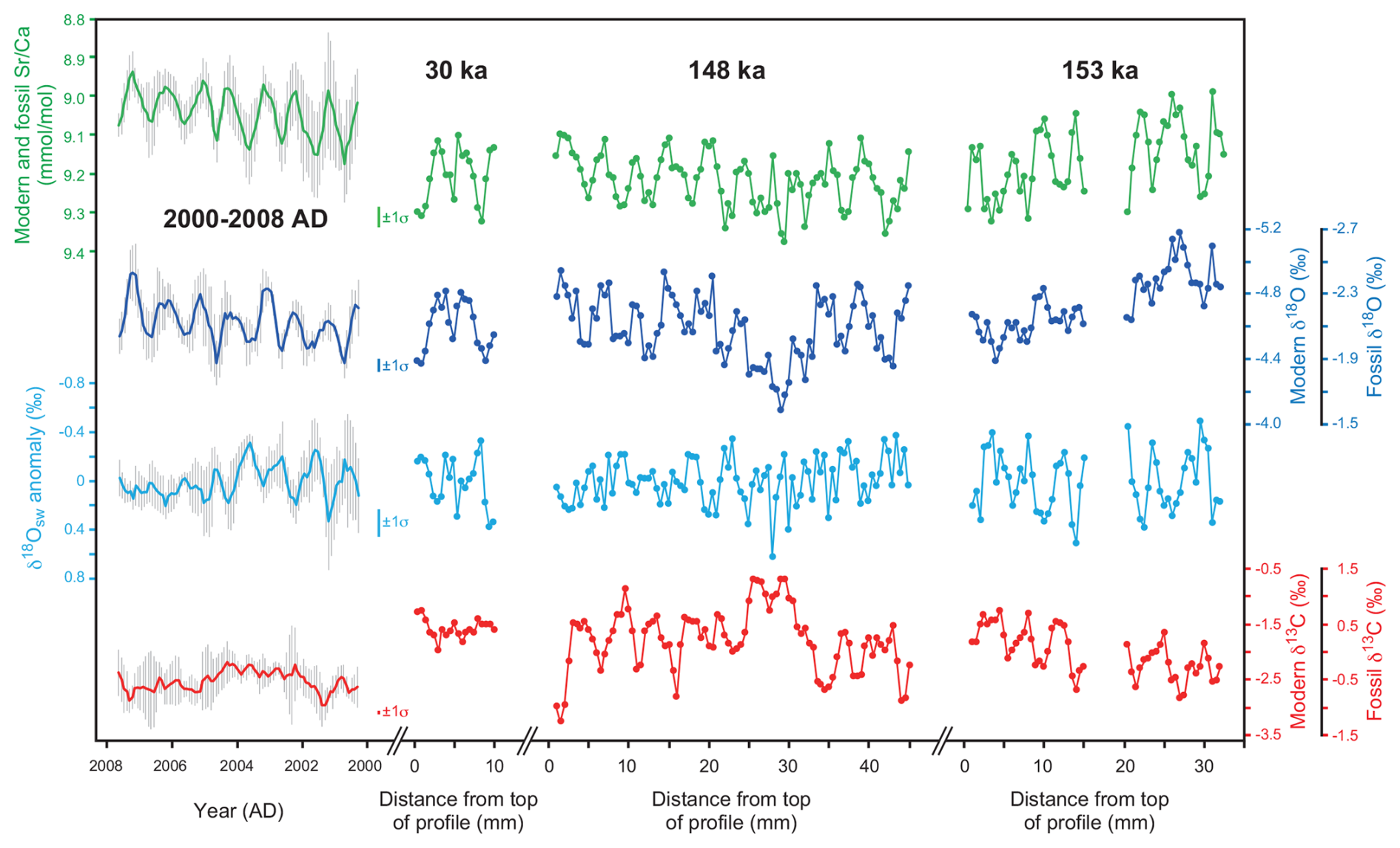
Figure 4Records of , δ18O, and δ13C in fossil Tahiti corals of the penultimate glacial and last glacial, without any corrections for seawater chemistry variations and skeletal growth rate effects. Seawater δ18O (δ18Osw) anomalies estimated from and δ18O records are presented. Annual cycles are clearly visible in the coral -SST proxy records and coral δ18O-combined SST and hydrology proxy records, and to some extent in the coral δ13C records. Coral ages are based on U-Th dating (Thomas et al., 2009). The growth direction is from right to left. For comparison, monthly resolved records of respective mean ±1σ values from five modern Tahiti corals are shown (2000–2008 AD, data from Knebel et al., 2024). Vertical bars represent analytical errors (±1σ).
Annual cycles in coral δ18O, and to some extent in coral δ13C, are in correspondence with the clear annual cycles in the -SST proxy record. The interpretation of coral δ13C on glacial-interglacial timescales is complex, as previously discussed for last deglacial GBR corals, which relate to the global carbon cycle, including changes in atmospheric CO2, reef carbonate production, and the decomposition of organic land carbon (Felis et al., 2022). Thus, in this study we focus on the paleoclimatic interpretation of coral and δ18O. The average coral δ18O values in annual minimum and maximum -derived SSTs are ‰ and ‰ for 153 ka, ‰ and ‰ for 148 ka, and ‰ and ‰ for 30 ka, respectively. There exist significant correlations of coral vs. δ18O records for 153 ka (r=0.74, n=54, p<0.01), 148 ka (r=0.71, n=89, p<0.01), and 30 ka (r=0.71, n=20, p<0.01) (Fig. 5). Moderate correlations between coral and δ18O records (r=0.71–0.74, p<0.01) may indicate contributions by δ18Osw changes on seasonal to interannual timescales. This result is consistent with large amplitudes (∼0.5 ‰) of the δ18Osw anomaly variations estimated from coral and δ18O records (Fig. 4), implying that interannual-scale SSS variations associated with the ITCZ and SPCZ variability may be observed in Tahiti during glacial periods similar to today.
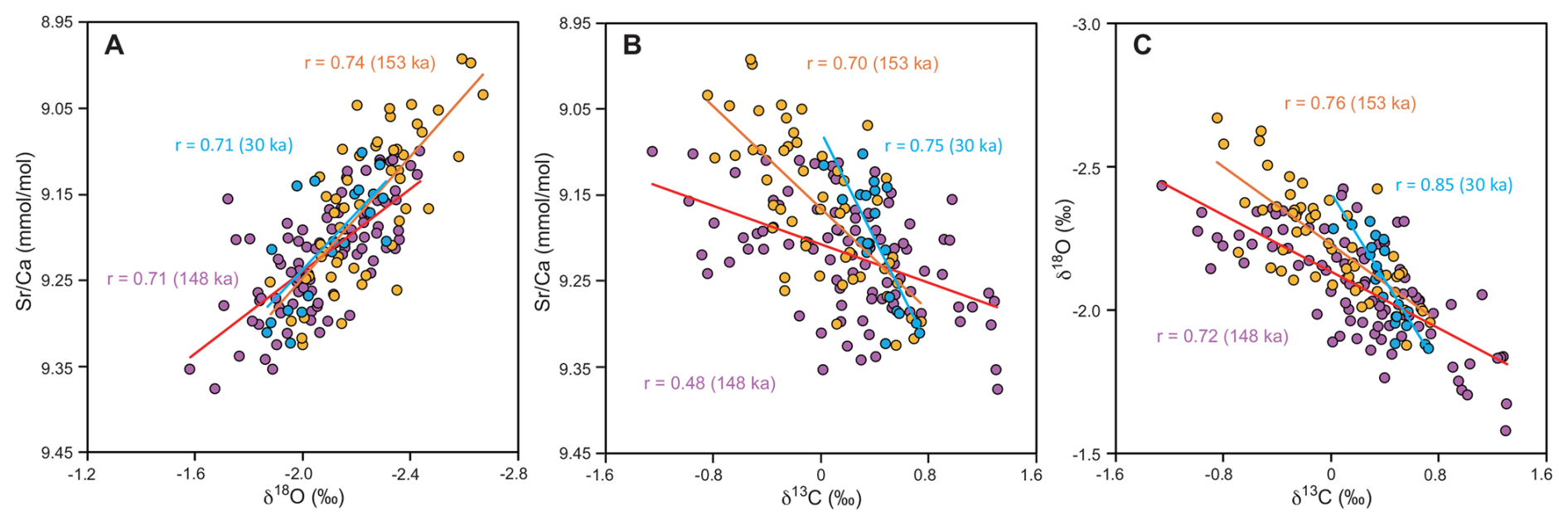
Figure 5Cross plots of the geochemical records (A: vs. δ18O, B: vs. δ13C, C: δ18O vs. δ13C) in fossil Tahiti corals (blue, 30 ka; purple, 148 ka; orange, 153 ka).
The skeletal growth rates based on annual cycles are 4.3 mm yr−1 for 153 ka, 4.8 mm yr−1 for 148 ka, and 3.6 mm yr−1 for 30 ka, which is substantially lower than 15.8 mm yr−1 for modern Tahiti corals (Knebel et al., 2024). The lower growth rates are likely a result of lower SST during glacial periods. It is noted that the effects of coral growth on geochemical records should be carefully considered for paleo-temperature estimations (see Sect. 3.2).
3.2 Paleo-SST and -SSS estimates from coral geochemistry
Coral is an established proxy for seawater temperature in Porites corals (e.g., Smith et al., 1979; Corrège, 2006; Inoue et al., 2007). Paired measurements of coral and δ18O records enable estimation of both SST and δ18Osw (≈ salinity), by removing the temperature component of the coral δ18O variation (e.g., Gagan et al., 1998; Cahyarini et al., 2008). Annual maximum and minimum values in a fossil coral are assigned as annual minimum and maximum SSTs recorded in winter and summer, respectively. Compared with modern Tahiti corals (Knebel et al., 2024), the fossil corals have higher annual, summer, and winter (δ18O) values by 0.12, 0.08, and 0.17 mmol mol−1 (2.35 ‰, 2.41 ‰, and 2.34 ‰) for 153 ka, by 0.18, 0.16, and 0.20 mmol mol−1 (2.54 ‰, 2.50 ‰, and 2.59 ‰) for 148 ka, and by 0.16, 0.14, and 0.19 mmol mol−1 (2.55 ‰, 2.56 ‰, and 2.55 ‰) for 30 ka (Table 1 and Fig. 4).
Table 1Estimates of sea surface temperature (SST) and seawater oxygen isotope (δ18Osw) values from penultimate glacial, last glacial, and modern corals at Tahiti (Uncertainties are at 1σ level).
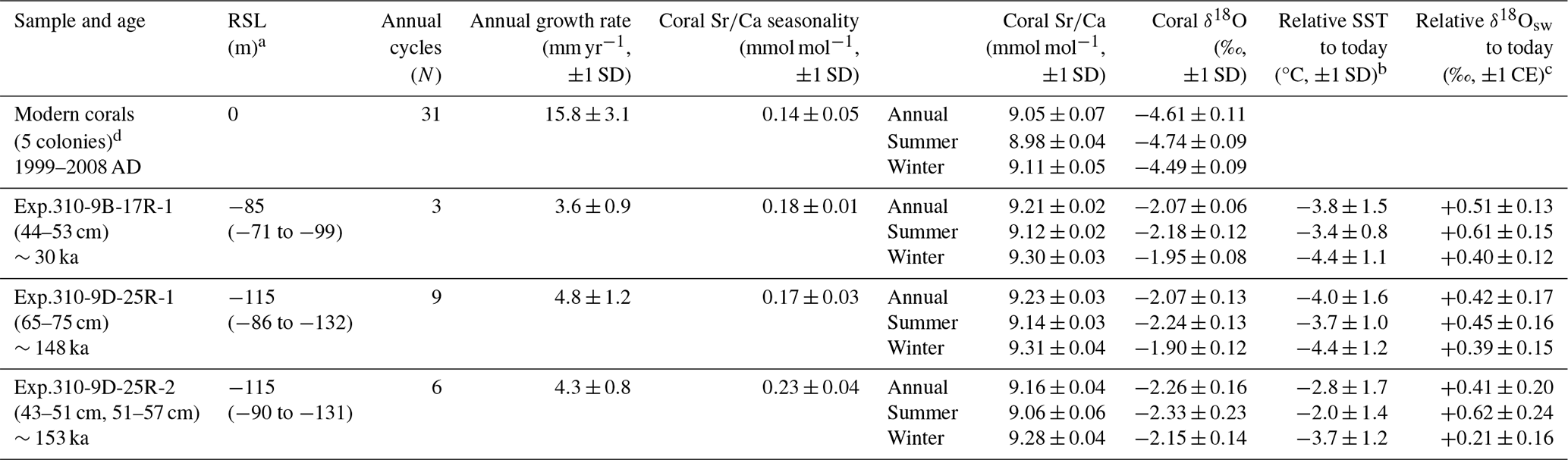
a Relative sea level estimated from benthic foraminifera records (Waelbroeck et al., 2002). The averages with ranges in parentheses were used for the corrections of differences in seawater chemistry due to sea level changes. b Corrected for seawater changes (Stoll and Schrag, 1998; de Villiers, 1999) and for the offset of JCp-1 mean values between Knebel et al. (2024) and this study. Relative SST was estimated using a -SST equation (Knebel et al., 2024). c Corrected for δ18Osw changes (Waelbroeck et al., 2002) and annual growth rate differences (Felis et al., 2003) and estimated using a δ18O-SST equation (Juillet-Leclerc and Schmidt, 2001). d Data from Knebel et al. (2024).
Sea-level changes on glacial/interglacial timescales are responsible for variations in seawater (Stoll and Schrag, 1998; Schrag et al., 2002) and δ18Osw (Waelbroeck et al., 2002). For each record, data is corrected for seawater changes using the sea level at a given age (Waelbroeck et al., 2002), assuming that seawater was increased by 0.5 % (Stoll and Schrag, 1998; Asami et al., 2009; Felis et al., 2012) relative to the present (8.539 mmol mol−1: de Villiers, 1999) during the LGM. Paleo-SST differences relative to the present (2000–2008 AD) are estimated using the -SST calibration slope of mmol mol−1 °C−1 from modern Tahiti corals (Knebel et al., 2024). Taking account of the effects of recent global warming since 1950, our paleo-SST reconstructions should be corrected using the SST difference of 0.7±0.4 °C between 2000–2008 and 1854–1950, as estimated from NOAA NCDC ERSST v5 data.
For δ18Osw estimation, coral δ18O data is corrected for δ18Osw changes using the sea level at given age, as inferred from benthic foraminiferal δ18O records (Waelbroeck et al., 2002), and for the δ18O offset caused by the difference in annual growth rate between modern and fossil corals using a previously established equation with an r2 value of 0.91 for eleven Porites corals with growth rates of 2.0–15.2 mm yr−1 (Felis et al., 2003), which is similar to other studies (Hayashi et al., 2013; Hirabayashi et al., 2013). In contrast, coral data is not corrected for the offset caused by differences in annual growth rate because there is no significant relationship between coral and growth rates (Inoue et al., 2007; Hirabayashi et al., 2013). Paleo-δ18Osw differences relative to the present are estimated using the coral δ18O-SST calibration slope of ‰ °C−1 derived from Porites corals in a large tropical and subtropical region (Juillet-Leclerc and Schmidt, 2001). Based on the law of propagation of data error, the errors on the SST and δ18Osw reconstructions were estimated from the root-sum-square of the standard deviations of parameters used for calculation.
Applying corrections for the inter-laboratory offsets, for the seawater and δ18Osw changes, and for the skeletal growth rate effects, improved SST and δ18Osw estimates relative to the present were inferred from the fossil Tahiti coral records of the penultimate glacial and last glacial (Table 1). The corresponding results indicate annual mean, summer, and winter SST and δ18Osw are 2.8, 2.0, and 3.7 °C lower (4.0, 3.7, and 4.4 °C lower) and 0.41 ‰, 0.62 ‰, and 0.21 ‰ higher (0.42 ‰, 0.45 ‰, and 0.39 ‰ higher) at 153 ka (at 148 ka) than today. At 30 ka, the respective values are 3.8, 3.4, and 4.4 °C lower and 0.51 ‰, 0.61 ‰, and 0.40 ‰ higher relative to today, which is similar to those of the 148 ka coral. It is noted that our corals provide snapshots of less than 10-year-long time series for selected glacial periods, and the actual SST estimates could be potentially changed by interannual and decadal SST variability. Considering the inter-colony variability of 0.023 mmol mol−1 (equivalent to 0.46 °C) from modern Tahiti corals (Knebel et al., 2024), the estimated SST differences are significant between the glacial periods and the present. Considering the inter-colony δ18O variability of ±0.12 ‰ (Sayani et al., 2019), δ18Osw differences between glacial periods and the present are significant. However, we cannot discuss the difference among 153, 148, and 30 ka corals for paleoclimate interpretation.
These coral-based SST and δ18Osw estimates suggest the central tropical South Pacific Ocean around Tahiti was colder by 3–4 °C relative to today during MIS 6b (153 and 148 ka) and MIS 3a (30 ka). We note that these results represent upper estimates of the magnitude of cooling, although corrected for seawater changes on glacial-interglacial timescales. Lower cooling estimates would have resulted if -SST relationships for reconstructions of mean SST changes had been applied (Felis et al., 2009, DeLong et al., 2010; Gagan et al., 2012), as has been discussed in previous studies (Felis et al., 2012, 2014; Knebel et al., 2024). Ice volume corrected δ18Osw estimates suggest a higher SSS by +1 during these time intervals, if a modern salinity-δ18Osw relationship for South Pacific surface waters is applied (LeGrande and Schmidt, 2006). Our reconstructions are broadly consistent with subtropical South Pacific SST estimates for the LGM (3–4 °C lower than today) derived from isotope-enabled climate model simulations using data assimilation (Tierney et al., 2020), but are more pronounced than previous estimates (1–2 °C lower than today) (CLIMAP Project Members, 1976; MARGO Project Members, 2009).
3.3 Penultimate glacial mean climate in the tropical South Pacific
At Tahiti, fossil coral records for key periods of the last deglaciation, such as Heinrich Stadial 1 (HS1), Melt-Water Pulse 1A (MWP 1A), Bølling-Allerød (B-A), and the Younger Dryas (YD) are available (Asami et al., 2009; Hathorne et al., 2011; Felis et al., 2012; Knebel et al., 2024). For comparison, previously reported coral values were corrected for inter-laboratory offsets relative to the average value of 8.901 mmol mol−1 for the JCp-1 standard (Knebel et al., 2024) as well as seawater changes on glacial-interglacial timescales, and the time-weighted averages for selected periods during which the U-Th ages of fossil corals overlap are estimated following previous studies (Chuang et al., 2023; Knebel et al., 2024).
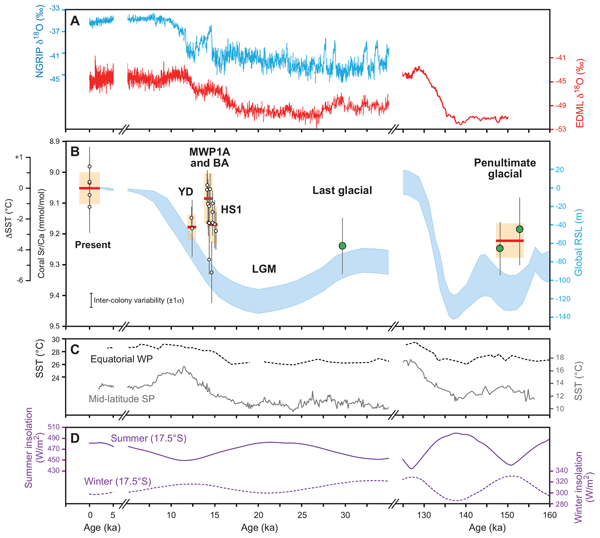
Results show that the annual mean SST during the penultimate glacial is 2.7±0.2 °C lower than the MWP 1A and B-A warming periods and 1.0±0.3 °C lower than the HS1 and YD cooling periods. The most recent glacial maxima are the PGM (∼140 ka, Lisiecki and Raymo, 2005) and the LGM (27–19 ka, Clark et al., 2009), corresponding to relative sea level lowstands of >120 m (Siddall et al., 2003; Yokoyama et al., 2018) (Fig. 6A). Our mean SST estimates from Tahiti coral are broadly consistent (r=0.94, n=3, p<0.01) with the global climate state at relative sea levels of about −115 m (ranging from −132 to −86 m) for MIS 6b during the penultimate glacial period and of −85 m (ranging from −99 to −71 m) for MIS3a during the last glacial period, just before the respective glacial maxima, the PGM and LGM (Waelbroeck et al., 2002) (Fig. 6B), harmonizing well with Antarctica ice core records at the sites Vostok (Petit et al., 1999), EPICA Dome C (Jouzel et al., 2007), and EDML (EPICA Community Members, 2006). Ice volume corrected mean δ18Osw values of 0.4 ‰ (153–148 ka) and 0.5 ‰ higher (30 ka) relative to the present (Table 1) demonstrate that the central tropical South Pacific surface ocean around Tahiti during MIS 6b and 3a had more positive mean δ18Osw values (equivalent to higher SSS by +1, if a salinity-δ18Osw relationship is applied (LeGrande and Schmidt, 2006)) than today.
At Rotuma, Fiji, Tonga, Rarotonga, and Tahiti in the tropical South Pacific, modern coral geochemical records reflect variations in SST, SSS, and precipitation associated with SPCZ variability (Linsley et al., 2006; Juillet-Leclerc et al., 2006; Wu et al., 2013; Todorović et al., 2024). Our δ18Osw estimates from fossil Tahiti corals are consistent with higher δ18O values of precipitation in the tropical-to-subtropical South Pacific during the LGM, derived from isotope-enabled climate model simulations using data assimilation (Tierney et al., 2020). Thus, we suggest our fossil Tahiti coral data can be best explained by less active and/or northwestward-contracted SPCZ during the penultimate glacial and the last glacial periods. This was probably accompanied by a westward expansion of the subtropical South Pacific dry area, characterized by higher salinity, under the colder climates. Our paleoclimatic interpretation is largely consistent with modern oceanographic findings that the waters around the southeastern edge of the SPCZ are not only influenced by variations in the position of the SPCZ but also by the surface ocean salinity front that separates the warm/fresher waters in the northwest from the cool/saline waters in the southeast and east (Delcroix and McPhaden, 2002). It is noted that the salinity front could have changed on interannual and decadal timescales associated with thermal and hydrological variations due to the ENSO and the Pacific Decadal Oscillation (Delcroix and McPhaden, 2002; Gouriou and Delcroix, 2002; Delcroix et al., 2007). A climate modelling study shows that tropical precipitation decreases during the LGM, resulting in the southward shift, narrowing, and weakening of the ITCZ (Wang et al., 2023), which is consistent with the Indonesia stalagmite δ18O records (Yuan et al., 2023). These lines of evidence for a weakened ITCZ during the LGM can further support our fossil coral records, which suggest a weakened and/or northwestward-contracted SPCZ during MIS 6b and 3a.
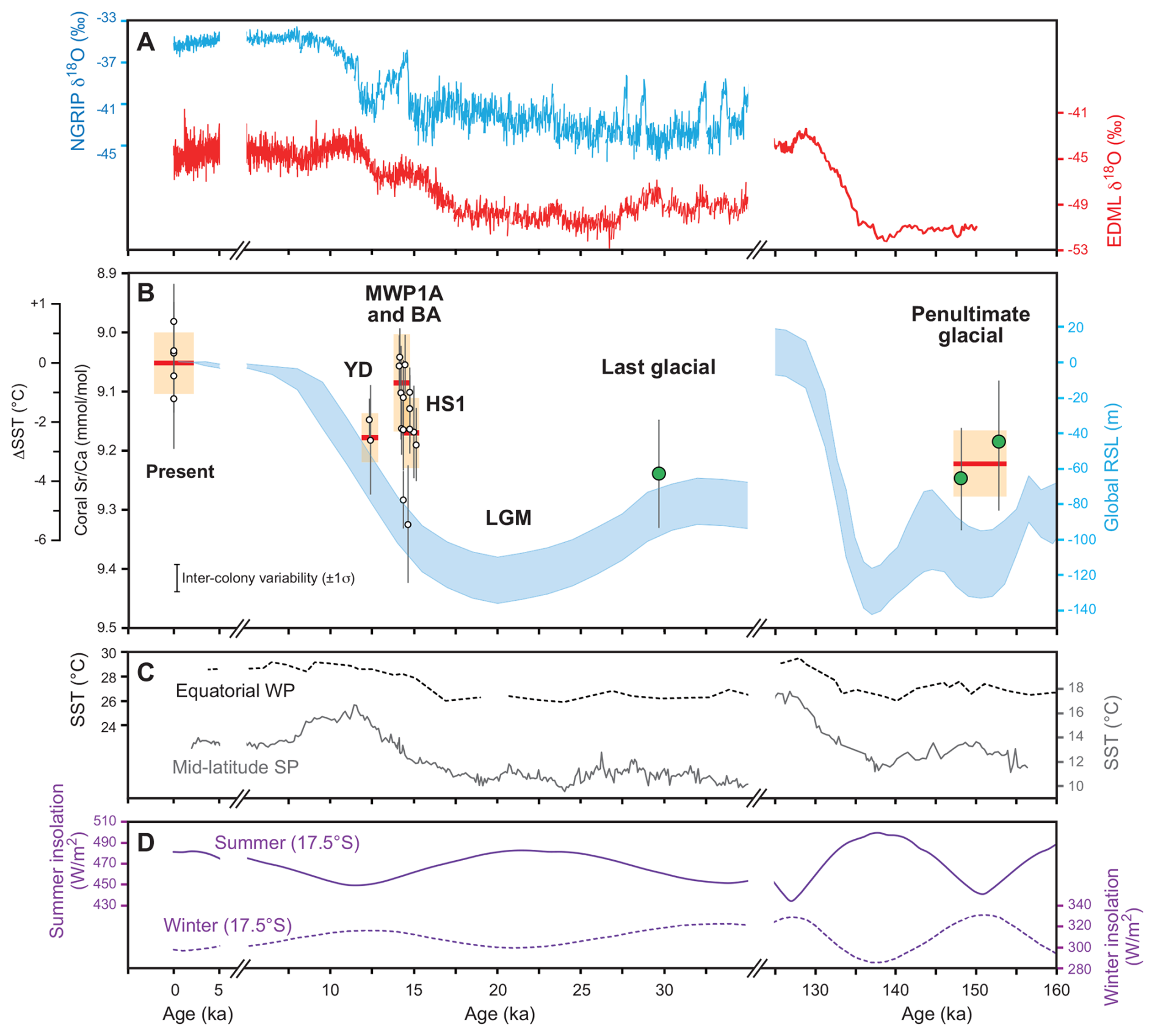
Figure 6Temperature proxy records from Tahiti corals and paleoclimate records for the penultimate glacial, last glacial, last deglacial, and present. (A) Greenland (NGRIP, Rasmussen et al., 2006) and Antarctica (EDML, EPICA Community Members, 2006) ice core δ18O records. (B) Annual mean of sub-seasonally resolved modern and fossil Tahiti corals (white symbols, Asami et al., 2009; Hathorne et al., 2011; Felis et al., 2012; Knebel et al., 2024; green, this study). Vertical bars: Mean seasonality. Red horizontal bars: Weighted average of colony means for given interval (penultimate glacial, HS1: Heinrich Stadial 1, MWP1A: Melt-Water Pulse 1A, BA: Bølling–Allerød, YD: Younger Dryas, present: 2000–2008 AD) with uncertainty (CE: combined error, light orange area). The JCp-1 value representative for the coral values shown is 8.901 mmol mol−1 (Knebel et al., 2024). Corrected for seawater changes by sea-level dependency at a given age (Waelbroeck et al., 2002) assuming seawater 0.5 % higher than present (8.539 mmol mol−1) at the Last Glacial Maximum (LGM) (Stoll and Schrag, 1998; de Villiers, 1999). Reconstructed SST anomaly relative to today based on modern Tahiti coral -SST relationship ( mmol mol−1 °C−1, Knebel et al., 2024). The inter-colony variability (±1σ) estimated from modern Tahiti corals (Knebel et al., 2024) is shown. The light blue belt denotes a range of maximum and minimum global sea level inferred from benthic foraminiferal δ18O records (Waelbroeck et al., 2002). (C) Equatorial western Pacific SST from foraminiferal (ODP 806B, Medina-Elizalde and Lea, 2005) and South Pacific mid-latitude SST from alkenones (MD97-2120, Sikes and Volkman, 1993; Pahnke and Sachs, 2006). (D) Summer and winter insolation at the latitude of Tahiti (17.5° S) (Laskar et al., 2004).
Our fossil coral records provide snapshots of the tropical South Pacific climate around 153–148 ka and at 30 ka (Fig. 4). The weighted average SST reconstruction from our coral records shows that the mean climate condition around Tahiti (17.5° S) is 3.4±1.1 °C colder for 153–148 ka than the present (Fig. 6B). Foraminiferal records from ODP core 806B at 0.3° N (Medina-Elizalde and Lea, 2005) and alkenone records from MD97-2120 core at 45.5° S (Sikes and Volkman, 1993; Pahnke and Sachs, 2006) show a cooling by 1.8±0.6 °C in the WPWP and 4.4±0.5 °C in the mid-latitude South Pacific at that time (Fig. 6C), consistent with benthic foraminiferal δ18O records in the Tasman Sea west of New Zealand (43.5° S, Ronge et al., 2015). These results may indicate stronger latitudinal and/or zonal mean SST gradients in the South Pacific during the penultimate glacial (MIS 6b) relative to today. During the last glacial period (MIS 3a), the three paleoclimate proxy records show a lower SST by ∼3 °C (0.3° N), 3.8±1.5 °C (17.5° S), and ∼6 °C (45.5° S) than the present, possibly indicating the mean SST gradient was more pronounced in the subtropical to mid-latitude South Pacific relative to the penultimate glacial period. These lines of evidence for the stronger latitudinal and/or zonal SST gradients imply that latitudinal winds were probably more pronounced during glacial cold periods, which could be supported by results of climate simulation experiments and dust fluxes in ice cores (Lambert et al., 2008; Cao et al., 2019; Krätschmer et al., 2022). Paleoclimate records and simulations indicate less frequent and weaker ENSO variability during the LGM relative to the present (Ford et al., 2015; Thirumalai et al., 2024). A climate simulation suggests that the equatorial Pacific climate under glacial conditions is characterized by a contracted WPWP and stronger SST gradient together with a deeper mixed layer driven by a stronger Walker circulation (Thirumalai et al., 2024). These considerations can support our interpretation of SST gradients in the subtropical and the mid-latitude regions of the South Pacific.
3.4 Seasonal SST and SSS differences: Paleoclimatological implications
The seasonal amplitude is calculated using individual data for modern and fossil corals in the same manner and shown as the averages of corals for respective age intervals (Table 1). Our Tahiti coral seasonality of 0.23±0.04 and 0.17±0.03 mmol mol−1 at 153–148 ka and 0.18±0.01 mmol mol−1 at 30 ka is larger than that previously reported for HS1 (0.13±0.01 mmol mol−1), B-A (0.12±0.01 mmol mol−1), and the present (0.14±0.01 mmol mol−1) (Knebel et al., 2024) (Fig. 6B). The seasonality difference can be explained by a SST decrease that is larger in austral winter by 0.8–1.7 and 1.0 °C compared to austral summer at 153–148 ka and at 30 ka relative to present, respectively (Table 1). The seasonal thermal difference at Tahiti may indicate a stronger latitudinal gradient of winter SST in the central tropical-to-subtropical South Pacific relative to today (Fig. 1). Furthermore, we found that the δ18Osw (salinity) increase relative to the present is 0.1–0.4 ‰ (equivalent to 0.1–0.9) and 0.2 ‰ (equivalent to 0.5) larger in the austral summer than in austral winter at 153–148 and 30 ka (Table 1). The hydrological differences during the seasons may suggest that the surface ocean around Tahiti experienced higher evaporation (lower precipitation) and/or northwestward advection of saltier waters from the eastern subtropics in austral summer rather than winter at that time, possibly associated with the SPCZ variability different from today.
The SPCZ is a diagonal band of intense rainfall and deep atmospheric convection extending from the WPWP to the subtropical South Pacific (Fig. 1). The area to the east of the SPCZ is characterized as south-east Pacific dry area because of being persistently free of deep convective rainfall, possibly linked to orographic forcing from the Andes via feedbacks involving subsidence of low specific humidity air, low clouds and cooler SSTs (Takahashi and Battisti, 2007). The extent of this dry zone affects the position of the eastern edge of the SPCZ. Consequently, our results of reconstructed SST and δ18Osw changes during the penultimate and last glacial from fossil Tahiti corals can be best explained by lower activity of the SPCZ and/or its contraction to the northwest, and an accompanying expansion of the South Pacific subtropical dry area during glacial periods. This climatic interpretation could be supported by a simulation study suggesting that the WPWP contracted to the west and the SST gradient became stronger in the equatorial Pacific during the LGM (Thirumalai et al., 2024).
Previous work on geochemical records of fossil Tahiti corals reported an increased -derived SST seasonality of 0.17±0.02 mmol mol−1 during the YD, a pronounced cold interval of the last deglaciation in the Northern Hemisphere and Tahiti (Asami et al., 2009), which was suggested to result from reduced thickness of the mixed layer and an enhanced influence of the South Pacific Subtropical Gyre due to a weakening of SPCZ activity (Knebel et al., 2024). Interestingly, our reconstructed weighted average coral seasonality of 0.20±0.05 mmol mol−1 at 153–148 ka is similar to or larger than that during the YD period (Fig. 6B), which may indicate a thinner mixed layer around Tahiti during the penultimate glacial period. The comparison of SST seasonality between the penultimate glacial and the YD period is significant because the fossil corals were collected from the same site (Tiarei) in Tahiti and analyzed by the same methodology. Our climatic interpretation is further supported by variations in orbital parameters that cannot explain the increased temperature seasonality at Tahiti during these time intervals. Austral summer and winter insolation at Tahiti (17.5° S) were relatively low and high, respectively, during the MIS 6b as well as the YD, with a smaller seasonality relative to today (Laskar et al., 2004) (Fig. 6D). We speculate that SST and SSS variability around Tahiti under glacial conditions were strongly influenced by a weakening and/or contraction of the SPCZ and expansion and/or westward migration of the South Pacific dry area, as reflected in our coral-based evidence for larger SST seasonality and higher reconstructed mean δ18Osw (salinity) values during the penultimate glacial period. Radiogenic neodymium isotope and records from Atlantic marine sediments show higher values at 153, 148, and 30 ka as well as during the YD relative to interglacial periods (Böhm et al., 2015; Deaney et al., 2017), which might suggest atmospheric teleconnections in transferring climate signals from the Atlantic to the tropical Pacific for MIS 6b and 3a associated with slowdowns of the Atlantic meridional overturning circulation (McManus et al., 2004; Timmermann et al., 2007).
We present new monthly-to-bimonthly resolved and δ18O records of well-preserved fossil Tahiti corals recovered by IODP Expedition 310 to reconstruct annual mean, summer, and winter SST and δ18Osw at 153 and 148 ka (MIS 6b) and 30 (MIS 3a) in the tropical-to-subtropical South Pacific Ocean. When compared with records from last deglacial and modern Tahiti corals (Knebel et al., 2024), our coral proxy records indicate that penultimate glacial and last glacial climate around Tahiti is characterized by colder and more saline conditions at the sea surface. The coral-based reconstructions reveal differences in thermal and hydrological seasonal conditions that are best explained by SST and SSS anomalies associated with spatial variations in the SPCZ and the South Pacific subtropical dry area. These conditions show similarities to those previously inferred from Tahiti corals for the YD cold period (Knebel et al., 2024). Given potential uncertainties in inter-colony δ18O variability (Sayani et al., 2019), more fossil coral samples are needed to quantitatively evaluate the significance of δ18Osw differences between the past and present and to verify our paleoclimatological suggestions. Long-lived fossil corals are also required to discuss the respective components of seasonal, interannual, and decadal variations in paleo-SST and -δ18Osw records strongly relating to the ITCZ and SPCZ variability associated with ENSO. To date, there is only one such record documenting pronounced interannual variability in tropical South Pacific temperatures at typical ENSO periods during Heinrich Stadial 1 of the last glacial (Felis et al., 2012). Nevertheless, our combined coral-based results of tropical South Pacific SST and δ18Osw characteristics under glacial conditions can help to constrain model simulations of past and future climate change. Recently, IODP Expedition 389 “Hawaiian Drowned Reefs” drilled coral reefs in the central tropical-subtropical North Pacific Ocean to reconstruct glacial-interglacial environmental changes over the last 500 000 years (Webster et al., 2024). Future, integrated interpretations of coral-based climate reconstructions from Hawaii and Tahiti fossil corals will provide a more thorough understanding of changes in seasonality, interannual variability, and mean climate changes across the central tropical-to-subtropical North and South Pacific during the penultimate glacial and last glacial periods.
Coral data generated from this study (Asami et al., 2025) are available at the World Data Center PANGAEA (https://doi.org/10.1594/PANGAEA.987216). Correspondence and requests for data and materials should be addressed to Ryuji Asami.
The supplement related to this article is available online at https://doi.org/10.5194/cp-21-2525-2025-supplement.
RA and TF designed the study. RA conducted experiments, performed data analyses, and wrote the original draft. TF revised the original draft. RS, MM, and YI collaborated with experiments. All authors discussed the results and edited the manuscript.
The contact author has declared that none of the authors has any competing interests.
Publisher's note: Copernicus Publications remains neutral with regard to jurisdictional claims made in the text, published maps, institutional affiliations, or any other geographical representation in this paper. While Copernicus Publications makes every effort to include appropriate place names, the final responsibility lies with the authors. Views expressed in the text are those of the authors and do not necessarily reflect the views of the publisher.
This study used fossil coral samples provided by IODP, drilled on a mission-specific platform expedition conducted by the European Consortium for Ocean Research Drilling (ECORD) Science Operator (ESO). We gratefully acknowledge G. Camoin, D. McInroy, and all Science Party colleagues for collaboration during the Onshore/Offshore Parties, W. Hale, U. Röhl, A. Wülbers, and all Bremen Core Repository members for support during the Onshore Party. We also thank Y. Tsuji and E. Shimbo of JOGMEC for help with isotope experiment.
This work was financially supported by the Japan Society for the Promotion of Science (JSPS) KAKENHI (grant nos. 26707028, 22H01291, 23K22562, and 24K21560 to Ryuji Asami) and World Premier International Research Center Initiative (WPI), MEXT, Japan. Thomas Felis acknowledges Deutsche Forschungsgemeinschaft (German Research Foundation, DFG) – Project number 408139156.
This paper was edited by Stephen Obrochta and reviewed by two anonymous referees.
Asami, R., Felis, T., Deschamps, P., Hanawa, K., Iryu, Y., Bard, E., Durand, N., and Murayama, M.: Evidence for tropical South Pacific climate change during the Younger Dryas and the Bølling-Allerød from geochemical records of fossil Tahiti corals, Earth Planet. Sc. Lett., 288, 96–107, https://doi.org/10.1016/j.epsl.2009.09.011, 2009.
Asami, R., Iryu, Y., Hanawa, K., Miwa, T., Holden, P., Shinjo, R., and Paulay, G.: MIS 7 interglacial sea surface temperature and salinity reconstructions from a southwestern subtropical Pacific coral, Quat. Res., 80, 575–585, https://doi.org/10.1016/j.yqres.2013.09.002, 2013.
Asami, R., Yoshimura, N., Toriyabe, H., Minei, S., Shinjo, R., Hongo, C., Sakamaki, T., and Fujita, K.: High-resolution evidence for middle Holocene East Asian winter and summer monsoon variations: snapshots of fossil coral records, Geophys. Res. Lett., 47, e2020GL088509, https://doi.org/10.1029/2020GL088509, 2020.
Asami, R., Felis, T., Shinjo, R., Murayama, M., and Iryu, Y.: Geochemical data from IODP Expedition 310 Tahiti fossil corals, PANGAEA [data set], https://doi.org/10.1594/PANGAEA.987216, 2025.
Ayling, B. F., McCulloch, M. T., Gagan, M. K., Stirling, C. H., Andersen, M. B., and Blake, S. G.: and δ18O seasonality in a Porites coral from the MIS 9 (339–303 ka) interglacial, Earth Planet. Sc. Lett., 248, 462–475, https://doi.org/10.1016/j.epsl.2006.06.009, 2006.
Böhm, E., Lippold, J., Gutjahr, M., Frank, M., Blaser, P., Antz, B., Fohlmeister, J., Frank, N., Andersen, M. B., and Deininger, M.: Strong and deep Atlantic meridional overturning circulation during the last glacial cycle, Nature, 517, 73–76, https://doi.org/10.1038/nature14059, 2015.
Brenner, L. D., Linsley, B. K., Webster, J. M., Potts, D., Felis, T., Gagan, M. K., Inoue, M., McGregor, H., Suzuki, A., Tudhope, A., Esat, T., Thomas, A., Thompson, W., Fallon, S., Humblet, M., Tiwari, M., and Yokoyama, Y.: Coral record of Younger Dryas Chronozone warmth on the Great Barrier Reef, Paleoceanogr. Paleoclimatol., 35, e2020PA003962, https://doi.org/10.1029/2020PA003962, 2020.
Brocas, W. M., Felis, T., Gierz, P., Lohmann, G., Werner, M., Obert, J. C., Scholz, D., Kölling, M., and Scheffers, S. R.: Last interglacial hydroclimate seasonality reconstructed from tropical Atlantic corals. Paleoceanography and Paleoclimatology, 33, 198–213, https://doi.org/10.1002/2017PA003216, 2018.
Brown, J. R., Lengaigne, M., Lintner, B. R. Widlansky, M. J., Van der Wiel, K., Dutheil, C., Linsley, B. K., Matthews, A. J., and Renwick, J.: South Pacific Convergence Zone dynamics, variability and impacts in a changing climate, Nature Rev. Earth Environ., 1, 530–543, https://doi.org/10.1038/s43017-020-0078-2, 2020.
Cahyarini, S. Y., Pfeiffer, M., Timm, O., Dullo, W. C., and Schönberg, D. G.: Reconstructing seawater δ18O from paired coral δ18O and ratios: methods, error analysis and problems, with examples from Tahiti (French Polynesia) and Timor (Indonesia), Geochim. Cosmochim. Acta, 72, 2841–2853, https://doi.org/10.1016/j.gca.2008.04.005, 2008.
Camoin, G. F., Iryu, Y., McInroy, D., and the Expedition 310 Scientists: Proc. IODP, 310, Integrated Ocean Drilling Program Management International, Inc., Washington DC, https://doi.org/10.2204/iodp.proc.310.2007, 2007.
Cao, J., Wang, B., and Liu, J.: Attribution of the Last Glacial Maximum climate formation, Clim. Dynam., 53, 1661–1679, https://doi.org/10.1007/s00382-019-04711-6, 2019.
Carton, J. A., Chepurin, G. A., and Chen, L.: SODA3: A new ocean climate reanalysis, J. Climate, 31, 6967–6983, https://doi.org/10.1175/jcli-d-18-0149.1, 2018.
Chuang, K.-Y., Asami, R., Takayanagi, H., Morimoto, M., Abe, O., Nakamori, T., and Iryu, Y.: Multidecadal-to-interannual modulations of Late Holocene climate variations reconstructed from oxygen isotope ratios of a 237-year-long lived fossil coral in Kikai Island, southwestern Japan, Quat. Sci. Rev., 322, 108392, https://doi.org/10.1016/j.quascirev.2023.108392, 2023.
Clark, P. U., Dyke, A. S., Shakun, J. D., Carlson, A. E., Clark, J., Wohlfarth, B., Mitrovica, J. X., Hostetler, S. W., and McCabe, A. M.: The Last Glacial Maximum, Science, 325, 710–714, https://doi.org/10.1126/science.1172873, 2009.
CLIMAP Project Members: The surface of the Ice-Age Earth, Science, 191, 1131–1137, https://doi.org/10.1126/science.191.4232.1131, 1976.
Cole, J. E., Fairbanks, R. G., and Shen, G. T.: Recent variability in the Southern Oscillation: Isotopic results from a Tarawa Atoll coral, Science, 260, 1790–1793, https://doi.org/10.1126/science.260.5115.1790, 1993.
Corrège, T.: Sea surface temperature and salinity reconstruction from coral geochemical tracers, Palaeogeogr. Palaeoclimatol. Palaeoecol., 232, 408–428, https://doi.org/10.1016/j.palaeo.2005.10.014, 2006.
Deaney, E., Barker, S., and van de Flierdt, T.: Timing and nature of AMOC recovery across Termination 2 and magnitude of deglacial CO2 change, Nat. Commun., 8, 14595, https://doi.org/10.1038/ncomms14595, 2017.
de Boyer Montégut, C., Madec, G., Fischer, A. S., Lazar, A., and Iudicone, D.: Mixed layer depth over the global ocean: An examination of profile data and a profile-based climatology, J. Geophys. Res., 109, C12003, https://doi.org/10.1029/2004JC002378, 2004.
Delcroix, T. and McPhaden, M. J.: Interannual sea surface salinity and temperature changes in the western Pacific warm pool during 1992–2000, J. Geophys. Res., 107, 1–17, https://doi.org/10.1029/2001JC000862, 2002.
Delcroix, T., Cravatte, S., and McPhaden, M. J.: Decadal variations and trends in tropical Pacific sea surface salinity since 1970, J. Geophys. Res., 112, C03012, https://doi.org/10.1029/2006JC003801, 2007.
DeLong, K. L., Quinn, T. M., Shen, C.-C., and Lin, K.: A snapshot of climate variability at Tahiti at 9.5 ka using a fossil coral from IODP Expedition 310, Geochem. Geophys. Geosyst., 11, Q06005, https://doi.org/10.1029/2009GC002758, 2010.
de Villiers, S.: Seawater strontium and variability in the Atlantic and Pacific oceans, Earth Planet. Sc. Lett., 171, 623–634, https://doi.org/10.1016/S0012-821X(99)00174-0, 1999.
EPICA Community Members: One-to-one coupling of glacial climate variability in Greenland and Antarctica, Nature, 444, 195–197, https://doi.org/10.1038/nature05301, 2006.
Felis, T.: Extending the instrumental record of ocean-atmosphere variability into the last interglacial using tropical corals, Oceanography, 33, 68–79, https://doi.org/10.5670/oceanog.2020.209, 2020.
Felis, T., Pätzold, J., and Loya, Y.: Mean oxygen-isotope signatures in Porites spp. corals: Inter-colony variability and correction for extension-rate effects, Coral Reefs, 22, 328–336, https://doi.org/10.1007/s00338-003-0324-3, 2003.
Felis, T., Lohmann, G., Kuhnert, H., Lorenz, S. J., Scholz, D., Pätzold, J., Al-Rousan, S. A., and Al-Moghrabi, S. M.: Increased seasonality in Middle East temperatures during the last interglacial period, Nature, 429, 164–168, https://doi.org/10.1038/nature02546, 2004.
Felis, T., Suzuki, A., Kuhnert, H., Dima, M., Lohmann, G., and Kawahata, H.: Subtropical coral reveals abrupt early-twentieth-century freshening in the western North Pacific Ocean, Geology, 37, 527–530, https://doi.org/10.1130/G25581A.1, 2009.
Felis, T., Merkel, U., Asami, R., Deschamps, P., Hathorne, E. C., Kölling, M., Bard, E., Cabioch, G., Durand, N., Prange, M., Schulz, M., Cahyarini, S. Y., and Pfeiffer, M.: Pronounced interannual variability in tropical South Pacific temperatures during Heinrich Stadial 1, Nat. Commun., 3, 965, https://doi.org/10.1038/ncomms1973, 2012.
Felis, T., McGregor, H. V., Linsley, B. K., Tudhope, A. W., Gagan, M. K., Suzuki, A., Inoue, M., Thomas, A. L., Esat, T. M., Thompson, W. G., Tiwari, M., Potts, D. C., Mudelsee, M., Yokoyama, Y., and Webster, J. M.: Intensification of the meridional temperature gradient in the Great Barrier Reef following the Last Glacial Maximum, Nat. Commun., 5, 4102, https://doi.org/10.1038/ncomms5102, 2014.
Felis, T., Hinestrosa, G., Köhler, P., and Webster, J. M.: Role of the deglacial buildup of the Great Barrier Reef for the global carbon cycle, Geophys. Res. Lett., 49, e2021GL096495, https://doi.org/10.1029/2021GL096495, 2022.
Ford, H., Ravelo, A. C., and Polissar, P.: Reduced El Niño–Southern Oscillation during the Last Glacial Maximum, Science, 347, 255–258, https://doi.org/10.1126/science.1258437, 2015.
Gagan, M. K., Ayliffe, L. K., Hopley, D., Cali, J. A., Mortimer, G. E., Chappell, J., McCulloch, M. T., and Head, M. J.: Temperature and surface-ocean water balance of the mid-Holocene tropical western Pacific, Science, 279, 1014–1018, https://doi.org/10.1126/science.279.5353.1014, 1998.
Gagan, M. K., Dunbar, G. B., and Suzuki, A.: The effect of skeletal mass accumulation in Porites on coral and δ18O paleothermometry, Paleoceanography, 27, PA1203, https://doi.org/10.1029/2011PA002215, 2012.
Giry, C., Felis, T., Kölling, M., Scholz, D., Wei, W., Lohmann, G., and Scheffers, S.: Mid- to late Holocene changes in tropical Atlantic temperature seasonality and interannual to multidecadal variability documented in southern Caribbean corals. Earth Planet. Sc. Lett., 331–332, 187–200, https://doi.org/10.1016/j.epsl.2012.03.019, 2012.
Gouriou, Y. and Delcroix, T.: Seasonal and ENSO variations of sea surface salinity and temperature in the South Pacific Convergence Zone during 1976–2000, J. Geophys. Res., 107, 3185, https://doi.org/10.1029/2001JC000830, 2002.
Hathorne, E. C., Felis, T., James, R. H., and Thomas, A.: Laser ablation ICP-MS screening of corals for diagenetically affected areas applied to Tahiti corals from the last deglaciation, Geochim. Cosmochim. Acta, 75, 1490–1506, https://doi.org/10.1016/j.gca.2010.12.011, 2011.
Hathorne, E. C., Gagnon, A., Felis, T., Adkins, J., Asami, R., Boer, W., Caillon, N., Case, D., Cobb, K. M., Douville, E., deMenocal, P., Eisenhauer, A., Garbe-Schönberg, D., Geibert, W., Goldstein, S., Hughen, K., Inoue, M., Kawahata, H., Kölling, M., Cornec, F. L., Linsley, B. K., McGregor, H. V., Montagna, P., Nurhati, I. S., Quinn, T. M., Raddatz, J., Rebaubier, H., Robinson, L., Sadekov, A., Sherrell, R., Sinclair, D., Tudhope, A. W., Wei, G., Wong, H., Wu, H. C., and You, C.-F.: Interlaboratory study for coral and other element/Ca ratio measurements, Geochem., Geophys., Geosyst., 14, 3730–3750, https://doi.org/10.1002/ggge.20230, 2013.
Hayashi, E., Suzuki, A., Nakamura, T., Iwase, A., Ishimura, T., Iguchi, A., Sakai, K., Okai, T., Inoue, M., Araoka, D., Murayama, S., and Kawahata, H.: Growth-rate influences on coral climate proxies tested by a multiple colony culture experiment, Earth Planet. Sc. Lett., 362, 198–206, https://doi.org/10.1016/j.epsl.2012.11.046, 2013.
Hirabayashi, S., Yokoyama, Y., Suzuki, A., Kawakubo, Y., Miyairi, Y., Okai, T., and Nojima, S.: Coral growth-rate insensitive as a robust temperature recorder at the extreme latitudinal limits of Porites, Geochem. J., 47, e1–e5, https://doi.org/10.2343/geochemj.2.0259, 2013.
Huang, B., Liu, C., Banzon, V. F., Freeman, E., Graham, G., Hankins, W., Smith, T. M., and Zhang, H.-M.: NOAA 0.25-degree daily optimum interpolation sea surface temperature (OISST), Version 2.1, NOAA [data set], https://doi.org/10.25921/RE9P-PT57, 2020.
Inoue, M., Suzuki, A., Nohara, M., Hibino, K., and Kawahata, H.: Empirical assessment of coral and ratios as climate proxies using colonies grown at different temperatures, Geophys. Res. Lett., 34, L12611, https://doi.org/10.1029/2007GL029628, 2007.
Inoue, M., Yokoyama, Y., Harada, M., Suzuki, A., Kawahata, H., Matsuzaki, H., and Iryu, Y.: Trace element variations in fossil corals from Tahiti collected by IODP Expedition 310: Reconstruction of marine environments during the last deglaciation (15 to 9 ka), Mar. Geol., 271, 303–306, https://doi.org/10.1016/j.margeo.2010.02.016, 2010.
Jouzel, J., Masson-Delmotte, V., Cattani, O., Dreyfus, G., Falourd, S., Hoffmann, G., Minster, B., Nouet, J., Barnola, J. M., Chappellaz, J., Fischer, H., Gallet, J. C., Johnsen, S., Leuenberger, M., Loulergue, L., Luethi, D., Oerter, H., Parrenin, F., Raisbeck, G., Raynaud, D., Schilt, A., Schwander, J., Selmo, E., Souchez, R., Spahni, R., Stauffer, B., Steffensen, J. P., Stenni, B., Stocker, T. F., Tison, J. L., Werner, M., and Wolff, E. W.: Orbital and millennial Antarctic climate variability over the past 800,000 years, Science, 317, 793–796, https://doi.org/10.1126/science.1141038, 2007.
Juillet-Leclerc, A. and Schmidt, G.: A calibration of the oxygen isotope paleothermometer of coral aragonite from Porites, Geophys. Res. Lett., 28, 4135–4138, https://doi.org/10.1029/2000GL012538, 2001.
Juillet-Leclerc, A., Thiria, S., Naveau, P., Delcroix, T., Le Bec, N., Blamart, D., and Corrège, T. SPCZ migration and ENSO events during the 20th century as revealed by climate proxies from a Fiji coral, Geophys. Res. Lett., 33, L17710, https://doi.org/10.1029/2006GL025950, 2006.
Kageyama, M., Sime, L. C., Sicard, M., Guarino, M.-V., de Vernal, A., Stein, R., Schroeder, D., Malmierca-Vallet, I., Abe-Ouchi, A., Bitz, C., Braconnot, P., Brady, E. C., Cao, J., Chamberlain, M. A., Feltham, D., Guo, C., LeGrande, A. N., Lohmann, G., Meissner, K. J., Menviel, L., Morozova, P., Nisancioglu, K. H., Otto-Bliesner, B. L., O'ishi, R., Ramos Buarque, S., Salas y Melia, D., Sherriff-Tadano, S., Stroeve, J., Shi, X., Sun, B., Tomas, R. A., Volodin, E., Yeung, N. K. H., Zhang, Q., Zhang, Z., Zheng, W., and Ziehn, T.: A multi-model CMIP6-PMIP4 study of Arctic sea ice at 127 ka: sea ice data compilation and model differences, Clim. Past, 17, 37–62, https://doi.org/10.5194/cp-17-37-2021, 2021.
Knebel, O., Felis, T., Asami, R., Deschamps, P., Kölling, M., and Scholz, D.: Last deglacial environmental change in the tropical South Pacific from Tahiti corals, Paleoceanogr. Paleoclimatol., 39, e2022PA004585, https://doi.org/10.1029/2022PA004585, 2024.
Krätschmer, S., van der Does, M., Lamy, F., Lohmann, G., Völker, C., and Werner, M.: Simulating glacial dust changes in the Southern Hemisphere using ECHAM6.3-HAM2.3, Clim. Past, 18, 67–87, https://doi.org/10.5194/cp-18-67-2022, 2022.
Lambert, F., Delmonte, B., Petit, J., Bigler, M., Kaufmann, P. R., Hutterli, M. A., Stocker, T. F., Ruth, U., Steffensen, J. P., and Maggi, V.: Dust-climate couplings over the past 800,000 years from the EPICA Dome C ice core, Nature, 452, 616–619, https://doi.org/10.1038/nature06763, 2008.
Laskar, J., Robutel, P., Joutel, F., Gastineau, M., Correia, A. C. M., and Levrard, B.: A long-term numerical solution for the insolation quantities of the Earth, Astron. Astrophys., 428, 261–285, https://doi.org/10.1051/0004-6361:20041335, 2004.
LeGrande, A. N. and Schmidt, G. A.: Global gridded data set of the oxygen isotopic composition in seawater, Geophys. Res. Lett., 33, L12604, https://doi.org/10.1029/2006GL026011, 2006.
Linsley, B. K., Kaplan, A., Gouriou, Y., Salinger, J., deMenocal, P. B., Wellington, G. M., and Howe, S. S.: Tracking the extent of the South Pacific Convergence Zone since the early 1600s, Geochem., Geophys., Geosyst., 7, Q05003, https://doi.org/10.1029/2005GC001115, 2006.
Lisiecki, L. E. and Raymo, M. E.: A Pliocene–Pleistocene stack of 57 globally distributed benthic δ18O records, Paleoceanography, 20, PA1003, https://doi.org/10.1029/2004PA001071, 2005.
Locarnini, R. A., Mishonov, A. V., Baranova, O. K., Boyer, T. P., Zweng, M. M., Garcia, H. E., Reagan, J. R., Seidov, D., Weathers, K., Paver, C. R., and Smolyar, I.: World Ocean Atlas 2018, Volume 1: Temperature, edited by: Mishonov, A., NOAA Atlas NESDIS 81, NOAA National Centers for Environmental Information, 52 pp., https://doi.org/10.25923/e5rn-9711, 2018.
MARGO Project Members: Constraints on the magnitude and patterns of ocean cooling at the Last Glacial Maximum, Nat. Geosci., 2, 127–132, https://doi.org/10.1038/ngeo411, 2009.
McManus, J. F., Francois, R., Gherardi, J. M., Keigwin, L. D., and Brown-Leger, S.: Collapse and rapid resumption of Atlantic meridional circulation linked to deglacial climate changes, Nature, 428, 834–837, https://doi.org/10.1038/nature02494, 2004.
Medina-Elizalde, M. and Lea, D. W.: The Mid-Pleistocene transition in the tropical Pacific, Science, 310, 1009–1012, https://doi.org/10.1126/science.1115933, 2005.
Meehl, G. A.: The annual cycle and interannual variability in the tropical Pacific and Indian Ocean regions, Mon. Weather Rev., 115, 27–50, https://doi.org/10.1175/1520-0493(1987)115<0027:TACAIV>2.0.CO;2, 1987.
Okai, T., Suzuki, A., Kawahata, H., Terashima, S., and Imai, N.: Preparation of a new geological survey of Japan geochemical reference material: Coral JCp-1, Geostand. Newslett., 26, 95–99, https://doi.org/10.1111/j.1751-908X.2002.tb00627.x, 2002.
Pahnke, K. and Sachs, J. P.: Sea surface temperatures of southern midlatitudes 0–160 kyr B.P., Paleoceanography, 21, PA2003, https://doi.org/10.1029/2005PA001191, 2006.
Petit, J., Jouzel, J., Raynaud, D., Barkov, N. I., Barnola, J.-M., Basile, I., Bender, M., Chappellaz, J., Davis, M., Delaygue, G., Delmotte, M., Kotlyakov, V. M., Legrand, M., Lipenkov, V. Y., Lorius, C., PÉpin, L., Ritz, C., Saltzman, E., and Stievenard, M.: Climate and atmospheric history of the past 420,000 years from the Vostok ice core, Antarctica, Nature, 399, 429–436, https://doi.org/10.1038/20859, 1999.
Rasmussen, S. O., Andersen, K. K., Svensson, A. M., Steffensen, J. P., Vinther, B., Clausen, H. B., Siggaard-Andersen, M.-L., Johnsen, S. J., Larsen, L. B., Dahl-Jensen, D., Bigler, M., Röthlisberger, R., Fischer, H., Goto-Azuma, K., Hansson, M., and Ruth, U.: A new Greenland ice core chronology for the last glacial termination, J. Geophys. Res., 111, D06102, https://doi.org/10.1029/2005JD006079, 2006.
Ronge, T. A., Steph, S., Tiedemann, R., Prange, M., Merkel, U., Nürnberg, D., and Kuhn, G.: Pushing the boundaries: Glacial/interglacial variability of intermediate and deep waters in the southwest Pacific over the last 350,000 years, Paleoceanography, 30, 23–38, https://doi.org/10.1002/2014PA002727, 2015.
Sayani, H. R., Cobb, K. M., DeLong, K., Hitt, N. T., and Druffel, E. R. M.: Intercolony δ18O and variability among Porites spp. corals at Palmyra Atoll: Toward more robust coral-based estimates of climate, Geochem. Geophys. Geosyst., 20, 5270–5284, https://doi.org/10.1029/2019GC008420, 2019.
Schrag, D. P., Adkins, J. F., McIntyre, K., Alexander, J. L., Hodell, D. A., Charles, C. D., and McManus, J. F.: The oxygen isotopic composition of seawater during the Last Glacial Maximum, Quat. Sci. Rev., 21, 331–342, https://https://doi.org/10.1016/S0277-3791(01)00110-X, 2002.
Siddall, M., Rohling, E. J., Almogi-Labin, A., Hemleben, Ch., Meischner, D., Schmelzer, I., and Smeed, D. A.: Sea-level fluctuations during the last glacial cycle, Nature, 423, 853–858, https://doi.org/10.1038/nature01690, 2003.
Sikes, E. L. and Volkman, J. K.: Calibration of alkenone unsaturation ratios (U) for paleotemperature estimation in cold polar waters: Geochim. Cosmochim. Acta, 57, 1883–1889, https://doi.org/10.1016/0016-7037(93)90120-L, 1993.
Smith, A. S. V., Buddemeier, R. W., Redalje, R. C., and Houck, J. E.: Strontium-calcium thermometry in coral skeletons. Science, 204, 404–407, https://doi.org/10.1126/science.204.4391.404, 1979.
Stoll, H. M. and Schrag, D. P.: Effects of Quaternary sea-level cycles on strontium in seawater, Geochim. Cosmochim. Acta, 62, 1107–1118, https://doi.org/10.1016/S0016-7037(98)00042-8, 1998.
Takahashi, K. and Battisti, D. S.: Processes controlling the mean tropical pacific precipitation pattern. Part II: The SPCZ and the southeast Pacific dry zone, J. Climate, 20, 5696–5706, https://doi.org/10.1175/2007JCLI1656.1, 2007.
Thirumalai, K., DiNezio, P. N., Partin, J. W., Liu, D., Costa, K., and Jacobel, A.: Future increase in extreme El Niño supported by past glacial changes, Nature, 634, 374–380, https://doi.org/10.1038/s41586-024-07984-y, 2024.
Thomas, A., Henderson, G. M., Deschamps, P., Yokoyama, Y., Mason, A. J., Bard, E., Hamelin, B., Durand, N., and Camoin, G.: Penultimate Deglacial Sea-Level Timing from Uranium/Thorium Dating of Tahitian Corals, Science, 324, 1186–1189, https://doi.org/10.1126/science.1168754, 2009.
Tierney, J. E., Zhu, J., King, J., Malevich, S. B., Hakim, G. J., and Poulsen, C. J.: Glacial cooling and climate sensitivity revisited, Nature, 584, 569–573, /https://doi.org/10.1038/s41586-020-2617-x, 2020.
Timmermann, A., Okumura, Y., An, S.-I., Clement, A., Dong, B., Guilyardi, E., Hu, A., Jungclaus, J. H., Renold, M., Stocker, T. F., Stouffer, R. J., Sutton, R., Xie, S.-P., and Yin, J.: The influence of a weakening of the Atlantic meridional overturning circulation on ENSO, J. Climate, 20, 4899–4919, https://doi.org/10.1175/JCLI4283.1, 2007.
Todorović, S., Wu, H. C., Linsley, B. K., Kuhnert, H., Menkes, C., Isbjakowa, A., and Dissard, D.: Western Pacific warm pool warming and salinity front expansion since 1821 reconstructed from paired coral δ18O, , and reconstructed δ18Osw, Paleoceanogr. Paleoclimatol., 39, e2024PA004843, https://doi.org/10.1029/2024PA004843, 2024.
Trenberth, K. E.: Spatial and temporal variations of the southern oscillation, Q. J. Roy. Meteor. Soc., 102, 639–653, https://doi.org/10.1002/qj.49710243310, 1976.
Vincent, D. G.: The South Pacific Convergence Zone (SPCZ): a review, Mon. Weather Rev., 122, 1949–1970, https://doi.org/10.1175/1520-0493(1994)122<1949:TSPCZA>2.0.CO;2, 1994.
Vincent, E. M., Lengaigne, M., Menkes, C. E., Jourdain, N. C., Marchesiello, P., and Madec, G.: Interannual variability of the South Pacific Convergence Zone and implications for tropical cyclone genesis, Clim. Dynam., 36, 1881–1896, https://doi.org/10.1007/s00382-009-0716-3, 2011.
Waelbroeck, C., Labeyrie, L., Michel, E., Duplessy, J. C., Mcmanus, J. F., Lambeck, K., Balbon, E., and Labracherie, M.: Sea-level and deep water temperature changes derived from benthic foraminifera isotopic records, Quat. Sci. Rev., 21, 295–305, https://doi.org/10.1016/S0277-3791(01)00101-9, 2002.
Wang, T., Wang, N., and Jiang, D.: Last glacial maximum ITCZ changes from PMIP3/4 simulations, J. Geophys. Res., 128, e2022JD038103, https://doi.org/10.1029/2022JD038103, 2023.
Webster, J. M., Ravelo, A. C., Grant, H. L. J., and the Expedition 389 Scientists: Expedition 389 Preliminary Report: Hawaiian Drowned Reefs, International Ocean Discovery Program, IODP Publications, https://doi.org/10.14379/iodp.pr.389.2024, 2024.
Wu, H. C., Linsley, B. K., Dassié, E. P., Schiraldi, B., and de Menocal, P. B.: Oceanographic variability in the South Pacific Convergence Zone region over the last 210 years from multi-site coral records, Geochem. Geophys. Geosyst., 14, 1435–1453, https://doi.org/10.1029/2012GC004293, 2013.
Yokoyama, Y., Esat, T. M., Thompson, W. G., Thomas, A. L., Webster, J. M., Miyairi, Y., Sawada, C., Aze, T., Matsuzaki, H., Okuno, J., Fallon, S., Braga, J.-C., Humblet, M., Iryu, Y., Potts, D. C., Fujita, K., Suzuki, A., and Kan, H.: Rapid glaciation and a two-step sea level plunge into the Last Glacial Maximum, Nature, 559, 603–607, https://doi.org/10.1038/s41586-018-0335-4, 2018.
Yuan, S., Chiang, H.-W., Liu, G., Bijaksana, S., He, S., Jiang, X., Imran, A. M., Wicaksono, S. A., and Wang, X.: The strength, position, and width changes of the intertropical convergence zone since the Last Glacial Maximum, P. Natl. Acad. Sci. USA, 120, e2217064120, https://doi.org/10.1073/pnas.2217064120, 2023.
Zweng, M. M., Reagan, J. R., Seidov, D., Boyer, T. P., Locarnini, R. A., Garcia, H. E., Mishonov, A. V., Baranova, O. K., Weathers, K., Paver, C. R., and Smolyar, I.: World Ocean Atlas 2018, Volume 2: Salinity, edited by: Mishonov, A., NOAA Atlas NESDIS 82, NOAA National Centers for Environmental Information, 50 pp., https://doi.org/10.25923/9pgv-1224, 2018.