
Articles | Volume 21, issue 11
https://doi.org/10.5194/cp-21-2225-2025
© Author(s) 2025. This work is distributed under
the Creative Commons Attribution 4.0 License.
the Creative Commons Attribution 4.0 License.
https://doi.org/10.5194/cp-21-2225-2025
© Author(s) 2025. This work is distributed under
the Creative Commons Attribution 4.0 License.
the Creative Commons Attribution 4.0 License.
Research article
| 
17 Nov 2025
Research article |
| 17 Nov 2025
| 17 Nov 2025
Ocean control on sea ice in the Nordic Seas

NORCE Norwegian Research Centre, Bjerknes Centre for Climate Research, 5007 Bergen, Norway
Bjørg Risebrobakken
NORCE Norwegian Research Centre, Bjerknes Centre for Climate Research, 5007 Bergen, Norway
Malin Ödalen
NORCE Norwegian Research Centre, Bjerknes Centre for Climate Research, 5007 Bergen, Norway
Amandine Aline Tisserand
NORCE Norwegian Research Centre, Bjerknes Centre for Climate Research, 5007 Bergen, Norway
Kirsten Fahl
Alfred Wegener Institute, Helmholtz Centre for Polar and Marine Research, 27568 Bremerhaven, Germany
Ruediger Stein
Alfred Wegener Institute, Helmholtz Centre for Polar and Marine Research, 27568 Bremerhaven, Germany
Faculty of Geosciences (FB5) and Center for Marine Environmental Sciences (MARUM), University of Bremen, 28359 Bremen, Germany
Key Laboratory of Marine Chemistry Theory and Technology, Ocean University of China, 266100 Qingdao, China
Eystein Jansen
NORCE Norwegian Research Centre, Bjerknes Centre for Climate Research, 5007 Bergen, Norway
Department of Earth Science, University of Bergen, Bjerknes Centre for Climate Research, 5007 Bergen, Norway
Related authors
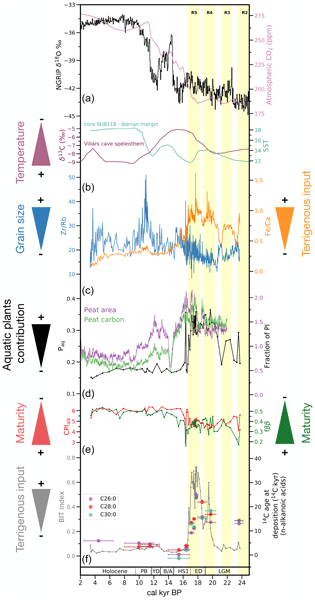
Eduardo Queiroz Alves, Wanyee Wong, Jens Hefter, Hendrik Grotheer, Tommaso Tesi, Torben Gentz, Karin Zonneveld, and Gesine Mollenhauer
Clim. Past, 20, 121–136, https://doi.org/10.5194/cp-20-121-2024, https://doi.org/10.5194/cp-20-121-2024, 2024
Short summary
Short summary
Our study reveals a previously unknown peat source for the massive influx of terrestrial organic matter that was exported from the European continent to the ocean during the last deglaciation. Our findings shed light on ancient terrestrial organic carbon mobilization, providing insights that are crucial for refining climate models.
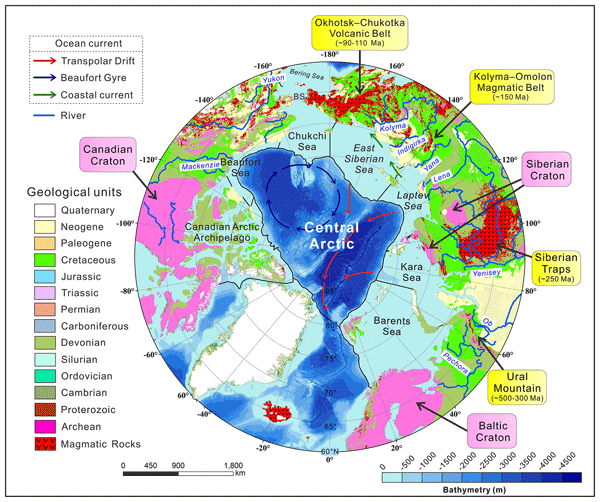
Zhengquan Yao, Han Feng, Ruediger Stein, Yanguang Liu, Xuefa Shi, Yuri Vasilenko, Seung-Il Nam, Linsen Dong, Fengdeng Shi, Kunshan Wang, Zhihua Chen, Shuqing Qiao, Qiuling Li, Song Zhao, Xinyue Pei, Huiyu Guo, and Yaru Liu
Earth Syst. Sci. Data, 18, 6649–6665, https://doi.org/10.5194/essd-18-6649-2026, https://doi.org/10.5194/essd-18-6649-2026, 2026
Short summary
Short summary
We present an open-access compilation of mineralogical and geochemical provenance data for surface sediments across the Arctic Ocean. The Circum-Arctic Sediment PROvenance Database (CASPROD) integrates four provenance proxies, including bulk sediment Sr–Nd isotopes, detrital zircon U–Pb ages, clay mineral assemblages, and detrital mineral compositions, from more than 4000 stations in the Arctic Ocean. All datasets are standardized with consistent metadata and are provided in multiple machine-readable formats.
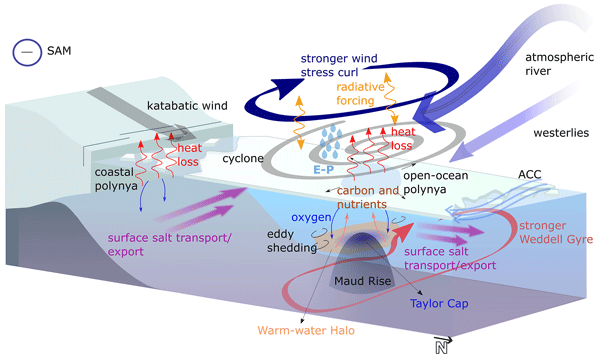
Lu Zhou, Holly Ayres, Birte Gülk, Aditya Narayanan, Casimir de Lavergne, Malin Ödalen, Alessandro Silvano, Xingchi Wang, Margaret Lindeman, and Nadine Steiger
The Cryosphere, 20, 285–308, https://doi.org/10.5194/tc-20-285-2026, https://doi.org/10.5194/tc-20-285-2026, 2026
Short summary
Short summary
Polynyas are large openings in polar sea ice that can influence global climate and ocean circulation. After disappearing for 40 years, major polynyas reappeared in the Weddell Sea in 2016 and 2017, sparking new scientific questions. Our review explores how ocean currents, atmospheric conditions, and deep ocean heat drive their formation. These polynyas impact ecosystems, carbon exchange, and deep water formation, but their future remains uncertain, requiring better observations and models.
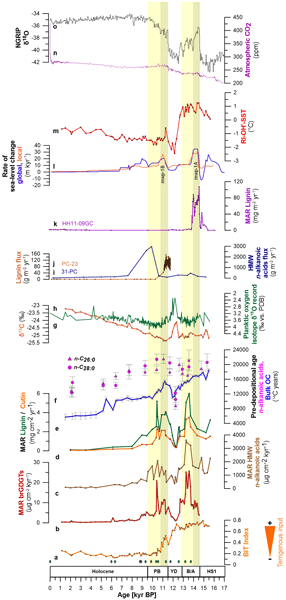
Arnaud Nicolas, Jens Hefter, Hendrik Grotheer, Tommaso Tesi, Ruediger Stein, Alessio Nogarotto, Eduardo Queiroz Alves, and Gesine Mollenhauer
Clim. Past, 21, 2579–2599, https://doi.org/10.5194/cp-21-2579-2025, https://doi.org/10.5194/cp-21-2579-2025, 2025
Short summary
Short summary
We analyzed a high-resolution marine sediment record from the Laptev Sea to reconstruct deglacial permafrost thaw events during the last 16 kyr. Using biomarkers and radiocarbon dating, we found that peaks in pre-aged terrigenous material coincided with rapid sea-level rise, indicating coastal erosion as the main mobilization mechanism. This research provides insights into past permafrost carbon release, informing predictions of future climate-permafrost feedback in a warming world.
Karl Purcell, Margit H. Simon, Ellie J. Pryor, Simon J. Armitage, H. J. L. van der Lubbe, and Eystein Jansen
Clim. Past, 21, 1383–1404, https://doi.org/10.5194/cp-21-1383-2025, https://doi.org/10.5194/cp-21-1383-2025, 2025
Short summary
Short summary
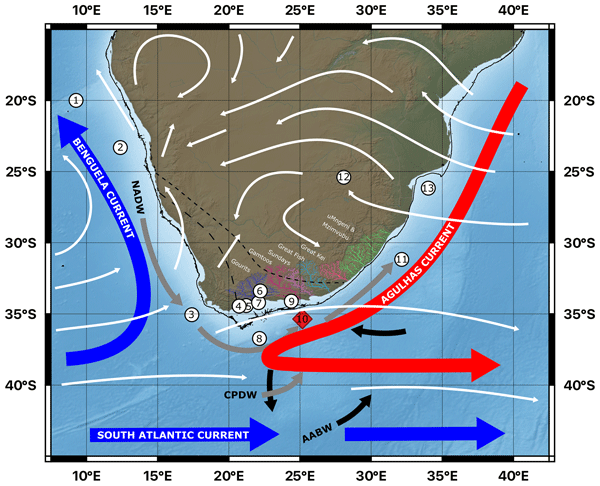
During the past 260 000 years, rains over southern South Africa underwent many fluctuations which could have affected the behaviour and innovations of humans living there. In this study we reconstruct the rainfall during this period in this area using X-ray analysis of a sediment core retrieved in the ocean south of South Africa. We confirmed that a 23 000-year cycle of the orbit of the Earth affected rainfall and that rainfall was higher around 117 000, 93 000 and 72 000 years ago.
Joanna Davies, Kirsten Fahl, Matthias Moros, Alice Carter-Champion, Henrieka Detlef, Ruediger Stein, Christof Pearce, and Marit-Solveig Seidenkrantz
The Cryosphere, 18, 3415–3431, https://doi.org/10.5194/tc-18-3415-2024, https://doi.org/10.5194/tc-18-3415-2024, 2024
Short summary
Short summary
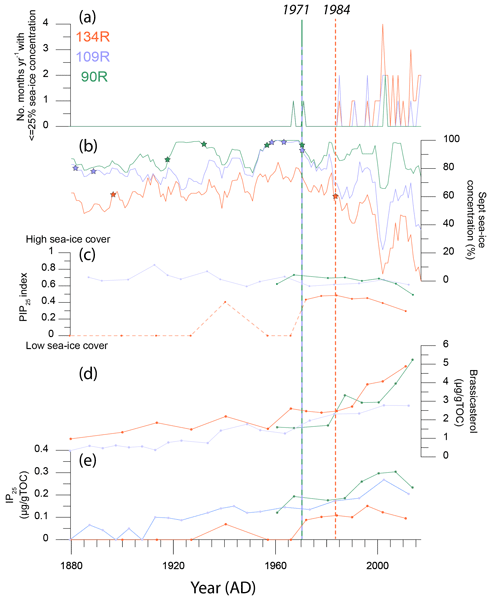
Here, we evaluate the use of biomarkers for reconstructing sea ice between 1880 and 2017 from three sediment cores located in a transect across the Northeast Greenland continental shelf. We find that key changes, specifically the decline in sea-ice cover identified in observational records between 1971 and 1984, align with our biomarker reconstructions. This outcome supports the use of biomarkers for longer reconstructions of sea-ice cover in this region.
Holly C. Ayres, David Ferreira, Wonsun Park, Joakim Kjellsson, and Malin Ödalen
Weather Clim. Dynam., 5, 805–820, https://doi.org/10.5194/wcd-5-805-2024, https://doi.org/10.5194/wcd-5-805-2024, 2024
Short summary
Short summary
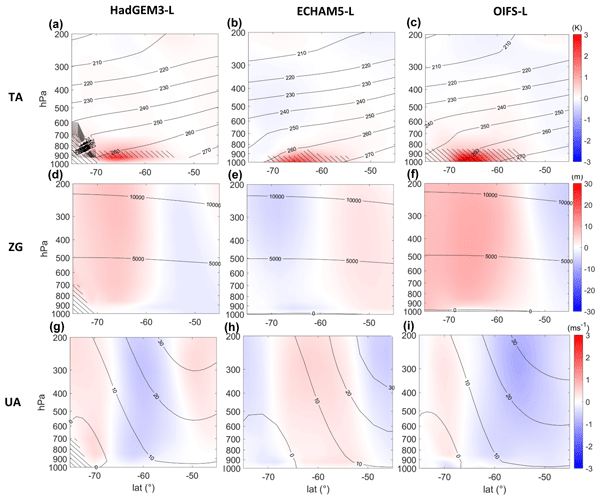
The Weddell Sea Polynya (WSP) is a large, closed-off opening in winter sea ice that has opened only a couple of times since we started using satellites to observe sea ice. The aim of this study is to determine the impact of the WSP on the atmosphere. We use three numerical models of the atmosphere, and for each, we use two levels of detail. We find that the WSP causes warming but only locally, alongside an increase in precipitation, and shows some dependence on the large-scale background winds.
Eduardo Queiroz Alves, Wanyee Wong, Jens Hefter, Hendrik Grotheer, Tommaso Tesi, Torben Gentz, Karin Zonneveld, and Gesine Mollenhauer
Clim. Past, 20, 121–136, https://doi.org/10.5194/cp-20-121-2024, https://doi.org/10.5194/cp-20-121-2024, 2024
Short summary
Short summary
Our study reveals a previously unknown peat source for the massive influx of terrestrial organic matter that was exported from the European continent to the ocean during the last deglaciation. Our findings shed light on ancient terrestrial organic carbon mobilization, providing insights that are crucial for refining climate models.
Bjørg Risebrobakken, Mari F. Jensen, Helene R. Langehaug, Tor Eldevik, Anne Britt Sandø, Camille Li, Andreas Born, Erin Louise McClymont, Ulrich Salzmann, and Stijn De Schepper
Clim. Past, 19, 1101–1123, https://doi.org/10.5194/cp-19-1101-2023, https://doi.org/10.5194/cp-19-1101-2023, 2023
Short summary
Short summary
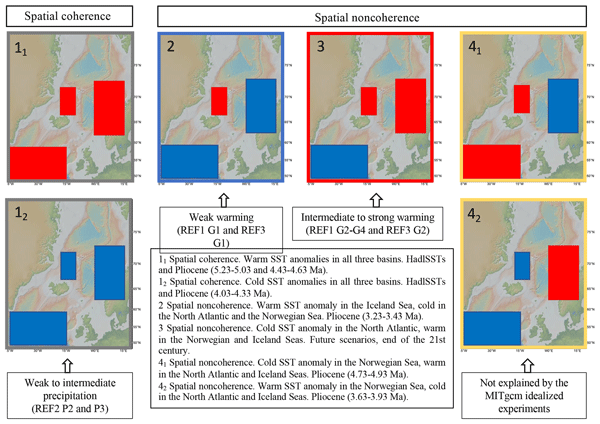
In the observational period, spatially coherent sea surface temperatures characterize the northern North Atlantic at multidecadal timescales. We show that spatially non-coherent temperature patterns are seen both in further projections and a past warm climate period with a CO2 level comparable to the future low-emission scenario. Buoyancy forcing is shown to be important for northern North Atlantic temperature patterns.
Claire Waelbroeck, Jerry Tjiputra, Chuncheng Guo, Kerim H. Nisancioglu, Eystein Jansen, Natalia Vázquez Riveiros, Samuel Toucanne, Frédérique Eynaud, Linda Rossignol, Fabien Dewilde, Elodie Marchès, Susana Lebreiro, and Silvia Nave
Clim. Past, 19, 901–913, https://doi.org/10.5194/cp-19-901-2023, https://doi.org/10.5194/cp-19-901-2023, 2023
Short summary
Short summary
The precise geometry and extent of Atlantic circulation changes that accompanied rapid climate changes of the last glacial period are still unknown. Here, we combine carbon isotopic records from 18 Atlantic sediment cores with numerical simulations and decompose the carbon isotopic change across a cold-to-warm transition into remineralization and circulation components. Our results show that the replacement of southern-sourced by northern-sourced water plays a dominant role below ~ 3000 m depth.
Cited articles
Alexeev, V. A., Walsh, J. E., Ivanov, V. V, Semenov, V. A., and Smirnov, A. V: Warming in the Nordic Seas, North Atlantic storms and thinning Arctic sea ice, Environ. Res.h Lett., 12, 084011, https://doi.org/10.1088/1748-9326/aa7a1d, 2017.
Andersen, K. K., Svensson, A., Johnsen, S. J., Rasmussen, S. O., Bigler, M., Röthlisberger, R., Ruth, U., Siggaard-Andersen, M. L., Peder Steffensen, J., Dahl-Jensen, D., Vinther, B. M., and Clausen, H. B.: The Greenland Ice Core Chronology 2005, 15-42 ka. Part 1: constructing the time scale, Quaternary Sci. Rev., 25, 3246–3257, https://doi.org/10.1016/j.quascirev.2006.08.002, 2006.
Årthun, M. and Eldevik, T.: On Anomalous Ocean Heat Transport toward the Arctic and Associated Climate Predictability, J. Climate, 29, 689–704, https://doi.org/10.1175/JCLI-D-15-0448.1, 2016.
Årthun, M., Eldevik, T., and Smedsrud, L. H.: The Role of Atlantic Heat Transport in Future Arctic Winter Sea Ice Loss, J. Climate, 32, 3327–3341, https://doi.org/10.1175/JCLI-D-18-0750.1, 2019.
Barker, S., Greaves, M., and Elderfield, H.: A study of cleaning procedures used for foraminiferal Mg
Beer, E., Eisenman, I., Wagner, T. J. W., and Fine, E. C.: A Possible Hysteresis in the Arctic Ocean due to Release of Subsurface Heat during Sea Ice Retreat, J. Phys. Oceanogr., 53, 1323–1335, https://doi.org/10.1175/JPO-D-22-0131.1, 2023.
Belt, S. T., Allard, W. G., Massé, G., Robert, J.-M., and Rowland, S. J.: Highly branched isoprenoids (HBIs): identification of the most common and abundant sedimentary isomers, Geochim. Cosmochim. Ac., 64, 3839–3851, https://doi.org/10.1016/S0016-7037(00)00464-6, 2000.
Belt, S. T., Massé, G., Rowland, S. J., Poulin, M., Michel, C., and LeBlanc, B.: A novel chemical fossil of palaeo sea ice: IP25, Org. Geochem., 38, 16–27, https://doi.org/10.1016/j.orggeochem.2006.09.013, 2007.
Bensi, M., Kovačević, V., Langone, L., Aliani, S., Ursella, L., Goszczko, I., Soltwedel, T., Skogseth, R., Nilsen, F., Deponte, D., Mansutti, P., Laterza, R., Rebesco, M., Rui, L., Lucchi, R. G., Wåhlin, A., Viola, A., Beszczynska-Möller, A., and Rubino, A.: Deep Flow Variability Offshore South-West Svalbard (Fram Strait), Water (Basel), 11, 683, https://doi.org/10.3390/w11040683, 2019.
Berben, S. M. P., Dokken, T. M., Abbott, P. M., Cook, E., Sadatzki, H., Simon, M. H., and Jansen, E.: Independent tephrochronological evidence for rapid and synchronous oceanic and atmospheric temperature rises over the Greenland stadial-interstadial transitions between ca. 32 and 40 ka b2k, Quaternarz Sci. Rev., 236, https://doi.org/10.1016/j.quascirev.2020.106277, 2020.
Blindheim, J. and Østerhus, S.: The Nordic seas, main oceanographic features, American Geophysical Union, 11–37, https://doi.org/10.1029/158GM03, 2005.
Boon, J. J., Rijpstra, W. I. C., De Lange, F., De Leeuw, J. W., Yoshioka, M., and Shimizu, Y.: Black Sea sterol – a molecular fossil for dinoflagellate blooms, Nature, 277, 125–127, https://doi.org/10.1038/277125a0, 1979.
Bosse, A., Fer, I., Søiland, H., and Rossby, T.: Atlantic Water Transformation Along Its Poleward Pathway Across the Nordic Seas, J. Geophys. Res.-Oceans, 123, 6428–6448, https://doi.org/10.1029/2018JC014147, 2018.
Boyle, E. A.: Cadmium, zinc, copper, and barium in foraminifera tests, Earth Planet. Sc. Lett., 53, 11–35, https://doi.org/10.1016/0012-821X(81)90022-4, 1981.
Boyle, E. A. and Keigwin, L. D.: Comparison of Atlantic and Pacific paleochemical records for the last 215,000 years: changes in deep ocean circulation and chemical inventories, Earth Planet. Sc. Lett., 76, 135–150, https://doi.org/10.1016/0012-821X(85)90154-2, 1985.
Bradtmiller, L. I., McManus, J. F., and Robinson, L. F.: 231Pa/230Th evidence for a weakened but persistent Atlantic meridional overturning circulation during Heinrich Stadial 1, Nat. Commun., 5, 5817, https://doi.org/10.1038/ncomms6817, 2014.
Bryden, H. L.: Wind-driven and buoyancy-driven circulation in the subtropical North Atlantic Ocean, Proceedings of the Royal Society A: Mathematical, Physical and Engineering Sciences, 477, https://doi.org/10.1098/rspa.2021.0172, 2021.
Buizert, C., Sowers, T. A., Niezgoda, K., Blunier, T., Gkinis, V., Harlan, M., He, C., Jones, T. R., Kjaer, H. A., Liisberg, J. B., Menking, J. A., Morris, V., Noone, D., Rasmussen, S. O., Sime, L. C., Steffensen, J. P., Svensson, A., Vaughn, B. H., Vinther, B. M., and White, J. W. C.: The Greenland spatial fingerprint of Dansgaard–Oeschger events in observations and models, P. Natl. Acad. Sci. USA, 121, https://doi.org/10.1073/pnas.2402637121, 2024.
Cuny, J., Rhines, P. B., Niiler, P. P., and Bacon, S.: Labrador Sea Boundary Currents and the Fate of the Irminger Sea Water, J. Phys. Oceanogr., 32, 627–647, https://doi.org/10.1175/1520-0485(2002)032<0627:LSBCAT>2.0.CO;2, 2002.
Dansgaard, W., Clausen, H. B., Gundestrup, N., Hammer, C. U., Johnsen, S. F., Kristinsdottir, P. M., and Reeh, N.: A New Greenland Deep Ice Core, Science, 218, https://doi.org/10.1126/science.218.4579.1273, 1982.
Day, J. J., Hargreaves, J. C., Annan, J. D., and Abe-Ouchi, A.: Sources of multi-decadal variability in Arctic sea ice extent, Environmental Research Letters, 7, 034011, https://doi.org/10.1088/1748-9326/7/3/034011, 2012.
Docquier, D. and Koenigk, T.: A review of interactions between ocean heat transport and Arctic sea ice, Environmental Research Letters, 16, 123002, https://doi.org/10.1088/1748-9326/ac30be, 2021.
Docquier, D., Vannitsem, S., Ragone, F., Wyser, K., and Liang, X. S.: Causal Links Between Arctic Sea Ice and Its Potential Drivers Based on the Rate of Information Transfer, Geophys Res Lett, 49, https://doi.org/10.1029/2021GL095892, 2022.
Dokken, T. M., Nisancioglu, K. H., Li, C., Battisti, D. S., and Kissel, C.: Dansgaard-Oeschger cycles: Interactions between ocean and sea ice intrinsic to the Nordic seas, Paleoceanography, 28, 491–502, https://doi.org/10.1002/palo.20042, 2013.
El bani Altuna, N., Ezat, M. M., Smik, L., Muschitiello, F., Belt, S. T., Knies, J., and Rasmussen, T. L.: Sea ice-ocean coupling during Heinrich Stadials in the Atlantic–Arctic gateway, Sci. Rep., 14, 1065, https://doi.org/10.1038/s41598-024-51532-7, 2024a.
El bani Altuna, N., Ezat, M. M., Smik, L., Muschitiello, F., Belt, S. T., Knies, J., and Rasmussen, T. L.: Supporting Data for: Sea-ice biomarker and sea-ice index data from core HH15-1252PC, V1, DataverseNO [data set], https://doi.org/10.18710/Z0ODIA, 2024b.
Elderfield, H. and Ganssen, G.: Past temperature and δ18O of surface ocean waters inferred from foraminiferal Mg
Ezat, M. M., Rasmussen, T. L., and Groeneveld, J.: Persistent intermediate water warming during cold stadials in the southeastern Nordic seas during the past 65 k.y., Geology, 42, 663–666, https://doi.org/10.1130/G35579.1, 2014.
Ezat, M. M., Rasmussen, T. L., and Groeneveld, J.: Reconstruction of hydrographic changes in the southern Norwegian Sea during the past 135 kyr and the impact of different foraminiferal Mg
Fahl, K. and Stein, R.: Modern seasonal variability and deglacial/Holocene change of central Arctic Ocean sea-ice cover: New insights from biomarker proxy records, Earth Planet. Sc. Lett., 351–352, 123–133, https://doi.org/10.1016/j.epsl.2012.07.009, 2012.
Fahrbach, E., Meincke, J., Østerhus, S., Rohardt, G., Schauer, U., Tverberg, V., Verduin, J., Fahrbach, E., Rohardt, G., Schauer, U., and Verduin, J.: Direct measurements of volume transports through Fram Strait, Polar Res., 20, 217–224, 2001.
Falk-Petersen, S., Pavlov, V., Berge, J., Cottier, F., Kovacs, K. M., and Lydersen, C.: At the rainbow's end: high productivity fueled by winter upwelling along an Arctic shelf, Polar Biol., 38, 5–11, https://doi.org/10.1007/s00300-014-1482-1, 2015.
Ferrari, R. and Wunsch, C.: Ocean Circulation Kinetic Energy: Reservoirs, Sources, and Sinks, Annu. Rev. Fluid Mech., 41, 253–282, https://doi.org/10.1146/annurev.fluid.40.111406.102139, 2009.
Fetterer, F., Knowles, K., Meier, W. N., Savoie, M., and Windnagel, A. K.: Sea Ice Index. (G02135, Version 3). Boulder, Colorado USA. National Snow and Ice Data Center [data set], https://doi.org/10.7265/N5K072F8, 2017.
Furevik, T.: Annual and interannual variability of Atlantic Water temperatures in the Norwegian and Barents Seas: 1980–1996, Deep-Sea Res. Pt. I, 48, 383–404, 2001.
Gordon, A. L.: Interocean exchange of thermocline water, J. Geophys. Res.-Oceans, 91, 5037–5046, https://doi.org/10.1029/JC091iC04p05037, 1986.
Govin, A., Braconnot, P., Capron, E., Cortijo, E., Duplessy, J.-C., Jansen, E., Labeyrie, L., Landais, A., Marti, O., Michel, E., Mosquet, E., Risebrobakken, B., Swingedouw, D., and Waelbroeck, C.: Persistent influence of ice sheet melting on high northern latitude climate during the early Last Interglacial, Clim. Past, 8, 483–507, https://doi.org/10.5194/cp-8-483-2012, 2012.
Greaves, M., Caillon, N., Rebaubier, H., Bartoli, G., Bohaty, S., Cacho, I., Clarke, L., Cooper, M., Daunt, C., Delaney, M., deMenocal, P., Dutton, A., Eggins, S., Elderfield, H., Garbe-Schoenberg, D., Goddard, E., Green, D., Groeneveld, J., Hastings, D., Hathorne, E., Kimoto, K., Klinkhammer, G., Labeyrie, L., Lea, D. W., Marchitto, T., Martínez-Botí, M. A., Mortyn, P. G., Ni, Y., Nuernberg, D., Paradis, G., Pena, L., Quinn, T., Rosenthal, Y., Russell, A., Sagawa, T., Sosdian, S., Stott, L., Tachikawa, K., Tappa, E., Thunell, R., and Wilson, P. A.: Interlaboratory comparison study of calibration standards for foraminiferal Mg
Hall, M. M. and Bryden, H. L.: Direct estimates and mechanisms of ocean heat transport, Deep-Sea Res., 29, 339–359, https://doi.org/10.1016/0198-0149(82)90099-1, 1982.
Hattermann, T., Isachsen, P. E., Von Appen, W. J., Albretsen, J., and Sundfjord, A.: Eddy-driven recirculation of Atlantic Water in Fram Strait, Geophys. Res. Lett., 43, 3406–3414, https://doi.org/10.1002/2016GL068323, 2016.
Henry, L. G., McManus, J. F., Curry, W. B., Roberts, N. L., Piotrowski, A. M., and Keigwin, L. D.: North Atlantic ocean circulation and abrupt climate change during the last glaciation, Science (1979), 353, https://doi.org/10.1126/science.aaf5529, 2016a.
Henry, L. G., McManus, J. F., Curry, W. B., Roberts, N. L., Piotrowski, A. M., and Keigwin, L. D.: Bermuda Rise High Resolution 60-25KYrBP Uranium Series Data, National Centers for Environmental Information [data set], https://doi.org/10.25921/97wv-5p13, 2016b.
Hoff, U., Rasmussen, T. L., Stein, R., Ezat, M. M., and Fahl, K.: Sea ice and millennial-scale climate variability in the Nordic seas 90 kyr ago to present, Nat. Commun., 7, https://doi.org/10.1038/ncomms12247, 2016.
Holliday, N. P., Meyer, A., Bacon, S., Alderson, S. G., and de Cuevas, B.: Retroflection of part of the east Greenland current at Cape Farewell, Geophys. Res. Lett., 34, https://doi.org/10.1029/2006GL029085, 2007.
Ingvaldsen, R. B.: Width of the North Cape Current and location of the Polar Front in the western Barents Sea, Geophys. Res. Lett., 32, https://doi.org/10.1029/2005GL023440, 2005.
Jansen, E., Christensen, J. H., Dokken, T., Nisancioglu, K. H., Vinther, B. M., Capron, E., Guo, C., Jensen, M. F., Langen, P. L., Pedersen, R. A., Yang, S., Bentsen, M., Kjær, H. A., Sadatzki, H., Sessford, E., and Stendel, M.: Past perspectives on the present era of abrupt Arctic climate change, Nat. Clim. Change, 10, 714–721, https://doi.org/10.1038/s41558-020-0860-7, 2020.
Jensen, M. F., Nummelin, A., Nielsen, S. B., Sadatzki, H., Sessford, E., Risebrobakken, B., Andersson, C., Voelker, A., Roberts, W. H. G., Pedro, J., and Born, A.: A spatiotemporal reconstruction of sea-surface temperatures in the North Atlantic during Dansgaard–Oeschger events 5–8, Clim. Past, 14, 901–922, https://doi.org/10.5194/cp-14-901-2018, 2018.
Jones, C. S., Jiang, S., and Abernathey, R. P.: A Comparison of Diagnostics for AMOC Heat Transport Applied to the CESM Large Ensemble, J. Adv. Model. Earth Sy., 16, https://doi.org/10.1029/2023MS003978, 2024.
Kindler, P., Guillevic, M., Baumgartner, M., Schwander, J., Landais, A., and Leuenberger, M.: Temperature reconstruction from 10 to 120 kyr b2k from the NGRIP ice core, Clim. Past, 10, 887–902, https://doi.org/10.5194/cp-10-887-2014, 2014.
Kissel, C., Laj, C., Labeyrie, L., Dokken, T., Voelker, A., and Blamart, D.: Rapid climatic variations during marine isotopic stage 3: Magnetic analysis of sediments from Nordic Seas and North Atlantic, Earth Planet Sci Lett, 171, 489–502, https://doi.org/10.1016/S0012-821X(99)00162-4, 1999.
Kolling, H. M., Stein, R., Fahl, K., Sadatzki, H., de Vernal, A., and Xiao, X.: Biomarker Distributions in (Sub)-Arctic Surface Sediments and Their Potential for Sea Ice Reconstructions, Geochem. Geophy. Geosy., 21, https://doi.org/10.1029/2019GC008629, 2020.
Köseoğlu, D., Belt, S. T., Husum, K., and Knies, J.: An assessment of biomarker-based multivariate classification methods versus the PIP25 index for paleo Arctic sea ice reconstruction, Org. Geochem., 125, 82–94, https://doi.org/10.1016/j.orggeochem.2018.08.014, 2018.
Larson, S. M., Buckley, M. W., and Clement, A. C.: Extracting the Buoyancy-Driven Atlantic Meridional Overturning Circulation, J. Climate, 33, 4697–4714, https://doi.org/10.1175/JCLI-D-19-0590.1, 2020.
Li, C. and Born, A.: Coupled atmosphere-ice-ocean dynamics in Dansgaard-Oeschger events, Quaternary Sci. Rev., 203, 1–20, https://doi.org/10.1016/j.quascirev.2018.10.031, 2019.
Liang, X. and Losch, M.: On the Effects of Increased Vertical Mixing on the Arctic Ocean and Sea Ice, J. Geophys. Res.-Oceans, 123, 9266–9282, https://doi.org/10.1029/2018JC014303, 2018.
Lind, S., Ingvaldsen, R. B., and Furevik, T.: Arctic layer salinity controls heat loss from deep Atlantic layer in seasonally ice-covered areas of the Barents Sea, Geophys. Res. Lett., 43, 5233–5242, https://doi.org/10.1002/2016GL068421, 2016.
Liu, W., Xie, S.-P., Liu, Z., and Zhu, J.: Overlooked possibility of a collapsed Atlantic Meridional Overturning Circulation in warming climate, Sci. Adv., 3, https://doi.org/10.1126/sciadv.1601666, 2017.
Lozier, M. S., Li, F., Bacon, S., Bahr, F., Bower, A. S., Cunningham, S. A., de Jong, M. F., de Steur, L., deYoung, B., Fischer, J., Gary, S. F., Greenan, B. J. W., Holliday, N. P., Houk, A., Houpert, L., Inall, M. E., Johns, W. E., Johnson, H. L., Johnson, C., Karstensen, J., Koman, G., Le Bras, I. A., Lin, X., Mackay, N., Marshall, D. P., Mercier, H., Oltmanns, M., Pickart, R. S., Ramsey, A. L., Rayner, D., Straneo, F., Thierry, V., Torres, D. J., Williams, R. G., Wilson, C., Yang, J., Yashayaev, I., and Zhao, J.: A sea change in our view of overturning in the subpolar North Atlantic, Science (1979), 363, 516–521, https://doi.org/10.1126/science.aau6592, 2019.
Mahajan, S., Zhang, R., and Delworth, T. L.: Impact of the Atlantic Meridional Overturning Circulation (AMOC) on Arctic Surface Air Temperature and Sea Ice Variability, J. Climate, 24, 6573–6581, https://doi.org/10.1175/2011JCLI4002.1, 2011.
Mandal, G., Hettiarachchi, A. I., and Ekka, S. V.: The North Atlantic subpolar ocean dynamics during the past 21,000 years, Dynam. Atmos. Oceans, 106, 101462, https://doi.org/10.1016/j.dynatmoce.2024.101462, 2024.
Martin, P. A. and Lea, D. W.: A simple evaluation of cleaning procedures on fossil benthic foraminiferal Mg
Missiaen, L., Bouttes, N., Roche, D. M., Dutay, J.-C., Quiquet, A., Waelbroeck, C., Pichat, S., and Peterschmitt, J.-Y.: Carbon isotopes and Pa
Mogensen, I. A.: Dansgaard-Oeschger Cycles, in: Encyclopedia of Paleoclimatology and Ancient Environments, Springer Netherlands, Dordrecht, 229–233, https://doi.org/10.1007/978-1-4020-4411-3_55, 2009.
Morley, A., de la Vega, E., Raitzsch, M., Bijma, J., Ninnemann, U., Foster, G. L., Chalk, T. B., Meilland, J., Cave, R. R., Büscher, J. V., and Kucera, M.: A solution for constraining past marine Polar Amplification, Nat. Commun., 15, 9002, https://doi.org/10.1038/s41467-024-53424-w, 2024.
Müller, J., Wagner, A., Fahl, K., Stein, R., Prange, M., and Lohmann, G.: Towards quantitative sea ice reconstructions in the northern North Atlantic: A combined biomarker and numerical modelling approach, Earth Planet. Sc. Lett., 306, 137–148, https://doi.org/10.1016/j.epsl.2011.04.011, 2011.
Nguyen, A. T., Menemenlis, D., and Kwok, R.: Improved modeling of the Arctic halocline with a subgrid-scale brine rejection parameterization, J. Geophys. Res.-Oceans, 114, https://doi.org/10.1029/2008JC005121, 2009.
North Greenland Ice Core Project members: High-resolution record of Northern Hemisphere climate extending into the last interglacial period, Nature, 431, 147–151, https://doi.org/10.1038/nature02805, 2004.
Orvik, K. A. and Niiler, P.: Major pathways of Atlantic water in the northern North Atlantic and Nordic Seas toward Arctic, Geophys. Res. Lett., 29, https://doi.org/10.1029/2002GL015002, 2002.
Pedro, J. B., Andersson, C., Vettoretti, G., Voelker, A. H. L., Waelbroeck, C., Dokken, T. M., Jensen, M. F., Rasmussen, S. O., Sessford, E. G., Jochum, M., and Nisancioglu, K. H.: Dansgaard-Oeschger and Heinrich event temperature anomalies in the North Atlantic set by sea ice, frontal position and thermocline structure, Quatrnary Sci. Rev., 289, https://doi.org/10.1016/j.quascirev.2022.107599, 2022.
Petit, T., Lozier, M. S., Josey, S. A., and Cunningham, S. A.: Role of air–sea fluxes and ocean surface density in the production of deep waters in the eastern subpolar gyre of the North Atlantic, Ocean Sci., 17, 1353–1365, https://doi.org/10.5194/os-17-1353-2021, 2021.
Polyakov, I. V., Pnyushkov, A. V., Alkire, M. B., Ashik, I. M., Baumann, T. M., Carmack, E. C., Goszczko, I., Guthrie, J., Ivanov, V. V., Kanzow, T., Krishfield, R., Kwok, R., Sundfjord, A., Morison, J., Rember, R., and Yulin, A.: Greater role for Atlantic inflows on sea-ice loss in the Eurasian Basin of the Arctic Ocean, Science (1979), 356, 285–291, https://doi.org/10.1126/science.aai8204, 2017.
Poulain, P. M., Warn-Varnas, A., and Niiler, P. P.: Near-surface circulation of the Nordic seas as measured by Lagrangian drifters, J. Geophys. Res.-Oceans, 101, 18237–18258, https://doi.org/10.1029/96JC00506, 1996.
Rasmussen, S. O., Bigler, M., Blockley, S. P., Blunier, T., Buchardt, S. L., Clausen, H. B., Cvijanovic, I., Dahl-Jensen, D., Johnsen, S. J., Fischer, H., Gkinis, V., Guillevic, M., Hoek, W. Z., Lowe, J. J., Pedro, J. B., Popp, T., Seierstad, I. K., Steffensen, J. P., Svensson, A. M., Vallelonga, P., Vinther, B. M., Walker, M. J. C., Wheatley, J. J., and Winstrup, M.: A stratigraphic framework for abrupt climatic changes during the Last Glacial period based on three synchronized Greenland ice-core records: Refining and extending the INTIMATE event stratigraphy, Quaternary Sci. Rev., 106, 14–28, https://doi.org/10.1016/j.quascirev.2014.09.007, 2014.
Rasmussen, T. L. and Thomsen, E.: The role of the North Atlantic Drift in the millennial timescale glacial climate fluctuations, Palaeogeogr. Palaeocl., 210, 101–116, https://doi.org/10.1016/j.palaeo.2004.04.005, 2004.
Rhein, M., Kieke, D., Hüttl-Kabus, S., Roessler, A., Mertens, C., Meissner, R., Klein, B., Böning, C. W., and Yashayaev, I.: Deep water formation, the subpolar gyre, and the meridional overturning circulation in the subpolar North Atlantic, Deep-Sea Res. Pt. II, 58, 1819–1832, https://doi.org/10.1016/j.dsr2.2010.10.061, 2011.
Rheinlænder, J. W., Smedsrud, L. H., and Nisanciouglu, K. H.: Internal Ocean Dynamics Control the Long-Term Evolution of Weddell Sea Polynya Activity, Frontiers in Climate, 3, https://doi.org/10.3389/fclim.2021.718016, 2021.
Robinson, L. F., Henderson, G. M., Ng, H. C., and McManus, J. F.: Pa
Sadatzki, H., Dokken, T., Berben, S. M. P., Muschitiello, F., Stein, R., Fahl, K., Menviel, L., Timmermann, A., and Jansen, E.: Multiproxy sedimentary records from core MD99-2284 and LOVECLIM model simulations in the southern Norwegian Sea, 32–40 ka, PANGAEA [data set], https://doi.org/10.1594/PANGAEA.894970, 2018.
Sadatzki, H., Dokken, T. M., Berben, S. M. P., Muschitiello, F., Stein, R., Fahl, K., Menviel, L., Timmermann, A., and Jansen, E.: Sea ice variability in the southern Norwegian Sea during glacial Dansgaard-Oeschger climate cycles, Sci. Adv., 5, https://doi.org/10.1126/sciadv.aau6174, 2019.
Sadatzki, H., Maffezzoli, N., Dokken, T. M., Simon, M. H., Berben, S. M. P., Fahl, K., Kjær, H. A., Spolaor, A., Stein, R., Vallelonga, P., Vinther, B. M., and Jansen, E.: Rapid reductions and millennial-scale variability in Nordic Seas sea ice cover during abrupt glacial climate changes, P. Natl. Acad. Sci. USA, 117, 29478–29486, https://doi.org/10.1073/pnas.2005849117, 2020.
Saenz, B. T., McKee, D. C., Doney, S. C., Martinson, D. G., and Stammerjohn, S. E.: Influence of seasonally varying sea-ice concentration and subsurface ocean heat on sea-ice thickness and sea-ice seasonality for a “warm-shelf” region in Antarctica, J. Glaciol., 69, 1466–1482, https://doi.org/10.1017/jog.2023.36, 2023.
Schlichtholz, P.: Influence of oceanic heat variability on sea ice anomalies in the Nordic Seas, Geophys. Res. Lett., 38, https://doi.org/10.1029/2010GL045894, 2011.
Schlitzer, R.: Ocean Data View, 2025, https://odv.awi.de/, last access: 10 July 2025.
Scoto, F., Sadatzki, H., Maffezzoli, N., Barbante, C., Gagliardi, A., Varin, C., Vallelonga, P., Gkinis, V., Dahl-Jensen, D., Kjær, H. A., Burgay, F., Saiz-Lopez, A., Stein, R., and Spolaor, A.: Sea ice fluctuations in the Baffin Bay and the Labrador Sea during glacial abrupt climate changes, P. Natl. Acad. Sci. USA, 119, https://doi.org/10.1073/pnas.2203468119, 2022.
Seierstad, I. K., Abbott, P. M., Bigler, M., Blunier, T., Bourne, A. J., Brook, E., Buchardt, S. L., Buizert, C., Clausen, H. B., Cook, E., Dahl-Jensen, D., Davies, S. M., Guillevic, M., Johnsen, S. J., Pedersen, D. S., Popp, T. J., Rasmussen, S. O., Severinghaus, J. P., Svensson, A., and Vinther, B. M.: Consistently dated records from the Greenland GRIP, GISP2 and NGRIP ice cores for the past 104 ka reveal regional millennial-scale δ18O gradients with possible Heinrich event imprint, Quaternary Sci. Rev., 106, 29–46, https://doi.org/10.1016/j.quascirev.2014.10.032, 2014.
Sessford, E. G., Jensen, M. F., Tisserand, A. A., Muschitiello, F., Dokken, T., Nisancioglu, K. H., and Jansen, E.: Consistent fluctuations in intermediate water temperature off the coast of Greenland and Norway during Dansgaard-Oeschger events, Quaternary Sci. Rev., 223, https://doi.org/10.1016/j.quascirev.2019.105887, 2019.
Smedsrud, L. H., Muilwijk, M., Brakstad, A., Madonna, E., Lauvset, S. K., Spensberger, C., Born, A., Eldevik, T., Drange, H., Jeansson, E., Li, C., Olsen, A., Skagseth, Ø., Slater, D. A., Straneo, F., Våge, K., and Årthun, M.: Nordic Seas Heat Loss, Atlantic Inflow, and Arctic Sea Ice Cover Over the Last Century, Rev. Geophys., 60, e2020RG000725, https://doi.org/10.1029/2020RG000725, 2022.
Stein, R., Fahl, K., Gierz, P., Niessen, F., and Lohmann, G.: Arctic Ocean sea ice cover during the penultimate glacial and the last interglacial, Nat. Commun., 8, https://doi.org/10.1038/s41467-017-00552-1, 2017.
Sun, J., Latif, M., and Park, W.: Subpolar Gyre – AMOC – Atmosphere Interactions on Multidecadal Timescales in a Version of the Kiel Climate Model, J. Climate, 34, 1–56, https://doi.org/10.1175/JCLI-D-20-0725.1, 2021.
van der Linden, E. C., Le Bars, D., Bintanja, R., and Hazeleger, W.: Oceanic heat transport into the Arctic under high and low CO2 forcing, Clim. Dynam., 53, 4763–4780, https://doi.org/10.1007/s00382-019-04824-y, 2019.
Volkman, J. K.: A review of sterol markers for marine and terrigenous organic matter, Org. Geochem., 9, 83–99, https://doi.org/10.1016/0146-6380(86)90089-6, 1986.
Wong, W., Risebrobakken, B., Ödalen, M., Tisserand, A., Fahl, K., Stein, R., and Jansen, E.: Biomarker results from the eastern Fram Strait between 40 and 33.5 ka b2k, PANGAEA [data set], https://doi.org/10.1594/PANGAEA.980706, 2025a.
Wong, W., Risebrobakken, B., Ödalen, M., Tisserand, A., Fahl, K., Stein, R., and Jansen, E.: Planktonic foraminiferal Mg
Wong, W., Risebrobakken, B., Fahl, K., Stein, R., Jansen, E., Steinsland, K., and Kissel, C.: Sea ice in the Nordic Seas: Greenland stadial to interstadial changes, Quaternarz Sci. Rev., 343, 108916, https://doi.org/10.1016/j.quascirev.2024.108916, 2024.
Xiao, X., Fahl, K., Müller, J., and Stein, R.: Sea-ice distribution in the modern Arctic Ocean: Biomarker records from trans-Arctic Ocean surface sediments, Geochim. Cosmochim. Ac., 155, 16–29, https://doi.org/10.1016/J.GCA.2015.01.029, 2015.
Yu, J., Anderson, R. F., Jin, Z. D., Ji, X., Thornalley, D. J. R., Wu, L., Thouveny, N., Cai, Y., Tan, L., Zhang, F., Menviel, L., Tian, J., Xie, X., Rohling, E. J., and McManus, J. F.: Millennial atmospheric CO2 changes linked to ocean ventilation modes over past 150,000 years, Nat. Geosci., 16, 1166–1173, https://doi.org/10.1038/s41561-023-01297-x, 2023.
Zhang, S., Wu, L., Arnqvist, J., Hallgren, C., and Rutgersson, A.: Mapping coastal upwelling in the Baltic Sea from 2002 to 2020 using remote sensing data, Int. J. Appl. Earth Obs., 114, 103061, https://doi.org/10.1016/j.jag.2022.103061, 2022.
Short summary
Sea ice variability in the eastern Fram Strait between, and within, individual Greenland Stadials and Interstadials is documented by high-resolution proxy reconstructions. Unlike the southeastern Nordic Seas and North Atlantic, these changes were less linked to Greenland climate oscillations. Instead, they were driven by ocean heat transport, regulated by the interplay between the Atlantic Meridional Overturning Circulation strength and sea ice cover in the southeastern Nordic Seas.
Sea ice variability in the eastern Fram Strait between, and within, individual Greenland...


