
the Creative Commons Attribution 4.0 License.
the Creative Commons Attribution 4.0 License.
 | 20 Nov 2026
Exploring the Cenozoic Earth system with extraterrestrial 3He

Frank J. Pavia
Jennifer L. Middleton
Gisela Winckler
A key method for contextualizing climate today and into the future is to draw upon the past. Marine sediments accumulating at the bottom of the ocean serve as the only continuous archive of Earth's climate history spanning tens of millions of years. From the earliest studies of marine sediments, reconstructed changes in the inputs of sedimentary constituents such as volcanic glass, ice-rafted debris, particulates carried by rivers, desert dust, organic and inorganic remnants of organisms and biological processes, and even extraterrestrial material, have been used to discern past environmental conditions. Specifically, it is the rate at which these different components of sediments from the bottom of the ocean accrue over time that can provide unique and important insight into how Earth system dynamics operated in the near and distant past. Traditional techniques for quantifying sediment mass accumulation rates (MARs) contain numerous complexities that can lead to erroneous MAR determinations. Constant flux proxies (CFPs), particularly extraterrestrial 3He (3HeET) delivered in interplanetary dust particles from space, are underutilized geochemical tools that alleviate these issues as long as key assumptions can be constrained. In this perspective, we review 3HeET as a CFP and outline its benefit for understanding Cenozoic climate beyond the Quaternary. Ultimately, we suggest that the application of 3HeET is valuable for providing the broader paleoclimate and paleoceanography communities with accurate records of Cenozoic Earth system change from a MAR perspective.
- Article
(3257 KB) - Full-text XML
- BibTeX
- EndNote


A variety of archives contain crucial information about the paleo-Earth System. However, many of these, such as tree rings (e.g., Anchukaitis, 2017) and ice cores (e.g., Brook and Buizert, 2018; Jouzel and Masson-Delmotte, 2010), are primarily restricted to the last ∼ 1 million years (Myr). Additionally, while the application of new dating methods has allowed for the use of speleothems (e.g., Harmon et al., 2004; McDermott, 2004; White, 2007; Wong and Breecker, 2015) and corals (e.g., Felis and Pätzold, 2003; Kiessling, 2001; Lough, 2010; Thompson, 2022) as paleoclimate indicators within and beyond this shorter timescale, these archives are spatially limited and typically only cover relatively short intervals of time. Terrestrial deposits such as accumulations of loess or extensive lacustrine deposits can provide information spanning several million years (Bird et al., 2020; Caves Rugenstein and Chamberlain, 2018; Cohen et al., 2022; Ding et al., 2002; Guo et al., 2002; Maher, 2016; Williams et al., 1997), but are susceptible to hiatuses, usually have low resolution chronologies, and, like older corals and speleothems, are spatially limited. High resolution archives that are also temporally expansive are integral for understanding the modern Earth system, not least because several warm intervals of the Cenozoic (∼ 66 million years ago (Ma) to present), such as the mid-Piacenzian Warm Period (mPWP; ∼ 3.3–3.0 Ma), mid-Miocene Climatic Optimum (MMCO; ∼ 17–15 Ma), and Paleocene-Eocene Thermal Maximum (PETM; ∼ 56 Ma) are relevant for future, rapid climate change (Burke et al., 2018; Tierney et al., 2020).
Marine sediments, while not devoid of complications (one of which is the focus of this perspective), offer several solutions to the disadvantages mentioned above. Owing to a plethora of national and international coring efforts across the last several decades (Becker et al., 2019; Normile and Kerr, 2003; Ocean Sciences Board, 2011; Robinson et al., 2024; Smith et al., 2010) marine sediments from a wide swath of every major ocean basin are available. By combining these extensive coring programs with comprehensive and robust stratigraphic work, and accounting for the nature of sedimentation processes in the ocean, recovered marine sediments constitute (mostly) continuous archives of paleoenvironmental change (Becker, 2014). The temporal coverage of these records depends on location-specific rates of accumulation, but can span up to tens-of-millions of years. For shorter cores, or longer cores from regions characterized by rapidly accumulating sediments, material collected typically only encompasses portions of the Quaternary (∼ 2.6 Ma to present) or short windows of time within older intervals. However, the resolution of these cores, in conjunction with ever-improving analytical techniques, can provide insight into seasonal and inter-annual processes, thus overlapping with observational records and data from other archives. Taken together, marine sediments are likely the only archive that can offer information at high resolution about the Earth System across the Cenozoic from a global perspective.
There are numerous organic and inorganic materials found within sediments at the bottom of the ocean that can provide insights into the larger Earth System. These include (but are not strictly limited to) (i) fossils, biominerals, and organic matter related to organisms living within the water column and in the sediments, (ii) terrigenous material from land transported via rivers or wind, (iii) volcanic detritus, (iv) authigenic mineral precipitates, (v), hydrothermal inputs, and (vi) material from space (Li and Schoonmaker, 2003). Quantitative assessments of how certain sediment constituents vary through time can offer crucial knowledge regarding past changes in terrestrial environments (e.g., Crocker et al., 2022), atmospheric and ocean circulation (e.g., Adkins, 2013; Frank, 2002; Rea, 1994), ocean chemistry and biology (e.g., Ravizza and Zachos, 2003), and nutrient cycling (e.g., Deutsch and Weber, 2012; Tagliabue et al., 2017), among others. Specifically, it is the accumulation rate of certain sediment constituents that can offer valuable insight into the characteristics of Earth's atmosphere, oceans, and landscapes in the past.
An inherent property of marine sediments that contain multiple constituents is that, unless the input rate (i.e., mass accumulation rate, MAR) of each can be independently determined, it is difficult to know if changes observed in the concentration of a specific component are driven by shifts in its own input, or that of another component. The latter scenario is referred to as “dilution” and is one major issue of solely relying on concentrations to develop records of past changes in the Earth System (Anderson and Winckler, 2005; Bacon, 1984; Tyson, 2001). As such, our ability to develop reliable interpretations of the paleo-Earth system using sediment components such as dust (e.g., Rea, 1994), organic matter and its by-products (e.g., Schoepfer et al., 2015), and extraterrestrial material (e.g., Farley, 1995), relies on accurate quantification of the MARs of these constituents.
While reconstructing sediment MARs is a promising and widely used approach for evaluating past climates, there are important caveats that need to be considered if we are to push the boundaries of our paleoclimate knowledge. A key concern is whether the sediment MARs we use actually reflect the MARs we need to answer our specific question. The primary reasons why the answer to this query might be “no” are associated with (1) the resolution at which we can determine sediment fluxes and (2) horizontal movement of sediment at the bottom of the ocean. The latter process can prove particularly troublesome because in many cases Earth scientists need to know the MAR of material that is raining from above, and not what is being gained or lost via lateral sediment transport in the deep ocean. If those working with marine sediments cannot be confident that they are using a sediment MAR that fits their need, then a question arises. Can we trust our interpretations, at least those based upon MARs, of what marine archives say about ocean-atmosphere-landscape conditions, both today and in the past?
The most widely used method of calculating marine sediment MARs uses linear sedimentation rates (LSRs), which are derived from a record's age model. While the depth-age tie-points constituting the age model are independently determined, the calculated LSRs can be influenced by both resolution limitations and horizontal sediment transport. Over the last several decades, new approaches have been developed to address these complications. Termed “constant flux proxies” (CFPs), these geochemical tools have provided key insights into how the Earth system behaved in the past that would have otherwise remained elusive using the traditional sediment MAR method (Costa et al., 2020; McGee and Mukhopadhyay, 2013). The two primary CFPs used for marine sediment flux studies are thorium-230 (230Th) and extraterrestrial helium-3 (3HeET). While the former has been much more widely applied, the 75 584 ± 110-year half-life of 230Th (Cheng et al., 2013) limits its applicability to the last ∼ 400–500 kyr (thousand years = kyr). 3HeET, as a stable isotope, is thus the only CFP that can provide insight into marine sediment MARs (and thus the Earth system from a MAR perspective) beyond the late Quaternary. This makes 3HeET the only reliable method for confidently reconstructing past changes in the MAR of all components of marine sediments on these timescales unless (i) a marine sediment record has an age model constrained at a similar resolution to the timescales being studied, and (ii) horizontal sediment redistribution by ocean bottom currents can be ruled out.
Building on an earlier, foundational review by McGee and Mukhopadhyay (2013), here we provide an updated, comprehensive perspective on 3HeET as a CFP and its utility to the paleoclimate community. Specifically, we:
-
Present a detailed background on the age model-based method for determining MARs of marine sediments and the caveats associated with this approach.
-
Describe CFPs and their utility, with a specific focus on 3HeET.
-
Emphasize the importance of using the CFP 3HeET to study past changes in climate using marine sediment archives and highlight two examples: one from the Pliocene North Pacific and the other from the early Cenozoic Southern Ocean.
-
Lay out important remaining uncertainties related to the application of 3HeET in marine sediments, and detail future work to address these issues.
Overall, we aim to provide a compelling argument for Earth scientists to more fully utilize 3HeET to produce accurate fluxes of materials found within marine sediments to study the Cenozoic.
The most commonly used approach for the determination of MARs of bulk marine sediment (and in turn any sediment component) is only reliant on knowing the ages (tn and tn−1) of two depth horizons (zn and zn−1), where n refers to a given horizon with a known depth and age, and sediment dry bulk density (DBD; typically in g cm−3) between these depth horizons. To start, LSRs (typically in cm kyr−1) are calculated via:
Subsequently, the LSR can be converted into a MAR (typically in units of g cm−2 kyr−1) using the sediment DBD with the equation:
We hereafter refer to any MAR derived using the age model as “bulk” MARs (bMARs). As this method was increasingly embraced, key problems related to this approach were identified, and a potential solution provided (Bacon, 1984).
Specifically, two prominent issues plague bMARs. The first is the dependence on an age model itself to calculate bMARs. Because quantifying temporal changes in sediment bMARs is reliant on the resolution of the age model, and changes in bMARs can occur between age model tie points (regardless of age model resolution), fluxes of constituents based on the identified depth-age horizons contain inherent uncertainty and could ultimately prove inaccurate (Fig. 1) (Francois et al., 2004). In addition to missing changes in sedimentation rates between tie-points, gaps in sediment accumulation may also go unaccounted for using the age model-based approach, again biasing these interpolated bMARs (Dott, 1983; Sadler, 1981, 1999). For cores with high resolution age models, these issues become less relevant. However, many cores, particularly those that cover longer time intervals, tend to rely on dating methods that produce tie points with hundreds of thousands to millions of years between them (e.g., magnetostratigraphy and biostratigraphy).
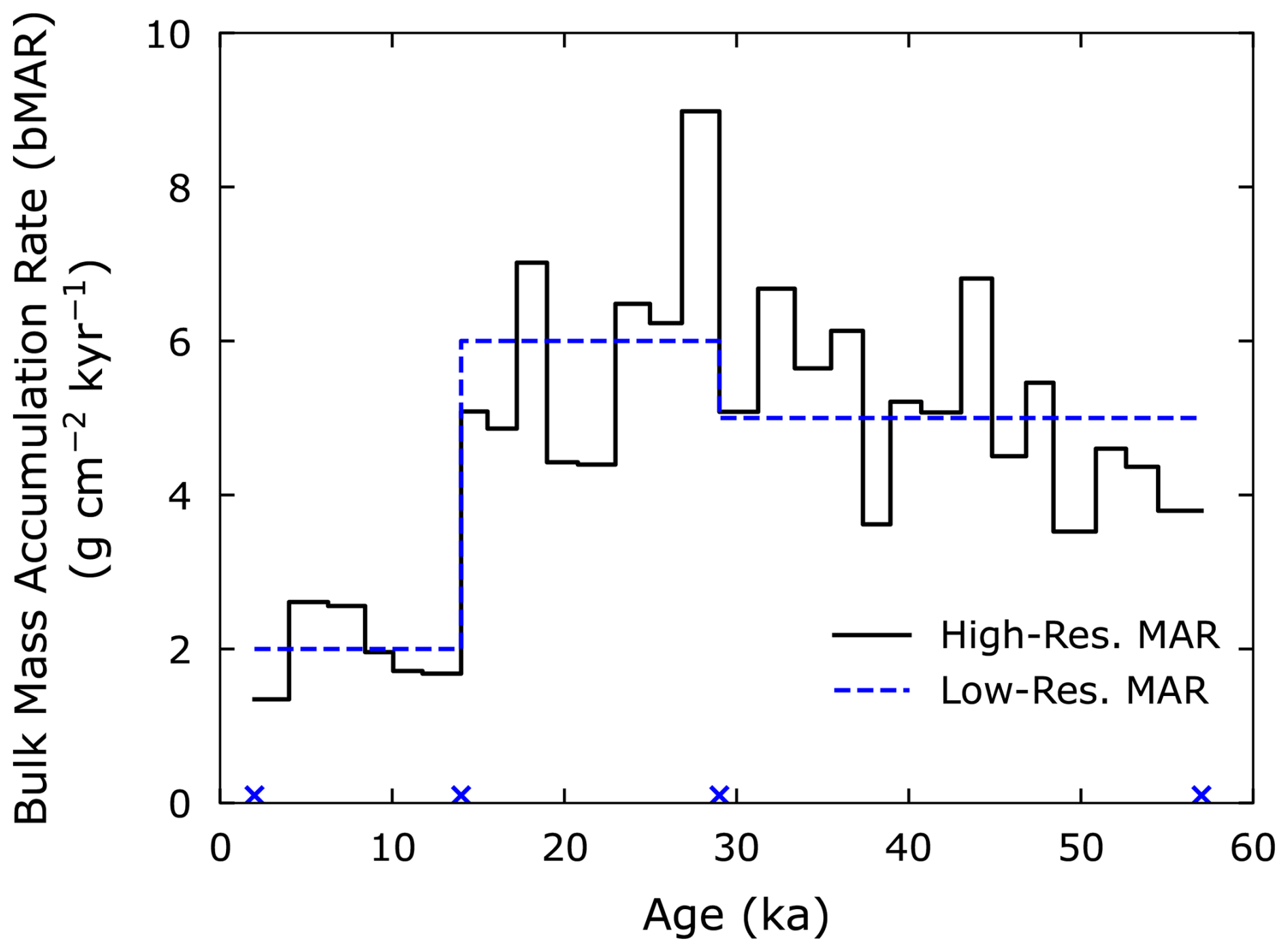
Figure 1Idealized representation of bMAR dependence on the resolution of the available age model. The two lines are separate determinations of bMAR over the last ∼ 60 kyr for a hypothetical marine sediment core using two age models of different resolutions. The blue crosses denote four tie-points for the original, low-resolution age model, and the blue dashed line is the sediment bMAR based on this lower-resolution age model. The black line represents the sediment bMAR calculated using a higher resolution age model produced after the original. Note the substantial changes in bMARs that go unrecognized with the lower-resolution age model, while still producing the same overall average bMAR for the wider interval. DBD was assumed to be constant for the entire core.
A second process that leads to uncertainties in age model-derived bMARs is the net movement of sediment laterally via ocean currents during or after deposition at the seafloor (Dubois and Mitchell, 2012; Frank et al., 1999; Johnson and Johnson, 1970; Watkins and Kennett, 1977). This horizontal sediment redistribution can result in net material transport to a site (focusing) or net transport away from a site (winnowing). In many applications, the age model-derived bMARs are assumed to reflect the rate of material transported vertically downwards to the site (vMAR). However, syndepositional lateral sediment advection can complicate records relying on age model-derived bMARs, such that bMARs diverge from vMARs. Ignoring for a moment these potential discrepancies between bMARs and vMARs, the MARs of specific sediment constituents (MARX) are determined from bMARs via:
where bMARX is the MAR of sediment component X based on the age model-derived bMAR and [X] is the fraction of component X in the sediment sample.
An additional uncertainty arises for bMARX when using age model-derived sediment bMARs because any perceived variability in bMARX between age model tie-points will be driven solely by changes in the concentration of X. Put another way, combining high-resolution concentration data with lower-resolution bMARs is not equivalent to high resolution bMARX. In fact, the potential impacts of dilution by different sediment components become relevant again for this scenario.
CFPs are invaluable for circumventing the uncertainties originating from age model resolution and lateral sediment transport for age model-derived sediment bMARs. Specifically, CFPs allow for the direct quantification of marine sediment vMARs. In doing so, they can provide improved constraints on a range of dynamics spanning every component of the Earth system.
3.1 Setting the scene: 230Th as a CFP
Marine geochemists recognized over four decades ago that one could take advantage of the chemical behavior of certain radioactive isotopes of uranium (U) and Th in seawater to independently determine marine sediment vMARs (Bacon, 1984; Suman and Bacon, 1989). U is conservative with nearly constant concentrations within the ocean (∼ 3 % change in concentration per salinity unit difference from 35) (Owens et al., 2011), and 234U decays to produce 230Th at a known rate, the latter of which is quickly adsorbed onto particulate matter, which sinks through the water column and delivers this 230Th, known as 230Thxs, to the seafloor. This constant production and deposition of 230Thxs in marine sediments means that its concentration within said sediments ([230Th]; typically expressed in disintegrations per minute (dpm) g−1) is only reliant on its production rate (β; typically in units of dpm cm−3 kyr−1), which scales with water depth (z), and dilution by other sediment constituents. This dilution is driven by the vMAR of the sediment, so 230Thxs concentrations scale inversely with sediment vMAR. We note that there are additional sources of 230Th that contribute to the total measured 230Th, such as 230Th stemming from detrital or authigenic components in the sediments, that are accounted for to produce 230Thxs. Finally, 230Th decay through time must be considered, and the concentration of 230Thxs is adjusted to reflect time since deposition (230Thxs,0). For additional details on this specific method, see Francois et al. (2004) and Costa et al. (2020). 230Thxs,0 is related to sediment vMAR via:
This equation can be rearranged to solve for sediment vMAR:
Going one step further, the vMAR of any sediment constituent is then found via:
230Th can be measured on any given sample, meaning that the resolution of a 230Thxs,0-derived vMAR record is only limited by the sampling resolution, not the resolution of the age model. We stress that the ages of samples are still reliant on the core's age model, so the determination of 230Thxs,0 (i.e., the 230Th concentration corrected for decay and detrital/authigenic components) is inextricably linked to the available age model. Additionally, it has been shown that, for most settings and within the ∼ 30 % uncertainties of the assumed constancy of the 230Th burial rate, 230Th likely travels with horizontally redistributed sediments in nearly the same proportion as the originally deposited material (Costa et al., 2020; Francois et al., 2004; McGee et al., 2010; Tomchovska et al., 2025). This characteristic of 230Th is why CFP-derived MARs are considered to reflect vMARs, not bMARs. There are certain locations where this assumption has been called into question (e.g., Kretschmer et al., 2010; Lyle et al., 2005, 2014). Generally, however, provided that the [230Th] of laterally transported sediment is the same as the sediment of the site of interest, then horizontal sediment redistribution will not substantially bias 230Th-based vMARs (Costa et al., 2020).
Under the assumptions described above, Costa et al. (2020) quantified sediment redistribution for two time intervals, the late Holocene (5–0 ka, thousand years ago = ka) and Last Glacial Maximum (23.5–18.5 ka), using available 230Thxs,0-derived vMARs. Specifically, these authors calculated sediment focusing factors (Ψ) (Suman and Bacon, 1989), defined as:
where ρavg is the average dry bulk density, [CFP]avg is the average CFP (either 3HeET or 230Thxs,0) concentration, PCFP is the production rate of the CFP, (zn–zn−1) is the sediment thickness, and (tn–tn−1) is the elapsed time, all between two dated sediment horizons. Put more simply, the focusing factor can roughly be thought of as the ratio of total sediment in a given interval compared to what was delivered vertically. Values for Ψ that are less than 1 indicate winnowing, while value greater than 1 indicate focusing. As an example, a value of 0.5 implies that half of sediment delivered vertically is transported away, while a value of 2 means that only half of the total sediment comes from sediment delivered vertically.
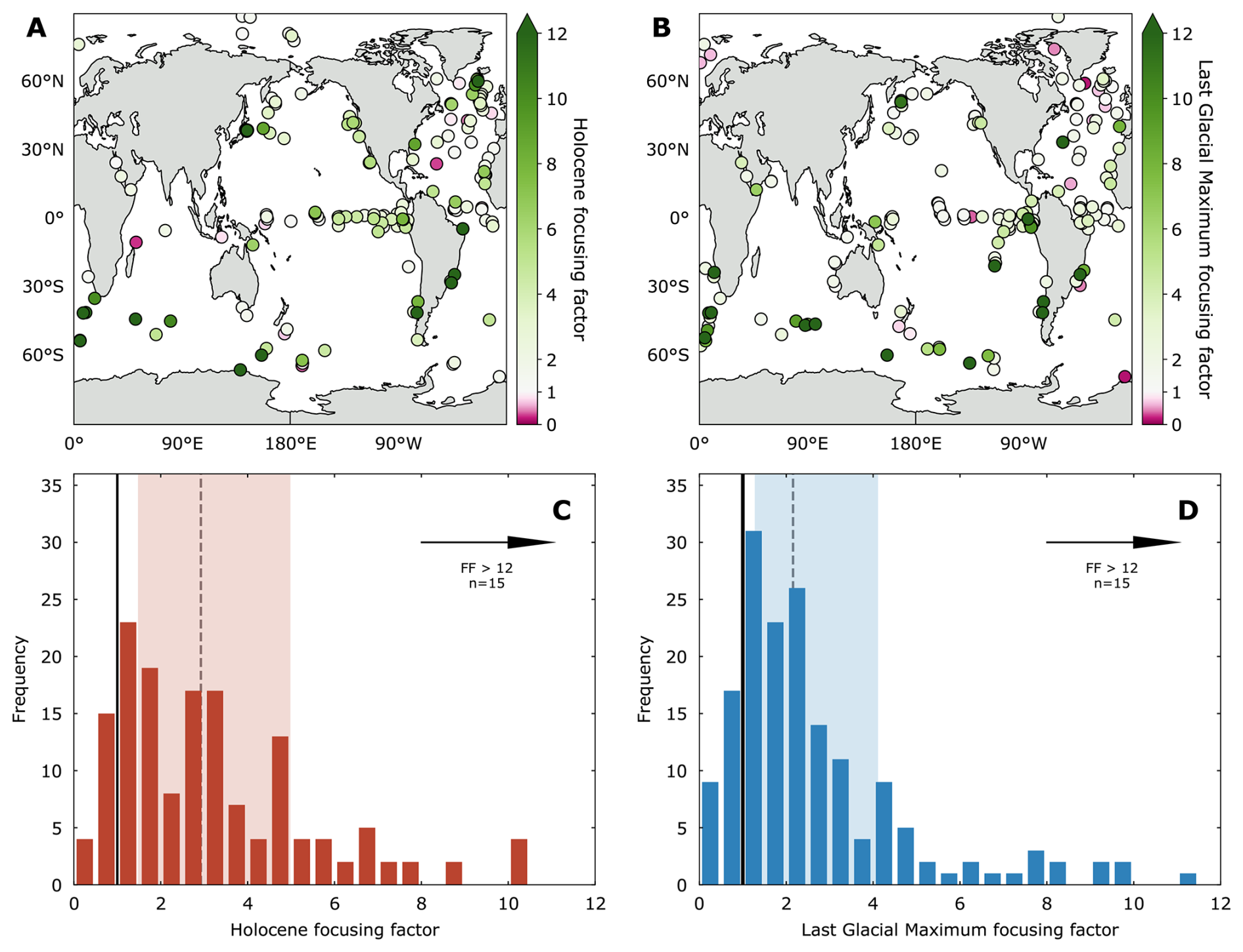
Figure 2Sediment focusing based on the 230Thxs,0 method. (A) Late Holocene (5–0 ka) focusing factors. (B) Last Glacial Maximum (23.5–18.5 ka) focusing factors. (C) Histogram of late Holocene focusing factors. Solid black line indicates a focusing factor of 1 (i.e. bMAR = vMAR). Dashed gray line indicates the median focusing factor. Light red region represents the interquartile range. (D) Same as panel (C), but for the Last Glacial Maximum focusing factor data. All focusing factor data is from Costa et al. (2020).
Costa et al. (2020)'s compiled results highlighted the extensive nature of marine sediment reworking and characterized its spatial and temporal variability on a global scale (Fig. 2). The focusing factor distributions, specifically the high proportion of focused sites, also illustrate the paleoclimate community's propensity to retrieve samples from regions with thick sediment sequences. While intuitive and necessary, seeking material from these settings immediately increases the potential for these sediments to be impacted by sediment redistribution. In sum, the potential for 230Th to produce high resolution records of sediment fluxes that are corrected for syndepositional sediment redistribution make it a vital tool for studying past climates using ocean sediments.
3.2 Accurate MARs in deeper time: 3HeET as a CFP
In the 1960s, Merrihue (1964) pointed out that at least some He, particularly 3He, found in marine sediments likely came from a source outside of Earth. Later work determined that this extraterrestrial 3He (3HeET) is contained in micrometer-scale “space dust”, commonly referred to as interplanetary dust particles (IDPs), and can be found in numerous archives across the planet (Farley et al., 2021; McGee and Mukhopadhyay, 2013; Peucker-Ehrenbrink et al., 2016; Schlosser and Winckler, 2002; Taylor et al., 2016). This extraterrestrial component of marine sediment 3He is deconvolved from terrestrial 3He (3Heterr) using assumed helium isotope ratio values for these two sources ((3He 4He)ET and (3He 4He)terr) and the sample's helium isotope ratio ((3He 4He)meas) (McGee and Mukhopadhyay, 2013) via the equation:
where [3Hemeas] is the measured concentration of 3He (typically in pico-cubic centimeters (pcc) g−1), and [3HeET] is the determined 3HeET concentration in the same units. Marcantonio et al. (1995) proposed using this noble gas isotope from space dust found within marine sediments as a CFP to determine the vMAR of said sediments. Specifically:
where represents the flux of 3HeET to Earth. This value has been independently constrained for the late Quaternary using 230Th as well as ice cores to be 0.8 ± 0.3 pcc cm−2 kyr−1 (McGee and Mukhopadhyay, 2013). We discuss in Sect. 6 the uncertainties regarding this value during earlier intervals of Earth's history. It is important to again stress that, as with any application of CFPs to determine vMARs, the ages determined for all samples from a particular site still rely on the age model for the core. The key difference, in terms of vMARs and bMARs, is that the determined vMARs for each sample of a given age do not depend on the age model, while bMARs are directly dependent on the age model (as described in Sect. 2). Put another way, if the age model for a marine sediment core is later refined and tie-points are altered, CFP-derived sample vMARs will only shift in age, not value, while age model-derived sample bMARs will change both in age and value.
Assuming is constant over the period of interest, 3HeET can be applied in the same way as 230Th. However, unlike 230Th, which decays over time, 3HeET is a stable isotope and can hypothetically be applied in any interval, taking into account assumptions regarding helium retentivity (i.e., the capacity of a He-bearing mineral to retain that He through time). Because the application of 230Th is limited to the last ∼ 400–500 kyr, 3HeET opened the door for studies of marine sediment fluxes prior to the latest Quaternary (e.g., Blard et al., 2023; Farley and Eltgroth, 2003; Lucas et al., 2024; Marcantonio et al., 2009; McGee and Mukhopadhyay, 2013; Mukhopadhyay et al., 2001b; Murphy et al., 2010; O'Mara et al., 2022, 2024; Torfstein et al., 2010; Winckler et al., 2005). In fact, 3HeET has been identified in sediments from ∼ 480 Ma (Patterson et al., 1998), indicating its utility beyond the Cenozoic. Considering that age model resolution (and therefore bMAR resolution) is typically lower in older strata, 3HeET-derived vMARs become increasingly necessary as we seek to interrogate the sediment record in deeper time at higher resolution. Recent work also suggests that 3HeET may provide additional advantages to 230Th in certain depositional environments because it is not affected by boundary scavenging, which can bias 230Th in settings proximal to hydrothermal systems or coastal locations with extremely high vMARs (Middleton et al., 2020; Pavia et al., 2024; Tomchovska et al., 2025). Overall, 3HeET offers numerous advantages over the traditional age model-based approach to reconstructing marine sediment fluxes, particularly prior to the late Quaternary.
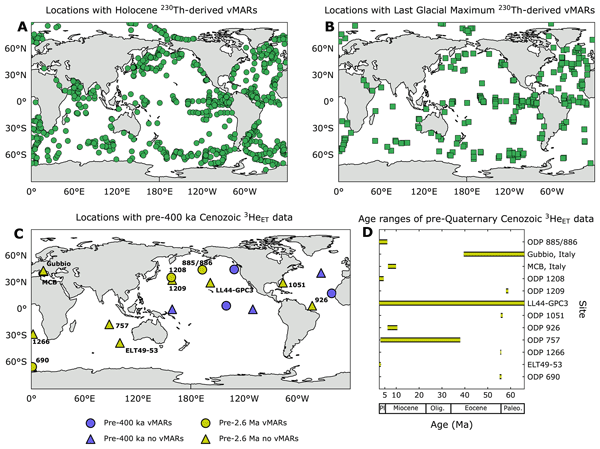
While there are 230Th-derived MAR data covering a substantial portion of almost every major ocean basin for the Holocene and Last Glacial Maximum, there are very few 3HeET marine sediment data prior to the window typically afforded by 230Th (∼ 400 ka) (Fig. 3). In fact, several of the published 3HeET data for the Cenozoic were not utilized to calculate vMARs of sediment constituents, but were combined with age model-derived MARs to either estimate an influx of 3HeET from space () (Farley, 1995; Farley et al., 2006; Farley and Patterson, 1995; Graham and Konrad, 2022; Marcantonio et al., 2009; Montanari et al., 2017; Mukhopadhyay et al., 2001b; Patterson and Farley, 1998; Winckler et al., 2004), or to determine the duration of a rapid climatic event (Farley and Eltgroth, 2003; Mukhopadhyay et al., 2001a; Murphy et al., 2010). Where deeper-time 3HeET data have been generated, most records are limited to short, targeted windows of interest (Farley and Eltgroth, 2003; Marcantonio et al., 2009; Murphy et al., 2010), with little development of longer-term, multi-million year records.
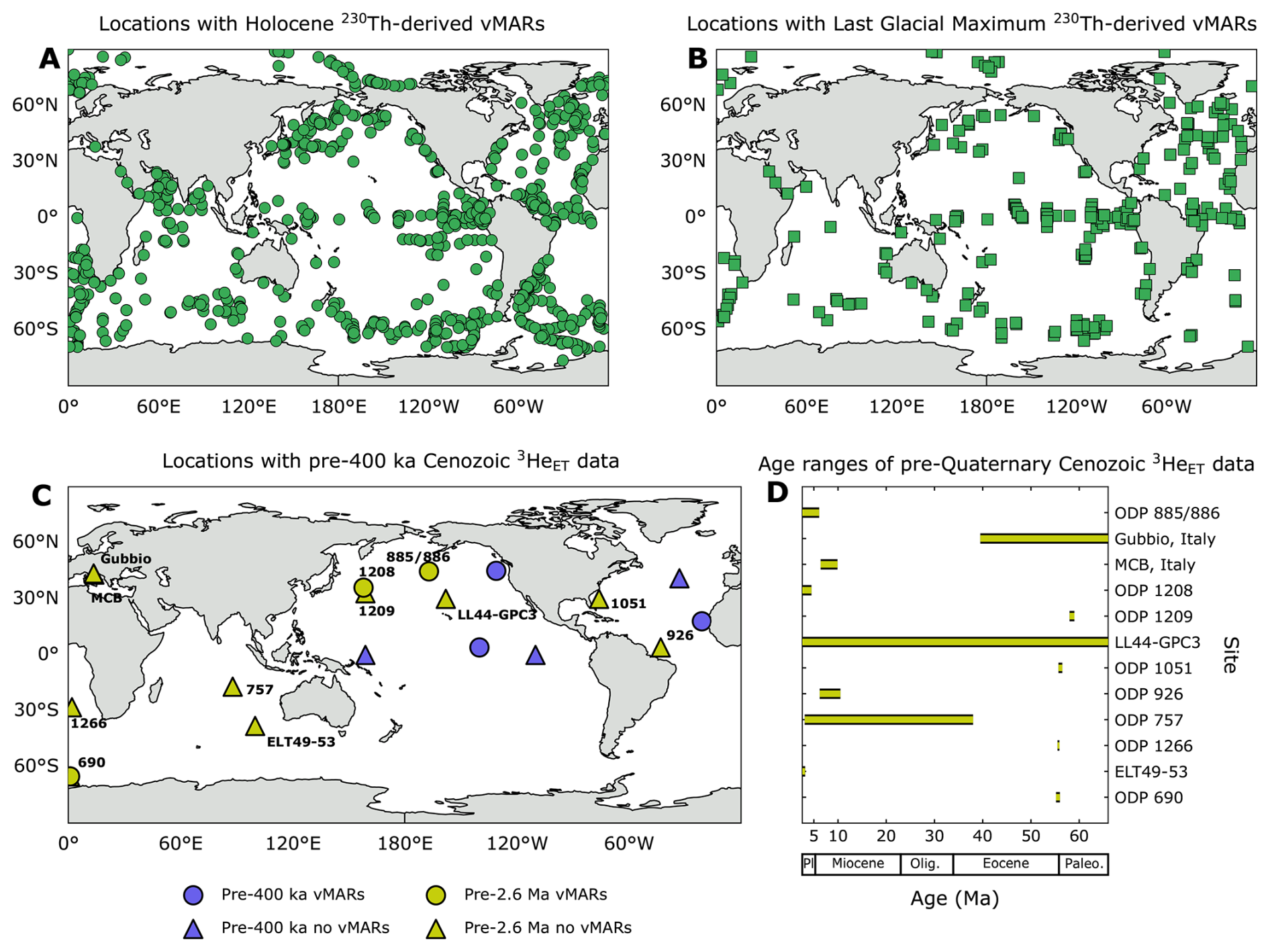
Figure 3Available CFP data for various time intervals. (A) Locations with late Holocene (5–0 ka) 230Th-normalized sediment vMAR data (Costa et al., 2020). (B) Locations of Last Glacial Maximum (23.5–18.5 ka) 230Th-normalized sediment vMARs (Costa et al., 2020). (C) Locations with any marine sediment 3HeET (or just 3He) data for the Cenozoic prior to ∼ 400 ka. No studies that produced 3HeET data from only ∼ 0–400 ka (i.e., the approximate range where 230Th can be applied) or prior to the Cenozoic are included here. Purple symbols indicate sites with 3HeET data that fall only within the Quaternary prior to ∼ 400 ka (Farley and Patterson, 1995; Middleton et al., 2020; O'Mara et al., 2022, 2024; Patterson and Farley, 1998; Winckler et al., 2004, 2005). Yellow symbols represent sites with at least some 3HeET data for the Cenozoic prior to the Quaternary (Abell et al., 2021, 2023; Abell and Winckler, 2023; Farley, 1995; Farley et al., 2006; Farley and Eltgroth, 2003; Graham and Konrad, 2022; Marcantonio et al., 2009; Montanari et al., 2017; Mukhopadhyay et al., 2001b; Murphy et al., 2010). Circles indicate sites where 3HeET data have been used to calculate sediment constituent vMARs (Abell et al., 2021, 2023; Abell and Winckler, 2023; Middleton et al., 2020; O'Mara et al., 2022, 2024; Torfstein et al., 2010). Triangles represent sites where 3HeET data are not used to determine sediment constituent vMARs. These studies either (1) determine an influx of 3HeET using the site's age model (Farley, 1995; Farley et al., 2006; Farley and Patterson, 1995; Graham and Konrad, 2022; Montanari et al., 2017; Mukhopadhyay et al., 2001a; Patterson and Farley, 1998; Winckler et al., 2004) or (2) determine a flux of 3HeET using the site's age model and then calculate sediment accumulation rates and/or event durations using this value (Farley and Eltgroth, 2003; Marcantonio et al., 2009; Murphy et al., 2010). “MCB” stands for Monte dei Corvi Beach, Italy. (D) Temporal coverage of 3HeET data from the beginning of the Cenozoic to the Pliocene.
Considering all of these points, and acknowledging the large-scale, secular shifts in Earth's climate and landscapes documented across the Cenozoic (Molnar, 2004; Molnar and England, 1990; Mudelsee et al., 2014; Tierney et al., 2020; Westerhold et al., 2020), we assert that the CFP 3HeET may be one of the most vital yet underused tools for interrogating both short- and long-term shifts in the Earth system from a marine sediment flux perspective. At minimum, we suggest that the paleoclimate and climate science communities could greatly benefit from further utilization of 3HeET as a CFP.
To explicitly illustrate the impact of using 3HeET-derived marine sediment vMARs on our understanding of sediment MARs in the ocean, and in turn Earth's atmosphere, ocean, and terrestrial landscapes prior to the time window afforded by 230Th, we present two case studies. The first draws on the findings recently described by Abell et al. (2021) and Abell and Winckler (2023) using Pliocene marine sediments in the North Pacific Ocean, while the second discusses how 3HeET has been used to re-evaluate the role of ocean productivity during the PETM (Ma et al., 2014; Torfstein et al., 2010). In each example, we address in detail the similarities and differences between the MARs produced using age models (i.e., bMARs) and 3HeET (i.e., vMARs) in these works. We then highlight the influence that the CFP-derived sediment vMARs had on proxy flux records relevant to reconstructing past Earth system conditions. While each of these studies certainly contain their own assumptions, uncertainties, and caveats, our goal is to present them as examples of “stories still unwritten” within existing marine sediment cores. In doing so, we hope to stimulate the paleoclimate and paleoceanography communities to consider what we think we know regarding the paleo-Earth system from a marine sediment MAR perspective, and in turn pursue new hypotheses using this important proxy.
5.1 North Pacific sediment fluxes, dust inputs, and primary productivity in the Pliocene
Both of the studies covered here primarily focused on the Pliocene (∼ 5.3–2.6 Ma) sections of Ocean Drilling Program (ODP) marine sediment cores Sites 885/886 located in the central subarctic North Pacific Ocean (Rea et al., 1993). ODP Sites 885/886 contain biogenic opal, dust predominantly from Asia, and minor amounts of circum-Pacific volcanic material (Pettke et al., 2000; Rea et al., 1993, 1998; Snoeckx et al., 1995). Due to a lack of calcium carbonate, the age model (and in turn sediment fluxes) for the core are determined using a combination of magnetostratigraphy and biostratigraphy (Dickens et al., 1995; Morley and Nigrini, 1995; Rea et al., 1993). For much of the Pliocene and Quaternary, the resolution of the age model is on the order of several hundred thousand to millions of years, limiting our knowledge of sediment constituent bMARs on timescales less than this range. Additionally, several hiatuses (likely erosional) within the Cenozoic have been suggested based on the core's stratigraphy (Rea et al., 1993). Any unidentified erosional hiatus(es) would bias bMARs low within the remaining sections of a given interval containing one or more hiatuses. Finally, we note that early work suggested that opal sedimentation patterns at ODP Sites 885/886 are anomalous for much of the Pliocene compared to other productivity proxy records produced at these sites, and even at other sites within the subarctic North Pacific (Dickens et al., 1995; Morley and Nigrini, 1995; Rea et al., 1993; Snoeckx et al., 1995). Combined, these findings suggest the age model-derived LSRs and bMARs at ODP Sites 885/886 are potentially problematic, and make these cores optimal targets for applying the 3HeET method. The production of CFP-derived vMARs for ODP Sites 885/886 is even more relevant considering the number of Pliocene dust, carbonate, opal, and other flux datasets produced using these marine core sites (Bailey et al., 2011; Chen et al., 2024; Rea et al., 1998; Zhang et al., 2018, 2020, 2021).
Together, the studies of Abell et al. (2021) and Abell and Winckler (2023) produced 3HeET-derived sediment vMARs spanning ∼ 6.0–2.5 Ma at ODP Sites 885/886. For much of the Pliocene at ODP Sites 885/886, there are substantial discrepancies between the age model-derived bMARs and 3HeET-derived vMARs, particularly during the period of ∼ 5.5–3.6 Ma (Fig. 4). Specifically, the 3HeET-derived sediment vMARs suggest that sediments at ODP Sites 885/886 spanning ∼ 5.5–3.6 Ma (1) experienced substantial winnowing, and/or (2) contain at least one erosional hiatus that dramatically reduces the overall age model-derived bMAR for that interval. Because of the discrepant bMARs and vMARs, sediment vMARs at ODP Sites 885/886 determined using 3HeET (Abell et al., 2021; Abell and Winckler, 2023) produce completely different dust and opal MAR records at these sites when compared to earlier work (Fig. 5) (Rea et al., 1998; Snoeckx et al., 1995). As such, Abell et al. (2021) found no large increase in dust MARs during the Pliocene, a feature evident in the initial work of Rea et al. (1998). Additionally, while Snoeckx et al. (1995) previously suggested low opal accumulation (a proxy for productivity) in the central subarctic North Pacific during the early and mid-Pliocene (∼ 5–3.6 Ma), contrary to evidence from several other studies produced around the same time (Arnold et al., 1995; Barron, 1998; Dickens and Barron, 1997; Dickens and Owen, 1996), Abell and Winckler (2023) found high vMARs of two productivity proxies in this interval (Fig. 5C and D). Abell and Winckler (2023) posited that this period of elevated productivity could be attributed to North Pacific deep water formation, although this hypothesis is still heavily debated (Burls et al., 2017; Novak et al., 2024). Regardless of the driver, by reconstructing opal vMARs using 3HeET at ODP Sites 885/886 during the early and mid-Pliocene, Abell and Winckler (2023) found that opal accumulation at these sites is consistent with other datasets from these same cores (Arnold et al., 1995; Dickens and Barron, 1997; Dickens and Owen, 1996) as well as many other ODP sites from the subarctic North Pacific (Barron, 1998). Finally, by comparing the Pliocene 3HeET-derived dust vMAR records from ODP Sites 885/886 to another core with 3HeET-derived vMARs located in the North Pacific, Abell et al. (2021) showed that changes in atmospheric circulation, specifically the westerlies, occurred with the intensification of Northern Hemisphere Glaciation in response to shifts in Northern Hemisphere ice sheets and meridional temperature gradients.
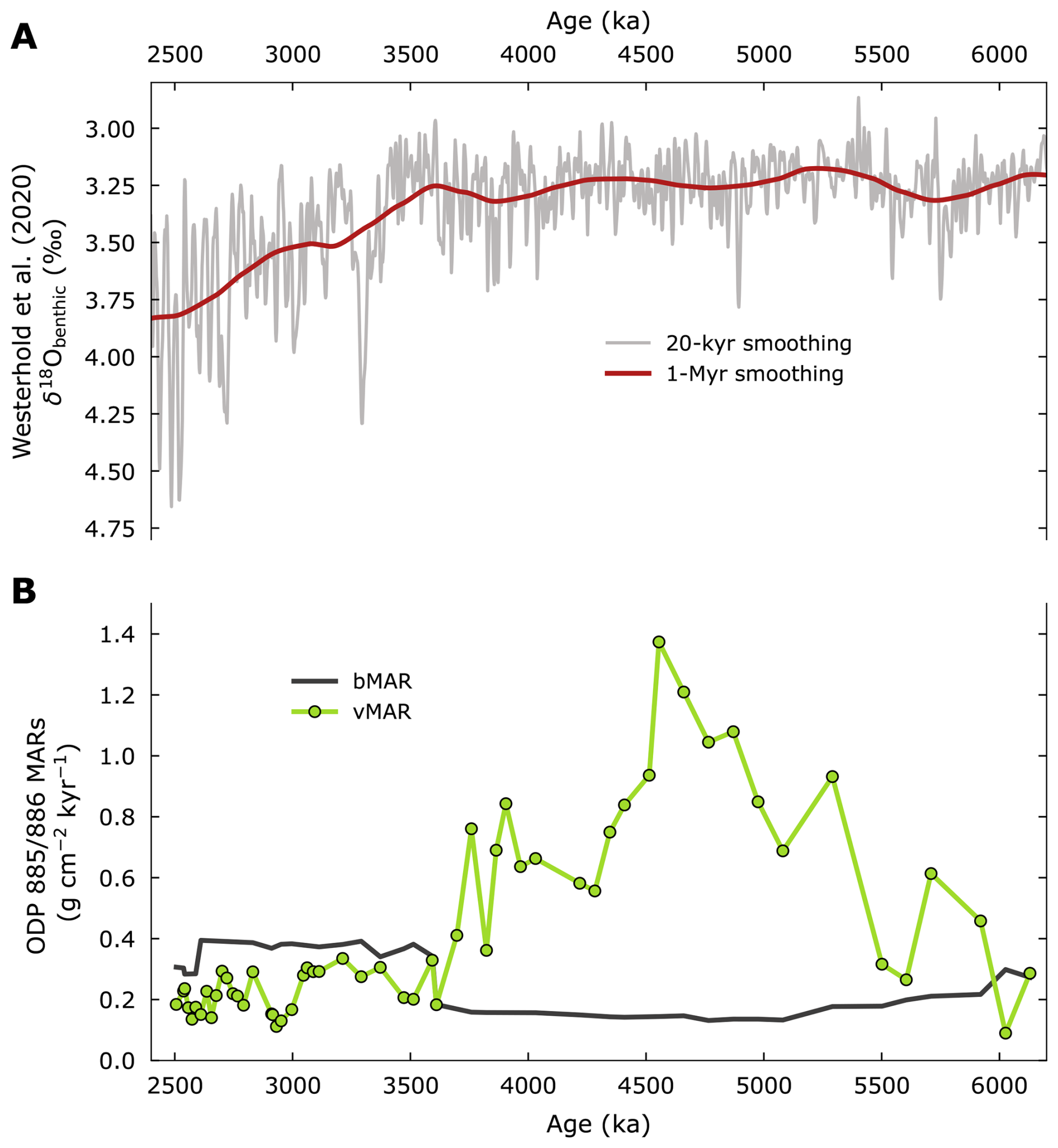
Figure 4Late Miocene, Pliocene, and early Pleistocene MARs at ODP Sites 885/886. (A) Benthic oxygen isotope compilation of Westerhold et al. (2020). Gray curve is the 20 kyr smoothed record, while the red curve is the 1-Myr smoothed record. (B) bMARs (Dickens et al., 1995; Rea et al., 1998) and vMARs (Abell et al., 2021; Abell and Winckler, 2023) for ODP Sites 885/886. To allow for direct comparison, LSRs and DBDs were interpolated to calculate bMARs for sample locations with 3HeET-derived vMARs. Uncertainty estimates on vMARs are removed for clarity (see original studies for uncertainties associated with 3HeET-derived vMARs).
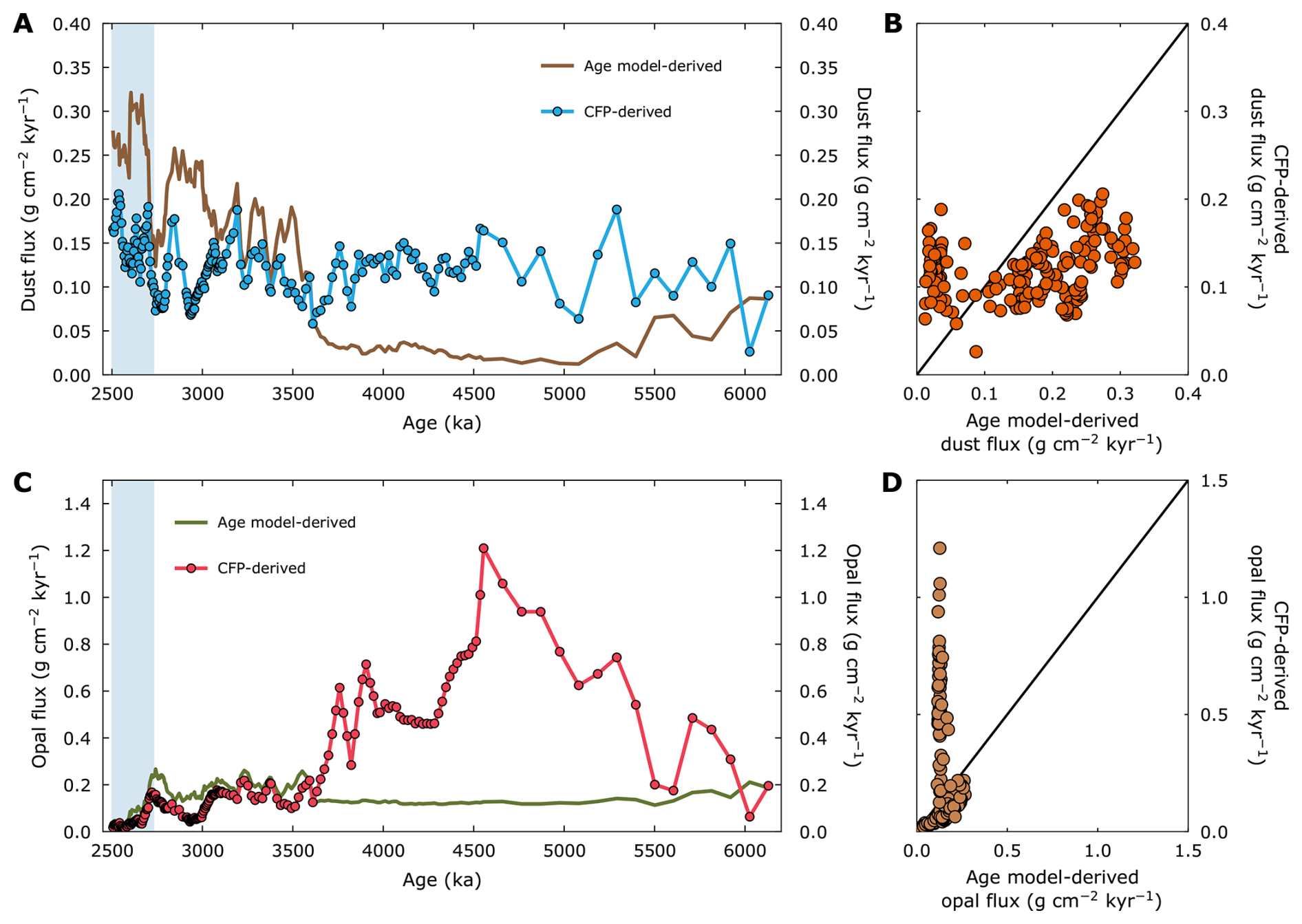
Figure 5Pliocene dust and opal fluxes derived using different methods at ODP Site 885/886. (A) ODP 885/886 Pliocene age model (brown line) and CFP-derived (blue line with circles) dust fluxes using a combination of Th, Al, Fe, and Ti concentrations as dust proxies (Abell et al., 2021; Abell and Winckler, 2023). Blue shading indicates the intensification of Northern Hemisphere Glaciation. (B) Scatterplot of dust fluxes from panel (A). Black line indicates a 1-to-1 relationship. (C) ODP Site 885/886 Pliocene age model (green line) and CFP-derived (pink line with circles) opal fluxes (Abell and Winckler, 2023). Opal concentrations are determined assuming a two-endmember sediment composition system. Specifically, the concentrations of four detrital endmember element proxies (Th, Al, Fe, and Ti) are combined to calculate dust concentrations, and the dust concentrations are then subtracted from 100 to determine the opal concentrations. Blue shading indicates the intensification of Northern Hemisphere Glaciation. (D) Scatterplot of opal fluxes from panel (C). Black line indicates a 1-to-1 relationship. Uncertainty estimates on vMARs are removed for clarity (see original studies for uncertainties associated with 3HeET-derived vMARs).
We highlight the various paleoclimate-related findings of each of these individual studies in order to emphasize just how critical the use of the CFP 3HeET was to these datasets and interpretations. For ODP Sites 885/886, CFP-derived MARs not only produced fundamental differences in productivity and dust reconstructions by accounting for sediment winnowing and/or unidentified hiatuses, they also greatly increased the resolution of the available MAR (in this case vMAR) data. It is integral to remember that even when combining lower resolution bMARs with higher resolution sediment constituent concentration data, the reliability of the derived higher-resolution constituent bMARs is still limited to the resolution of the age model. Using ODP Sites 885/886 as an example, any study directly using higher-resolution dust or opal bMARs for paleoclimate interpretations implicitly assumes that all changes in dust or opal bMARs between tie-points are driven by changes in their respective bMARs, not dilution. Turning to the multi-site approach of Abell et al. (2021), the use of CFPs allowed for the normalization of variable sediment accumulation histories and age model resolutions across independent (and quite distal) sites, and thus provided internally consistent comparisons. Overall, without employing a CFP, core-specific issues such as age model resolution and sediment redistribution cannot be completely ameliorated.
5.2 The “productivity feedback hypothesis” for the PETM recovery
The PETM is a hyperthermal that occurred at ∼ 56 Ma caused by an enormous input of carbon into the atmosphere-ocean system (McInerney and Wing, 2011). The exact cause, duration, and mechanisms of climate system recovery for the PETM are still debated. One posited hypothesis for the recovery suggests that the efficiency of the marine biological pump shifted in response to the large carbon perturbation, ultimately reducing atmospheric CO2 and inducing a return to background conditions (Bains et al., 2000; Ma et al., 2014; Papadomanolaki et al., 2022; Stoll et al., 2007). While all proxies used to make inferences about the biological pump have inherent uncertainties, some of the best evidence of the productivity feedback mechanism comes from barite/excess barium present in marine sediments (Bains et al., 2000; Ma et al., 2014). These studies generally point to increased productivity during the onset of the carbon isotope excursion that is used to stratigraphically mark the onset and recovery of the PETM. Importantly, in the work of Bains et al. (2000) and Ma et al. (2014), barite/excess barium bMARs are assumed to represent the vertical rain rate of these proxies as indicators for productivity. Considering this assumption, additional information further constraining sediment vMARs through 3HeET is crucial.
There are only two sites where published 3HeET and barite/excess barium data exists for the entirety of the PETM, which are ODP Site 690 in the Southern Ocean and ODP 1266 in the South Atlantic (Bains et al., 2000; Farley and Eltgroth, 2003; Ma et al., 2014; Murphy et al., 2010). At ODP Site 690, Bains et al. (2000) used the age model-based sediment MARs to calculate barite MARs, and found increased productivity coincident with the onset of the carbon isotope excursion. However, by applying the 3HeET data produced by Farley and Eltgroth (2003) as a CFP, Torfstein et al. (2010) found that barite MARs (and in turn productivity) did not increase until ∼ 70 kyr after the onset of the carbon isotope excursion. As such, the latter study proposed the productivity feedback hypothesis cannot be invoked for the PETM. Interestingly, a similar yet less dramatic discrepancy exists between the barite/excess barium bMARs and vMARs at ODP Site 1266. Using the 3HeET data from Murphy et al. (2010), Ma et al. (2014) found productivity peaks at ∼ 80 and 125 kyr after the onset of the carbon isotope excursion. However, if the bMARs are applied, then the major increase in barite fluxes is observed earlier, at ∼ 50 kyr post-onset of the carbon isotope excursion. Depending on how the productivity data are considered in the framework of the productivity feedback hypothesis, these differences in timing could lead to quite varied interpretations of the marine carbon cycle across the PETM. While this feedback mechanism would be (and is) debated even without considering the CFP data, this is just another example where 3HeET can lead to substantial revisions of how we as Earth scientists view key climatic events within the Cenozoic.
While we have shown that 3HeET can be important for reconstructing accurate marine sediment and paleoclimate proxy vMARs, this approach is not without its own uncertainties and caveats. These can be encountered during measurement and subsequent quantification of the terrestrial and extraterrestrial components, or can be related to assumptions made regarding the characteristics of 3HeET delivery to Earth. We briefly detail each of these below.
When measuring typical sample sizes (∼ 100–200 mg post-leaching, but could be larger or smaller depending on the available sample extraction system), the low abundance of the 3HeET-bearing IDPs in all but the slowest accumulating marine sediments can lead to low reproducibility in replicates. This statistical uncertainty stemming from sampling can be partially ameliorated by measuring several replicates for a given sample as well as leaching biogenic sediment components (i.e., carbonates) to concentrate He-bearing sediment constituents (i.e., terrestrial and extraterrestrial material) within a particular sample prior to analysis. A related artifact of IDP delivery to marine sediments is the presence of rare, large IDPs. Referred to as the “nugget effect”, the presence of these IDPs in samples being measured can produce anomalously high concentrations of 3HeET (Farley et al., 1997). As with the reproducibility issue, analysis of multiple replicates per sample can help to identify samples with these nuggets.
Post-measurement, one must carefully consider which helium isotope ratios are used for the terrestrial and extraterrestrial endmembers (Eq. 8). As initially pointed out by Marcantonio et al. (1998), if the 3He 4He ratio of a given sample falls near the terrestrial endmember value, then the determined 3HeET concentration will be highly sensitive to the chosen terrestrial endmember value, ultimately imparting large uncertainties on the 3HeET-derived fluxes. Considering that terrestrial endmember helium isotope ratios have been suggested to span several orders of magnitude (Marcantonio et al., 1998; McGee et al., 2016), and high MARs and sediment detrital content both act to reduce measured 3He 4He ratios, there are likely certain types of depositional environments in the ocean where 3HeET concentrations are so uncertain that the application of 3HeET is not advisable. We suggest studies employing 3HeET as a CFP perform sensitivity analysis on their chosen terrestrial endmember value to evaluate its effects on calculated 3HeET concentrations (Abell et al., 2023; Abell and Winckler, 2023; Marcantonio et al., 1998; Middleton et al., 2016; O'Mara et al., 2022, 2024; Pavia et al., 2024, 2025).
To this point, we have described the carrier of 3HeET to marine sediments as IDPs (Ozima et al., 1984), predominantly those of the smaller (≲ 20–35 µm) size fraction of overall IDPs (Brook et al., 2009; Farley et al., 1997; Fénisse et al., 2025; Mukhopadhyay and Farley, 2006; Torfstein, 2012), although this is debated (Jull et al., 2007; Lal and Jull, 2005; Stuart et al., 1999; Stuart and Lee, 2012). Importantly, specific mineral phases have been implicated as the primary location where 3HeET is hosted in the larger IDP, including (but not limited to) magnetic minerals such as magnetite, ilmenite, or ulvospinel, various silicate phases such as olivine and pyroxene, Al oxides, diamond, and graphite (Darrah and Poreda, 2012; Fukumoto et al., 1986; Matsuda et al., 1990; Mukhopadhyay and Farley, 2006; Stuart and Lee, 2012). Based on a suite of methods, including microscopy, grain size separation, leaching, magnetic separation, and step heating, the magnetic and silicate phases are the most likely candidates (Darrah and Poreda, 2012; Mukhopadhyay and Farley, 2006; Stuart and Lee, 2012). Currently, we lack a quantitative determination of the partitioning of the 3HeET between these two mineral groupings. Because a silicate mineral such as olivine or pyroxene is susceptible to diagenesis under different conditions than a magnetic mineral such as magnetite, ilmenite, or ulvospinel, accurately characterizing the mineral host of 3HeET is essential. An example to illustrate the consequences of an equivocal understanding of 3HeET in IDPs for 3HeET as a CFP is the impact of temporally varying marine sediment porewater chemistry. If there are intervals of suboxia/anoxia (i.e., where iron reduction occurs) that lead to the dissolution of fine-grained magnetic minerals, then 3HeET being hosted in magnetite/ilmenite/ulvospinel could be lost to seawater, biasing sediment vMARs too high for these intervals. Silicate minerals would not undergo substantial dissolution at these times. However, if porewaters became alkaline, then silicate minerals could undergo diagenesis while the mentioned magnetic minerals would likely survive intact. Future work could address these uncertainties either through processing collected IDPs with various leaching experiments or comparing 230Thxs,0- and 3HeET-derived vMARs across intervals in marine sediments where known changes in sedimentary porewater conditions occurred.
While numerous studies have compared 230Thxs,0- and 3HeET-derived vMARs at sites with low to moderate levels of sediment redistribution and found minimal impacts, there have only been two studies that addressed the influence of intense sediment redistribution on 3HeET-derived MARs (McGee et al., 2010; Tomchovska et al., 2025). While both McGee et al. (2010) and Tomchovska et al. (2025) found sediment focusing to minimally impact 3HeET-derived vMARs, intense winnowing led to substantial discrepancies between 230Thxs,0- and 3HeET-derived vMARs (Tomchovska et al., 2025). However, because there is still debate over the effects of focusing and winnowing on 230Th (Costa et al., 2020; Lyle et al., 2005, 2014; Marcantonio et al., 1995, 2014; McGee et al., 2010), and the findings of Tomchovska et al. (2025) are limited to one region of the ocean, more work is needed to assess the impacts on 3HeET, particularly where winnowing is the dominant process. A related sedimentary process that does impact CFP-derived vMARs is dissolution of biogenic sediments. Under this scenario, both age model-derived bMARs and CFP-derived vMARs would only reflect the remaining sediment, as long as the CFP in question is not lost to the water column (Costa et al., 2020).
The final, and potentially most important uncertainty to consider stems from the selection of for the period of study. A plethora of studies have worked to determine and its consistency in the modern and late Quaternary (Brook et al., 2000, 2009; Farley et al., 2021; Fénisse et al., 2025; Higgins et al., 2002; Marcantonio et al., 1995, 1996, 1999; McGee et al., 2010; McGee and Mukhopadhyay, 2013; Middleton et al., 2020; Winckler et al., 2004, 2005; Winckler and Fischer, 2006). While initially posited to vary on ∼ 100 kyr timescales (Farley and Patterson, 1995; Patterson and Farley, 1998), comparisons with the CFP 230Th in a variety of marine depositional settings, as well as independent constraints from ice cores, support the notion that was constant at ∼ 0.8 pcc cm−2 kyr−1 on at least glacial-interglacial timescales over the last ∼ 400–500 kyr. Unfortunately, the value of in deeper time is, at present, underconstrained. The only available estimates for prior to the Quaternary are either determined under the assumption that the archive used did not experience sediment redistribution (Farley, 1995; Farley et al., 2006; Montanari et al., 2017; Mukhopadhyay et al., 2001a), or consider the potential for sediment redistribution for the site(s) in question, and in turn produce a “relative” or “implied” (i.e. site-specific) value to use for determining MARs (Farley and Eltgroth, 2003; Marcantonio et al., 2009; Murphy et al., 2010). While proposed values for much of the Cenozoic are less than the value derived for the late Quaternary, these are not consistent across sites (McGee and Mukhopadhyay, 2013). In the late Miocene, values range from ∼ 0.1 to 1.0 pcc cm−2 kyr−1 when comparing ODP Site 926 (Farley et al., 2006), ODP Site 757 (Farley et al., 2006), and Monte dei Corvi Beach, Italy (Montanari et al., 2017). A marginally reduced range (∼ 0.1–0.7 pcc cm−2 kyr−1) of estimates for are reconstructed for the late Paleocene and early Eocene across six sites (Farley, 1995; Farley and Eltgroth, 2003; McGee and Mukhopadhyay, 2013; Mukhopadhyay et al., 2001a; Murphy et al., 2010). Three possible explanations for these discrepancies include (1) loss of 3HeET due to post-depositional heating (likely to only influence terrestrial sites such as Gubbio and Monte dei Corvi Beach in Italy), (2) sediment focusing or winnowing biasing bMARs low or high, and (3) unidentified erosional hiatuses biasing bMARs low. While point no. 2 could impact any marine sediment core, point no. 3 is particularly relevant for sites with low-resolution age models, such as LL44-GPC3 in the central North Pacific (Fig. 3). In fact, LL44-GPC3 displays bMARs that generally scale with age model resolution (Doh et al., 1988; Doyle and Riedel, 1979; Farley, 1995; Prince et al., 1980), potential evidence for unidentified periods of non-deposition or erosion impacting this core (Sadler, 1981, 1999), and thus biased values. We note that these points are speculative, and additional data from uplifted late Mesozoic marine rocks support a low early Cenozoic of around ∼ 0.1 pcc cm−2 kyr−1 (Blard et al., 2023). Specifically, the use of a Quaternary value for the sites studied by Blard et al. (2023) would cause extremely large (a factor of ∼ 10) discrepancies between bMARs and vMARs. However, another explanation for these data could be that the Quaternary value of is appropriate for this interval, and ∼ 90 % of the 3HeET in these rocks was lost over time (potentially via heating during burial), which together would produce the same estimates of vMARs in the study (Blard et al., 2023). Preferential loss of 3HeET in sediments/rocks through time could also explain the lower suggested for much of the Cenozoic (Farley, 1995; McGee and Mukhopadhyay, 2013). As previously mentioned, it is extremely difficult to discern which (if any) of these proposed processes are impacting . Considering the abundance of uncertainties surrounding the value of prior to the late Quaternary, we suggest that future studies relying on 3HeET to determine marine sediment fluxes prior to the Quaternary use both the late Quaternary value and another estimate from the period of interest and evaluate the dataset's sensitivity to the chosen value. Importantly, as long as is constant over the period of interest, interpretations regarding relative changes in vMARs are still viable. Further constraints on the value of for at least the late Neogene and Quaternary could be provided via combined analyses with other geochemical tracers that have known production rates. One example is meteoric 10Be (Frank et al., 2002; Winckler et al., 2005), although 10Be is not without its own complexities (Middleton et al., 2026; Savranskaia et al., 2024).
In this perspective, we have described how CFPs applied to marine sediments have provided, and can continue to provide new, valuable information about the Earth system across tens-of-millions of years. With that being said, Fig. 3 clearly demonstrates that 3HeET, the only viable CFP beyond the late Quaternary, has yet to be used outside of a handful of studies. We stress that this is not because 3HeET is new to the field of paleoclimatology or has not been well-studied as a proxy. To be clear, those who apply 3HeET as a CFP are quite aware of its inherent uncertainties and where further constraints are needed, which we have highlighted in this work. Considering the unique benefits of the proxy illustrated by our review of several recent studies from both the late and early Cenozoic that utilize the CFP 3HeET, we propose that the logical next step for this proxy is widespread utilization to both re-evaluate existing records and address novel paleoclimate questions.
So, what is standing in the way of applying this influential method to every marine sediment core to develop both short- and long-term accurate records of changes in the Earth system across the Cenozoic? In a practical sense, the simple answers to this question at present are (1) a scarcity of laboratories making measurements of marine sediment noble gases, (2) the analytical challenges of generating reliable sediment helium isotope data, and (3) limited attempts to describe 3HeET's utility to the broader Earth science community (McGee and Mukhopadhyay, 2013). While points nos. 1 and 2 are not amenable to a “quick fix”, we have expanded on the previous review of McGee and Mukhopadhyay (2013) in an effort to address point no. 3. Specifically, not only do we provide a systematic overview of age model-derived bMARs and CFP-derived vMARs and their associated uncertainties, but also incorporate new findings accumulated over the last ∼ 15 years to provide a paleoclimate-centric perspective on the benefits of applying 3HeET as a CFP to explore the pre-Quaternary Cenozoic Earth system.
In summary, it is our opinion that without the application of 3HeET prior to the late Quaternary, key future questions regarding both short- and long-term shifts in the Earth system over the last ∼ 66 Myr that can only be investigated from a marine sediment flux perspective may go unanswered. Potentially even more problematic is that our current understanding of Earth's climate and landscapes based on fluxes in the ocean could be erroneous due to reliance on existing age model-derived bMAR datasets. While our case studies focused on small spatial and temporal scales compared to the applicable range of 3HeET, we stress that new findings stemming from the application of this CFP are not limited to just the North Pacific and Southern Ocean, nor just the Pliocene and PETM. As evidenced with 230Th, processes influencing our ability to accurately reconstruct MARs in the ocean with traditional approaches are spatially heterogeneous and change over time. As we attempt to peer back farther into Earth's past through the lens of marine sediment MARs, recognizing and correcting for these uncertainties is paramount. Finally, with new deep ocean drilling heavily reduced for the foreseeable future (Robinson et al., 2024), utilizing available marine sediment cores to address these and other questions is crucial. CFPs, and 3HeET in particular, provide a means to expand work on these irreplaceable archives while generating new information about the Earth system across the Cenozoic.
All data needed to evaluate the conclusions in the paper are present in the Supplementary Data File and associated files deposited in a repository. Files containing the dust, productivity, mass accumulation rate, and focusing factor data from the original cited studies, as well as the code files for figure generation, are stored at http://figshare.com (last access: 15 November 2026) via the link: https://doi.org/10.6084/m9.figshare.31813906 (Abell, 2026).
All authors contributed to the conceptualization of this perspective. J.T.A. compiled the published data and performed all analyses. J.T.A. wrote the initial version of the manuscript. All authors provided comments and revisions.
The contact author has declared that none of the authors has any competing interests.
Publisher's note: Copernicus Publications remains neutral with regard to jurisdictional claims made in the text, published maps, institutional affiliations, or any other geographical representation in this paper. The authors bear the ultimate responsibility for providing appropriate place names. Views expressed in the text are those of the authors and do not necessarily reflect the views of the publisher.
All the authors would like to thank those who dedicated time, energy, and resources to collect the marine sediments we in the Earth science community continually use to better understand our ever-changing planet.
J.T.A. was supported by a U.S. NSF Division of Ocean Sciences MG&G grant (no. 2449952) during a portion of the time that he wrote this manuscript. F.J.P. was supported by startup funds provided by the University of Washington.
This research has been supported by the National Science Foundation, Directorate for Geosciences (grant no. 2449952) and the University of Washington.
This paper was edited by Gerilyn (Lynn) Soreghan and reviewed by David McGee, Pierre-Henri Blard, and one anonymous referee.
Abell, J. T.: Published data and code files used in “Abell et al. Exploring the Cenozoic Earth system with extraterrestrial 3He”, figshare [data set], https://doi.org/10.6084/m9.figshare.31813906, 2026.
Abell, J. T. and Winckler, G.: Long-Term Variability in Pliocene North Pacific Ocean Export Production and Its Implications for Ocean Circulation in a Warmer World, AGU Advances, 4, e2022AV000853, https://doi.org/10.1029/2022AV000853, 2023.
Abell, J. T., Winckler, G., Anderson, R. F., and Herbert, T. D.: Poleward and weakened westerlies during Pliocene warmth, Nature, 589, 70–75, 2021.
Abell, J. T., Winckler, G., Pullen, A., Kinsley, C. W., Kapp, P. A., Middleton, J. L., Pavia, F. J., McGee, D., Ford, H. L., and Raymo, M. E.: Evaluating the Drivers of Quaternary Dust Fluxes to the Western North Pacific: East Asian Dustiness and Northern Hemisphere Gustiness, Paleoceanog. Paleoclimatol., 38, e2022PA004571, https://doi.org/10.1029/2022PA004571, 2023.
Adkins, J. F.: The role of deep ocean circulation in setting glacial climates, Paleoceanography, 28, 539–561, https://doi.org/10.1002/palo.20046, 2013.
Anchukaitis, K. J.: Tree rings reveal climate change past, present, and future, P. Am. Philos. Soc., 161, 244–263, 2017.
Anderson, R. F. and Winckler, G.: Problems with paleoproductivity proxies, Paleoceanography, 20, https://doi.org/10.1029/2004PA001107, 2005.
Arnold, E., Leinen, M., and King, J.: Paleoenvironmental variation based on the mineralogy and rock-magnetic properties of sediment from Sites 885 and 886, in: Proceedings of the Ocean Drilling Program, Scientific results, Ocean Drilling Program, vol. 145, 231–245, https://doi.org/10.2973/odp.proc.sr.145.113.1995, 1995.
Bacon, M. P.: Glacial to interglacial changes in carbonate and clay sedimentation in the Atlantic Ocean estimated from 230Th measurements, Chem. Geol., 46, 97–111, https://doi.org/10.1016/0009-2541(84)90183-9, 1984.
Bailey, I., Liu, Q., Swann, G. E., Jiang, Z., Sun, Y., Zhao, X., and Roberts, A. P.: Iron fertilisation and biogeochemical cycles in the sub-Arctic northwest Pacific during the late Pliocene intensification of northern hemisphere glaciation, Earth Planet. Sc. Lett., 307, 253–265, 2011.
Bains, S., Norris, R. D., Corfield, R. M., and Faul, K. L.: Termination of global warmth at the Palaeocene/Eocene boundary through productivity feedback, Nature, 407, 171–174, https://doi.org/10.1038/35025035, 2000.
Barron, J. A.: Late Neogene changes in diatom sedimentation in the North Pacific, J. Asian Earth Sci., 16, 85–95, https://doi.org/10.1016/S0743-9547(97)00046-9, 1998.
Becker, K.: Chapter 1 – Major Scientific Achievements of the Integrated Ocean Drilling Program: Overview and Highlights, in: Developments in Marine Geology, edited by: Stein, R., Blackman, D. K., Inagaki, F., and Larsen, H.-C., Elsevier, vol. 7, 1–36, https://doi.org/10.1016/B978-0-444-62617-2.00001-3, 2014.
Becker, K., Austin, J. A., Exon, N., Humphris, S., Kastner, M., McKenzie, J. A., Miller, K. G., Suyehiro, K., and Taira, A.: 50 Years of Scientific Ocean Drilling, Oceanography, 32, 17–21, 2019.
Bird, A., Millar, I., Rodenburg, T., Stevens, T., Rittner, M., Vermeesch, P., and Lu, H.: A constant Chinese Loess Plateau dust source since the late Miocene, Quaternary Sci. Rev., 227, 106042, https://doi.org/10.1016/j.quascirev.2019.106042, 2020.
Blard, P.-H., Sucheras-Marx, B., Suan, G., Godet, B., Tibari, B., Dutilleul, J., Mezine, T., and Adatte, T.: Are marl-limestone alternations mainly driven by CaCO3 variations at the astronomical timescale? New insights from extraterrestrial 3He, Earth Planet. Sc. Lett., 614, 118173, https://doi.org/10.1016/j.epsl.2023.118173, 2023.
Brook, E. J. and Buizert, C.: Antarctic and global climate history viewed from ice cores, Nature, 558, 200–208, https://doi.org/10.1038/s41586-018-0172-5, 2018.
Brook, E. J., Kurz, M. D., Curtice, J., and Cowburn, S.: Accretion of interplanetary dust in polar ice, Geophys. Res. Lett., 27, 3145–3148, https://doi.org/10.1029/2000GL011813, 2000.
Brook, E. J., Kurz, M. D., and Curtice, J.: Flux and size fractionation of 3He in interplanetary dust from Antarctic ice core samples, Earth Planet. Sc. Lett., 286, 565–569, https://doi.org/10.1016/j.epsl.2009.07.024, 2009.
Burke, K. D., Williams, J. W., Chandler, M. A., Haywood, A. M., Lunt, D. J., and Otto-Bliesner, B. L.: Pliocene and Eocene provide best analogs for near-future climates, P. Natl. Acad. Sci. USA, 115, 13288–13293, https://doi.org/10.1073/pnas.1809600115, 2018.
Burls, N. J., Fedorov, A. V., Sigman, D. M., Jaccard, S. L., Tiedemann, R., and Haug, G. H.: Active Pacific meridional overturning circulation (PMOC) during the warm Pliocene, Sci. Adv., 3, e1700156, https://doi.org/10.1126/sciadv.1700156, 2017.
Caves Rugenstein, J. K. and Chamberlain, C. P.: The evolution of hydroclimate in Asia over the Cenozoic: A stable-isotope perspective, Earth-Sci. Rev., 185, 1129–1156, https://doi.org/10.1016/j.earscirev.2018.09.003, 2018.
Chen, T., Liu, Q., Ao, H., and Ryves, D. B.: Temperature modulation of Northern Mid-Latitude Westerly winds intensity and displacement across the warm Pliocene, Global Planet. Change, 240, 104531, https://doi.org/10.1016/j.gloplacha.2024.104531, 2024.
Cheng, H., Lawrence Edwards, R., Shen, C.-C., Polyak, V. J., Asmerom, Y., Woodhead, J., Hellstrom, J., Wang, Y., Kong, X., Spötl, C., Wang, X., and Calvin Alexander, E.: Improvements in 230Th dating, 230Th and 234U half-life values, and U–Th isotopic measurements by multi-collector inductively coupled plasma mass spectrometry, Earth Planet. Sc. Lett., 371–372, 82–91, https://doi.org/10.1016/j.epsl.2013.04.006, 2013.
Cohen, A. S., Du, A., Rowan, J., Yost, C. L., Billingsley, A. L., Campisano, C. J., Brown, E. T., Deino, A. L., Feibel, C. S., Grant, K., Kingston, J. D., Lupien, R. L., Muiruri, V., Owen, R. B., Reed, K. E., Russell, J., and Stockhecke, M.: Plio-Pleistocene environmental variability in Africa and its implications for mammalian evolution, P. Natl. Acad. Sci. USA, 119, e2107393119, https://doi.org/10.1073/pnas.2107393119, 2022.
Costa, K. M., Hayes, C. T., Anderson, R. F., Pavia, F. J., Bausch, A., Deng, F., Dutay, J., Geibert, W., Heinze, C., Henderson, G., Hillaire-Marcel, C., Hoffmann, S., Jaccard, S. L., Jacobel, A. W., Kienast, S. S., Kipp, L., Lerner, P., Lippold, J., Lund, D., Marcantonio, F., McGee, D., McManus, J. F., Mekik, F., Middleton, J. L., Missiaen, L., Not, C., Pichat, S., Robinson, L. F., Rowland, G. H., Roy-Barman, M., Tagliabue, A., Torfstein, A., Winckler, G., and Zhou, Y.: 230Th Normalization: New Insights on an Essential Tool for Quantifying Sedimentary Fluxes in the Modern and Quaternary Ocean, Paleoceanog. Paleoclimatol., 35, e2019PA003820, https://doi.org/10.1029/2019PA003820, 2020.
Crocker, A. J., Naafs, B. D. A., Westerhold, T., James, R. H., Cooper, M. J., Röhl, U., Pancost, R. D., Xuan, C., Osborne, C. P., and Beerling, D. J.: Astronomically controlled aridity in the Sahara since at least 11 million years ago, Nat. Geosci., 15, 671–676, 2022.
Darrah, T. H. and Poreda, R. J.: Evaluating the accretion of meteoritic debris and interplanetary dust particles in the GPC-3 sediment core using noble gas and mineralogical tracers, Geochim. Cosmochim. Ac., 84, 329–352, https://doi.org/10.1016/j.gca.2012.01.030, 2012.
Deutsch, C. and Weber, T.: Nutrient Ratios as a Tracer and Driver of Ocean Biogeochemistry, Annu. Rev. Mar. Sci., 4, 113–141, https://doi.org/10.1146/annurev-marine-120709-142821, 2012.
Dickens, G. R. and Barron, J. A.: A rapidly deposited pennate diatom ooze in Upper Miocene-Lower Pliocene sediment beneath the North Pacific polar front, Mar. Micropaleontol., 31, 177–182, https://doi.org/10.1016/S0377-8398(97)00003-0, 1997.
Dickens, G. R. and Owen, R. M.: Sediment geochemical evidence for an early-middle Gilbert (early Pliocene) productivity peak in the North Pacific Red Clay Province, Mar. Micropaleontol., 27, 107–120, https://doi.org/10.1016/0377-8398(95)00054-2, 1996.
Dickens, G. R., Snoeckx, H., Arnold, E., Morley, J. J., Owen, R. M., Rea, D. K., and Ingram, L.: Composite Depth Scale And Stratigraphy For Sites 885/886, in: Proceedings of the Ocean Drilling Program: Scientific Results, Ocean Drilling Program, vol. 145, 205, https://doi.org/10.2973/odp.proc.sr.145.144.1995, 1995.
Ding, Z. L., Derbyshire, E., Yang, S. L., Yu, Z. W., Xiong, S. F., and Liu, T. S.: Stacked 2.6-Ma grain size record from the Chinese loess based on five sections and correlation with the deep-sea δ18O record, Paleoceanography, 17, 5-1–5-21, https://doi.org/10.1029/2001PA000725, 2002.
Doh, S.-J., King, J. W., and Leinen, M.: A rock-magnetic study of giant piston core LL44-GPC3 from the central North Pacific and its paleoceanographic implications, Paleoceanography, 3, 89–111, https://doi.org/10.1029/PA003i001p00089, 1988.
Dott, R. H.: Episodic sedimentation; how normal is average? How rare is rare? Does it matter?, J. Sediment. Res., 53, 5–23, https://doi.org/10.1306/212F8148-2B24-11D7-8648000102C1865D, 1983.
Doyle, P. S. and Riedel, W. R.: Cretaceous to Neogene ichthyoliths in a giant piston core from the central North Pacific, Micropaleontology, 337–364, https://doi.org/10.2307/1485427, 1979.
Dubois, N. and Mitchell, N. C.: Large-scale sediment redistribution on the equatorial Pacific seafloor, Deep-Sea Res. Pt. I, 69, 51–61, https://doi.org/10.1016/j.dsr.2012.07.006, 2012.
Farley, K. A.: Cenozoic variations in the flux of interplanetary dust recorded by 3He in a deep-sea sediment, Nature, 376, 153–156, https://doi.org/10.1038/376153a0, 1995.
Farley, K. A. and Eltgroth, S. F.: An alternative age model for the Paleocene–Eocene thermal maximum using extraterrestrial 3He, Earth Planet. Sc. Lett., 208, 135–148, https://doi.org/10.1016/S0012-821X(03)00017-7, 2003.
Farley, K. A. and Patterson, D. B.: A 100-kyr periodicity in the flux of extraterrestrial 3He to the sea floor, Nature, 378, 600–603, https://doi.org/10.1038/378600a0, 1995.
Farley, K. A., Love, S. G., and Patterson, D. B.: Atmospheric entry heating and helium retentivity of interplanetary dust particles, Geochim. Cosmochim. Ac., 61, 2309–2316, https://doi.org/10.1016/S0016-7037(97)00068-9, 1997.
Farley, K. A., Vokrouhlický, D., Bottke, W. F., and Nesvorný, D.: A late Miocene dust shower from the break-up of an asteroid in the main belt, Nature, 439, 295–297, https://doi.org/10.1038/nature04391, 2006.
Farley, K. A., Taylor, S., Treffkorn, J., Lever, J. H., and Gow, A. L.: 3He flux obtained from South Pole air and snow-ice and its connection to interplanetary dust particles, Meteorit. Planet. Sci., 56, 1988–2001, https://doi.org/10.1111/maps.13759, 2021.
Felis, T. and Pätzold, J.: Climate Records from Corals, in: Marine Science Frontiers for Europe, edited by: Wefer, G., Lamy, F., and Mantoura, F., Springer Berlin Heidelberg, Berlin, Heidelberg, 11–27, https://doi.org/10.1007/978-3-642-55862-7_2, 2003.
Fénisse, G., Bekaert, D. V., Blard, P.-H., Duprat, J., Mattia, I., Genge, M., Suttle, M. D., Barres, O., Engrand, C., and Marrocchi, Y.: The extraterrestrial dust accretion rate on Earth at Dome C, Antarctica: a fresh look with 3He, Earth Planet. Sc. Lett., 663, 119396, https://doi.org/10.1016/j.epsl.2025.119396, 2025.
Francois, R., Frank, M., Rutgers Van Der Loeff, M. M., and Bacon, M. P.: 230 Th normalization: An essential tool for interpreting sedimentary fluxes during the late Quaternary, Paleoceanography, 19, 2003PA000939, https://doi.org/10.1029/2003PA000939, 2004.
Frank, M.: Radiogenic Isotopes: Tracers of Past Ocean Circulation and Erosional Input, Rev. Geophys., 40, 1-1–1-38, https://doi.org/10.1029/2000RG000094, 2002.
Frank, M., Gersonde, R., and Mangini, A.: Sediment Redistribution, 230Thex- Normalization and Implications for the Reconstruction of Particle Flux and Export Paleoproductivity, in: Use of Proxies in Paleoceanography: Examples from the South Atlantic, edited by: Fischer, G. and Wefer, G., Springer, Berlin, Heidelberg, 409–426, https://doi.org/10.1007/978-3-642-58646-0_16, 1999.
Frank, M., Rutgers van der Loeff, M. M., Kubik, P. W., and Mangini, A.: Quasi-conservative behaviour of 10Be in deep waters of the Weddell Sea and the Atlantic sector of the Antarctic Circumpolar Current, Earth Planet. Sc. Lett., 201, 171–186, https://doi.org/10.1016/S0012-821X(02)00688-X, 2002.
Fukumoto, H., Nagao, K., and Matsuda, J.: Noble gas studies on the host phase of high 3He4He ratios in deep-sea sediments, Geochim. Cosmochim. Ac., 50, 2245–2253, https://doi.org/10.1016/0016-7037(86)90079-7, 1986.
Graham, D. W. and Konrad, K.: Supernova versus cosmic ray origin for exotic nuclides in geomaterials: A test using 3He with 60Fe in marine sediments, Geochim. Cosmochim. Ac., 336, 177–187, https://doi.org/10.1016/j.gca.2022.09.016, 2022.
Guo, Z. T., Ruddiman, W. F., Hao, Q. Z., Wu, H. B., Qiao, Y. S., Zhu, R. X., Peng, S. Z., Wei, J. J., Yuan, B. Y., and Liu, T. S.: Onset of Asian desertification by 22 Myr ago inferred from loess deposits in China, Nature, 416, 159–163, https://doi.org/10.1038/416159a, 2002.
Harmon, R. S., Schwarcz, H. P., Gascoyne, M., Hess, J. W., and Ford, D. C.: Paleoclimate Information from Speleothems: The Present as a Guide to the Past, in: Studies of Cave Sediments, Springer, 199–226, https://doi.org/10.1007/978-1-4419-9118-8_11, 2004.
Higgins, S. M., Anderson, R. F., Marcantonio, F., Schlosser, P., and Stute, M.: Sediment focusing creates 100-ka cycles in interplanetary dust accumulation on the Ontong Java Plateau, Earth Planet. Sc. Lett., 203, 383–397, https://doi.org/10.1016/S0012-821X(02)00864-6, 2002.
Johnson, D. A. and Johnson, T. C.: Sediment redistribution by bottom currents in the central Pacific, Deep Sea Research and Oceanographic Abstracts, 17, 157–169, https://doi.org/10.1016/0011-7471(70)90094-X, 1970.
Jouzel, J. and Masson-Delmotte, V.: Paleoclimates: what do we learn from deep ice cores?, WIREs Climate Change, 1, 654–669, https://doi.org/10.1002/wcc.72, 2010.
Jull, A. J. T., Lal, D., Taylor, S., Wieler, R., Grimberg, A., Vacher, L., McHargue, L. R., Freeman, S. P. H. T., Maden, C., Schnabel, C., Xu, S., Finkel, R. C., Kim, K. J., and Marti, K.: 3He, 20,21,22Ne, 14C, 10Be, 26Al, and 36Cl in magnetic fractions of cosmic dust from Greenland and Antarctica, Meteorit. Planet. Sci., 42, 1831–1840, https://doi.org/10.1111/j.1945-5100.2007.tb00541.x, 2007.
Kiessling, W.: Paleoclimatic significance of Phanerozoic reefs, Geology, 29, 751–754, https://doi.org/10.1130/0091-7613(2001)029<0751:PSOPR>2.0.CO;2, 2001.
Kretschmer, S., Geibert, W., Rutgers van der Loeff, M. M., and Mollenhauer, G.: Grain size effects on 230Thxs inventories in opal-rich and carbonate-rich marine sediments, Earth Planet. Sc. Lett., 294, 131–142, https://doi.org/10.1016/j.epsl.2010.03.021, 2010.
Lal, D. and Jull, A. J. T.: On the fluxes and fates of 3He accreted by the Earth with extraterrestrial particles, Earth Planet. Sc. Lett., 235, 375–390, https://doi.org/10.1016/j.epsl.2005.04.011, 2005.
Li, Y. H. and Schoonmaker, J. E.: Chemical Composition and Mineralogy of Marine Sediments, in: Treatise on Geochemistry, edited by: Holland, H. D. and Turekian, K. K., Pergamon, Oxford, 7, 1–35, https://doi.org/10.1016/B0-08-043751-6/07088-2, 2003.
Lough, J. M.: Climate records from corals, WIREs Climate Change, 1, 318–331, https://doi.org/10.1002/wcc.39, 2010.
Lucas, J. R., Batenburg, S. J., Hillegonds, D. J., Mabry, J. C., Jenkyns, H. C., Ballentine, C. J., and Robinson, S. A.: Helium-isotope constraints on palaeoceanographic change and sedimentation rates during precession cycles (Cenomanian Scaglia Bianca Formation, central Italy), Sedimentology, 71, 1895–1921, https://doi.org/10.1111/sed.13197, 2024.
Lyle, M., Mitchell, N., Pisias, N., Mix, A., Martinez, J. I., and Paytan, A.: Do geochemical estimates of sediment focusing pass the sediment test in the equatorial Pacific?, Paleoceanography, 20, https://doi.org/10.1029/2004PA001019, 2005.
Lyle, M., Marcantonio, F., Moore, W. S., Murray, R. W., Huh, C., Finney, B. P., Murray, D. W., and Mix, A. C.: Sediment size fractionation and focusing in the equatorial Pacific: Effect on230 Th normalization and paleoflux measurements, Paleoceanography, 29, 747–763, https://doi.org/10.1002/2014PA002616, 2014.
Ma, Z., Gray, E., Thomas, E., Murphy, B., Zachos, J., and Paytan, A.: Carbon sequestration during the Palaeocene–Eocene Thermal Maximum by an efficient biological pump, Nat. Geosci., 7, 382–388, https://doi.org/10.1038/ngeo2139, 2014.
Maher, B. A.: Palaeoclimatic records of the loess/palaeosol sequences of the Chinese Loess Plateau, Quaternary Sci. Rev., 154, 23–84, https://doi.org/10.1016/j.quascirev.2016.08.004, 2016.
Marcantonio, F., Kumar, N., Stute, M., Anderson, R. F., Seidl, M. A., Schlosser, P., and Mix, A.: A comparative study of accumulation rates derived by He and Th isotope analysis of marine sediments, Earth Planet. Sc. Lett., 133, 549–555, 1995.
Marcantonio, F., Anderson, R. F., Stute, M., Kumar, N., Schlosser, P., and Mix, A.: Extraterrestrial 3He as a tracer of marine sediment transport and accumulation, Nature, 383, 705–707, 1996.
Marcantonio, F., Higgins, S., Anderson, R. F., Stute, M., Schlosser, P., and Rasbury, E. T.: Terrigenous helium in deep-sea sediments, Geochim. Cosmochim. Ac., 62, 1535–1543, 1998.
Marcantonio, F., Turekian, K. K., Higgins, S., Anderson, R. F., Stute, M., and Schlosser, P.: The accretion rate of extraterrestrial 3He based on oceanic 230Th flux and the relation to Os isotope variation over the past 200 000 years in an Indian Ocean core, Earth Planet. Sc. Lett., 170, 157–168, https://doi.org/10.1016/S0012-821X(99)00100-4, 1999.
Marcantonio, F., Thomas, D. J., Woodard, S., McGee, D., and Winckler, G.: Extraterrestrial 3He in Paleocene sediments from Shatsky Rise: Constraints on sedimentation rate variability, Earth Planet. Sc. Lett., 287, 24–30, 2009.
Marcantonio, F., Lyle, M., and Ibrahim, R.: Particle sorting during sediment redistribution processes and the effect on 230Th-normalized mass accumulation rates, Geophys. Res. Lett., 41, 5547–5554, https://doi.org/10.1002/2014GL060477, 2014.
Matsuda, J., Murota, M., and Nagao, K.: He and Ne isotopic studies on the extraterrestrial material in deep-sea sediments, J. Geophys. Res.-Sol. Ea., 95, 7111–7117, https://doi.org/10.1029/JB095iB05p07111, 1990.
McDermott, F.: Palaeo-climate reconstruction from stable isotope variations in speleothems: a review, Quaternary Sci. Rev., 23, 901–918, https://doi.org/10.1016/j.quascirev.2003.06.021, 2004.
McGee, D. and Mukhopadhyay, S.: Extraterrestrial He in Sediments: From Recorder of Asteroid Collisions to Timekeeper of Global Environmental Changes, in: The Noble Gases as Geochemical Tracers, edited by: Burnard, P., Springer Berlin Heidelberg, Berlin, Heidelberg, 155–176, https://doi.org/10.1007/978-3-642-28836-4_7, 2013.
McGee, D., Marcantonio, F., McManus, J. F., and Winckler, G.: The response of excess 230Th and extraterrestrial 3He to sediment redistribution at the Blake Ridge, western North Atlantic, Earth Planet. Sc. Lett., 299, 138–149, 2010.
McGee, D., Winckler, G., Borunda, A., Serno, S., Anderson, R. F., Recasens, C., Bory, A., Gaiero, D., Jaccard, S. L., Kaplan, M., McManus, J. F., Revel, M., and Sun, Y.: Tracking eolian dust with helium and thorium: Impacts of grain size and provenance, Geochim. Cosmochim. Ac., 175, 47–67, https://doi.org/10.1016/j.gca.2015.11.023, 2016.
McInerney, F. A. and Wing, S. L.: The Paleocene-Eocene Thermal Maximum: A Perturbation of Carbon Cycle, Climate, and Biosphere with Implications for the Future, Annu. Rev. Earth Pl. Sc., 39, 489–516, https://doi.org/10.1146/annurev-earth-040610-133431, 2011.
Merrihue, C.: Rare gas evidence for cosmic dust in modern Pacific red clay, Ann. N. Y. Acad. Sci., 119, 351–367, 1964.
Middleton, J. L., Langmuir, C. H., Mukhopadhyay, S., McManus, J. F., and Mitrovica, J. X.: Hydrothermal iron flux variability following rapid sea level changes, Geophys. Res. Lett., 43, 3848–3856, https://doi.org/10.1002/2016GL068408, 2016.
Middleton, J. L., Mukhopadhyay, S., Costa, K. M., Pavia, F. J., Winckler, G., McManus, J. F., D'Almeida, M., Langmuir, C. H., and Huybers, P. J.: The spatial footprint of hydrothermal scavenging on 230ThXS-derived mass accumulation rates, Geochim. Cosmochim. Ac., 272, 218–234, https://doi.org/10.1016/j.gca.2020.01.007, 2020.
Middleton, J. L., Pavia, F. J., Anderson, R. F., Schwartz, R., Fleisher, M. Q., Lao, Y., Zhao, Y., Kinsley, C. W., Schaefer, J. M., Frank, M., and Winckler, G.: Oceanographic and climatic controls of meteoric 10Be fluxes to seafloor sediments: A global synthesis, Quaternary Sci. Rev., https://doi.org/10.1016/j.quascirev.2026.109922, 2026.
Molnar, P.: Late Cenozoic Increase in Accumulation Rates of Terrestrial Sediment: How might climate change have affected erosion rates, Annu. Rev. Earth Planet. Sci, 32, 67–89, 2004.
Molnar, P. and England, P.: Late Cenozoic uplift of mountain ranges and global climate change: chicken or egg?, Nature, 346, 29–34, https://doi.org/10.1038/346029a0, 1990.
Montanari, A., Farley, K., Claeys, P., De Vleeschouwer, D., de Winter, N., Vansteenberge, S., Sinnesael, M., and Koeberl, C.: Stratigraphic record of the asteroidal Veritas breakup in the Tortonian Monte dei Corvi section (Ancona, Italy), GSA Bulletin, 129, 1357–1376, https://doi.org/10.1130/B31476.1, 2017.
Morley, J. J. and Nigrini, C.: Miocene to Pleistocene radiolarian biostratigraphy of North Pacific Sites 881, 884, 885, 886, and 887, in: Proceedings of the Ocean Drilling Program. Scientific results, Ocean Drilling Program, vol. 145, 55–91, https://doi.org/10.2973/odp.proc.sr.145.107.1995, 1995.
Mudelsee, M., Bickert, T., Lear, C. H., and Lohmann, G.: Cenozoic climate changes: A review based on time series analysis of marine benthic δ18 O records, Rev. Geophys., 52, 333–374, https://doi.org/10.1002/2013RG000440, 2014.
Mukhopadhyay, S. and Farley, K. A.: New insights into the carrier phase(s) of extraterrestrial 3He in geologically old sediments, Geochim. Cosmochim. Ac., 70, 5061–5073, https://doi.org/10.1016/j.gca.2006.06.1566, 2006.
Mukhopadhyay, S., Farley, K. A., and Montanari, A.: A 35 Myr record of helium in pelagic limestones from Italy: implications for interplanetary dust accretion from the early Maastrichtian to the middle Eocene, Geochim. Cosmochim. Ac., 65, 653–669, https://doi.org/10.1016/S0016-7037(00)00555-X, 2001a.
Mukhopadhyay, S., Farley, K. A., and Montanari, A.: A Short Duration of the Cretaceous-Tertiary Boundary Event: Evidence from Extraterrestrial Helium-3, Science, 291, 1952–1955, https://doi.org/10.1126/science.291.5510.1952, 2001b.
Murphy, B. H., Farley, K. A., and Zachos, J. C.: An extraterrestrial 3He-based timescale for the Paleocene–Eocene thermal maximum (PETM) from Walvis Ridge, IODP Site 1266, Geochim. Cosmochim. Ac., 74, 5098–5108, https://doi.org/10.1016/j.gca.2010.03.039, 2010.
Normile, D. and Kerr, R. A.: A Sea Change in Ocean Drilling, Science, 300, 410–412, https://doi.org/10.1126/science.300.5618.410, 2003.
Novak, J. B., Caballero-Gill, R. P., Rose, R. M., Herbert, T. D., and Dowsett, H. J.: Isotopic evidence against North Pacific Deep Water formation during late Pliocene warmth, Nat. Geosci., 17, 795–802, 2024.
Ocean Sciences Board: Scientific ocean drilling: accomplishments and challenges, National Academies Press, https://doi.org/10.17226/13232, 2011.
O'Mara, N. A., Skonieczny, C., McGee, D., Winckler, G., Bory, A. J.-M., Bradtmiller, L. I., Malaizé, B., and Polissar, P. J.: Pleistocene drivers of Northwest African hydroclimate and vegetation, Nat. Commun., 13, 3552, https://doi.org/10.1038/s41467-022-31120-x, 2022.
O'Mara, N. A., Skonieczny, C., McGee, D., Winckler, G., Bory, A. J. -M., Bradtmiller, L. I., Malaizé, B., and Polissar, P. J.: Constraining Plio-Pleistocene Shifts in Northwest African Hydroclimate, Ecosystem Distributions, and Marine Productivity: New Paleo-Records Across the Mid-Pleistocene Transition, Paleoceanog. Paleoclimatol., 39, e2023PA004777, https://doi.org/10.1029/2023PA004777, 2024.
Owens, S. A., Buesseler, K. O., and Sims, K. W. W.: Re-evaluating the 238U-salinity relationship in seawater: Implications for the 238U–234Th disequilibrium method, Mar. Chem., 127, 31–39, https://doi.org/10.1016/j.marchem.2011.07.005, 2011.
Ozima, M., Takayanagi, M., Zashu, S., and Amari, S.: High 3He/4He ratio in ocean sediments, Nature, 311, 448–450, https://doi.org/10.1038/311448a0, 1984.
Papadomanolaki, N. M., Sluijs, A., and Slomp, C. P.: Eutrophication and Deoxygenation Forcing of Marginal Marine Organic Carbon Burial During the PETM, Paleoceanog. Paleoclimatol., 37, e2021PA004232, https://doi.org/10.1029/2021PA004232, 2022.
Patterson, D. B. and Farley, K. A.: Extraterrestrial 3He in seafloor sediments: evidence for correlated 100 kyr periodicity in the accretion rate of interplanetary dust, orbital parameters, and Quaternary climate, Geochim. Cosmochim. Ac., 62, 3669–3682, https://doi.org/10.1016/S0016-7037(98)00263-4, 1998.
Patterson, D. B., Farley, K. A., and Schmitz, B.: Preservation of extraterrestrial 3He in 480-Ma-old marine limestones, Earth Planet. Sc. Lett., 163, 315–325, https://doi.org/10.1016/S0012-821X(98)00197-6, 1998.
Pavia, F. J., Abell, J. T., Middleton, J. L., Leal, A., Vivancos, S. M., Fleisher, M. Q., Winckler, G., and Anderson, R. F.: Discrepant mass accumulation rates of sediments in the South Pacific Ocean from 230Th and 3He measurements, Geochim. Cosmochim. Ac., 365, 215–228, 2024.
Pavia, F. J., Farmer, J. R., Gemery, L., Cronin, T. M., Treffkorn, J., and Farley, K. A.: Cosmic dust reveals dynamic shifts in central Arctic sea-ice coverage over the past 30 000 years, Science, 390, 628–632, https://doi.org/10.1126/science.adv5767, 2025.
Pettke, T., Halliday, A. N., Hall, C. M., and Rea, D. K.: Dust production and deposition in Asia and the north Pacific Ocean over the past 12 Myr, Earth Planet. Sc. Lett., 178, 397–413, 2000.
Peucker-Ehrenbrink, B., Ravizza, G., and Winckler, G.: Geochemical Tracers of Extraterrestrial Matter in Sediments, Elements, 12, 191–196, https://doi.org/10.2113/gselements.12.3.191, 2016.
Prince, R. A., Heath, G. R., and Kominz, M.: Paleomagnetic Studies of Central North Pacific Sediment Cores: Stratigraphy, Sedimentation Rates, and the Origin of Magnetic Instability, GSA Bulletin, 91, 1789–1835, https://doi.org/10.1130/GSAB-P2-91-1789, 1980.
Ravizza, G. E. and Zachos, J. C.: Records of Cenozoic ocean chemistry, in: Treatise on geochemistry, edited by: Holland, H. D. and Turekian, K. K., Elsevier, 6, 551–581, https://doi.org/10.1016/B0-08-043751-6/06121-1, 2003.
Rea, D. K.: The paleoclimatic record provided by eolian deposition in the deep sea: The geologic history of wind, Rev. Geophys., 32, 159–195, 1994.
Rea, D. K., Basov, I., and Janecek, T.: Cenozoic paleoceanography of the North Pacific ocean: Results of ODP leg 145, the North Pacific transect, in: Proceedings of the Ocean Drilling Program. Scientific Results, Ocean Drilling Program, vol. 145, https://doi.org/10.2973/odp.proc.sr.145.146.1995, 1993.
Rea, D. K., Snoeckx, H., and Joseph, L. H.: Late Cenozoic eolian deposition in the North Pacific: Asian drying, Tibetan uplift, and cooling of the northern hemisphere, Paleoceanography, 13, 215–224, 1998.
Robinson, R. S., Tikoo, S., and Fulton, P.: Sea changes for scientific ocean drilling, Phys. Today, 77, 28–34, https://doi.org/10.1063/pt.onot.yjak, 2024.
Sadler, P. M.: Sediment Accumulation Rates and the Completeness of Stratigraphic Sections, J. Geol., 89, 569–584, https://doi.org/10.1086/628623, 1981.
Sadler, P. M.: The influence of hiatuses on sediment accumulation rates, in: GeoResearch Forum, Trans Tech Publications, Switzerland, 15–40, 1999.
Savranskaia, T., Egli, R., Simon, Q., Valet, J.-P., Bassinot, F., and Thouveny, N.: Removing Climatic Overprints in Sedimentary Cosmogenic Beryllium Records: Potentials and Limits, Geochem. Geophy. Geosy., 25, e2024GC011761, https://doi.org/10.1029/2024GC011761, 2024.
Schlosser, P. and Winckler, G.: Noble gases in ocean waters and sediments, Rev. Mineral. Geochem., 47, 701–730, 2002.
Schoepfer, S. D., Shen, J., Wei, H., Tyson, R. V., Ingall, E., and Algeo, T. J.: Total organic carbon, organic phosphorus, and biogenic barium fluxes as proxies for paleomarine productivity, Earth-Sci. Rev., 149, 23–52, 2015.
Smith, D. K., Exon, N., Barriga, F. J. A. S., and Tatsumi, Y.: Ocean Drilling: Forty Years of International Collaboration, Eos, Transactions American Geophysical Union, 91, 393–394, https://doi.org/10.1029/2010EO430001, 2010.
Snoeckx, H., Rea, D. K., Jones, C. E., and Ingram, B. L.: Eolian And Silica Deposition In The Central North Pacific: Results From Sites 885/886, in: Proceedings of the Ocean Drilling Program Initital Reports, Ocean Drilling Program, vol. 145, https://doi.org/10.2973/odp.proc.sr.145.123.1995, 1995.
Stoll, H. M., Shimizu, N., Archer, D., and Ziveri, P.: Coccolithophore productivity response to greenhouse event of the Paleocene–Eocene Thermal Maximum, Earth Planet. Sc. Lett., 258, 192–206, https://doi.org/10.1016/j.epsl.2007.03.037, 2007.
Stuart, F. M. and Lee, M. R.: Micrometeorites and extraterrestrial He in a ferromanganese crust from the Pacific Ocean, Chem. Geol., 322–323, 209–214, https://doi.org/10.1016/j.chemgeo.2012.07.002, 2012.
Stuart, F. M., Harrop, P. J., Knott, S., and Turner, G.: Laser extraction of helium isotopes from Antarctic micrometeorites: source of He and implications for the flux of extraterrestrial 3He to earth, Geochim. Cosmochim. Ac., 63, 2653–2665, https://doi.org/10.1016/S0016-7037(99)00161-1, 1999.
Suman, D. O. and Bacon, M. P.: Variations in Holocene sedimentation in the North American Basin determined from 230Th measurements, Deep-Sea Res. Pt. I, 36, 869–878, https://doi.org/10.1016/0198-0149(89)90033-2, 1989.
Tagliabue, A., Bowie, A. R., Boyd, P. W., Buck, K. N., Johnson, K. S., and Saito, M. A.: The integral role of iron in ocean biogeochemistry, Nature, 543, 51–59, https://doi.org/10.1038/nature21058, 2017.
Taylor, S., Messenger, S., and Folco, L.: Cosmic Dust: Finding a Needle in a Haystack, Elements, 12, 171–176, https://doi.org/10.2113/gselements.12.3.171, 2016.
Thompson, D. M.: Environmental records from coral skeletons: A decade of novel insights and innovation, WIREs Climate Change, 13, e745, https://doi.org/10.1002/wcc.745, 2022.
Tierney, J. E., Poulsen, C. J., Montañez, I. P., Bhattacharya, T., Feng, R., Ford, H. L., Hönisch, B., Inglis, G. N., Petersen, S. V., Sagoo, N., Tabor, C. R., Thirumalai, K., Zhu, J., Burls, N. J., Foster, G. L., Goddéris, Y., Huber, B. T., Ivany, L. C., Kirtland Turner, S., Lunt, D. J., McElwain, J. C., Mills, B. J. W., Otto-Bliesner, B. L., Ridgwell, A., and Zhang, Y. G.: Past climates inform our future, Science, 370, eaay3701, https://doi.org/10.1126/science.aay3701, 2020.
Tomchovska, I., Pavia, F. J., Adkins, J. F., Berelson, W. M., Quinan, M. P., and Farley, K. A.: Fractionation during sediment winnowing drives divergent mass accumulation rates derived from 230Th and 3He on the Cocos Ridge, Geochim. Cosmochim. Ac., https://doi.org/10.1016/j.gca.2025.02.021, 2025.
Torfstein, A.: Size fractionation, reproducibility and provenance of helium isotopes in north-equatorial pacific pelagic clays, Earth Planet. Sc. Lett., 339–340, 151–163, https://doi.org/10.1016/j.epsl.2012.05.030, 2012.
Torfstein, A., Winckler, G., and Tripati, A.: Productivity feedback did not terminate the Paleocene-Eocene Thermal Maximum (PETM), Clim. Past, 6, 265–272, https://doi.org/10.5194/cp-6-265-2010, 2010.
Tyson, R. V.: Sedimentation rate, dilution, preservation and total organic carbon: some results of a modelling study, Org. Geochem., 32, 333–339, https://doi.org/10.1016/S0146-6380(00)00161-3, 2001.
Watkins, N. D. and Kennett, J. P.: Erosion of Deep-Sea Sediments in the Southern Ocean Between Longitudes 70° E and 190° E and Contrasts in Manganese Nodule Development, in: Developments in Sedimentology, vol. 23, edited by: Heezen, B. C., Elsevier, 103–111, https://doi.org/10.1016/S0070-4571(08)70553-3, 1977.
Westerhold, T., Marwan, N., Drury, A. J., Liebrand, D., Agnini, C., Anagnostou, E., Barnet, J. S. K., Bohaty, S. M., De Vleeschouwer, D., Florindo, F., Frederichs, T., Hodell, D. A., Holbourn, A. E., Kroon, D., Lauretano, V., Littler, K., Lourens, L. J., Lyle, M., Pälike, H., Röhl, U., Tian, J., Wilkens, R. H., Wilson, P. A., and Zachos, J. C.: An astronomically dated record of Earth's climate and its predictability over the last 66 million years, Science, 369, 1383–1387, https://doi.org/10.1126/science.aba6853, 2020.
White, W. B.: Cave sediments and paleoclimate, J. Cave Karst Stud., 69, 76–93, 2007.
Williams, D. F., Peck, J., Karabanov, E. B., Prokopenko, A. A., Kravchinsky, V., King, J., and Kuzmin, M. I.: Lake Baikal Record of Continental Climate Response to Orbital Insolation During the Past 5 Million Years, Science, 278, 1114–1117, https://doi.org/10.1126/science.278.5340.1114, 1997.
Winckler, G. and Fischer, H.: 30 000 Years of Cosmic Dust in Antarctic Ice, Science, 313, 491–491, https://doi.org/10.1126/science.1127469, 2006.
Winckler, G., Anderson, R. F., Stute, M., and Schlosser, P.: Does interplanetary dust control 100 kyr glacial cycles?, Quaternary Sci. Rev., 23, 1873–1878, https://doi.org/10.1016/j.quascirev.2004.05.007, 2004.
Winckler, G., Anderson, R. F., and Schlosser, P.: Equatorial Pacific productivity and dust flux during the mid-Pleistocene climate transition, Paleoceanography, 20, https://doi.org/10.1029/2005PA001177, 2005.
Wong, C. I. and Breecker, D. O.: Advancements in the use of speleothems as climate archives, Quaternary Sci. Rev., 127, 1–18, https://doi.org/10.1016/j.quascirev.2015.07.019, 2015.
Zhang, Q., Liu, Q., Li, J., and Sun, Y.: An integrated study of the eolian dust in pelagic sediments from the North Pacific Ocean based on environmental magnetism, transmission electron microscopy, and diffuse reflectance spectroscopy, J. Geophys. Res.-Sol. Ea., 123, 3358–3376, 2018.
Zhang, Q., Liu, Q., Roberts, A. P., Larrasoaña, J. C., Shi, X., and Jin, C.: Mechanism for enhanced eolian dust flux recorded in North Pacific Ocean sediments since 4.0 Ma: Aridity or humidity at dust source areas in the Asian interior?, Geology, 48, 77–81, 2020.
Zhang, Q., Liu, Q., Roberts, A. P., Yu, J., Liu, Y., and Li, J.: Magnetotactic bacterial activity in the North Pacific Ocean and its relationship to Asian dust inputs and primary productivity since 8.0 Ma, Geophys. Res. Lett., 48, e2021GL094687, https://doi.org/10.1029/2021GL094687, 2021.
- Abstract
- Introduction
- MARs based on age models
- CFPs and getting at the true vertical MAR
- The state of 3HeET as a Cenozoic CFP
- Pre-Quaternary 3HeET case studies
- Important caveats and uncertainties to consider when using 3HeET as a CFP
- The future of 3HeET and our understanding of the Cenozoic Earth system from marine sediments
- Code and data availability
- Author contributions
- Competing interests
- Disclaimer
- Acknowledgements
- Financial support
- Review statement
- References