
Articles | Volume 22, issue 8
https://doi.org/10.5194/cp-22-1481-2026
© Author(s) 2026. This work is distributed under
the Creative Commons Attribution 4.0 License.
the Creative Commons Attribution 4.0 License.
https://doi.org/10.5194/cp-22-1481-2026
© Author(s) 2026. This work is distributed under
the Creative Commons Attribution 4.0 License.
the Creative Commons Attribution 4.0 License.
Research article
| 
06 Aug 2026
Research article |
| 06 Aug 2026
| 06 Aug 2026
Permian-Triassic redox shift and its ferruginous aftermath in epicontinental seas
Fen Yang
Institute of Karst Geology, CAGS/Key Laboratory of Karst Dynamics, MNR & GZAR/International Research Center on Karst under the Auspices of UNESCO, Guilin, Guangxi 541004, China
Pingguo Guangxi, Karst Ecosystem, National Observation and Research Station, Pingguo, Guangxi 531406, China
Sen Li
CORRESPONDING AUTHOR
State Key Laboratory of Geomicrobiology and Environmental Changes, China University of Geosciences, Wuhan 430074, China
Stephen E. Grasby
Geological Survey of Canada, 3303-33rd Street NW, Calgary, Alberta T2L 2A7, Canada
David P. G. Bond
School of Environmental and Life Sciences, University of Hull, Hull, HU6 7RX, United Kingdom
Ming Pan
Institute of Karst Geology, CAGS/Key Laboratory of Karst Dynamics, MNR & GZAR/International Research Center on Karst under the Auspices of UNESCO, Guilin, Guangxi 541004, China
Pingguo Guangxi, Karst Ecosystem, National Observation and Research Station, Pingguo, Guangxi 531406, China
Yadong Sun
State Key Laboratory of Geomicrobiology and Environmental Changes, China University of Geosciences, Wuhan 430074, China
Related authors
No articles found.
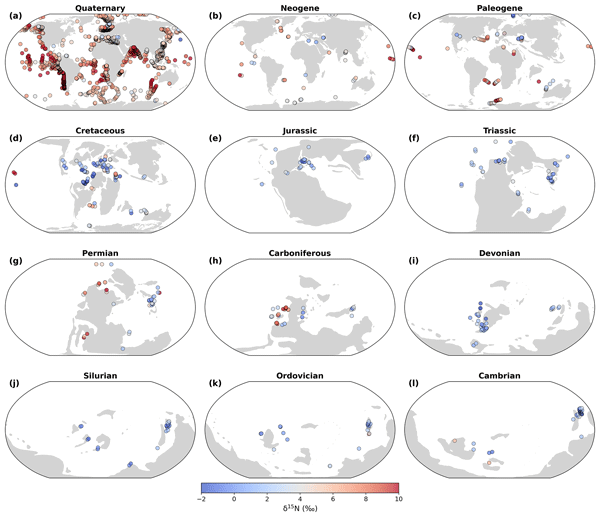
Yong Du, Huyue Song, Thomas J. Algeo, Hui Zhang, Jianwei Peng, Yuyang Wu, Jiankang Lai, Xiang Shu, Hanchen Song, Lai Wei, Jincheng Zhang, Eva E. Stüeken, Stephen E. Grasby, Jacopo Dal Corso, Xiaokang Liu, Daoliang Chu, Li Tian, Qingzhong Liang, Xinchuan Li, Hong Yao, and Haijun Song
Earth Syst. Sci. Data, 18, 675–690, https://doi.org/10.5194/essd-18-675-2026, https://doi.org/10.5194/essd-18-675-2026, 2026
Short summary
Short summary
This study presents a global database of nitrogen isotope data from ancient ocean sediments, covering Earth's history from the present back to billions of years ago. The database includes over 70 000 nitrogen isotope records from 417 studies, along with essential geological context and related chemical data. This database will help reveal the mechanisms behind critical events like mass extinctions and major ocean changes, enhancing our understanding of Earth's long-term environmental processes.
Cited articles
Alcott, L. J., Krause, A. J., Hammarlund, E. U., Bjerrum, C. J., Scholz, F., Xiong, Y., Hobson, A. J., Neve, L., Mills, B. J. W., März, C., Schnetger, B., Bekker, A., and Poulton, S. W.: Development of Iron Speciation Reference Materials for Palaeoredox Analysis, Geostand. Geoanal. Res., 44, 581–591, https://doi.org/10.1111/ggr.12342, 2020.
Algeo, T., Shen, Y., Zhang, T., Lyons, T., Bates, S., Rowe, H., and Nguyen, T. K. T.: Association of 34S-depleted pyrite layers with negative carbonate δ13C excursions at the Permian-Triassic boundary: Evidence for upwelling of sulfidic deep-ocean water masses, Geochem. Geophys. Geosyst., 9, https://doi.org/10.1029/2007GC001823, 2008.
Algeo, T. J. and Tribovillard, N.: Environmental analysis of paleoceanographic systems based on molybdenum–uranium covariation, Chem. Geol., 268, 211–225, https://doi.org/10.1016/j.chemgeo.2009.09.001, 2009.
Algeo, T. J. and Twitchett, R. J.: Anomalous Early Triassic sediment fluxes due to elevated weathering rates and their biological consequences, Geology, 38, 1023–1026, https://doi.org/10.1130/G31203.1, 2010.
Algeo, T. J., Ellwood, B., Nguyen, T. K. T., Rowe, H., and Maynard, J. B.: The Permian–Triassic boundary at Nhi Tao, Vietnam: evidence for recurrent influx of sulfidic watermasses to a shallow-marine carbonate platform, Palaeogeogr. Palaeoclimatol. Palaeoecol., 252, 304–327, https://doi.org/10.1016/j.palaeo.2006.11.055, 2007.
Algeo, T. J., Hinnov, L., Moser, J., Maynard, J. B., Elswick, E., Kuwahara, K., and Sano, H.: Changes in productivity and redox conditions in the Panthalassic Ocean during the latest Permian, Geology, 38, 187–190, https://doi.org/10.1130/G30483.1, 2010.
Algeo, T. J., Kuwahara, K., Sano, H., Bates, S., Lyons, T., Elswick, E., Hinnov, L., Ellwood, B., Moser, J., and Maynard, J. B.: Spatial variation in sediment fluxes, redox conditions, and productivity in the Permian–Triassic Panthalassic Ocean, Palaeogeogr. Palaeoclimatol. Palaeoecol., 308, 65–83, https://doi.org/10.1016/j.palaeo.2010.07.007, 2011.
Algeo, T. J., Henderson, C. M., Tong, J., Feng, Q., Yin, H., and Tyson, R. V.: Plankton and productivity during the Permian–Triassic boundary crisis: an analysis of organic carbon fluxes. Glob. Planet. Change, 105, 52–67, https://doi.org/10.1016/j.gloplacha.2012.02.008, 2013.
Beatty, T. W., Zonneveld, J. P., and Henderson, C. M.: Anomalously diverse Early Triassic ichnofossil assemblages in northwest Pangea: A case for a shallow-marine habitable zone, Geology, 36, 771–774, https://doi.org/10.1130/G24952A.1, 2008.
Bjerrum, C. J. and Canfield, D. E.: Ocean productivity before about 1.9 Gyr ago limited by phosphorus adsorption onto iron oxides, Nature, 417, 159–162, https://doi.org/10.1038/417159a, 2002.
Bond, D. P. G. and Wignall, P. B.: Pyrite framboid study of marine Permian–Triassic boundary sections: A complex anoxic event and its relationship to contemporaneous mass extinction, GSA Bull., 122, 1265–1279, https://doi.org/10.1130/B30042.1, 2010.
Burgess, S. D. and Bowring, S. A.: High-precision geochronology confirms voluminous magmatism before, during, and after Earth's most severe extinction, Sci. Adv. 1, e1500470, https://doi.org/10.1126/sciadv.1500470, 2015.
Canfield, D. E., Raiswell, R., Westrich, J. T., Reaves, C. M., and Berner, R. A.: The use of chromium reduction in the analysis of reduced inorganic sulfur in sediments and shales, Chem. Geol., 54, 149–155, https://doi.org/10.1016/0009-2541(86)90078-1, 1986.
Cao, C., Love, G. D., Hays, L. E., Wang, W., Shen, S., and Summons, R. E.: Biogeochemical evidence for euxinic oceans and ecological disturbance presaging the end-Permian mass extinction event, Earth Planet. Sci. Lett., 281, 188–201, https://doi.org/10.1016/j.epsl.2009.02.012, 2009.
Cawood, P. A., Zhao, G. C., Yao, J. L., Wang, W., Xu, Y. J., and Wang, Y. J.: Reconstructing South China in Phanerozoic and Precambrian supercontinents, Earth Sci. Rev. 186, 173–194, https://doi.org/10.1016/j.earscirev.2017.06.001, 2018.
Chen, J. T., Montañez, P. I., Qi, Y. P., Shen, S. Z., and Wang, X. D.: Strontium and carbon isotopic evidence for decoupling of pCO2 from continental weathering at the apex of the late Paleozoic glaciation, Geology, 46, 395–398, https://doi.org/10.1130/G40093.1, 2018.
Chen, Z. Q. and Benton, M. J.: The timing and pattern of biotic recovery following the end-Permian mass extinction, Nat. Geosci., 5, 375–383, https://doi.org/10.1038/ngeo1475, 2012.
Chen, Z. Q., Fang, Y., Wignall, P. B., Guo, Z., Wu, S., Liu, Z., Wang, R., Huang, Y., and Feng, X.: Microbial Blooms Triggered Pyrite Framboid Enrichment and Oxygen Depletion in Carbonate Platforms Immediately After the Latest Permian Extinction, Geophys. Res. Lett., 49, e2021GL096998, https://doi.org/10.1029/2021GL096998, 2022.
Clarkson, M. O., Poulton, S. W., Guilbaud, R., and Wood, R. A.: Assessing the utility of Fe
Clarkson, M. O., Wood, R. A., Poulton, S. W., Richoz, S., Newton, R. J., Kasemann, S. A., Bowyer, F., and Krystyn, L.: Dynamic anoxic ferruginous conditions during the end-Permian mass extinction and recovery, Nat Commun., 7, 12236, https://doi.org/10.1038/ncomms12236, 2016.
Crowell, J. C.: The Ending of the Late Paleozoic Ice Age During the Permian Period, in: The Permian of Northern Pangea, edited by: Scholle, P. A., Peryt, T. M., and Ulmer-Scholle, D. S., Springer, Berlin, Heidelberg, https://doi.org/10.1007/978-3-642-78593-1_5, 1995.
Erwin, D. H.: Extinction: How life on Earth nearly ended 250 million years ago, Princeton University Press, Princeton, NJ, US, viii, 296 pp., ISBN 0691005249, 2006.
Fan, J. X., Shen, S. Z., Erwin, D. H., Sadler, P. M., MacLeod, N., Cheng, Q. M., Hou, X. D., Yang, J., Wang, X. D., Wang, Y., Zhang, H., Chen, X., Li, G. X., Zhang, Y. C., Shi, Y. K., Yuan, D. X., Chen, Q., Zhang, L. N., Li, C., and Zhao, Y. Y.: A high-resolution summary of Cambrian to Early Triassic marine invertebrate biodiversity, Science, 367, 272–277, https://doi.org/10.1126/science.aax4953, 2020.
Feng, Z. Z., Yang, Y. Q., Jin, Z. K., He, Y. B., Wu, S. H., Xin, W. J., Bao, Z. D., and Tan, J.: Lithofacies paleogeography of the Permian of South China, Acta Sedimentol. Sin., 14, 1–11, 1996 (in Chinese with English abstract).
Foster, W. J. and Twitchett, R. J.: Functional diversity of marine ecosystems after the Late Permian mass extinction event, Nat. Geosci., 7, 233–238, https://doi.org/10.1038/ngeo2079, 2014.
Frank, A. B., Karapunar, B., Grasby, S. E., Koşun, E., Lahajnar, N., Gómez Correa, M. A., Buchwald, S. Z., Metzke, M., and Foster, W. J.: Assessing the role of anoxia as a potential extinction driver in the shallow marine Neotethys during the Permian-Triassic mass extinction, Chem. Geol., 696, 123108, https://doi.org/10.1016/j.chemgeo.2025.123108, 2025.
Garbelli, C., Angiolini, L., Brand, U., Shen, S., Jadoul, F., Posenato, R., Azmy, K., and Cao, C.: Neotethys seawater chemistry and temperature at the dawn of the end Permian mass extinction, Gondwana Res., 35, 272–285, https://doi.org/10.1016/j.gr.2015.05.012, 2016.
Ge, X., Chen, D., Zhang, G., Huang, T., Liu, M., and El-Shafeiy, M.: Marine redox evolution and organic accumulation in an intrashelf basin, NE Sichuan Basin during the Late Permian, Mar. Pet. Geol., 140, 105633, https://doi.org/10.1016/j.marpetgeo.2022.105633, 2022.
Ge, Y. and Bond, D. P. G.: Two deep marine oxygenation events during the Permian-Triassic boundary interval in South China: Relationship with ocean circulation and marine primary productivity, Earth-Sci. Rev., 234, 104220, https://doi.org/10.1016/j.earscirev.2022.104220, 2022.
Grasby, S. E. and Beauchamp, B.: Intrabasin variability of the carbon-isotope record across the Permian–Triassic transition, Sverdrup Basin, Arctic Canada, Chem. Geol., 253, 141–150, https://doi.org/10.1016/j.chemgeo.2008.05.005, 2008.
Grasby, S. E., Beauchamp, B., Embry, A., and Sanei, H.: Recurrent Early Triassic ocean anoxia, Geology, 41, 175–178, https://doi.org/10.1130/G33599.1, 2013.
Grasby, S. E., Beauchamp, B., and Knies, J.: Early Triassic productivity crises delayed recovery from world's worst mass extinction, Geology, 44, 779–782, https://doi.org/10.1130/G38141.1, 2016.
Grasby, S. E., Knies, J., Beauchamp, B., Bond, D. P. G., Wignall, P., and Sun, Y.: Global warming leads to Early Triassic nutrient stress across northern Pangea, GSA Bull., 132, 943–954, https://doi.org/10.1130/B32036.1, 2020.
Grasby, S. E., Bond, D. P. G., Wignall, P. B., Yin, R., Strachan, L. J., and Takahashi, S.: Transient Permian-Triassic euxinia in the southern Panthalassa deep ocean, Geology, 49, 889–893, https://doi.org/10.1130/G48928.1, 2021.
Grice, K., Cao, C., Love, G. D., Böttcher, M. E., Twitchett, R. J., Grosjean, E., Summons, R. E., Turgeon, S. C., Dunning, W., and Jin, Y.: Photic Zone Euxinia During the Permian-Triassic Superanoxic Event, Science, 307, 706–709, https://doi.org/10.1126/science.1104323, 2005.
He, B., Xu, Y. G., Huang, X. L., Luo, Z. Y., Shi, Y. R., Yang, Q. J., and Yu, S. Y.: Age and duration of the Emeishan flood volcanism, SW China: Geochemistry and SHRIMP zircon U-Pb dating of silicic ignimbrites, post-volcanic Xuanwei Formation and clay tuff at the Chaotian section, Earth Planet. Sci. Lett. 255, 306–323, https://doi.org/10.1016/j.epsl.2006.12.021, 2007.
Henderson, C. M.: Uppermost Permian conodonts and the Permian-Triassic boundary in the Western Canada Sedimentary Basin, B. Can. Petrol. Geol., 45, 693–707, 1997.
Hülse, D., Lau, K. V., van de Velde, S. J., Arndt, S., Meyer, K. M., and Ridgwell, A.: End-Permian marine extinction due to temperature-driven nutrient recycling and euxinia, Nat. Geosci., 14, 862–867, https://doi.org/10.1038/s41561-021-00829-7, 2021.
Isozaki, Y.: Permo-Triassic Boundary Superanoxia and Stratified Superocean: Records from Lost Deep Sea, Science, 276, 235–238, https://doi.org/10.1126/science.276.5310.235, 1997.
Isozaki, Y.: Integrated “plume winter” scenario for the double-phased extinction during the Paleozoic–Mesozoic transition: The G-LB and P-TB events from a Panthalassan perspective, J. Asian Earth Sci., 36, 459–480, https://doi.org/10.1016/j.jseaes.2009.05.006, 2009.
Joachimski, M. M., Lai, X., Shen, S., Jiang, H., Luo, G., Chen, B., Chen, J., and Sun, Y.: Climate warming in the latest Permian and the Permian–Triassic mass extinction, Geology, 40, 195–198, https://doi.org/10.1130/G32707.1, 2012.
Knies, J., Schönenberger, J., Zwingmann, H., van der Lelij, R., Smelror, M., Vullum, P. E., Brönner, M., Vogt, C., Fredin, O., Müller, A., Grasby, S. E., Beauchamp, B., and Viola, G.: Continental weathering and recovery from ocean nutrient stress during the Early Triassic Biotic Crisis, Commun. Earth Environ., 3, 161, https://doi.org/10.1038/s43247-022-00480-z, 2022.
Kump, L. R., Pavlov, A., and Arthur, M. A.: Massive release of hydrogen sulfide to the surface ocean and atmosphere during intervals of oceanic anoxia, Geology, 33, 397–400, https://doi.org/10.1130/G21295.1, 2005.
Lau, K. V., Maher, K., Altiner, D., Kelley, B. M., Kump, L. R., Lehrmann, D. J., Silva-Tamayo, J. C., Weaver, K. L., Yu, M., and Payne, J. L.: Marine anoxia and delayed Earth system recovery after the end-Permian extinction, P. Natl. Acad. Sci. USA, 113, 2360–2365, https://doi.org/10.1073/pnas.1515080113, 2016.
Lei, L. D., Shen, J., Li, C., Algeo, T. J., Chen, Z. Q., Feng, Q. L., Cheng, M., Jin, C. S., and Huang, J. H.: Controls on regional marine redox evolution during Permian-Triassic transition in South China, Palaeogeogr. Palaeoclimatol. Palaeoecol., 486, 17–32, https://doi.org/10.1016/j.palaeo.2017.02.010, 2017.
López-Gómez, J., Arche, A., Marzo, M., and Durand, M.: Stratigraphical and palaeogeographical significance of the continental sedimentary transition across the Permian–Triassic boundary in Spain, Palaeogeogr. Palaeoclimatol. Palaeoecol., 229, 3–23, https://doi.org/10.1016/j.palaeo.2004.11.028, 2005.
Luo, G., Kump, L. R., Wang, Y., Tong, J., Arthur, M. A., Yang, H., Huang, J., Yin, H., and Xie, S.: Isotopic evidence for an anomalously low oceanic sulfate concentration following end-Permian mass extinction, Earth Planet. Sci. Lett., 300, 101–111, https://doi.org/10.1016/j.epsl.2010.09.041, 2010.
Medici, G., West, L. J., and Mountney, N. P.: Sedimentary flow heterogeneities in the Triassic U.K. Sherwood Sandstone Group: insights for hydrocarbon exploration, Geol. J., 54, 1361–1378, https://doi.org/10.1002/gj.3233, 2019.
Mettam, C., Zerkle, A. L., Claire, M. W., Izon, G., Junium, C. J., and Twitchett, R. J.: High-frequency fluctuations in redox conditions during the latest Permian mass extinction, Paleogeogr. Paleoclimatol. Paleoecol., 485, 210–223, https://doi.org/10.1016/j.palaeo.2017.06.014, 2017.
Meyer, K. M., Kump, L. R., and Ridgwell, A.: Biogeochemical controls on photic-zone euxinia during the end-Permian mass extinction, Geology, 36, 747–750, https://doi.org/10.1130/G24618A.1, 2008.
Monger, J. and Price, R.: The Canadian Cordillera: geology and tectonic evolution, GSEG Recorder, 27, 17–36, 2002.
Müller, J., Sun, Y., Yang, F., Fantasia, A., and Joachimski, M.: Phosphorus Cycle and Primary Productivity Changes in the Tethys Ocean During the Permian-Triassic Transition: Starving Marine Ecosystems, Front. Earth Sci., 10, https://doi.org/10.3389/feart.2022.832308, 2022.
Müller, J., Sun, Y. D., Yang, F., Regelous, M., and Joachimski, M. M.: Manganous water column in the Tethys Ocean during the Permian-Triassic transition, Glob. Planet. Change., 222, 104067, https://doi.org/10.1016/j.gloplacha.2023.104067, 2023.
Newby, S. M., Owens, J. D., Schoepfer, S. D., and Algeo, T. J.: Transient ocean oxygenation at end-Permian mass extinction onset shown by thallium isotopes, Nat. Geosci., 14, 678–683, https://doi.org/10.1038/s41561-021-00802-4, 2021.
Nielsen, J. K., Shen, Y., Piasecki, S., and Stemmerik, L.: No abrupt change in redox condition caused the end-Permian marine ecosystem collapse in the East Greenland Basin, Earth Planet. Sci. Lett., 291, 32–38, https://doi.org/10.1016/j.epsl.2009.12.043, 2010.
Papadomanolaki, N. M., Lenstra, W. K., Wolthers, M., and Slomp, C. P.: Enhanced phosphorus recycling during past oceanic anoxia amplified by low rates of apatite authigenesis, Sci. Adv., 8, eabn2370, https://doi.org/10.1126/sciadv.abn2370, 2022.
Pietsch, C., Ritterbush, K. A., Thompson, J. R., Petsios, E., and Bottjer, D. J.: Evolutionary models in the early Triassic marine realm, Palaeogeogr. Palaeoclimatol. Palaeoecol. 513, 65–85, https://doi.org/10.1016/j.palaeo.2017.12.016, 2019.
Poulton, S. W.: The Iron Speciation Paleoredox Proxy, Elements in Geochemical Tracers in Earth System Science, Cambridge University Press, https://doi.org/10.1017/9781108847148, 2021.
Poulton, S. W. and Canfield, D. E.: Development of a sequential extraction procedure for iron: implications for iron partitioning in continentally derived particulates, Chem. Geol., 214, 209–221, https://doi.org/10.1016/j.chemgeo.2004.09.003, 2005.
Poulton, S. W. and Canfield, D. E.: Ferruginous Conditions: A Dominant Feature of the Ocean through Earth's History, Elements, 7, 107–112, https://doi.org/10.2113/gselements.7.2.107, 2011.
Poulton, S. W. and Raiswell, R.: The low-temperature geochemical cycle of iron: From continental fluxes to marine sediment deposition, Am. J. Sci., 302, 774–805, https://doi.org/10.2475/ajs.302.9.774, 2002.
Proemse, B. C., Grasby, S. E., Wieser, M. E., Mayer, B., and Beauchamp, B.: Molybdenum isotopic evidence for oxic marine conditions during the latest Permian extinction, Geology, 41, 967–970, https://doi.org/10.1130/G34466.1, 2013.
Pruss, S. B., Bottjer, D. J., Corsetti, F. A., and Baud, A.: A global marine sedimentary response to the end-Permian mass extinction: Examples from southern Turkey and the western United States, Earth-Sci. Rev., 78, 193–206, https://doi.org/10.1016/j.earscirev.2006.05.002, 2006.
Schobben, M., Stebbins, A., Ghaderi, A., Strauss, H., Korn, D., and Korte, C.: Flourishing ocean drives the end-Permian marine mass extinction, P. Natl. Acad. Sci. USA, 112, 10298–10303, https://doi.org/10.1073/pnas.1503755112, 2015.
Schobben, M., Foster, W. J., Sleveland, A. R. N., Zuchuat, V., Svensen, H. H., Planke, S., Bond, D. P. G., Marcelis, F., Newton, R. J., Wignall, P. B., and Poulton, S. W.: A nutrient control on marine anoxia during the end-Permian mass extinction, Nat. Geosci., 13, 640–646, https://doi.org/10.1038/s41561-020-0622-1, 2020.
Scotese, C.: Atlas of Middle & Late Permian and Triassic Paleogeographic Maps, Atlas of Middle & Late Permian and Triassic Paleogeographic Maps, Maps 43–52, Volumes 3 & 4, PALEOMAP PaleoAtlas for ArcGIS, PALEOMAP Project, Evanston, IL, https://doi.org/10.13140/2.1.2609.9209, 2014.
Sepkoski, J. J.: A Factor Analytic Description of the Phanerozoic Marine Fossil Record, Paleobiology, 7, 36–53, 1981.
Sheldon, N. D.: Abrupt chemical weathering increase across the Permian–Triassic boundary, Palaeogeogr. Palaeoclimatol. Palaeoecol., 231, 315–321, https://doi.org/10.1016/j.palaeo.2005.09.001, 2006.
Shen, J., Algeo, T. J., Hu, Q., Zhang, N., Zhou, L., Xia, W., Xie, S., and Feng, Q.: Negative C-isotope excursions at the Permian-Triassic boundary linked to volcanism, Geology, 40, 963–966, https://doi.org/10.1130/G33329.1, 2012.
Shen, J., Schoepfer, S. D., Feng, Q.L., Zhou, L., Yu, J. X., Song, H. Y., Wie, H. Y., and Algeo, T. J.: Marine productivity changes during the end-Permian crisis and Early Triassic recovery, Earth-Sci. Rev., 149, 136–162, https://doi.org/10.1016/j.earscirev.2014.11.002, 2015.
Shen, J., Feng, Q., Algeo, T. J., Li, C., Planavsky, N. J., Zhou, L., and Zhang, M.: Two pulses of oceanic environmental disturbance during the Permian–Triassic boundary crisis, Earth Planet. Sci. Lett., 443, 139–152, https://doi.org/10.1016/j.epsl.2016.03.030, 2016.
Shen, Y., Farquhar, J., Zhang, H., Masterson, A., Zhang, T., and Wing, B. A.: Multiple S-isotopic evidence for episodic shoaling of anoxic water during Late Permian mass extinction, Nat Commun., 2, 210, https://doi.org/10.1038/ncomms1217, 2011.
Song, H., Tong, J., Algeo, T. J., Song, H., Qiu, H., Zhu, Y., Tian, L., Bates, S., Lyons, T. W., Luo, G., and Kump, L. R.: Early Triassic seawater sulfate drawdown, Geochim. Cosmochim. Acta., 128, 95–113, https://doi.org/10.1016/j.gca.2013.12.009, 2014.
Stebbins, A., Williams, J., Brookfield, M., Nye, S. W., and Hannigan, R.: Frequent euxinia in southern Neo-Tethys Ocean prior to the end-Permian biocrisis: Evidence from the Spiti region, India, Palaeogeogr. Palaeoclimatol. Palaeoecol., 516, 1–10, https://doi.org/10.1016/j.palaeo.2018.11.030, 2019.
Sun, H., Xiao, Y., Gao, Y., Zhang, G., Casey, J. F., and Shen, Y.: Rapid enhancement of chemical weathering recorded by extremely light seawater lithium isotopes at the Permian–Triassic boundary, P. Natl. Acad. Sci. USA, 115, 3782–3787, https://doi.org/10.1073/pnas.1711862115, 2018.
Sun, Y.: Dynamics of nutrient cycles in the Permian–Triassic oceans, Earth-Sci. Rev., 258, 104914, https://doi.org/10.1016/j.earscirev.2024.104914, 2024.
Sun, Y., Joachimski, M. M., Wignall, P. B., Yan, C., Chen, Y., Jiang, H., Wang, L., and Lai, X.: Lethally Hot Temperatures During the Early Triassic Greenhouse, Science, 338, 366–370, https://doi.org/10.1126/science.1224126, 2012.
Takahashi, S., Hori, R. S., Yamakita, S., Aita, Y., Takemura, A., Ikehara, M., Xiong, Y., Poulton, S. W., Wignall, P. B., Itai, T., Campbell, H. J., and Spörli, B. K.: Progressive development of ocean anoxia in the end-Permian pelagic Panthalassa, Glob. Planet. Change, 207, 103650, https://doi.org/10.1016/j.gloplacha.2021.103650, 2021.
Taniwaki, T., Elders, C., Böttcher, M. E., Holman, A. I., and Grice, K.: Photic zone redox oscillations and microbialite development recorded by Early Triassic sediments of the Perth Basin: A geochemical approach, Geochim. Cosmochim. Acta., 336, 188–207, https://doi.org/10.1016/j.gca.2022.09.011, 2022.
Taylor, S. R., and McLennan, S. M.: The Continental Crust: Its Composition and Evolution, Blackwell Scientific Publications, Oxford, ISBN 0-632-01148-3, 1985.
Tribovillard, N., Algeo, T. J., Lyons, T., and Riboulleau, A.: Trace metals as paleoredox and paleoproductivity proxies: An update, Chem. Geol., 232, 12–32, https://doi.org/10.1016/j.chemgeo.2006.02.012, 2006.
Tribovillard, N., Algeo, T. J., Baudin, F., and Riboulleau, A.: Analysis of marine environmental conditions based onmolybdenum–uranium covariation – Applications to Mesozoic paleoceanography, Chem. Geol., 324–325, 46–58, https://doi.org/10.1016/j.chemgeo.2011.09.009, 2012.
Wan, T. F.: The Tectonics of China: Data, Maps and Evolution, Springer-Verlag, Berlin, Heidelberg, https://doi.org/10.1007/978-3-642-11868-5, 2012.
Wang, Y., Qian, X., Cawood, P. A., Liu, H., Feng, Q., Zhao, G., Zhang, Y., He, H., and Zhang, P.: Closure of the East Paleotethyan Ocean and amalgamation of the Eastern Cimmerian and Southeast Asia continental fragments, Earth-Sci. Rev.186, 195–230, https://doi.org/10.1016/j.earscirev.2017.09.013, 2018.
Warren, J. K.: Evaporites through time: Tectonic, climatic and eustatic controls in marine and nonmarine deposits, Earth Sci. Rev., 98, 217–268, https://doi.org/10.1016/j.earscirev.2009.11.004, 2010.
Wignall, P. and Twitchett, R.: Extent, duration, and nature of the Permian-Triassic superanoxic event, in: Catastrophic events and mass extinctions: impacts and beyond, Special Paper 356, edited by: Koeberl, C., and MacLoed, K., Geological Society of America, 395–413, https://doi.org/10.1130/0-8137-2356-6.395, 2002.
Wignall, P. B. and Hallam, A.: Anoxia as a cause of the Permian/Triassic mass extinction: facies evidence from northern Italy and the western United States, Palaeogeogr. Palaeoclimatol. Palaeoecol., 93, 21–46, https://doi.org/10.1016/0031-0182(92)90182-5, 1992.
Wignall, P. B. and Newton, R.: Contrasting Deep-Water Records from the Upper Permian and Lower Triassic of South Tibet and British Columbia: Evidence for a Diachronous Mass Extinction, Palaios, 18, 153–167, 2003.
Wignall, P. B. and Twitchett, R. J.: Oceanic Anoxia and the End Permian Mass Extinction, Science, 272, 1155–1158, https://doi.org/10.1126/science.272.5265.1155, 1996.
Wilkin, R. T. and Barnes, H. L.: Pyrite formation by reactions of iron monosulfides with dissolved inorganic and organic sulfur species, Geochim. Cosmochim. Acta., 60, 4167–4179, https://doi.org/10.1016/S0016-7037(97)81466-4, 1996.
Wilkin, R. T., Barnes, H. L., and Brantley, S. L.: The size distribution of framboidal pyrite in modern sediments: An indicator of redox conditions, Geochim. Cosmochim. Acta., 60, 3897–3912, https://doi.org/10.1016/0016-7037(96)00209-8, 1996.
Winguth, C. and Winguth, A. M.: Simulating Permian–Triassic oceanic anoxia distribution: Implications for species extinction and recovery, Geology, 40, 127–130, https://doi.org/10.1130/g32453.1, 2012.
Woods, A. D., Zonneveld, J. P., and Wakefield, R.: Hyperthermal-driven anoxia and reduced productivity in the aftermath of the Permian-Triassic mass extinction: a case study from Western Canada, Front. Earth Sci., 11, https://doi.org/10.3389/feart.2023.1323413, 2023.
Wu, Y., Pohl, A., Tian, L., Corso, J. D., Cui, Y., Chu, D., Tong, J., Song, H., Song, H., and Song, H.: Recurrent marine anoxia in the Paleo-Tethys linked to constriction of seaways during the Early Triassic, Earth Planet. Sci. Lett., 643, 118882, https://doi.org/10.1016/j.epsl.2024.118882, 2024.
Xiang, L., Schoepfer, S. D., Zhang, H., Yuan, D., Cao, C., Zheng, Q., Henderson, C. M., and Shen, S.: Oceanic redox evolution across the end-Permian mass extinction at Shangsi, South China, Paleogeogr. Paleoclimatol. Paleoecol. 448, 59–71, https://doi.org/10.1016/j.palaeo.2015.10.046, 2016.
Xiang, L., Zhang, H., Schoepfer, S. D., Cao, C., Zheng, Q., Yuan, D., Cai, Y., and Shen, S.: Oceanic redox evolution around the end-Permian mass extinction at Meishan, South China, Paleogeogr. Paleoclimatol. Paleoecol., 544, 109626, https://doi.org/10.1016/j.palaeo.2020.109626, 2020.
Xiang, L., Schoepfer, S. D., Yuan, D. X., Zheng, Q. F., and Zhang, H.: Oceanic redox evolution across the end-Permian mass extinction at Penglaitan section, South China, Palaeoworld, 31, 93–102, https://doi.org/10.1016/j.palwor.2021.02.003, 2022.
Xiong, Y., Guilbaud, R., Peacock, C. L., Cox, R. P., Canfield, D. E., Krom, M. D., and Poulton, S. W.: Phosphorus cycling in Lake Cadagno, Switzerland: A low sulfate euxinic ocean analogue, Geochim. Cosmochim. Acta., 251, 116–135, https://doi.org/10.1016/j.gca.2019.02.011, 2019.
Yang, F., Sun, Y. D., Frings, P. J., Luo, L., E, J. W., Wang, L. N., Huang, Y. F., Wang, T., Müller, J., and Xie, S. C.: Collapse of Late Permian chert factories in the equatorial Tethys and the nature of the Early Triassic chert gap, Earth Planet. Sci. Lett., 600, 117861, https://doi.org/10.1016/j.epsl.2022.117861, 2022.
Yang, F., Li, S., An, K. Y., Bond, P. G. D., Ao, R., Wu, X. B., Ma, L. L., and Sun, Y. D.: Re-Evaluating Water Column Reoxygenation During the End Permian Mass Extinction. Geochem. Geophys. Geosyst. 25, https://doi.org/10.1029/2024gc011779, 2024.
Yang, F., Li, S., Grasby, S., Bond, D., Pan, M., and Sun, Y.: Open Supporting Information for: Permian-Triassic redox shift and its ferruginous aftermath in epicontinental seas, Zenodo [data set], https://doi.org/10.5281/zenodo.21429153, 2026.
Yuan, D., Shen, S., Henderson, C. M., Chen, J., Zhang, H., and Feng, H.: Revised conodont-based integrated high-resolution timescale for the Changhsingian Stage and end-Permian extinction interval at the Meishan sections, South China, Lithos, 204, 220–245, https://doi.org/10.1016/j.lithos.2014.03.026, 2014.
Zegeye, A., Bonneville, S., Benning, L. G., Sturm, A., Fowle, D. A., Jones, C., Canfield, D. E., Ruby, C., MacLean, L. C., Nomosatryo, S., Crowe, S. A., and Poulton, S. W.: Green rust formation controls nutrient availability in a ferruginous water column, Geology, 40, 599–602, https://doi.org/10.1130/G32959.1, 2012.
Zhang, G., Zhang, X., Hu, D., Li, D., Algeo, T. J., Farquhar, J., Henderson, C. M., Qin, L., Shen, M., Shen, D., Schoepfer, S. D., Chen, K., and Shen, Y.: Redox chemistry changes in the Panthalassic Ocean linked to the end-Permian mass extinction and delayed Early Triassic biotic recovery, P. Natl. Acad. Sci. USA, 114, 1806–1810, https://doi.org/10.1073/pnas.1610931114, 2017.
Zhang, M., Qin, H., Hou, Y., He, K., Deng, C., Shen, S. Z., and Pan, Y. X.: Shifts in magnetic mineral assemblages support ocean deoxygenation before the end-Permian mass extinction, Commun. Earth Environ., 5, 218, https://doi.org/10.1038/s43247-024-01394-8, 2024.
Zhang, Y. X., Wen, H. J., Fan, H. F., Zhu, C. W., Xiao, J. F., and Qiao, P.: Cadmium isotopic evidence for reduced deep-water marine primary productivity during the end-Permian mass extinction, Earth Planet. Sci. Lett., 621, https://doi.org/10.1016/j.epsl.2023.118371, 2023.
Zelt, C. A., Ellis, R. M., and Zelt, B. C.: Three-dimensional structure across the Tintina strike-slip fault, northern Canadian Cordillera, from seismic refraction and reflection tomography, Geophys. J. Int. 167, 1292–1308, https://doi.org/10.1111/j.1365-246X.2006.03090.x, 2006.
Short summary
The end-Permian mass extinction was the most severe loss of life in Earth history, yet the role of ocean oxygen restriction remains debated. We examined rock records from South China and western Canada to track redox conditions before and after the crisis. Oxygen levels were already low prior to the extinction, and widespread seafloor anoxia developed at its peak. Afterwards, ferruginous conditions dominated, reducing nutrient availability, limiting productivity, and slowing life’s recovery.
The end-Permian mass extinction was the most severe loss of life in Earth history, yet the role...


