
Articles | Volume 22, issue 5
https://doi.org/10.5194/cp-22-1023-2026
© Author(s) 2026. This work is distributed under
the Creative Commons Attribution 4.0 License.
the Creative Commons Attribution 4.0 License.
https://doi.org/10.5194/cp-22-1023-2026
© Author(s) 2026. This work is distributed under
the Creative Commons Attribution 4.0 License.
the Creative Commons Attribution 4.0 License.
Research article
| 
15 May 2026
Research article |
| 15 May 2026
| 15 May 2026
Microscale alkenone heterogeneity and replicability of ultra-high-resolution temperature records from marine sediments
Alfred-Wegener-Institut, Helmholtz Center for Polar and Marine Research, Potsdam, 14473, Germany
University of Bremen, MARUM – Center for Marine Environmental Sciences and Faculty of Geosciences, Bremen, 28334, Germany
Lars Wörmer
University of Bremen, MARUM – Center for Marine Environmental Sciences and Faculty of Geosciences, Bremen, 28334, Germany
Kai-Uwe Hinrichs
University of Bremen, MARUM – Center for Marine Environmental Sciences and Faculty of Geosciences, Bremen, 28334, Germany
Thomas Laepple
Alfred-Wegener-Institut, Helmholtz Center for Polar and Marine Research, Potsdam, 14473, Germany
University of Bremen, MARUM – Center for Marine Environmental Sciences and Faculty of Geosciences, Bremen, 28334, Germany
Related authors
No articles found.
Fyntan Shaw, Torben Kunz, and Thomas Laepple
EGUsphere, https://doi.org/10.5194/egusphere-2026-3558, https://doi.org/10.5194/egusphere-2026-3558, 2026
This preprint is open for discussion and under review for The Cryosphere (TC).
Short summary
Short summary
Estimates of water isotope diffusion lengths in ice cores are used to correct signal loss and infer past firn temperatures, but require accurate spectral fitting. Existing methods neglect effects from discrete sampling, causing an estimation bias which we demonstrate grows with sampling interval and decreasing diffusion length. By incorporating sampling effects into the model fit, we derive an unbiased estimator that improves estimates from coarse data and ice cores with small diffusion lengths.
Kshema Shaju, Thomas Laepple, Nora Hirsch, and Peter Zaspel
Geosci. Instrum. Method. Data Syst., 14, 459–474, https://doi.org/10.5194/gi-14-459-2025, https://doi.org/10.5194/gi-14-459-2025, 2025
Short summary
Short summary
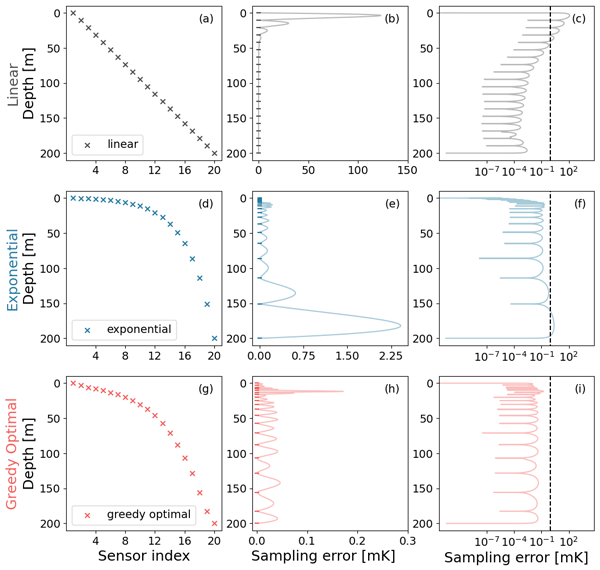
We present a method to optimize the number and placement of temperature sensors in the borehole for borehole thermometry. Based on heat transfer model simulations, a greedy algorithm chooses sensor locations that minimize sampling errors. Applications in Antarctic and Greenland boreholes show this method outperforms traditional linear and exponential spacing, reducing errors up to tenfold. This approach offers an efficient, cost-effective solution to improve subsurface temperature monitoring.
Mara Y. McPartland, Thomas Münch, Andrew M. Dolman, Raphaël Hébert, and Thomas Laepple
Clim. Past, 21, 1917–1931, https://doi.org/10.5194/cp-21-1917-2025, https://doi.org/10.5194/cp-21-1917-2025, 2025
Short summary
Short summary
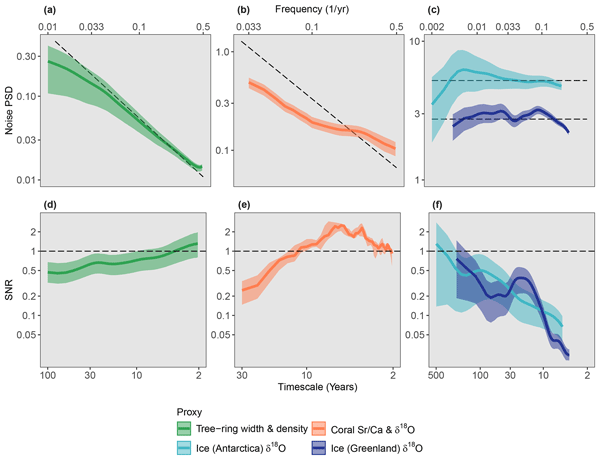
Paleoclimate proxy records contain a combination of climate signals and non-climatic noise. This noise can affect year-to-year variations, or introduce uncertainty on medium and long timescales. Proxies contain different types, or "colors" of noise stemming from the diverse physical and biological processes that go into their creation. We show how non-climatic noise affects tree rings, corals and ice cores. We aim to improve representations of noise in paleoclimate research activities.
Fyntan Shaw, Thomas Münch, Vasileios Gkinis, and Thomas Laepple
The Cryosphere, 19, 4913–4928, https://doi.org/10.5194/tc-19-4913-2025, https://doi.org/10.5194/tc-19-4913-2025, 2025
Short summary
Short summary
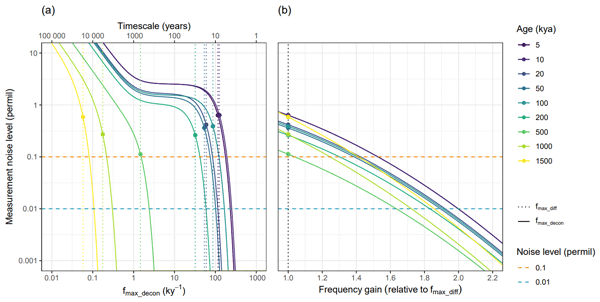
Diffusion in combination with measurement noise erase high-frequency water isotope variability in ice cores, linking measurement precision to recoverable resolution. We derive expressions for this relationship, finding a resolution improvement of 1.5 times for a 10-fold measurement noise reduction. Based on the current age-depth model, our method predicts 10 000-year cycles will be recoverable in the 1.5 Myr old ice from the Oldest Ice Core δ18O record if a noise level of 0.01 ‰ is achieved.
Daniel Müller, Bo Liu, Walter Geibert, Moritz Holtappels, Lasse Sander, Elda Miramontes, Heidi Taubner, Susann Henkel, Kai-Uwe Hinrichs, Denise Bethke, Ingrid Dohrmann, and Sabine Kasten
Biogeosciences, 22, 2541–2567, https://doi.org/10.5194/bg-22-2541-2025, https://doi.org/10.5194/bg-22-2541-2025, 2025
Short summary
Short summary
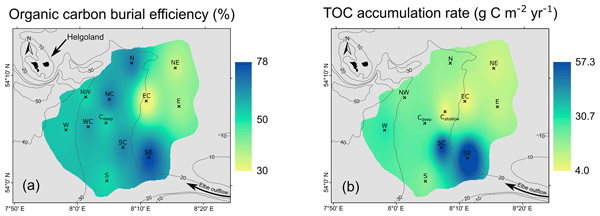
Coastal and shelf sediments are the most important sinks for organic carbon (OC) on Earth. We produced a new high-resolution sediment and porewater data set from the Helgoland Mud Area (HMA), North Sea, to determine which depositional factors control the preservation of OC. The burial efficiency is highest in an area of high sedimentation and terrigenous OC. The HMA covers 0.09 % of the North Sea but accounts for 0.76 % of its OC accumulation, highlighting the importance of the depocentre.
Laura Schild, Peter Ewald, Chenzhi Li, Raphaël Hébert, Thomas Laepple, and Ulrike Herzschuh
Earth Syst. Sci. Data, 17, 2007–2033, https://doi.org/10.5194/essd-17-2007-2025, https://doi.org/10.5194/essd-17-2007-2025, 2025
Short summary
Short summary
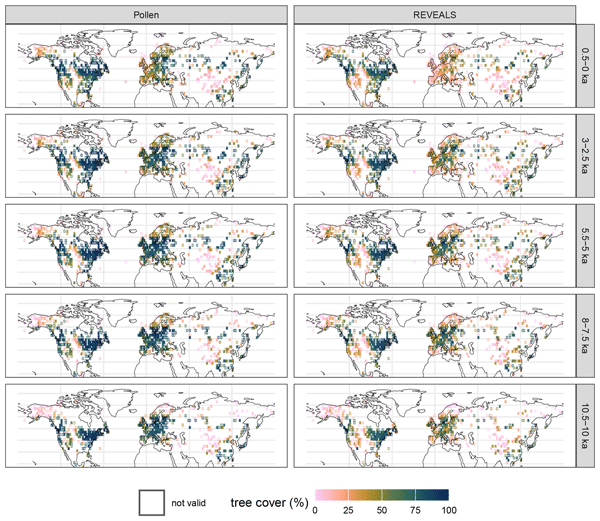
This study reconstructed vegetation and tree cover in the Northern Hemisphere from a harmonized dataset of pollen counts from sediment and peat cores for the past 14 000 years. A model was applied to correct for differences in pollen production between different plants, and modern remote-sensing forest cover was used to validate the reconstructed tree cover. Accurate data on past vegetation are invaluable for the investigation of vegetation–climate dynamics and the validation of vegetation models.
Rémi Dallmayr, Hannah Meyer, Vasileios Gkinis, Thomas Laepple, Melanie Behrens, Frank Wilhelms, and Maria Hörhold
The Cryosphere, 19, 1067–1083, https://doi.org/10.5194/tc-19-1067-2025, https://doi.org/10.5194/tc-19-1067-2025, 2025
Short summary
Short summary
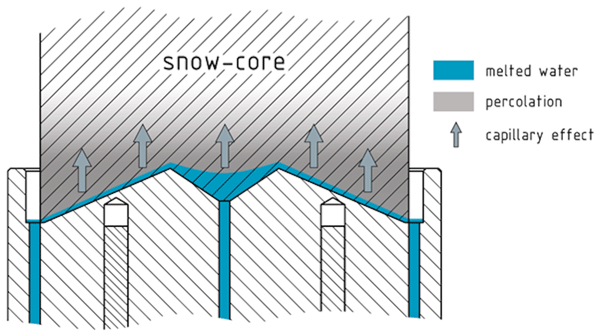
Recent studies showed that a large number of independent vertical profiles allow for inferring a common local climate signal from the stacked stable water isotope record. Through investigating instrumental limitation and the effect of percolation of such porous samples, this study assesses the continuous flow analysis (CFA) technique in order to analyze the significant number of snow surface profiles within a reasonable time and with high quality.
Fyntan Shaw, Andrew M. Dolman, Torben Kunz, Vasileios Gkinis, and Thomas Laepple
The Cryosphere, 18, 3685–3698, https://doi.org/10.5194/tc-18-3685-2024, https://doi.org/10.5194/tc-18-3685-2024, 2024
Short summary
Short summary
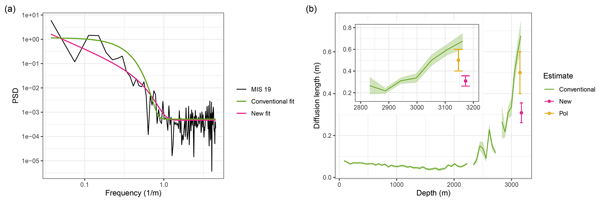
Fast variability of water isotopes in ice cores is attenuated by diffusion but can be restored if the diffusion length is accurately estimated. Current estimation methods are inadequate for deep ice, mischaracterising millennial-scale climate variability. We address this using variability estimates from shallower ice. The estimated diffusion length of 31 cm for the bottom of the Dome C ice core is 20 cm less than the old method, enabling signal recovery on timescales previously considered lost.
Alexandra M. Zuhr, Sonja Wahl, Hans Christian Steen-Larsen, Maria Hörhold, Hanno Meyer, Vasileios Gkinis, and Thomas Laepple
Earth Syst. Sci. Data, 16, 1861–1874, https://doi.org/10.5194/essd-16-1861-2024, https://doi.org/10.5194/essd-16-1861-2024, 2024
Short summary
Short summary
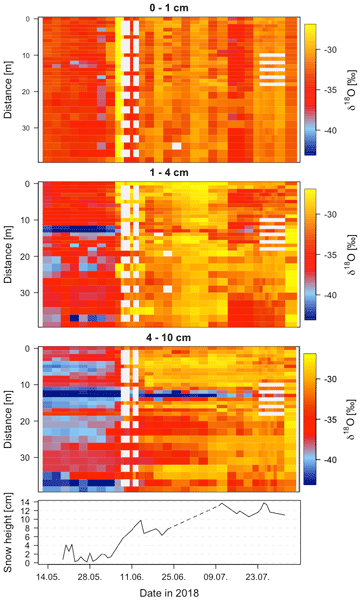
We present stable water isotope data from the accumulation zone of the Greenland ice sheet. A spatial sampling scheme covering 39 m and three depth layers was carried out between 14 May and 3 August 2018. The data suggest spatial and temporal variability related to meteorological conditions, such as wind-driven snow redistribution and vapour–snow exchange processes. The data can be used to study the formation of the stable water isotopes signal, which is seen as a climate proxy.
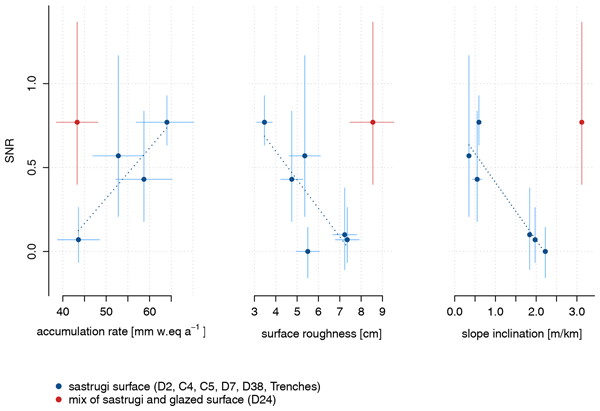
Nora Hirsch, Alexandra Zuhr, Thomas Münch, Maria Hörhold, Johannes Freitag, Remi Dallmayr, and Thomas Laepple
The Cryosphere, 17, 4207–4221, https://doi.org/10.5194/tc-17-4207-2023, https://doi.org/10.5194/tc-17-4207-2023, 2023
Short summary
Short summary
Stable water isotopes from firn cores provide valuable information on past climates, yet their utility is hampered by stratigraphic noise, i.e. the irregular deposition and wind-driven redistribution of snow. We found stratigraphic noise on the Antarctic Plateau to be related to the local accumulation rate, snow surface roughness and slope inclination, which can guide future decisions on sampling locations and thus increase the resolution of climate reconstructions from low-accumulation areas.

Antoine Grisart, Mathieu Casado, Vasileios Gkinis, Bo Vinther, Philippe Naveau, Mathieu Vrac, Thomas Laepple, Bénédicte Minster, Frederic Prié, Barbara Stenni, Elise Fourré, Hans Christian Steen-Larsen, Jean Jouzel, Martin Werner, Katy Pol, Valérie Masson-Delmotte, Maria Hoerhold, Trevor Popp, and Amaelle Landais
Clim. Past, 18, 2289–2301, https://doi.org/10.5194/cp-18-2289-2022, https://doi.org/10.5194/cp-18-2289-2022, 2022
Short summary
Short summary
This paper presents a compilation of high-resolution (11 cm) water isotopic records, including published and new measurements, for the last 800 000 years from the EPICA Dome C ice core, Antarctica. Using this new combined water isotopes (δ18O and δD) dataset, we study the variability and possible influence of diffusion at the multi-decadal to multi-centennial scale. We observe a stronger variability at the onset of the interglacial interval corresponding to a warm period.
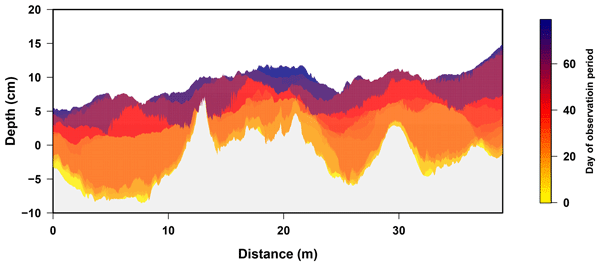
Alexandra M. Zuhr, Thomas Münch, Hans Christian Steen-Larsen, Maria Hörhold, and Thomas Laepple
The Cryosphere, 15, 4873–4900, https://doi.org/10.5194/tc-15-4873-2021, https://doi.org/10.5194/tc-15-4873-2021, 2021
Short summary
Short summary
Firn and ice cores are used to infer past temperatures. However, the imprint of the climatic signal in stable water isotopes is influenced by depositional modifications. We present and use a photogrammetry structure-from-motion approach and find variability in the amount, the timing, and the location of snowfall. Depositional modifications of the surface are observed, leading to mixing of snow from different snowfall events and spatial locations and thus creating noise in the proxy record.
Cited articles
Alfken, S., Wörmer, L., Lipp, J. S., Wendt, J., Taubner, H., Schimmelmann, A., and Hinrichs, K.-U.: Micrometer scale imaging of sedimentary climate archives – Sample preparation for combined elemental and lipid biomarker analysis, Org. Geochem., 127, 81–91, https://doi.org/10.1016/j.orggeochem.2018.11.002, 2019.
Alfken, S., Wörmer, L., Lipp, J. S., Wendt, J., Schimmelmann, A., and Hinrichs, K.: Mechanistic Insights Into Molecular Proxies Through Comparison of Subannually Resolved Sedimentary Records With Instrumental Water Column Data in the Santa Barbara Basin, Southern California, Paleoceanogr. Paleoclimatol., 35, https://doi.org/10.1029/2020PA004076, 2020.
Alfken, S., Wörmer, L., Lipp, J. S., Napier, T., Elvert, M., Wendt, J., Schimmelmann, A., and Hinrichs, K.: Disrupted Coherence Between Upwelling Strength and Redox Conditions Reflects Source Water Change in Santa Barbara Basin During the 20th Century, Paleoceanogr. Paleoclimatol., 36, e2021PA004354, https://doi.org/10.1029/2021PA004354, 2021.
Anderson, D. M.: Attenuation of millennial-scale events by bioturbation in marine sediments, Paleoceanography, 16, 352–357, https://doi.org/10.1029/2000PA000530, 2001.
Anderson, R. Y., Gardner, J. V., and Hemphill-Haley, E.: Variability of the Late Pleistocene-Early Holocene Oxygen-Minimum Zone off Northern California, in: Aspects of Climate Variability in the Pacific and the Western Americas, American Geophysical Union (AGU), 75–84, https://doi.org/10.1029/GM055p0075, 1989.
Anderson, R. Y., Linsley, B. K., and Gardner, J. V.: Expression of seasonal and ENSO forcing in climatic variability at lower than ENSO frequencies: evidence from Pleistocene marine varves off California, Palaeogeogr. Palaeoclimatol. Palaeoecol., 78, 287–300, https://doi.org/10.1016/0031-0182(90)90218-V, 1990.
Ault, T. R., Deser, C., Newman, M., and Emile-Geay, J.: Characterizing decadal to centennial variability in the equatorial Pacific during the last millennium, Geophys. Res. Lett., 40, 3450–3456, https://doi.org/10.1002/grl.50647, 2013.
Behl, R. J.: Sedimentary Facies and Sedimentology of the Late Quaternary Santa Barbara Basin, Site 893, Proc. Ocean Drill. Program, 146/2, 295–308, https://doi.org/10.2973/odp.proc.sr.146-2.276.1995, 1995.
Bernhard, J. M., Visscher, P. T., and Bowser, S. S.: Submillimeter life positions of bacteria, protists, and metazoans in laminated sediments of the Santa Barbara Basin, Limnol. Oceanogr., 48, 813–828, https://doi.org/10.4319/lo.2003.48.2.0813, 2003.
Blanchet, C. L., Tjallingii, R., Schleicher, A. M., Schouten, S., Frank, M., and Brauer, A.: Deoxygenation dynamics on the western Nile deep-sea fan during sapropel S1 from seasonal to millennial timescales, Clim. Past, 17, 1025–1050, https://doi.org/10.5194/cp-17-1025-2021, 2021.
Bograd, S. J., Schroeder, I. D., and Jacox, M. G.: A water mass history of the Southern California current system, Geophys. Res. Lett., 46, 6690–6698, https://doi.org/10.1029/2019GL082685, 2019.
Bojinski, S., Verstraete, M., Peterson, T. C., Richter, C., Simmons, A., and Zemp, M.: The Concept of Essential Climate Variables in Support of Climate Research, Applications, and Policy, Bull. Am. Meteorol. Soc., 95, 1431–1443, https://doi.org/10.1175/BAMS-D-13-00047.1, 2014.
Brassell, S. C., Eglinton, G., Marlowe, I. T., Pflaumann, U., and Sarnthein, M.: Molecular stratigraphy: a new tool for climatic assessment, Nature, 320, 129–133, https://doi.org/10.1038/320129a0, 1986.
Butz, C., Grosjean, M., Fischer, D., Wunderle, S., Tylmann, W., and Rein, B.: Hyperspectral imaging spectroscopy: a promising method for the biogeochemical analysis of lake sediments, J. Appl. Remote Sens., 9, 096031, https://doi.org/10.1117/1.JRS.9.096031, 2015.
California State Department of Fish and Game; NOAA Fisheries; Scripps Institution of Oceanography: Chemical, physical, and other data collected in the coastal waters of California as part of the California Cooperative Fisheries Investigation (CalCOFI) project since 1949, Temperature data of station 81.8-46.9 1984-2009, NOAA National Centers for Environmental Information, https://www.ncei.noaa.gov/access/metadata/landing-page/bin/iso?id=gov.noaa.nodc:CalCOFI (last access: 3 March 2023) 2001.
Chaler, R., Grimalt, J. O., Pelejero, C., and Calvo, E.: Sensitivity Effects in Uk`37 Paleotemperature Estimation by Chemical Ionization Mass Spectrometry, Anal. Chem., 72, 5892–5897, https://doi.org/10.1021/ac001014q, 2000.
Chaler, R., Villanueva, J., and Grimalt, J. O.: Non-linear effects in the determination of paleotemperature Uk'37 alkenone ratios by chemical ionization mass spectrometry, J. Chromatogr. A, 1012, 87–93, https://doi.org/10.1016/S0021-9673(03)01188-9, 2003.
Conte, M. H. and Eglinton, G.: Alkenone and alkenoate distributions within the euphotic zone of the eastern North Atlantic: correlation with production temperature, Deep Sea Res. Part Oceanogr. Res. Pap., 40, 1935–1961, https://doi.org/10.1016/0967-0637(93)90040-A, 1993.
Cressie, N. A. C.: Statistics for spatial data, Rev. ed., Wiley, New York, 900 pp., 1993.
de Winter, N. J., Agterhuis, T., and Ziegler, M.: Optimizing sampling strategies in high-resolution paleoclimate records, Clim. Past, 17, 1315–1340, https://doi.org/10.5194/cp-17-1315-2021, 2021.
Du, X., Hendy, I., and Schimmelmann, A.: A 9000-year flood history for Southern California: A revised stratigraphy of varved sediments in Santa Barbara Basin, Mar. Geol., 397, 29–42, https://doi.org/10.1016/j.margeo.2017.11.014, 2018.
Fisher, D. A., Reeh, N., and Clausen, H. B.: Stratigraphic Noise in Time Series Derived from Ice Cores, Ann. Glaciol., 7, 76–83, https://doi.org/10.3189/S0260305500005942, 1985.
Freeman, K. H. and Wakeham, S. G.: Variations in the distributions and isotopic composition of alkenones in Black Sea particles and sediments, Org. Geochem., 19, 277–285, https://doi.org/10.1016/0146-6380(92)90043-W, 1992.
Glaubke, R. H., Thirumalai, K., Schmidt, M. W., and Hertzberg, J. E.: Discerning Changes in High-Frequency Climate Variability Using Geochemical Populations of Individual Foraminifera, Paleoceanogr. Paleoclimatol., 36, e2020PA004065, https://doi.org/10.1029/2020PA004065, 2021.
Goericke, R., Strom, S. L., and Bell, M. A.: Distribution and sources of cyclic pheophorbides in the marine environment, Limnol. Oceanogr., 45, 200–211, https://doi.org/10.4319/lo.2000.45.1.0200, 2000.
Gräler, B., Pebesma, E., and Heuvelink, G.: Spatio-Temporal Interpolation using gstat, R J., 8, 204–218, 2016.
Hathorne, E., Dolman, A. M., and Laepple, T.: Assessing seasonal and inter-annual marine sediment climate proxy data, Paleoceanogr. Paleoclimatol., e2023PA004649, https://doi.org/10.1029/2023PA004649, 2023.
Hendy, I. L., Dunn, L., Schimmelmann, A., and Pak, D. K.: Resolving varve and radiocarbon chronology differences during the last 2000 years in the Santa Barbara Basin sedimentary record, California, Quat. Int., 310, 155–168, https://doi.org/10.1016/j.quaint.2012.09.006, 2013.
Herbert, T. D., Schuffert, J. D., Thomas, D., Lange, C., Weinheimer, A., Peleo-Alampay, A., and Herguera, J.-C.: Depth and seasonality of alkenone production along the California Margin inferred from a core top transect, Paleoceanography, 13, 263–271, https://doi.org/10.1029/98PA00069, 1998.
Huang, B., Thorne, P. W., Banzon, V. F., Boyer, T., Chepurin, G., Lawrimore, J. H., Menne, M. J., Smith, T. M., Vose, R. S., and Zhang, H.-M.: Extended Reconstructed Sea Surface Temperature, Version 5 (ERSSTv5): Upgrades, Validations, and Intercomparisons, J. Clim., 30, 8179–8205, https://doi.org/10.1175/JCLI-D-16-0836.1, 2017.
Hülse, D., Vervoort, P., van de Velde, S. J., Kanzaki, Y., Boudreau, B., Arndt, S., Bottjer, D. J., Hoogakker, B., Kuderer, M., Middelburg, J. J., Volkenborn, N., Kirtland Turner, S., and Ridgwell, A.: Assessing the impact of bioturbation on sedimentary isotopic records through numerical models, Earth-Sci. Rev., 234, 104213, https://doi.org/10.1016/j.earscirev.2022.104213, 2022.
Ingram, B. L. and Kennett, J. P.: RADIOCARBON CHRONOLOGY AND PLANKTONIC-BENTHIC FORAMINIFERAL 14C AGE DIFFERENCES IN SANTA BARBARA BASIN SEDIMENTS, HOLE 893A, Proc. Ocean Drill. Program, 146/2, 19–27, 1995.
Kirchner, J. W.: Aliasing in
Laepple, T. and Huybers, P.: Global and regional variability in marine surface temperatures, Geophys. Res. Lett., 41, 2528–2534, https://doi.org/10.1002/2014GL059345, 2014.
Liao, S., Liu, X.-L., Manz, K. E., Pennell, K. D., Novak, J., Santos, E., and Huang, Y.: Comprehensive analysis of alkenones by reversed-phase HPLC-MS with unprecedented selectivity, linearity and sensitivity, Talanta, 260, 124653, https://doi.org/10.1016/j.talanta.2023.124653, 2023.
Liu, H., Meyers, S. R., and Marcott, S. A.: Unmixing deep-sea paleoclimate records: A study on bioturbation effects through convolution and deconvolution, Earth Planet. Sci. Lett., 564, 116883, https://doi.org/10.1016/j.epsl.2021.116883, 2021.
Liu, W., Alfken, S., Wörmer, L., Lipp, J. S., and Hinrichs, K.-U.: Hidden molecular clues in marine sediments revealed by untargeted mass spectrometry imaging, Front. Earth Sci., 10, 931157, https://doi.org/10.3389/feart.2022.931157, 2022.
Liu, W., Viola, J. F., and Zander, Y.: weimin-liu/msiAlign: Release v20250407130502, Zenodo, https://doi.org/10.5281/zenodo.15167672, 2025.
Maroufpoor, S., Bozorg-Haddad, O., and Chu, X.: Geostatistics, in: Handbook of Probabilistic Models, Elsevier, 229–242, https://doi.org/10.1016/B978-0-12-816514-0.00009-6, 2020.
McPartland, M. Y., Dolman, A. M., and Laepple, T.: Separating Common Signal From Proxy Noise in Tree Rings, Geophys. Res. Lett., 51, e2024GL109282, https://doi.org/10.1029/2024GL109282, 2024.
Müller, P. J., Kirst, G., Ruhland, G., von Storch, I., and Rosell-Melé, A.: Calibration of the alkenone paleotemperature index U37K' based on core-tops from the eastern South Atlantic and the global ocean (60° N–60° S), Geochim. Cosmochim. Acta, 62, 1757–1772, https://doi.org/10.1016/S0016-7037(98)00097-0, 1998.
Münch, T. and Laepple, T.: What climate signal is contained in decadal- to centennial-scale isotope variations from Antarctic ice cores?, Clim. Past, 14, 2053–2070, https://doi.org/10.5194/cp-14-2053-2018, 2018.
Münch, T., Kipfstuhl, S., Freitag, J., Meyer, H., and Laepple, T.: Regional climate signal vs. local noise: a two-dimensional view of water isotopes in Antarctic firn at Kohnen Station, Dronning Maud Land, Clim. Past, 12, 1565–1581, https://doi.org/10.5194/cp-12-1565-2016, 2016.
Napier, T. J., Wörmer, L., Wendt, J., Lückge, A., Rohlfs, N., and Hinrichs, K.-U.: Sub-Annual to Interannual Arabian Sea Upwelling, Sea Surface Temperature, and Indian Monsoon Rainfall Reconstructed Using Congruent Micrometer-Scale Climate Proxies, Paleoceanogr. Paleoclimatol., 37, e2021PA004355, https://doi.org/10.1029/2021PA004355, 2022.
Obreht, I., De Vleeschouwer, D., Wörmer, L., Kucera, M., Varma, D., Prange, M., Laepple, T., Wendt, J., Nandini-Weiss, S. D., Schulz, H., and Hinrichs, K.-U.: Last Interglacial decadal sea surface temperature variability in the eastern Mediterranean, Nat. Geosci., 15, 812–818, https://doi.org/10.1038/s41561-022-01016-y, 2022a.
Obreht, I., De Vleeschouwer, D., Wörmer, L., Kucera, M., Varma, D., Prange, M., Laepple, T., Wendt, J., Nandini-Weiss, S. D., Schulz, H., and Hinrichs, K.-U.: Last Interglacial decadal sea surface temperature variability in the eastern Mediterranean, Nat. Geosci., 15, 812–818, https://doi.org/10.1038/s41561-022-01016-y, 2022b.
O'Mara, N. A., Cheung, A. H., Kelly, C. S., Sandwick, S., Herbert, T. D., Russell, J. M., Abella-Gutiérrez, J., Dee, S. G., Swarzenski, P. W., and Herguera, J. C.: Subtropical Pacific Ocean Temperature Fluctuations in the Common Era: Multidecadal Variability and Its Relationship With Southwestern North American Megadroughts, Geophys. Res. Lett., 46, 14662–14673, https://doi.org/10.1029/2019GL084828, 2019.
Pebesma, E. J.: Multivariable geostatistics in S: the gstat package, Comput. Geosci., 30, 683–691, https://doi.org/10.1016/j.cageo.2004.03.012, 2004.
Posit team: RStudio: Integrated Development Environment for R, Posit Software, PBC, Boston, MA, http://www.posit.co/ (last access: 14 October 2025), 2025.
Prahl, F. G. and Wakeham, S. G.: Calibration of unsaturation patterns in long-chain ketone compositions for palaeotemperature assessment, Nature, 330, 367–369, https://doi.org/10.1038/330367a0, 1987.
Prahl, F. G., Muehlhausen, L. A., and Zahnle, D. L.: Further evaluation of long-chain alkenones as indicators of paleoceanographic conditions, Geochim. Cosmochim. Acta, 52, 2303–2310, https://doi.org/10.1016/0016-7037(88)90132-9, 1988.
R Core Team: R: A Language and Environment for Statistical Computing, R Foundation for Statistical Computing, Vienna, Austria, https://www.R-project.org (last access: 14 October 2025), 2024.
Rama-Corredor, O., Cortina, A., Martrat, B., Lopez, J. F., and Grimalt, J. O.: Removal of bias in C37 alkenone-based sea surface temperature measurements by high-performance liquid chromatography fractionation, J. Chromatogr. A, 1567, 90–98, https://doi.org/10.1016/j.chroma.2018.07.004, 2018.
Reimers, C. E., Lange, C. B., Tabak, M., and Bernhard, J. M.: Seasonal spillover and varve formation in the Santa Barbara Basin, California, Limnol. Oceanogr., 35, 1577–1585, https://doi.org/10.4319/lo.1990.35.7.1577, 1990.
Schiffelbein, P.: Effect of benthic mixing on the information content of deep-sea stratigraphical signals, Nature, 311, 651–653, https://doi.org/10.1038/311651a0, 1984.
Schimmelmann, A. and Lange, C. B.: Tales of 1001 varves: a review of Santa Barbara Basin sediment studies, Geol. Soc. Lond. Spec. Publ., 116, 121–141, https://doi.org/10.1144/GSL.SP.1996.116.01.12, 1996.
Schimmelmann, A., Berger, W. H., and Lange, C. B.: Climatically controlled marker layers in Santa Barbara Basin sediments and fine-scale core-to-core correlation, Limnol. Oceanogr., 35, 165–173, https://doi.org/10.4319/lo.1990.35.1.0165, 1990.
Schimmelmann, A., Lange, C. B., Berger, W. H., Simon, A., Burke, S. K., and Dunbar, R. B.: Extreme climatic conditions recorded in Santa Barbara Basin laminated sediments: the 1835–1840 Macoma event, Mar. Geol., 106, 279–299, https://doi.org/10.1016/0025-3227(92)90134-4, 1992.
Schimmelmann, A., Lange, C. B., Schieber, J., Francus, P., Ojala, A. E. K., and Zolitschka, B.: Varves in marine sediments: A review, Earth-Sci. Rev., 159, 215–246, https://doi.org/10.1016/j.earscirev.2016.04.009, 2016.
Soutar, A. and Crill, P. A.: Sedimentation and climatic patterns in the Santa Barbara Basin during the 19th and 20th centuries, GSA Bull., 88, 1161–1172, https://doi.org/10.1130/0016-7606(1977)88<1161:SACPIT>2.0.CO;2, 1977.
Suigetsu 2006 Project Members and Nakagawa, T.: High-precision sampling of laminated sediments: Strategies from Lake Suigetsu, Past Glob. Chang. Mag., 22, 12–13, https://doi.org/10.22498/pages.22.1.12, 2014.
Szymczak-Żyła, M., Kowalewska, G., and Louda, J. W.: Chlorophyll-a and derivatives in recent sediments as indicators of productivity and depositional conditions, Mar. Chem., 125, 39–48, https://doi.org/10.1016/j.marchem.2011.02.002, 2011.
Thomson, D. J.: Spectrum estimation and harmonic analysis, Proc. IEEE, 70, 1055–1096, https://doi.org/10.1109/PROC.1982.12433, 1982.
Thunell, R. C., Tappa, E., and Anderson, D. M.: Sediment fluxes and varve formation in Santa Barbara Basin, offshore California, Geology, 23, 1083–1086, https://doi.org/10.1130/0091-7613(1995)023<1083:SFAVFI>2.3.CO;2, 1995.
Tierney, J. E. and Tingley, M. P.: BAYSPLINE: A New Calibration for the Alkenone Paleothermometer, Paleoceanogr. Paleoclimatol., 33, 281–301, https://doi.org/10.1002/2017PA003201, 2018.
Tobias, F. and Hummon, A. B.: Considerations for MALDI-Based Quantitative Mass Spectrometry Imaging Studies, J. Proteome Res., 19, 3620–3630, https://doi.org/10.1021/acs.jproteome.0c00443, 2020.
Viola, J.: Code to Viola J.: Microscale Alkenone Heterogeneity and Replicability of Ultra-High-Resolution Temperature Records from Marine Sediments, Zenodo [code], https://doi.org/10.5281/zenodo.17352962, 2025.
Viola, J., Hinrichs, K.-U., Wörmer, L., and Laepple, T.: Data to Viola J.: Microscale Alkenone Heterogeneity and Replicability of Ultra-High-Resolution Temperature Records from Marine Sediments [Data set], in: Climate of the Past: Vols 2025-5089, Zenodo [data set], https://doi.org/10.5281/zenodo.18682000, 2026.
Wikle, C. K., Zammit-Mangion, A., and Cressie, N. A. C.: Spatio-temporal statistics with R, CRC Press, Taylor & Francis Group, Boca Raton, 380 pp., https://doi.org/10.1201/9781351769723, 2019.
Wörmer, L., Elvert, M., Fuchser, J., Lipp, J. S., Buttigieg, P. L., Zabel, M., and Hinrichs, K.-U.: Ultra-high-resolution paleoenvironmental records via direct laser-based analysis of lipid biomarkers in sediment core samples, P. Natl. Acad. Sci. USA, 111, 15669–15674, https://doi.org/10.1073/pnas.1405237111, 2014.
Wörmer, L., Wendt, J., Boehman, B., Haug, G. H., and Hinrichs, K.-U.: Deglacial increase of seasonal temperature variability in the tropical ocean, Nature, 612, 88–91, https://doi.org/10.1038/s41586-022-05350-4, 2022a.
Wörmer, L., Wendt, J., Boehman, B., Haug, G. H., and Hinrichs, K.-U.: Deglacial increase of seasonal temperature variability in the tropical ocean, Nature, 612, 88–91, https://doi.org/10.1038/s41586-022-05350-4, 2022b.
Zander, P. D., Wienhues, G., and Grosjean, M.: Scanning Hyperspectral Imaging for In Situ Biogeochemical Analysis of Lake Sediment Cores: Review of Recent Developments, J. Imaging, 8, 58, https://doi.org/10.3390/jimaging8030058, 2022.
Zander, Y., Liu, W., Viola, J., Altun, J., Groninga, J., Nettersheim, B., Kapiri, M.-S., Obreht, I., and Wörmer, L.: Mass spectrometry imaging in the earth sciences – A tutorial to the micrometer-scale mapping of molecular fossils via MALDI FT-ICR MS, Anal. Chim. Acta, 345142, https://doi.org/10.1016/j.aca.2026.345142, 2026.
Zhao, M., Eglinton, G., Read, G., and Schimmelmann, A.: An alkenone (U37K') quasi-annual sea surface temperature record (A.D. 1440 to 1940) using varved sediments from the Santa Barbara Basin, Org. Geochem., 31, 903–917, https://doi.org/10.1016/S0146-6380(00)00034-6, 2000.
Short summary
This study used mass spectrometry imaging (MSI) to detect spatial patterns of biomarkers used for sea surface temperature (SST) reconstructions. The observed proxy heterogeneity was bigger than expected within layered marine sediments. The data was used to estimate the climate signal content of individual MSI based reconstructions. The results can be used to inform sampling decisions or to derive uncertainty estimates for high-resolution SST reconstructions and climate variability estimates.
This study used mass spectrometry imaging (MSI) to detect spatial patterns of biomarkers used...


