
Articles | Volume 22, issue 1
https://doi.org/10.5194/cp-22-73-2026
© Author(s) 2026. This work is distributed under
the Creative Commons Attribution 4.0 License.
the Creative Commons Attribution 4.0 License.
https://doi.org/10.5194/cp-22-73-2026
© Author(s) 2026. This work is distributed under
the Creative Commons Attribution 4.0 License.
the Creative Commons Attribution 4.0 License.
Research article
| 
14 Jan 2026
Research article |
| 14 Jan 2026
| 14 Jan 2026
Data-model comparisons of the tropical hydroclimate response to the 8.2 ka Event with an isotope-enabled climate model

Department of Earth, Ocean, and Atmospheric Science, Florida State University, Tallahassee, Florida, USA
Department of Earth, Ocean, and Atmospheric Science, Florida State University, Tallahassee, Florida, USA
Raquel E. Pauly
Department of Earth, Ocean, and Atmospheric Science, Florida State University, Tallahassee, Florida, USA
Related authors
Alyssa R. Atwood, Andrea L. Moore, Kristine L. DeLong, Sylvia E. Long, Sara C. Sanchez, Jessica A. Hargreaves, Chandler A. Morris, Raquel E. Pauly, Émilie P. Dassié, Thomas Felis, Antje H. L. Voelker, Sujata A. Murty, and Kim M. Cobb
Earth Syst. Sci. Data, 18, 1921–1941, https://doi.org/10.5194/essd-18-1921-2026, https://doi.org/10.5194/essd-18-1921-2026, 2026
Short summary
Short summary
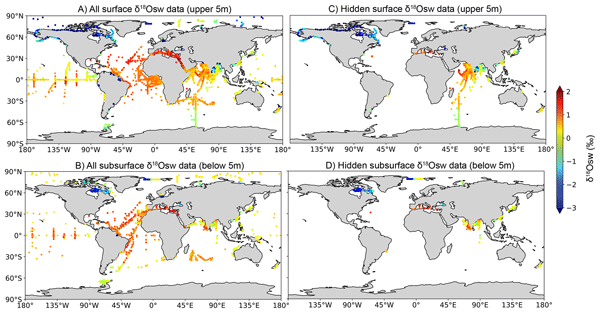
The stable isotopic composition of seawater is a valuable tool for studying the global water cycle in the past, present, and future. However, an active repository dedicated to archiving this type of data has been lacking, and many datasets remain hidden from public view. We have created a new database of observational seawater isotope data that is rich in metadata, publicly accessible, and machine readable to increase its availability and usability for a variety of Earth Science applications.
Rachel M. Walter, Hussein R. Sayani, Thomas Felis, Kim M. Cobb, Nerilie J. Abram, Ariella K. Arzey, Alyssa R. Atwood, Logan D. Brenner, Émilie P. Dassié, Kristine L. DeLong, Bethany Ellis, Julien Emile-Geay, Matthew J. Fischer, Nathalie F. Goodkin, Jessica A. Hargreaves, K. Halimeda Kilbourne, Hedwig Krawczyk, Nicholas P. McKay, Andrea L. Moore, Sujata A. Murty, Maria Rosabelle Ong, Riovie D. Ramos, Emma V. Reed, Dhrubajyoti Samanta, Sara C. Sanchez, Jens Zinke, and the PAGES CoralHydro2k Project Members
Earth Syst. Sci. Data, 15, 2081–2116, https://doi.org/10.5194/essd-15-2081-2023, https://doi.org/10.5194/essd-15-2081-2023, 2023
Short summary
Short summary
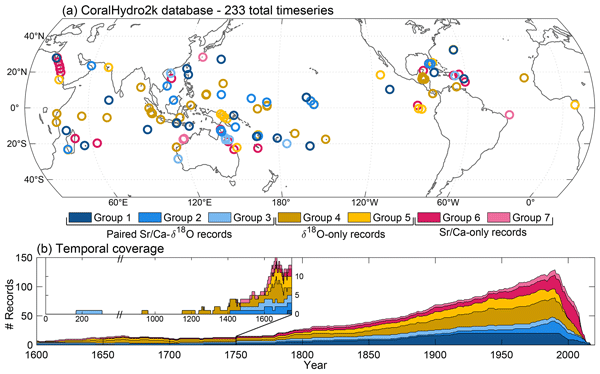
Accurately quantifying how the global hydrological cycle will change in the future remains challenging due to the limited availability of historical climate data from the tropics. Here we present the CoralHydro2k database – a new compilation of peer-reviewed coral-based climate records from the last 2000 years. This paper details the records included in the database and where the database can be accessed and demonstrates how the database can investigate past tropical climate variability.
Alyssa R. Atwood, Andrea L. Moore, Kristine L. DeLong, Sylvia E. Long, Sara C. Sanchez, Jessica A. Hargreaves, Chandler A. Morris, Raquel E. Pauly, Émilie P. Dassié, Thomas Felis, Antje H. L. Voelker, Sujata A. Murty, and Kim M. Cobb
Earth Syst. Sci. Data, 18, 1921–1941, https://doi.org/10.5194/essd-18-1921-2026, https://doi.org/10.5194/essd-18-1921-2026, 2026
Short summary
Short summary
The stable isotopic composition of seawater is a valuable tool for studying the global water cycle in the past, present, and future. However, an active repository dedicated to archiving this type of data has been lacking, and many datasets remain hidden from public view. We have created a new database of observational seawater isotope data that is rich in metadata, publicly accessible, and machine readable to increase its availability and usability for a variety of Earth Science applications.
Rachel M. Walter, Hussein R. Sayani, Thomas Felis, Kim M. Cobb, Nerilie J. Abram, Ariella K. Arzey, Alyssa R. Atwood, Logan D. Brenner, Émilie P. Dassié, Kristine L. DeLong, Bethany Ellis, Julien Emile-Geay, Matthew J. Fischer, Nathalie F. Goodkin, Jessica A. Hargreaves, K. Halimeda Kilbourne, Hedwig Krawczyk, Nicholas P. McKay, Andrea L. Moore, Sujata A. Murty, Maria Rosabelle Ong, Riovie D. Ramos, Emma V. Reed, Dhrubajyoti Samanta, Sara C. Sanchez, Jens Zinke, and the PAGES CoralHydro2k Project Members
Earth Syst. Sci. Data, 15, 2081–2116, https://doi.org/10.5194/essd-15-2081-2023, https://doi.org/10.5194/essd-15-2081-2023, 2023
Short summary
Short summary
Accurately quantifying how the global hydrological cycle will change in the future remains challenging due to the limited availability of historical climate data from the tropics. Here we present the CoralHydro2k database – a new compilation of peer-reviewed coral-based climate records from the last 2000 years. This paper details the records included in the database and where the database can be accessed and demonstrates how the database can investigate past tropical climate variability.
Cited articles
Aguiar, W., Prado, L. F., Wainer, I., Liu, Z., Montenegro, A., Meissner, K. J., and Mata, M. M.: Freshwater forcing control on early-Holocene South American monsoon, Quaternary Science Reviews, 245, 106498, https://doi.org/10.1016/j.quascirev.2020.106498, 2020.
Aguiar, W., Meissner, K. J., Montenegro, A., Prado, L., Wainer, I., Carlson, A. E., and Mata, M. M.: Magnitude of the 8.2 ka event freshwater forcing based on stable isotope modelling and comparison to future Greenland melting, Scientific Reports, 11, 5473, https://doi.org/10.1038/s41598-021-84709-5, 2021.
Alley, R. B., Mayewski, P. A., Sowers, T., Stuiver, M., Taylor, K. C., and Clark, P. U.: Holocene climatic instability: A prominent, widespread event 8200 yr ago, Geology, 25, 483–486, https://doi.org/10.1130/0091-7613(1997)025<0483:HCIAPW>2.3.CO;2, 1997.
Arbuszewski, J. A., deMenocal, P. B., Cléroux, C., Bradtmiller, L., and Mix, A.: Meridional shifts of the Atlantic intertropical convergence zone since the Last Glacial Maximum, Nature Geosci., 6, 959–962, https://doi.org/10.1038/ngeo1961, 2013.
Atwood, A. R., Donohoe, A., Battisti, D. S., Liu, X., and Pausata, F. S. R.: Robust Longitudinally Variable Responses of the ITCZ to a Myriad of Climate Forcings, Geophysical Research Letters, 47, e2020GL088833, https://doi.org/10.1029/2020GL088833, 2020.
Ayliffe, L. K., Gagan, M. K., Zhao, J., Drysdale, R. N., Hellstrom, J. C., Hantoro, W. S., Griffiths, M. L., Scott-Gagan, H., Pierre, E. S., Cowley, J. A., and Suwargadi, B. W.: Rapid interhemispheric climate links via the Australasian monsoon during the last deglaciation, Nat. Commun., 4, 2908, https://doi.org/10.1038/ncomms3908, 2013.
Azevedo, V., Strikis, N. M., Novello, V. F., Roland, C. L., Cruz, F. W., Santos, R. V., Vuille, M., Utida, G., De Andrade, F. R. D., Cheng, H., and Edwards, R. L.: Paleovegetation seesaw in Brazil since the Late Pleistocene: A multiproxy study of two biomes, Earth and Planetary Science Letters, 563, 116880, https://doi.org/10.1016/j.epsl.2021.116880, 2021.
Barber, D. C., Dyke, A., Hillaire-Marcel, C., Jennings, A. E., Andrews, J. T., Kerwin, M. W., Bilodeau, G., McNeely, R., Southon, J., Morehead, M. D., and Gagnon, J.-M.: Forcing of the cold event of 8,200 years ago by catastrophic drainage of Laurentide lakes, Nature, 400, 344–348, https://doi.org/10.1038/22504, 1999.
Berkelhammer, M., Sinha, A., Stott, L., Cheng, H., Pausata, F. S. R., and Yoshimura, K.: An Abrupt Shift in the Indian Monsoon 4000 Years Ago, in: Geophysical Monograph Series, edited by: Giosan, L., Fuller, D. Q., Nicoll, K., Flad, R. K., and Clift, P. D., American Geophysical Union, Washington, D. C., 75–88, https://doi.org/10.1029/2012GM001207, 2013.
Bernal, J. P., Cruz, F. W., Stríkis, N. M., Wang, X., Deininger, M., Catunda, M. C. A., Ortega-Obregón, C., Cheng, H., Edwards, R. L., and Auler, A. S.: High-resolution Holocene South American monsoon history recorded by a speleothem from Botuverá Cave, Brazil, Earth and Planetary Science Letters, 450, 186–196, https://doi.org/10.1016/j.epsl.2016.06.008, 2016.
Biasutti, M., Voigt, A., Boos, W. R., Braconnot, P., Hargreaves, J. C., Harrison, S. P., Kang, S. M., Mapes, B. E., Scheff, J., Schumacher, C., Sobel, A. H., and Xie, S.-P.: Global energetics and local physics as drivers of past, present and future monsoons, Nature Geosci., 11, 392–400, https://doi.org/10.1038/s41561-018-0137-1, 2018.
Bird, B. W., Abbott, M. B., Rodbell, D. T., and Vuille, M.: Holocene tropical South American hydroclimate revealed from a decadally resolved lake sediment δ18O record, Earth and Planetary Science Letters, 310, 192–202, https://doi.org/10.1016/j.epsl.2011.08.040, 2011.
Bird, B. W., Polisar, P. J., Lei, Y., Thompson, L. G., Yao, T., Finney, B. P., Bain, D. J., Pompeani, D. P., and Steinman, B. A.: A Tibetan lake sediment record of Holocene Indian summer monsoon variability, Earth and Planetary Science Letters, 399, 92–102, https://doi.org/10.1016/j.epsl.2014.05.017, 2014.
Blaauw, M. and Christen, J. A.: Flexible paleoclimate age-depth models using an autoregressive gamma process, Bayesian Analysis, 6, 457–474, https://doi.org/10.1214/11-BA618, 2011.
Bowen, G. J., Cai, Z., Fiorella, R. P., and Putman, A. L.: Isotopes in the Water Cycle: Regional- to Global-Scale Patterns and Applications, Annu. Rev. Earth Planet. Sci., 47, 453–479, https://doi.org/10.1146/annurev-earth-053018-060220, 2019.
Brady, E., Stevenson, S., Bailey, D., Liu, Z., Noone, D., Nusbaumer, J., Otto-Bliesner, B. L., Tabor, C., Tomas, R., Wong, T., Zhang, J., and Zhu, J.: The Connected Isotopic Water Cycle in the Community Earth System Model Version 1, J. Adv. Model Earth Syst., 11, 2547–2566, https://doi.org/10.1029/2019MS001663, 2019.
Breitenbach, S. F. M., Rehfeld, K., Goswami, B., Baldini, J. U. L., Ridley, H. E., Kennett, D. J., Prufer, K. M., Aquino, V. V., Asmerom, Y., Polyak, V. J., Cheng, H., Kurths, J., and Marwan, N.: COnstructing Proxy Records from Age models (COPRA), Clim. Past, 8, 1765–1779, https://doi.org/10.5194/cp-8-1765-2012, 2012.
Bustamante, M. G., Cruz, F. W., Vuille, M., Apaéstegui, J., Strikis, N., Panizo, G., Novello, F. V., Deininger, M., Sifeddine, A., Cheng, H., Moquet, J. S., Guyot, J. L., Santos, R. V., Segura, H., and Edwards, R. L.: Holocene changes in monsoon precipitation in the Andes of NE Peru based on δ18O speleothem records, Quaternary Science Reviews, 146, 274–287, https://doi.org/10.1016/j.quascirev.2016.05.023, 2016.
Cai, Y., Fung, I. Y., Edwards, R. L., An, Z., Cheng, H., Lee, J.-E., Tan, L., Shen, C.-C., Wang, X., Day, J. A., Zhou, W., Kelly, M. J., and Chiang, J. C. H.: Variability of stalagmite-inferred Indian monsoon precipitation over the past 252,000 y, Proc. Natl. Acad. Sci. U.S.A., 112, 2954–2959, https://doi.org/10.1073/pnas.1424035112, 2015.
Carlson, A. E., Clark, P. U., Haley, B. A., and Klinkhammer, G. P.: Routing of western Canadian Plains runoff during the 8.2 ka cold event, Geophysical Research Letters, 36, 2009GL038778, https://doi.org/10.1029/2009GL038778, 2009.
Carolin, S. A., Cobb, K. M., Lynch-Stieglitz, J., Moerman, J. W., Partin, J. W., Lejau, S., Malang, J., Clark, B., Tuen, A. A., and Adkins, J. F.: Northern Borneo stalagmite records reveal West Pacific hydroclimate across MIS 5 and 6, Earth and Planetary Science Letters, 439, 182–193, https://doi.org/10.1016/j.epsl.2016.01.028, 2016.
Chawchai, S., Tan, L., Löwemark, L., Wang, H.-C., Yu, T.-L., Chung, Y.-C., Mii, H.-S., Liu, G., Blaauw, M., Gong, S.-Y., Wohlfarth, B., and Shen, C.-C.: Hydroclimate variability of central Indo-Pacific region during the Holocene, Quaternary Science Reviews, 253, 106779, https://doi.org/10.1016/j.quascirev.2020.106779, 2021.
Chen, S., Hoffmann, S. S., Lund, D. C., Cobb, K. M., Emile-Geay, J., and Adkins, J. F.: A high-resolution speleothem record of western equatorial Pacific rainfall: Implications for Holocene ENSO evolution, Earth and Planetary Science Letters, 442, 61–71, https://doi.org/10.1016/j.epsl.2016.02.050, 2016.
Cheng, H., Fleitmann, D., Edwards, R. L., Wang, X., Cruz, F. W., Auler, A. S., Mangini, A., Wang, Y., Kong, X., Burns, S. J., and Matter, A.: Timing and structure of the 8.2 kyr B.P. event inferred from δ18O records of stalagmites from China, Oman, and Brazil, Geology, 37, 1007–1010, https://doi.org/10.1130/G30126A.1, 2009.
Cheng, H., Sinha, A., Cruz, F. W., Wang, X., Edwards, R. L., d'Horta, F. M., Ribas, C. C., Vuille, M., Stott, L. D., and Auler, A. S.: Climate change patterns in Amazonia and biodiversity, Nat. Commun., 4, 1411, https://doi.org/10.1038/ncomms2415, 2013.
Chiang, J. C. H. and Bitz, C. M.: Influence of high latitude ice cover on the marine Intertropical Convergence Zone, Climate Dynamics, 25, 477–496, https://doi.org/10.1007/s00382-005-0040-5, 2005.
Chiang, J. C. H., Herman, M. J., Yoshimura, K., and Fung, I. Y.: Enriched East Asian oxygen isotope of precipitation indicates reduced summer seasonality in regional climate and westerlies, Proc. Natl. Acad. Sci. U.S.A., 117, 14745–14750, https://doi.org/10.1073/pnas.1922602117, 2020.
Cohen, J.: A Coefficient of Agreement for Nominal Scales, Educational and Psychological Measurement, 20, 37–46, https://doi.org/10.1177/001316446002000104, 1960.
Cohen, J.: Weighted kappa: Nominal scale agreement provision for scaled disagreement or partial credit, Psychological Bulletin, 70, 213–220, https://doi.org/10.1037/h0026256, 1968.
Comas-Bru, L., Rehfeld, K., Roesch, C., Amirnezhad-Mozhdehi, S., Harrison, S. P., Atsawawaranunt, K., Ahmad, S. M., Brahim, Y. A., Baker, A., Bosomworth, M., Breitenbach, S. F. M., Burstyn, Y., Columbu, A., Deininger, M., Demény, A., Dixon, B., Fohlmeister, J., Hatvani, I. G., Hu, J., Kaushal, N., Kern, Z., Labuhn, I., Lechleitner, F. A., Lorrey, A., Martrat, B., Novello, V. F., Oster, J., Pérez-Mejías, C., Scholz, D., Scroxton, N., Sinha, N., Ward, B. M., Warken, S., Zhang, H., and SISAL Working Group members: SISALv2: a comprehensive speleothem isotope database with multiple age–depth models, Earth Syst. Sci. Data, 12, 2579–2606, https://doi.org/10.5194/essd-12-2579-2020, 2020.
Conroy, J. L., Overpeck, J. T., Cole, J. E., Shanahan, T. M., and Steinitz-Kannan, M.: Holocene changes in eastern tropical Pacific climate inferred from a Galápagos lake sediment record, Quaternary Science Reviews, 27, 1166–1180, https://doi.org/10.1016/j.quascirev.2008.02.015, 2008.
Cruz, F. W., Vuille, M., Burns, S. J., Wang, X., Cheng, H., Werner, M., Lawrence Edwards, R., Karmann, I., Auler, A. S., and Nguyen, H.: Orbitally driven east–west antiphasing of South American precipitation, Nature Geosci, 2, 210–214, https://doi.org/10.1038/ngeo444, 2009.
Curtis, J. H., Brenner, M., Hodell, D. A., Balser, R. A., Islebe, G. A., and Hooghiemstra, H.: A multi-proxy study of Holocene environmental change in the Maya Lowlands of Peten, Guatemala, Journal of Paleolimnology, 19, 139–159, https://doi.org/10.1023/A:1007968508262, 1998.
Denniston, R. F., Wyrwoll, K.-H., Polyak, V. J., Brown, J. R., Asmerom, Y., Wanamaker, A. D., LaPointe, Z., Ellerbroek, R., Barthelmes, M., Cleary, D., Cugley, J., Woods, D., and Humphreys, W. F.: A Stalagmite record of Holocene Indonesian–Australian summer monsoon variability from the Australian tropics, Quaternary Science Reviews, 78, 155–168, https://doi.org/10.1016/j.quascirev.2013.08.004, 2013.
DiNezio, P. N. and Tierney, J. E.: The effect of sea level on glacial Indo-Pacific climate, Nature Geosci., 6, 485–491, https://doi.org/10.1038/ngeo1823, 2013.
Duan, P., Li, H., Sinha, A., Voarintsoa, N. R. G., Kathayat, G., Hu, P., Zhang, H., Ning, Y., and Cheng, H.: The timing and structure of the 8.2 ka event revealed through high-resolution speleothem records from northwestern Madagascar, Quaternary Science Reviews, 268, 107104, https://doi.org/10.1016/j.quascirev.2021.107104, 2021.
Duarte, E., Obrist-Farner, J., Correa-Metrio, A., and Steinman, B. A.: A progressively wetter early through middle Holocene climate in the eastern lowlands of Guatemala, Earth and Planetary Science Letters, 561, 116807, https://doi.org/10.1016/j.epsl.2021.116807, 2021.
Dutt, S., Gupta, A. K., Clemens, S. C., Cheng, H., Singh, R. K., Kathayat, G., and Edwards, R. L.: Abrupt changes in Indian summer monsoon strength during 33,800 to 5500 years B.P.: Indian summer monsoon, Geophys. Res. Lett., 42, 5526–5532, https://doi.org/10.1002/2015GL064015, 2015.
Dykoski, C., Edwards, R., Cheng, H., Yuan, D., Cai, Y., Zhang, M., Lin, Y., Qing, J., An, Z., and Revenaugh, J.: A high-resolution, absolute-dated Holocene and deglacial Asian monsoon record from Dongge Cave, China, Earth and Planetary Science Letters, 233, 71–86, https://doi.org/10.1016/j.epsl.2005.01.036, 2005.
Ellison, C. R. W., Chapman, M. R., and Hall, I. R.: Surface and Deep Ocean Interactions During the Cold Climate Event 8200 Years Ago, Science, 312, 1929–1932, https://doi.org/10.1126/science.1127213, 2006.
Escobar, J., Hodell, D. A., Brenner, M., Curtis, J. H., Gilli, A., Mueller, A. D., Anselmetti, F. S., Ariztegui, D., Grzesik, D. A., Pérez, L., Schwalb, A., and Guilderson, T. P.: A ∼43-ka record of paleoenvironmental change in the Central American lowlands inferred from stable isotopes of lacustrine ostracods, Quaternary Science Reviews, 37, 92–104, https://doi.org/10.1016/j.quascirev.2012.01.020, 2012.
Fensterer, C., Scholz, D., Hoffmann, D. L., Spötl, C., Schröder-Ritzrau, A., Horn, C., Pajón, J. M., and Mangini, A.: Millennial-scale climate variability during the last 12.5 ka recorded in a Caribbean speleothem, Earth and Planetary Science Letters, 361, 143–151, https://doi.org/10.1016/j.epsl.2012.11.019, 2013.
Fleitmann, D., Burns, S. J., Mangini, A., Mudelsee, M., Kramers, J., Villa, I., Neff, U., Al-Subbary, A. A., Buettner, A., Hippler, D., and Matter, A.: Holocene ITCZ and Indian monsoon dynamics recorded in stalagmites from Oman and Yemen (Socotra), Quaternary Science Reviews, 26, 170–188, https://doi.org/10.1016/j.quascirev.2006.04.012, 2007.
Geen, R., Bordoni, S., Battisti, D. S., and Hui, K.: Monsoons, ITCZs, and the Concept of the Global Monsoon, Reviews of Geophysics, 58, https://doi.org/10.1029/2020RG000700, 2020.
Haslett, J. and Parnell, A.: A Simple Monotone Process with Application to Radiocarbon-Dated Depth Chronologies, Journal of the Royal Statistical Society Series C: Applied Statistics, 57, 399–418, https://doi.org/10.1111/j.1467-9876.2008.00623.x, 2008.
Hillman, A. L., Yao, A., Finkenbinder, M. S., and Abbott, M. B.: A 17,000-year multi-proxy study of the Indian Summer Monsoon from Lake Dian, Yunnan, China, Palaeogeography, Palaeoclimatology, Palaeoecology, 567, 110292, https://doi.org/10.1016/j.palaeo.2021.110292, 2021.
Hodell, D. A., Curtis, J. H., and Brenner, M.: Possible role of climate in the collapse of Classic Maya civilization, Nature, 375, 391–394, https://doi.org/10.1038/375391a0, 1995.
Holmgren, K., Lee-Thorp, J. A., Cooper, G. R. J., Lundblad, K., Partridge, T. C., Scott, L., Sithaldeen, R., Siep Talma, A., and Tyson, P. D.: Persistent millennial-scale climatic variability over the past 25,000 years in Southern Africa, Quaternary Science Reviews, 22, 2311–2326, https://doi.org/10.1016/S0277-3791(03)00204-X, 2003.
Hu, J., Emile-Geay, J., Tabor, C., Nusbaumer, J., and Partin, J.: Deciphering Oxygen Isotope Records From Chinese Speleothems With an Isotope-Enabled Climate Model, Paleoceanography and Paleoclimatology, 34, 2098–2112, https://doi.org/10.1029/2019PA003741, 2019.
Huang, W., Wang, Y., Cheng, H., Edwards, R. L., Shen, C.-C., Liu, D., Shao, Q., Deng, C., Zhang, Z., and Wang, Q.: Multi-scale Holocene Asian monsoon variability deduced from a twin-stalagmite record in southwestern China, Quat. Res., 86, 34–44, https://doi.org/10.1016/j.yqres.2016.05.001, 2016.
Huguet, C., Routh, J., Fietz, S., Lone, M. A., Kalpana, M. S., Ghosh, P., Mangini, A., Kumar, V., and Rangarajan, R.: Temperature and Monsoon Tango in a Tropical Stalagmite: Last Glacial-Interglacial Climate Dynamics, Sci. Rep., 8, 5386, https://doi.org/10.1038/s41598-018-23606-w, 2018.
Iturbide, M., Gutiérrez, J. M., Alves, L. M., Bedia, J., Cerezo-Mota, R., Cimadevilla, E., Cofiño, A. S., Di Luca, A., Faria, S. H., Gorodetskaya, I. V., Hauser, M., Herrera, S., Hennessy, K., Hewitt, H. T., Jones, R. G., Krakovska, S., Manzanas, R., Martínez-Castro, D., Narisma, G. T., Nurhati, I. S., Pinto, I., Seneviratne, S. I., van den Hurk, B., and Vera, C. S.: An update of IPCC climate reference regions for subcontinental analysis of climate model data: definition and aggregated datasets, Earth Syst. Sci. Data, 12, 2959–2970, https://doi.org/10.5194/essd-12-2959-2020, 2020.
Jiang, X., He, Y., Shen, C., Kong, X., Li, Z., and Chang, Y.: Stalagmite-inferred Holocene precipitation in northern Guizhou Province, China, and asynchronous termination of the Climatic Optimum in the Asian monsoon territory, Chin. Sci. Bull., 57, 795–801, https://doi.org/10.1007/s11434-011-4848-6, 2012.
Johnson, T. C., Brown, E. T., McManus, J., Barry, S., Barker, P., and Gasse, F.: A High-Resolution Paleoclimate Record Spanning the Past 25,000 Years in Southern East Africa, Science, 296, 113–132, https://doi.org/10.1126/science.1070057, 2002.
Kang, S. M., Held, I. M., Frierson, D. M. W., and Zhao, M.: The Response of the ITCZ to Extratropical Thermal Forcing: Idealized Slab-Ocean Experiments with a GCM, Journal of Climate, 21, 3521–3532, https://doi.org/10.1175/2007JCLI2146.1, 2008.
Kang, S. M., Frierson, D. M. W., and Held, I. M.: The Tropical Response to Extratropical Thermal Forcing in an Idealized GCM: The Importance of Radiative Feedbacks and Convective Parameterization, Journal of the Atmospheric Sciences, 66, 2812–2827, https://doi.org/10.1175/2009JAS2924.1, 2009.
Killick, R., Fearnhead, P., and Eckley, I. A.: Optimal Detection of Changepoints With a Linear Computational Cost, Journal of the American Statistical Association, 107, 1590–1598, https://doi.org/10.1080/01621459.2012.737745, 2012.
Kobashi, T., Severinghaus, J. P., Brook, E. J., Barnola, J.-M., and Grachev, A. M.: Precise timing and characterization of abrupt climate change 8200 years ago from air trapped in polar ice, Quaternary Science Reviews, 26, 1212–1222, https://doi.org/10.1016/j.quascirev.2007.01.009, 2007.
Konecky, B. L., Noone, D. C., and Cobb, K. M.: The Influence of Competing Hydroclimate Processes on Stable Isotope Ratios in Tropical Rainfall, Geophys. Res. Lett., 46, 1622–1633, https://doi.org/10.1029/2018GL080188, 2019.
Konecky, B. L., McKay, N. P., Churakova (Sidorova), O. V., Comas-Bru, L., Dassié, E. P., DeLong, K. L., Falster, G. M., Fischer, M. J., Jones, M. D., Jonkers, L., Kaufman, D. S., Leduc, G., Managave, S. R., Martrat, B., Opel, T., Orsi, A. J., Partin, J. W., Sayani, H. R., Thomas, E. K., Thompson, D. M., Tyler, J. J., Abram, N. J., Atwood, A. R., Cartapanis, O., Conroy, J. L., Curran, M. A., Dee, S. G., Deininger, M., Divine, D. V., Kern, Z., Porter, T. J., Stevenson, S. L., von Gunten, L., and Iso2k Project Members: The Iso2k database: a global compilation of paleo-δ18O and δ2H records to aid understanding of Common Era climate, Earth Syst. Sci. Data, 12, 2261–2288, https://doi.org/10.5194/essd-12-2261-2020, 2020.
Koutavas, A. and Lynch-Stieglitz, J.: Variability of the Marine ITCZ over the Eastern Pacific during the Past 30,000 Years, in: The Hadley Circulation: Present, Past and Future, vol. 21, edited by: Diaz, H. F. and Bradley, R. S., Springer Netherlands, Dordrecht, 347–369, https://doi.org/10.1007/978-1-4020-2944-8_13, 2004.
Lachniet, M. S.: Climatic and environmental controls on speleothem oxygen-isotope values, Quaternary Science Reviews, 28, 412–432, https://doi.org/10.1016/j.quascirev.2008.10.021, 2009.
Lachniet, M. S., Asmerom, Y., Burns, S. J., Patterson, W. P., Polyak, V. J., and Seltzer, G. O.: Tropical response to the 8200 yr B.P. cold event? Speleothem isotopes indicate a weakened early Holocene monsoon in Costa Rica, Geol., 32, 957, https://doi.org/10.1130/G20797.1, 2004.
Landis, J. R. and Koch, G. G.: The Measurement of Observer Agreement for Categorical Data, Biometrics, 33, 159, https://doi.org/10.2307/2529310, 1977.
Lechleitner, F. A., Breitenbach, S. F. M., Cheng, H., Plessen, B., Rehfeld, K., Goswami, B., Marwan, N., Eroglu, D., Adkins, J., and Haug, G.: Climatic and in-cave influences on δ 18 O and δ 13 C in a stalagmite from northeastern India through the last deglaciation, Quat. Res., 88, 458–471, https://doi.org/10.1017/qua.2017.72, 2017.
LeGrande, A. N. and Schmidt, G. A.: Ensemble, water isotope–enabled, coupled general circulation modeling insights into the 8.2 ka event, Paleoceanography, 23, https://doi.org/10.1029/2008PA001610, 2008.
LeGrande, A. N. and Schmidt, G. A.: Sources of Holocene variability of oxygen isotopes in paleoclimate archives, Clim. Past, 5, 441–455, https://doi.org/10.5194/cp-5-441-2009, 2009.
Lewis, S. C., LeGrande, A. N., Kelley, M., and Schmidt, G. A.: Water vapour source impacts on oxygen isotope variability in tropical precipitation during Heinrich events, Clim. Past, 6, 325–343, https://doi.org/10.5194/cp-6-325-2010, 2010.
Li, G. and Xie, S.-P.: Tropical Biases in CMIP5 Multimodel Ensemble: The Excessive Equatorial Pacific Cold Tongue and Double ITCZ Problems, Journal of Climate, 27, 1765–1780, https://doi.org/10.1175/JCLI-D-13-00337.1, 2014.
Li, T.-Y., Shen, C.-C., Li, H.-C., Li, J.-Y., Chiang, H.-W., Song, S.-R., Yuan, D.-X., Lin, C. D.-J., Gao, P., Zhou, L., Wang, J.-L., Ye, M.-Y., Tang, L.-L., and Xie, S.-Y.: Oxygen and carbon isotopic systematics of aragonite speleothems and water in Furong Cave, Chongqing, China, Geochimica et Cosmochimica Acta, 75, 4140–4156, https://doi.org/10.1016/j.gca.2011.04.003, 2011.
Li, Y.-X., Törnqvist, T. E., Nevitt, J. M., and Kohl, B.: Synchronizing a sea-level jump, final Lake Agassiz drainage, and abrupt cooling 8200 years ago, Earth and Planetary Science Letters, 315–316, 41–50, https://doi.org/10.1016/j.epsl.2011.05.034, 2012.
Liu, X. and Battisti, D. S.: The Influence of Orbital Forcing of Tropical Insolation on the Climate and Isotopic Composition of Precipitation in South America, Journal of Climate, 28, 4841–4862, https://doi.org/10.1175/JCLI-D-14-00639.1, 2015.
Liu, Y.-H., Henderson, G. M., Hu, C.-Y., Mason, A. J., Charnley, N., Johnson, K. R., and Xie, S.-C.: Links between the East Asian monsoon and North Atlantic climate during the 8,200 year event, Nature Geosci., 6, 117–120, https://doi.org/10.1038/ngeo1708, 2013.
LoDico, J. M., Flower, B. P., and Quinn, T. M.: Subcentennial-scale climatic and hydrologic variability in the Gulf of Mexico during the early Holocene: HOLOCENE CLIMATE CHANGE, Paleoceanography, 21, https://doi.org/10.1029/2005PA001243, 2006.
McKay, N. and Emile-Geay, J.: The Abrupt Change Toolkit in R, Zenodo [code], https://doi.org/10.5281/zenodo.6926612, 2022.
McKay, N. P. and Emile-Geay, J.: Technical note: The Linked Paleo Data framework – a common tongue for paleoclimatology, Clim. Past, 12, 1093–1100, https://doi.org/10.5194/cp-12-1093-2016, 2016.
McKay, N. P., Emile-Geay, J., and Khider, D.: geoChronR – an R package to model, analyze, and visualize age-uncertain data, Geochronology, 3, 149–169, https://doi.org/10.5194/gchron-3-149-2021, 2021.
Moore, A., Atwood, A., and Pauly, R.: Model Data for “Data-model comparisons of the tropical hydroclimate response to the 8.2 ka Event with an isotope-enabled climate model”, in: Climate of the Past, Zenodo [code], https://doi.org/10.5281/zenodo.17702428, 2025a.
Moore, A., Atwood, A., and Pauly, R.: LiPD Data for “Data-model comparisons of the tropical hydroclimate response to the 8.2 ka Event with an isotope-enabled climate model”, in: Climate of the Past, Zenodo [data set], https://doi.org/10.5281/zenodo.17704007, 2025b.
Morrill, C., Anderson, D. M., Bauer, B. A., Buckner, R., Gille, E. P., Gross, W. S., Hartman, M., and Shah, A.: Proxy benchmarks for intercomparison of 8.2 ka simulations, Clim. Past, 9, 423–432, https://doi.org/10.5194/cp-9-423-2013, 2013.
Neff, U., Burns, S. J., Mangini, A., Mudelsee, M., Fleitmann, D., and Matter, A.: Strong coherence between solar variability and the monsoon in Oman between 9 and 6 kyr ago, Nature, 411, 290–293, https://doi.org/10.1038/35077048, 2001.
Novello, V. F., Cruz, F. W., Vuille, M., Stríkis, N. M., Edwards, R. L., Cheng, H., Emerick, S., De Paula, M. S., Li, X., Barreto, E. D. S., Karmann, I., and Santos, R. V.: A high-resolution history of the South American Monsoon from Last Glacial Maximum to the Holocene, Sci. Rep., 7, 44267, https://doi.org/10.1038/srep44267, 2017.
Otto-Bliesner, B. L., Braconnot, P., Harrison, S. P., Lunt, D. J., Abe-Ouchi, A., Albani, S., Bartlein, P. J., Capron, E., Carlson, A. E., Dutton, A., Fischer, H., Goelzer, H., Govin, A., Haywood, A., Joos, F., LeGrande, A. N., Lipscomb, W. H., Lohmann, G., Mahowald, N., Nehrbass-Ahles, C., Pausata, F. S. R., Peterschmitt, J.-Y., Phipps, S. J., Renssen, H., and Zhang, Q.: The PMIP4 contribution to CMIP6 – Part 2: Two interglacials, scientific objective and experimental design for Holocene and Last Interglacial simulations, Geosci. Model Dev., 10, 3979–4003, https://doi.org/10.5194/gmd-10-3979-2017, 2017.
Parker, S. E. and Harrison, S. P.: The timing, duration and magnitude of the 8.2 ka event in global speleothem records, Sci. Rep., 12, 10542, https://doi.org/10.1038/s41598-022-14684-y, 2022.
Pausata, F. S. R., Battisti, D. S., Nisancioglu, K. H., and Bitz, C. M.: Chinese stalagmite δ18O controlled by changes in the Indian monsoon during a simulated Heinrich event, Nature Geosci., 4, 474–480, https://doi.org/10.1038/ngeo1169, 2011.
Peltier, W. R.: Global glacial isostasy and the surface of the ice-age Earth: The ICE-5G (VM2) model and GRACE, Annu. Rev. Earth Planet. Sci., 32, 111–149, https://doi.org/10.1146/annurev.earth.32.082503.144359, 2004.
Peltier, W. R., Argus, D. F., and Drummond, R.: Space geodesy constrains ice age terminal deglaciation: The global ICE-6G_C (VM5a) model: Global Glacial Isostatic Adjustment, J. Geophys. Res. Solid Earth, 120, 450–487, https://doi.org/10.1002/2014JB011176, 2015.
Penny, A., Harding, S., Atkinson, I., Christie, D., Archer, C., Zahawi, R., Hemingway, J., Horton, B., Archer, C., Prachumsri, J., Ziembicki, M., McComiskie, R., and Trewin, D.: State of the Tropics (2021) The Digital Divide in the Tropics, James Cook University, Townsville, Australia, ISBN 978-0-6489220-7-0, https://www.jcu.edu.au/state-of-the-tropics/publications/2021-digital-divide-in-the-tropics (last access: 28 July 2022), 2021.
Polissar, P. J., Abbott, M. B., Wolfe, A. P., Vuille, M., and Bezada, M.: Synchronous interhemispheric Holocene climate trends in the tropical Andes, Proc. Natl. Acad. Sci. U.S.A., 110, 14551–14556, https://doi.org/10.1073/pnas.1219681110, 2013.
R Core Team: R: A Language and Environment for Statistical Computing, https://cran.r-project.org/bin/windows/base/old/4.1.1/ (last access: 28 July 2022), 2021.
Renssen, H., Goosse, H., Roche, D. M., and Seppä, H.: The global hydroclimate response during the Younger Dryas event, Quaternary Science Reviews, 193, 84–97, https://doi.org/10.1016/j.quascirev.2018.05.033, 2018.
Rhodes, R. H., Brook, E. J., Chiang, J. C. H., Blunier, T., Maselli, O. J., McConnell, J. R., Romanini, D., and Severinghaus, J. P.: Enhanced tropical methane production in response to iceberg discharge in the North Atlantic, Science, 348, 1016–1019, https://doi.org/10.1126/science.1262005, 2015.
Roberts, W. H. G. and Hopcroft, P. O.: Controls on the Tropical Response to Abrupt Climate Changes, Geophys. Res. Lett., 47, https://doi.org/10.1029/2020GL087518, 2020.
Roberts, W. H. G., Valdes, P. J., and Singarayer, J. S.: Can energy fluxes be used to interpret glacial/interglacial precipitation changes in the tropics?, Geophys. Res. Lett., 44, 6373–6382, https://doi.org/10.1002/2017GL073103, 2017.
Rohling, E. J. and Pälike, H.: Centennial-scale climate cooling with a sudden cold event around 8,200 years ago, Nature, 434, 975–979, https://doi.org/10.1038/nature03421, 2005.
Russell, J. M., Vogel, H., Konecky, B. L., Bijaksana, S., Huang, Y., Melles, M., Wattrus, N., Costa, K., and King, J. W.: Glacial forcing of central Indonesian hydroclimate since 60,000 y B.P., Proc. Natl. Acad. Sci. U.S.A., 111, 5100–5105, https://doi.org/10.1073/pnas.1402373111, 2014.
Schmidt, M. W., Weinlein, W. A., Marcantonio, F., and Lynch-Stieglitz, J.: Solar forcing of Florida Straits surface salinity during the early Holocene: HOLOCENE TROPICAL HYDROLOGIC CYCLE, Paleoceanography, 27, https://doi.org/10.1029/2012PA002284, 2012.
Schneider, T., Bischoff, T., and Haug, G. H.: Migrations and dynamics of the intertropical convergence zone, Nature, 513, 45–53, https://doi.org/10.1038/nature13636, 2014.
Staubwasser, M., Sirocko, F., Grootes, P. M., and Segl, M.: Climate change at the 4.2 ka BP termination of the Indus valley civilization and Holocene south Asian monsoon variability: south asian holocene climate change, Geophys. Res. Lett., 30, https://doi.org/10.1029/2002GL016822, 2003.
Strikis, N. M., Cruz, F. W., Cheng, H., Karmann, I., Edwards, R. L., Vuille, M., Wang, X., De Paula, M. S., Novello, V. F., and Auler, A. S.: Abrupt variations in South American monsoon rainfall during the Holocene based on a speleothem record from central-eastern Brazil, Geology, 39, 1075–1078, https://doi.org/10.1130/G32098.1, 2011.
Sullivan, R. M., van Hengstum, P. J., Coats, S. J., Donnelly, J. P., Tamalavage, A. E., Winkler, T. S., and Albury, N. A.: Hydroclimate Dipole Drives Multi-Centennial Variability in the Western Tropical North Atlantic Margin During the Middle and Late Holocene, Paleoceanog. and Paleoclimatol., 36, https://doi.org/10.1029/2020PA004184, 2021.
Thirumalai, K., Richey, J. N., and Quinn, T. M.: Holocene Evolution of Sea-Surface Temperature and Salinity in the Gulf of Mexico, Paleoceanogr. Paleoclimatol., 36, https://doi.org/10.1029/2021PA004221, 2021.
Thomas, E. R., Wolff, E. W., Mulvaney, R., Steffensen, J. P., Johnsen, S. J., Arrowsmith, C., White, J. W. C., Vaughn, B., and Popp, T.: The 8.2ka event from Greenland ice cores, Quaternary Science Reviews, 26, 70–81, https://doi.org/10.1016/j.quascirev.2006.07.017, 2007.
Törnqvist, T. E. and Hijma, M. P.: Links between early Holocene ice-sheet decay, sea-level rise and abrupt climate change, Nature Geosci., 5, 601–606, https://doi.org/10.1038/ngeo1536, 2012.
van Breukelen, M. R., Vonhof, H. B., Hellstrom, J. C., Wester, W. C. G., and Kroon, D.: Fossil dripwater in stalagmites reveals Holocene temperature and rainfall variation in Amazonia, Earth and Planetary Science Letters, 275, 54–60, https://doi.org/10.1016/j.epsl.2008.07.060, 2008.
Voarintsoa, N. R. G., Railsback, L. B., Brook, G. A., Wang, L., Kathayat, G., Cheng, H., Li, X., Edwards, R. L., Rakotondrazafy, A. F. M., and Madison Razanatseheno, M. O.: Three distinct Holocene intervals of stalagmite deposition and nondeposition revealed in NW Madagascar, and their paleoclimate implications, Clim. Past, 13, 1771–1790, https://doi.org/10.5194/cp-13-1771-2017, 2017.
Voarintsoa, N. R. G., Matero, I. S. O., Railsback, L. B., Gregoire, L. J., Tindall, J., Sime, L., Cheng, H., Edwards, R. L., Brook, G. A., Kathayat, G., Li, X., Michel Rakotondrazafy, A. F., and Madison Razanatseheno, M. O.: Investigating the 8.2 ka event in northwestern Madagascar: Insight from data–model comparisons, Quaternary Science Reviews, 204, 172–186, https://doi.org/10.1016/j.quascirev.2018.11.030, 2019.
Wahl, D., Byrne, R., and Anderson, L.: An 8700 year paleoclimate reconstruction from the southern Maya lowlands, Quaternary Science Reviews, 103, 19–25, https://doi.org/10.1016/j.quascirev.2014.08.004, 2014.
Wang, L., Sarnthein, M., Grootes, P. M., and Erlenkeuser, H.: Millennial reoccurrence of century-scale abrupt events of East Asian Monsoon: A possible heat conveyor for the global deglaciation, Paleoceanography, 14, 725–731, https://doi.org/10.1029/1999PA900028, 1999.
Wang, Y., Cheng, H., Edwards, R. L., He, Y., Kong, X., An, Z., Wu, J., Kelly, M. J., Dykoski, C. A., and Li, X.: The Holocene Asian Monsoon: Links to Solar Changes and North Atlantic Climate, Science, 308, 854–857, https://doi.org/10.1126/science.1106296, 2005.
Ward, B. M., Wong, C. I., Novello, V. F., McGee, D., Santos, R. V., Silva, L. C. R., Cruz, F. W., Wang, X., Edwards, R. L., and Cheng, H.: Reconstruction of Holocene coupling between the South American Monsoon System and local moisture variability from speleothem δ18O and 87Sr/86Sr records, Quaternary Science Reviews, 210, 51–63, https://doi.org/10.1016/j.quascirev.2019.02.019, 2019.
Warken, S. F., Scholz, D., Spötl, C., Jochum, K. P., Pajón, J. M., Bahr, A., and Mangini, A.: Caribbean hydroclimate and vegetation history across the last glacial period, Quaternary Science Reviews, 218, 75–90, https://doi.org/10.1016/j.quascirev.2019.06.019, 2019.
Winter, A., Zanchettin, D., Lachniet, M., Vieten, R., Pausata, F. S. R., Ljungqvist, F. C., Cheng, H., Edwards, R. L., Miller, T., Rubinetti, S., Rubino, A., and Taricco, C.: Initiation of a stable convective hydroclimatic regime in Central America circa 9000 years BP, Nature Communications, 11, 716, https://doi.org/10.1038/s41467-020-14490-y, 2020.
Woods, A., Rodbell, D. T., Abbott, M. B., Hatfield, R. G., Chen, C. Y., Lehmann, S. B., McGee, D., Weidhaas, N. C., Tapia, P. M., Valero-Garcés, B. L., Bush, M. B., and Stoner, J. S.: Andean drought and glacial retreat tied to Greenland warming during the last glacial period, Nat. Commun., 11, 5135, https://doi.org/10.1038/s41467-020-19000-8, 2020.
Wu, C.-H., Lee, S.-Y., and Chiang, J. C. H.: Relative influence of precession and obliquity in the early Holocene: Topographic modulation of subtropical seasonality during the Asian summer monsoon, Quaternary Science Reviews, 191, 238–255, https://doi.org/10.1016/j.quascirev.2018.05.021, 2018.
Wurtzel, J. B., Abram, N. J., Lewis, S. C., Bajo, P., Hellstrom, J. C., Troitzsch, U., and Heslop, D.: Tropical Indo-Pacific hydroclimate response to North Atlantic forcing during the last deglaciation as recorded by a speleothem from Sumatra, Indonesia, Earth and Planetary Science Letters, 492, 264–278, https://doi.org/10.1016/j.epsl.2018.04.001, 2018.
Yang, X., Yang, H., Wang, B., Huang, L.-J., Shen, C.-C., Edwards, R. L., and Cheng, H.: Early-Holocene monsoon instability and climatic optimum recorded by Chinese stalagmites, The Holocene, 29, 1059–1067, https://doi.org/10.1177/0959683619831433, 2019.
Zhang, H.-L., Yu, K.-F., Zhao, J.-X., Feng, Y.-X., Lin, Y.-S., Zhou, W., and Liu, G.-H.: East Asian Summer Monsoon variations in the past 12.5ka: High-resolution δ18O record from a precisely dated aragonite stalagmite in central China, Journal of Asian Earth Sciences, 73, 162–175, https://doi.org/10.1016/j.jseaes.2013.04.015, 2013.
Zhang, N. R. and Siegmund, D. O.: A Modified Bayes Information Criterion with Applications to the Analysis of Comparative Genomic Hybridization Data, Biometrics, 63, 22–32, https://doi.org/10.1111/j.1541-0420.2006.00662.x, 2007.
Zhu, J., Liu, Z., Brady, E. C., Otto-Bliesner, B. L., Marcott, S. A., Zhang, J., Wang, X., Nusbaumer, J., Wong, T. E., Jahn, A., and Noone, D.: Investigating the Direct Meltwater Effect in Terrestrial Oxygen-Isotope Paleoclimate Records Using an Isotope-Enabled Earth System Model, Geophys. Res. Lett., 44, https://doi.org/10.1002/2017GL076253, 2017.
Short summary
Around 8200 years ago, Earth experienced an abrupt climate event when melting glaciers disrupted Atlantic Ocean circulation, triggering rapid global changes. Using statistical methods that account for dating uncertainties in paleoclimate records, we find tropical rainfall patterns shifted dramatically for 150 years. The regional complexity of these changes, verified by model simulations, provides insights for understanding how similar ocean changes could impact rainfall in our warming world.
Around 8200 years ago, Earth experienced an abrupt climate event when melting glaciers disrupted...


