
Articles | Volume 22, issue 2
https://doi.org/10.5194/cp-22-315-2026
© Author(s) 2026. This work is distributed under
the Creative Commons Attribution 4.0 License.
the Creative Commons Attribution 4.0 License.
https://doi.org/10.5194/cp-22-315-2026
© Author(s) 2026. This work is distributed under
the Creative Commons Attribution 4.0 License.
the Creative Commons Attribution 4.0 License.
Research article
| 
11 Feb 2026
Research article |
| 11 Feb 2026
| 11 Feb 2026
The elusive 8.2 ka event in speleothems from southern France
Maddalena Passelergue
CORRESPONDING AUTHOR
Laboratoire EDYTEM, UMR 5204 Université Savoie Mont Blanc-CNRS, 73376 Le Bourget du Lac, France
School of Geography, Earth and Atmospheric Sciences (SGEAS), University of Melbourne, Parkville 3010 VIC, Australia
Isabelle Couchoud
CORRESPONDING AUTHOR
Laboratoire EDYTEM, UMR 5204 Université Savoie Mont Blanc-CNRS, 73376 Le Bourget du Lac, France
School of Geography, Earth and Atmospheric Sciences (SGEAS), University of Melbourne, Parkville 3010 VIC, Australia
Russell N. Drysdale
School of Geography, Earth and Atmospheric Sciences (SGEAS), University of Melbourne, Parkville 3010 VIC, Australia
John Hellstrom
School of Geography, Earth and Atmospheric Sciences (SGEAS), University of Melbourne, Parkville 3010 VIC, Australia
Dirk L. Hoffmann
GZG – Geochemistry and Isotope Geology, Georg-August-Universität Göttingen, 37077 Göttingen, Germany
Alan Greig
School of Geography, Earth and Atmospheric Sciences (SGEAS), University of Melbourne, Parkville 3010 VIC, Australia
Related authors
No articles found.
Himadri Saini, David K. Hutchinson, Josephine R. Brown, Russell N. Drysdale, Yanxuan Du, and Laurie Menviel
Clim. Past, 22, 1457–1479, https://doi.org/10.5194/cp-22-1457-2026, https://doi.org/10.5194/cp-22-1457-2026, 2026
Short summary
Short summary
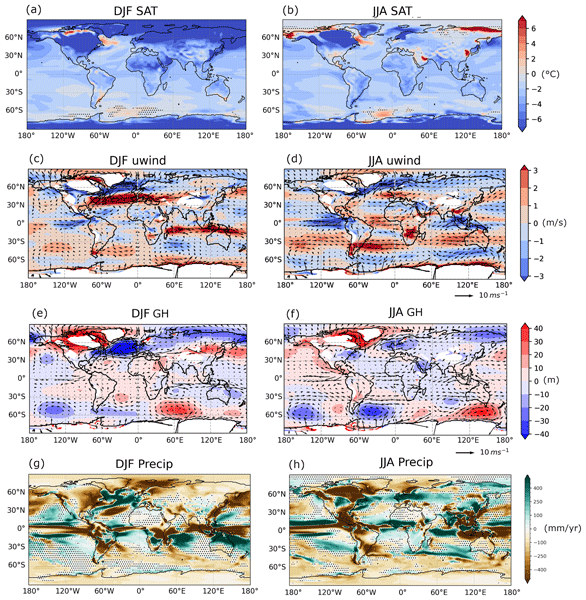
During the last ice age, Northern Hemisphere ice sheets reshaped global climate. They shifted North Atlantic winds southward, increasing summer rainfall across Eurasia. They also altered tropical and Southern Hemisphere weather patterns, affecting rainfall far beyond the ice-covered regions. Our results show that the height and shape of the ice sheets had a much greater influence on global wind and rainfall patterns than changes in Earth’s orbit, greenhouse gases, or surface reflectivity.
Yanxuan Du, Josephine R. Brown, Laurie Menviel, Himadri Saini, Russell N. Drysdale, David K. Hutchinson, and Calla N. Gould-Whaley
Clim. Past, 22, 1105–1124, https://doi.org/10.5194/cp-22-1105-2026, https://doi.org/10.5194/cp-22-1105-2026, 2026
Short summary
Short summary
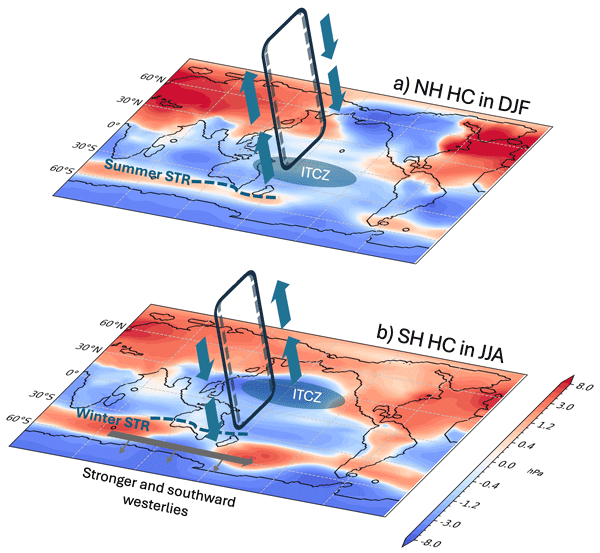
This study examines the climate response to different magnitudes of Atlantic Meridional Overturning Circulation (AMOC) weakening under glacial conditions using the Australian Earth System Model. A potential threshold is identified between linear AMOC slowdown and nonlinear shutdown, driven by a critical change in ocean heat loss that induces a nonlinear atmospheric response governed by energetic constraints.
Georgina Falster, Gab Abramowitz, Sanaa Hobeichi, Catherine Hughes, Pauline Treble, Nerilie J. Abram, Michael I. Bird, Alexandre Cauquoin, Bronwyn Dixon, Russell Drysdale, Chenhui Jin, Niels Munksgaard, Bernadette Proemse, Jonathan J. Tyler, Martin Werner, and Carol V. Tadros
Hydrol. Earth Syst. Sci., 30, 289–315, https://doi.org/10.5194/hess-30-289-2026, https://doi.org/10.5194/hess-30-289-2026, 2026
Short summary
Short summary
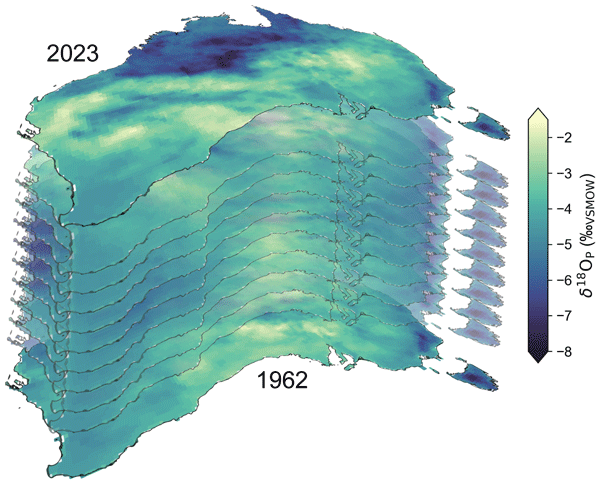
We used a random forest approach to produce estimates of monthly precipitation stable isotope variability from 1962–2023, at high resolution across the entire Australian continent. Comprehensive skill and sensitivity testing shows that our random forest models skilfully predict precipitation isotope values in places and times that observations are not available. We make all outputs freely available, facilitating use in fields from ecology and hydrology to archaeology and forensic science.
Timothy J. Pollard, Jon D. Woodhead, Russell N. Drysdale, R. Lawrence Edwards, Xianglei Li, Ashlea N. Wainwright, Mathieu Pythoud, Hai Cheng, John C. Hellstrom, Ilaria Isola, Eleonora Regattieri, Giovanni Zanchetta, and Dylan S. Parmenter
Geochronology, 7, 335–355, https://doi.org/10.5194/gchron-7-335-2025, https://doi.org/10.5194/gchron-7-335-2025, 2025
Short summary
Short summary
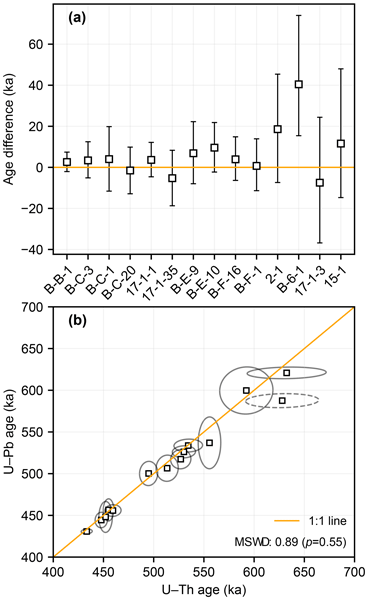
The uranium–thorium (U–Th) and uranium–lead (U–Pb) radiometric dating methods are both suitable for dating carbonate samples ranging in age from about 400 000 to 650 000 years. Here we test agreement between the two methods by dating speleothems (i.e. secondary cave mineral deposits) that are well-suited to both methods. We demonstrate excellent agreement between them and discuss their relative strengths and weaknesses.
Calla N. Gould-Whaley, Russell N. Drysdale, Pauline C. Treble, Jan-Hendrik May, Stacey C. Priestley, John C. Hellstrom, Christopher R. Vardanega, and Clare C. Buswell
Clim. Past, 21, 857–876, https://doi.org/10.5194/cp-21-857-2025, https://doi.org/10.5194/cp-21-857-2025, 2025
Short summary
Short summary
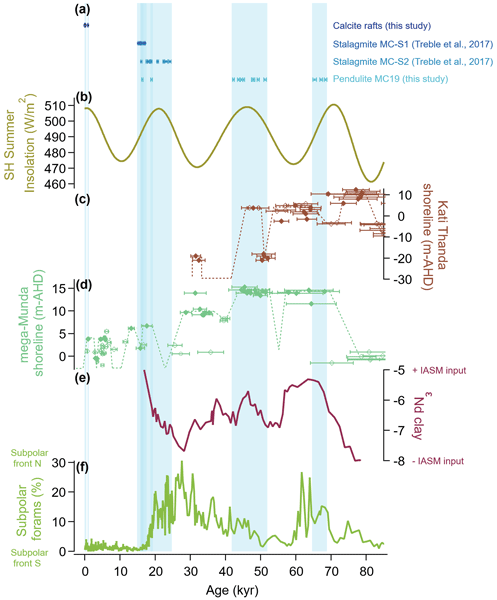
Climate change is causing enhanced aridity across many regions of the globe, leading to increased reliance on groundwater resources. We need to understand how groundwater recharge behaves in arid regions over long timescales; unfortunately, arid landscapes tend to preserve very little evidence of their climatic past. We present evidence to suggest that carbonate formations that grow in groundwater can be used as archives of past groundwater recharge in Australia's arid zone.
Hubert B. Vonhof, Sophie Verheyden, Dominique Bonjean, Stéphane Pirson, Michael Weber, Denis Scholz, John Hellstrom, Hai Cheng, Xue Jia, Kévin Di Modica, Gregory Abrams, Marjan A. P. van Nunen, Joost Ruiter, Michèlle van der Does, Daniel Böhl, and Jeroen H. J. L. van der Lubbe
Clim. Past, 20, 2741–2758, https://doi.org/10.5194/cp-20-2741-2024, https://doi.org/10.5194/cp-20-2741-2024, 2024
Short summary
Short summary
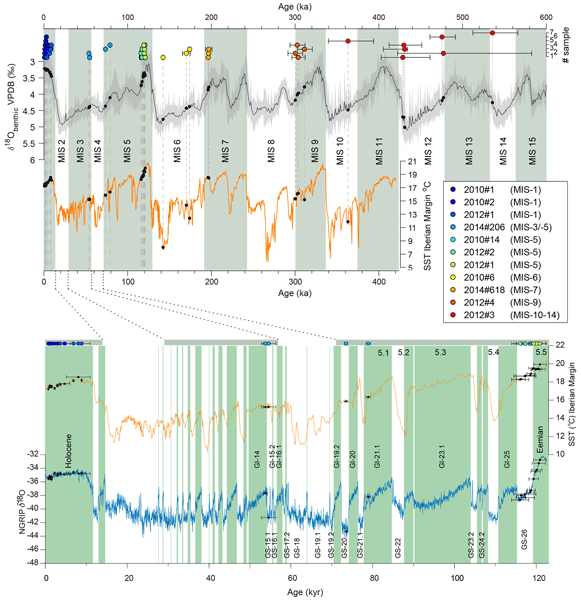
The sedimentary sequence in Scladina Cave (Belgium) is well-known for its rich archeological assemblages and its numerous faunal remains. Of particular interest is the presence of a nearly complete jaw bone of a Neanderthal child. In this study, we present new uranium series ages of stalagmites from the archeological sequence that allow more precise dating of the archeological finds. One key result is that the Neanderthal child may be slightly older than previously thought.
Frédéric Parrenin, Marie Bouchet, Christo Buizert, Emilie Capron, Ellen Corrick, Russell Drysdale, Kenji Kawamura, Amaëlle Landais, Robert Mulvaney, Ikumi Oyabu, and Sune Olander Rasmussen
Geosci. Model Dev., 17, 8735–8750, https://doi.org/10.5194/gmd-17-8735-2024, https://doi.org/10.5194/gmd-17-8735-2024, 2024
Short summary
Short summary
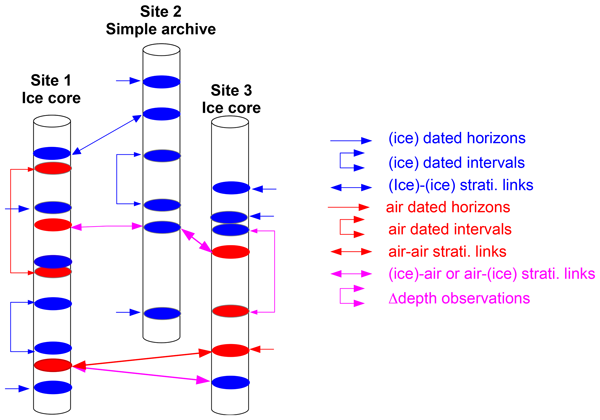
The Paleochrono-1.1 probabilistic dating model allows users to derive a common and optimized chronology for several paleoclimatic sites from various archives (ice cores, speleothems, marine cores, lake cores, etc.). It combines prior sedimentation scenarios with chronological information such as dated horizons, dated intervals, stratigraphic links and (for ice cores) Δdepth observations. Paleochrono-1.1 is available under an open-source license.
Miguel Bartolomé, Ana Moreno, Carlos Sancho, Isabel Cacho, Heather Stoll, Negar Haghipour, Ánchel Belmonte, Christoph Spötl, John Hellstrom, R. Lawrence Edwards, and Hai Cheng
Clim. Past, 20, 467–494, https://doi.org/10.5194/cp-20-467-2024, https://doi.org/10.5194/cp-20-467-2024, 2024
Short summary
Short summary
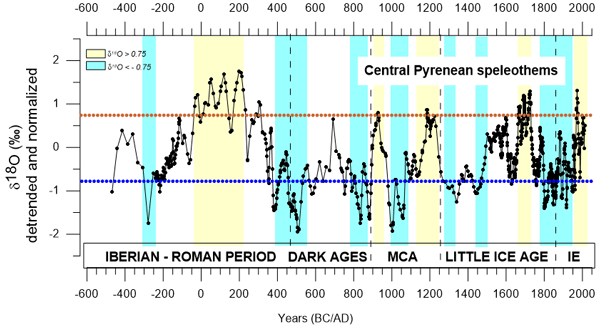
Reconstructing past temperatures at regional scales during the Common Era is necessary to place the current warming in the context of natural climate variability. We present a climate reconstruction based on eight stalagmites from four caves in the Pyrenees, NE Spain. These stalagmites were dated precisely and analysed for their oxygen isotopes, which appear dominated by temperature changes. Solar variability and major volcanic eruptions are the two main drivers of observed climate variability.
Timothy Pollard, Jon Woodhead, John Hellstrom, John Engel, Roger Powell, and Russell Drysdale
Geochronology, 5, 181–196, https://doi.org/10.5194/gchron-5-181-2023, https://doi.org/10.5194/gchron-5-181-2023, 2023
Short summary
Short summary
When using the uranium–lead (U–Pb) radiometric dating method on very young materials (e.g. Quaternary age zircon and carbonate minerals), it is important to accurately account for the production and decay of intermediate
daughterisotopes in the uranium-series decay chain. DQPB is open-source software that allows users to easily perform such calculations for a variety of sample types and produce publication-ready graphical outputs of the resulting age information.

Hege Kilhavn, Isabelle Couchoud, Russell N. Drysdale, Carlos Rossi, John Hellstrom, Fabien Arnaud, and Henri Wong
Clim. Past, 18, 2321–2344, https://doi.org/10.5194/cp-18-2321-2022, https://doi.org/10.5194/cp-18-2321-2022, 2022
Short summary
Short summary
The analysis of stable carbon and oxygen isotopic ratios, trace element ratios, and growth rate from a Spanish speleothem provides quantitative information on past hydrological conditions during the early Holocene in south-western Europe. Our data show that the cave site experienced increased effective recharge during the 8.2 ka event. Additionally, the oxygen isotopes indicate a change in the isotopic composition of the moisture source, associated with the meltwater flux to the North Atlantic.

Zuorui Liu, Amy Prendergast, Russell Drysdale, and Jan-Hendrik May
E&G Quaternary Sci. J., 71, 227–241, https://doi.org/10.5194/egqsj-71-227-2022, https://doi.org/10.5194/egqsj-71-227-2022, 2022
Short summary
Short summary
Past studies used two sampling strategies, the "bulk" and "sequential" drilling methods, for stable isotopic analysis of mammoth tooth enamel and paleoenvironmental reconstruction. This study applied both methods to the same enamel ridges of multiple mammoth teeth and compared their respective δ18O values. Offsets were detected between the bulk and average sequential δ18O values. The potential reasons for the offsets and their impacts on cross-method data comparison were discussed.
Cinthya Esther Nava Fernandez, Tobias Braun, Bethany Fox, Adam Hartland, Ola Kwiecien, Chelsea Pederson, Sebastian Hoepker, Stefano Bernasconi, Madalina Jaggi, John Hellstrom, Fernando Gázquez, Amanda French, Norbert Marwan, Adrian Immenhauser, and Sebastian Franz Martin Breitenbach
Clim. Past Discuss., https://doi.org/10.5194/cp-2021-172, https://doi.org/10.5194/cp-2021-172, 2022
Manuscript not accepted for further review
Short summary
Short summary
We provide a ca. 1000 year long (6.4–5.4 ka BP) stalagmite-based reconstruction of mid-Holocene rainfall variability in the tropical western Pacific. The annually laminated multi-proxy (δ13C, δ18O, X/Ca, gray values) record comes from Niue island and informs on El Nino-Southern Oscillation and South Pacific Convergence Zone dynamics. Our data suggest that ENSO was active and influenced rainfall seasonality over the covered time interval. Rainfall seasonality was subdued during active ENSO phases
Cited articles
Affolter, S., Häuselmann, A., Fleitmann, D., Edwards, R. L., Cheng, H., and Leuenberger, M.: Central Europe temperature constrained by speleothem fluid inclusion water isotopes over the past 14 000 years, Sci. Adv., 5, eaav3809, https://doi.org/10.1126/sciadv.aav3809, 2019.
Ait Brahim, Y., Wassenburg, J. A., Sha, L., Cruz, F. W., Deininger, M., Sifeddine, A., Bouchaou, L., Spötl, C., Edwards, R. L., and Cheng, H.: North Atlantic Ice-Rafting, Ocean and Atmospheric Circulation During the Holocene: Insights From Western Mediterranean Speleothems, Geophysical Research Letters, 46, 7614–7623, https://doi.org/10.1029/2019GL082405, 2019.
Allan, M., Fagel, N., Van Der Lubbe, H. J. L., Vonhof, H. B., Cheng, H., Edwards, R. L., and Verheyden, S.: High-resolution reconstruction of 8.2-ka BP event documented in Père Noël cave, southern Belgium, J. Quaternary Science, 33, 840–852, https://doi.org/10.1002/jqs.3064, 2018.
Alley, R. B., Mayewski, P. A., Sowers, T., Stuiver, M., Taylor, K. C., and Clark, P. U.: Holocene climatic instability: A prominent, widespread event 8200 yr ago, Geol., 25, 483, https://doi.org/10.1130/0091-7613(1997)025<0483:HCIAPW>2.3.CO;2, 1997.
Andersen, N., Lauterbach, S., Erlenkeuser, H., Danielopol, D. L., Namiotko, T., Hüls, M., Belmecheri, S., Dulski, P., Nantke, C., Meyer, H., Chapligin, B., Von Grafenstein, U., and Brauer, A.: Evidence for higher-than-average air temperatures after the 8.2 ka event provided by a Central European δ18O record, Quaternary Science Reviews, 172, 96–108, https://doi.org/10.1016/j.quascirev.2017.08.001, 2017.
Baldini, J. U. L., McDermott, F., and Fairchild, I. J.: Structure of the 8200-year cold event revealed by a speleothem trace element record, Science, 296, 2203–2206, https://doi.org/10.1126/science.1071776, 2002.
Baldini, L. M., Baldini, J. U. L., McDermott, F., Arias, P., Cueto, M., Fairchild, I. J., Hoffmann, D. L., Mattey, D. P., Müller, W., Nita, D. C., Ontañón, R., Garciá-Moncó, C., and Richards, D. A.: North Iberian temperature and rainfall seasonality over the Younger Dryas and Holocene, Quaternary Science Reviews, 226, 105998, https://doi.org/10.1016/j.quascirev.2019.105998, 2019.
Barber, D. C., Dyke, A., Hillaire-Marcel, C., Jennings, A. E., Andrews, J. T., Kerwin, M. W., Bilodeau, G., McNeely, R., Southon, J., Morehead, M. D., and Gagnon, J.-M.: Forcing of the cold event of 8200 years ago by catastrophic drainage of Laurentide lakes, Nature, 400, 344–348, https://doi.org/10.1038/22504, 1999.
Benson, A., Hoffmann, D. L., Daura, J., Sanz, M., Rodrigues, F., Souto, P., and Zilhão, J.: A speleothem record from Portugal reveals phases of increased winter precipitation in western Iberia during the Holocene, The Holocene, 31, 1339–1350, https://doi.org/10.1177/09596836211011666, 2021.
Berger, J.-F., Delhon, C., Magnin, F., Bonté, S., Peyric, D., Thiébault, S., Guilbert, R., and Beeching, A.: A fluvial record of the mid-Holocene rapid climatic changes in the middle Rhone valley (Espeluche-Lalo, France) and of their impact on Late Mesolithic and Early Neolithic societies, Quaternary Science Reviews, 136, 66–84, https://doi.org/10.1016/j.quascirev.2015.11.019, 2016.
Bernal-Wormull, J. L., Moreno, A., Bartolomé, M., Arriolabengoa, M., Pérez-Mejías, C., Iriarte, E., Osácar, C., Spötl, C., Stoll, H., Cacho, I., Edwards, R. L., and Cheng, H.: New insights into the climate of northern Iberia during the Younger Dryas and Holocene: The Mendukilo multi-speleothem record, Quaternary Science Reviews, 305, 108006, https://doi.org/10.1016/j.quascirev.2023.108006, 2023.
Blaauw, M. and Christen, J. A.: Flexible paleoclimate age-depth models using an autoregressive gamma process, Bayesian Analysis, 6, 457–474, https://doi.org/10.1214/11-BA618, 2011.
Boch, R., Spötl, C., and Kramers, J.: High-resolution isotope records of early Holocene rapid climate change from two coeval stalagmites of Katerloch Cave, Austria, Quaternary Science Reviews, 28, 2527–2538, https://doi.org/10.1016/j.quascirev.2009.05.015, 2009.
Bosq, M., Bertran, P., Degeai, J.-P., Kreutzer, S., Queffelec, A., Moine, O., and Morin, E.: Last Glacial aeolian landforms and deposits in the Rhône Valley (SE France): Spatial distribution and grain-size characterization, Geomorphology, 318, 250–269, https://doi.org/10.1016/j.geomorph.2018.06.010, 2018.
Bradley, R.: Climate forcing during Holocene, in: Global Change in the Holocene, edited by: Mackay A., Battarbee R., Birks J., and Oldfield F., Routledge, London, UK, https://doi.org/10.22498/pages.11.2-3.18, 2005.
Budsky, A., Scholz, D., Wassenburg, J. A., Mertz-Kraus, R., Spötl, C., Riechelmann, D. F., Gibert, L., Jochum, K. P., and Andreae, M. O.: Speleothem δ13C record suggests enhanced spring/summer drought in south-eastern Spain between 9.7 and 7.8 ka – A circum-Western Mediterranean anomaly?, The Holocene, https://doi.org/10.1177/0959683619838021, 2019.
Cacho, I., Grimalt, J. O., and Canals, M.: Response of the Western Mediterranean Sea to rapid climatic variability during the last 50 000 years: a molecular biomarker approach, Journal of Marine Systems, 33–34, 253–272, https://doi.org/10.1016/S0924-7963(02)00061-1, 2002.
Carlson, P. E., Miller, N. R., Banner, J. L., Breecker, D. O., and Casteel, R. C.: The potential of near-entrance stalagmites as high-resolution terrestrial paleoclimate proxies: Application of isotope and trace-element geochemistry to seasonally-resolved chronology, Geochimica et Cosmochimica Acta, 235, 55–75, https://doi.org/10.1016/j.gca.2018.04.036, 2018.
Català, A., Cacho, I., Frigola, J., Pena, L. D., and Lirer, F.: Holocene hydrography evolution in the Alboran Sea: a multi-record and multi-proxy comparison, Clim. Past, 15, 927–942, https://doi.org/10.5194/cp-15-927-2019, 2019.
Celle-Jeanton, H., Travi, Y., and Blavoux, B.: Isotopic typology of the precipitation in the Western Mediterranean Region at three different time scales, Geophysical Research Letters, 28, 1215–1218, https://doi.org/10.1029/2000GL012407, 2001.
Cheng, H., Lawrence Edwards, R., Shen, C.-C., Polyak, V. J., Asmerom, Y., Woodhead, J., Hellstrom, J., Wang, Y., Kong, X., Spötl, C., Wang, X., and Calvin Alexander, E.: Improvements in 230Th dating, 230Th and 234U half-life values, and U–Th isotopic measurements by multi-collector inductively coupled plasma mass spectrometry, Earth and Planetary Science Letters, 371–372, 82–91, https://doi.org/10.1016/j.epsl.2013.04.006, 2013.
Corrick, E. C., Drysdale, R. N., Hellstrom, J. C., Capron, E., Rasmussen, S. O., Zhang, X., Fleitmann, D., Couchoud, I., and Wolff, E.: Synchronous timing of abrupt climate changes during the last glacial period, Science, 369, 963–969, https://doi.org/10.1126/science.aay5538, 2020.
Couchoud, I.: Les isotopes stables de l'oxygène et du carbone dans les spéléothèmes: des archives paléoenvironnementales, Quaternaire, 275–291, https://doi.org/10.4000/quaternaire.4532, 2008.
Daley, T. J., Thomas, E. R., Holmes, J. A., Street-Perrott, F. A., Chapman, M. R., Tindall, J. C., Valdes, P. J., Loader, N. J., Marshall, J. D., Wolff, E. W., Hopley, P. J., Atkinson, T., Barber, K. E., Fisher, E. H., Robertson, I., Hughes, P. D. M., and Roberts, C. N.: The 8200 yr BP cold event in stable isotope records from the North Atlantic region, Global and Planetary Change, 79, 288–302, https://doi.org/10.1016/j.gloplacha.2011.03.006, 2011.
Dansgaard, W.: Stable isotopes in precipitation, Tellus, 16, 436–468, https://doi.org/10.1111/j.2153-3490.1964.tb00181.x, 1964.
Delhon, C.: Anthropisation et paléoclimats du tardiglaciaire à l'Holocène en moyenne vallée du Rhône: études pluridisciplinaires des spectres phytolithiques et pédo-anthracologiques de séquences naturelles et de sites archéologiques, PhD thesis, University Paris 1, https://theses.fr/2005PA010511 (last access: 6 February 2026), 2005.
Demény, A., Czuppon, G., Kern, Z., Hatvani, I. G., Topál, D., Karlik, M., Surányi, G., Molnár, M., Kiss, G. I., Szabó, M., Shen, C.-C., Hu, H.-M., and May, Z.: A speleothem record of seasonality and moisture transport around the 8.2 ka event in Central Europe (Vacska Cave, Hungary), Quat. Res., 1–16, https://doi.org/10.1017/qua.2023.33, 2023.
d'Oliveira, L., Dugerdil, L., Ménot, G., Evin, A., Muller, S. D., Ansanay-Alex, S., Azuara, J., Bonnet, C., Bremond, L., Shah, M., and Peyron, O.: Reconstructing 15 000 years of southern France temperatures from coupled pollen and molecular (branched glycerol dialkyl glycerol tetraether) markers (Canroute, Massif Central), Clim. Past, 19, 2127–2156, https://doi.org/10.5194/cp-19-2127-2023, 2023.
Dominguez-Villar, D., Fairchild, I. J., Baker, A., Wang, X., Edwards, R. L., and Cheng, H.: Oxygen isotope precipitation anomaly in the North Atlantic region during the 8.2 ka event, Geology, 37, 1095–1098, https://doi.org/10.1130/G30393A.1, 2009.
Dorale, J. and Liu, Z.: Limitations of Hendy Test criteria in judging the paleoclimatic suitability of speleothems and the need for replication, Journal of Cave and Karst Studies, 71, 73–80, 2009.
Dredge, J., Fairchild, I. J., Harrison, R. M., Fernandez-Cortes, A., Sanchez-Moral, S., Jurado, V., Gunn, J., Smith, A., Spötl, C., Mattey, D., Wynn, P. M., and Grassineau, N.: Cave aerosols: distribution and contribution to speleothem geochemistry, Quaternary Science Reviews, 63, 23–41, https://doi.org/10.1016/j.quascirev.2012.11.016, 2013.
Drysdale, R., Zanchetta, G., Hellstrom, J., Maas, R., Fallick, A., Pickett, M., Cartwright, I., and Piccini, L.: Late Holocene drought responsible for the collapse of Old World civilizations is recorded in an Italian cave flowstone, Geology, 34, 101–104, https://doi.org/10.1130/G22103.1, 2006.
Ellison, C. R. W., Chapman, M. R., and Hall, I. R.: Surface and Deep Ocean Interactions During the Cold Climate Event 8200 Years Ago, Science, 312, 1929–1932, https://doi.org/10.1126/science.1127213, 2006.
Fairchild, I. J., Borsato, A., Tooth, A. F., Frisia, S., Hawkesworth, C. J., Huang, Y., McDermott, F., and Spiro, B.: Controls on trace element (Sr–Mg) compositions of carbonate cave waters: implications for speleothem climatic records, Chemical Geology, 166, 255–269, https://doi.org/10.1016/S0009-2541(99)00216-8, 2000.
Fohlmeister, J., Schröder-Ritzrau, A., Scholz, D., Spötl, C., Riechelmann, D. F. C., Mudelsee, M., Wackerbarth, A., Gerdes, A., Riechelmann, S., Immenhauser, A., Richter, D. K., and Mangini, A.: Bunker Cave stalagmites: an archive for central European Holocene climate variability, Clim. Past, 8, 1751–1764, https://doi.org/10.5194/cp-8-1751-2012, 2012.
Frigola, J., Moreno, A., Cacho, I., Canals, M., Sierro, F. J., Flores, J. A., Grimalt, J. O., Hodell, D. A., and Curtis, J. H.: Holocene climate variability in the western Mediterranean region from a deepwater sediment record, Paleoceanography, 22, https://doi.org/10.1029/2006PA001307, 2007.
Gabitov, R. I., Sadekov, A., and Leinweber, A.: Crystal growth rate effect on Mg
Genty, D., Blamart, D., Ghaleb, B., Plagnes, V., Causse, Ch., Bakalowicz, M., Zouari, K., Chkir, N., Hellstrom, J., and Wainer, K.: Timing and dynamics of the last deglaciation from European and North African δ13C stalagmite profiles – comparison with Chinese and South Hemisphere stalagmites, Quaternary Science Reviews, 25, 2118–2142, https://doi.org/10.1016/j.quascirev.2006.01.030, 2006.
Genty, D., Labuhn, I., Hoffmann, G., Danis, P. A., Mestre, O., Bourges, F., Wainer, K., Massault, M., Van Exter, S., Régnier, E., Orengo, Ph., Falourd, S., and Minster, B.: Rainfall and cave water isotopic relationships in two South-France sites, Geochimica et Cosmochimica Acta, 131, 323–343, https://doi.org/10.1016/j.gca.2014.01.043, 2014.
Ghilardi, B. and O'Connell, M.: Early Holocene vegetation and climate dynamics with particular reference to the 8.2 ka event: pollen and macrofossil evidence from a small lake in western Ireland, Veget. Hist. Archaeobot., 22, 99–114, https://doi.org/10.1007/s00334-012-0367-x, 2013.
Heaton, T. J., Köhler, P., Butzin, M., Bard, E., Reimer, R. W., Austin, W. E. N., Ramsey, C. B., Grootes, P. M., Hughen, K. A., Kromer, B., Reimer, P. J., Adkins, J., Burke, A., Cook, M. S., Olsen, J., and Skinner, L. C.: Marine20 – The Marine Radiocarbon Age Calibration Curve (0–55 000 cal BP), Radiocarbon, 62, 779–820, https://doi.org/10.1017/RDC.2020.68, 2020.
Hellstrom, J.: Rapid and accurate U/Th dating using parallel ion-counting multi-collector ICP-MS, J. Anal. At. Spectrom., 18, 1346, https://doi.org/10.1039/b308781f, 2003.
Hellstrom, J.: U–Th dating of speleothems with high initial 230Th using stratigraphical constraint, Quaternary Geochronology, 1, 289–295, https://doi.org/10.1016/j.quageo.2007.01.004, 2006.
Hellstrom, J., McCulloch, M., and Stone, J.: A Detailed 31,000-Year Record of Climate and Vegetation Change, from the Isotope Geochemistry of Two New Zealand Speleothems, Quaternary Research, 50, 167–178, https://doi.org/10.1006/qres.1998.1991, 1998.
Hendy, C. H.: The isotopic geochemistry of speleothems – I. The calculation of the effects of different modes of formation on the isotopic composition of speleothems and their applicability as palaeoclimatic indicators, Geochimica et Cosmochimica Acta, 35, 801–824, https://doi.org/10.1016/0016-7037(71)90127-X, 1971.
Hodell, D., Crowhurst, S., Skinner, L., Tzedakis, P. C., Margari, V., Channell, J. E. T., Kamenov, G., Maclachlan, S., and Rothwell, G.: Response of Iberian Margin sediments to orbital and suborbital forcing over the past 420 ka, Paleoceanography, 28, 185–199, https://doi.org/10.1002/palo.20017, 2013.
Hoffmann, D. L., Prytulak, J., Richards, D. A., Elliott, T., Coath, C. D., Smart, P. L., and Scholz, D.: Procedures for accurate U and Th isotope measurements by high precision MC-ICPMS, International Journal of Mass Spectrometry, 264, 97–109, https://doi.org/10.1016/j.ijms.2007.03.020, 2007.
Hoffmann, D. L., Pike, A. W. G., García-Diez, M., Pettitt, P. B., and Zilhão, J.: Methods for U-series dating of CaCO3 crusts associated with Palaeolithic cave art and application to Iberian sites, Quaternary Geochronology, 36, 104–119, https://doi.org/10.1016/j.quageo.2016.07.004, 2016.
Holmes, J. A., Tindall, J., Roberts, N., Marshall, W., Marshall, J. D., Bingham, A., Feeser, I., O'Connell, M., Atkinson, T., Jourdan, A.-L., March, A., and Fisher, E. H.: Lake isotope records of the 8200-year cooling event in western Ireland: Comparison with model simulations, Quaternary Science Reviews, 131, 341–349, https://doi.org/10.1016/j.quascirev.2015.06.027, 2016.
Huang, Y. and Fairchild, I.: Partitioning of Sr2+ and Mg2+ into calcite in karst-analogue experimental solutions, Geochimica et Cosmochimica Acta, 65, 47–62, https://doi.org/10.1016/S0016-7037(00)00513-5, 2001.
Jalali, B., Sicre, M.-A., Bassetti, M.-A., and Kallel, N.: Holocene climate variability in the North-Western Mediterranean Sea (Gulf of Lions), Clim. Past, 12, 91–101, https://doi.org/10.5194/cp-12-91-2016, 2016.
Jouffroy-Bapicot, I., Pulido, M., Baron, S., Galop, D., Monna, F., Lavoie, M., Ploquin, A., Petit, C., de Beaulieu, J.-L., and Richard, H.: Environmental impact of early palaeometallurgy: Pollen and geochemical analysis, Vegetation History and Archaeobotany, 16, 251–258, https://doi.org/10.1007/s00334-006-0039-9, 2007.
Kilhavn, H., Couchoud, I., Drysdale, R. N., Rossi, C., Hellstrom, J., Arnaud, F., and Wong, H.: The 8.2 ka event in northern Spain: timing, structure and climatic impact from a multi-proxy speleothem record, Clim. Past, 18, 2321–2344, https://doi.org/10.5194/cp-18-2321-2022, 2022.
Kobashi, T., Severinghaus, J. P., Brook, E. J., Barnola, J.-M., and Grachev, A. M.: Precise timing and characterization of abrupt climate change 8200 years ago from air trapped in polar ice, Quaternary Science Reviews, 26, 1212–1222, https://doi.org/10.1016/j.quascirev.2007.01.009, 2007.
Lachniet, M. S.: Climatic and environmental controls on speleothem oxygen-isotope values, Quaternary Science Reviews, 28, 412–432, https://doi.org/10.1016/j.quascirev.2008.10.021, 2009.
Laskar, J., Robutel, P., Joutel, F., Gastineau, M., Correia, A. C. M., and Levrard, B.: A long-term numerical solution for the insolation quantities of the Earth, Astronomy & Astrophysics, 428, 261–285, https://doi.org/10.1051/0004-6361:20041335, 2004.
Magny, M., de Beaulieu, J.-L., Drescher-Schneider, R., Vannière, B., Walter-Simonnet, A.-V., Miras, Y., Millet, L., Bossuet, G., Peyron, O., Brugiapaglia, E., and Leroux, A.: Holocene climate changes in the central Mediterranean as recorded by lake-level fluctuations at Lake Accesa (Tuscany, Italy), Quaternary Science Reviews, 26, 1736–1758, https://doi.org/10.1016/j.quascirev.2007.04.014, 2007.
Marshall, J. D., Lang, B., Crowley, S. F., Weedon, G. P., Van Calsteren, P., Fisher, E. H., Holme, R., Holmes, J. A., Jones, R. T., Bedford, A., Brooks, S. J., Bloemendal, J., Kiriakoulakis, K., and Ball, J. D.: Terrestrial impact of abrupt changes in the North Atlantic thermohaline circulation: Early Holocene, UK, Geol., 35, 639, https://doi.org/10.1130/G23498A.1, 2007.
Martin, C., Ménot, G., Thouveny, N., Peyron, O., Andrieu-Ponel, V., Montade, V., Davtian, N., Reille, M., and Bard, E.: Early Holocene Thermal Maximum recorded by branched tetraethers and pollen in Western Europe (Massif Central, France), Quaternary Science Reviews, 228, 106109, https://doi.org/10.1016/j.quascirev.2019.106109, 2020.
Martrat, B., Jimenez-Amat, P., Zahn, R., and Grimalt, J. O.: Similarities and dissimilarities between the last two deglaciations and interglaciations in the North Atlantic region, Quaternary Science Reviews, 99, 122–134, https://doi.org/10.1016/j.quascirev.2014.06.016, 2014.
McDermott, F.: Palaeo-climate reconstruction from stable isotope variations in speleothems: a review, Quaternary Science Reviews, 23, 901–918, https://doi.org/10.1016/j.quascirev.2003.06.021, 2004.
McDermott, F., Frisia, S., Huang, Y., Longinelli, A., Spiro, B., Heaton, T. H. E., Hawkesworth, C. J., Borsato, A., Keppens, E., and Fairchild, I. J.: Holocene climate variability in Europe: Evidence from O, textural and extension-rate variations in three speleothems, Quaternary Science Reviews, 18, 1021–1038, https://doi.org/10.1016/S0277-3791(98)00107-3, 1999.
McMillan, E. A., Fairchild, I. J., Frisia, S., Borsato, A., and McDermott, F.: Annual trace element cycles in calcite-aragonite speleothems: evidence of drought in the western Mediterranean 1200–1100 yr BP, J. Quaternary Sci., 20, 423–433, https://doi.org/10.1002/jqs.943, 2005.
Morrill, C., Anderson, D. M., Bauer, B. A., Buckner, R., Gille, E. P., Gross, W. S., Hartman, M., and Shah, A.: Proxy benchmarks for intercomparison of 8.2 ka simulations, Clim. Past, 9, 423–432, https://doi.org/10.5194/cp-9-423-2013, 2013.
North Greenland Ice Core Project members: High-resolution record of Northern Hemisphere climate extending into the last interglacial period, Nature, 431, 147–151, https://doi.org/10.1038/nature02805, 2004.
Parker, S. E. and Harrison, S. P.: The timing, duration and magnitude of the 8.2 ka event in global speleothem records, Sci. Rep., 12, 10542, https://doi.org/10.1038/s41598-022-14684-y, 2022.
Perşoiu, A., Onac, B. P., Wynn, J. G., Blaauw, M., Ionita, M., and Hansson, M.: Holocene winter climate variability in Central and Eastern Europe, Sci. Rep., 7, 1196, https://doi.org/10.1038/s41598-017-01397-w, 2017.
Prasad, S., Witt, A., Kienel, U., Dulski, P., Bauer, E., and Yancheva, G.: The 8.2 ka event: Evidence for seasonal differences and the rate of climate change in western Europe, Global and Planetary Change, 67, 218–226, https://doi.org/10.1016/j.gloplacha.2009.03.011, 2009.
Regattieri, E., Zanchetta, G., Drysdale, R. N., Isola, I., Hellstrom, J. C., and Dallai, L.: Lateglacial to Holocene trace element record (Ba, Mg, Sr) from Corchia Cave (Apuan Alps, central Italy): paleoenvironmental implications: Trace element record from Corchia Cave, central Italy, J. Quaternary Sci., 29, 381–392, https://doi.org/10.1002/jqs.2712, 2014.
Rohling, E. J. and Pälike, H.: Centennial-scale climate cooling with a sudden cold event around 8200 years ago, Nature, 434, 975–979, https://doi.org/10.1038/nature03421, 2005.
Ruan, J.: Characterization of Holocene climate variability in the west of Europe and Mediterranean basin using high-resolution stalagmite records, PhD thesis, University Paris-Saclay (ComUE), https://theses.fr/2016SACLS223 (last access: 6 February 2026), 2016.
Schubert, A., Lauterbach, S., Leipe, C., Brauer, A., and Tarasov, P. E.: Visible or not? Reflection of the 8.2 ka BP event and the Greenlandian–Northgrippian boundary in a new high-resolution pollen record from the varved sediments of Lake Mondsee, Austria, Quaternary Science Reviews, 308, 108073, https://doi.org/10.1016/j.quascirev.2023.108073, 2023.
Shi, X., Lohmann, G., Sidorenko, D., and Yang, H.: Early-Holocene simulations using different forcings and resolutions in AWI-ESM, The Holocene, 30, 996–1015, https://doi.org/10.1177/0959683620908634, 2020.
Siani, G., Magny, M., Paterne, M., Debret, M., and Fontugne, M.: Paleohydrology reconstruction and Holocene climate variability in the South Adriatic Sea, Clim. Past, 9, 499–515, https://doi.org/10.5194/cp-9-499-2013, 2013.
Sinclair, D. J., Banner, J. L., Taylor, F. W., Partin, J., Jenson, J., Mylroie, J., Goddard, E., Quinn, T., Jocson, J., and Miklavič, B.: Magnesium and strontium systematics in tropical speleothems from the Western Pacific, Chemical Geology, 294–295, 1–17, https://doi.org/10.1016/j.chemgeo.2011.10.008, 2012.
Smith, D. E., Harrison, S., Firth, C. R., and Jordan, J. T.: The early Holocene sea level rise, Quaternary Science Reviews, 30, 1846–1860, https://doi.org/10.1016/j.quascirev.2011.04.019, 2011.
Thomas, E. R., Wolff, E. W., Mulvaney, R., Steffensen, J. P., Johnsen, S. J., Arrowsmith, C., White, J. W. C., Vaughn, B., and Popp, T.: The 8.2ka event from Greenland ice cores, Quaternary Science Reviews, 26, 70–81, https://doi.org/10.1016/j.quascirev.2006.07.017, 2007.
Tindall, J. C. and Valdes, P. J.: Modeling the 8.2 ka event using a coupled atmosphere–ocean GCM, Global and Planetary Change, 79, 312–321, https://doi.org/10.1016/j.gloplacha.2011.02.004, 2011.
Tinner, W. and Lotter, A. F.: Central European vegetation response to abrupt climate change at 8.2 ka, Geol., 29, 551, https://doi.org/10.1130/0091-7613(2001)029<0551:CEVRTA>2.0.CO;2, 2001.
Tremaine, D. M. and Froelich, P. N.: Speleothem trace element signatures: A hydrologic geochemical study of modern cave dripwaters and farmed calcite, Geochimica et Cosmochimica Acta, 121, 522–545, https://doi.org/10.1016/j.gca.2013.07.026, 2013.
Tremaine, D. M., Froelich, P. N., and Wang, Y.: Speleothem calcite farmed in situ: Modern calibration of δ18O and δ13C paleoclimate proxies in a continuously-monitored natural cave system, Geochimica et Cosmochimica Acta, 75, 4929–4950, https://doi.org/10.1016/j.gca.2011.06.005, 2011.
Verheyden, S., Keppens, E., Fairchild, I. J., McDermott, F., and Weis, D.: Mg, Sr and Sr isotope geochemistry of a Belgian Holocene speleothem: implications for paleoclimate reconstructions, Chemical Geology, 169, 131–144, https://doi.org/10.1016/S0009-2541(00)00299-0, 2000.
Von Grafenstein, U. V., Erlenkeuser, H., Brauer, A., Jouzel, J., and Johnsen, S. J.: A Mid-European Decadal Isotope-Climate Record from 15 500 to 5000 Years B.P., Science, 284, 1654–1657, https://doi.org/10.1126/science.284.5420.1654, 1999.
Waltgenbach, S., Scholz, D., Spötl, C., Riechelmann, D. F. C., Jochum, K. P., Fohlmeister, J., and Schröder-Ritzrau, A.: Climate and structure of the 8.2 ka event reconstructed from three speleothems from Germany, Global and Planetary Change, 193, 103266, https://doi.org/10.1016/j.gloplacha.2020.103266, 2020.
Wassenburg, J. A., Dietrich, S., Fietzke, J., Fohlmeister, J., Jochum, K. P., Scholz, D., Richter, D. K., Sabaoui, A., Spötl, C., Lohmann, G., Andreae, M. O., and Immenhauser, A.: Reorganization of the North Atlantic Oscillation during early Holocene deglaciation, Nature Geosci., 9, 602–605, https://doi.org/10.1038/ngeo2767, 2016.
Wassenburg, J. A., Riechelmann, S., Schröder-Ritzrau, A., Riechelmann, D. F. C., Richter, D. K., Immenhauser, A., Terente, M., Constantin, S., Hachenberg, A., Hansen, M., and Scholz, D.: Calcite Mg and Sr partition coefficients in cave environments: Implications for interpreting prior calcite precipitation in speleothems, Geochimica et Cosmochimica Acta, 269, 581–596, https://doi.org/10.1016/j.gca.2019.11.011, 2020.
Wiersma, A. P. and Renssen, H.: Model–data comparison for the 8.2kaBP event: confirmation of a forcing mechanism by catastrophic drainage of Laurentide Lakes, Quaternary Science Reviews, 25, 63–88, https://doi.org/10.1016/j.quascirev.2005.07.009, 2006.
Zanchetta, G., Drysdale, R. N., Hellstrom, J. C., Fallick, A. E., Isola, I., Gagan, M. K., and Pareschi, M. T.: Enhanced rainfall in the Western Mediterranean during deposition of sapropel S1: stalagmite evidence from Corchia cave (Central Italy), Quaternary Science Reviews, 26, 279–286, https://doi.org/10.1016/j.quascirev.2006.12.003, 2007.
Short summary
The Holocene is marked at 8.2 ka by a North Atlantic freshening event. We investigate its climatic impact in SW France using high-resolution speleothem multiproxy analysis. While the event is seen in some European records, no clear signal appears in SW France. This may reflect either limited regional impact, and/or low speleothem sensitivity to this North Atlantic event, possibly masked by Mediterranean influences.
The Holocene is marked at 8.2 ka by a North Atlantic freshening event. We investigate its...


